• Skip to primary navigation
  • Skip to main content
  • Skip to footer
Benedictine Sisters of FL

Holy Name Monastery
Founded 1889

Donate Now
  • Home
  • About Us
    • History
    • Being Benedictine
    • Benedictine Monasticism
    • Meet Our Community
    • Holy Name Academy-Alumnae
  • What We Do
    • Mission, Vision and Our Partners
    • Retreats
      • Invitation to Retreat
      • Accommodations
    • Volunteer Programs
    • Oblate Program
    • Spiritual Direction
    • Aqua/Hydroponics
    • More of Our Ministries
  • What’s Happening
    • Articles of Interest
    • Events
    • Commemorative Bricks
    • Newsletters
    • Brochures
    • Links
  • Support Us
    • Gifts of Support
    • Wish List
  • Stories Shared
  • Galleries
    • Photos
    • Videos
      • Benedictine Sisters of FL Videos
      • Other Videos
  • Contact Us

Gospel

Prayer

July 28, 2025 by Holy Name Monastery Leave a Comment

It’s interesting to me that the disciples ask Jesus to teach them to pray “just as John taught his disciples.”   They wanted the words, didn’t they, for certainly Jesus had given them an example of prayer.  He had modeled time alone, told them to “go to your room and pray”.  They’d witnessed Him with raised eyes, hands and voice in intercessory prayer before miraculous healings.  But they, like us, want “the words to say.”  We forget sometimes that when we descend into our hearts, in silent waiting, it is there we meet the Spirit who is already praying within us.

We look for “words” … in a prayer book, on a holy card, in the life of a saint ….  We look for a guide, a director, a mentor.  I don’t mean to belittle the worthwhile role these spiritual aids play in our lives. They are often critical to our spiritual growth and our salvation.  We just need to keep in mind the tremendous role that Scripture plays in our lives. It is there that we read “the “Spirit of Truth will show you all things.”  St. Paul reminds us: “If you do these things, you can be saved. Be joyful at all times, pray without ceasing and give thanks for all things.”

In the shortened version of what we call the “Lord’s Prayer” we pray “give us each day”. We do not ask for a train load of blessings to last us all year – just today’s help, Lord, that’s all I am asking…   not even tomorrow’s help … just get me through today – I trust you will be there tomorrow – even when I feel like Mother Teresa once prayed: “I KNOW GOD WON’T GIVE ME ANYTHING I CAN’T HANDLE …  I JUST WISH HE DIDN’T TRUST ME SO MUCH.”

In the Gospel, did you notice the difference in the phrase regarding forgiveness in the Our Father?  We pray” forgive us our sins for we ourselves forgive everyone in debt to us.”   That statement is strong, firm, and expresses willingness to forgive everyone.   In the traditional version we pray “forgive us our debts, (or trespasses) as we forgive our debtors.”   It sounds as if God’s forgiveness to me is measured by my willingness to forgive others.  I like the second version even while I feel it is a greater challenge.  I commit, I promise:  I will forgive EVERYONE who is in debt to me.  No willy nilly “this one but not that one, at least not today.”  I forgive EVERYONE.  Think of that in a few minutes when we pray the Our Father… and at Mass tomorrow…  you are agreeing to forgive EVERYONE…  a huge and freeing commitment.

And we do that day after day after day.  Repetition isn’t just for those things we may have told our mothers were stupid… things like making the bed that we are only going to rumple up in a few hours or doing the dishes after every meal instead of collecting them until the cupboard is bare or cleaning the toilet that someone is going to mess up the minute I leave the bathroom.  Repetition perfects skill in music, in handwriting, in the acquisition of good, or bad habits.   And, in the repetition of daily chores (even the ones only I see), there is a meaningful expression of hospitality to myself and my companions.  In the repetition of the Psalms, of favorite prayers, and liturgical actions there is a meaningful acknowledgment of our creaturely participation in God’s creative act, day after day after day.

In today’s Gospel the church offers us three examples of prayer: first the GREAT prayer, then the “ask-seek-knock” words that have inspired hymns, and finally the story of the persistent neighbor which teaches us that knocking at the door gets God’s attention and rewards our persistence.  So, we pray, day after day for peace, for relief from suffering and war and for a forgiving heart.

Through our communal and personal prayer, we feed not only our own spirits, but we are, so to speak, attached by a spiritual cord to everyone with whom we have ever come into contact.  That is literally, collectively the cord that nourishes thousands of people.  We feed ourselves spiritually, and we also nourish all those contacts through our prayers.  Our prayer is universal.  We forgive everyone who is in debt to us.   Luke’s recollection of Jesus’ words in his Gospel is not everyone to whom we owe a debt … rather those who are in debt to us.  Who would that be?  And why would someone be in debt to me?

I’ll close with a story – a simplistic reminder that sometimes we just have to be in the right DIS-position to pray:

A priest, a minister and a guru were discussing the best positions for prayer.  Unbeknownst to them a TECO linesman was listening in as he worked with wires on the nearby pole.  The priest was saying:  “Kneeling is definitely the best way to pray.”  “No,” the minister said, “I get the best results standing with my hands outstretched to Heaven.” “You’re both wrong,” the guru said. “The most effective prayer position is lying down on the floor.” The repairman could contain himself no longer. “Hey, fellas,” he interrupted, “The best praying I ever did was when I was hanging upside down from a power pole.”

~Reflection by Sister Roberta Bailey, OSB


First Reading: Genesis 18:20-32                       Second Reading: Colossians 2:12-14
Gospel: Luke 11:1-13
Continue Reading

Filed Under: Blog, Front Page, Homily Tagged With: everyone, God, Gospel, Jesus, Lord's prayer, Mother Teresa, Prayer, St. Paul

Fifteenth Sunday in Ordinary Time

July 14, 2025 by Holy Name Monastery Leave a Comment

The dialogue in this Gospel starts with a question: “Teacher, what must I do to inherit eternal life?” It seems like a reasonable question, something you would ask a visiting rabbi.  But what was behind the question? On the one hand it may have been idle curiosity.   Or perhaps the person wanted to trick Jesus by poking fun at Him in front of the crowd.  Maybe, just maybe, the questioner thought that God might let anyone and everyone, including the riffraff, into heaven.  Was the raised voice from the crowd an enemy of Jesus, who was just out to get him?  Or might it have been pride? In his heart he may have been feeling: “Hey, look at me! I’ll be one of the few saved! These poor souls surrounding me – I hope they realize how pleased God is with me.”

It seems possible, too, that the question was neither purely academic nor a trick to entrap Jesus. It could have been a sincere question on a very personal level. Maybe the fellow was worried sick about himself, that he wouldn’t make it. Despair could have driven his question.  He was looking for the slightest sliver of hope.

In any case, we’re not told the outspoken one’s motivation. What we do know is how Jesus answered (or didn’t answer).  Instead of a direct answer, Jesus gives us another story, a very human story, a story that changed the world.

Often near the end of the TV evening news we hear news castors make reference to “Good Samaritan” stories.  For instance, a traffic accident witness stepped forward to offer assistance.

Here in our diocese, we know the Good Samaritan Society, perhaps best, through summer volunteerism.  The Good Samaritan Project (GSP), is a week-long service retreat led by the Office of Youth and Young Adult Ministry.   Middle and high school teens gather from across our Diocese to serve, pray, and have fun together for the betterment of the community and the Glory of God.  Our monastic community has been the beneficiary of services of youth and young adult groups from Las Vegas, California.  They have come from Catholic high schools and parish faith formation programs as well as our nearby university.  Local food banks and the Daystar Hope Center in Dade City have also benefited from initiatives such as  “Food for the World” Saturday and “Pack a Bag”.

Who knows how many trillions of dollars in charitable giving this one story from Jesus has inspired over the years? More than that, it has inspired countless small acts of human kindness that have made our world a more livable place.

Good Samaritans are people who open their schedules to accommodate another’s need.  They are persons who open their wallets or keep a fistful of fast food gift certificates to hand out the car window to the empty hands seen many mornings at the busiest of intersections.

Even people who are not God-followers or believers appreciate this ethical parable of Jesus. Re-read it.  Let it seep in.  Look at the words with fresh eyes.  Listen to the story. Read it aloud with open ears, hands and heart. (Read it now ….   ) “On one occasion an expert in the law stood up to test Jesus. Teacher,” he asked, “what must I do to inherit eternal life?”  Jesus replied: “What is written in the Law? How do you read it?”

~Reflection by Sister Roberta Bailey, OSB


First Reading:   Deuteronomy 30:10-14         Second Reading:  Colossians 1:15-20
Gospel:   Luke 10:25-37
Continue Reading

Filed Under: Blog, Front Page, Homily Tagged With: God, Good Samaritan, Gospel, Jesus, Luke, volunteer, volunteerism

Let All The Earth Cry Out To God With Joy

July 7, 2025 by Holy Name Monastery Leave a Comment

(At the outset let it be understood that what follows may appear to be fiction but it is not. St. Luke shared this with me.)

One day, when the man of God Benedict was doing Lectio and pondering how to incorporate his set of values into his manuscript directed to his followers, St. Luke entered his reverie.  What an inspiration!  Luke and Benedict chatted with each other for a spell.  Look Ben, (said Luke) you’ve consulted the writings of the one you call the Master.  May I suggest you look at my record of the sayings of THE Master.  Compare it with the 10th chapter of my Gospel. Sure enough!  Very many of our special Benedictine values are put forth by THE Master Jesus.  For instance:

+ A SPIRIT of POVERTY: take nothing with you (is how Jesus puts it) No money bags, no suitcase, no canvas bag or pretty tote and no sandals.  Or as you say it in your Rule: “No one may presume to give, receive or retain anything as her own, nothing at all, in short not a single item … no one shall presume ownership of anything. “

+ A SENSE of STABILITY: Jesus advises his followers: Into whatever house you enter, stay in the same house; don’t be moving from one house to another.   Benedict, you describe the first kind of monastics called cenobites.  From what you say, I sense this may be your preferred type of members.  “Those who belong to a particular monastery, where they serve under the rule of a superior.”

+ Further, Benedict, you expect these cenobites to follow Jesus’ way of life, personally and communally, practicing a SPIRIT of SIMPLICITY and ACCEPTANCE of WHATEVER IS AVAILABLE:  In your words:  Eating and drinking whatever is offered to you; whatever is set before you.

Benedict, my friend, you have an obvious understanding of human nature. Could we attribute that to your twin sister’s influence?  She took her turn as cook for her group of women whom she loved as ardently as you looked after the rough and tough gang of men that lived with you. It’s evident in your words: Taking turns serving one another, using an unvoiced system of gestures when anything is required.  And (yes, PLEASE God) it will save you a heap of trouble if you designate a weekly reader to proclaim the Holy Word throughout the meal.

In studying your Rule, Benedict, it seems to go without saying that there will likely be no harmony in the group unless the members all strive to AVOID EVIL and CLING to PEACE.   I (that is Luke) remind my readers: Remember what Jesus said (It’s right there in verse 9). “If peace is not present in the house where you find yourself, go out into the streets and shake the dust from your feet and leave that town.”  When you feel evil rising in you, get in touch with the cause – shame the devil – leave the occasion of sin.

In this weekend’s second reading St. Paul reminds us that we bear the marks of Jesus in our body.  Jesus conquered evil so that we, too, might be part of the new creation. We rejoice with the disciples, reveling as they did in first fervor.  We rejoice because “our names are written in heaven.”  Sing with Isaiah in the First Reading: We rely on the gentle care God has for us: we shall be carried in God’s arms, comforted as a mother comforts her child and fondles the child in her lap and delights in nursing the babe.  That’s the joy that can erupt in the words of tomorrow’s responsorial psalm: LET ALL THE EARTH CRY OUT TO GOD WITH JOY.

~Reflection by Sister Roberta Bailey, OSB


Let us remember each other in prayer on Friday, July 11th, the Summer feast of St. Benedict.


First Reading: Isaiah  66:10-14                     Second Reading: Galatians 6:14-18
Gospel: Luke 10:1-12, 17-20
Continue Reading

Filed Under: Blog, Front Page, Homily Tagged With: Benedict, Gospel, Jesus, poverty, sense, Spirit, st. benedict, St. Luke, stability

Third Sunday of Lent

March 24, 2025 by Holy Name Monastery Leave a Comment

The Choice is Ours


One day, a week or so after the “big storm,” I saw the Master Gardener in our gardens.  Have you met Him?  This day He seemed to be assessing the damage Milton had reeked on our plant life.  Like the fig tree in Luke’s story, our plants, our Laudato Si Aquaponic Gardens and the “hobby gardens” were about to get a reprieve.  Insurance money gifted us with the wherewithal to rebuild the Hydro/aquaponic operation. And if you look closely, you can see plants that appeared to have been cut off at the root, are beginning to sprout ever so tiny green leaves peeking through the churned up soil.

Did you know Jesus was quite a gardener Himself?  Artists often depict Him with His foster father Joseph in a carpenter’s workshop.  But He also spent time with Mary, His mother, learning the art of cultivation of plants.  What cultivation skills did we learn under our mother’s watchful eye?  It may not have been working in a garden, but someone in our life showed us how to coax maturity to signs of new life.

The Gospel is asking us to take a good look at ourselves.  The tree in the parable is showing signs of life but it bears no fruit.  We ask ourselves: Is that me?  Am I barely managing to “hang in there?”   Am I being called to more than that? Yes, God has higher hopes for each of us, if we will but give grace a chance.

For instance, we can ask ourselves:

  • How do I relate with those I reside with? With outsiders?  Is my presence a positive element or do I fall into the negativity trap?  Do I pass judgment without giving God credit for knowing the whole story?
  • Am I a good or sour influence within my community (or my family circle)?
  • What is my attitude towards people I do not know or who aren’t “useful” to me?
  • What kind of contribution (including being physically present) do I make to the life of this community?
  • In general, what kind of contribution do I make to our community and beyond?  What COULD I be doing?

Pope Francis has reminded us more than once of something we know deep down – but sometimes, especially in the midst of trouble, we tend to forget.  He says: “There are no situations we cannot get out of.  We are not condemned to sink into quicksand where the more we move the deeper we sink.  Jesus is always there, his hand extended, ready to reach out to us and pull us up out of the mud, out of sin, out of the abyss into which we have stumbled.

The barren fig tree in Jesus’ story is given a reprieve.  It is allowed another chance to respond favorably and to produce fruit.  Every Lenten season offers us a chance to fertilize our tree, the tree which is our life, and to see how it can be more fruitful.

We need to realize love is only fully completed in us when we become a genuinely loving and caring person; one who loves both God and others in word and action.  We have the choice to open ourselves and come closer to God, to experience the gift of LOVE personified in Jesus. The choice is up to us. God’s love is there for the taking.  What are you, what are we waiting for?

~Reflection by Sister Roberta Bailey, OSB


First Reading:   Exodus 3:1-8a, 13-15       Second Reading:  1 Corinthians 10:1-6, 10-12
Gospel:   Luke 13:1-8
Continue Reading

Filed Under: Blog, Front Page, Homily Tagged With: 3rd Sunday of Lent, carpenter, gardener, God, Gospel, Jesus, Lent, Third Sunday of Lent

Eighth Sunday in Ordinary Time

March 3, 2025 by Holy Name Monastery Leave a Comment

This Sunday can fall either before Lent or after the Easter season, so it is not often celebrated.

THE GOSPEL IS A STRONG CHALLENGE to the lifestyle that prevails in most of our cities in the so-called developed world.  Jesus puts it bluntly: “You cannot at the same time be the slave of God and “mammon.” What Matthew is pointing out is that since human beings are not self-sufficient, we are dependent on something outside ourselves. It should be God, not the material goods we own.  Matthew concludes by reminding us to use our “one day at a time” confidence and remember that we are in God’s loving care. The graces we need will be there when we need them.  We can’t stock-pile graces for a rainy day.

What is in question is our attitude towards “things.”  Lent is a good time to review  the contents of our closets and other possessions.  Jesus is teaching us that our only real security is total trust in God.  We have to make a choice between God’s vision of life and a preoccupation with possessions. That involves different goals and visions of what is most important in life.  We can wear a veneer of Christian practice, but it won’t penetrate below the surface of our skin.

Jesus preaches something akin to “holy indifference” toward material goods. It should be obvious that some material things — like food and clothing and shelter — are necessary for daily living and everyone has a right to have these things.  The attitude of ‘holy indifference’ is not to be confused with an attitude of not caring about anyone or anything.   On the contrary, a person who practices holy indifference cares much and deeply and says ‘yes’ only to what is needed.

In the ordinary run of things, worry is a waste of time and psychic energy because it’s all about being uneasy about what might happen and will probably never happen. (Father) Tony de Mello quotes the Buddhist axiom: “Why worry?  If you don’t worry, you die; if you do worry, you die.  So, why worry?”    Fr. Tony continues: “Be yourself.  Be here.  Be now.”  God has provided you with everything you need right now to be happy.”  Our lives would be transformed if only we could really take Jesus’ advice: “Do not worry about tomorrow: tomorrow will take care of itself.”

If you tend to be a worrywart, Jesus has a remedy for you.  He says, look at the birds of the air and the flowers in the field.  They do nothing except be themselves and God takes care of them.  People are often so busy regretting the past or fretting about what MIGHT BE in the future that they can’t enjoy life.

Sounds so logical but you and I both know that everyone here worries about something. Some of us probably only worry every now and then. Some of us could win the prize for the world’s “expert worrier”. If we find ourselves with nothing to worry about, we worry that there’s nothing to worry about… so we worry until we figure out what that “nothing” is.  Right?

You know, worry is almost always about assuming control over things.  That’s a control that God never meant for us to have. Assuming control for the future is just not part of what we’re designed to do. Jesus says, “Can any of you by worrying add a single hour to your span of life?”   We don’t have that kind of power.   But we can come into the peace of “the birds of the air and the flowers of the fields” when we are content with just being a human being and stop trying to be God.  “Let go, let God!”  This Gospel lesson reminds us that we are called to trust in God who knows what we need and when we need it.  We are called to believe that God will give it to us, when we need it.

~Reflection by Sister Roberta Bailey, OSB


Prepare ye that way for the good Lenten experience.

God bless!


First Reading:   Isaiah 49:14-15         Second Reading:  1 Corinthians 4:1-5
Gospel:   Matthew 6:24-34
Continue Reading

Filed Under: Blog, Front Page, Homily Tagged With: God, Gospel, happy, holy indifference, Jesus, Lent, things, worry

Give to everyone that asks.

February 24, 2025 by Holy Name Monastery Leave a Comment

We live in a society that seems to have forgotten much of this Gospel message.  Children come to believe there is a trophy for every event in life.   They have forgotten – if they ever knew – the thrill of running for the sheer joy of feeling the wind on their faces, a hug from a parent – a loving squeeze without words that conveys, “I am so proud of you!”

All-too-quickly many lose (and sadly never rediscover) the warm, fuzzy feelings of self-satisfaction that was once a natural reaction to success  – that gleeful, almost smug smile the first time they stood alone, took their first step… when for the first time, to the consternation of the adults, they opened a child-proof container, hammered the first nail into mom’s precious table or exhibited their wonderful drawing with indelible pen on the living room wall…no one could be prouder of an achievement!

School children vie with each other to make donations to a collective cause.   Why?  Because they are learning the virtue of mercy?   Or because they get a “free dress” day at school?

Jesus tells us: Give to everyone who asks; treat others as you’d like to be treated; don’t take back what you gave as gift; give God the credit due for the generous urges you feel toward others and the charitable thoughts that squelch the unkind words that try to spring thoughtlessly past our lips.

Jesus advises us: Give your cloak AND your tunic – not just your warm coat (since you have another at home) but also the shirt off your back.  Today Jesus might challenge us – Why is your closet stuffed with blouses you haven’t worn since before you lost weight – or gained it?  It is quite unlikely you’ll never wear them again.  But what about that DAYSTAR customer, or that lady from the Sunrise women’s shelter who is going for a job interview?  Your blouse would fit her perfectly and add an ounce of confidence to her self-esteem.

Jesus reminds us, when we invite company for a meal not to wait for a return dinner date.  Don’t ask: whose turn is it to pick up the tab this time? He says to lend freely without expectation of repayment.  And when you respond generously to the impulse to do good – what caused that desire to arise?   Be slow to assume it is due to anything you have done.  Remember Jesus says “even sinners lend to their own kind.”  Give, and gifts will be given to you – in good measure, tamped down, packed tight, so your vessel can hold every tiny possible grain of blessing – full to overflowing – spilling over into your life and influencing all around you.

But there is a condition – if you are stingy, stinginess will be yours.  But, If you give without measure, generosity will be yours.  So how will you measure your kindness – by the teaspoon, tablespoon or a cupful?  By the minute, by the hour it might take you?  You know that you have 24 hours in a day.  That’s a 168 hours each week, (true not all are waking hours). That’s time in excess of 8,000 hours a year!  How flexible will you be with these God-given hours?  Will you respond to an imposition on your time – Now?  Tomorrow?  Next week?  Or with a prayer that the request will be forgotten?  Or will you give with open hands and heart – freely, without measure?  Jesus promises us: “the measure with which you measure, it will in turn be measured out to you.”

~Reflection by Sister Roberta Bailey, OSB


First Reading:   1 Samuel 26:2, 7-9, 12-13, 22-23         Second Reading:  1 Corinthians 15:45-49
Gospel:   Luke 6:27-38
Continue Reading

Filed Under: Blog, Front Page, Homily Tagged With: Give to everyone that asks, Gospel, Jesus, Jesus advises us, jesus tells us, Luke

  • « Go to Previous Page
  • Page 1
  • Page 2
  • Page 3
  • Page 4
  • Page 5
  • Interim pages omitted …
  • Page 13
  • Go to Next Page »

Footer

Prayer / Newsletter / Info

 Contact Info

Benedictine Sisters of Florida

PO Box 2450
12138 Wichers Road
St. Leo, FL 33574-2450
(352) 588-8320
(352) 588-8443

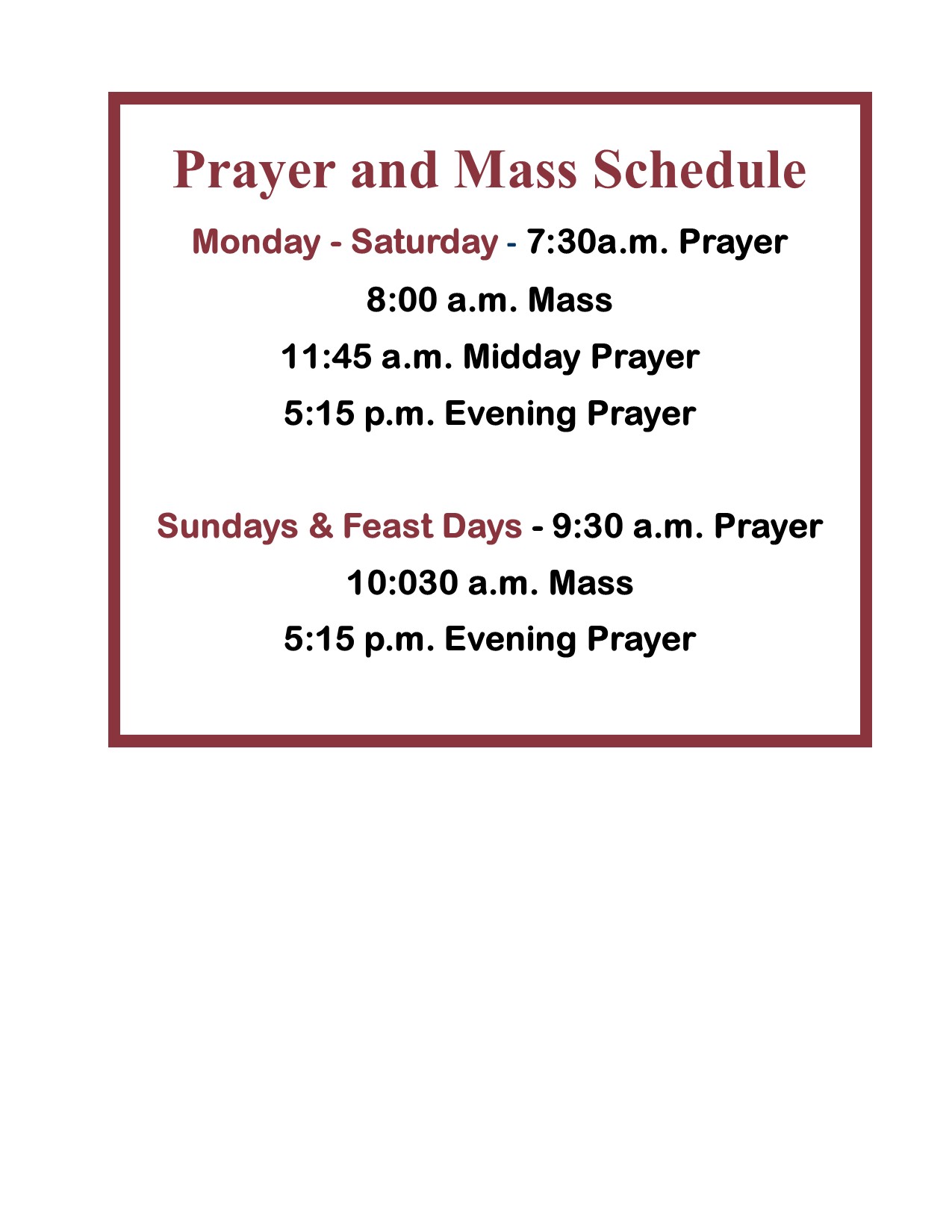
 Mass Schedule

Related Links

Copyright © 2026 · Benedictine Sisters of FL · Touching Lives Through Prayer and Service

Copyright © 2026 · Bendedictine Theme on Genesis Framework · WordPress · Log in