• Skip to primary navigation
  • Skip to main content
  • Skip to footer
Benedictine Sisters of FL

Holy Name Monastery
Founded 1889

Donate Now
  • Home
  • About Us
    • History
    • Being Benedictine
    • Benedictine Monasticism
    • Meet Our Community
    • Holy Name Academy-Alumnae
  • What We Do
    • Mission, Vision and Our Partners
    • Retreats
      • Invitation to Retreat
      • Accommodations
    • Volunteer Programs
    • Oblate Program
    • Spiritual Direction
    • Aqua/Hydroponics
    • More of Our Ministries
  • What’s Happening
    • Articles of Interest
    • Events
    • Newsletters
    • Brochures
    • Links
  • Support Us
    • Gifts of Support
    • Wish List
  • Stories Shared
  • Galleries
    • Photos
    • Videos
      • Benedictine Sisters of FL Videos
      • Other Videos
  • Contact Us

Gospel

Third Sunday of Lent

March 24, 2025 by Holy Name Monastery Leave a Comment

The Choice is Ours


One day, a week or so after the “big storm,” I saw the Master Gardener in our gardens.  Have you met Him?  This day He seemed to be assessing the damage Milton had reeked on our plant life.  Like the fig tree in Luke’s story, our plants, our Laudato Si Aquaponic Gardens and the “hobby gardens” were about to get a reprieve.  Insurance money gifted us with the wherewithal to rebuild the Hydro/aquaponic operation. And if you look closely, you can see plants that appeared to have been cut off at the root, are beginning to sprout ever so tiny green leaves peeking through the churned up soil.
Did you know Jesus was quite a gardener Himself?  Artists often depict Him with His foster father Joseph in a carpenter’s workshop.  But He also spent time with Mary, His mother, learning the art of cultivation of plants.  What cultivation skills did we learn under our mother’s watchful eye?  It may not have been working in a garden, but someone in our life showed us how to coax maturity to signs of new life.

The Gospel is asking us to take a good look at ourselves.  The tree in the parable is showing signs of life but it bears no fruit.  We ask ourselves: Is that me?  Am I barely managing to “hang in there?”   Am I being called to more than that? Yes, God has higher hopes for each of us, if we will but give grace a chance.

For instance, we can ask ourselves:

  • How do I relate with those I reside with? With outsiders?  Is my presence a positive element or do I fall into the negativity trap?  Do I pass judgment without giving God credit for knowing the whole story?
  • Am I a good or sour influence within my community (or my family circle)?
  • What is my attitude towards people I do not know or who aren’t “useful” to me?
  • What kind of contribution (including being physically present) do I make to the life of this community?
  • In general, what kind of contribution do I make to our community and beyond?  What COULD I be doing?

Pope Francis has reminded us more than once of something we know deep down – but sometimes, especially in the midst of trouble, we tend to forget.  He says: “There are no situations we cannot get out of.  We are not condemned to sink into quicksand where the more we move the deeper we sink.  Jesus is always there, his hand extended, ready to reach out to us and pull us up out of the mud, out of sin, out of the abyss into which we have stumbled.

The barren fig tree in Jesus’ story is given a reprieve.  It is allowed another chance to respond favorably and to produce fruit.  Every Lenten season offers us a chance to fertilize our tree, the tree which is our life, and to see how it can be more fruitful.

We need to realize love is only fully completed in us when we become a genuinely loving and caring person; one who loves both God and others in word and action.  We have the choice to open ourselves and come closer to God, to experience the gift of LOVE personified in Jesus. The choice is up to us. God’s love is there for the taking.  What are you, what are we waiting for?

~Reflection by Sister Roberta Bailey, OSB


First Reading:   Exodus 3:1-8a, 13-15       Second Reading:  1 Corinthians 10:1-6, 10-12
Gospel:   Luke 13:1-8
Continue Reading

Filed Under: Blog, Front Page, Homily Tagged With: 3rd Sunday of Lent, carpenter, gardener, God, Gospel, Jesus, Lent, Third Sunday of Lent

Eighth Sunday in Ordinary Time

March 3, 2025 by Holy Name Monastery Leave a Comment

This Sunday can fall either before Lent or after the Easter season, so it is not often celebrated.

THE GOSPEL IS A STRONG CHALLENGE to the lifestyle that prevails in most of our cities in the so-called developed world.  Jesus puts it bluntly: “You cannot at the same time be the slave of God and “mammon.” What Matthew is pointing out is that since human beings are not self-sufficient, we are dependent on something outside ourselves. It should be God, not the material goods we own.  Matthew concludes by reminding us to use our “one day at a time” confidence and remember that we are in God’s loving care. The graces we need will be there when we need them.  We can’t stock-pile graces for a rainy day.

What is in question is our attitude towards “things.”  Lent is a good time to review  the contents of our closets and other possessions.  Jesus is teaching us that our only real security is total trust in God.  We have to make a choice between God’s vision of life and a preoccupation with possessions. That involves different goals and visions of what is most important in life.  We can wear a veneer of Christian practice, but it won’t penetrate below the surface of our skin.

Jesus preaches something akin to “holy indifference” toward material goods. It should be obvious that some material things — like food and clothing and shelter — are necessary for daily living and everyone has a right to have these things.  The attitude of ‘holy indifference’ is not to be confused with an attitude of not caring about anyone or anything.   On the contrary, a person who practices holy indifference cares much and deeply and says ‘yes’ only to what is needed.

In the ordinary run of things, worry is a waste of time and psychic energy because it’s all about being uneasy about what might happen and will probably never happen. (Father) Tony de Mello quotes the Buddhist axiom: “Why worry?  If you don’t worry, you die; if you do worry, you die.  So, why worry?”    Fr. Tony continues: “Be yourself.  Be here.  Be now.”  God has provided you with everything you need right now to be happy.”  Our lives would be transformed if only we could really take Jesus’ advice: “Do not worry about tomorrow: tomorrow will take care of itself.”

If you tend to be a worrywart, Jesus has a remedy for you.  He says, look at the birds of the air and the flowers in the field.  They do nothing except be themselves and God takes care of them.  People are often so busy regretting the past or fretting about what MIGHT BE in the future that they can’t enjoy life.

Sounds so logical but you and I both know that everyone here worries about something. Some of us probably only worry every now and then. Some of us could win the prize for the world’s “expert worrier”. If we find ourselves with nothing to worry about, we worry that there’s nothing to worry about… so we worry until we figure out what that “nothing” is.  Right?

You know, worry is almost always about assuming control over things.  That’s a control that God never meant for us to have. Assuming control for the future is just not part of what we’re designed to do. Jesus says, “Can any of you by worrying add a single hour to your span of life?”   We don’t have that kind of power.   But we can come into the peace of “the birds of the air and the flowers of the fields” when we are content with just being a human being and stop trying to be God.  “Let go, let God!”  This Gospel lesson reminds us that we are called to trust in God who knows what we need and when we need it.  We are called to believe that God will give it to us, when we need it.

~Reflection by Sister Roberta Bailey, OSB

 

Prepare ye that way for the good Lenten experience.

God bless!


First Reading:   Isaiah 49:14-15         Second Reading:  1 Corinthians 4:1-5
Gospel:   Matthew 6:24-34
Continue Reading

Filed Under: Blog, Front Page, Homily Tagged With: God, Gospel, happy, holy indifference, Jesus, Lent, things, worry

Give to everyone that asks.

February 24, 2025 by Holy Name Monastery Leave a Comment

We live in a society that seems to have forgotten much of this Gospel message.  Children come to believe there is a trophy for every event in life.   They have forgotten – if they ever knew – the thrill of running for the sheer joy of feeling the wind on their faces, a hug from a parent – a loving squeeze without words that conveys, “I am so proud of you!”

All-too-quickly many lose (and sadly never rediscover) the warm, fuzzy feelings of self-satisfaction that was once a natural reaction to success  – that gleeful, almost smug smile the first time they stood alone, took their first step… when for the first time, to the consternation of the adults, they opened a child-proof container, hammered the first nail into mom’s precious table or exhibited their wonderful drawing with indelible pen on the living room wall…no one could be prouder of an achievement!

School children vie with each other to make donations to a collective cause.   Why?  Because they are learning the virtue of mercy?   Or because they get a “free dress” day at school?

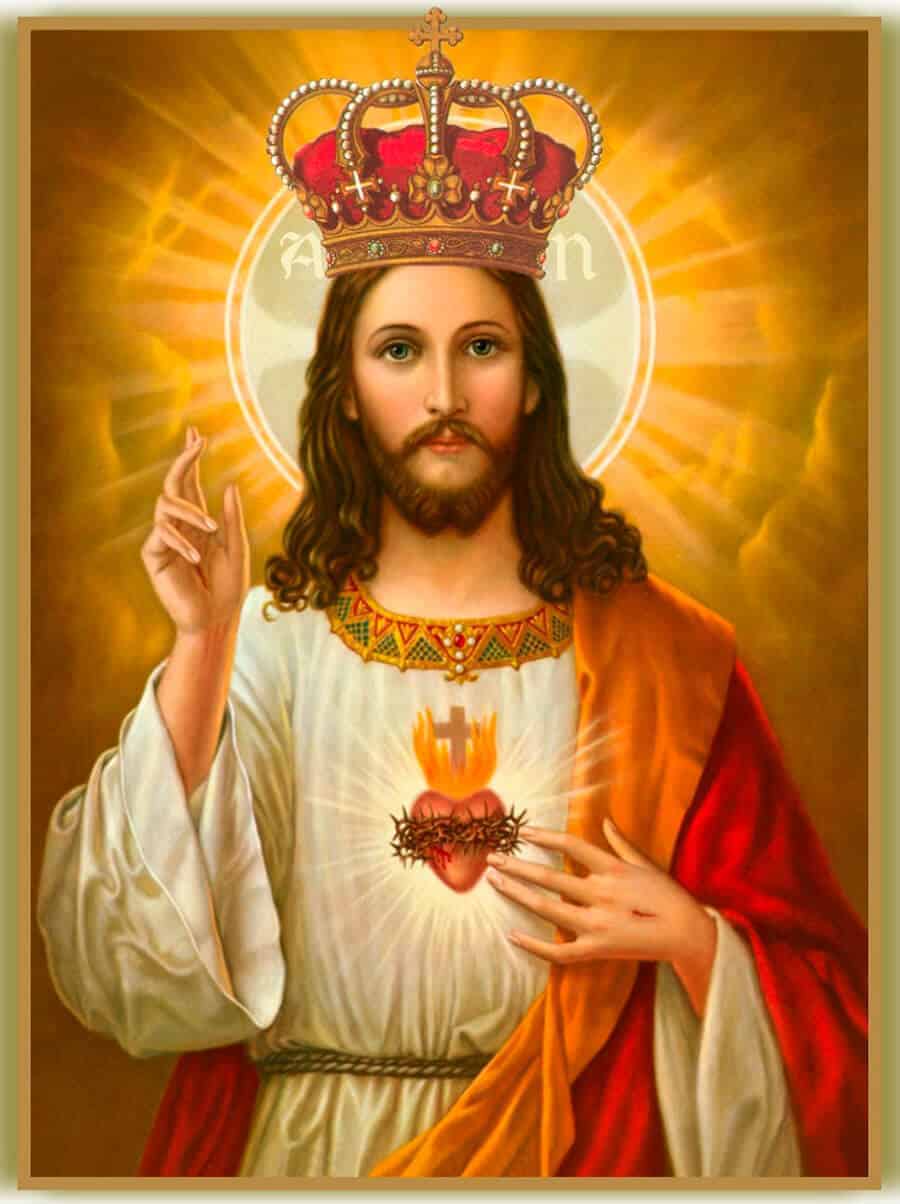
Jesus tells us: Give to everyone who asks; treat others as you’d like to be treated; don’t take back what you gave as gift; give God the credit due for the generous urges you feel toward others and the charitable thoughts that squelch the unkind words that try to spring thoughtlessly past our lips.

Jesus advises us: Give your cloak AND your tunic – not just your warm coat (since you have another at home) but also the shirt off your back.  Today Jesus might challenge us – Why is your closet stuffed with blouses you haven’t worn since before you lost weight – or gained it?  It is quite unlikely you’ll never wear them again.  But what about that DAYSTAR customer, or that lady from the Sunrise women’s shelter who is going for a job interview?  Your blouse would fit her perfectly and add an ounce of confidence to her self-esteem.

Jesus reminds us, when we invite company for a meal not to wait for a return dinner date.  Don’t ask: whose turn is it to pick up the tab this time? He says to lend freely without expectation of repayment.  And when you respond generously to the impulse to do good – what caused that desire to arise?   Be slow to assume it is due to anything you have done.  Remember Jesus says “even sinners lend to their own kind.”  Give, and gifts will be given to you – in good measure, tamped down, packed tight, so your vessel can hold every tiny possible grain of blessing – full to overflowing – spilling over into your life and influencing all around you.

But there is a condition – if you are stingy, stinginess will be yours.  But, If you give without measure, generosity will be yours.  So how will you measure your kindness – by the teaspoon, tablespoon or a cupful?  By the minute, by the hour it might take you?  You know that you have 24 hours in a day.  That’s a 168 hours each week, (true not all are waking hours). That’s time in excess of 8,000 hours a year!  How flexible will you be with these God-given hours?  Will you respond to an imposition on your time – Now?  Tomorrow?  Next week?  Or with a prayer that the request will be forgotten?  Or will you give with open hands and heart – freely, without measure?  Jesus promises us: “the measure with which you measure, it will in turn be measured out to you.”

~Reflection by Sister Roberta Bailey, OSB


First Reading:   1 Samuel 26:2, 7-9, 12-13, 22-23         Second Reading:  1 Corinthians 15:45-49
Gospel:   Luke 6:27-38
Continue Reading

Filed Under: Blog, Front Page, Homily Tagged With: Give to everyone that asks, Gospel, Jesus, Jesus advises us, jesus tells us, Luke

Every Ending Holds the Seeds of a New Beginning

November 25, 2024 by Holy Name Monastery Leave a Comment

The readings this weekend continue the theme (as Father John has been reminding us) of endings that signal a beginning.  Every “good night” holds the promise of a “good morning!”  The sunset kisses the earth good-bye for a brief moment in time and surprises us with its rising on what seems to be the other side of the earth.  Every death is a hand-off to new life. St. Augustine echoes this concept when he calls to God: “O Beauty, so ancient, so new.”  Every “good-bye” uncovers a “hello” and every ending is a step to a new adventure.  When does the “NEW” become “NOW”?   When does “tomorrow” turn to “today”?  When we let go of yesterday, where does it go?  The character Tevya in Fiddler on the Roof sings about this phenomenon: “Sunrise, sunset; Swiftly flow the days; Seedlings turn overnight to sunflowers, blossoming even as we gaze.  Sunrise, sunset; swiftly fly the years, one season following another.”

In our Gospel Pilate asks: “What is truth?”  Jesus answers: “You shall know the truth, and the truth shall make you free.”  A few evenings ago I was half-watching TV when out of my distraction I heard: “So, what is truth?”  I’d started this reflection earlier in the day so the question seemed like part of another reality.  A World War II veteran was sharing that upon retirement from active service, he’s been “down in the dumps”, experiencing a lack of appreciation for his years in service to our country in defense of freedom and truth. Then he’d recalled Jesus’ words: “The truth shall make you free.”  He turned his bitterness into working with youth when he came to the realization that “The truth that makes you free, is the truth that stirs you to action.”

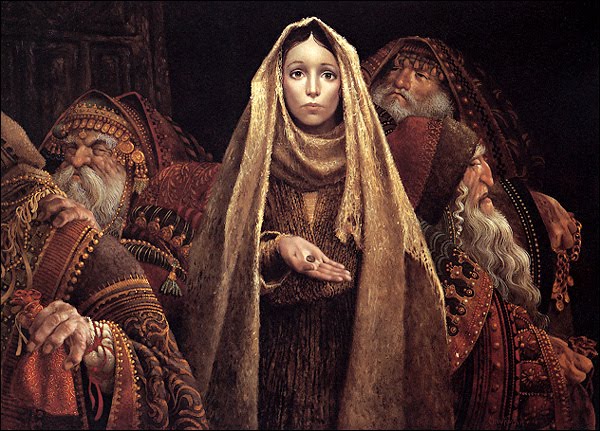
This weekend we observe the Solemnity of Christ the King which was first proclaimed universally as a feast in 1925 by Pope Pius IX.  In 2015, the prescribed date was moved from October to the last Sunday in the church year and raised to a solemnity.  At that time Pope Francis added a phrase to the title of the day: “Christ the King, the living face of the Father’s mercy.”

In tomorrow’s responsorial psalm we will proclaim: “The Lord is king; he is robed in majesty.”  We often raise a hand in benediction as we sing: “May the blessing of the Lord be upon you.”  If we believe it’s true that Jesus is Lord, why do we sometimes scramble to find a substitute to replace the word “Lord?”  That raises the question: Is Jesus my King?  Do I know him on my own or is my relationship with Jesus based on borrowed thoughts from books I’ve read or homilies and retreat talks that I’ve heard? Do I sing with conviction the sentiments of the kingly hymns that spring to mind: “Come, Christians, Join to Sing”, “Rejoice, the Lord Is King”, “Praise to our victorious King”?  And let’s not overlook the triumphant echoing of a favorite Christmas carol: “Joy to the world! Let earth receive her king!”

At the other end of this week, we will be “jump-started” into the season of Advent, an experience of an “ending” that is a “beginning” – a time of waiting for the One who will come.  He is the One who is promised to us in the second Mass reading from book of Revelation: “Behold, he is coming and everyone will see him; the Alpha and the Omega, the one who is and who was and who is to come.”

~Reflection by Sister Roberta Bailey, OSB


First Reading:   2 Daniel 7:1-14         Second Reading:  Revelation 1:5-8
Gospel:   John 18:33b-37
Continue Reading

Filed Under: Blog, Front Page, Homily Tagged With: God, Gospel, Jesus, King, Lord, solemnity of Christ the King

Each day is our moment to resist any act of violence against creation.

November 11, 2024 by Holy Name Monastery Leave a Comment

This weekend’s first reading, the story of the widow in Elijah’s time, and the Gospel of the widow in Jesus’ time, prompt us to take a hard look at our individual and communal giving practices.  As followers of Jesus Christ, we see clearly that God is the giver of all.  That raises the question: What portion of our blessings do we give back to honor God and build up God’s Kingdom on earth?

In this reflection, instead of emphasizing the spirit of giving often connected with the story of the widow’s mite, I’d like to share some ideas that convey the perspective that it is not all about GIVING.  This summer’s siege of storm devastation and raging fires in the western U.S. is often blamed on changing weather patterns.  But is not much of it due to poor land management, human carelessness and a growing history of trying to control the forces of nature?  The Benedictine value of STEWARDSHIP (preserving the earth and respecting people) calls us to responsible care rather than oppressive authoritative dominance.  Our current readings from the Rule of Benedict remind us: “Treat all things as INSTRUMENTS of the ALTAR.”  “A good word is better than the best gift.”  Living out the Benedictine value of prudent stewardship can require a radical shift in our thinking lest we too easily become accustomed to regarding earth’s resources as if they had no intrinsic worth.  For example, the demand for fast, prepackaged food contributes to the stripping of rain forests in order to provide pastureland.  In the process, many Indigenous peoples have been rendered homeless, and the habitat of endangered species has been lost forever.  Advances have been made in the production of biodegradable substances but so far, it’s only resulted in a reduction in the time it takes plastics and Styrofoam to disintegrate – they still constitute a hazard to the environment.

One of the biggest offenders is plastic bottles.  In landfills toxic gases are leached into the environment causing a variety of health issues.  Landfills in the U.S. have over 2- million discarded plastic bottles that each take up to 1,000 years to decompose.  How many thousand years did we toss into the landfill this week?  In the last month?  Trying to conserve by switching from plastic to glass containers is foiled here in our county because glass is not recycled.  Our primary motivation is that all (now and in the future) may have a share in God’s gifts. We have to think bigger than the cash register. Each day is our moment to resist any act of violence against creation.

We wrestle prayerfully with questions about how we can adopt, and adapt, to a simpler lifestyle: letting go of some things, being patient when our preferences are denied by unavailability of pantry supplies. We have to start where we are, doing what we can, with the insight and energy we have to make a difference.  Maybe we begin with one thing, one purchase, one habit a month that we change.  For example: spend a few pennies more to make a purchase from a local vendor that you usually make at a big box store.  Or make a pint or gallon purchase of hand soap instead of several smaller bottles.    Run 2-sided copies and use scrap paper for note pads. After a month, don’t forsake the new habit, keep it up and add a new pattern.  By the end of the year, you’ll be 12x more conservative.  You may ask: how does doing any of this help the people in the 3rd world?  The truth is, it doesn’t directly.  It changes YOU.   At the heart of our actions must rest the conviction that our world belongs to God and any misuse dishonors the Creator.

The widow in the Gospel was made destitute by life’s circumstances.  We by no means live a life of destitution – but we know people who do.  We are invited to ask ourselves: What can I, what can we, do to reverse the destructive patterns of life that are making a negative impact on our earth and in the lives of those we profess to serve?  In the mix, is the challenge THINK GLOBAL, ACT LOCAL.  Each day we are challenged to figure out what to do with our “too much”?  The answer is NOT to find an empty shelf, an empty room, to store it.  If we are not using it, do we REALLY need it? If we haven’t worn it since we moved into this building, who could use it?  If we have forgotten we ever had it, did we ever really need it?  Are we saving it because, deep down, we don’t trust God to come through for us on a “rainy day?”  We can only give from our need if we trust (really and truly deep down) that God will provide.   We can sing God’s praises with Elijah’s widow in tomorrow’s first reading because, for nigh on 137 years, our community “jar of flour has not gone empty” and “our jug of oil has never run dry”.

~Reflection by Sister Roberta Bailey, OSB


Thank God for the gift that Veterans have offered for our nation and for world peace ….   Remember, too, the families of veterans …  their lives too were, and are, affected by the impact on service women and me …  witnessing the effects of turmoil between peoples and nations.  Pray for strength for veterans and their families to be compassionate, supportive, faithful to relationships and seeking available medical and mental services.    

Have a good week!


First Reading:  Kings 17:10-16                 Second Reading:  Hebrews 9:24-28
Gospel:  Mark 12:38-44
Continue Reading

Filed Under: Blog, Front Page Tagged With: Benedict, Elijah, Elijah's widow, giving, God, Gospel, Jesus, Widow

It is a story of commitment

September 30, 2024 by Holy Name Monastery Leave a Comment

The people to whom Jesus was speaking in this Gospel would have understood His references a little more clearly than we do.  The teaching is not meant to be taken literally.  It is a metaphor.   Many of the people to whom Jesus was speaking were farmers.  Injuries to hands, feet and eyes were the kinds of injuries farmers incurred frequently. So, they would not have flinched at the descriptive injury. Also, in Jesus’ time the idea of losing an offensive body part to prevent oneself from falling into sin was a common type of proverbial saying. Stories were also written with this underlying thought. The entire story of Oedipus is an example. Oedipus removes his own eyes rather than look at the children he begot with his own mother.  He did not know her to be his mother, but his lack of knowledge did not make him innocent.  Nor did he know the man he had slayed at the crossroads was his father.  Jesus’ audience would have fully understood these sayings as metaphors.  We may cry: “I didn’t know!”  That may be our reason; but it is no excuse.

So, what was Jesus saying metaphorically?  It is a story of commitment. The people to whom Jesus is talking are people who have agreed and want to follow him.   I guess one can say Jesus is asking them, “Just what do you believe? Do you believe in me as the Messiah? Do you believe in God’s way or do you believe in the ways of the world?”

How do we fare today? What do we believe about our calling to discipleship? To conversion of life? It is easy to stay committed when the times are easy. It is easy to say, “Yes, Lord, I believe,” when we are not asked to do anything out of the ordinary. But, how about when the times are tough? What do we believe when we are asked to do something we really don’t want to do? How do we respond when we are asked to take an unpopular stand?  To side with someone who is being ridiculed?  To speak our mind when we suspect it will be a minority position?  The real question for us is: Is following Jesus Christ the most important thing in my life? Or does something else take its place when being a Christian is not convenient?

Jesus calls us to a radical faith. How do we make credible the expression “radical hospitality?”  We are called to be radical not “radical” as in being crazy, but radical as different, radical as turning the world’s understanding of life upside down. Jesus is calling us to a radical expression of all aspects of our faith.  Jesus calls us to love our enemies when the world says destroy – bomb them, shoot them, destroy their reputation.  Listen to Jesus who says the greatest gift we can give is our life for the sake of another.  Life in this sense can often mean the gift of our time, our attention, our care and concern in concrete, real-time actions. These are radical ideas for this world. Alone we cannot hope to be that generous.   However, we know that with God all things are possible. Jesus has set the example.  He leads the way; He models the behaviors we are to imitate. His is an attitude of tolerance, compassion and acceptance of the gifts of others.  Jesus challenges us to be humble, inclusive and tolerant.

Jesus offered his life for us and He taught the twelve how to do the same. They scattered and hid at first, but eventually they got it right. They were not perfect, but they believed. Jesus is calling us to do the same. We may not always get it right; sometimes we falter.  There will be those times when we do get it right. At those times we humbly say, “Thank you, Lord – to You be the praise – that in all things God may be glorified!”  Ponder the closing sentences of the first reading, words attributed to Moses: “Would that all people of the Lord were prophets!  Would that the Lord might bestow His spirit on them all.”

~Reflection by Sister Roberta Bailey, OSB
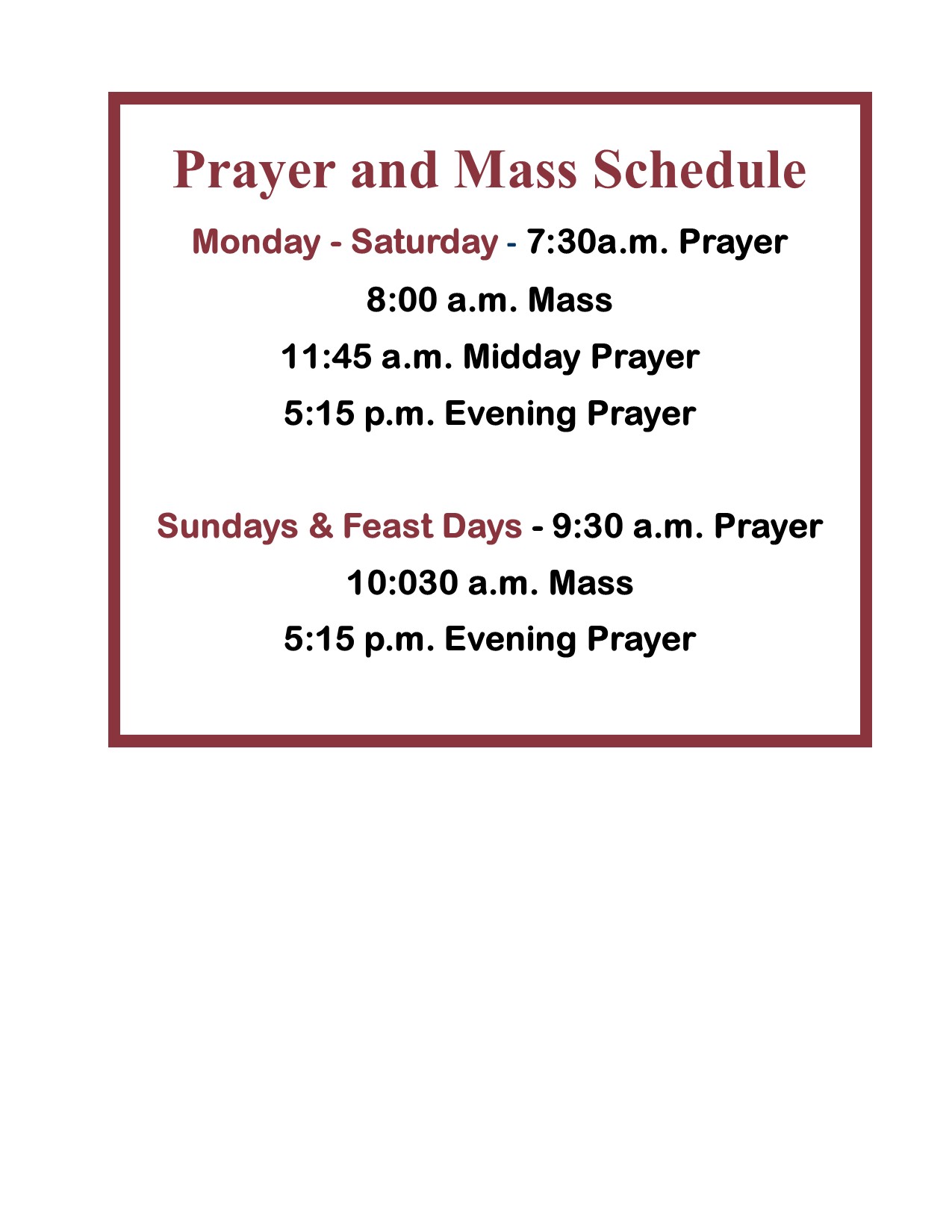
 

Our chaplain will be in Lourdes and Ireland from October 4-18.   There will be no Mass at the monastery during that time.  The Sisters and our faith community will attend Sunday Mass (October 6 and 13) in one of the parishes.     May God bless Fr. John on pilgrimage and his family visit to his homeland. 


First Reading:   Numbers 11:25-29         Second Reading:  James 5:1-6
Gospel:   Mark 9:38-43, 45, 47-48
Continue Reading

Filed Under: Blog, Front Page, Homily Tagged With: apostles, commitment, Gospel, Jesus, Mark, radical hospitality, stories

  • « Go to Previous Page
  • Page 1
  • Page 2
  • Page 3
  • Page 4
  • Page 5
  • Page 6
  • Interim pages omitted …
  • Page 13
  • Go to Next Page »

Footer

Prayer / Newsletter / Info

 Contact Info

Benedictine Sisters of Florida

PO Box 2450
12138 Wichers Road
St. Leo, FL 33574-2450
(352) 588-8320
(352) 588-8443

 Mass Schedule

Related Links

Copyright © 2026 · Benedictine Sisters of FL · Touching Lives Through Prayer and Service

Copyright © 2026 · Bendedictine Theme on Genesis Framework · WordPress · Log in