
• Skip to primary navigation
  • Skip to main content
  • Skip to footer
Benedictine Sisters of FL

Holy Name Monastery
Founded 1889

Donate Now
  • Home
  • About Us
    • History
    • Being Benedictine
    • Benedictine Monasticism
    • Meet Our Community
    • Holy Name Academy-Alumnae
  • What We Do
    • Mission, Vision and Our Partners
    • Retreats
      • Invitation to Retreat
      • Accommodations
    • Volunteer Programs
    • Oblate Program
    • Spiritual Direction
    • Aqua/Hydroponics
    • More of Our Ministries
  • What’s Happening
    • Articles of Interest
    • Events
    • Newsletters
    • Brochures
    • Links
  • Support Us
    • Gifts of Support
    • Wish List
  • Stories Shared
  • Galleries
    • Photos
    • Videos
      • Benedictine Sisters of FL Videos
      • Other Videos
  • Contact Us

Homily

Companions Like Porcupines on a Cold Winter’s Night

September 14, 2026 by Holy Name Monastery Leave a Comment

In this Sunday’s Gospel reading Peter asks Jesus how many times one ought to extend forgiveness to another. Peter proposes a reasonable number of times, perhaps seven. Jesus replies by extending Peter’s proposal by an enormous amount; not just seven times but 77 times. There is a temptation to quantify forgiveness as Peter tried to do, but Jesus’ point is that forgiveness is not about quantity.  The lesson is clear: If we hoard God’s mercy for ourselves while showing no mercy to others, we will risk forfeiting the effects of God’s mercy in our own lives.

Picture this: a cluster of porcupines on a cold winter’s night. The cold drives them to huddle together to keep warm, but as soon as they get close to one another they start jabbing each other with their spines and forcing them to move apart; thus they are forever coming together and moving apart in a kind of slow dance.  There may be a great deal of truth to that. Remember the saying about Benedictine life: we fall down and we get up.

For Jesus’ and Benedict there is no excuse for violating the first step in their instruction.  It’s not just a suggestion – these are words from the lips of Jesus.  If you’ve been offended, it is your responsibility to GO.  You don’t wait for the one who has offended to come to you.  You are accountable for your own actions!

So, you’ve approached the person who you feel has offended you – had a little “come to Jesus” chat with her– all seemingly to no avail.  What’s the next step? No, it is not turning a blind eye to the behavior IF you truly feel it is disrupting your peace and peace in the community.  The challenge is finding a person who can remain neutral.  Benedict describes this person as “wise and mature who secretly goes to the person to urge her to be humble and to offer her consolation so she is not overcome with excessive sorrow.”

Now it is time again to question yourself. Am I making a mountain out of a mole hill?  Am I acting out of my OCD tendencies?  Can I really let go and let God?  Or is God urging me to kick it up a notch and take a witness with me to listen in objectively, offering no opinions, just listen, and only speak if it seems needed to repeat what seems to be being said?

I want to affirm that I am not acting with rash judgement.  Do I have all the facts? We are human and God gave us a mind and the ability to reason but sometimes we don’t have all the pieces. Was I just being overly sensitive?

So, now you and a witness-friend have had that calm, rational talk with the person you are convinced intended to offend you.  Hopefully, your love and genuine concern are evident and she will not feel: “She’s just out to get me” or “They’re ganging up on me!”  If the truth be told, she would never have approached you in the first place if she did not trust you and care for you.  The hope is that the intervention will bring about reconciliation and peace.

What’s next?  Benedict advises separation from the community provided that she understands the nature of the measure.  For Benedict, non-participation in chapel and separation from the community table was a grave measure.  Benedict doesn’t say to starve the offender … just let her take her meals alone and at a different time.  Some today do that by choice.  But, I suppose, if it were announced that she is not allowed to have meals with the rest of the community, it would have a different feel and effect.

When all else fails, Jesus and Benedict agree there is no other choice than to apply the “cauterizing iron of excommunication … lest one diseased sheep infect the whole flock.”  But even then Benedict looks favorably on the return, the re-entry of a dismissed or dissociated member if she promises to make full amends, not simply say “I’m sorry”, but to make a sincere effort to change her ways and fit into community.

Just remember to always start with Step One: GO, don’t wait for the other to make an approach – Go alone (take a walk; share a cup of tea, sit on a swing, whatever but keep it private between the two of you).

Jesus and Benedict assure us if we follow their directives we’ll come to be like the little child who was saying her bedtime prayers. As she went down the list of family members, asking God to bless them one by one, she omitted her sister’s name. Her mother injected:  “Why didn’t you pray for Susie?” She looked up puzzled and said, “I’m not going to ask God to bless Susie because she broke my doll’s arm.”  “But,” her mother said, “Don’t you remember Jesus said to forgive your enemies?” “That’s just the trouble”, the child said: “Susie isn’t my enemy; she’s my sister.”

~Reflection by Sister Roberta Bailey, OSB


First Reading:   Sirach 27:30 – 28:9         Second Reading:  Romans 14:7-9
Gospel:   Matthew 18:21-35
Continue Reading

Filed Under: Blog, Front Page, Homily Tagged With: Benedict, forgiveness, God, Gospel, Jesus, mercy, Peter

Benedict Mirror Jesus’ Message of Hope

September 8, 2026 by Holy Name Monastery Leave a Comment

St. Benedict bases his belief on that of Jesus: that any correction should always be commensurate with the debt owed and promotes a choice for a change in behavior.  The dignity of the offending member is to be guarded first by insisting that the superior decides the gravity of the fault and that the matter be first handled in private. After living with his Rule for some time, Benedict revisited the practicality of various sections.  One example may be found in Chapter 69.

Benedict uses the image of Jesus – that of a wise physician.  He reminds the community that it’s not the healthy who need the soothing ointment of encouragement, but the sick is the one who needs urging to be humble and to make satisfaction for faults.  Our aim is to keep the community “one flock.”    TOGETHER we shall go to God. It’s an “one for all and all for one” deal.  So, let’s take a look at how this works – Jesus and Benedict lay out the same steps.

In Jesus’ instruction it is about SIN; in Benedict’s precepts it concerns matters within community.    But both concern personal offenses … person to person.  And whether sin or a less serious matter, the first approach is to be in private … one on one.  You must seek out the one who has offended you directly, with love and in humility … face-to-face … as a shepherd looking for the lost sheep … out in the rain, through the brambles, across the brook …  it doesn’t make any difference how difficult the terrain is, you must seek out person you feel offended you.    And this is to be done in a calm, rational manner.  You most certainly won’t win over the other person if you lose your temper, insult or mock them and generally act like a jerk.  Keep in mind: this is your Sister for whom Christ died.  No matter what she has done, place her above yourself so you don’t jeopardize your mission.  Even “if a life is a land full of thorns and weeds there is always a space in which the good seed can grow.”

Also remind yourself that no matter how convinced you are of the justice of your cause, you are only human.  You could be misguided in your judgement – have jumped to a false conclusion.  You must listen carefully to and weigh the other’s argument … unless, of course, she immediately agrees with you and, as Benedict says, makes due satisfaction.  Otherwise, you must give the person a thorough opportunity to respond. In any case, it is simply not enough to say, “I’m sorry” or “I apologize.”  An apology is an inadequate human substitute for the real thing.  Nowhere does the Scripture require, nor does Benedict ever use language to even encourage, apologizing.  To say “I’m sorry” is a human dodge to avoid reconciliation and to save myself from having to say: “I was wrong, will you forgive me?”

The most important thing, Jesus and Benedict remind us, is to go alone, keep the matter private.   You want to protect her reputation, and your own. If the information you may have spread is proven to be false and damaging, you’re the one who will have dirt on your face.

Approaching the person directly and in person helps preserve peace in the community.  Benedict condemns gossip in no uncertain terms referring to it at least a dozen times – variously translated as gossip, murmuring or grumbling.  In conclusion Benedict says: “There must be no word or sign of the evil of murmuring, no manifestation of it for any reason at all.”

If you feel compelled to confront a member about a behavior, remember it is just that – THE BEHAVIOR, not the person.  And, recall Jesus’ and Benedict’s first principles: face-to-face and in private.  This goes along with the rule of thumb: Praise in public, correct in private.

In the end, the Gospel message is one of hope.  Jesus is present with our community and will guide us in our relationships. If decisions are made in prayer, then the community can be assured of God’s assistance.  As Paul says: “The body is one and has many members, but all the members, many though they are, are one body.”  You may recall the Boys’ Town picture of a slightly older boy carrying a younger boy piggyback and saying, “He ain’t heavy, Father; he’s my brother.”

~Reflection by Sister Roberta Bailey, OSB



First Reading:   Ezekiel 33:7-9         Second Reading:  Romans 13:8-10
Gospel:   Matthew 18:15-20
Continue Reading

Filed Under: Blog, Front Page, Homily Tagged With: Benedict, Community, Gospel, Hope, Jesus, Justice, offended, personal offense

22nd Sunday in Ordinary Time

August 31, 2026 by Holy Name Monastery Leave a Comment

Have you ever had this the experience? You’ve composed an email and as you push “send” you have a flash of insight that you forgot a word or an idea but off it goes into cyberspace anyway.  If Peter lived today, he’d probably have quite a few of such experiences.  He is a prime example of the saying: “Open mouth, insert foot.”  He may have wished he’d heard what Dietrich Bonhoeffer wrote in his classic book, The Cost of Discipleship: “When Christ calls a man, he bids him to die.”

As with Peter, it’s probably a good thing we don’t know the bottom line when we sign on with Jesus.  We haven’t yet read all the fine print or it might literally scare us to death, or at least cause us to shrink or depart from his company.

It’s a good thing that we have become cynics when it comes to promises received in the mail or on the computer in spam mail.  Almost daily, some spam mailing assures us that we are the “lucky winner of one of several prizes.” All we need to do is contact them to identify our prize. Fortunately, we’ve learned that no matter how good the promises sound, they simply are not true.  Have any of you become the promised “Publisher’s House” mystery winner – and then heard them knocking at your door to televise your exuberant surprise?!

In order for you to more easily understand this “bottom line” business and the “fine print” concept, let’s imagine a contemporary, local situation.   Let’s say a local dairy farmer sees a TV ad for a great buy on a new pickup truck.  The ad promises deep discounts and unbelievable factory rebates. So, he decides to trade in his old clunker. He chooses a new model and was ready to write the check for the full amount. The salesman says, “Wait, wait I haven’t given you the final cost yet.” The farmer says, “Isn’t it the price I saw on TV?”  The salesman says, “Well, yes, but that’s for the basic model, all the options cost extra. After the options you’ve chosen are added, this is the price.”  The farmer really wanted that new truck – and anyway he’d gotten all his junk out of the old clunker.  So, the farmer reluctantly writes a check and drives off in his new pick-up.

A few months goes by.  That same car salesman calls on the farmer because he wants to buy a cow for his daughter’s 4-H project. The farmer assures the car salesman he has several good milk cows for sale for $500. The salesman drives out and selects a cow and takes out his checkbook. The farmer says, “Wait. I haven’t given you the final cost yet.” Then he hands the salesman a bill that reads:

BASIC MODEL COW          $500
Two-tone exterior                  $45
Extra stomach                        $75
Milk storage compartment     $60
Straw recycle compartment   $120
4 handy spigots  @  $10each  $40
Leather upholstery                  $125
Dual horns                               $45
Automatic rear fly swatter      $38
Natural fertilizer attachment $185
               GRAND TOTAL  $1,233

Sadly, many people are only interested in the basic model of Christian living. They want just enough to keep them out of hell without intruding on their fun. You won’t find the full cost of discipleship advertised in many places today. It doesn’t fill the pews in our churches or religious vocation programs.  Whether you’re buying cars or cows, it’s important to get to “the bottom line” even if we go into sticker shock when we discover the full cost.

Be assured by what Paul says in this weekend’s second reading: “I urge you to discern what is the will of God, what is good and pleasing and perfect.”  We know what Jeremiah means in the first reading when he says: “God’s word becomes like fire burning in my heart; I grow weary holding it in.”  That’s our bottom line.

~Reflection by Sister Roberta Bailey, OSB



First Reading:   Jeremiah 20:7-9         Second Reading:  Romans 12:1-2
Gospel:   Matthew 16:21-27
Continue Reading

Filed Under: Blog, Front Page, Homily Tagged With: Bonhoeffer, cow, farmer, fine print, Jesus, Matthew, Paul, Peter, salesman, truck

Who Do You Say That I Am?

August 24, 2026 by Holy Name Monastery Leave a Comment

“Who do you say that I am?”  If we finally figure out who Jesus is, He strictly orders us in the next breath, “Tell no one I am the Christ.”   But if we can’t tell anyone, what’re we supposed to do with that long sought-after revelation?

May I suggest: Rest comfortably in Jesus’ presence and turn his question back on him: Who do YOU say that I am?  Why do you love me so much? On an occasion when I did this, an answer came slowly: “Because you’re always there.”  Now my challenge is to figure out how to “always be there.”  Be where?  How do I remain comfortable and at the same time alert to Jesus’ presence in others?  I’ve concluded that the operative part in Jesus’ command is “not tell.”  We’re not meant to tell others what or who to believe in so much as to be a model that reveals more than words can say.  We must let our lives be a “show and tell” of mutual love and respect, of deference to each other.  We must “keep our doors figuratively and literally open to others i.e. to be a “flesh and blood” model of as we build community and maintain a balance in our communal and personal lives of prayer and work, art and music and poetry.

A living example of how “give and take” is part of life-long learning and nurtures our love for each other in spite of – no, because it causes us to see our own shadow side.  Our sunlit side shows itself in modulated and friendly laughter, in our expressions of gratitude with a simple phrase like “thank you”, and in our hospitality and sharing.  It shows in our gentle determination to be Christ-like AND to BE Christ to others.  The tenor of our voice in our exchanges, our harmony in prayer and song, our attentive awareness to join the pace of our liturgy, our acknowledgement of Christ in the other when we pass in the hallways – all this “tells” who our Beloved model is.

And, you know what it takes to DO and BE this.  That’s the answer to the question Jesus asks: “Who do YOU say that I am?”  It takes close familiarity with WHO Jesus is.  You’ve probably heard the expression “familiarity breeds contempt.”  But the opposite is true for those who seek to know Jesus – really to know anyone.  Time spent in Jesus’ company – in the company of our companions – fosters intimacy, closeness and an ease in each other’s company.  It’s true, too, for all who seek to build a relationship with another person or persons in community.  It’s a powerful realization when we stop to think that each one of us is responsible for the community we create.

I’d like to relate one of the many stories Monsignor Cummings (1918-2020) shared with me in his later years.  I’d first met “Father George” in 1949 as a youngster at Good Counsel Camp.  This story was also quoted at his funeral.  It serves to remind all of us of what it takes to be a loyal follower, an imitator of Christ – a true servant.

When Msgr was around 50 years a priest, (this true story goes) a young intern at Good Counsel Camp asked Fr. George: “When did you decide to become a priest?”  Without skipping a beat, Cummings answered: “This morning.”  He added as aside, “Every day I wake up and I recommit myself, to serving as a priest.”

That’s a true vocation story!  Each and every day, we hear Jesus ask: “Who do you say that I am?”  Whatever our response, He cautions: “Tell no one I am the Christ.”   “Rather, my friend, recommit yourself to be my instrument of peace in your community, your family, your social group who, in turn, together will be a living example of a “peaceable kingdom” to all who witness your way of life, and your living.  “For where God has placed you, that is your pulpit.”

~Reflection by Sister Roberta Bailey, OSB

 AN AFTERTHOUGHT …  On Friday we had a reading that (I believe) is An answer given long before Jesus walked on earth. The reading is from Deuteronomy 6:4-9.  Ponder it for yourself.  


“Hear, O Israel! The Lord is our God, the Lord alone! Therefore, you shall love the Lord, your God, with your whole heart, and with our whole being, and with your whole strength.  Take to heart these words which I command you today. Keep repeating them to your children.  Recite them when you are at home and when you are away, when you lie and when you get up.  Bind them on your arm as a sign and let them be as a pendant on your forehead.  Write them on the doorposts of your houses and on your gates.”

We, Benedictine Sisters of Holy Name Monastery, have a ring that binds our finger and on many days the Sisters wear a “pendant” – a metal of our founder, St. Benedict.   And in most of the Sisters’ rooms, somewhere you will find “writing on the walls” – family photos, favorites paintings, calligraphy hand-printed quotes that we can see “when we lie and when we get up.”


First Reading:   Isaiah 22:19-23         Second Reading:  Romans 17:33-36
Gospel:   Matthew 16:13-20
Continue Reading

Filed Under: Blog, Front Page, Homily Tagged With: Christ, Christ-like, Jesus, Monsignor Cummings, show and tell, Who Do You Say That I Am?

Let it be done for you as you wish.

August 17, 2026 by Holy Name Monastery Leave a Comment

Today we are with Jesus when he meets a distraught woman with a special needs child. Maybe you have seen her, too, at the local Publix or Walmart or you might remember the parent of a child in your school, or the child of a relative in your family or someone you’ve seen shopping at Daystar.   This is a mixed-race woman, a foreigner.  Her family has disowned her.   And when she told her boyfriend she was pregnant he fled.

But she is a determined, courageous woman who has survived as a single mother.   When her daughter began having seizures, gossipy opinions surfaced: “She deserves what she gets. See what happens when you make the kind of decisions she’s made.”  On top of that she is a woman in a society in which women have no real value or standing.

Now, she is out of options.  She’s heard that a Jewish miracle-worker is passing through the area. Maybe, just maybe, this Jesus is the answer to her prayers.  At first Jesus appears to be ignoring her. The disciples ask Jesus to send her away, and Jesus seems to agree, remarking that he was sent to minister to Jews alone.

She’s already endured a series of obstacles that would threaten the best of us. She can’t believe what she’s hearing.  Is Jesus being rude to her?   Did he really refer to her using a Jewish word of derision for Gentiles, “dog”?  Listen as the woman cleverly turns Jesus’ own words against him.  “Even the dogs eat the scraps.”  Only then does Jesus grant her request and heal her daughter.

Let’s consider why Jesus would lead this mother through a humbling process in order to grant her request.  Could it be that Jesus used this encounter to help her develop a deep courageous faith that would sustain her for the rest of her life?  Don’t miss the lesson that she praised Jesus in the midst of her pain.  Notice that she referred to Jesus as Lord, acknowledging that He is worthy of praise.  She is obviously a very humble woman.  But never confuse humility with weakness. Pride would have been offended by the “dog” comment. And pride would have gone away empty; without a miracle; without a healthy, whole child.

It’s a nice story but what does it teach us?  Here we have lessons in skilled, reverent, peaceful confrontation; tenacity, humility and focus on the important matter for winning a hearing.  Heeding the example of the Canaanite woman we must come to stand before God, united in our plea for an end to racism and violence; for peace in our world, for calmness to conquer brashness, humility to counter pride and persistence to win out over discouragement.

There is a tale told about former President Andrew Jackson.  His former childhood friends were reminiscing about their childhood with Andy and expressing surprise at how successful he’d become considering all his flaws.  They recalled that whenever they wrestled, the class bully would throw Andy three times out of four.   A listener asked: “What happened on the fourth time?”  Andy’s friend spoke up: “I guess that was Andy’s secret. He just wouldn’t stay “throwed.”

As Andy and the Canaanite woman teach us: if life circumstances throw you down, don’t stay “throwed.”  You’ve heard it said that Benedictine community life is a series of beginnings. Like those bottom-weighted good-luck dolls, we just keep bouncing upright.  As one author puts it: we fall down and we get up.  Or as the saying goes: seven times down; eight times up.  So let us stand firm in praying for peace that we may hear the same response Jesus gave to the Canaanite woman: “Great is your faith!  Let it be done for you as you wish.”

~Reflection by Sister Roberta Bailey, OSB



First Reading:   Isaiah 56:1, 6-7         Second Reading:  Romans 11:13-15; 29-32
Gospel:   Matthew 15:21-28
Continue Reading

Filed Under: Blog, Front Page, Homily Tagged With: Canaanite, daughter, Faith, Jesus, Jewish, special needs

19th Sunday in Ordinary Time

August 10, 2026 by Holy Name Monastery Leave a Comment

Imagine it is the fourth hour of the night, between 3 to 6 a.m. The sun is just beginning to peek over the horizon.  If Father John is in his usual breakfast place, he’s on the porch sipping English tea and pondering his homily for the Sisters’ Mass as he observes the rising sun coming up.  He might take a photo if the sky is beautifully lit up.

Let’s return to Jesus’ story.  Earlier, He had shepherded his disciples into a boat and pushed them further out into the lake.  Jesus himself headed toward one of his favorite places for solitude, up the hillside by himself. Out on the lake, until a few minutes ago, everyone in the boat had been asleep or in that twilight state between sleep and alertness, that brief moment when you’re not quite sure if you’re awake or dreaming.  Suddenly, the rocking of the boat shook them all awake.  Gasping for air they shouted to each other: “Where’s Jesus?”

Then Peter spied Jesus in the mist and heard “Come!” At Jesus’ beckoning, Peter got out of the boat and began to walk on the water toward Jesus.  As long as he kept his eyes on Jesus, his feet found steady grounding even in the churning sea.  It’s difficult, isn’t it, to keep your eyes on the goal when there is a whirlwind swirling around you.  But remember, as long as we keep our eyes focused on Jesus, on our overall goal, and on each other, we’ll stay afloat with a tangible sense of peace.

Now, don’t disregard the fact that it was early dawn when Jesus came toward his disciples walking on the water.  You may have to squint until your eyes adjust to the darkness to make out clearly your surroundings.  But listen!  It’s not a ghost.  There is a whisper that, strange as it seems, is booming over the sound of the threatening waves of the storms in life: “Do not be afraid.  It is I.”

Jesus is reaching out a hand toward us, but it will fall empty to his side if we do not reach out in return.  Jesus, in the person of our donors, reaches out with eager hands to help us.  For the gift to be received we simply have to grasp their hands in ours in acceptance of their generosity.  We strive to respond without fear when we see them walking on the water toward us with their gift of self.  Like impulsive Peter, we speak up: “If that is really you, Lord, command me to come to you on the water.”

At this point in our lives, that moment has come as we move into American House.  We’ve left behind the safety and security of the known at the monastery building. We’ve stepped into the realm of the unknown. We must be willing to trust our life to our God’s care. It’s difficult to leave our safety nets.  We worked hard to insulate ourselves from the danger of failure.  The threat of the unknown can be paralyzing.  It’s pretty comfortable in the boat we’ve constructed. It’s not fancy but we have everything we need. Then God invites us to step out of our boat and venture into an unknown future.

Jesus repeats, “Come.”  Why did Jesus not go to Peter; why did he beckon him to “come”?   That’s the lesson for us.  We can’t sit, as they say, on our laurels, in our boat and do nothing.  When the storms of life are blowing all around us, Jesus says: COME.   Like a parent coaxing an infant to take a first step or like Elijah in the First Reading, you’ll hear a tiny whispering sound: COME! Come apart and rest in Me.  I am always within reach.  Grab that life jacket or that raft or an inner tube and get those arms and legs moving.  SWIM!  Pray, yes, but don’t forget to paddle, swim or row.  Take your time if you need to; catch your breath.  And don’t worry about calming the storm; Jesus promises “I’ll take care of that.  You just calm yourself.  Look around.  You will spot me in the mist, beckoning to you: COME!”

~Reflection by Sister Roberta Bailey, OSB


First Reading:   1 Kings 19:9a, 11-13         Second Reading:  Romans 9:1-5
Gospel:   Matthew 14:22-33
Continue Reading

Filed Under: Blog, Front Page, Homily Tagged With: Come, do not be afraid, It is I, Jesus, Jesus walks on water, Peter

  • Page 1
  • Page 2
  • Page 3
  • Interim pages omitted …
  • Page 93
  • Go to Next Page »

Footer

Prayer / Newsletter / Info

 Contact Info

Benedictine Sisters of Florida

PO Box 2450
12138 Wichers Road
St. Leo, FL 33574-2450
(352) 588-8320
(352) 588-8443

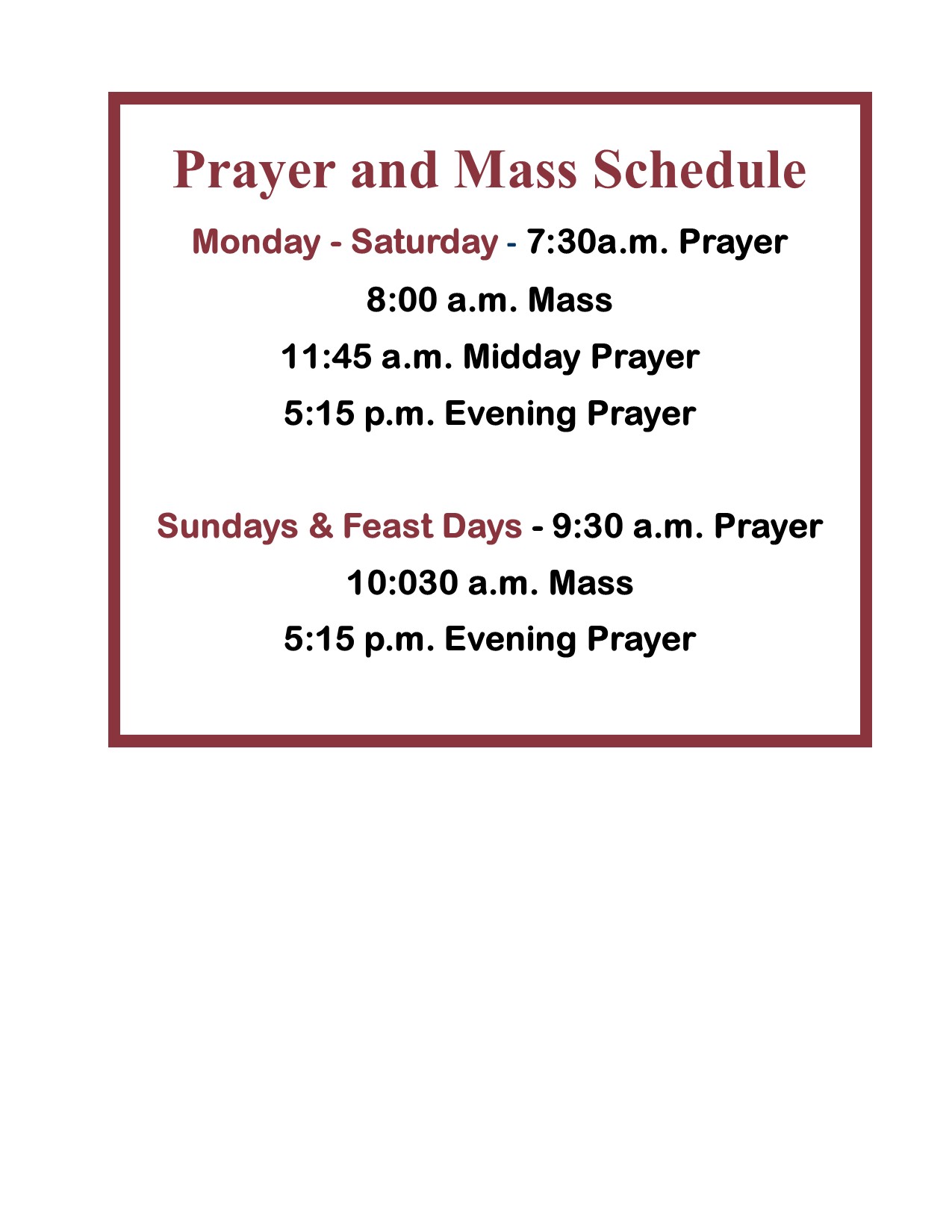
 Mass Schedule

Related Links

Copyright © 2026 · Benedictine Sisters of FL · Touching Lives Through Prayer and Service

Copyright © 2026 · Bendedictine Theme on Genesis Framework · WordPress · Log in