• Skip to primary navigation
  • Skip to main content
  • Skip to footer
Benedictine Sisters of FL

Holy Name Monastery
Founded 1889

Donate Now
  • Home
  • About Us
    • History
    • Being Benedictine
    • Benedictine Monasticism
    • Meet Our Community
    • Holy Name Academy-Alumnae
  • What We Do
    • Mission, Vision and Our Partners
    • Retreats
      • Invitation to Retreat
      • Accommodations
    • Volunteer Programs
    • Oblate Program
    • Spiritual Direction
    • Aqua/Hydroponics
    • More of Our Ministries
  • What’s Happening
    • Articles of Interest
    • Events
    • Commemorative Bricks
    • Newsletters
    • Brochures
    • Links
  • Support Us
    • Gifts of Support
    • Wish List
  • Stories Shared
  • Galleries
    • Photos
    • Videos
      • Benedictine Sisters of FL Videos
      • Other Videos
  • Contact Us

Luke

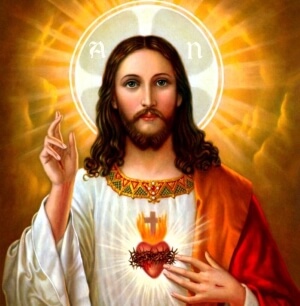
Feast of the Sacred Heart

June 15, 2026 by Holy Name Monastery Leave a Comment

July is fast approaching when summer’s heat begins to wear down even the most dedicated of beach goers, sun lovers and spontaneous ball players. Life begins to feel sticky; nights get close; days get long and dry – and in Florida, very humid! Everything becomes a major effort; we slow down like rusty cogs on old wheels. Time seems suspended. Nothing much gets done. Day follows day with not much to show for any of them. Oh, yes, monastics know all about that kind of thing. Ancient monastics warn us to “beware the devil of the noonday sun.” Spiritual sloth they called it.  Rather, keep up your practice of lectio and don’t let lazy summer weather slow down your response time to others’ needs nor the whirling storms cause lightning-fast thunderous boisterous uncharitable remarks.

Who is it that gets us through our down times?  Who is it that gives us a boost “up” when life seems “blah”?  Jesus takes all our burdens and gives us every good thing.  In the end, we simply must confess, “Lord, my times are in your hands: my future, you’re my daily bread – you’ve carried it all and always will for me.”  What are we left with?  Comfort, confidence, joy…rest for our souls.  Trust Jesus’ promise.  Take his easy yoke, don’t fight it – trust. It is only when we wrestle with a yoke that it chafes our necks.  Jesus says: “My yoke is easy; my burden is light.  Learn from me – I am meek and humble of heart.”

The evangelist Matthew tells the story in his Gospel of the day Jesus offered us a bequest that gathered many of His lessons into one gift-wrapped package we call the BEATITUDES.  The evangelist Luke, too, relates his version of that afternoon on the mountainside.  Both men may have been there in the crowd on the hillside with Jesus but Matthew’s version contains more details.  We know that Luke gleaned an insight into Jesus’ home life from Mary, Jesus’ mother.  This particular day I know Matthew was there, hearing Jesus firsthand.  He was seated right beside me.  I can conjure up his image now.  He wasn’t very agile so he kept squirming to find a comfortable position on the grassy slope.

 LISTEN UP NOW!  Jesus is getting ready to speak.  Look around you. The Beatitudes that he’ll share are not some pie-in-the-sky sayings.  What Jesus says reflects what He saw so often.   He gives us a gift to unwrap and remember in our everyday life.  “Blessed are they.”

Jesus spots a rich man and his wife who live very simply.  Did you notice her peasant style dress?  She got it at the Jerusalem Good Will store.  This couple has a reputation for generosity.  Raising his hand in blessing over the crowd, Jesus says: “Blessed are the poor in spirit, the kingdom of God is theirs.”

See that family there that is mourning the death of their infant daughter?  Hear Jesus when he says: “Blessed are the sorrowing, they shall be comforted.”

Turning to make eye contact with the family whose only child is in a wheelchair and has many special needs, Jesus says: “Blessed are the lowly; they shall inherit the land.”

 Seeing some of John’s disciples, Jesus senses the people’s hunger for His words.  But, the sun is high in the sky.  Some have traveled far and Jesus knows they must be weary and hungry.  But they wait with an air of expectancy to see if He will offer than a word.  Jesus does not disappoint them as he says: “Blessed are they who hunger and thirst for holiness, they shall have their fill.”

Oh, look over to your right.  Do you see the older woman gently soothing a fretting infant so a young mother can rock her fretting toddler to sleep?  Hear Jesus when he says: “Blessed are they who show mercy, mercy shall be theirs.”

Why is Jesus looking over there?  He seems to be focusing on some who’ve lost interest in his sermon.  He knows that they’ve heard this before in different ways.  This time it might soak in if they’d just listen.  He knows their deep desire to be always in his presence.  He reminds them: “Blessed are the singe-hearted for they shall see God.”

 Why is He smiling now?  Oh, I see.  It’s that young father rolling a yarn ball back and forth to his two young sons.  A moment ago they were squabbling over the ball. Gently flicking the ball in the direction of each boy in turn seems to be a habit of his. And all the time Papa’s listening so intently to Jesus’ words.  “Blessed are the peacemakers; they shall be called children of God.”

Jesus’ express changes.  Mmmm.  He’s looking at those church officials.  The ones who have dared to follow him.  They know they’re going to be the object of tomorrow’s gossip fest.  Jesus speaks directly to them.   “Blessed are those persecuted for holiness sake; the reign of God is theirs.”

Slowly scanning the entire crowd, Jesus goes on to say: “Blest are YOU when they insult you and persecute you and utter every kind of slander against you because of me.  Be glad and rejoice, for your reward is great in heaven.   You are the salt of the earth. But if the salt loses its saltiness, how can it be made salty again? It is no longer good for anything, except to be thrown out and trampled underfoot.”

 Again, I remind you: You are the light of the world. A town built on a hill cannot be hidden. Neither do people light a lamp and put it under a bowl. Instead they put it on its lampstand so it gives light to everyone in the house. In the same way, “let your light shine before others, that they may see your good deeds and glorify your Father in

heaven.”

~Reflection by Sister Roberta Bailey, OSB


First Reading: Zechariah 9:9-10                    Second Reading: Romans 8:9, 11-13
Gospel Reading: Matthew 11:25-30
Continue Reading

Filed Under: Blog, Front Page, Homily Tagged With: Beatitudes, blessed, Feast of the Sacred Heart, Jesus, Luke, Matthew, Sacred Heart

“By your perseverance you will secure your lives.”

November 17, 2025 by Holy Name Monastery Leave a Comment

“Remember you are not to prepare your defense beforehand, for I shall give you a wisdom in speaking that all your adversaries will be powerless to resist or refute.  … By your perseverance you will secure your lives.”  In another translation we read: “This will be your chance to tell the Good News. Do not worry about what to say in court. For I will give you wise words. None of your enemies will be able to prove that you are wrong. They will not be able to say that your words are false.”

Much is written in support of the practice of imagining or role-playing various scenarios before actually confronting someone or being caught in a confrontational situation.  I don’t mean to belittle the value that might have to ease the knots in your stomach but these words of Jesus quoted by Luke remind us, when we actually get in a situation we can depend on God for Jesus says: “I myself will give you a wisdom, wise words, in speaking.”

A few months back my sign (Scorpio) read: “Worry is like a rocking chair: it gives you something to do but gets you nowhere.”  Sometimes that “rocking chair” could work ruts in the carpet…

One group of researchers have evidence to proof that we worry about – (commentary is mine.)

40% of our worries are things that will never happen [Whew, that’s a huge chunk we can let go of]

30% are about the past – which can’t be changed anyway – so dump the gunny sack and look to today

12 % are about criticism by others, mostly untrue – and many imaginary – why do we so often assume that other people are going to spend time their precious time thinking about “me”?

10% are about health, which only gets worse with stress – better to relax, loosen up and let our bodies work their own magic on the knots (I hear you: “that’s easier said than done.”)

8% are about real problems that can be solved – so here is where we need to spend our energy and focus our prayer.  Remember Jesus’ promise (and He is a person of his word): “By your perseverance you will secure your lives!”  So, “hands off” and “zip the lip” offering God the right solution because our limited eyesight most likely will see only a rather self-serving solution …  “God-sight” knows the key to the best fix for all concerned.

 Worry and fretting allows what we see as problems to come between us and God.   It is the view that God has somehow lost control of the situation and we’ve lost trust in God’s omnipotent care for us.  A legitimate concern should draw us closer to God and cause us to rely on His providential love for us.

By our Corporate Commitment we profess to respond to the needs of the people of God with the “compassion of Christ.”  But how can we do that if we have not learned to depend on the compassion of Christ?   Saying the words is one thing; living with a firm conviction that compassion begets compassion is all together another matter.   Let us seek ways to be compassionate. Not wishy, washy – for COM-passion means “with passion” – with fervor, excitement, enthusiasm, even obsession.  Compassion is a component of the good zeal our Holy Rule commends.

Mother Evangelista Kremiter – founding superior of the Atchison Benedictines and certainly was a mover and shaker in founding our federation – is quoted as saying: “Our lives, not words, make us credible.  Words move but example motivates.”  May our lives, individually and collectively, be an example that motives all who meet us to be people of compassion.

~Reflection by Sister Roberta Bailey, OSB


As we prepare to celebrate Thanksgiving ….   Consider what you are doing for someone(s) less fortunate that you and your family ..  donate money or canned goods to a food bank or place a surprise in their mailbox or on the doorstep, work a church event ….. or invite a live-alone person for a meal and conversation ….  or  how long has it been since  you’ve worn some things hanging in the closet for eons ….

  “Bend a knee”  a whisper THANK YOU!


First Reading:   Malachi 8:19-20a         Second Reading:  2 Thess 3:7-12
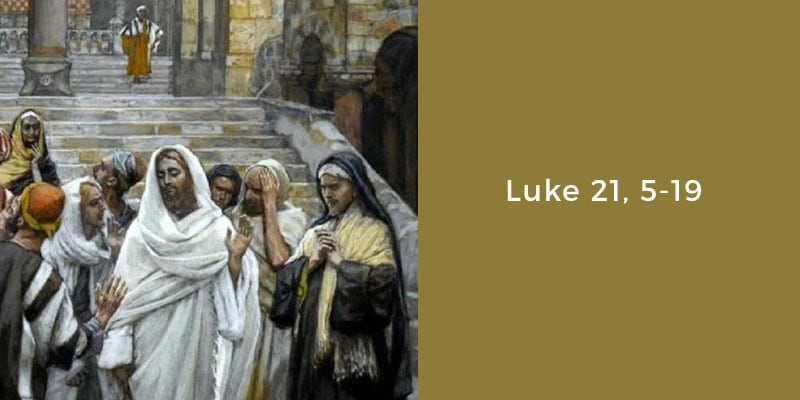
Gospel:   Luke 21:5-19
Continue Reading

Filed Under: Blog, Front Page, Homily Tagged With: "By your perseverance you will secure your lives.", Corporate Commitment, defense, God, Good News, Jesus, love, Luke

Mercy Over Merit

October 27, 2025 by Holy Name Monastery Leave a Comment

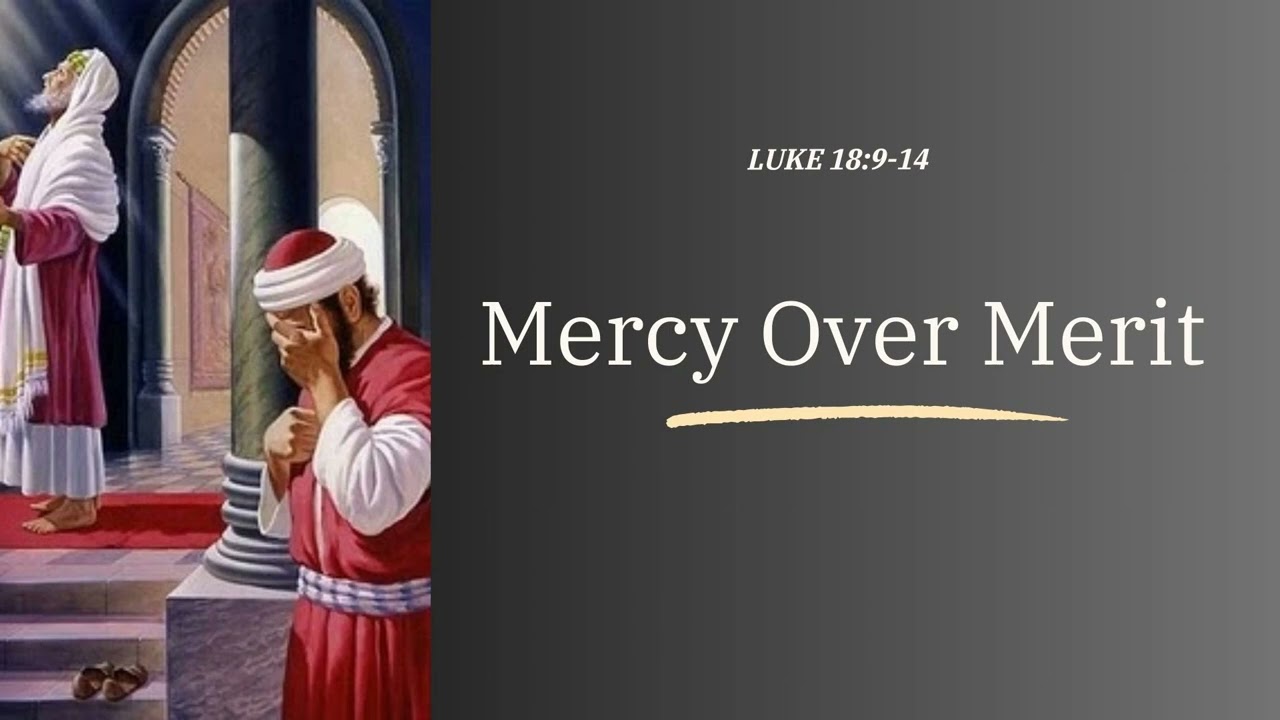
It is important to note at the outset of this particular reading just who it is that Jesus is speaking to.  Luke says: “Jesus told this parable to some who trusted in themselves that they were righteous and treated others with contempt.”

But, then there’s this.  Elsewhere in Scripture, Proverbs tells us: “To do righteousness is more acceptable to the Lord than sacrifice” and “Blessings are on the head of the righteous.”  Turning to Isaiah we read: “The work of righteousness will be peace, and the effect of righteousness, quietness and assurance forever.”

So, why does Jesus seem to be criticizing the righteous one?  One little word makes the difference.  Jesus is talking to the self-righteous; those who trusted in themselves. They’re a little too sure they are right and anyone who thinks differently must be wrong.  They (or is it we?) are so full of self that there’s little room for God’s grace to filter in.

It’s interesting when you think about it that everything the Pharisee says is true. He has set himself apart from others by his faithful adherence to the law. He is, by the standards of his day, a righteous man.   It isn’t that the Pharisee is speaking falsely, but rather that the Pharisee misses the true nature of his blessing. As Luke says he has trust in himself. His prayer of gratitude may be addressed to God, but it is really about himself. He credits his righteousness entirely in his own actions.

The tax collector, on the other hand, does not even raise his eyes to heaven.  He knows that he possesses no means by which to claim righteousness. He declares he has done nothing of merit. So, he stands back, hardly daring to approach the Temple, and throws himself on the mercy of the Lord.  He seems not so much humble as desperate.  He stakes his hope entirely on the mercy of God.

At the end of the day, the Pharisee will leave the Temple and return to his home the same virtuous, honorable man he was when he came to the temple.  That hasn’t changed.  The Pharisee’s mistake, as Scott Peck says, is that he thinks that whenever he wants, he can pull “God out of his hip pocket.”   On the other hand, the tax collector will go back to his home exalted in God’s eyes because he humbled himself.

If you’re spiritually alive, and give credit where credit is due, you’re going to love this take on the parable.  If you’re spiritually dead, you won’t even want to hear it.  If you’re spiritually curious, there is still hope!

A Church goer wrote a letter to the editor of his hometown newspaper and complained that it made no sense to him at all to go to church every Sunday.  He wrote: “I’ve gone for 30 years now, and in that time I have heard something like 3,000 sermons, but for the life of me, I can’t remember a single one of them.  So, it’s been a waste of my time and on the part of homilists a waste of their time by giving sermons at all”.

This started a real controversy in the “Letters to the Editor” column.  Much to the delight of the editor, it went on for weeks until someone wrote a real clincher:  “I’ve been married for 30 years now. In that time my wife has cooked some 32,000 meals. But, for the life of me, I cannot recall the entire menu for a single one of those meals.  But I do know this: they all nourished me and gave me the strength I needed to do my work.   If my wife had not given me those meals, I would be physically dead today.”

We might say: I’ve been in community x number of years.  In that time, I’ve been nourished and supported by my Sisters thousands of times in hundreds of different ways. But sadly, I can only recall a few, if any, instances in full detail. This much I DO know, without their support my spirit would have withered long ago.  Likewise, if I had not gone to Mass and been faithful to my time of private and communal prayer, I would be spiritually dead today!

~Reflection by Sister Roberta Bailey, OSB


Sending from home of OSB sisters in Pittsburgh PA where I am on vacation for a month – sunny 43 degree, some Fall colors.

Unsure if for next few weekends will be sending reflections …  Know that I will remembering you and your intentions in prayer.


First Reading:   Sirach 35:12-14, 16-18         Second Reading:  2 Timothy 4:6-8, 16-18
Gospel:   Luke 18:9-14
Continue Reading

Filed Under: Blog, Front Page, Homily Tagged With: God, Jesus, Luke, mercy, Mercy over merit, merit, Pharisee, Pharisees, temple

30th Sunday in Ordinary Time

September 29, 2025 by Holy Name Monastery Leave a Comment

It is important to note at the outset of this particular reading just who it is that Jesus is speaking to. Luke says: “Jesus told this parable to some who trusted in themselves that they were righteous and treated others with contempt.”

But, then there’s this. Elsewhere in Scripture, Proverbs tells us: “To do righteousness is more acceptable to the Lord than sacrifice” and “Blessings are on the head of the righteous.” Turning to Isaiah we read: “The work of righteousness will be peace, and the effect of righteousness, quietness and assurance forever.”

So, why does Jesus seem to be criticizing the righteous one? One little word makes the difference. Jesus is talking to the self-righteous; those who trusted in themselves. They’re a little too sure they are right and anyone who thinks differently must be wrong. They (or is it we?) are so full of self that there’s little room for God’s grace to filter in.

It’s interesting when you think about it that everything the Pharisee says is true. He has set himself apart from others by his faithful adherence to the law. He is, by the standards of his day, a righteous man. It isn’t that the Pharisee is speaking falsely, but rather that the Pharisee misses the true nature of his blessing. As Luke says, he has trust in himself. His prayer of gratitude may be addressed to God, but it is really about himself. He credits his righteousness entirely to his own actions.

The tax collector, on the other hand, does not even raise his eyes to heaven. He knows that he possesses no means by which to claim righteousness. He declares he has done nothing of merit. So, he stands back, hardly daring to approach the Temple, and throws himself on the mercy of the Lord. He seems not so much humble as desperate. He stakes his hope entirely on the mercy of God.

At the end of the day, the Pharisee will leave the Temple and return to his home the same virtuous, honorable man he was when he came to the temple. That hasn’t changed. The Pharisee’s mistake, as Scott Peck says, is that he thinks that whenever he wants, he can pull “God out of his hip pocket.” On the other hand, the tax collector will go back to his home exalted in God’s eyes because he humbled himself.

If you’re spiritually alive, and give credit where credit is due, you’re going to love this take on the parable. If you’re spiritually dead, you won’t even want to hear it. If you’re spiritually curious, there is still hope!

A churchgoer wrote a letter to the editor of his hometown newspaper and complained that it made no sense to him at all to go to church every Sunday. He wrote: “I’ve gone for 30 years now, and in that time I have heard something like 3,000 sermons, but for the life of me, I can’t remember a single one of them. So, it’s been a waste of my time and on the part of homilists a waste of their time by giving sermons at all”.

This started a real controversy in the “Letters to the Editor” column. Much to the delight of the editor, it went on for weeks until someone wrote a real clincher: “I’ve been married for 30 years now. In that time my wife has cooked some 32,000 meals. But, for the life of me, I cannot recall the entire menu for a single one of those meals. But I do know this: they all nourished me and gave me the strength I needed to do my work. If my wife had not given me those meals, I would be physically dead today.”

We might say: I’ve been in community x number of years. In that time, I’ve been nourished and supported by my Sisters thousands of times in hundreds of different ways. But sadly, I can only recall a few, if any, instances in full detail. This much I DO know: without their support my spirit would have withered long ago. Likewise, if I had not gone to Mass and been faithful to my time of private and communal prayer, I would be spiritually dead today!

~Reflection by Sister Roberta Bailey, OSB


Yesterday was Oblate Sunday at the Monastery. We welcomed 15 Oblates for Mass, Dinner and an instructive gathering for an exchange of ideas based on assigned “Homework.”

A Benedictine oblate is a lay Christian who has made a spiritual commitment to live according to the Rule of Saint Benedict and be affiliated with a Benedictine monastery, though they do not take religious vows or live in the monastery. Oblates integrate Benedictine values of prayer, work, hospitality, and community into their daily lives in the world, forming an “extended family” to the monastery. For more information contact S. Mary David at mary.david.hydro@saintleo.edu or call 352-588-7176.


First Reading: Sirach 35:12-14, 16-18 Second Reading: 2 Timothy 4:6-8, 16-18
Gospel: Luke 18:9-14
Continue Reading

Filed Under: Blog, Front Page, Homily Tagged With: Jesus, Luke, Oblate, Oblate Sunday, Pharisee, Proverbs

Teaching is not what Jesus did; it’s who he was.

August 4, 2025 by Holy Name Monastery Leave a Comment

This Gospel sets us pondering about what is important in our lives.  The man in the incident Luke describes holds a world view that is fairly exclusive, doesn’t he?  It’s just him and HIS things. Now he’s shocked to learn that he is about to lose his life. What good are his possessions going to be to him now?   Jesus makes his opinion quite plain.  “You fool! This very night your life will be taken away.  To whom will everything belong then?!”

Surprise! Jesus refuses to take the case.  Instead, Jesus gives the squabbling brothers a parable to “mull over”.   And, what’s the point of Jesus’ story?  It’s not even remotely related to the problem that the two brothers are having.  It features a wealthy landowner that doesn’t describe either of the siblings.  Then Jesus lumps the boys in the same pot as the landowner.  He calls than all “fools”.

Better take fair warning! There is danger in thinking this parable applies only to “those rich people.” To put the matter more pointedly, thinking of those rich fools enables me NOT to think of myself as a “rich fool.”

In this little parable Jesus probes our hearts.  “Where is your treasure?” he asks.   Don’t make the mistake that this farmer made.  Examine my story. The farmer wasn’t wicked.  He didn’t gain his wealth illegally or by taking advantage of others. He’s not particularly greedy. So, what’s wrong with building larger barns, renting a storage unit to store away some of today’s bounty for a leaner tomorrow?  This kind of thinking can lead us to ask: Is there anything wrong with hanging on to clothing we’ve outgrown but might wear again someday? Or stockpiling furniture that serves only as a “catch all” because it’s just too nice to give away?  What’s wrong with requesting more allowance than we actually need saying it’s so we can do charity?  But somehow, we never find a charity other than our own pockets.  What’s the matter with setting up a little enterprise to supplement our allowance?  Why can’t we accept or ask for money gifts or gift cards from personal friends giving them the impression that our community does not take care of our needs?

Notice what the farmer’s consistent focus is.   “What should I do? I have no place to store my crops.” “I will do this: I will pull down my barns and build larger ones, and there I will store all my grain and my goods.”   It’s his relentless use of “I” and “my” that betray a preoccupation with self. He’s fallen prey to worshiping the most popular of gods: the Unholy Trinity of “me, myself, and I.”   He gives no thought to using the abundance to help others.  This most likely is what leads to a second mistake: foolishness in thinking that making provision for the future; will secure one’s future.

Jesus used the opportunity as a “teachable moment.”  Life, he impresses upon us, does not consist in things; not even in having MANY things.  The farmer in the parable is a rich man, who fears he is not rich enough.  Jesus didn’t judge him; He did teach. He was teaching all of us how to live.  After all: “Teaching is not what Jesus did; it’s who he was.”

~Reflection by Sister Roberta Bailey, OSB


First Reading:   Ecclesiastes 1:2; 2:21-23         Second Reading:  Colossians 3:1-5,9-11Gospel:   Luke12:13-21


Continue Reading

Filed Under: Blog, Front Page, Homily Tagged With: barn, crops, farmer, Gospel, Jesus, Luke, rich Fool, teachable moment

Fifteenth Sunday in Ordinary Time

July 14, 2025 by Holy Name Monastery Leave a Comment

The dialogue in this Gospel starts with a question: “Teacher, what must I do to inherit eternal life?” It seems like a reasonable question, something you would ask a visiting rabbi.  But what was behind the question? On the one hand it may have been idle curiosity.   Or perhaps the person wanted to trick Jesus by poking fun at Him in front of the crowd.  Maybe, just maybe, the questioner thought that God might let anyone and everyone, including the riffraff, into heaven.  Was the raised voice from the crowd an enemy of Jesus, who was just out to get him?  Or might it have been pride? In his heart he may have been feeling: “Hey, look at me! I’ll be one of the few saved! These poor souls surrounding me – I hope they realize how pleased God is with me.”

It seems possible, too, that the question was neither purely academic nor a trick to entrap Jesus. It could have been a sincere question on a very personal level. Maybe the fellow was worried sick about himself, that he wouldn’t make it. Despair could have driven his question.  He was looking for the slightest sliver of hope.

In any case, we’re not told the outspoken one’s motivation. What we do know is how Jesus answered (or didn’t answer).  Instead of a direct answer, Jesus gives us another story, a very human story, a story that changed the world.

Often near the end of the TV evening news we hear news castors make reference to “Good Samaritan” stories.  For instance, a traffic accident witness stepped forward to offer assistance.

Here in our diocese, we know the Good Samaritan Society, perhaps best, through summer volunteerism.  The Good Samaritan Project (GSP), is a week-long service retreat led by the Office of Youth and Young Adult Ministry.   Middle and high school teens gather from across our Diocese to serve, pray, and have fun together for the betterment of the community and the Glory of God.  Our monastic community has been the beneficiary of services of youth and young adult groups from Las Vegas, California.  They have come from Catholic high schools and parish faith formation programs as well as our nearby university.  Local food banks and the Daystar Hope Center in Dade City have also benefited from initiatives such as  “Food for the World” Saturday and “Pack a Bag”.

Who knows how many trillions of dollars in charitable giving this one story from Jesus has inspired over the years? More than that, it has inspired countless small acts of human kindness that have made our world a more livable place.

Good Samaritans are people who open their schedules to accommodate another’s need.  They are persons who open their wallets or keep a fistful of fast food gift certificates to hand out the car window to the empty hands seen many mornings at the busiest of intersections.

Even people who are not God-followers or believers appreciate this ethical parable of Jesus. Re-read it.  Let it seep in.  Look at the words with fresh eyes.  Listen to the story. Read it aloud with open ears, hands and heart. (Read it now ….   ) “On one occasion an expert in the law stood up to test Jesus. Teacher,” he asked, “what must I do to inherit eternal life?”  Jesus replied: “What is written in the Law? How do you read it?”

~Reflection by Sister Roberta Bailey, OSB


First Reading:   Deuteronomy 30:10-14         Second Reading:  Colossians 1:15-20
Gospel:   Luke 10:25-37
Continue Reading

Filed Under: Blog, Front Page, Homily Tagged With: God, Good Samaritan, Gospel, Jesus, Luke, volunteer, volunteerism

  • Page 1
  • Page 2
  • Page 3
  • Interim pages omitted …
  • Page 6
  • Go to Next Page »

Footer

Prayer / Newsletter / Info

 Contact Info

Benedictine Sisters of Florida

PO Box 2450
12138 Wichers Road
St. Leo, FL 33574-2450
(352) 588-8320
(352) 588-8443

 Mass Schedule

Related Links

Copyright © 2026 · Benedictine Sisters of FL · Touching Lives Through Prayer and Service

Copyright © 2026 · Bendedictine Theme on Genesis Framework · WordPress · Log in