• Skip to primary navigation
  • Skip to main content
  • Skip to footer
Benedictine Sisters of FL

Holy Name Monastery
Founded 1889

Donate Now
  • Home
  • About Us
    • History
    • Being Benedictine
    • Benedictine Monasticism
    • Meet Our Community
    • Holy Name Academy-Alumnae
  • What We Do
    • Mission, Vision and Our Partners
    • Retreats
      • Invitation to Retreat
      • Accommodations
    • Volunteer Programs
    • Oblate Program
    • Spiritual Direction
    • Aqua/Hydroponics
    • More of Our Ministries
  • What’s Happening
    • Articles of Interest
    • Events
    • Commemorative Bricks
    • Newsletters
    • Brochures
    • Links
  • Support Us
    • Gifts of Support
    • Wish List
  • Stories Shared
  • Galleries
    • Photos
    • Videos
      • Benedictine Sisters of FL Videos
      • Other Videos
  • Contact Us

Gospel

You don’t need a building to represent God’s presence – God is ever near

November 10, 2025 by Holy Name Monastery Leave a Comment

Have you ever had the experience of talking to someone who is behind you?   You think you are having a really good conversation only to discover the other person has long since left the room or fallen asleep in the back seat.  Not long ago I experienced this when trying to converse with a friend as we walked down a long busy hallway.  What my friend did not realize was that someone had stepped between us while she continued speaking over her shoulder. “Let’s go into town tonight, find a good dancing place; maybe have a drink or two.”  Imagine her surprise when a male voice responded: “I’d like that – Is it OK if I bring my wife?”

That’s similar to what is happening in this Gospel story.  Folks are going through all kinds of activities directed to a God who has long stopped paying attention to all of their religious rituals, performances and pretenses.  What was taking place in the Temple was all the outward activity with none of the genuine reality. The motives had become mixed: it was much more about what they could get from the Temple rather than responding in gratitude for what God has done for them and their ancestors.

The picture here is not a gentle, soft-spoken Jesus – not the smiling Jesus calmly confronting the religious establishment with authoritative teaching and divine wisdom.  He does not ask the vendors to kindly remove their display tables outside the temple.  Nor does he ask the buyers to hold on to their money and put it in the donation basket.  Rather, he appears with His sleeves rolled up ready for a fight. He makes his own whip and chares through the heart of the religious establishment striking forcefully and aggressively at a religious system that has become skewed. Imagine it! Jesus is opening the cages of sheep, and doves with one hand, while, wielding a whip of cords in the other. He is driving animals and people alike into confusion and retreat.

The Jewish leaders ask Jesus for his credentials: what sign does he offer for taking this radical action?  Their demand is amazing but it seems a fair question.  They are checking what right He has to clear the Temple. Even among those who trusted Jesus, there is something that is not trustworthy. Jesus knew that even among those who believe, there is something fundamentally wonky. We are prone to get it wrong. Even among those who have true faith in Jesus, there is the possibility that we will let ritual replace reality.

Recall Jesus’ response to his critics in the temple?  “You want proof that I have the right to condemn religious pretension.   Let me give you the sign that I have the authority to condemn the Temple. You are going to kill me, and when you destroy me, I will raise it up again.” He is saying that resurrection is the ultimate authentication that he is who he says he is.  The religious leaders were incredulous.

He’s telling them and us: You don’t need a building to represent My presence because I am the connecting point between you and God.  In just a little more a month we will be celebrating Christmas and singing about Emmanuel, God with us. Authentic worship is not attached to Jerusalem or any other place. It is attached to Jesus. You / we won’t be making a pilgrimage to Jerusalem. But, we will be moving through Advent – a movement of the heart.  Turn away, Jesus says, from all that detracts from Me and our relationship.

So, if the Gospel message is that we don’t need a building to find and worship God, why are we celebrating the dedication a basilica today?  Parishes commemorate their founding dates but that’s usually a local celebration.  Why does the dedication of a building in a faraway city supersede the 32nd Sunday liturgy?  This church, the Lateran Basilica, not St. Peter’s, is a diocesan cathedral, the pope’s church, in his role as bishop of Rome.  It was built in the 4th century on donated land.  The structure has suffered fire, earthquake and ravages of war.  The present structure was commissioned 1200 years later, in 1646.  Beneath its high altar rests the remains of a small wooden table, on which according to tradition, St. Peter celebrated Mass.  The building may have been repaired and its role changed since the fourth century, but Jesus Christ remains its cornerstone.  This is our mother church, the spiritual home of the people who are the church.

Shortly before his death, Pope Francis give us insight into his concept of Church:

“I would like a more missionary church, not so much a tranquil church, but a beautiful church that goes forward in joy.”    At the opening of the Synod on the Family Pope Francis made it clear no question would be out of place, Discussion was not to be censored; no topics or questions were to be off the table. He wanted full, robust debate.   Then, in his closing remarks at the Synod he challenged the bishops with homework: “We still have one year to mature, to find concrete solutions to so many difficulties and innumerable challenges to confront; to give answers to the many discouragements that surround and suffocate.”

Our gospel is not a bedtime pretend story about some long-ago hypocritical religious leaders. It’s really our story too.  Our covenant relationship with Jesus, with God is not just about becoming a better version of ourselves through self-improvement.  It’s not about following a set of rules, reading the words of someone else’s prayers, being on our knees or sitting down, genuflecting or bowing.  It’s about becoming the best we can be – living to our full potential – not putting ourselves down in false humility or denying God’s free gifts to us.

A very real question is whether we believe that the resurrection fact or fiction?  Do we truly believe the sign that Jesus gives us, that He rose after three days buried in the earth?   If you believe He did, then we need to pay attention, because this is no ordinary man.  Let us, pray, then THAT our community, that every community of faith gathering to worship, may go forth from church buildings into their everyday lives to share their faith and resources with those in need.

~Reflection by Sister Roberta Bailey, OSB


First Reading:   Ezekiel 47:1-2,8-9,12        Second Reading:  1 Corinthians 3:9-13,16-17
Gospel:   John 2:13-22
Continue Reading

Filed Under: Blog, Front Page, Homily Tagged With: building, God, God's presence, Gospel, Jesus, leaders, Pope Francis, temple

Perseverance in Prayer

October 20, 2025 by Holy Name Monastery Leave a Comment

In the Gospel we have a lesson about perseverance in prayer.  The point of the story is not that prayer is nagging God for what we want.  Nor is it meant to teach us that God is like the judge in the parable – worn down by requests and coerced to respond.

The key to understanding the meaning is found in the description of the judge as corrupt and unjust. Since God can be neither, we must understand Jesus to be saying that if even an unjust judge responds to the persistence of the widow, how much more will God listen to our prayers. God truly wants to hear our needs and respond generously.  Didn’t Jesus say: “Ask and you shall receive?”   Jesus is telling us that God wants us to be like the persistent widow, staying in relationship with God, confident that God hears and answers prayers.   And He understands how easy it is to lose heart.  He asks: “Will such faith, the faith of the widow, be found when the Son of Man returns?”

A beginning of the answer to the question appears to be that the Son of Man will find faith, but it may be in unexpected places, as it has been in the Gospel — not among the religious professionals or the ones certain of their own righteousness, but among the outsiders, the unlovely, the unclean, the ones certain of their sinfulness.

The parable suggests that a sign of faith will be a willingness to persist in prayer, as we see in this widow who persists against all odds in her fight for justice against the powerful judge. Another sign may be in what we pray for: daily bread, the Holy Spirit, the coming of the kingdom, justice.

In his gospel, the evangelist Luke portrays widows as vulnerable but at the same time prophetic, active, and faithful.  The widow of this parable is forceful enough to get the justice she demands even from an utterly unjust judge.

If we could read the Greek version of this parable, we’d get a glimpse of Jesus sense of humor.   Now by “Greek” I don’t mean the language we refer to when we say “It’s all Greek to me.”  In the Greek Scriptures the judge gives in to the widow because if he doesn’t, he fears she may give him a black eye.  Jesus uses a metaphor from boxing to make his point about the need to continue in prayer. Be as persistent as a boxer in the ring when it comes to prayer. Jesus gives a second teaching in the parable. If an unjust judge answers the pleas of a widow how much more will God answer our prayers.  We just don’t know WHEN.  Remember the words of the prophet Habakkuk?  “The vision still has its time and will not disappoint.”   God takes the long view,  knows what is best and we may sometimes have to wait until we’re, as they say: “on the other side of the grass,” where we’ll understand that all along God knew best.

Luke seems to be very much aware of the real danger of giving up, of losing heart when we suffer injustice.  Luke is saying that if we pray hard enough and if we don’t lose heart, God will give us justice, right? Well, does God? Is there justice in the world?  In our country?   In our local communities, and (sadly) In our churches?  We have only to watch the evening news or read the day’s headlines to learn of multiple cases of brutality and injustice.

Could it be possible that God’s justice looks different than our justice?  Good question. Yet, somehow I trust that God gives us a righteous sense of justice–especially if it is a selfless sense of justice–one that is concerned with others.  Look at our widow. What does she do to obtain justice? She is persistent. She is stubborn. Perhaps we should call her attitude a kind of “holy stubbornness.” She doesn’t give up – she doesn’t lose heart. She keeps knocking at the judge’s door.

Now, I believe I don’t have to explain “stubbornness.”  Some of us had it sprinkled on us in our cradles!  We can prettify it, call it by another name, whatever we want: high principles, perseverance, tenacity, determined or just plain pig-headedness.  Yes, we seem to be naturally endowed with the “great gift of stubbornness” and the only thing God has to help us with is to learn how to be stubborn for the right causes — God’s justice. In that case we may talk about a “holy stubbornness.”  That happens when we start not only to pray our prayers, but when we start to live our prayers.  In other words, we put our actions where our words are.  Victims of poverty, injustice or violence don’t want to hear about God’s commandments, about moral values, about self-denial, or even about justice.

Luke is right: it is easy to lose heart and go with the flow rather than go against the current.   It takes more than a petition at Mass to make our prayers effective. Think of all the corporate commitment action opportunities we are offered.  When we support our petitions with a donation to Christmas for the residents at Heritage, attend the Sunrise Prayer Vigil, write letters asking for legislative action on behalf of the poor, make a donation to the Soup Supper or volunteer at Daystar.

You may ask, or be asked: “can prayer move God’s arm?” Jesus turns this question back on us today and concludes his parable with the question: “Will the Son of man find faith when he returns?” In other words, he is asking: “Can prayer move your own arm?  Are you willing to put your actions where your words are?” God always has relied on his children–people like you and me–to usher in His Kingdom. God will give us strength, God will empower us, but we still need to stubbornly live out our prayers for justice. The first reading reminds us we don’t have to be alone in our entreaties.  One of the beauties of living in community or being part of a faith community is that, like Moses’ (in tomorrow’s first reading) – we have friends who “hold our hands until sunset” – we have  the prayer support of many others.  Are our prayers effective? The answer lies squarely with us: “it depends on how effective we help make them.”

~Reflection by Sister Roberta Bailey, OSB


First Reading:   Exodus 17:8-13         Second Reading:  2 Timothy 3:14 – 4:2
Gospel:   Luke18:1-8
Continue Reading

Filed Under: Blog, Front Page, Homily Tagged With: Faith, God, Gospel, Holy Spirit, Jesus, perseverance in prayer, persistent widow, Prayer

Faith the size of a Mustard Seed

October 7, 2025 by Holy Name Monastery Leave a Comment

In this Gospel Jesus offers his disciples two related teachings his disciples when they cry out for an increase in faith. The first is the familiar reminder that faith, even just a little, will enable the followers of Jesus to do wondrous things. But this uplifting and inspiring teaching is quickly followed by the second teaching, a caution about knowing one’s place in God’s plans. Even when God works wonders through us, with our mustard seed-sized faith, we must not seek praise. Our participation in God’s plans is God’s grace to us—nothing more, nothing less. Pope Francis reminds us: “Our life is not all written down; it means going, walking, doing, searching, seeing … We must enter into the adventure of the quest for meeting God; we must let God search and encounter us.” When we are graced enough to cooperate with God, the work we do is nothing more than our obligation to God as faithful stewards. And yet, our faith enables us to believe that what we have offered in service to God, as his servants, can be made to produce a hundredfold.

Last week we celebrated St. Francis Day so I want to tell you a St. Francis story – maybe only part truth. This is not the story of how his father disowned him, and he stripped naked in court and walked away. It’s not the story of how he received the stigmata. Nor is it the story of the Wolf of Gubbio. This is a story you may not have heard; this is the story of St. Francis and the Sultan Al-Kamil. It takes place during the Fifth Crusade – when Francis’ pilgrimage took him across the battle lines in ancient Egypt. He was immediately captured and brought before Sultan. According to some versions of the story, he challenged the Muslim clerics to a trial by fire: both he and they would preach from the heart of a bonfire and whoever was not burned alive would be the one preaching the true God. The Muslim clerics declined the challenge. Francis then offered to go into the fire by himself, with the proviso that if he was not burned up the Sultan and all his followers would have to convert to Christianity. The Sultan did not take Francis up on this offer.

Whether or not that’s true, it is known that Francis preached to the Sultan and his household, who were so impressed by Francis that the Sultan offered him numerous gifts — which Francis refused — and gave him safe conduct back to the Crusader camp. When in time the Crusader Kingdoms fell, the Muslim rulers granted permission for Christians to tend the Christian holy sites in the Holy Land, but that permission was not given to the Church as a whole, it was given specifically to the Franciscans. In fact this arrangement persists to this day — there is a Catholic office called “Custodian of the Holy Land,” and it is always held by a Franciscan; and in places where custody is shared by different Christian denominations — like the Church of the Holy Sepulcher — it is Franciscans who represent the Roman Catholic church. All because of that one visit between St. Francis and the Sultan.

It may seem a stretch from the Gospel story to tell a tale about Francis of Assisi. So, why you may ask, tell it? A convergence of awareness led me to share this with you.

Jesus says, “If you had faith the size of a mustard seed, you could say to this mulberry tree, ‘Be uprooted and planted in the sea,’ and it would obey you.” St. Francis acted out of this spirit of courage and faith when he crossed the battle lines in Egypt. He had no idea what would happen to him; he had every reason to expect to be taken prisoner at the very least. Afterward, he doubtless thought his mission had failed. But — he had made a connection — a moment of authentic human connection, two people meeting each other face to face — that has had consequences to this very day – over 800 years!

The world is full of people who are divided from us, even opposed to us — because of religion, nationality, ethnicity, or political views, or any of a thousand things. God calls us to reach out to these people in a spirit of courage and love, unashamed of our testimony about our Lord and our mission, our way of life. We may not convince them — we may not bring them around to our point of view. We may not even make peace. The world being what it is, the odds are against it.

But if we can just make that one moment of connection, that one moment where we see each other face to face as human beings, as St. Francis did with the Sultan— that’s the mustard seed. That’s the opportunity for God to act and do something unexpected and miraculous.

The big problems in the world — hunger, war, religious conflict, and so on — often seem too big for us. Maybe they are. But we have to have faith that if we can move the pebble — then God will move the mountain.

Pope Francis once said in an interview said, “Instead of being just a church that welcomes and receives by keeping the doors open, let us try also to be a church that finds new roads, that are able to step outside itself…” Sounding like his patron Francis, he says: “We need to proclaim the Gospel on every street corner, preaching the good news of the kingdom and healing… focusing on the essentials… We have to find a new balance; otherwise we will lose the freshness and fragrance of the Gospel.”

A Sufi story tells of disciples who were despairing because their leader was about to die. They asked him, “If you leave us, Master, how will we know what to do?” The master replied, “I am nothing but a finger pointing at the moon. Perhaps when I am gone you will see the moon.”

~Reflection by Sister Roberta Bailey, OSB
 

First Reading: Habakkuk 1:2-3; 2:2-4 Second Reading: 2 Timothy 1:6-8,13-14
Gospel: Luke 17: 5-10
Continue Reading

Filed Under: Blog, Front Page, Homily Tagged With: Faith, Gospel, Jesus, Mustard seed, St. Francis, Sultan

25th Sunday in Ordinary Time

September 22, 2025 by Holy Name Monastery Leave a Comment

This parable is challenging to explain but, it came from the mouth of God’s Son so it must be important for us to grapple with. What might Christ be saying to us? Here is what I heard – colored by the recent readings from chapter 2 of Benedict’s Rule on the Qualities of the Prioress. The Gospel tells us if we can’t be trusted in little matters we certainly cannot be trusted with great ones. If you are not a leader in a Benedictine community it may be easy to breeze through chapter 2 with an attitude of ho, hum – that’s for them – glad it’s not me.

To say that Benedict lays down high standards for the superior may be an understatement. He places the chapter on leadership qualities early in the Rule, only after he defines the type of monk he is writing for. So we know he is writing about the qualities of the leaders of the “strongest kind of monastics” – the ones who have chosen to live under a Rule and a monastic leader.

I am thinking Benedict left it unsaid in Chapter 2, but he sprinkled exhortations regarding leadership for all the members elsewhere in the Rule. Benedict echoes Jesus when he presses home the “the person who is dishonest in very small matters will also be dishonest in great ones.” It does not require a great leap to apply this maxim to all of us – the youngest in community to the eldest. It seems to me Benedict is waving a banner before our eyes of what we each need to be so that a call to leadership does not include an abrupt change of lifestyle. Benedict knew from his own experience that the leader’s role in community is time-limited. He himself had experienced the call to leadership and call to a hermit’s life. He must have foreseen, perhaps with a nudge from his twin sister Scholastica, that the monastic must be prepared in all aspects of her life to move in and out of leadership roles. If the individual member does not engage in a lifelong endeavor to develop the attitudes, skills and qualities that Benedict laid out for the superior, (guess what?) an election or appointment to a leadership position will not ipso facto endow a saintly disposition. If a person has not learned to be accountable for her own actions (or at least tried to be), and to be solicitous for the welfare of those in her charge (as a teacher, principal, supervisor, kitchen manager, sacristan, chief floor scrubber, head nurse….), an imposition of hands or a community blessing, or even the bishop’s blessing will not infuse saintliness: responsibility, accountability, compassion or mercy.

You may remember the lesson of the geese who fly in V formation? As each bird flaps its wings, it creates an uplift for the bird following it. Combined, the whole flock adds 71% greater flying range than if the individual geese flew alone. Whenever a goose falls out of formation, it suddenly feels the drag and resistance of trying to fly alone and quickly gets back into formation. When the lead goose gets tired, it rotates back into the formation and another goose flies at the point position. The geese in the formation honk from behind to encourage those in front to keep up their speed.

Note that Benedict does not let the “honkers” off the hook. In speaking of the qualities of the abbot, Benedict intersperses words to the “monks in the pews.” If the prioress is to call the community or individuals to account, the member must be docile to listen. If the prioress is to be a shepherd, the sheep have to be willing to be corralled and led. It’s impossible to lead if no one follows.

Benedict reveals his keen insight into human nature when he talks about the cast of characters who can be gathered into one community. He reminds the leader, and by inclusion, all the members, to “accommodate and adapt themselves to the character and intelligence of their Sisters.” In conclusion, Benedict smiles upon the leader consoling her that she does not lack resources. He quotes Psalm 33: “Those who fear God lack nothing.” In helping others, the leader achieves the amendment of her own faults. Benedict does not mention, but I bet he knew, the gratifying support the prioress or the abbot, (or leaders of any sort) daily receives in unpretentious, quiet affirmations.

Like the story of the geese, in monastic life when the leader gets sick or is shot down (with arrows or words), individual members drop out of formation to help, protect and reaffirm the leader until she is either able to again take the lead or fly in formation with the other members. Jesus reminds us in this parable that, in the end, it doesn’t matter when you came into community, even when you came into the church. The reward for putting your hand to the plow will be the same: a day’s work in the kingdom for God’s daily wage … the last, the same as the first. It’s been that way for all eternity. You’ll find when you get there (I’m guessing) that your view from the mansion God is saving for you is just as magnificent as that of Moses or Adam and Eve or your favorite saints – everyone’s mansion has a “throne-side view” of heavenly glory.


P.S.  World Mission Sunday

World Mission Sunday is scheduled for the weekend of October 18-19, 2025, and this year’s theme is “Missionaries of Hope Among All Peoples.” During this Jubilee Year of Hope, the theme is most appropriate, and all are called to engage in missionary work in one form or another, thereby bringing hope to those in despair. This annual worldwide collection helps to provide aid to 1,124 dioceses that cannot sustain themselves because they are too poor, young, or actively persecuted.


~Reflection by Sister Roberta Bailey, OSB


First Reading:   Amos 8:4-7         Second Reading:  1 Timothy 2:1-8
Gospel:   Luke 16:1-13
Continue Reading

Filed Under: Blog, Front Page, Homily Tagged With: Benedict, Christ, geese, God, Gospel, st. benedict, The Rule, World Mission Sunday

Don’t Stay In Your Comfort Zone

September 1, 2025 by Holy Name Monastery Leave a Comment

The advice in this Gospel is for us whether we are the guest or the hostess.  But it is not simply suggestions about etiquette. Something more is going on here. What Jesus advocates is not only for social occasions, but it’s meant to shape the entirety of our lives.

Jesus is advising us against staying in in our comfort zone. Rather than limiting our guest list to people who are clones of ourselves, people with whom we’re comfortable, who don’t threaten or even challenge us, Jesus encourages us to instead invite those who are different, people who make us uncomfortable, but whose difference from us may bring with it a blessing.

Repeatedly Jesus takes the low seat and invites unlikely types to be his guests.  Those who come to his banquet make it through the narrow door because they claim no merit of their own.  Jesus leaves the comfort zone of his place by his Father to come to earth as a tiny, helpless child. He leaves the comfort zone of earthly life, and allows himself to be placed in a narrow grave.

How can we move out of our comfort zone?

+   Develop a deeper spirituality,

+   Engage in service, – sit next to a stranger or a person you recognize but    want to know better.  It could even be a person you’ve lived with for years but who still feels like a stranger.

+   Help others on their spiritual journey – it’s amazing how you will change,
+   Keep saying “no” to the ways of the world and “yes” to the ways of God.

Jesus asks us that we do him the honor of keeping ourselves, our religion, our community from becoming trapped in some comfort zone.  For us in this Benedictine community, with the move to a new monastery in 2014 and all that involved choosing what to keep and what to divest ourselves of in gifts others was a daily reality.  We place great trust in God to guide us as we refuse to linger very long in any comfort zone, moving always past safety to encounter unexpected challenges to follow the crucified and risen One. This is what it means to live the life of faith – a life on the ladder of humility as described in the Rule of Benedict …  living in reverence and deference to others.

As Perpetual Adoration Benedictine Sister Mary Jane Romero puts it:  As a sister grows in humility, she is transformed interiorly, and it overflows into her exterior behavior.  She possesses a dignity that expresses her reverent attitude toward God, her sisters, and all of life.

Joan Chittister says it this way: Humility and contemplation are the invisible twins of the spiritual life.  (I like the symbol of twins … perhaps inspired by the image of Benedict and his twin sister.)  She continues: One without the other is impossible.  In the first place, there is no such thing as a contemplative life without the humility that takes us beyond the myth of our own grandeur to the cosmic grandeur of God.   Humility enables me to stand before the world in awe, to receive its gifts and to learn from its lessons.  But to be humble is not to be diminished.  Indeed, humility and humiliations are not the same thing.  Humility is the ability to recognize my right place in the universe, both dust and glory; God’s glory, indeed, but dust, nevertheless.  Being realistic about the self, the mind is free to become full of God.

Or consider this from Eugene Boylan in his book THIS TREMENDOUS LOVER: In the practice of humility, it is a very sound principle never to display a humility that is not sincere.  (Recall what Benedict directs: strive not to be called holy; rather, be holy.)  Frequent meditation on the Passion will bring us more quickly to humility than anything else, and while humility is dependent upon true self-knowledge, such knowledge is better obtained by studying what God is, than what we ourselves are.

A final thought …Humility is like underwear, essential, but indecent if it shows.

~Reflection by Sister Roberta Bailey, OSB



First Reading:   Sirach 3:17-18,20,28-29         Second Reading:  Hebrews 12:18-19,22-24
Gospel:   Luke 14:1,7-14
Continue Reading

Filed Under: Blog, Front Page, Homily Tagged With: comfort zone, don't stay in your comfort zone, Gospel, humility, Jesus, Joan Chittister

Wishful Waiting

August 18, 2025 by Holy Name Monastery Leave a Comment

This Gospel offers us the reassurance that Jesus understands how difficult it is to wait.  Jesus is in a state of wishful waiting.  He waits for the Spirit. He’d waited for his cousin John who would baptize him.  He’d waited for the day the Father would give the go ahead to His working miracles.  He’d waited for the “three days” and His resurrection.

And we, our Sisters have lived through waiting too.   Tomorrow we will mark the 11th anniversary of the day we took up residence in our one-story home (here) on Wichers Road.  Our sisters have waited, responded, moved from Pennsylvania, to Dallas House to San Antonio Plaza to a hotel turned Convent.  Then came the move of that building to the shores of Lake Jovita where we resided until our home for deemed a fire risk.  The Academy girls and the Sisters had “sleep overs” in the parish school auditorium and the homes of local families.   We waited and waited for the Bishop’s okay to build a new home, Benedictine Hall.  Then came the call of the Spirit to down-size, build and relocate to the residence we now call home.  August 18, 2014, our friends from St. Mark’s parish gathered us and our “things” and we set foot in this our “new home.”

From the beginning of His coming on earth Jesus taught us lessons in waiting.  Mary and Elizabeth waited nine months for the birth of their babies.  The Holy Family waited three years in Egypt until it was safe to return to Nazareth. Jesus waited 30 years to begin his public ministry.  He waited three days to respond to Lazarus’ sisters’ news that his friend had died.  He waited 3 years for His Father to prompt him NOW is the right time for His last supper with friends, time for betrayal and crucifixion, time to rest in a borrowed tomb until he would be raised from the dead.  He waited for the right time to reveal himself to Mary Magdalene in the garden and later to appear to the disciples and his mother Mary huddled in the upper room drawing strength and comfort from each other. in the upper room.  He’d waited 40 days for the time to ascend and take His place at the right hand of his father.

And we? Oftentimes what do we do with our waiting time?  We look for the shortest check-out lane knowing full well that the shortest line can be the longest wait if the clerk calls for a price check.  We grit our teeth (we hope unseen) if the buffet line slows as someone goes back to read the menu; or we repeatedly hit we “print” command on the keyboard in hopes we can hurry it up.   What are the words in the hymn by St. louis Jesuits, TRUST IN THE LORD?  “Wait for the Lord, you shall not tire; wait for the Lord, you shall not weaken.  For the Lord’s own strength will uphold you, you shall renew your life and live.”

The message in the Gospel also reminds us that choosing to do good requires on-going decision-making. We all know full well that life isn’t conflict-free no matter how holy, easy-going or patient a person we may be.  We well know, living in a monastery isn’t surefire protection. We’re all still human, with human limitations.  But we are also followers of Jesus who said, “What makes you think I have come to establish peace?  I tell you I have come to sow division.”  He is alerting us to be prepared for difficult decisions.

Jesus is letting us know beforehand that He is right in the middle of the fray. Recall He said: “I have come to set the earth afire.”  He is telling us that when we make the decision to follow him, we may face opposition from some quarters, perhaps even from our peers, our family or friends.  He cheers us on when conflicts arise, and He can foresee the peace of reconciliation coming down the pike.

Consider your choices: add fuel to the fire or bite your tongue, cool your jets and exercise patience.   Figuratively, if we engage the faucet and turn on the nozzle, we can control the hose that can put out the fire between us.  The landscape may look charred. The ashes will remain.  But out of the ashes will come new life: green plants and colorful flowers – some never seen before.  And yes – peace will come!

~Reflection by Sister Roberta Bailey, OSB


First Reading:  Jeremiah 38:4-6,8-10         Second Reading:  Hebrews 12:1-4
Gospel:   Luke 12:49-53
Continue Reading

Filed Under: Blog, Front Page, Homily Tagged With: Gospel, Jesus, sisters, Spirit, Waiting, Wishful Waiting

  • Page 1
  • Page 2
  • Page 3
  • Interim pages omitted …
  • Page 12
  • Go to Next Page »

Footer

Prayer / Newsletter / Info

 Contact Info

Benedictine Sisters of Florida

PO Box 2450
12138 Wichers Road
St. Leo, FL 33574-2450
(352) 588-8320
(352) 588-8443

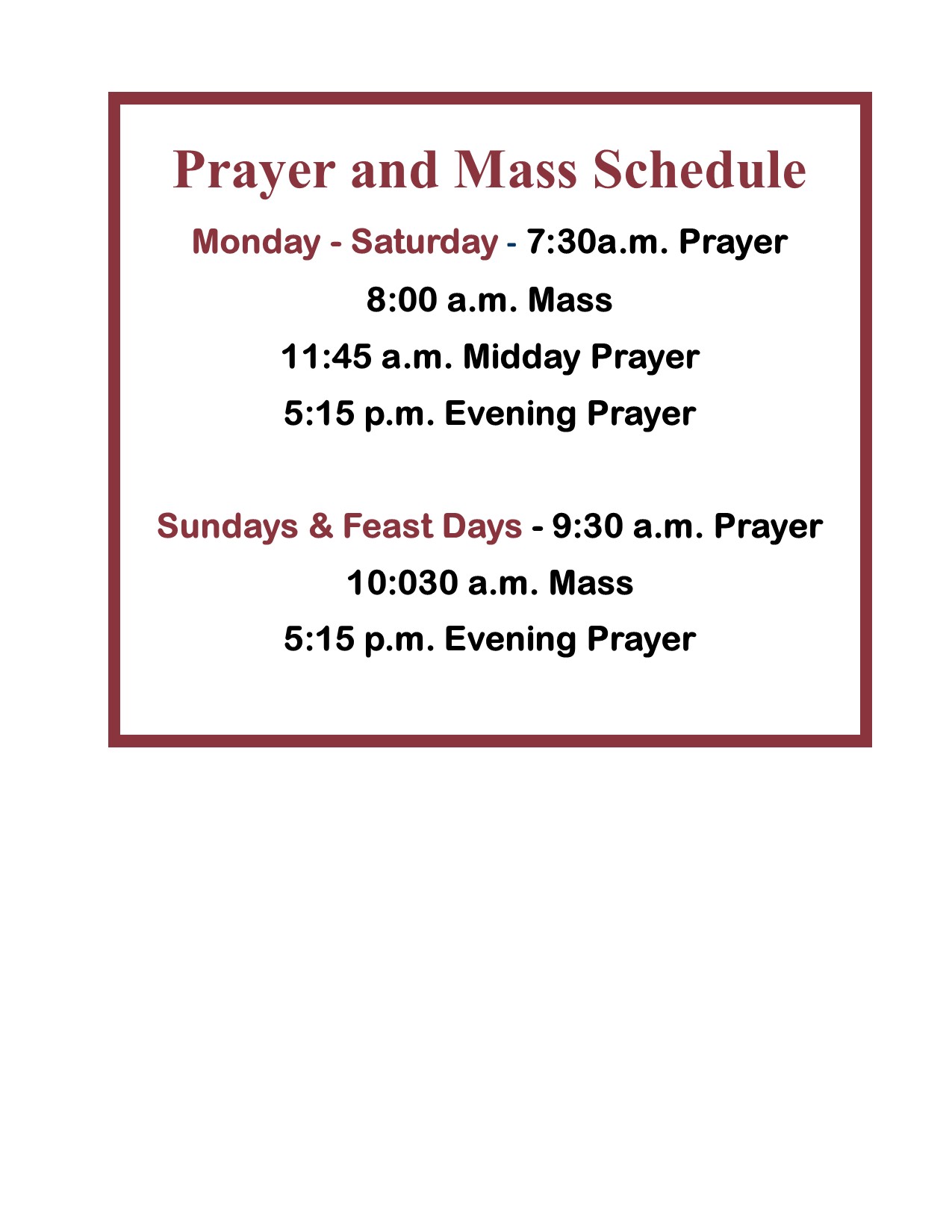
 Mass Schedule

Related Links

Copyright © 2025 · Benedictine Sisters of FL · Touching Lives Through Prayer and Service

Copyright © 2025 · Bendedictine Theme on Genesis Framework · WordPress · Log in