• Skip to primary navigation
  • Skip to main content
  • Skip to footer
Benedictine Sisters of FL

Holy Name Monastery
Founded 1889

Donate Now
  • Home
  • About Us
    • History
    • Being Benedictine
    • Benedictine Monasticism
    • Meet Our Community
    • Holy Name Academy-Alumnae
  • What We Do
    • Mission, Vision and Our Partners
    • Retreats
      • Invitation to Retreat
      • Accommodations
    • Volunteer Programs
    • Oblate Program
    • Spiritual Direction
    • Aqua/Hydroponics
    • More of Our Ministries
  • What’s Happening
    • Articles of Interest
    • Events
    • Commemorative Bricks
    • Newsletters
    • Brochures
    • Links
  • Support Us
    • Gifts of Support
    • Wish List
  • Stories Shared
  • Galleries
    • Photos
    • Videos
      • Benedictine Sisters of FL Videos
      • Other Videos
  • Contact Us

Holy Name Monastery

On the Road to Emmaus

April 20, 2026 by Holy Name Monastery Leave a Comment

Two of the disciples of Jesus were on the road that leads to Emmaus. They were low because their Master had been crucified like a common thief. But now they’d heard reports that their Master was not dead at all. Reliable sources have told them that he had appeared to some of their most trusted friends. Was he really alive? Should they believe the good news or the bad? And that’s our dilemma, isn’t it? DO WE BELIEVE THE GOOD NEWS OR THE BAD? The good news is that Christ is alive. The bad news is how little impact that event is having in our world.

The Jewish custom required that the two disciples invite Jesus to a meal. Hence, they invited Him for a night’s rest in their house–and Jesus accepted the invitation. During the meal, when Jesus broke the bread, the disciples realized that this stranger was not a stranger after all – this was Jesus, the Risen Christ. Later they said to each other, “Did not our hearts burn within us when he opened up the Scriptures to us?”  Hidden for a time, Jesus took delight in revealing himself in the breaking of the bread.  Mangiare! Eat up! It’s good for you!

You will recall on Easter morning, Jesus told the disciples to “go home” – this time they “go back” -walking 7 miles to Jerusalem to share their story.   They were probably pondering all along the way how they, like Mary Magdalene, did not recognize Jesus.  For Mary the revelation (Jesus’ delight) came when she heard Jesus’ voice.  For the Emmaus disciples it was the breaking of the bread.    That continues to this day, Jesus meets us on our way to Emmaus, in the ordinary experiences of our lives, and in the places to which we retreat when life is too much for us. The story warns us, however, that the risen Lord will take delight in coming to us when we least expect him.

In the story of Winnie-the-Pooh, Pooh and Piglet are taking their evening walk. For a long time they walk in the kind of silence good friends can share.  Finally, Piglet asks, “When you wake up in the morning, Pooh, what’s the first thing you say to yourself?” “What’s for breakfast?” answers Pooh and then asks. “And what do you say, Piglet?” Piglet says, “I say, I wonder what exciting thing is going to happen today?”   You and I can’t really plan to meet the Risen Christ because we never really know when or where He’s going to show up. But you can be sure of this: He will show up.  Take delight in his revelation!

Have you heard about the little boy who told his mother, “I’m going out to play ball with God.”  When his mother asked him just how he could do this, the little boy answered: “Oh, I throw the ball up to His sky, and He throws it back to me.”  Jesus will not disappoint you – You can depend on Him – throw the ball up – He will toss it back – be careful it does not land on your head because you failed to recognize him in the unexpected moment.  Consider when an idea comes to you “from out of the blue”.  Might it be God throwing it back to you with the prayer you tossed in his lap?  Might it be God’s way of saying: “Catch!  You can handle this one?”

How about the tale of the young boy walking home through the park after attending a Sunday school class? Somehow, he couldn’t stop thinking about the Bible lesson for that day. What impressed him most was when the teacher said, “You will find the risen Jesus in everyone you meet.” As he continued through the park, he noticed an old woman sitting on a bench. She looked lonely and hungry. So he sat down next to her, took out the chocolate bar he had saved and offered some to her. She accepted it with a beautiful smile.  They sat together in silence, just smiling at each other.  When the boy was leaving, he had gone short distance when he ran back to the bench, and gave the woman a big hug. When he arrived home, his mother asked, “What’s making you so happy today?” He said, “I shared my chocolate bar with Jesus.” Before his mother could ask more questions, he added, “You know, she has the most beautiful smile in the world.”  Meanwhile, the old woman returned to her little apartment where she lived with her sister who remarked, “You seem really happy today.  “I am,” she replied, “I was sitting in the park, eating a chocolate bar with Jesus. And, you know, he looks a lot younger than I expected.”   Isn’t that the lesson in today’s gospel?  We will meet and experience the risen Jesus in unexpected places and persons.  Make someone smile and take care to notice God’s delight in the smiles returned to you.

~Reflection by Sister Roberta Bailey, OSB


Next issue of TIDE is in the mail …  if you are not on our mailing list you can find it on line at www.benedictinesistersoffl.org

  God bless you and your family.


First Reading:   Acts 2:14         Second Reading:  1 Peter 1:17-21
Gospel:   Luke 24:13-35
Continue Reading

Filed Under: Blog, Front Page, Homily Tagged With: bread, Christ, disciples, Easter, Emmaus, Jesus, Master, On the Road to Emmaus

Second Sunday of Easter

April 13, 2026 by Holy Name Monastery Leave a Comment

The Frailty of Easter  Based in part on a reflection by John Slattery  (adapted)

Easter is all about smallness.  That’s why we are drawn to reading and re-reading the Easter accounts in the Gospels each year.  Despite the ocean of books, songs, sermons, and lectures written about Easter or on Easter-themes, our Scripture includes just four small stories about this Jesus who rose from the dead.  The combined resurrection stories encompass about 3500 words–the equivalent of about 15 pages, the length of an average term paper.

Jesus’ resurrection was such a humble thing.  There were no angel trumpeteers or singers in the skies. It was more like the story in Psalm 119. “Without a word, without a sound, without a voice being heard, the message fills all the earth, resounding to the ends of the universe.”  First, Jesus surprised Mary in the garden.  She told a few other women, then they told a few men and soon Jesus appeared to them.  He spoke about peace, about the Spirit of God, about hope.  He showed his wounds.  He ate some food and then he drifted up into the clouds.  He didn’t march on Rome or lead a rebellion against those who brought him to Pilate.  After his resurrection He didn’t heal anyone else or preach to vast crowds as He had done previously.  He didn’t cast out any more demons, trade barbs with rabbis, or visit the Temple.  The resurrection, in many ways, was a quiet event.

It challenges us to read that Jesus showed his followers his wounds.  “See,” he seems to say, “a broken body is not made whole by erasing the imperfections.  Feel this hole in my side,” he says to Thomas and to each of us.  “See, I have sanctified what the world calls spoiled.  A broken body is made whole not by removing the scars but by embracing the permanence of the wounds.”

We like this small and quiet resurrection where Jesus is not the definition of a contemporary superhero.  He doesn’t return triumphant and knock Pilate off his throne, bringing God’s wrath on the vicious Roman Empire.  He appears to his friends, simply showing his wounds and talking about love and peace.

Today’s story of Thomas illustrates our Christian experience. We are called to believe without seeing.  In fact, all Christians (after the first witnesses) have been called to believe without seeing. Thus, we sing “Without seeing you, we love you; without seeing you, we believe.”  Thomas’ doubt is hardly surprising; the news of Jesus’ appearance was incredible to the disciples who had seen him crucified and buried. Thomas’ human nature compelled him to want hard evidence that the Jesus, who appeared to the disciples after his death was indeed the same Jesus who had been crucified. Thomas is given the opportunity to act on that desire. He is our witness that Jesus is truly raised from the dead.  With him we proclaim: “We have been told, we’ve seen his face, and heard his voice alive in our hearts.”

Jesus wants us to be perfect, but not the kind of perfect that ninjas or Superman display.  Jesus wants us to be perfect “as our heavenly Father is perfect.”  God’s perfection and the message of Jesus’ Resurrection call us to an unconditional embrace of frailty, pain, and brokenness.

It is an embrace that calls us to resist all forms of violence, power, and hatred.  There is growing acknowledgement of that fact that TV and video game violence, like second-hand smoke affects one’s lungs, permanently affects our brains.  Many persons, families, and faith communities refuse to allow TV violence, fictionalized or news reports, to invade their living spaces.  Jesus did not arm his apostles with weapons for revenge — he armed them with prayer and baptized them in a spirit of hope and forgiveness.

We are surrounded today with so much sadness and fear and anger.  We who live in a peaceful community rejoice in the security and sanctity that empowers us to extend open arms in hospitality to those in the world who yearn for that same privilege.

At the end of our Gospel selection we read, “Jesus did many other signs that are not written in this book.  But these ARE written that you may come to believe …and through this belief you may have life in Jesus’ name.

We join the psalmist in singing: “By the Lord has this been done; it is wonderful in our eyes.  This is the day the Lord has made; let us be glad and rejoice in it.”

~Reflection by Sister Roberta Bailey, OSB


First Reading:   Acts of the Apostles 2:42-47         Second Reading:  1 Peter 1:3-9
Gospel:   John 20:19-31
Continue Reading

Filed Under: Blog, Front Page, Homily Tagged With: Easter, Gospel, gospels, Jesus, resurrection, Second Sunday of Easter, Thomas, wounds

Palm Sunday

March 30, 2026 by Holy Name Monastery Leave a Comment

The contemporary author Thomas Moore says, “The whole point of a good story is to give birth to other stories and to deep reflection.”  (Thomas Moore Original Self p. 66) The Palm Sunday stories certainly call us to reflection.  There are stories within stories that bring more stories to mind.   We can be tempted to try to reflect on too many details.  In Lectio, as in any of the arts, we can allow the music, the photo, the artwork, the Word to take over.  We, our brain, or attention can overload on details.    So, I suggest a good choice for the Palm Sunday stories may be to simply “sit with” the story.  Together let’s break the Word.    Allow me to share a little of my reflection with you.

Palm Sunday liturgy, it seems to me, is a mixture of themes evoking a potpourri of emotions.  We move from high hosannas and a supper with friends, to an example of loving humility, washing of feet and later washing of hands to a scene of betrayal and mocking.  We meet Simon and Veronica, John and Mary, Joseph and the women.  We are impressed with their loving care and their courage and compassion.  Then we hear the roughness of the soldier’s “Surely this was an innocent man; could he save himself?!.”  We breathe a slow sigh when we hear of the donation of a burial place, the preparation of the body of a loved-one, the watching and waiting … and waiting … and waiting.

Palm Sunday services begin with such glorious solemnity … waving palms, processions, joyful singing of hosanna!  Within about an hour’s time we travel from cries of “Blessed is He who comes in the name of God!” to shouts of “Away with this man – Crucify him!”  I like the Eucharistic acclamation that we no longer use: “Christ has died, Christ is risen, Christ will come again!” We pray for forgiveness and daily bread.   We exchange God’s own peace with each other.  We recall Jesus’ supreme sacrifice and take into ourselves His body and blood.   Then the communion antiphon calls us back to the beginning of the story – to the thread that winds through the whole story: “Father, if you are willing, take this cup away from me: still, not my will but yours be done.”  A few hours later Jesus will utter: “Father, into your hands I commend my spirit.”

This same sentiment is echoed in the prayer often used at the Stations of the Cross: “Oh, my God, I love you.  I love you more than myself.  Grant that I may love you always, then do with me what you will.”   When I hand myself over to God, as Jesus did, in a sincere act of self-surrender in the words we (Sisters) sang in our vow ceremony: “Suscipe me”,  I am asking God to accept me NOW, just as I am now, open, vulnerable, powerless.  I am also saying that I am willing to receive whatever God has in store for me in the future: the journey onward, the Palm Sundays, the Good Fridays, the Easters in my life.  “Accept me, accept us, O God as you have promised and I shall live, we shall live; and we shall not be disappointed our hope.”

~by Sister Roberta Bailey, OSB


May  you have a blessed Holy Week experience and a very Happy Easter!

Continue Reading

Filed Under: Blog, Front Page, Homily Tagged With: Christ, Jesus, Palm Sunday, palms, Thomas Moore

Fifth Sunday of Lent

March 23, 2026 by Holy Name Monastery Leave a Comment

This story of Jesus raising Lazarus from the dead is so familiar that I’m curious what I may need to hear this Lenten season.  I feel the anguish of the sisters and friends of the deceased as they watch their loved one struggle with a terminal illness, and then watch life drain out of him.  I can feel their frustration when Jesus does not come at their call.  They are hoping against all hope that he would get there in time to keep Lazarus from dying.

We wander into a scene of much confusion.  The two sisters of the dead man had sent word to Jesus that his friend, their brother, was ill. Jesus is said to have loved the three siblings: Mary, Martha, and Lazarus, but he delays responding with the haste we and they might have expected.  To the puzzlement all who were aware of the situation, it is two days later that Jesus finally declares that he will make the journey to Bethany.  Thomas says to his companions: “Let us go with him.”  And he warns that they must be prepared to die with Jesus.

This is the seventh and final sign in John’s gospel.  It appears that the crowd has overheard the exchange between Jesus and Lazarus’ siblings.  It seems obvious Jesus was a frequent “drop in” at their house.  They seem very comfortable with chiding Jesus, weeping in his presence and engaging in a verbal back and forth with him.

Jesus’ delay heightens the drama.  We know the end of the story, so we can recognize that the delay was deliberate.  Jesus had to wait until Lazarus had succumbed to his illness for Jesus to glorify His father through Lazarus’ resurrection.

Can’t you see Jesus?  He elicits from Martha a profession of faith, probably amid many nodding heads of the bystanders, “Yes, Lord, I have come to believe that you are the Christ, the Son of God, the one who is coming into the world.”  (Do you hear the “but” coming?)   Then she runs for Mary – why?  Perhaps she thinks that Mary’s special friendship with Jesus will win his favorable response to their request to “do something!”   Touched by Mary’s tears, Jesus wept!  Then there is a preview of what will happen in a short while: Jesus asks that they roll aside the stone – sign of resurrection.

Don’t you love what happens next?  Raising his eyes Jesus says “Thanks, Father, for hearing me.  I’ve tried with this crowd. I need a little help here – that they may believe that you sent me.”  Then he says in a loud voice: “Lazarus! Come out!”  When Lazarus appears at the mouth of the cave, his burial place, Jesus orders: “Untie him and let him go.”

All through Lent this is what Jesus has been doing for us and calling to us:  He says in a loud voice “Come out!  Be your true self!  Let me untie you, and let you go.  I know you, I love you! And, I know what you are capable of doing and who you can be.  I have a special niche carved out for you.  You are in the palm of my hand.  You have a unique role I have carved out for you to play in the work of creation.  If you stay in the cave of your selfishness and self-interests, hidden behind your mistaken concept of humility, reluctant to respond to the call of my poor ones, the job will not get done.  I need YOU to be my hands on this one.  You say you believe my words.  Now it is time for you to COME OUT.  Let me untie the binding cloths (this is something you can’t do yourself), uncover your face – and let the world see the person that has existed in the mind of God for all eternity.  Don’t worry about the stench from the “four days” you’ve lain in the tomb of resistance to my call.  I invite you again, COME OUT!”


~Reflection by Sister Roberta Bailey, OSB



First Reading:   Ezekiel 37: 37: 12-14       Second Reading:  Romans 8: 8-11
Gospel:   John 11:3-7, 17, 20-27, 33b-45
Continue Reading

Filed Under: Blog, Front Page, Homily Tagged With: Fifth Sunday of Lent, Jesus, Lazarus, Lent, Martha, Mary, resurrection

Fourth Sunday of Lent

March 16, 2026 by Holy Name Monastery Leave a Comment

Today in our country, there has been a glut of news and information that can wash us away if we are not careful.  Unfortunately, much of it is commentary disguised as factual news which can mislead well-intentioned people.  It is easy to become overly skeptical of anything we hear or simply become deaf to it – tune it out and live in a news-free bubble.  We become over-saturated, de-sensitized, numb to the sounds of guns that we invited into our family rooms.  We may close our ears to the sounds of violence and personally offensive language.  Or we might shut our eyes to distasteful ads while at the same time are not bothered by liturgical graphics of weapons of cruelty.  We may leave the room during the 7-minute commercial phase that brings previews depicting guns, cyber-crimes, fictionalized murders polluting our relaxation space.

It’s past time we created our own litany of care.  Call to mind caretakers, emergency workers, medical personnel… those who keep a death-watch for a loved one.  Pray for enlightenment for those who are frustrated because in their mental state they cannot recognize the seriousness of the world situation. Pray also for those who are burdened with an already existing anxiety disorder which is only compounded by the 24/7 cycle of dire news.  Pray for those who are isolated and lonely, secluded in small spaces.  Remember in gratitude those who check-in by phone with persons who live alone. Pray for those who are called to make decisions, often unpopular, for those under their care and persons who make poor decisions seemingly oblivious to the ripple effect of their choices.  Pray for those whose theme song is “I am special”.  Pray you never portray the attitude: “I don’t have to follow the rules of the RULE.”  Remember those who attitude projects “I don’t have to do what ‘they’ tell me.”  I am the exception.  I have God’s special protection.  Unusual circumstances call for unusual (some would say heroic) responses.

Pray for all of us, pray for yourself – that we may be patient and forbearing with those who bear the cross of cognitive decline.  Slow your pace to match someone using a walker, hold the door open an extra minute, find the seatmate’s page in the prayer book.  In all ways treat each other, as Benedict says: as a vessel of the altar.  Anticipate the other’s need before she recognizes she can use an extra hand.  May we be graciously cooperative team players with an intact sense of humor.

Strive to live up to the ideals Benedict proposes:

  • Pursue what you consider better for the other.
  • Be the first to show respect to the other.
  • Be patient with each other.
  • Earnestly compete in obedience (even when it goes against the grain).

In all circumstances, may we prefer nothing whatever to the love of Christ.  May we together know Benedict’s promise of life in abundance. (RB 72).  But, as Sister Julia Marie Roy OSB, Benedictine Sister from Tulsa, says: “There is no precedent for us to follow.  For Benedictines, so mindful of tradition, that is a lot to try to process!”

The Gospel readings for these middle three weeks of Lent. Last week the Samaritan woman, today the curing of the blind man, and next week the raising of Lazarus, are proclaimed every year at the liturgies that feature Scrutinies for those in OCIA, (the Catholic Church’s process for welcoming new members).  They tell of a Jesus who offers us new life in him.  These are stories of a Savior who offers us living water, dispels the darkness of our blindness, and conquers the power of death.  They are not simply the plot and climax of good stories.  They tell the real truth.  This isn’t simply factual news.  It is the good news.  Jesus was and is real and the fact that he can heal us should not be disputed.  Too often too many people live lives of anxiety, desperation and despair, seemingly unaware that Jesus wants to help all of us bear our burdens.

~Reflection by Sister Roberta Bailey, OSB



First Reading:   1  Samuel 16:1b, 6-7, 10-13a      Second Reading:  Ephesians 5:8-14
Gospel:   John 9:1-41
Continue Reading

Filed Under: Blog, Front Page, Homily Tagged With: Benedict, blind man, Christ, Fourth Sunday of Lent, Gospel, language, Lent, news, pray, Rule

Third Sunday of Lent

March 9, 2026 by Holy Name Monastery Leave a Comment

The most startling aspect of this famous conversation is that it happened at all.  The woman herself alludes to the break from tradition when she asks Jesus: “How can you, a Jew, ask me, a Samaritan woman, for a drink?”  One may wonder: Was the woman embarrassed or ashamed? Or was she perhaps afraid of the moment when Jesus would expose her?”  She had quite a reputation.  She was no angel and had been married five times and was living with a man who wasn’t her husband.  Jesus doesn’t only converse with the woman.  He also asks to share her drinking vessel, making him unclean according to Jewish law.  The thing is, it doesn’t matter to Jesus. It must not have mattered to the Evangelist John either or he wouldn’t have included the story.

The Samaritan woman, like so many other female figures in the Bible, is only identified by her gender, her ethnicity, and her place in society.  One thing we know immediately is that this woman is an outcast, even from the other women in the area. She is traveling by herself, at noon, in the heat of the day. Something in her life has prevented her from being part of the in-crowd.  She has no friends among the women who come to the well in the cool of the day to share the news of the day.  She is treated like a leper.  This is the longest recorded conversation Jesus has with anyone. And it’s with someone who is the wrong gender, from the wrong place, and has lived the wrong life.

Don’t you love Jesus?  He’s out in the hot sun.  He’s thirsty.  He’s pondering how to get some water out of the well.  Then along comes a woman with a jug.  Maybe she reminds him of the many times his mother went to meet her friends at the town well.  This was a chore she reserved for herself – it was a time of camaraderie with the neighbor ladies.

Jesus is the one who begins the conversation with the woman. He doesn’t rush her. Slowly he stirs her interest.   To her relief he is not fresh with her. She does not feel intimidated.  But, imagine her reaction when this man, a stranger and a foreigner at that, asks her for a drink.  The water is the medium.  Without the water in the story would the woman have been out in the open alone at high noon?  Would a foreigner have approached her?  Would she have responded?  She’s been mistreated too often by men.  She’d had taken her share of abuse and wasn’t about to let this man take advantage of her.  She talks back to him.  And he takes mercy on her.  He offers her living water.  Maybe he means a flowing spring was nearby?  But, no, he changes gears and starts talking about her personal life.  This man is remarkable!  He must be a prophet. This woman may be wary, but she is bold.  She engages Jesus in a theological discussion. She is not about to let him just say things about her past and get away with it. She wants to talk more.  She recognizes that this man is a pretty special person.  He’s saying amazing things. Who could he be?

The high point of the conversation is when Jesus reveals himself to her as the Messiah.  She dashes off to spread the news that one who calls himself the Messiah is right there in the center of their town!  Notice that she does not hurriedly fill her jug and dash off with it.   She does not grab Jesus by the hand and drag him around showing him off to the women who had shunned her.   She abandons her jug and her new-found friend to return to her town and lead others to this Jewish traveler she has fallen in love with over a cup of water.

She tells her story to the townspeople, even the part that Jesus knew she was a sinner.  She is not a show-off.  She knows she does not have all the answers.  She does not demand that they believe what she says about the stranger.  She lets her hearers arrive at their own conclusions about Jesus.  And they do: “This is indeed the Savior of the world.”

This one day Jesus shared time, a conversation, the gift of himself with her. This one day Jesus was the epitome of RADICAL HOSPITALITY.  And, notice that the woman did not just sit on the edge of the wall everyday waiting to see who might happen by.  She may have been lonely, but she did not sit with her skirts spread prettily around her hoping some northern visitors would drop in.  She did her woman’s work, her daily chore of getting water.  She did not run when strangers came.  She did not force herself or the town rules upon them.  When she recognized the potential for good for her village, she ran back and raised the cry: “Come and see” … Like her we can’t sit on the front door step and wait for potential to show up.  We have to step into scary places – like the village square at high noon.  Yes, some may take “pot shots” at us or ignore us.  They may know little about our community and think they know everything.  If we offer them “water,” one by one strangers may become friends.  If we reach a hand out in friendship, speak up when invited to parishes, join in village activities, our community will be the richer, our profile higher in the Google and Chrome search engine.

This woman’s story and her encounter with Jesus show us that grace, living water, radical hospitality are ready to refresh the parched earth and its peoples.  We spent the first 9 months of our existence in an environment surrounded by water; we were baptized in water and we are nourished daily by the Living Waters of the Eucharist.   Perhaps even more significant than the individuals in this story is imagining what this story might have meant to the community that was hearing it for the first time.

~Reflection by Sister Roberta Bailey, OSB


First Reading:   Exodus 17:3-7       Second Reading:  Romans 5:1-2, 5-8
Gospel:   John 4:5-42
Continue Reading

Filed Under: Front Page, Homily Tagged With: Jesus, Messiah, Third Sunday of Lent, Water, Woman

  • Page 1
  • Page 2
  • Page 3
  • Interim pages omitted …
  • Page 122
  • Go to Next Page »

Footer

Prayer / Newsletter / Info

 Contact Info

Benedictine Sisters of Florida

PO Box 2450
12138 Wichers Road
St. Leo, FL 33574-2450
(352) 588-8320
(352) 588-8443

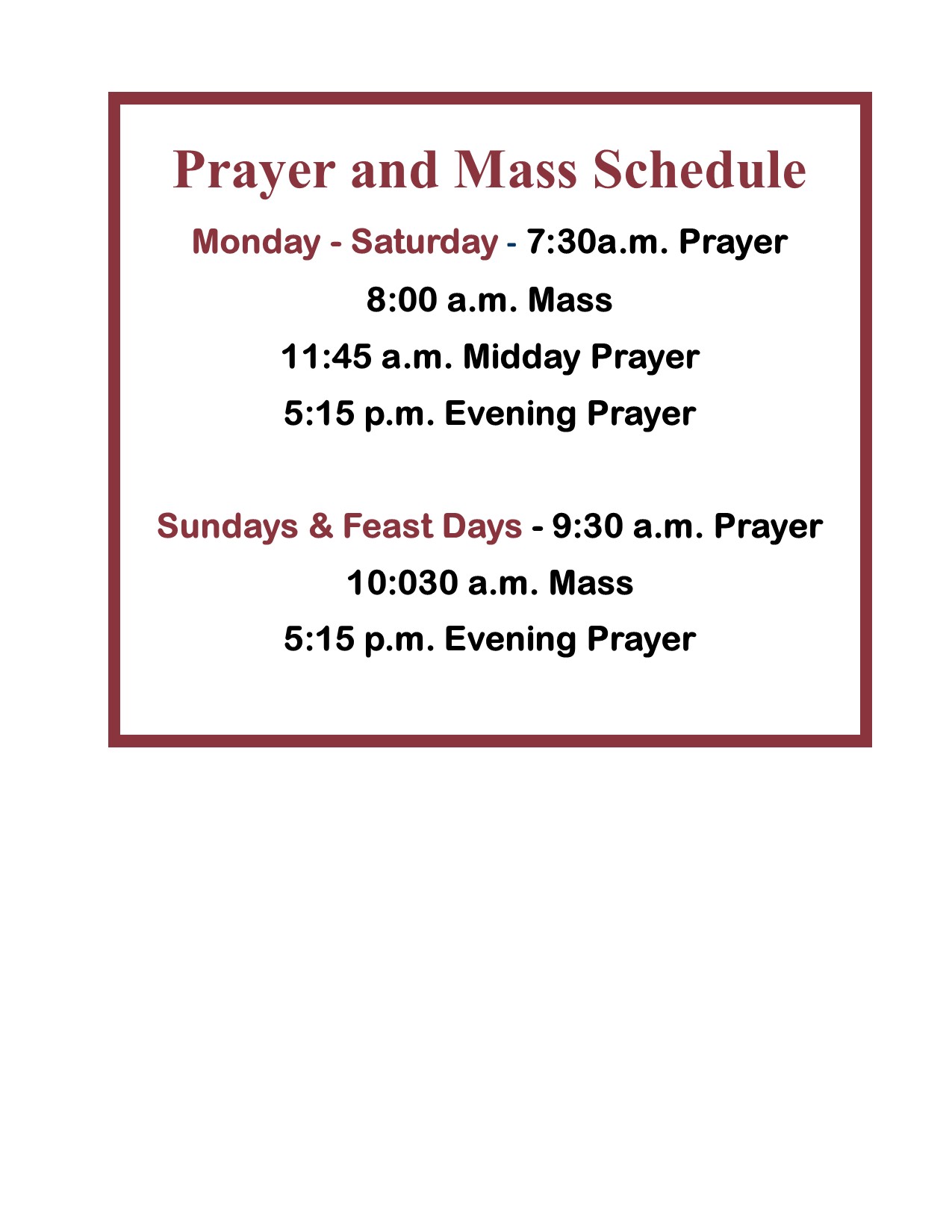
 Mass Schedule

Related Links

Copyright © 2026 · Benedictine Sisters of FL · Touching Lives Through Prayer and Service

Copyright © 2026 · Bendedictine Theme on Genesis Framework · WordPress · Log in