• Skip to primary navigation
  • Skip to main content
  • Skip to footer
Benedictine Sisters of FL

Holy Name Monastery
Founded 1889

Donate Now
  • Home
  • About Us
    • History
    • Being Benedictine
    • Benedictine Monasticism
    • Meet Our Community
    • Holy Name Academy-Alumnae
  • What We Do
    • Mission, Vision and Our Partners
    • Retreats
      • Invitation to Retreat
      • Accommodations
    • Volunteer Programs
    • Oblate Program
    • Spiritual Direction
    • Aqua/Hydroponics
    • More of Our Ministries
  • What’s Happening
    • Articles of Interest
    • Events
    • Newsletters
    • Brochures
    • Links
  • Support Us
    • Gifts of Support
    • Wish List
  • Stories Shared
  • Galleries
    • Photos
    • Videos
      • Benedictine Sisters of FL Videos
      • Other Videos
  • Contact Us

Gospel

What is the Astuteness of the Christian?

January 24, 2017 by Holy Name Monastery Leave a Comment

3rd Sunday in Ordinary Time

 Right to Life (January 23)  St. Paul (January 25)

First Reading   Isaiah 8:23-9:3          Second Reading  1 Corinthians 1:10-13,17
Gospel Reading  Matthew 4:12-23

In this Gospel the power of Jesus’ call is immediately evident – Peter, Andrew, James and John dropped everything to follow Jesus immediately.  Jesus doesn’t have to pitch the idea to these individuals nor does he need to persuade them.  Each has little reason to leave their current way of life.    Each seemingly has a steady job.  Most importantly they have familial ties to their vocations as family men and fishermen.  Now, in the new lifestyle they were inaugurating, their security would come from life in a mutually supporting community, where the needs of each one were taken care of.

Having begun to assemble his company of companions, Jesus turns to his ministry, as the Gospel describes it: teaching in the synagogues, proclaiming the gospel of the kingdom, and curing every disease and illness among the people.   He moved quickly and determinedly from one place to another … planting dreams, raising expectations, and opens doors of possibility.  His followers witnessed a dramatic alternative to the emptiness and despair that filled the lives of the people immersed in an atmosphere devoid off their trust and hope.

Whether man or a woman, when one joyfully responded to Jesus’ call to follow, and entered Jesus enterprise, their lives were dramatically changed.  They became agents of new possibility for all who came into contact with them – beacons of encouragement for the discouraged – inviting the stranger to faith in God and purpose in life.

The late Speaker of the House “Tip” O’Neill loved to relate a valuable lesson he’d learned early in his career. During his first political campaign, one of O’Neill’s neighbors told him: I am going to vote for you tomorrow, even though you didn’t ask me to! O’Neill was surprised and said: Why, Mrs. O’Brien, I have lived across from you for eighteen years, I cut your grass in the summer, I shoveled your walk in the winter; I didn’t think I had to ask for your vote! Mrs. O’Brien replied: Oh, Tommy, let me tell you something … people like to be asked!

A vital faith community will always be asking … inviting followers just as Jesus did.
It is never enough to simply welcome people when they happen to visit, we must also invite them to join us in our worship and ministries.  Without a direct “ask” a vocation may be stifled or a prayer-partner lost.  My mother spoke with great admiration for the Benedictine Sisters who were her teachers in elementary school.  I asked her once when she didn’t become a Sister – she replied “None of them asked me – so I figured I was not worthy.”  Of course, I would not be here telling you this story if she’d been asked and said YES.

Tomorrow (Monday, January 23) the church leads us in prayer for the sanctity of all life: for an end to abortion, euthanasia and the death penalty.  And more than that: to honor, respect and love all God’s people without reservation.  I invite you to listen to these words of Pope Francis (adapted slightly to be gender inclusion):

The Christian cannot allow her/himself the luxury to be an idiot, that’s clear. We don’t have the luxury to be fools because we have a very beautiful message of life and we’re not permitted to be fools.  For that reason, Jesus says, “Be astute, be careful.”  What is the astuteness of the Christian?  In knowing how to discern who is a wolf and who is a sheep. 

And when … a wolf disguises itself as a sheep, (the Christian) knows how they smell. “Look, you have the skin of a sheep but the smell of a wolf.” And this, this mandate that Jesus gives us is very important. It’s for something very great.  Jesus tells us something that attracts our attention, when someone asks him: “Well, why did you come into the world?” “Look, I come to bring life and for that life to be in abundance, and I am sending you so that you can advance that life, and so that it will be abundant.”

Jesus didn’t come to bring death (of the body), but rather, the death of hatred, the death of fighting, the death of slander, that is, killing with the tongue.  Jesus came to bring life and to bring the abundant life, and he sends us out, carrying that life, but he tells us: “Care for it!” Because there are people bringing us today the culture of death.  That is, life interests them insofar as it is useful, insofar as it has some kind of utility and if not, it doesn’t interest them.  And throughout the world, this weed has been planted, of the culture of death.

How beautiful is caring for life, allowing life to grow, to give life like Jesus, and to give it abundantly, not to permit that even one of these smallest ones be lost.  That is what Jesus asked of the Father: “that none of those whom You have given me be lost, that all of the life that You gave me to care for, might be cared for, that it might not be lost.”  And we care for life, because He cares for our life from the womb.

Caring for life from the beginning to the end. What a simple thing, what a beautiful thing.  Father, is that why there are so many wolves who want to eat us?  Is that why, tell me?  Who did Jesus kill? No one.  He did good things. And how did he end up?  If we go down the road of life ugly things can happen to us, but it doesn’t matter. It’s worth it.  He first opened the way.

So, go forth and don’t be discouraged.  Don’t be fools, remember, a Christian doesn’t have the luxury of being foolish, I’m going to repeat this: an idiot, a fool – you can’t give yourself that luxury.  You have to be clever, be astute!     Care for life. It’s worth it! “

~ Reflection by Sister Roberta Bailey, OSB, Prioress
Continue Reading

Filed Under: Blog, Homily Tagged With: astute, Christians, Faith, God, Gospel, Jesus, Pope Francis, Prayer

God’s Law – God’s Love

September 12, 2016 by Holy Name Monastery Leave a Comment

gods-lawFirst Reading  Exodus 32:7-11,13-14                 Second Reading 1 Timothy 1:12-17
Gospel Reading  Luke 15:1-32                            Intention Responsible Citizenship

An inner city church, located in an area of a large American city where there were few residents, was forced to a decision. A large corporation was offering them a great deal of money for their site, on which the corporation wanted to put a parking lot. The money would enable the parish to move to the inner city where they would find many more people to serve. Even though this was exciting to some of the congregation, other members were resistant to the idea. They pointed out that the church was the guardian of a building whose history and architecture reached back into the early part of the nineteenth century. History had been made in that building.

Eventually the congregation decided to sell the site and make the move to the inner-city neighborhood. The pastor said, “We had to decide whether we wanted to be in a museum or in mission, we couldn’t have it both ways.  It meant either staying on the original site, glorying in the past history and serving a few people, or giving up the past and gearing up ourselves for a significant ministry among the city’s people. We opted for mission status over museum status.

Something of this same struggle is indicated in this Gospel. The Pharisees and scribes came down on the side of museum religion. They wanted attention given to those who were stable, pious and not a liability if invited to the local country club. Their rationale was “Let’s have our synagogue programs be dependable for our like-minded types.”  Jesus disappointed them by insisting that the issue was one of mission: to reach out to those who needed great mercy and perhaps a bath.

The Pharisees’ love of God’s law made them forget about God’s love.   God loves us even more than a parent loves a child. God longs to rescue those who are lost.  (It’s like his favorite pastime.)  Our loving God will search for that which is lost. There’s no giving up, no quitting point. Just like looking for a lost coin – there’s no such thing as a life without worth. God doesn’t mind stooping down to find us and lift us up from the depths we have fallen into. Each time you stoop to pick up something that has fallen to the floor, however trivial a thing it may seem, that God does not disdain to stoop down to pick us up each and every time, after time that we fall.

In Jesus’ day when a husband took a bride, he gave her a headband with ten silver coins that were evenly spaced. She wore this headband in public to show that she was married. If she was unfaithful, one of the coins was removed, and the gap showed that she had disgraced her marriage vows. It was a shame and disgrace to lose any of these coins.

Loss of the coin in Jesus’ parable it seems was a result of carelessness, but not a moral disgrace. It was lost on a dirt floor in the darkness. People without God are the like that. They are not just lost, they are in the dirt and the dark. They need Jesus, the Light of the World – we all do.   Jesus looks for us, so He can bring us out of the darkness into the light!   Our community hospitality ministry helps people come into the light of welcome, friendship and compassion so that they in turn can be a light to those they associate with.   We feed their hunger for peace, camaraderie, spiritual growth, a prayerful liturgy and often top it with a good meal.

Let me end with a story that proves we never know what will bring people to their knees.

A minister was waiting in line at the Pearly Gates. Ahead of him there was a fellow who was dressed in sunglasses, a loud shirt, leather jacket and jeans. Saint Peter addressed the asked, “Who are you, so that I may know whether or not to admit you to the Kingdom of Heaven?”    “I’m Joe Cohen, taxi driver, of New York City”. Saint Peter consulted his list, smiled and said:  “Take this silken robe and enter.

Away he went.  Next in line was the minister. . He stood erect and boomed out, “I am Msgr Joseph, pastor of Saint Mary’s Cathedral for the last forty-three years.” Saint Peter consulted his list and said to the minister, “Here, take this cotton robe and you can come in.” Just a minute here,” said the minister. “That man was a taxi driver and he gets a silken robe. How can this be?” ”

“Up here,” said St. Peter, we work by results. While you preached, people slept. While he drove, people prayed.”

~Sister Roberta Bailey, OSB, Prioress
Continue Reading

Filed Under: Blog, Homily Tagged With: God, God's Law, God's Love, Gospel, Jesus, Pharisees

Comfort Zone

August 29, 2016 by Holy Name Monastery Leave a Comment

comfort zoneFirst Reading  Sirach 3:17-18,20,28-29     Second Reading   Hebrews 12:18-19,22-24
Gospel Reading   Luke 14:1,7-14      Intention End to terrorism

There is a term popular today that seems to me to fit with this message of Jesus. The term is “comfort zone” which refers to those situations in which the person feels comfortable, safe, and free from threat or even challenge. The comfort zone is, for the person involved, a thoroughly comfortable place. Life there is marked by ease and familiarity.

It’s natural to like one’s comfort zone, but most of us would admit that we should not remain there indefinitely. People do not become better or more mature or holier lingering in their comfort zone. That just doesn’t happen.

This, I think, appears to be a modern term for what concerns Jesus in today’s Gospel. The passage divides easily into two parts.

In the first part, Jesus cautions against sitting in the place of honor at a wedding banquet and advises taking the lowest place instead.

In the second part, he urges us to invite the crippled, lame, and blind when we give a luncheon or dinner, rather than friends, relatives, and rich people.

So there’s advice here for us when we’re the guest as well as when we are the ones hosting an event.  But it is about more than proper banquet etiquette.  Choosing the seat of honor for ourselves sounds a lot like craving our comfort zone. The best seat is the one where we feel comfortable: accepted, safe, free from threat, challenge or embarrassment or any sense of awkwardness.

Sharing a community meal, sitting at table should be less about power and all about sharing the joy of being together.   Even our legends acknowledge the power of a choice seat like King Arthur and the Knights of the Round Table. Sitting at a round table came to symbolize equality… because there was no head of the table. All had an equal seat and an equal say. Where you choose to sit matters. It matters in the way people perceive you and in the way you act in different environments.

Jesus challenges us against staying in our comfort zone. Rather than limiting our guest list to people who are clones of ourselves, people with whom we’re comfortable, who don’t threaten or challenge us, invite instead those who are different, people who make us uncomfortable, but whose difference from us may bring with it a blessing.  This is what I think is so significant about our Thanksgiving Day dinner.  We open our door, our hearts and our table expecting nothing in return.  The blessing of being in a position to share is its own reward.

Jesus not only teaches us this the lesson of stretching our comfort zone, he demonstrates it. His entire life, his public ministry, the passion and resurrection, is full of one episode after another of not remaining in a comfort zone.  Repeatedly Jesus takes the low seat and invites unlikely types to be his guests.

Finally he takes the worst seat of all––on the cross––and those who come to his banquet make it through the door (recall last Sunday’s Gospel)  because they claim no merit of their own. Finally he leaves the comfort zone of earth and expands his comfort zone forever, everywhere and with everyone – there are no strangers – all are welcome!

~Sister Roberta Bailey, OSB, Prioress
Continue Reading

Filed Under: Blog, Homily Tagged With: advice, comfort zone, equality, Gospel, high seats, Jesus, low seats, welcome

Availability

June 6, 2016 by Holy Name Monastery Leave a Comment

availabilityThroughout his Gospel, Luke demonstrates that God’s promises to Israel are fulfilled in the person of Jesus.  In this part of Luke’s story, Jesus and his disciples are approaching the city of Naim when they come upon a large funeral procession. Luke does not tell us how Jesus knows that the deceased is an only son of a widow.  Did He know the family or was the scene and the ritual all too familiar to him and his disciples?   Whatever the reason, had Jesus not been present to the moment and available to its significance it may have gone without noticed or ignored by the evangelist as well as the passersby.

Before I continue: a disclaimer is called for: Much of what follows is borrowed or adapted from Robert Wicks’ little volume entitled AVAILABLILTY.

The virtue, the gift of availability is indeed a simple but a great gift.  The freedom to be present when needed is something special.  It is an opportunity to be spiritual – to be open to relationship in the deepest, most elegant sense of the term.  However, this wonderful state of living often seems hidden or distorted.  Today, availability is a premium because it is not only a gift but also sometimes a great challenge for many of us – one that we need to more fully understand and address if we are to be able to continue to be present in the full sense of the word.  Availability is not only a gift; it is also a problem.

Some of us are “too available.”  Thus, true availability becomes watered down. We become too busy to pray, too tired to reflect, and, ironically, too stimulated interpersonally present to others.

Others among us pull back in anxiety.  Being available to God seems to raise too many questions or doubts.  Spending time alone is no longer relaxing; instead we feel lonely or preoccupied with our faults and failures.  And being with others doesn’t seem to help either; in some cases, we feel used, left out, or misunderstood.  The end result is that our expectations for intimacy are not realized and we feel the need to pull back more than ever.

The situation is not merely a sad one; it is a dangerous.  Without a sense of availability to self, others, and God, life loses it spirituality.  Relationships suffer, break down, and we are left with a void or sense of confusion.

We must address availability with the imperative that openness to the personal and interpersonal is essential if the Spirit is to be heard and felt. Any blocks to relationship must be removed if we are to prepare ourselves always for the continual coming of what is Good.  The very vitality of living out the Gospel depends on our being involved –  in an ongoing way – in the process.

When we spend time, especially unplanned time, with others it is not so much that we TAKE TIME OUT OUR DAY to be with them as that we had make the other part of our life.  For instance, today’s funeral for Kurt … because we generously welcomed them into our home God, through us, was enabled to share compassion, comfort and hospitality to a large group of mourners.

Jesus absorbed the widow’s sorry, made it his own and offered deep compassion and consolation to her even before he raised her boy from the funeral bier.  Did Mary witness this incident or did others relate to her?  Later when her son died do you think  she recalled he’d brought this Only son back, and Lazarus, too, back to life?  Did she live in hope that such a miracle would be granted her son?  Someday we may know.

Picking up cues, recognizing a silent need – reaching into self and out to others: this kind of attitude is at the heart of a life that reflects an appreciation of the gift of availability.  This attitude merits being kept in mind as we look at some of the basic problems we encounter in trying to be available to ourselves, others, and God.  Though the concept is simple, living a life of true availability isn’t easy for most of us.  It takes a conscious desire and effort to be present to all the nuances of the present moment.  Some people see only the dark clouds gathering; others see the rainbow emerging.  Let us be present to the moments when rainbows quietly and slowly are revealed in our lives.  Jesus would have missed the funeral scene if he had been too intent on getting to the farmer’s market in town.

~Reflection by Sister Roberta Bailey, OSB, Prioress


Continue Reading

Filed Under: Blog, Homily Tagged With: Availability, funeral, gift, God, Gospel, Jesus, Luke, Widow

  • « Go to Previous Page
  • Page 1
  • Interim pages omitted …
  • Page 11
  • Page 12
  • Page 13

Footer

Prayer / Newsletter / Info

 Contact Info

Benedictine Sisters of Florida

PO Box 2450
12138 Wichers Road
St. Leo, FL 33574-2450
(352) 588-8320
(352) 588-8443

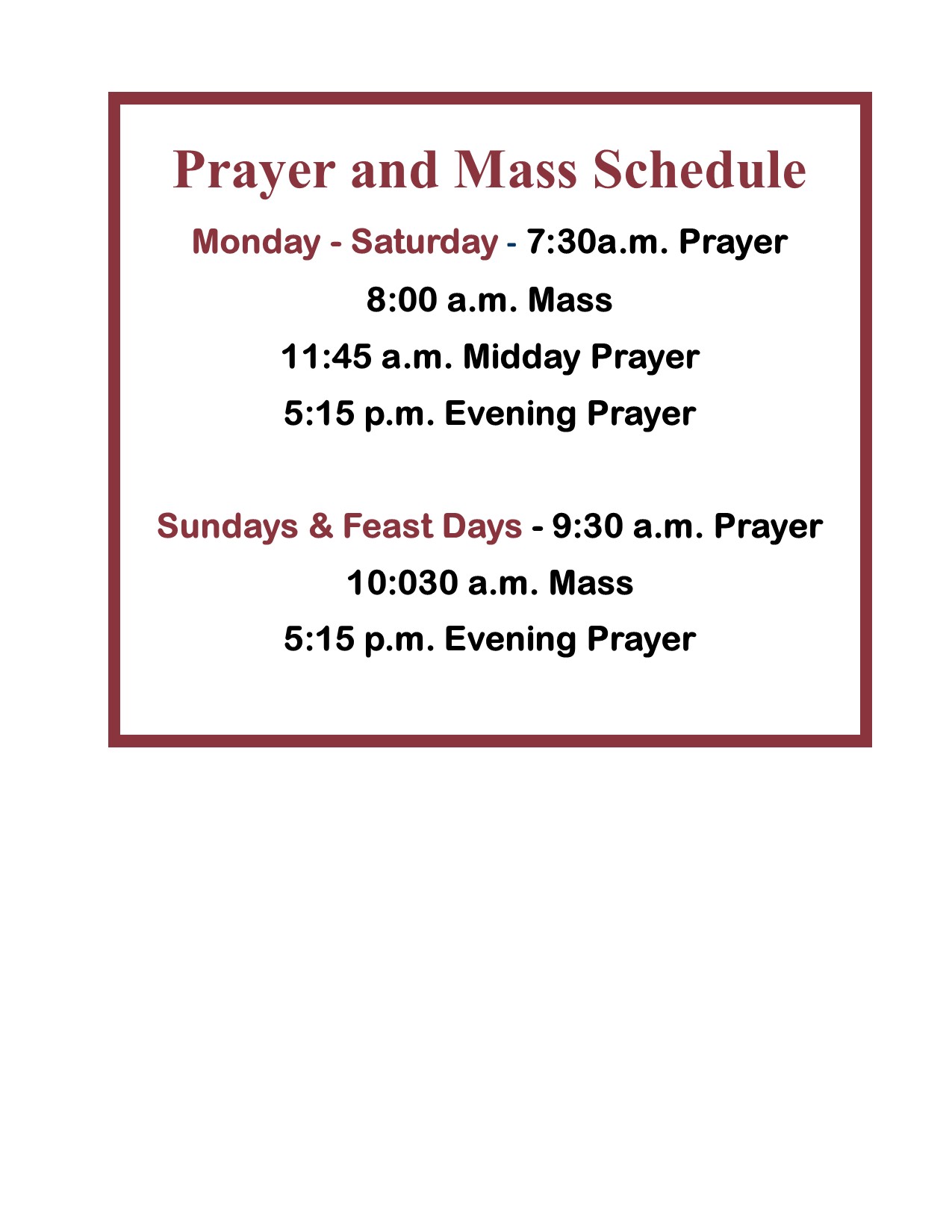
 Mass Schedule

Related Links

Copyright © 2026 · Benedictine Sisters of FL · Touching Lives Through Prayer and Service

Copyright © 2026 · Bendedictine Theme on Genesis Framework · WordPress · Log in