• Skip to primary navigation
  • Skip to main content
  • Skip to footer
Benedictine Sisters of FL

Holy Name Monastery
Founded 1889

Donate Now
  • Home
  • About Us
    • History
    • Being Benedictine
    • Benedictine Monasticism
    • Meet Our Community
    • Holy Name Academy-Alumnae
  • What We Do
    • Mission, Vision and Our Partners
    • Retreats
      • Invitation to Retreat
      • Accommodations
    • Volunteer Programs
    • Oblate Program
    • Spiritual Direction
    • Aqua/Hydroponics
    • More of Our Ministries
  • What’s Happening
    • Articles of Interest
    • Events
    • Newsletters
    • Brochures
    • Links
  • Support Us
    • Gifts of Support
    • Wish List
  • Stories Shared
  • Galleries
    • Photos
    • Videos
      • Benedictine Sisters of FL Videos
      • Other Videos
  • Contact Us

Benedict

Holy Family Sunday 2020

December 28, 2020 by Holy Name Monastery Leave a Comment

This coming year Pope Francis has designated the “Year of St. Joseph” marking the 150th anniversary of Pius IX’s declaration of St. Joseph as Patron of the Universal Church.  Francis describes Joseph as “a beloved father, tender and loving, obedient and accepting; a father who is creatively courageous, a working father, a father in the shadows.”

This weekend the Church turns our focus to Jesus’ earthly family with the feast of the Holy Family.  It’s natural when we celebrate the birth of the child Jesus that we would reflect on His family.  Do you realize that for every one year of his public life, Jesus spent ten years in family life?  That helps us understand the importance and priority He gave to family life.

What might that mean to (and for) us as monastics who we live in an intentional family we call community.  As Benedictines our lives are guided by the simple, yet profound, guidelines designed over 1500 years ago by the man Benedict.  His Rule gives us a picture of a man of great wisdom, compassion and much common sense. (I believe, we can agree, his guidelines were influenced to a great degree by his twin sister Scholastica.)

It is the spirit of the Rule that has survived.  Benedict had a knack for tempering discipline with compassion that makes the Rule come alive for so many.  His prudence shines through when, in so many words, he says: this is what works for us now – if the arrangement of the psalmody, the daily schedule and other daily living details don’t fit your need, change it.

If we only know the first word of the Rule “LISTEN” what an impact it could make on our own happiness and harmony between peoples.  To truly listen requires an attentive spirit … not a scramble to respond with advice, a witty remark or a “I’ve got a better one” or “I know exactly how you feel.”  When we truly listen to another we can identify their feeling, let it resonant within and know that very often all the person wants is a signal that we care.

Benedict’s Rule is not intended to be a great and lofty treatise on prayer or spirituality.  It’s just plain “down to earth” advice.  He says let this rule be read 3 times, cover to cover, to the potential member so she understands exactly what she is getting herself into.  The Rule is filled with practical guidance for ordinary people to live together peacefully. Benedict expected his followers to work hard, study hard and pray hard.  He recognized much of the study and work is an interior process – a true “self-study” steeped in a quiet atmosphere that is broken only by the sounds of nature, farm machinery, a printing press or sewing machine or the scratch of a calligraphy pen.  This kind of soul work begins in private prayer enriched in communal prayer.

I think Benedict must have valued the idea of cross-training.  Given the rotation of duties and positions in community, all members do well to take to heart the advice and warnings given to the various community officials: the prioress, the guest mistress and the porter; the cellarer, the artisans and the sub-prioress.  We all need to be aware of the final judgment – be strong, and at the same time, never be ashamed to have a tender heart.

From that first word in his Rule: LISTEN… to his advice to begin every good work with prayer … to keeping a lamp burning at night … and don’t loiter outside chapel if you are late … it is evident that Benedict saw God at work within the ordinary events of everyday life with all its joys and sorrows, struggles and high points, funerals and jubilees, comings and goings.  In Psalm 27, and often as an antiphon, we pray: “One thing I seek: to dwell in your presence, O God, all the days of my life.”  And, that presence does not refer only to our final day on earth or future eternal life in heaven.  It is not found only in the Eucharistic presence in the chapel – it is EVERYWHERE – in the Voice of the Spirit working in our personal lives and in the voices of each other and the sounds of daily living.

So, LISTEN – to the Voice of your God within – and listen with your heart to your comrades’ hungers and longings.  Just LISTEN – with your ears certainly but also with your eyes and heart and feelings.  The quality of our life in community, is shaped by each of us.

~ Reflection by Sister Roberta Bailey, OSB
First Reading  Genesis 15:1-6; 21:1-3    Second Reading  Colossians 3:12-21)
Gospel  Luke 2:22-40
Continue Reading

Filed Under: Blog, Front Page, Homily Tagged With: Benedict, Community, Feast of the Holy Family, Holy Family Sunday, listen, The Rule

Even When You Say You Did Not Believe

September 28, 2020 by Holy Name Monastery Leave a Comment

I’ll repeat the last line of that Gospel reading: “Yet even when you saw, you did not later change your mind and believe.”

Speaking in St. Petersburg (FL) on Friday (September 25) Florida Gov. Ron DeSantis lifted all restrictions statewide that were imposed to control the spread of the virus that causes COVID-19.  In his words: “Every business has the right to operate.”  The executive order will stop cities and counties from fining people for not wearing mandated face coverings.  The governor says there are no signs of a possible “second wave of infections.”  I am a bit skeptical of what signs of the times this man and many others are reading?  And, who or what advice are they listening to?

In our country – in the U.S. – there have been more than 7 million confirmed COVID cases – and God only knows how many more unreported.  There have been more than 200,000 deaths.  In Florida there have close to 700,000 reported, confirmed cases (not counting those that go unreported) and 14,000 COVID-reported deaths.  That is approximately 4500 more than the combined populations of (nearby) St. Leo, San Antonio and Dade City.

The daily reading from the Holy Rule, this Gospel, and other words we’ve prayed this past week, warn us about paying mere lip service to directives and about the danger of letting our diligence slip.

We heard Jeremiah say: The Lord searches the heart and examines the mind, to reward each one according to what their deeds deserve.”  And the psalmist who reminded us: “God searches the hearts and minds … The Holy One knows our thoughts.”  In the words of Benedict: “The disciple’s obedience must be given gladly, for ‘God loves a cheerful giver.’”  If the disciple obeys grudgingly and grumbles, not only aloud but also in her heart, then, even though the order is carried out, their actions will not be accepted with favor by God, who sees that she is grumbling in her heart.  She will have no reward for service of this kind.”

The evidence is all around us – the virus is still present in our world.  We can’t dispute the fact that there is confusion, fear and challenges that cause us to reflect on how we interact with each other and the greater community.  There is much soul-searching and a heightened awareness of the “hungers of the people of God.” (BSoFL Corporate Commitment) We need look no further than across the highway to witness the challenges of having university students on campus.

Yet, we still hear comments like: “it’s all a hoax – it’s only another form of the flu – I’m strong, I can fight it – She is my friend, they wouldn’t be here if she thought she was sick – the virus can’t be passed if we’re outdoors – it’s not in our part of the county – I’ll take an ibuprofen tonight, just in case – I don’t follow rules I don’t agree with or don’t like.”  What is not said is: “I’m scared – I can’t think about it – I have too many other health issues – there is so much confusion, I gave up – it’s like climate change; the scientists will figure it out – I followed the CDC and our house restrictions for a while, but not anymore; if it comes, it comes – if God wants to take me, that’s OK – if I get sick it’ll be someone else’s problem – they’ll take care of me.”

That’s the sticking point.  In truth, in time of illness, death or distress, we do care for each other.  The question before each of us each day is: am I taking care of, not just myself, but am I taking the most solicitous care I can of the 14 others I live with?  Do I keep in mind Jesus’ admonition: “Don’t do to others, what you would not want done to you.  Love others as you love yourself.”

These are times when the yoke of obedience and submission can really pinch – more for some personalities than others.  Listening to the “abbot” is one thing – listening to an external source, quite another: the bishops, local governments, the CDC, health departments, medical professionals …  where do they rank in our promise of obedience???  Our “conversion of life”?

Hospitality to each other is another whole package.  But, we know we are (like it or lump it) in these times -TOGETHER – either we will survive it without scarring OR the enemy: lack of diligence, carelessness, or disregard for others (the REAL fatal virus), will break through cracks in our walls.   Even hands held tightly can weaken – so hold tight…. Try not to be the one who loses grip.   Let us hold each other tightly in prayer and patience in the trials of “Safe at Home.”  We’ve a “mile to go before we can sleep” – i.e. let up on our vigilance.  Know and believe that God has a plan.  Be patient with the divine timing in day-by-day revealing that plan.  Remind yourself “the best IS yet to come.” Our ancestors in community got through the 1918 pandemic – so will we!

Peace – and good health and many blessings.
We’ll be praying in particular all this week for all health care workers and on Monday joining in spirit the Bishops for International Day of Prayer for Migrants, Refugees, Immigrants and Sojourners.
God bless you each!

~Reflection by Sister Roberta Bailey, OSB, Prioress


First reading: Ezekiel 18:25-28       Second Reading: Philippians 2:1-11
Gospel: Matthew 21:28-32
Continue Reading

Filed Under: Blog, Front Page, Homily Tagged With: Benedict, Covid, Covid-19, DeSantis, God, Gospel, governor, Holy Rule, Lord

To Listen is to Understand

July 13, 2020 by Holy Name Monastery Leave a Comment

I offer you two brief stories.  The first – a familiar story (one of many versions that can be found on the Internet) –

There once was a man that prayed, “God, speak to me.”  And a meadowlark sang.  But the man did not hear.

So the man spoke aloud: “God, speak to me!”  And thunder rolled across the sky.  But the man did not listen.

The man looked around and said, “God, let me see you.”  And a star shone brightly.  But he noticed it not.

The man then shouted, “God, show me a miracle.”  And a babe was born.  But the man was unaware.

So, the man cried out in despair, “Touch me, God, and let me know that you are here!”  Whereupon God reached down and touched the man.  But the man brushed the butterfly away and walked away.

The situation in the second story may also have a familiar ring –

A woman was having difficulty communicating with her husband … (or I could say two Benedictines Sisters were having difficulty with that same problem).  Each had concluded that the other must be hard of hearing.  So, (in the original scenario) the wife decided to conduct a test without her husband knowing about it.

One evening she sat in a chair on the far side of the room.  Her husband’s back was turned to her so he could not see her.  The room was very quiet; no TV was playing.  She whispered, “Can you hear me?”  There was no response.

Scooting a little closer, she asked again, “Can you hear me now?”  Still no reply.  Quietly she edged closer and whispered the same words, but still no answer.

Finally, she moved right in behind his chair and said, “Can you hear me now?”  To her surprise and chagrin, he responded with irritation in his voice, “For the fourth time, yes!”

And Jesus said: Whoever has ears ought to hear.

So, pondering both of these stories, we might ask:

  1. When God speaks, do we make sure we don’t miss some part of the message because the blessing is not packaged the way we expected?
  2. Is the problem that God is not speaking? Or, that we are not listening?
  3. Or, is the third step where we fail – Are we listening and hearing but, then, failing to act on what we hear?

We are all well aware of Benedict’s opening word to us in his Rule – it’s the same that Jesus speaks in this Gospel: Listen.  According to a footnote in my Bible, the phrase “Let they who have ears, let them hear” (or a similar expression) appears approximately 14 times in Scripture.  I find this interesting because the number 14 is considered to be a symbol of salvation and deliverance.  The 14th day of the first Hebrew month is Passover – the celebration of the deliverance from death of the firstborn of the Children of Israel.  The angel passed by all the homes where the doorposts had been painted with blood.  The word “Hear” (h e a r) in Greek means to understand, to perceive the sense of what is.

Benedict’s first word (in the Rule) – LISTEN is the key to what he says in the last two chapters of the Rule.  If only that one instruction were heeded, what an impact it could make on our own happiness and it would foster concord between peoples.  Isn’t attentive listening the master key that opens our hearts for good zeal?  Deep, sensitive listening is the undergirding to mutual obedience, anticipating one another’s needs, picking up on feelings, being aware when we’ve pushed another’s “buttons” and recognizing we need to change the course of this interaction.  To truly listen requires an attentive spirit.  Recall some of the points in Celeste Headlee’s TED talk that we viewed the other evening  [Celeste Headlee  10 ways to have a better conversation] Simple things but ones that take attention and self-discipline to put into practice.  Celeste reminded us: if your mouth is open, you’re not listening; if you want to pontificate, write a blog; listen to people and be prepared to be amazed; everyone is an expert at something!”

Jesus and Benedict each offer us a challenging but attainable ideal.  When the monastic breaches the ideal, we are expected to humbly ask forgiveness both from God and from our Sisters-in-Christ to whom we freely pledge to “form bonds of mutual love and respect and to call forth the best in one another.” (community Philosophy statement 2018)

~Reflection by Sister Roberta Bailey, OSB, Prioress
First Reading Isaiah 55: 10-11       Second Reading Romans 8:18-23
Gospel Matthew 13: 1-9


Continue Reading

Filed Under: Blog, Front Page, Homily Tagged With: Benedict, God, God spoke to me, Jesus, listen, Listen is to Understand, The Rule

PEACE

May 28, 2019 by Holy Name Monastery Leave a Comment

Reflection By Sister Roberta Bailey, OSB, Prioress

Memorial Day is an American holiday honoring the men and women who died while serving in the U.S. military.  It was originally called Decoration Day – a day to honor deceased soldiers by decorating their graves with flowers, flags and wreaths.  Although Memorial Day became its official title in the 1880s, the holiday wouldn’t legally be called Memorial Day until 1967 and its designation as a federal holiday came in 1971.

Enough history trivia!  The holiday prompts us to take some time to ponder the toll that war and violence have taken, and continues to take, on our society.  And lest that image overwhelm us we are moved to “raise our eyes to heaven; bow our heads in prayer” – hard to do at the same time.

In the Gospel we heard Jesus’ promise: “Peace I leave you, my peace I give you. … Do not let your hearts be troubled or afraid …You heard me tell you…”.  I suspect that one of Benedict’s favorite words must have been PAX, PEACE – The kind of peace Jesus gives, not as the world gives.  But, Benedict doesn’t promote an attitude of “peace at any cost.”  This is simply a false peace – smooth the surface of the waters and there’s churning beneath.  Agreeing with another simply to avoid conflict too often comes back to haunt us in the form of inner turmoil, headaches and stomach ailments and a long history of unrestful emotions.

The guidelines Benedict offers to his followers may involve great personal cost.  He seems to have an attitude of “nip it in the bud.”  Confronting isn’t easy for most folks.  Being the first to apologize can go against the grain.  And, gracefully accepting another’s expression of regret is a humbling exchange.  Benedict encourages us at the outset of our Benedictine journey: “Let peace be your quest and aim.”  [RB Prologue 17]  It’s difficult, some days more so than others.  We are a flawed people.  We have weaknesses, limitations, distractions that burden us and can cause us to be defensive, resentful and irritable.  (Remind you of the older brother in the parable of the Prodigal?”)

We know Benedict is right when he says that seeking peace is the way to heaven – heaven in the after-life and a little bit of heaven here on earth.  “If you wish to have true and eternal life, keep your tongue from evil and your lips from speaking deceit; turn from evil and do good; seek PEACE and pursue it.”  Another translation says, “Seek peace and go after it.”  And yet another says: “Chase peace and pursue it.”  Doesn’t that conjure up quite an image…   one that I imagine is depicted here in this drawing from What Do you Do With a Problem?  Can’t you see us – peace leading the way … dashing out of the chapel, into the dining room, down the halls, out the door, into the neighborhoods, climbing God’s holy mountain pursuing PEACE – never abandoning charity nor giving a false peace, peacefully performing whatever duties are entrusted to us and ensuring we have made peace before sundown.

Today, let us renew our commitment to make, to pursue PEACE so it is more than a concept that only we talk about.  Make a daily pledge to be people of peace, to be a peaceful people.  Make each day an echo of what Paul tells us in the Letter to the Corinthians “the old things have passed away; behold new things have come….  We have been reconciled through Christ and more than that, WE HAVE BEEN GIVEN A MINISTRY OF RECONCILATION.”  Peace is up to you and me.  Do you mean it when you sing: “Let there be peace on earth; and, let it begin with me?”

Another way to think about peace is expressed in this Chinese proverb.  It shows us the progression of light within to peace in the world…

If there is light in the soul,

There will be beauty in the person.

If there is beauty in the person,

There will be harmony in the house.

If there is harmony in the house,

There will be order in the nation.

If there is order in the nation,

There will be peace in the world.

(Chinese proverb)

Continue Reading

Filed Under: Blog, Front Page, Homily Tagged With: Benedict, Gospel, holiday, Jesus, Memorial Day, Peace, pusue, quest

Lord, where are you going?

May 23, 2019 by Holy Name Monastery Leave a Comment

Here (in this Gospel) we see Jesus troubled with the knowledge of who is about to betray him.  It is more troubling when you realize that Jesus truly did know who would betray him.  We may say: “I know what she’s thinking; I know why she did that.”  But, we don’t really – we’re second-guessing or assigning a motive based on our own behavior.”  Yet still knowing full well Judas’ heart and what would happen when they stepped into the garden after supper – watch what Jesus does.  He announces the imminent betrayal, and then proceeds to feed the betrayer:  “When he had dipped the piece of bread, he gave it to Judas, son of Simon Iscariot.”  With the flavor of the morsel still in his mouth, Judas leaves to do his dirty work.  The narrator adds, “… and it was night” – the deed is done under the cover of darkness.  In this dark moment Jesus says: “Now is the Son of Man glorified.”  He speaks of being glorified and focuses on preparing his disciples for what is to come.

Not included in the text for tomorrow, but in John’s Gospel, the conversation continues, with Peter asking, “Lord, where are you going?”  Jesus responds, “Where I am going you cannot follow me now, but you will follow afterward”.  Peter argues, “Lord, why can’t I follow you now?  I will lay down my life for you.”  But Jesus knows before the sun comes up, that Peter – one of his closest companions – will deny him three times.  Yet his parting words to his disciples focus not on blame for their failures.  He assures them that although he will no longer be physically present with them, they will not be alone.  He reminds them of their need for community.  “Love one another,” He counsels, “as I have loved you.”

Seems to me this is what Benedict means in RB 72 …  “Show pure love to each other…. don’t pursue self-interests… rather seek to anticipate what is better for someone else …. supporting each other with the greatest patience.”

Jesus demonstrates the kind of love he preaches.  He shows no partiality.  He does the same for the one who laid his head on Jesus breast as he does for the disciples who will fail him miserably.  Jesus washes and feeds Judas who will betray him, Peter who will deny him, and all the rest who will fail to stand by him in his hour of greatest need.  The love that Jesus demonstrates is not based on any earned merit or reciprocity.  He asks only that we freely love others in the same way He loves us.

It could not be any clearer!  Jesus to telling us it’s not by our knowledge of the church law, liturgical rites, the catechism, or even by our sense of morality, our ministerial service, attendance at funerals or obeying driver safety rules; not by my formation experience, nor by how I was brought up; it doesn’t depend on how neat or clean we keep our personal spaces, our table manners,  or whether we practice an exercise routine.  Simply put: (as the hymn says) “They’ll know we are Christians by our love.”  We won’t be tested, evaluated or judge by any measure other than this: Have our actions and interactions been loving – has our manner of living exuded love… at all times: not just when there are guests, or we are sporting a Benedictine Sisters logo shirt, or we think others are watching or that we may be overheard.

It comes down to a choice.  Like Judas, we’ve seen the evidence – we’ve witnessed Jesus’ miracles in the Scriptures and in our own life-time.  Along with other Christ-followers we’ve read and pondered and puzzled over Jesus radical teachings.  We’ve been there in spirit with the Marys who sat at the feet of Jesus absorbing his words.  We’ve stumbled and been raised up by the same Lord whose teaching we chose to ignore, disregard or just never delved into to.  We’ve followed others’ lead when we knew full well the ugliness of gossip, tittle-tattle and unacceptable language or jokes.  We forgot Jesus and our guardian angels were in the same room with us … and heard and saw it all.  We may have snubbed the prompting of the Spirit.  But, that still small voice will keep pestering us until we pay heed.  [Persistence must be one of the Spirit’s major virtues…]

As Benedict says in the Prologue, “The labor of obedience will bring you back to God from whom you have drifted.”  Ever noticed how a stick thrown into a body of water seems to flounder until it is grabbed by the drift forcing it in a particular direction.  It just can’t continue for very long going in circles or struggling against the current.  That’s you and me …  searching for a direction …  striving to give up self-will …  awed by all we’ve witnessed of God’s goodness.  Now, roused from sleep and equipped with good zeal and a determination to prefer nothing whatever to Christ, we are ready – we’re perked up and prepared to heed Benedict’s first word:  LISTEN!

At Noon Prayer earlier this week God spoke to us from long before Jesus walked this earth – long before he endured disappointment and betrayal and death.  To this day God promises:  “I will never take back my love; my faithfulness will not fail.  I will never break my covenant or go back on my promise.”

~Reflection by Sister Roberta Bailey, OSB, Prioress


5th Sunday of Easter (May 19, 2019)
First Reading Acts 14: 21-27 Second Reading   Revelation 21:1-5a
Gospel John 13: 31-33a, 34-15
Continue Reading

Filed Under: Blog, Front Page, Homily Tagged With: Benedict, betrayal, Christ, disciples, God, Jesus, Judas, Peter

The Prodigal Son

April 2, 2019 by Holy Name Monastery Leave a Comment

This Gospel says that while away the prodigal “came to himself.”   Developmental psychologists say that some young people need to reject their conventional faith (e.g. of their family) in order to come to their own faith.

Put another way, at least some may need to go to “a distant land” in order to “come to themselves.”  Note that the second son who stayed home also had his rebellion from conventional faith as he talks back to his Father, refusing to go to the feast.

Rather than having failed, parents of prodigals or rebels may have succeeded – in giving their young person the confidence to leave home to spread their wings and find their own faith.  You’ve probably heard the saying: “If you love something set it free, if it returns it was meant to be, if it continues to fly let it soar, and have faith that God has something better in store.”  And another one: “Sometimes, you just have to take the leap, and build your wings on the way down.”

The gospel suggests that the Prodigal Parent is on the look-out for their wandering child, scanning the horizon, hoping against hope for their return.   Upon sighting their child, the parent’s heart is “filled with compassion” and rushes out to welcome the one for whom they have yearned and prayed.   “Prodigals” of all ages need to know that we are hoping for their return and that they will always be welcome home – with open arms.

Our Gospel shows us the difference between “coming home” and a “home-coming.”  The son approached in fear and trepidation; the parent flung aside any resentment and ill-will.  The child was coming home to he knew-not-what kind of a reception.  The parent threw a spontaneous homecoming party.

The Parent welcomed and embraced the Prodigal before an apology crossed his lips.  What a picture of unconditional love!  Our diocesan motto “Live the Gospel Courageously” includes the theme of welcome to all, Saints and Sinner alike.

It doesn’t matter if prodigals don’t return to our particular expression of faith within God’s family.  We hear the expressions “fallen away Catholic” or “lapsed Catholic.”  We remain hopeful that they will make their way home to God.  The path may not be ours.  We pray that the good values that were instilled and modeled for them over the years – will sustain their journey, whatever road they take.  And, we pray that we remember: true “forgiveness” is present long before the embrace of a homecoming.

The waiting father, the renegade son and the “look at how good I have been” son … all knew peace at the end of the day.  The father seems to have completely forgotten his agitation, worry and concern as peace overwhelms him at the return of his younger son.  That wayward son must have been so very relieved at the response of his father that peaceful gratitude must have washed over him.  I suspect that the older brother forgot to sweep at his own front door – yes?   What peace must have invaded his attitude as his father – and younger brother – assured this embarrassed, humbled fellow of their never-ending love.

We believe Benedict when he says that seeking peace is the way to heaven – heaven in the after-life and a little bit of heaven here on earth.  In the Prologue to Benedict’s Rule we find the admonition: “If you wish to have true and eternal life, keep your tongue from evil and your lips from speaking deceit; turn from evil and do good; seek PEACE and pursue it.”  Another translation says, “seek peace and go after it.”  That conjures up quite an image…  dashing out of the chapel, into the dining room, down the halls, out the door, into the neighborhoods, climbing God’s holy mountain pursuing PEACE – never abandoning charity nor giving a false peace, peacefully performing whatever duties are entrusted to us, ensuring we have made peace before sundown.

Let us renew our commitment to make PEACE more than a concept that we talk about … let us make a daily pledge to be people of peace, to be a peaceful people.   Make each day an echo of what Paul tells us in the second reading: “the old things have passed away; behold new things have come….  We have been reconciled through Christ and (this is the punch line) WE HAVE BEEN GIVEN A MINISTRY OF RECONCILATION.”

~Reflection by Sister Roberta Bailey, OSB, Prioress


4th Sunday in Lent (March 31, 2019)
Joshua 5:9a; 10-12      2 Corinthians 5:17-21     Luke 15:1-3; 11-32


Continue Reading

Filed Under: Blog, Front Page, Homily Tagged With: Benedict, catholic, God, Gospel, Prodigal, Prodigal child

  • « Go to Previous Page
  • Page 1
  • Interim pages omitted …
  • Page 3
  • Page 4
  • Page 5
  • Page 6
  • Page 7
  • Go to Next Page »

Footer

Prayer / Newsletter / Info

 Contact Info

Benedictine Sisters of Florida

PO Box 2450
12138 Wichers Road
St. Leo, FL 33574-2450
(352) 588-8320
(352) 588-8443

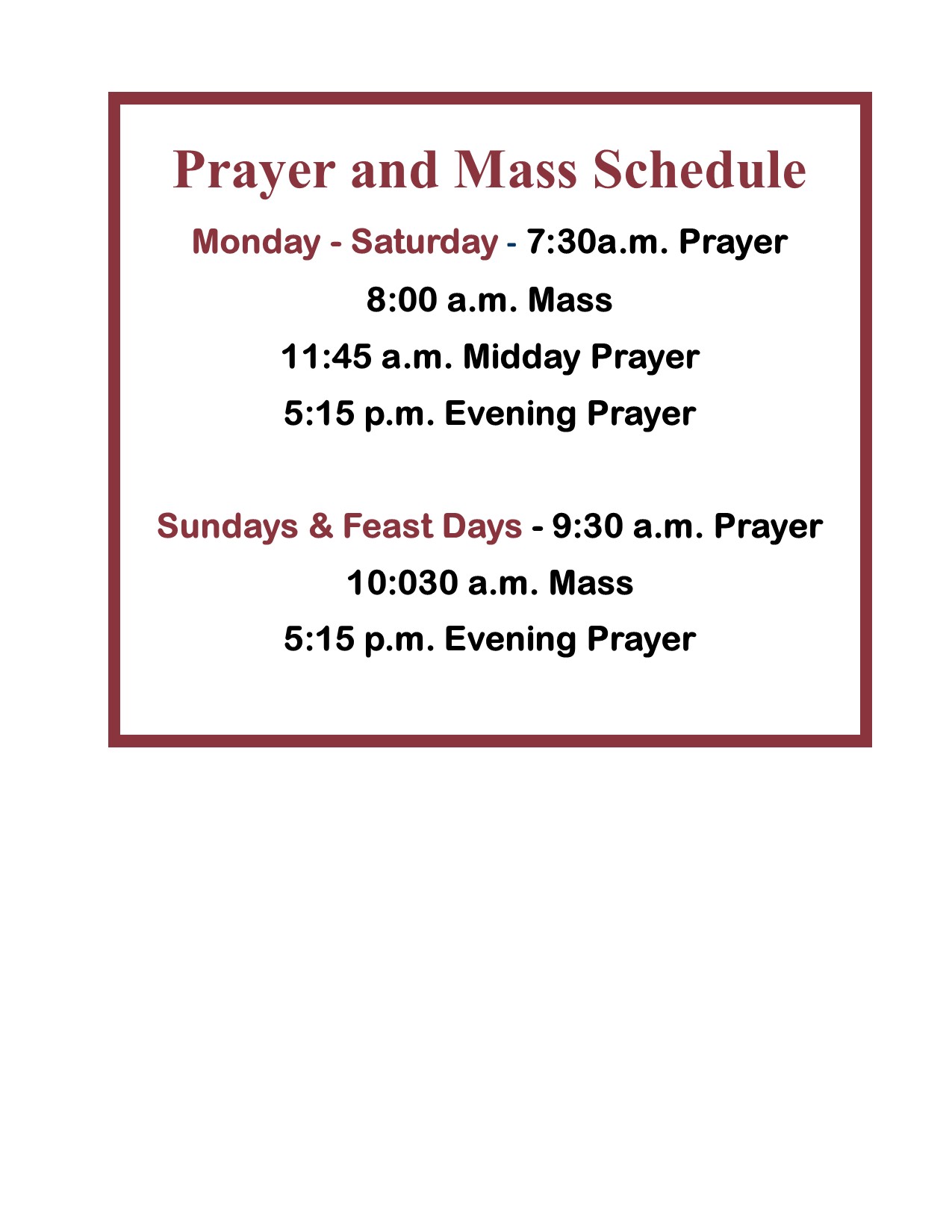
 Mass Schedule

Related Links

Copyright © 2026 · Benedictine Sisters of FL · Touching Lives Through Prayer and Service

Copyright © 2026 · Bendedictine Theme on Genesis Framework · WordPress · Log in