• Skip to primary navigation
  • Skip to main content
  • Skip to footer
Benedictine Sisters of FL

Holy Name Monastery
Founded 1889

Donate Now
  • Home
  • About Us
    • History
    • Being Benedictine
    • Benedictine Monasticism
    • Meet Our Community
    • Holy Name Academy-Alumnae
  • What We Do
    • Mission, Vision and Our Partners
    • Invitation to Retreat
    • Accommodations
    • Volunteer Programs
    • Oblate Program
    • Spiritual Direction
    • Aqua/Hydroponics
    • More of Our Ministries
  • What’s Happening
    • Articles of Interest
    • Events
    • Newsletters
    • Brochures
    • Links
  • Support Us
    • Gifts of Support
    • Wish List
  • Stories Shared
  • Galleries
    • Photos
    • Videos
      • Benedictine Sisters of FL Videos
      • Other Videos
  • Contact Us

Benedict

Listen

July 17, 2023 by Holy Name Monastery Leave a Comment

I offer you two wee stories.  The first, a familiar story, one of many versions that can be found on the Internet.

Once upon a time was a man that prayed quietly, “God, speak to me.”  And a meadowlark sang.  But the man did not hear its song.  So, the man spoke aloud: “God, speak to me!”  And thunder rolled across the sky.  But the man wasn’t listening.

The man looked around and said, “God, let me see you.”  And the stars shone brightly in the night sky.  But the man noticed it not.  He shouted, “God, show me a miracle.”  And a babe was born.  But the man was unaware.

So, the man cried out in despair, “Touch me, God, and let me know that you are here!”  Whereupon God reached down and touched the man.  But the man brushed the butterfly off his shoulder and walked away.

The situation in the second story may have a familiar ring.  It could take place in any setting where two people live together.  But for sake of this story, we’ll say it’s a wife and husband team.  Each had been having difficulty communicating with the other.  And, each had concluded that it was the other who was hard of hearing.

So, one evening the wife sat in a chair on the far side of the room.  Her husband’s back was turned to her so he could not see her.  The room was very quiet; no TV was playing.  She whispered, “Can you hear me?”  There was no response.

Scooting a just a little closer, she asked again, “Can you hear me now?”  Still no reply.  Quietly she edged closer and whispered the same words, but still no answer.

Finally, she moved right in behind his chair and said, “Can you hear me now?”  To her surprise and chagrin, he responded with irritation in his voice, “For the fourth time, yes!”

And Jesus said: Whoever has ears to hear, ought to hear.

So, pondering both of these stories, we might ask:

+   When God speaks, do we make sure we don’t miss some part of the message because it is not packaged the way we expected?

+  Is the problem that God is not speaking?  Or, that we are not listening?

+  Or, is the third step where we fail?  Are we listening and hearing but, then, we fail to act on what we hear?

We are all familiar with Benedict’s opening word to us in his Rule.  It’s the same word that Jesus speaks in this Gospel: Listen.  According to a footnote in my Bible, the phrase “Let they who have ears, let them hear” (or a similar expression) appears approximately 14 times in Scripture.  I find this interesting because the number 14 is considered to be a symbol of salvation and deliverance.  For instance, the 14th day of the 1st Hebrew month is Passover, the celebration of the deliverance from death of the firstborn of the Children of Israel.  The angel passed by all the homes where the doorposts had been painted with blood.

That first word in Benedict’s Rule: LISTEN is the key to what he says in the last two chapters of the Rule.  If only that instruction, LISTEN, were heeded, what an impact it could make on our own happiness and it would foster peace between peoples.  Isn’t attentive listening the master key that opens our hearts for good zeal?  Deep, sensitive listening is the undergirding to mutual obedience.  The attentive listener can anticipate another’s needs; pick up on feelings, be aware that she’s pushed another’s “buttons” and recognize the need to change the course of the interaction.  To truly listen requires attentive spirit.  Celeste Headlee in her TED talk says [Celeste Headlee 10 ways to have a better conversation] “If your mouth is open, you’re not listening.  If you want to pontificate, write a blog.  Listen to people and be prepared to be amazed; everyone is an expert at something!”

Jesus and Benedict each offer us a challenging but attainable ideal.  When the monastic falls short of the ideal, we are expected to humbly ask forgiveness both from God and from our Sisters-in-Christ to whom we freely pledge to “form bonds of mutual love and respect and to call forth the best in one another.” (Community Philosophy statement 2018)


~Reflection by Sister Roberta Bailey, OSB


First Reading:   Isaiah 55: 10-11         Second Reading:  Romans 8:18-23 13: 1-9
Gospel:   Matthew 13:1-23
Continue Reading

Filed Under: Blog, Front Page, Homily Tagged With: Benedict, God, Jesus, listen, two stories

He Knows Us Each By Name

May 1, 2023 by Holy Name Monastery Leave a Comment

Pastor and author Tony Campolo loved to tell the story of a particular census taker who went to the home of a rather poor family in the mountains of West Virginia to collect information.  When he asked the mother how many dependents she had, she began, “Well, there is Rosie, and the twins Billy and Betsy, there’s Susie, Harry, and Jeffrey.  There’s Johnny, and Harvey, and our dog, Willie.”  “No, ma’am, that’s not necessary. I only need the humans.”  “Ah,” she said.  “Well, there is Rosie, and the twins Billy and Betsy, and Susie”…At this the exasperated man said, “No, ma’am, you don’t seem to understand.  I don’t need their names; I just need the numbers.”  To which the confused woman threw up her arms and spoke slowly and plainly: “Sir, YOU don’t understand.  I don’t know their numbers.  I only know them by name.”

The two brief parables we have in this Gospel reveal Jesus as our unique means to salvation.  Jesus is our Good Shepherd.  He is the “sheep gate,” the gateway to eternal life; the selfless, caring “shepherd” who provides protection and life itself.  And, He knows us each by name!  Although there may be several flocks sharing the same sheepfold, when a shepherd walks up to the gate and calls out names, each one of the sheep will instantly recognize the voice of their own shepherd.  When Jesus calls His sheep will instinctively follow.  They will ignore the voice of every other  shepherd other than their own.  We will hear many voices competing for attention, but there is a special note to the voice of Jesus that demands our immediate and full attention.

Hopefully we are like that because daily we make time and space in our lives to stay in touch with our Good Shepherd.  Experience has taught us how to spot what is in harmony with the teachings of our Shepherd and what contradicts it.  We won’t be led astray by the voice of riffraff, half-truths, or so-called sugarcoated false miracle-solutions to problems that can only be addressed with honest assessment of root causes, genuine compassion, and “across the aisle” collaboration.

In his latest book (Coenobium) the Cistercian monk, Michael Casey, writes this: “Each of us is called to hear what the Spirit has to say to the churches, and to us.  We who live in community have the advantage of not only having personal designated times for prayer and lectio – anyone can set a self-made schedule.  We’ve also made a free commitment to each other to gather as a community and to do personal lectio to enrich and enhance our personal and our communal prayer.”  Participation in the Liturgy of the Hours begins (in Casey’s words) “when one sets aside whatever he or she is doing, puts the computer (tablet or TV) to sleep” and stands up ready to move, thus, creating a receptive space for whatever the coming liturgy will offer.  Casey continues, “arriving late or out of breath can be a sign of willful disorganization, passive aggression, or spiritual upheaval.”  [But, remember also what Benedict says in RB 43: “Better late than never!”]  Lectio divina and Liturgy of the Hours are not intended simply as an exercise to give monastics something to do to keep them out of mischief.  The primary purpose is to reconnect the pipeline to the spiritual world to sustain the person to live a life according to God.  Our Shepherd assures us that He knows every single sheep by name!  He’ll never come to the threshold and call out: “Hey you!”  And, we will each recognize His voice.  He has promised: “I know my sheep and my sheep know me!”

A man in Australia was arrested and charged with stealing a sheep.  But he claimed emphatically that it was one of his own that had been missing for many days.  When the case went to court, the judge was puzzled, not knowing how to decide the matter.  At last, he asked that the sheep be brought into the courtroom.  Then he ordered the plaintiff to step outside and call the animal.  The sheep made no response except to raise its head and look frightened.  The judge then instructed the defendant to go to the courtyard and call the sheep.  When the accused man began to make his distinctive call, the sheep bounded toward the door.  It was obvious that he recognized the familiar voice of his master.  “His sheep knows him,” said the judge.  “Case dismissed!”

~Reflection by Sister Roberta Bailey, OSB



First Reading:  Acts 2:14, 36-41         Second Reading:  1 Peter 2:20-25
Gospel:   John 10:1-10
Continue Reading

Filed Under: Blog, Front Page, Homily Tagged With: Benedict, Gospel, He knows my name, He knows us each by name, Jesus, Liturgy of the Hours

Feast Day of St. Scholastica

February 10, 2023 by Holy Name Monastery Leave a Comment

The Feast of Scholastica, the founder of Benedictine life for women, is observed on February 10.

Benedict had a sister, Scholastica, who also dedicated her life to the pursuit of God. She too founded monasteries and became an abbatial figure. The only story we have of Scholastica is told when Benedict was already an abbot of renown. The incident demonstrates clearly that the brother and sister were emotionally close, and, both of them, a spiritual influence on the other till the time of her death.

During one of their annual visits, Scholastica, inspired by the depth of their conversation, asked Benedict to remain overnight in the place where they were meeting in order to continue their talk and reflection on spiritual things. Benedict wouldn’t even think of it. It was getting dark; it was time to get back to the monastery; it was time to get on with the regular routine of the spiritual life.

Unable to persuade him with words, Scholastica put her head down on the table in deep prayer. Suddenly, out of nowhere, a great storm brought flash floods and Benedict realized that he could not possibly return to the monastery that night. And the Dialogues say, “he complained bitterly.”

He said, “God forgive you, sister! What have you done?”

Scholastica answered simply, “I asked you for a favor and you refused. I asked my God and I got it.”

This story is a vein worth mining for a lifetime:

It tells us that law is never greater than love.

It tells us to be intent on pursuing the values of life, not simply its rules.

It tells us that discipline is necessary in the spiritual life but that religious discipline is not enough, that depth is a process and that depth costs.

It tells us that God lurks in strange places. And waits for us. And puts in our paths just what we need in order to become what we are meant to be.

It reminds us that a woman has as much power in the eyes of God as any man and that we must recognize women, too, as spiritual guides.

God fractured Benedict’s rigidity in favor of a greater vision. Has your rigidity been fractured yet?

—from Radical Christian Life, by Joan Chittister (Liturgical Press)


Continue Reading

Filed Under: Prayer Tagged With: Benedict, Feast Day of St. Scholastica, God, lifetime, love, Sister, St. Scholastica

First Sunday of Advent

November 28, 2022 by Holy Name Monastery Leave a Comment

Advent is all about waiting.  But it’s not waiting for our turn because God’s line is busy.  Is it wonderful that we do not have to take turns – we don’t have to wait to be in touch!  Waiting is at the heart of Advent, active waiting.  Even when we don’t know that we are waiting, we’re waiting.  Even when we can’t find words to express what we are waiting for, we’re waiting.

For many people, Advent is an opportunity that is little understood, under-appreciated and commonly ignored.  Advent is about learning to wait.  It is about not having to know exactly what is coming tomorrow.  Advent teaches us the difference between expectation, anticipation and waiting; suspense, eagerness and “twiddling your thumbs to pass the time”.

We are waiting not just during Advent, but at all times for the advent of light; that ultimate light that is redemptive and terrifying at the same time.  It is redemptive because it puts an end to the darkness.  That is also why it is terrifying because the light reveals all that was hidden in the darkness.  For so long, actually for most of our lives, the darkness has been home.  We’ve become comfortable in our incompleteness.  Now to leave home is downright scary!  Change my ways of interacting with God and God’s people?  Whew!  Allow my rough edges to be smoothed?  That sounds irritating (no pun intended).  We are gifted with Advent time to do personal “Isaiah work” of filling in every valley; leveling every mountain so the hills will become a plain, and the rough country will be made smooth.  As the familiar banner asks:  If not now, when?

One of the ancient Advent prayers supplies us with a sentiment that Benedict echoes: “Give us grace that we may cast off the works of darkness and put on the armor of light.”  Many Advent hymns express the same theme.  For example: “When the darkness closes in, courage fails and hopes grow dim, clear the shadows from our sight, set our troubled world aright, fill our eyes with radiant light.  Come Lord Jesus, come!”

The final line of this Sunday’s selection from Matthew’s Gospel reminds us: “You must be prepared for, at an hour you do not expect, the Son of Man will come.”  That does not refer only to the hour of our death.  You may remember the valuable lesson an Abbot shared with his Rabbi friend: “The messiah is among the ranks of your community”.  We are challenged to be Messiah to each other, to treat each other with gentleness, respect, and courtesy for each one is the Messiah among us.

Our conversations can turn to stories and concerns focused outward, on the other rather than the self.  There is a rare sprinkling of “I” and “my” and “mine”.”  Attention is directed away from the self to shine our light on others.  We radiate the blessings of life, not the gloom of sadness, sickness, tiredness, or woe.  We become more fully human, full of compassion and full of consciousness.  Our community Advent practices help hone the attitude of prayerfulness, almsgiving and compassion.

So, we pray: “May the God of Israel increase our longing for Jesus our Savior and give each and all of us the strength to grow in love, that the dawn of Jesus’ coming may find us rejoicing in his presence and welcoming the light of Truth.”


~by Sister Roberta Bailey, OSB


First Reading  Isaiah 2:1-5                        
Second Reading Romans 13:11-14  
Gospel Reading  Matthew 24:37-44
Continue Reading

Filed Under: Blog, Front Page, Homily Tagged With: Advent, advent of light, Advent Season, Benedict, darkness, Fist Sunday of Advent, God, opportunity, Waiting

The Master

July 5, 2022 by Holy Name Monastery Leave a Comment

Rejoice!

One day, when the man of God, Benedict, was doing Lectio and pondering how to incorporate his set of values into his manuscript directed to his followers, St. Luke entered his reverie.  What an inspiration!  Luke and Benedict chatted with each other for a spell.  Look Ben, (said Luke) you’ve consulted the writings of the one you call the Master.  May I suggest you look at my record of the sayings of THE Master.  Check out the 10th chapter of my Gospel.  I think you’ll find a very fine touch stone.

Sure enough!  Very many of our special Benedictine values are put forth by THE Master Jesus.  Look at verses 1-20 as a “for instance”.

+ A SPIRIT of POVERTY: take nothing with you (is how Jesus puts it): no money bags, no suitcase, no canvas bag or pretty tote and no sandals.  Or as you say it in your Rule: “No one may presume to give, receive or retain anything as her own, nothing at all, in short not a single item … no one shall presume ownership of anything. “

+ A SENSE of STABILITY: Jesus advises his followers: into whatever house you enter, stay in the same house; don’t be moving from one house to another.   Benedict, you describe the first kind of monastics called cenobites.  From what you say, I sense this may be your preferred type of members.  “those who belong to a particular monastery, where they serve under the rule of a superior.”

+ Further, Benedict, you expect these cenobites to follow Jesus’ way of life, personally and communally, practicing a SPIRIT of SIMPLICITY and ACCEPTANCE of WHATEVER IS AVAILABLE:  in your words:  eating and drinking whatever is offered to you; whatever is set before you.

You have an obvious understanding of human nature, Benedict. Could we attribute it to your twin sister’s influence?  She took her turn as cook for her group of women whom she loved as ardently as you looked after the rough and tough gang of men that lived with you. It’s evident in your words: taking turns serving one another, using an unvoiced system of gestures when anything is required.  And (yes, PLEASE God) it will save you a heap of trouble if you designate a weekly reader to proclaim the Holy Word throughout the meal.

In studying your Rule, Benedict, it seems to go without saying that there will likely be no harmony in the group unless each and every member strive to AVOID EVIL and CLING to PEACE.   I (that is Luke) remind my readers: Remember what Jesus said (It’s right there in verse 9). “If peace is not present in the house where you find yourself, go out into the streets and shake the dust from your feet and leave that town.”  When you feel evil arising in you, get in touch with the cause – shame the devil – leave the occasion of sin.

In this weekend’s second reading, St. Paul reminds us that we bear in us the marks of Jesus in our body.  Jesus conquered evil so that we, too, might be part of the new creation.  We rejoice with the disciples, reveling as they did in first fervor.  We rejoice because our names are written in heaven.  Sing with Isaiah in the First Reading: we rely on the gentle care God has for us: we shall be carried in God’s arms, comforted as a mother comforts her child and fondles the child in her lap and delights in nursing the babe.  That’s the joy that can erupt in the words of tomorrow’s responsorial psalm: LET ALL THE EARTH CRY OUT TO GOD WITH JOY.

~Sister Roberta Bailey, OSB, Prioress

First Reading:  Isaiah 66:10-4          Second Reading:  Galatians 6:14-18
Gospel:  Luke 10:1-12, 17-20
Continue Reading

Filed Under: Blog, Front Page, Homily Tagged With: Benedict, cry out to God with Joy, Jesus, Luke, rejoice, the Master

Two Lines

October 11, 2021 by Holy Name Monastery Leave a Comment

Two Lines


Two lines jump out at me in this reading:

  1. What Jesus said to the young man – “You are lacking one thing.”
  2. The question the disciples ask Jesus – “Who can be saved?”

Jesus has already told them in this reading, four things they should NOT do: don’t commit adultery, don’t steal, don’t bear false witness, don’t defraud.  I smile when I read how He sums up His list, it’s what my dad would say: “Do what your mother tells you.”  The only time I remember him raising his voice to me was one day when my mother asked, “Do you want to do some ironing now?”  I had said, “No, not now.”  Wrong answer!  Jesus offered the same directive to the wine servers at the wedding where he and his mother were guests – “Do whatever she tells you.”  And when dying on the Cross, what did he say to John (and all of us) – “Behold your mother.”

Jesus told the young man, “You are lacking one thing.”  That’s his challenge to us this week, figure out what’s the one thing we are lacking.  Benedict’s Tools of Good Works (RB 4) is a good examination of conscience or you might use Joan Chittister’s listing of Benedict’s counsels:

            • Don’t pamper yourself
            • Be transparent
            • Be gentle with each other
            • Don’t expect too much or consume too much
            • Live in the moment of God’s grace
            • Be willing to be formed
            • Have a holy attitude toward persons and all of creation, and
            • Remember the tools of the spiritual life are the work of a lifetime. …

Jesus said, “Do what your parents tell you.”  Benedict says the same thing in several places in the Rule, do what the superior tells you.  He gives a little wiggle room when he speaks of impossible tasks but in the end, he says obedience will save us.  I’ve saved my mother’s message to me when I wrote to tell her that we now had the option of using our baptismal names and were shortening our skirts.  In her own way she said, “I’ve tried to teach you the value of obedience.  Do what your superiors are telling you.”   RB 7 places tremendous responsibility on each of us to give good example when our founder says, “The eighth degree in humility is that a monk do nothing but what the common rule of the monastery and the example of the seniors suggest.”

Like many people, the young man in the Gospel knew something was missing in his life. There’s some of the young man in all of us … we know something is lacking. We are surrounded with media that tries to convince us what that the one thing is that will bring us joy and well-being.  Although we know full well that wealth is not a guarantee for happiness in this life, that spirit can slip through the walls, even through convent walls.  We can sense it when we doubt that the common goods available are not sufficient for us.  We can act like children who don’t want the crayons put into a pile in the middle of the table.  We each want our own box of crayons because we don’t like the broken ones or the ones that have the paper peeled off or the ones you can tell have touched another color or are just not the brand we prefer.  Like the young man we want our own possessions and we want them NOW, today.  And, we find it hard to part with any of them graciously even when we hear Benedict say (in RB 54) that the members should not presume to accept gifts sent by parents or friends without previously telling the superior who has the power to give the gift to whomever and the one for whom it was originally given will not be distressed.

Maybe instead of asking “What am I lacking?” we need to ask ourselves, “What do I have too much of?”  Jesus says, “Amen, I say to you, no one who has given up house, brother, sisters or mother and father or children or lands for the sake of the Gospel will not receive 100 times more in the age to come.”  We may tick off all the items on that list one by one but the challenge keeps coming back to haunt us, “One thing is lacking.”

Jesus counsels us: “How hard it is, it’s easier to enter the kingdom of God than for a camel to pass through the needle gate.”  It’s hard, he says but not impossible, “For with God, all things are possible.”

Just don’t get caught in Peter’s trap – quickly retorting, “I’ve given up EVERYTHING, Lord!”  You’ll hear the echo, “One thing is lacking.  Go, give what you have to the poor, and THEN come follow Me.”

~Reflection by Sister Roberta Bailey, OSB


First Reading:   Wisdom 7:7-11            Second Reading:  Hebrews 4:12-13
Gospel:   Mark 10:17-30 (shorter form Mark 10:17-27)
Continue Reading

Filed Under: Blog, Front Page, Homily Tagged With: Benedict, Benedictine Rule, Gospel, Jesus, Joan Chittister, lacking one thing, Lord, two lines, with God all things are possible

  • « Go to Previous Page
  • Page 1
  • Page 2
  • Page 3
  • Page 4
  • Page 5
  • Page 6
  • Page 7
  • Go to Next Page »

Footer

Prayer / Newsletter / Info

 Contact Info

Benedictine Sisters of Florida

PO Box 2450
12138 Wichers Road
St. Leo, FL 33574-2450
(352) 588-8320
(352) 588-8443

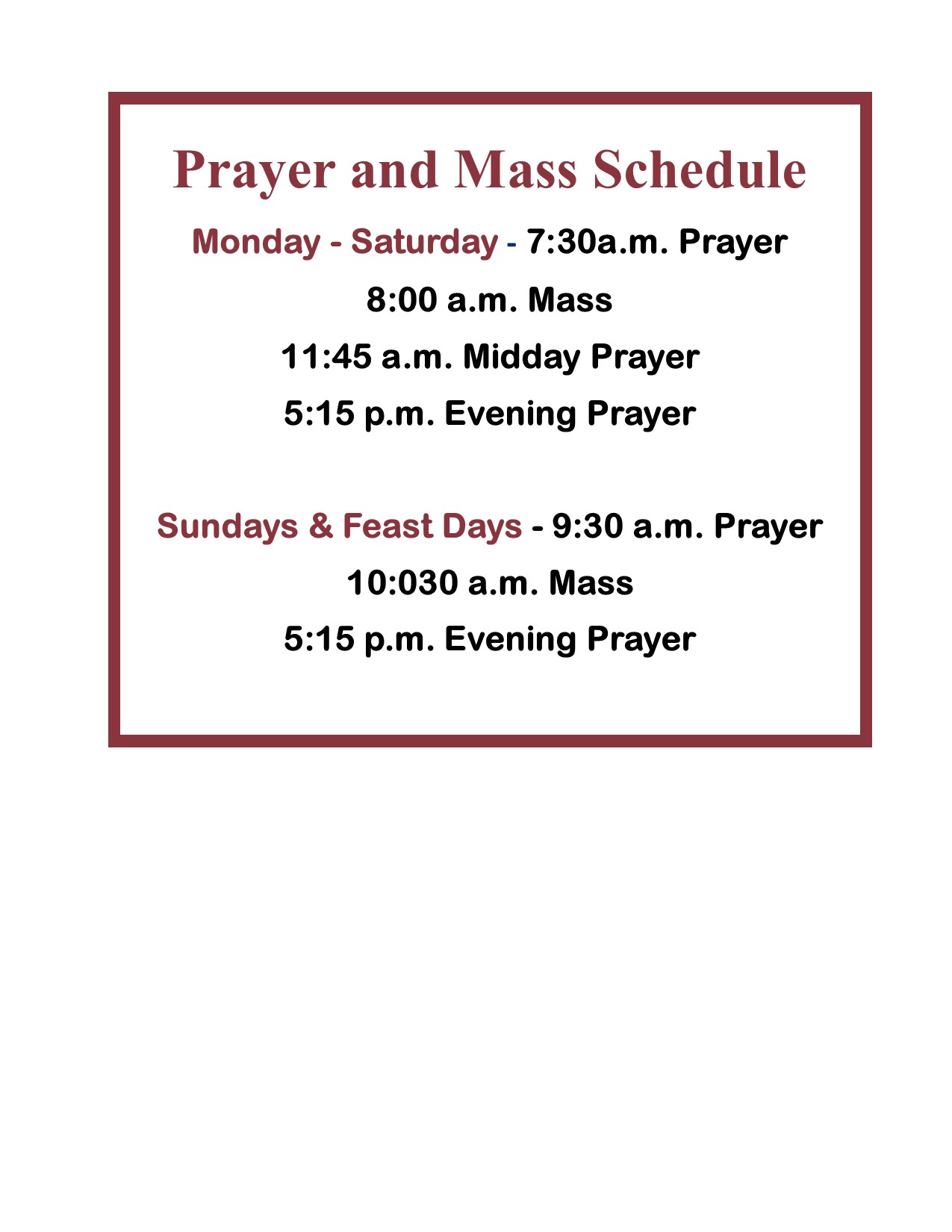
 Mass Schedule

Related Links

Copyright © 2026 · Benedictine Sisters of FL · Touching Lives Through Prayer and Service

Copyright © 2026 · Bendedictine Theme on Genesis Framework · WordPress · Log in