• Skip to primary navigation
  • Skip to main content
  • Skip to footer
Benedictine Sisters of FL

Holy Name Monastery
Founded 1889

Donate Now
  • Home
  • About Us
    • History
    • Being Benedictine
    • Benedictine Monasticism
    • Meet Our Community
    • Holy Name Academy-Alumnae
  • What We Do
    • Mission, Vision and Our Partners
    • Retreats
      • Invitation to Retreat
      • Accommodations
    • Volunteer Programs
    • Oblate Program
    • Spiritual Direction
    • Aqua/Hydroponics
    • More of Our Ministries
  • What’s Happening
    • Articles of Interest
    • Events
    • Newsletters
    • Brochures
    • Links
  • Support Us
    • Gifts of Support
    • Wish List
  • Stories Shared
  • Galleries
    • Photos
    • Videos
      • Benedictine Sisters of FL Videos
      • Other Videos
  • Contact Us

Benedict

Are You a Stumbling Block?

October 2, 2018 by Holy Name Monastery Leave a Comment

Last week we heard Jesus chastise his disciples for their arguing about who was the greatest in the group.  Today they take offense because they perceive a stranger’s action as a direct threat to their exclusive calling by Jesus.  Their attitude is clear: “you have no right; He gave us that job.”   They guard what they feel is their gift and they’re not about to share it.   Envy and jealousy raises its ugly head.

It seems we are witnessing how Jesus deals with this ages-old human condition.  We saw it first in the story of Cain and Abel.  In our own lives we may have been victim or culprit of it with our siblings or classmates.  St. Benedict guards against inroads of it in describing the Qualities of the Abbot, in the Tools of Good Works and the Steps of Humility; the distribution of labor and his directives about property and gifts.  The psalmist even applies the trait to God, and St. Paul says he experiences “a godly jealousy.”  We sing of it in our hymnody: “Our God is a jealous God.” And, here in this Gospel we hear the disciples grousing (Benedict called it “murmuring”) “How come they’re trying to use the gift you gave to us?”

So far they’ve missed the point of Jesus teaching about true discipleship.  That it’s how we relate to each other especially our interactions with the little ones and the least ones.  Jesus has shown by example that true disciples are to “forbid not the little ones to approach” and warned that true followers are not to “cause little ones to stumble.”

He’s been saying that who is included in the Kingdom is not within our authority, it’s not even within our concern!  Who is included in the Kingdom belongs alone to God.  Jesus makes it quite clear: whoever is not against us, is for us.  I think that’s why I struggle, and I know it really rankles with some, when an announcement is made at Mass about who can and cannot receive communion.

In this instance, Jesus in fact, immediately turns the tables on the disciples.  He warns them that they are the ones in danger of doing harm.  It’s as though Jesus says, “The problem is not those folks, guys.  Don’t worry about them — they are not the problem.  Rather, look at yourselves.  How are you getting in the way of the gospel?  Are you a stumbling block?”

We get a clear message that finger-pointing will not get us far with Jesus.   While the disciples are eager to bring judgment on the outsider who is acting in Jesus’ name, Jesus himself wants the disciples to pay attention instead to their own behavior.  Jesus couldn’t be more clear with his vivid example: a dire image of drowning to get his point across.  Better to drown (be thrown into the sea with a millstone around one’s neck) than do harm to “these little ones.”

He warns us that scrupulosity about others behavior or a judgement about their motivation can distract us so that we do harm and cause others to stumble.  Sometimes, even our best intentions to reprove others can have unintended consequences.  Jesus turns the focus back to our own behaviors, the ways we speak and reflect an image of Gospel living.  How authentic is it?

This gospel challenges us as individuals, and as community, to a self-examination.  What are the stumbling-blocks, the mind-fields we scatter before others that often unwittingly impedes the spread of the Good News?


~Reflection by Sister Roberta Bailey, OSB, Prioress
First Reading Numbers 11:25-29           Second Reading James 5:1-6
Gospel Mark 9:38-43,45,47-48
Continue Reading

Filed Under: Front Page, Homily Tagged With: Benedict, disciples, envy, God, jealousy, Jesus, little ones, stumbling block

Stay the Course

July 16, 2018 by Holy Name Monastery Leave a Comment

Luke and Matthew relate the same story heard in this gospel from Mark.  With Luke, you realize, it was hearsay …  he was not there to give an eye-witness account.  It’s interesting to see the minor, but specific differences in the three accounts.  For example, where Mark says, “take no money,” Matthew specifies, “take no silver, gold or copper coins.”  He was covering all the bases, not just the currency in current use.  He notes other details that let you know he was there and must have been a high sensate on the Myers-Briggs scale.  He begins the story with Jesus reminding the disciple-missionaries: “You received without paying, so now give without being paid.”  Where Mark says, “whatever house you enter,” Matthew is more aggressive: “Look for someone to welcome you.”  And, if when you wish them peace and it is not returned, “take back your greeting.”  Both Luke and Matthew, in the list of what not to take on their journey, quote Jesus saying: “take no beggar’s bag.”  They were to live dependent on the hospitality of the community, just as Jesus depended on others to provide for his needs.  Remember what he told one of his potential followers – “Foxes have dens and birds have nests, but the Son of Man has no place to lay his head.”  Jesus expected his disciples to “eat what is served, be satisfied with the bedding provided, follow their schedule, and don’t try to go it alone.”  Remind you of Benedict’s norms?

But, that’s enough about what NOT to take on your life’s journey.  Let’s look at what Jesus says is appropriate for our journey in order to carry on the mission of Jesus.

The first thing Jesus recommends that we travel two by two – life is not a solo venture.  He is reminding us not to try to go it alone.  We need a good support system as we experience life’s ups and downs.  Sharing the good times is as important as it is to share the not so great times.  Benedict recommends the same when, in the first chapter of the Rule, he describes the kinds of monks:  “First, there are the cenobites, those who belong to a (community) a monastery.”  Jesus sent the twelve in pairs not only for safety but for companionship, encouragement and help.

Remember that God is always with us, so we are never really alone.  But Jesus acknowledges that just as he is a member of the trinity, so we humans, social creatures made in God’s likeness draw life from companionship.

Jesus recommends sandals for our feet and a tunic, but not a second one.  Jesus asks us not to carry so much.  Take off that extra tunic – the worries that we carry can bring us down.  Stuffing them in our gunny sacks does nothing to change the situation – just adds wrinkles to our brow and sours our spirit.  Do what Jesus says: “shake the dust off your feet” and don’t look back and wonder what might have been, or might you have done.

Jesus asks us to carry and use a walking stick, so we can keep moving when we encounter ruts and pebbles in the road or to hold us up when we became worn out, tired and weary.  Maybe we even wander off the edge of the road until we hear the sound from the rumble strips.  A good walking stick helps us stay upright and get past mistakes which could hinder our spiritual growth and practice of conversio.  And, beyond that, it’s a fact that in order to do what we say in our Corporate Commitment (that is) “to meet the hungers of the people of God with the compassion of Christ” we must first be compassionate with ourselves.

Today Jesus sends us out again, with authority over unclean spirits … over the rancor, the violence, the rudeness, the degrading language and actions, the insensitivity …  the list can go on and on …  we can conquer the darkness with a refusal to lower our behavior, language and standards.  We can “shake that dust from our feet” and support actions on behalf of justice and peace because we are traveling “two by two,” with the sturdy walking stick of community and prayer, and wearing the sandals of our vows.  Like the disciples, we heed Jesus’ admonition to stay put in the house where they took us in, we can anoint others with inclusivity and peace.  Pray God we stay the course…

~Reflection by Sister Roberta Bailey, OSB, Prioress
First Reading    Amos 7:12-15                      Second Reading  Ephesians 1:3-14 
Gospel Mark 6:7-13
Continue Reading

Filed Under: Blog, Front Page, Homily Tagged With: Benedict, gosel from Mark, Jesus, life's journey, Luke, Matthew, pray

Holy Family

January 3, 2018 by Holy Name Monastery Leave a Comment

This weekend the Church celebrates the Feast of the Holy Family and, on Sunday evening, the Vigil of Feast of the Mother of God.  So, what does that mean for us as monastics?  We came from a family, we still have families and together we live in an intentional family.  Our life together as family is guided by the simple, yet profound, guidelines designed by St. Benedict.  He was a man of great wisdom, compassion and common sense.  We know that after some time of living in various settings with his original Rule, he added advice based on his observation of the interactions between those who chose monastic life.  Imagine having to warn his men not to sleep with knives, to wear clean underwear on a trip, for the learned to help those who could not read.  His prudence shines through when, in so many words, he says: this is what works for us now – if the schedule of psalmody, the horarium and other daily living details don’t fit your need, change it.

It is the spirit of the Rule that has survived because Benedict, even in his youth, had a deep understanding of human psychology.  A study of his early life lets us know he spent much time with his grandparents who lived a few miles from his home.  Walking along the ridge to their summer home he passed the huts and caves of hermits.  Before he was sent to Rome to pursue academics, he spent hours conversing with these solitary men … maybe women, too.  He absorbed the wisdom and practical advice from the older generations.  This is evident in the Rule –  he tempered discipline with compassion and he saw the spiritual quest as a joyful pursuit of God within the structures of ordinary life.  It is this joyous delight in everyday spirituality that kept his Rule for Monastics alive for over 1500 years.  His simple principles of living together under God’s love have been applied beyond monasteries to family life and especially Benedictine Oblates.

If we know only the first word of the Rule “LISTEN” what an impact it could make on our own happiness and create peace between peoples.  It’s interesting that Benedict uses the word LISTEN and not hear.  I don’t know about you, but it is only when I hear a noise in the night that I strain to listen for the next sound.  To truly listen to another requires perception, knowledge of human nature, biting the tongue before speaking and an open-hands approach in conversation.  To listen requires an attentive spirit … not a scramble to respond with advice, a witty or chiding remark or a one-upmanship story.  When we truly listen to another we can identify their feelings, let it resonant within and know that very often all the person wants is a listening heart that signals authentic caring.

Benedict’s Rule offers us a high ideal and when we breach the ideal we need to be humble enough to ask forgiveness both from God and from each other.  His down-to-earth advice survives because of its inner dynamic.  He wasn’t writing for honors students but for, as one author calls us “a motley crew”.  Benedict expected his followers to work hard, study hard and pray hard as they travel along a life-long path of falling down and getting up in a community where each member is valued and loved unconditionally.

From that first word in his Rule – “LISTEN” … to his advice to begin every good work with prayer … to keeping a lamp burning at night … to don’t loiter outside chapel if you are late … it is evident that Benedict saw God at work within the ordinary events of communal living – in the joys and sorrows of our everyday lives.

Tomorrow will be the eve of one year, and the dawning of a new one.  We recall with fond memory those who were with us last year and this year celebrated Christmas in the intimacy of heaven – we pray for those who in the coming year will, as the saying goes, enter into glory.

At the close of 2017, I invite you to take count of all the ways you have seen God’s glory –  when did THE WORD appear in your life, pierce your heart?  As the days go by, keep LISTENING to God speaking to your own heart, and to your comrades’ hungers and longings.  It may sound trite to say this, but we do have two ears and one tongue …  Maybe God intended us to listen twice as often as we use our words.  If we do this we are less likely toot our own horns or miss the other’s silent cue for a little attention.  When we cultivate silence and sincere listening we won’t step on others feelings, speak harshly or stir the pot by murmuring or spreading slander or spewing unpleasantness into the air we breathe.  Our current world is filled to overflowing with sound, with words, factual and fake. In many instances we do well to ask ourselves if a word is really called for or might silence serve the better part?    Remember the instruction you learned at your mother’s knee: “If you can’t say something nice, don’t say anything at all.”    In the end, our discernment is “what will most likely spread peace?”

As we step out into 2018, a whole new universe of grace lies open before us.  May the gift of faith enable us to see the invisible, believe the incredible and graciously receive the impossible … for with God, all things are possible.

~Reflection by Sister Roberta Bailey, OSB, Prioress
First Reading  Genesis 15:1-6; 21:1-3       Second Reading  Colossians 3:12-21)
Gospel  Luke 2:22-40


Continue Reading

Filed Under: Blog, Front Page, Homily Tagged With: Benedict, Feast of the Holy Family, God, Jesus, listen, Rule, Vigil of the Feast

What Is Your Journey Question?

November 20, 2017 by Holy Name Monastery Leave a Comment

In last week’s Gospel, Jesus emphasized that there is no way to predict His final coming to each individual.  He reminded us that we must remain vigilant and ready to receive our God and Savior at any time.  Now, in the weekend’s Gospel Jesus talks about the same concept this time using economic metaphors.  As he describes it, before the master leaves on a journey, he entrusts to his servants with various “allowances.”  He discerns the amount of the gift according to each servant’s ability.  But, you know the story.  Upon his return, he finds that the first and second servants have doubled their money, and, thus, both recipients are rewarded.  The third servant, however, afraid that he would lose his allowance, only conserved what he received.  He risked nothing; he did not even deposit the money in a bank to earn interest.  This servant is chastised, his money taken back and instead given to the servant who brought the greatest return.

We can’t be reminded too often that our gifts, or talents, are given to us for the service of others.  If we fail to use these gifts, God’s judgment on us will be severe.  On the other hand, if we make use of these gifts in service to others we will be rewarded and entrusted with even more responsibilities.  Sadly, some people deliberately fail at a job or chore they don’t like so they won’t get asked to do it again.

What about us and our talents?  Do we let dislike of a job, or the threat of failure, or someone else’s critical eye hold us back from exercising a God-given talent?  Or a more mundane question: We get an earthly allowance each month – do we bury it or use it for the good of others so it keeps moving forward, good upon good…

Benedict teaches us several lessons about “journeys.”  He speaks most directly to, and about, those who go on the journey … He doesn’t pass out money to those left to tend the vineyard, but he certainly leaves them a legacy.

Beginning with the opening words of his Rule one can sense a journey motif.  Benedict bids us: “Listen! The labor of obedience will bring you back (“coming back” requires a journey, doesn’t it?)  You’ll come to him from whom you have drifted…”  “Let us get up then (he says) at long last, (journey from the land of our dreams) for the Scriptures rouse us when they say: “It is high time for us to arise from sleep… run (speed along on your journey) while you have the light… go out (leave the familiar territory you call home) to seek workers in the multitude of the people ….”  Listen to Benedict: “moving on in your journey of faith, (and life in the monastery) “You will say, Here I am Lord.”  And, then he tells us how to prepare for our journey: “Clothed with faith and the performance of good works, let us set out on this way, with the Gospel for our guide…. Be just in all your dealings, speak the truth from the heart and do not practice deceit or listen to slander.”

Beyond the Prologue of the Rule, Benedict offers guidance for our conduct on the voyage of life.  After giving us an overview of what we will need in our toolkit, Benedict hastens us on our journey when he tells us: RUN on the path of God’s commandments, never swerving.”

By the time Benedict wrote chapter 67 one can tell he’s had some experience with monks who journeyed afar from the home monastery.  We know that Benedict, in his youth, has escaped “big city life.”  So he wanted to protect his monks from the evils and temptations of the prevailing society.  Notice he does not say … those who go on a journey.  Rather, those who are sent on a journey.  Those at home are to remember the absent ones in prayer … which means the gathered community may have “counted” noses” but not for the sake of taking roll but to pray for their confreres safety and protection from temptation.

I have to smile when I read what Benedict cautions next.  He certainly knew human nature: “no one should presume to relate what was seen or heard outside the monastery.”  Sounds to me like he’s witnessed some cases where “curiosity killed the cat.”  Benedict didn’t want stories of the world to creep in and cause dissension or dissatisfaction with the home experience to rankle or upset his community.  Times haven’t changed much over the passing years, we still need to on guard that we balance chartable interest in each other versus the drive to know every intimate detail about what was seen or heard by the other.

Benedict is solicitous of his monks on a journey that they not appear embarrassingly shabby.  He makes provision that they be LOANED underwear (that’s right with their long tunics their everyday wear might not have included underwear).

In line with the admonition to pray always, Benedict reminds his monks on a journey to keep an eye on the sun … listen for the bells from neighboring abbeys announcing prayer times.  … so, (Benedict reminds them) though at a distance too far to join the community they might “observe the prescribed hours” as best they can.  Thus, probably began the custom of the Angelus … the dialogue between Angel Gabriel and Mother Mary, a modified version of Sext (or Noon Prayer) that could be memorized so as not to neglect their “measure of service.”

The Rule closes with this journey-question: “Are you hastening toward your heavenly home?  Then keep this little rule … as you set out for loftier summits of the teaching and virtues we’ve mentioned.” Then Benedict echoes his message first heard in the Prologue with this promise: “under God’s protection” (together) we “will reach” our heavenly home … this is the self-same promise Jesus extends to us in the Gospel: Because “You were faithful in small matters … come, share your Master’s joy.”

~Reflection by Sister Roberta Bailey, OSB, Prioress
Thirty-Third Sunday in Ordinary Time   Sunday, November 19, 2017
First Reading  Selected verses Proverbs31   Second Reading  1 Thessalonians 5:1-6
Gospel Reading  Matthew 25:14-30
Continue Reading

Filed Under: Blog, Homily Tagged With: Benedict, God, Jesus, journey, Monks, pray, The Rule

God at our Calling

June 26, 2017 by Holy Name Monastery Leave a Comment

First Reading  Jeremiah 20:10-13    Second Reading  Romans 5:12-15
Gospel Matthew 10:26-33

In this Gospel passage, we rejoin Jesus during the first year of His public ministry.  Jesus directs the disciples to keep their focus on God.  He reminds them that those who can harm the body do not have ultimate power; God does.  Persecution and suffering may not be avoided or prevented but Jesus’ reassures us that God is always and forever at our call to care for us and protect us.

Jesus uses a simple, mind-opening analogy to illustrate his point.  His listeners knew that the cheapest life in the market was a small bird of the field, perhaps a sparrow.  Yet, God’s providential care knows even when this smallest of birds dies.  He is using here a rabbinic argument technique which compares a light matter to a heavy one. His idea here is to overcome fear and encourage the disciples, and us, to trust God.

From the moment we are born, we know fear – we squall at the change in our environment.  The startle reflex is tested in a baby’s first pediatrician’s visit.  Separation anxiety develops by 6 months and may raise its ugly head later in life feelings of abandonment.  Over time we may grow to fear even those who are closest to us.

Jesus recognizes that fear may cause failure on our part.  Jesus’ disciples, and we, courageously leave the security of home and family to follow a dream. As faithful followers of our “summons” to His call, may inevitably put us on a collision course with the allurements of the world. Jesus is starkly realistic about the threats we will face, at the same time he builds the case for why we should not let fear win out or hinder our ministry.

We see in the Gospels, how on the one hand, the disciples are granted remarkable powers to heal the sick, exorcise demons, cleanse lepers, even to raise the dead. But at the same time, Jesus denies the disciples money, extra clothes, or a staff to aid in climbing the ups and downs of life or to protect themselves from wolves.  He even denies them a pair of sandals to shield their feet from rocks and stones, or if they travel the fields in Florida, sandspurs.  They are to undertake their mission in complete vulnerability and dependence on God with an awareness that they go as “sheep in the midst of wolves.”

We know their stories: they faced arrests and beatings, hatred and persecution and opposition even from family members.

With great care and compassion Jesus names aloud the suffering to be endured and its causes.  This is the first step in freeing them from the tenacious grip of fear.  Benedict knew this, didn’t he?  Remember what he says about receiving newcomers (chapter 58).  Do not grant newcomers an easy entry … test the spirits, let them keep persistently knocking at the door four or five days … they should be clearly told the things of everyday living in community; all the hardships and difficulties that will lead to God … she, the newcomer, must be aware of what the Rule requires so that she may know what she is entering.”

It is clear in Jesus’ conversation with his disciples that the most important element in the sharing of the warnings and the loving reassurance lies in the integral relationship between the disciples and Jesus.  And, between Benedict and the novice .. and it should be evident between our community and the Seeker.

Just as Jesus modeled the way for his disciple, we make a commitment to the newcomer, and to each other, to model Benedictine living.   An example: A young boy, out for a walk with his father on a cold winter day, was scared to cross a frozen pond … afraid of falling through the ice. But then his Father offered to lead the way.  Now the boy didn’t hesitate to go across the ice. The ice hadn’t become less frightening, but he was able to follow his father, trusting his father wouldn’t lead him to harm. He followed his father without fear across the ice.   Jesus leads us; we lead each other; and we each help lead our Seekers.

As we sing in the Suscipe: “Upon me, O Lord, as you have promised, and I shall live, and do not disappoint me in my hope.”

~Reflection by Sister Roberta Bailey, OSB, Prioress


Continue Reading

Filed Under: Blog, Homily Tagged With: Benedict, Calling, disciples, Faith, God, Jesus, Seekers, Sister

We are Commissioned…

May 31, 2017 by Holy Name Monastery Leave a Comment

First Reading  Acts of the Apostles 1:1-11  Second Reading  Ephesians 1:17-23
Gospel Matthew 28:16-20

When someone commands you to do something, it is all on you.  You will either succeed or fail, but no matter how it turns out, it’s on you.  Even the consideration of whether you have the capacity to do it doesn’t necessarily factor into the equation.  You have been commanded, and now you must obey, sink or swim.

But being commissioned to do something, that’s different.  When you are commissioned you are not merely commanded but also equipped, empowered, and given the necessary authority to accomplish your duty.  Police officers and leaders in the military, for instance, are given many commands over the course of their careers, but before those commands come, they are commissioned into their offices – that is, invested with the necessary authority and support to accomplish their mission.

In life, maybe we’re most aware of this happening in religious life in community – we are often asked to do something that seems impossible.  It may be presented as if it is intended to be a request but it comes across as a command, certainly not a commission since it does not include a package of skills to complete the task.   Benedict in his Rule describes how the monk should respond when asked to perform what for them may seem an impossible task.  He apparently decided to include these directives after some time of living with the various characters who joined the ranks of community.  Chapter 68 is in the portion of the Rule thought to be a collection of after-thoughts.   It’s like “oh, and by the way, after what I said about obedience in Chapter 5, it could happen that: “A Sister may be assigned a burdensome task or something she cannot do. If so, she should, with complete gentleness and obedience, accept the order given her.   Should she see, however, that the weight of the burden is altogether too much for her strength, then she should choose the appropriate moment and explain patiently to the superior the reasons why she cannot perform the task.  This she ought to do without pride, obstinacy or refusal.  If after the explanation the superior is still determined to hold to her original order, then the junior must recognize that this is best for her. Trusting in God’s help, she must in love obey.”

We sing about the scene in today’s Gospel in the one of our hymns: “Lord, you gave the great commission … with the spirit’s gifts empowering us, for the work of ministry.”  The disciples, and we, are being entrusted and enabled to continue Jesus’ own work – to share the news of God’s love in word and deed.  And, not only that, but to invite those who receive it to be co-workers in bringing the kingdom to fruition. .

To be effective it takes willing teachers as well as willing pupils.  More than that, it takes disciples as well as students – pupils may be just there, students are open to learning – absorbing and putting into practice.  Everything we do in life initially begins with being directly or indirectly taught.  Children raised in environments where there is inadequate attention, care and interaction, suffer failure to thrive and many die at a young age.  We come into this world ready and willing to learn.  God gave us the power of reasoning that we might learn.  God sent us into this world to learn his will for our lives so that we might influence others to recognize God’s glory.  Remember the 2nd question in the Baltimore catechism?  “Why did God make you?  God made me to know, love and serve Him in this world and to be happy with him forever in the next.”

We are commissioned both as individuals and as a community.  Thus, we are accountable as individuals and as community.  Benedict places much of the burden of responsibility on the prioress.  However notice the role of mutual obedience in our lives … each one to each other.

If we are com-missioned then we have a mission.  But, it’s easy to lose sight of our mission.  We can get excited about proposed projects, ministerial opportunities, and personal pursuits.   New projects may have appeal but if they do not reflect our mission as Benedictine Sisters of FL, they are not for us.  Or, we need to discern and then endorse a new statement of mission.

This little story – maybe true – illustrates the principle of accountability – “inspect what you expect.”

The story goes: a young soldier was deployed for a minimum of a year.  When he left, his fiancé gave him a harmonica. Strange gift – but she said, “I want you to learn to play this: it will help to keep your mind off the war and the girls.”

He wrote to her often and told her that he was faithfully practicing his harmonica every evening.

After a year she met him at the airport, he grabbed her to kiss her and she pushed back and said, “Wait before you kiss me, I want to hear you play the harmonica.”

She was no fool.  She knew that the man’s love would be reflected in what he did. If he’d done what he’d promised – she’d know it by his actions.

So, too, does God know by our actions how sincere, how faithful we are to our God-given personal mission, and our community commitments.

~Reflection by Sister Roberta Bailey, OSB, Prioress


Continue Reading

Filed Under: Blog, Homily Tagged With: Benedict, commissioned, Community, God, Jesus, Rule, sisters, solemnity of the ascension

  • « Go to Previous Page
  • Page 1
  • Interim pages omitted …
  • Page 4
  • Page 5
  • Page 6
  • Page 7
  • Go to Next Page »

Footer

Prayer / Newsletter / Info

 Contact Info

Benedictine Sisters of Florida

PO Box 2450
12138 Wichers Road
St. Leo, FL 33574-2450
(352) 588-8320
(352) 588-8443

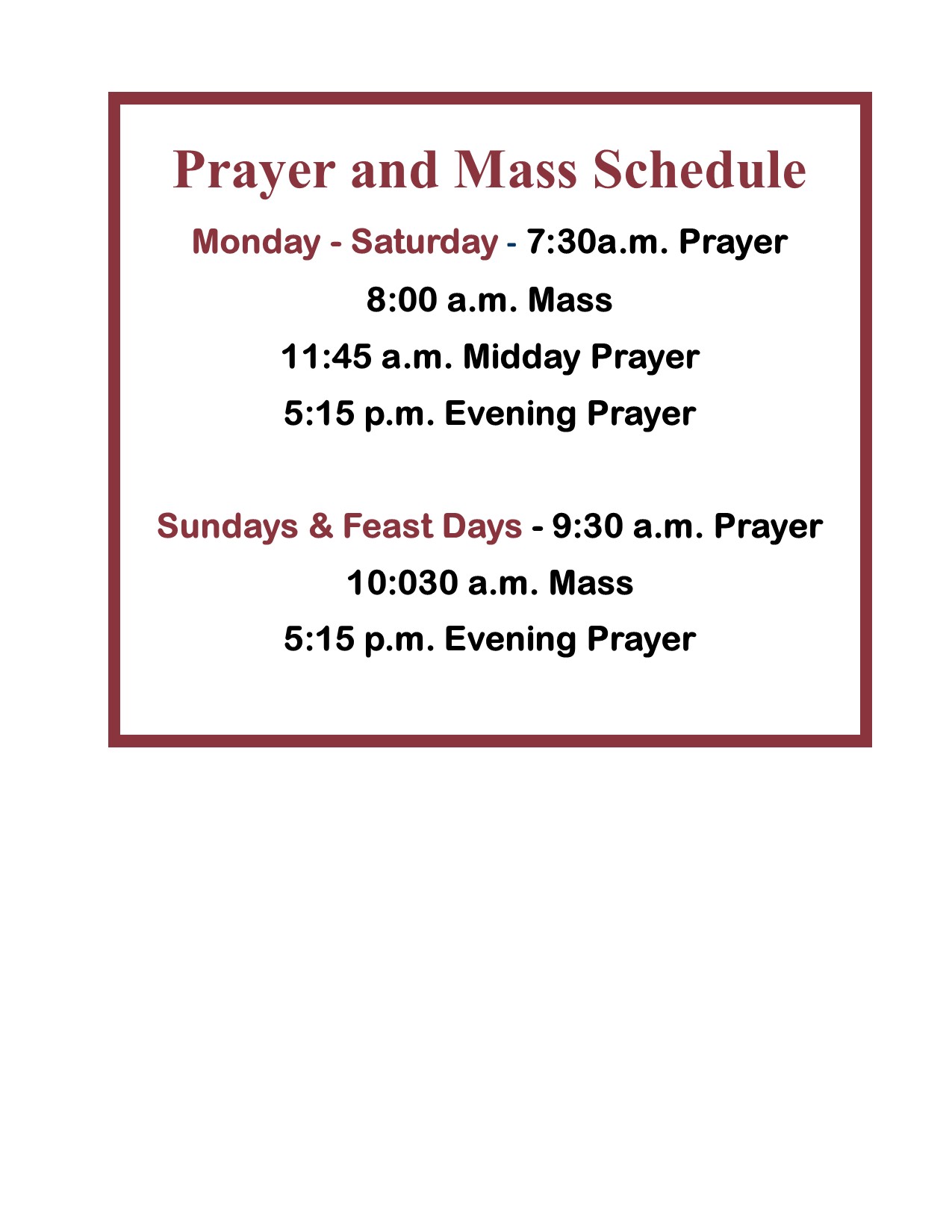
 Mass Schedule

Related Links

Copyright © 2026 · Benedictine Sisters of FL · Touching Lives Through Prayer and Service

Copyright © 2026 · Bendedictine Theme on Genesis Framework · WordPress · Log in