• Skip to primary navigation
  • Skip to main content
  • Skip to footer
Benedictine Sisters of FL

Holy Name Monastery
Founded 1889

Donate Now
  • Home
  • About Us
    • History
    • Being Benedictine
    • Benedictine Monasticism
    • Meet Our Community
    • Holy Name Academy-Alumnae
  • What We Do
    • Mission, Vision and Our Partners
    • Retreats
      • Invitation to Retreat
      • Accommodations
    • Volunteer Programs
    • Oblate Program
    • Spiritual Direction
    • Aqua/Hydroponics
    • More of Our Ministries
  • What’s Happening
    • Articles of Interest
    • Events
    • Newsletters
    • Brochures
    • Links
  • Support Us
    • Gifts of Support
    • Wish List
  • Stories Shared
  • Galleries
    • Photos
    • Videos
      • Benedictine Sisters of FL Videos
      • Other Videos
  • Contact Us

Front Page

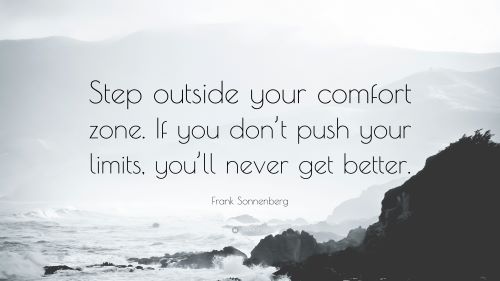
Don’t Stay In Your Comfort Zone

September 1, 2025 by Holy Name Monastery Leave a Comment

The advice in this Gospel is for us whether we are the guest or the hostess.  But it is not simply suggestions about etiquette. Something more is going on here. What Jesus advocates is not only for social occasions, but it’s meant to shape the entirety of our lives.

Jesus is advising us against staying in in our comfort zone. Rather than limiting our guest list to people who are clones of ourselves, people with whom we’re comfortable, who don’t threaten or even challenge us, Jesus encourages us to instead invite those who are different, people who make us uncomfortable, but whose difference from us may bring with it a blessing.

Repeatedly Jesus takes the low seat and invites unlikely types to be his guests.  Those who come to his banquet make it through the narrow door because they claim no merit of their own.  Jesus leaves the comfort zone of his place by his Father to come to earth as a tiny, helpless child. He leaves the comfort zone of earthly life, and allows himself to be placed in a narrow grave.

How can we move out of our comfort zone?

+   Develop a deeper spirituality,

+   Engage in service, – sit next to a stranger or a person you recognize but    want to know better.  It could even be a person you’ve lived with for years but who still feels like a stranger.

+   Help others on their spiritual journey – it’s amazing how you will change,
+   Keep saying “no” to the ways of the world and “yes” to the ways of God.

Jesus asks us that we do him the honor of keeping ourselves, our religion, our community from becoming trapped in some comfort zone.  For us in this Benedictine community, with the move to a new monastery in 2014 and all that involved choosing what to keep and what to divest ourselves of in gifts others was a daily reality.  We place great trust in God to guide us as we refuse to linger very long in any comfort zone, moving always past safety to encounter unexpected challenges to follow the crucified and risen One. This is what it means to live the life of faith – a life on the ladder of humility as described in the Rule of Benedict …  living in reverence and deference to others.

As Perpetual Adoration Benedictine Sister Mary Jane Romero puts it:  As a sister grows in humility, she is transformed interiorly, and it overflows into her exterior behavior.  She possesses a dignity that expresses her reverent attitude toward God, her sisters, and all of life.

Joan Chittister says it this way: Humility and contemplation are the invisible twins of the spiritual life.  (I like the symbol of twins … perhaps inspired by the image of Benedict and his twin sister.)  She continues: One without the other is impossible.  In the first place, there is no such thing as a contemplative life without the humility that takes us beyond the myth of our own grandeur to the cosmic grandeur of God.   Humility enables me to stand before the world in awe, to receive its gifts and to learn from its lessons.  But to be humble is not to be diminished.  Indeed, humility and humiliations are not the same thing.  Humility is the ability to recognize my right place in the universe, both dust and glory; God’s glory, indeed, but dust, nevertheless.  Being realistic about the self, the mind is free to become full of God.

Or consider this from Eugene Boylan in his book THIS TREMENDOUS LOVER: In the practice of humility, it is a very sound principle never to display a humility that is not sincere.  (Recall what Benedict directs: strive not to be called holy; rather, be holy.)  Frequent meditation on the Passion will bring us more quickly to humility than anything else, and while humility is dependent upon true self-knowledge, such knowledge is better obtained by studying what God is, than what we ourselves are.

A final thought …Humility is like underwear, essential, but indecent if it shows.

~Reflection by Sister Roberta Bailey, OSB


First Reading:   Sirach 3:17-18,20,28-29         Second Reading:  Hebrews 12:18-19,22-24
Gospel:   Luke 14:1,7-14
Continue Reading

Filed Under: Blog, Front Page, Homily Tagged With: comfort zone, don't stay in your comfort zone, Gospel, humility, Jesus, Joan Chittister

I Will Open the Door to You

August 25, 2025 by Holy Name Monastery Leave a Comment

Sometime back we heard the story of the man who eventually gave in and answered the door because his neighbor was persistent in knocking and calling out for bread.  Today the story is different – once the master locks the door there is no turning back.  We hear: “I don’t know you – depart from me!”  This parable is a message to those who have read Scripture, donned their “church clothes” every Sunday, sung the hymns, dropped money in the collection baskets in church and listened for years to sermons about Jesus without developing a personal relationship with Him.  Somehow the routines seem to fill their need for reassurance.  Because they have been “faithful” in coming to church, they feel that they have secured a place in heaven. What a distortion of the message that Jesus delivered. He’s tried, in various ways to tell the His followers to be wary of having too much religion and too little relationship with Jesus.

The world today is just as confused as the Jews of Jesus’ time about how one gets to heaven. There is a growing tendency to believe if a person is generally good and does good things for others during their lifetime, they will earn a place in Heaven.

Jesus does not imply that there is a specific route by which one must enter heaven.  He does mention a gate that is narrow and difficult to enter.   Because the gate is narrow, we must pass through one at a time.  But we will not get into heaven on someone else’s coat tails.    Each one will answer to God for herself.  Jesus tells the us how to be saved:  enter through the narrow gate, be strong when you knock, make certain that the Lord knows you, have meals together (the Eucharist), make friends with the prophets, associate with people from every corner of the world and don’t be concerned with where you are in line or at the table.  Jesus expands the picture for us when He says that people will come from the east and the west, the north and the south.

And He bids us come and recline at the table.  That’s not a typical image of us in church, is it?   How could it be when our parents, or the good Sisters, poked us on the shoulder to remind us to kneel up straight, get your butt off the seat…  Jesus, says come, recline at my table.  One of our challenges is to reserve a “table” where we can go to dine and converse with our most intimate friend, our God.    In spirit we “recline” stretch out, (remember, you have to fit through that narrow gate), We can tilt back, sprawl, loll in the Divine Presence. We recline with surety that our Host will recognize our voice because we’ve made a daily practice of “communing” with Him.   We need not have any concern for rank or place because He has promised: I will know your voice, I know where you are from, and I will open the door for you.

~Reflection by Sister Roberta Bailey, OSB


First Reading:   Isaiah 66:18-21         Second Reading:  Hebrews 12:57-, 11-13
Gospel:   Luke 13:22-30
Continue Reading

Filed Under: Blog, Front Page, Homily Tagged With: Door, Enter through the narrow door, Gate, Heaven, Jesus, narrow door, narrow gate, open

Wishful Waiting

August 18, 2025 by Holy Name Monastery Leave a Comment

This Gospel offers us the reassurance that Jesus understands how difficult it is to wait.  Jesus is in a state of wishful waiting.  He waits for the Spirit. He’d waited for his cousin John who would baptize him.  He’d waited for the day the Father would give the go ahead to His working miracles.  He’d waited for the “three days” and His resurrection.

And we, our Sisters have lived through waiting too.   Tomorrow we will mark the 11th anniversary of the day we took up residence in our one-story home (here) on Wichers Road.  Our sisters have waited, responded, moved from Pennsylvania, to Dallas House to San Antonio Plaza to a hotel turned Convent.  Then came the move of that building to the shores of Lake Jovita where we resided until our home for deemed a fire risk.  The Academy girls and the Sisters had “sleep overs” in the parish school auditorium and the homes of local families.   We waited and waited for the Bishop’s okay to build a new home, Benedictine Hall.  Then came the call of the Spirit to down-size, build and relocate to the residence we now call home.  August 18, 2014, our friends from St. Mark’s parish gathered us and our “things” and we set foot in this our “new home.”

From the beginning of His coming on earth Jesus taught us lessons in waiting.  Mary and Elizabeth waited nine months for the birth of their babies.  The Holy Family waited three years in Egypt until it was safe to return to Nazareth. Jesus waited 30 years to begin his public ministry.  He waited three days to respond to Lazarus’ sisters’ news that his friend had died.  He waited 3 years for His Father to prompt him NOW is the right time for His last supper with friends, time for betrayal and crucifixion, time to rest in a borrowed tomb until he would be raised from the dead.  He waited for the right time to reveal himself to Mary Magdalene in the garden and later to appear to the disciples and his mother Mary huddled in the upper room drawing strength and comfort from each other. in the upper room.  He’d waited 40 days for the time to ascend and take His place at the right hand of his father.

And we? Oftentimes what do we do with our waiting time?  We look for the shortest check-out lane knowing full well that the shortest line can be the longest wait if the clerk calls for a price check.  We grit our teeth (we hope unseen) if the buffet line slows as someone goes back to read the menu; or we repeatedly hit we “print” command on the keyboard in hopes we can hurry it up.   What are the words in the hymn by St. louis Jesuits, TRUST IN THE LORD?  “Wait for the Lord, you shall not tire; wait for the Lord, you shall not weaken.  For the Lord’s own strength will uphold you, you shall renew your life and live.”

The message in the Gospel also reminds us that choosing to do good requires on-going decision-making. We all know full well that life isn’t conflict-free no matter how holy, easy-going or patient a person we may be.  We well know, living in a monastery isn’t surefire protection. We’re all still human, with human limitations.  But we are also followers of Jesus who said, “What makes you think I have come to establish peace?  I tell you I have come to sow division.”  He is alerting us to be prepared for difficult decisions.

Jesus is letting us know beforehand that He is right in the middle of the fray. Recall He said: “I have come to set the earth afire.”  He is telling us that when we make the decision to follow him, we may face opposition from some quarters, perhaps even from our peers, our family or friends.  He cheers us on when conflicts arise, and He can foresee the peace of reconciliation coming down the pike.

Consider your choices: add fuel to the fire or bite your tongue, cool your jets and exercise patience.   Figuratively, if we engage the faucet and turn on the nozzle, we can control the hose that can put out the fire between us.  The landscape may look charred. The ashes will remain.  But out of the ashes will come new life: green plants and colorful flowers – some never seen before.  And yes – peace will come!

~Reflection by Sister Roberta Bailey, OSB


First Reading:  Jeremiah 38:4-6,8-10         Second Reading:  Hebrews 12:1-4
Gospel:   Luke 12:49-53
Continue Reading

Filed Under: Blog, Front Page, Homily Tagged With: Gospel, Jesus, sisters, Spirit, Waiting, Wishful Waiting

Stay Awake and Be Ready

August 11, 2025 by Holy Name Monastery Leave a Comment


The church offers the choice of dividing the Gospel passage into two sections.  It is the part that may be omitted that tells us: “Much will be required of persons entrusted with much.”  Luke couched that grim reminder with Jesus’ comforting words to his disciples: “Do not be afraid.”  We have been entrusted with so much, individually and collectively, that the words about the reciprocal demand could frighten us into inaction.  Our fears could make us feel that our feeble attempts to bring about peace and compassion and reconciliation are futile.  But we have the assurance of Jesus: Do not be afraid for your Father is PLEASED to give you the kingdom.  God is more than willing – God is PLEASED to give us the kingdom.   Thus, we must take delight in receiving all that the kingdom has to offer.  Do not be afraid but do be prepared.  “Stay awake!  Be prepared to see and greet the kingdom from afar.  Do not be afraid.”

I close with an excerpt of Nelson Mandela’s 1994 Inaugural Speech.  (Mandela’s words could be a homily in themselves)


Our deepest fear is not that we are inadequate.

Our deepest fear is that we are powerful beyond measure.


It is our light, not our darkness, that most frightens us.

We ask ourselves, who am I to be brilliant,

successful, talented and fabulous?

Actually, who are you not to be?

You are a child of God.


Your playing small doesn’t serve the world.

There’s nothing enlightened about shrinking

so that other people won’t feel insecure around you.


We were born to make manifest the glory that is within us,

It’s not just in some of us;

It’s in everyone.


As we let our own light shine,

We unconsciously give other people permission to do the same.

As we are liberated from our own fear,

Our presence automatically liberates others.


Nelson Mandela’s 1994 Inaugural Speech


~Reflection by Sister Roberta Bailey, OSB


Have a good week. Schools are starting this week – watch out for school buses and children on the roads … safety for all.


First Reading:   Wisdom 18:6-9         Second Reading:  Hebrews 11:1-2, 8-19
Gospel:   Luke 12:32-48
Continue Reading

Filed Under: Blog, Front Page, Homily Tagged With: do not be afraid, Father, Gospel, Jesus, Kingdom, Nelson Mandela, pleased, speech, stay awake and be ready

Teaching is not what Jesus did; it’s who he was.

August 4, 2025 by Holy Name Monastery Leave a Comment

This Gospel sets us pondering about what is important in our lives.  The man in the incident Luke describes holds a world view that is fairly exclusive, doesn’t he?  It’s just him and HIS things. Now he’s shocked to learn that he is about to lose his life. What good are his possessions going to be to him now?   Jesus makes his opinion quite plain.  “You fool! This very night your life will be taken away.  To whom will everything belong then?!”

Surprise! Jesus refuses to take the case.  Instead, Jesus gives the squabbling brothers a parable to “mull over”.   And, what’s the point of Jesus’ story?  It’s not even remotely related to the problem that the two brothers are having.  It features a wealthy landowner that doesn’t describe either of the siblings.  Then Jesus lumps the boys in the same pot as the landowner.  He calls than all “fools”.

Better take fair warning! There is danger in thinking this parable applies only to “those rich people.” To put the matter more pointedly, thinking of those rich fools enables me NOT to think of myself as a “rich fool.”

In this little parable Jesus probes our hearts.  “Where is your treasure?” he asks.   Don’t make the mistake that this farmer made.  Examine my story. The farmer wasn’t wicked.  He didn’t gain his wealth illegally or by taking advantage of others. He’s not particularly greedy. So, what’s wrong with building larger barns, renting a storage unit to store away some of today’s bounty for a leaner tomorrow?  This kind of thinking can lead us to ask: Is there anything wrong with hanging on to clothing we’ve outgrown but might wear again someday? Or stockpiling furniture that serves only as a “catch all” because it’s just too nice to give away?  What’s wrong with requesting more allowance than we actually need saying it’s so we can do charity?  But somehow, we never find a charity other than our own pockets.  What’s the matter with setting up a little enterprise to supplement our allowance?  Why can’t we accept or ask for money gifts or gift cards from personal friends giving them the impression that our community does not take care of our needs?

Notice what the farmer’s consistent focus is.   “What should I do? I have no place to store my crops.” “I will do this: I will pull down my barns and build larger ones, and there I will store all my grain and my goods.”   It’s his relentless use of “I” and “my” that betray a preoccupation with self. He’s fallen prey to worshiping the most popular of gods: the Unholy Trinity of “me, myself, and I.”   He gives no thought to using the abundance to help others.  This most likely is what leads to a second mistake: foolishness in thinking that making provision for the future; will secure one’s future.

Jesus used the opportunity as a “teachable moment.”  Life, he impresses upon us, does not consist in things; not even in having MANY things.  The farmer in the parable is a rich man, who fears he is not rich enough.  Jesus didn’t judge him; He did teach. He was teaching all of us how to live.  After all: “Teaching is not what Jesus did; it’s who he was.”

~Reflection by Sister Roberta Bailey, OSB


First Reading:   Ecclesiastes 1:2; 2:21-23         Second Reading:  Colossians 3:1-5,9-11Gospel:   Luke12:13-21


Continue Reading

Filed Under: Blog, Front Page, Homily Tagged With: barn, crops, farmer, Gospel, Jesus, Luke, rich Fool, teachable moment

Prayer

July 28, 2025 by Holy Name Monastery Leave a Comment

It’s interesting to me that the disciples ask Jesus to teach them to pray “just as John taught his disciples.”   They wanted the words, didn’t they, for certainly Jesus had given them an example of prayer.  He had modeled time alone, told them to “go to your room and pray”.  They’d witnessed Him with raised eyes, hands and voice in intercessory prayer before miraculous healings.  But they, like us, want “the words to say.”  We forget sometimes that when we descend into our hearts, in silent waiting, it is there we meet the Spirit who is already praying within us.

We look for “words” … in a prayer book, on a holy card, in the life of a saint ….  We look for a guide, a director, a mentor.  I don’t mean to belittle the worthwhile role these spiritual aids play in our lives. They are often critical to our spiritual growth and our salvation.  We just need to keep in mind the tremendous role that Scripture plays in our lives. It is there that we read “the “Spirit of Truth will show you all things.”  St. Paul reminds us: “If you do these things, you can be saved. Be joyful at all times, pray without ceasing and give thanks for all things.”

In the shortened version of what we call the “Lord’s Prayer” we pray “give us each day”. We do not ask for a train load of blessings to last us all year – just today’s help, Lord, that’s all I am asking…   not even tomorrow’s help … just get me through today – I trust you will be there tomorrow – even when I feel like Mother Teresa once prayed: “I KNOW GOD WON’T GIVE ME ANYTHING I CAN’T HANDLE …  I JUST WISH HE DIDN’T TRUST ME SO MUCH.”

In the Gospel, did you notice the difference in the phrase regarding forgiveness in the Our Father?  We pray” forgive us our sins for we ourselves forgive everyone in debt to us.”   That statement is strong, firm, and expresses willingness to forgive everyone.   In the traditional version we pray “forgive us our debts, (or trespasses) as we forgive our debtors.”   It sounds as if God’s forgiveness to me is measured by my willingness to forgive others.  I like the second version even while I feel it is a greater challenge.  I commit, I promise:  I will forgive EVERYONE who is in debt to me.  No willy nilly “this one but not that one, at least not today.”  I forgive EVERYONE.  Think of that in a few minutes when we pray the Our Father… and at Mass tomorrow…  you are agreeing to forgive EVERYONE…  a huge and freeing commitment.

And we do that day after day after day.  Repetition isn’t just for those things we may have told our mothers were stupid… things like making the bed that we are only going to rumple up in a few hours or doing the dishes after every meal instead of collecting them until the cupboard is bare or cleaning the toilet that someone is going to mess up the minute I leave the bathroom.  Repetition perfects skill in music, in handwriting, in the acquisition of good, or bad habits.   And, in the repetition of daily chores (even the ones only I see), there is a meaningful expression of hospitality to myself and my companions.  In the repetition of the Psalms, of favorite prayers, and liturgical actions there is a meaningful acknowledgment of our creaturely participation in God’s creative act, day after day after day.

In today’s Gospel the church offers us three examples of prayer: first the GREAT prayer, then the “ask-seek-knock” words that have inspired hymns, and finally the story of the persistent neighbor which teaches us that knocking at the door gets God’s attention and rewards our persistence.  So, we pray, day after day for peace, for relief from suffering and war and for a forgiving heart.

Through our communal and personal prayer, we feed not only our own spirits, but we are, so to speak, attached by a spiritual cord to everyone with whom we have ever come into contact.  That is literally, collectively the cord that nourishes thousands of people.  We feed ourselves spiritually, and we also nourish all those contacts through our prayers.  Our prayer is universal.  We forgive everyone who is in debt to us.   Luke’s recollection of Jesus’ words in his Gospel is not everyone to whom we owe a debt … rather those who are in debt to us.  Who would that be?  And why would someone be in debt to me?

I’ll close with a story – a simplistic reminder that sometimes we just have to be in the right DIS-position to pray:

A priest, a minister and a guru were discussing the best positions for prayer.  Unbeknownst to them a TECO linesman was listening in as he worked with wires on the nearby pole.  The priest was saying:  “Kneeling is definitely the best way to pray.”  “No,” the minister said, “I get the best results standing with my hands outstretched to Heaven.” “You’re both wrong,” the guru said. “The most effective prayer position is lying down on the floor.” The repairman could contain himself no longer. “Hey, fellas,” he interrupted, “The best praying I ever did was when I was hanging upside down from a power pole.”

~Reflection by Sister Roberta Bailey, OSB
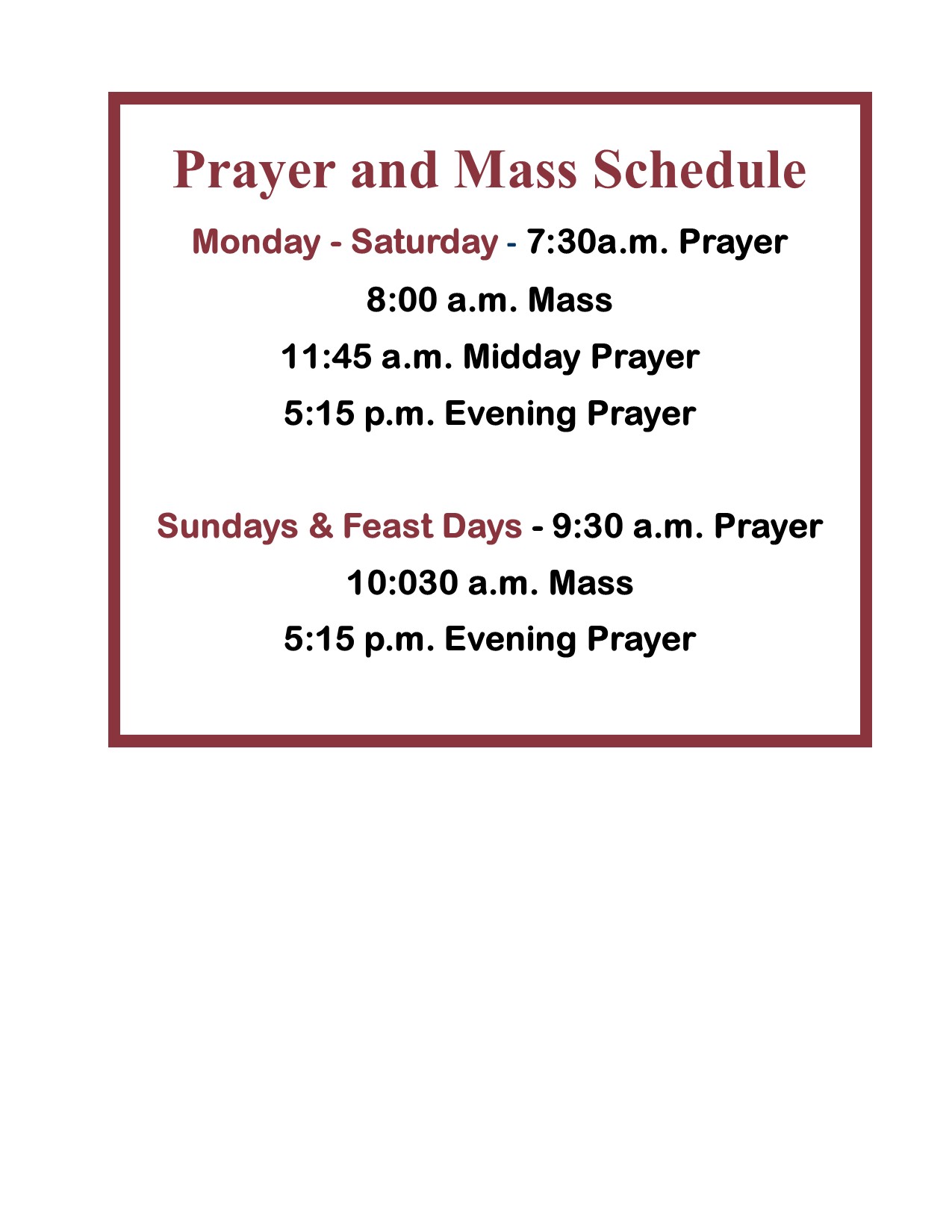


First Reading: Genesis 18:20-32                       Second Reading: Colossians 2:12-14
Gospel: Luke 11:1-13
Continue Reading

Filed Under: Blog, Front Page, Homily Tagged With: everyone, God, Gospel, Jesus, Lord's prayer, Mother Teresa, Prayer, St. Paul

  • « Go to Previous Page
  • Page 1
  • Interim pages omitted …
  • Page 7
  • Page 8
  • Page 9
  • Page 10
  • Page 11
  • Interim pages omitted …
  • Page 80
  • Go to Next Page »

Footer

Prayer / Newsletter / Info

 Contact Info

Benedictine Sisters of Florida

PO Box 2450
12138 Wichers Road
St. Leo, FL 33574-2450
(352) 588-8320
(352) 588-8443

 Mass Schedule

Related Links

Copyright © 2026 · Benedictine Sisters of FL · Touching Lives Through Prayer and Service

Copyright © 2026 · Bendedictine Theme on Genesis Framework · WordPress · Log in