• Skip to primary navigation
  • Skip to main content
  • Skip to footer
Benedictine Sisters of FL

Holy Name Monastery
Founded 1889

Donate Now
  • Home
  • About Us
    • History
    • Being Benedictine
    • Benedictine Monasticism
    • Meet Our Community
    • Holy Name Academy-Alumnae
  • What We Do
    • Mission, Vision and Our Partners
    • Retreats
      • Invitation to Retreat
      • Accommodations
    • Volunteer Programs
    • Oblate Program
    • Spiritual Direction
    • Aqua/Hydroponics
    • More of Our Ministries
  • What’s Happening
    • Articles of Interest
    • Events
    • Newsletters
    • Brochures
    • Links
  • Support Us
    • Gifts of Support
    • Wish List
  • Stories Shared
  • Galleries
    • Photos
    • Videos
      • Benedictine Sisters of FL Videos
      • Other Videos
  • Contact Us

Front Page

One Came Back

October 13, 2025 by Holy Name Monastery Leave a Comment

“And, one of them, realizing he had been healed, returned, glorifying God

in a loud voice; and he fell at the feet of Jesus and thanked him.”

What prompted this one man in ten to turn back to Jesus as soon as he realized the scourge of leprosy had vanished?  Had the group discerned what they ought to do: continue as instructed to go to the priests, run rejoicing to show themselves to their families, or go back to thank Jesus?   Was it only this one that figured out it was Jesus that had healed them?  We’ll never know.  What we do know, according to the story, is that Jesus noticed that only one returned in gratitude and that the grateful one “glorified God in a loud voice!”  And, as Jesus pointed out, this one was a foreigner.

I am reminded of the words of Hosea, the words that inspired the Weston Priory hymn: “Come back to me with all your heart, don’t let fear keep us apart.”   It took courage for the now-cleansed man to retrace his steps back to Jesus, to publicly – loudly – glorify God and proclaim his thanks to Jesus.  Deep in his heart he must have sensed the spirit of the words of Hosea: “Come back to me.”

This week we will be praying for the success of humanitarian efforts.  We ask God’s blessing on the people and the projects intended to relieve the scourge of the contemporary leprosies of poverty, hunger, homelessness, unemployment – the scourge of trying to rebuild lives and homes and villages after fires, floods, tornadoes, earthquakes, tsunamis.

With Jesus, with God, as our touchstone, all of us, not just those involved in notable humanitarian projects, will often “turn back” to glorify God – to give thanks for every success in our efforts.  Few successes will be as spectacular as being cleansed of leprosy – but we keep turning back to give thanks for God’s working among us and throughout the world.  Media sources are to be commended for reporting “pay it forward deeds” – “random acts of kindness” – highlighting the charity of sports and movie stars and corporations.   Maybe, like Jesus, we wonder “where are the other nine?”   And, the cynic in us may question the givers’ motivations.  But, like Jesus, we have to move beyond that reaction and give credit where credit is due.  With Jesus we say “stand up, keep up the good work – your faith has saved you.”

For ourselves, we say: Lord, I do believe.  Please, Sir, help my unbelief!  Cleanse us of our cynicism and pessimism.  Open our eyes to your miraculous actions among us.  Move us to great gratitude for the goodness in nature and in the generous nature of our sisters and all who work to relieve the suffering of “leprosy” in our times.  Remind us to take the time to heed your call to “turn back” with all our hearts.  Take our fears away and instill in us your courage to face and shape our future. Give success to the work of our hands – Lord, give success to our work.  Thank you!

~Reflection by Sister Roberta Bailey, OSB


First Reading:   2 Kings 5:14-17         Second Reading:  2 Timothy 2:8-13
Gospel:   Luke 17:11-19
Continue Reading

Filed Under: Blog, Front Page, Homily Tagged With: believe, God, Jesus, Jesus heals ten men with leprosy, leprosy, One Came Back

Faith the size of a Mustard Seed

October 7, 2025 by Holy Name Monastery Leave a Comment

In this Gospel Jesus offers his disciples two related teachings his disciples when they cry out for an increase in faith. The first is the familiar reminder that faith, even just a little, will enable the followers of Jesus to do wondrous things. But this uplifting and inspiring teaching is quickly followed by the second teaching, a caution about knowing one’s place in God’s plans. Even when God works wonders through us, with our mustard seed-sized faith, we must not seek praise. Our participation in God’s plans is God’s grace to us—nothing more, nothing less. Pope Francis reminds us: “Our life is not all written down; it means going, walking, doing, searching, seeing … We must enter into the adventure of the quest for meeting God; we must let God search and encounter us.” When we are graced enough to cooperate with God, the work we do is nothing more than our obligation to God as faithful stewards. And yet, our faith enables us to believe that what we have offered in service to God, as his servants, can be made to produce a hundredfold.

Last week we celebrated St. Francis Day so I want to tell you a St. Francis story – maybe only part truth. This is not the story of how his father disowned him, and he stripped naked in court and walked away. It’s not the story of how he received the stigmata. Nor is it the story of the Wolf of Gubbio. This is a story you may not have heard; this is the story of St. Francis and the Sultan Al-Kamil. It takes place during the Fifth Crusade – when Francis’ pilgrimage took him across the battle lines in ancient Egypt. He was immediately captured and brought before Sultan. According to some versions of the story, he challenged the Muslim clerics to a trial by fire: both he and they would preach from the heart of a bonfire and whoever was not burned alive would be the one preaching the true God. The Muslim clerics declined the challenge. Francis then offered to go into the fire by himself, with the proviso that if he was not burned up the Sultan and all his followers would have to convert to Christianity. The Sultan did not take Francis up on this offer.

Whether or not that’s true, it is known that Francis preached to the Sultan and his household, who were so impressed by Francis that the Sultan offered him numerous gifts — which Francis refused — and gave him safe conduct back to the Crusader camp. When in time the Crusader Kingdoms fell, the Muslim rulers granted permission for Christians to tend the Christian holy sites in the Holy Land, but that permission was not given to the Church as a whole, it was given specifically to the Franciscans. In fact this arrangement persists to this day — there is a Catholic office called “Custodian of the Holy Land,” and it is always held by a Franciscan; and in places where custody is shared by different Christian denominations — like the Church of the Holy Sepulcher — it is Franciscans who represent the Roman Catholic church. All because of that one visit between St. Francis and the Sultan.

It may seem a stretch from the Gospel story to tell a tale about Francis of Assisi. So, why you may ask, tell it? A convergence of awareness led me to share this with you.

Jesus says, “If you had faith the size of a mustard seed, you could say to this mulberry tree, ‘Be uprooted and planted in the sea,’ and it would obey you.” St. Francis acted out of this spirit of courage and faith when he crossed the battle lines in Egypt. He had no idea what would happen to him; he had every reason to expect to be taken prisoner at the very least. Afterward, he doubtless thought his mission had failed. But — he had made a connection — a moment of authentic human connection, two people meeting each other face to face — that has had consequences to this very day – over 800 years!

The world is full of people who are divided from us, even opposed to us — because of religion, nationality, ethnicity, or political views, or any of a thousand things. God calls us to reach out to these people in a spirit of courage and love, unashamed of our testimony about our Lord and our mission, our way of life. We may not convince them — we may not bring them around to our point of view. We may not even make peace. The world being what it is, the odds are against it.

But if we can just make that one moment of connection, that one moment where we see each other face to face as human beings, as St. Francis did with the Sultan— that’s the mustard seed. That’s the opportunity for God to act and do something unexpected and miraculous.

The big problems in the world — hunger, war, religious conflict, and so on — often seem too big for us. Maybe they are. But we have to have faith that if we can move the pebble — then God will move the mountain.

Pope Francis once said in an interview said, “Instead of being just a church that welcomes and receives by keeping the doors open, let us try also to be a church that finds new roads, that are able to step outside itself…” Sounding like his patron Francis, he says: “We need to proclaim the Gospel on every street corner, preaching the good news of the kingdom and healing… focusing on the essentials… We have to find a new balance; otherwise we will lose the freshness and fragrance of the Gospel.”

A Sufi story tells of disciples who were despairing because their leader was about to die. They asked him, “If you leave us, Master, how will we know what to do?” The master replied, “I am nothing but a finger pointing at the moon. Perhaps when I am gone you will see the moon.”

~Reflection by Sister Roberta Bailey, OSB


First Reading: Habakkuk 1:2-3; 2:2-4 Second Reading: 2 Timothy 1:6-8,13-14
Gospel: Luke 17: 5-10
Continue Reading

Filed Under: Blog, Front Page, Homily Tagged With: Faith, Gospel, Jesus, Mustard seed, St. Francis, Sultan

30th Sunday in Ordinary Time

September 29, 2025 by Holy Name Monastery Leave a Comment

It is important to note at the outset of this particular reading just who it is that Jesus is speaking to. Luke says: “Jesus told this parable to some who trusted in themselves that they were righteous and treated others with contempt.”

But, then there’s this. Elsewhere in Scripture, Proverbs tells us: “To do righteousness is more acceptable to the Lord than sacrifice” and “Blessings are on the head of the righteous.” Turning to Isaiah we read: “The work of righteousness will be peace, and the effect of righteousness, quietness and assurance forever.”

So, why does Jesus seem to be criticizing the righteous one? One little word makes the difference. Jesus is talking to the self-righteous; those who trusted in themselves. They’re a little too sure they are right and anyone who thinks differently must be wrong. They (or is it we?) are so full of self that there’s little room for God’s grace to filter in.

It’s interesting when you think about it that everything the Pharisee says is true. He has set himself apart from others by his faithful adherence to the law. He is, by the standards of his day, a righteous man. It isn’t that the Pharisee is speaking falsely, but rather that the Pharisee misses the true nature of his blessing. As Luke says, he has trust in himself. His prayer of gratitude may be addressed to God, but it is really about himself. He credits his righteousness entirely to his own actions.

The tax collector, on the other hand, does not even raise his eyes to heaven. He knows that he possesses no means by which to claim righteousness. He declares he has done nothing of merit. So, he stands back, hardly daring to approach the Temple, and throws himself on the mercy of the Lord. He seems not so much humble as desperate. He stakes his hope entirely on the mercy of God.

At the end of the day, the Pharisee will leave the Temple and return to his home the same virtuous, honorable man he was when he came to the temple. That hasn’t changed. The Pharisee’s mistake, as Scott Peck says, is that he thinks that whenever he wants, he can pull “God out of his hip pocket.” On the other hand, the tax collector will go back to his home exalted in God’s eyes because he humbled himself.

If you’re spiritually alive, and give credit where credit is due, you’re going to love this take on the parable. If you’re spiritually dead, you won’t even want to hear it. If you’re spiritually curious, there is still hope!

A churchgoer wrote a letter to the editor of his hometown newspaper and complained that it made no sense to him at all to go to church every Sunday. He wrote: “I’ve gone for 30 years now, and in that time I have heard something like 3,000 sermons, but for the life of me, I can’t remember a single one of them. So, it’s been a waste of my time and on the part of homilists a waste of their time by giving sermons at all”.

This started a real controversy in the “Letters to the Editor” column. Much to the delight of the editor, it went on for weeks until someone wrote a real clincher: “I’ve been married for 30 years now. In that time my wife has cooked some 32,000 meals. But, for the life of me, I cannot recall the entire menu for a single one of those meals. But I do know this: they all nourished me and gave me the strength I needed to do my work. If my wife had not given me those meals, I would be physically dead today.”

We might say: I’ve been in community x number of years. In that time, I’ve been nourished and supported by my Sisters thousands of times in hundreds of different ways. But sadly, I can only recall a few, if any, instances in full detail. This much I DO know: without their support my spirit would have withered long ago. Likewise, if I had not gone to Mass and been faithful to my time of private and communal prayer, I would be spiritually dead today!

~Reflection by Sister Roberta Bailey, OSB


Yesterday was Oblate Sunday at the Monastery. We welcomed 15 Oblates for Mass, Dinner and an instructive gathering for an exchange of ideas based on assigned “Homework.”

A Benedictine oblate is a lay Christian who has made a spiritual commitment to live according to the Rule of Saint Benedict and be affiliated with a Benedictine monastery, though they do not take religious vows or live in the monastery. Oblates integrate Benedictine values of prayer, work, hospitality, and community into their daily lives in the world, forming an “extended family” to the monastery. For more information contact S. Mary David at mary.david.hydro@saintleo.edu or call 352-588-7176.


First Reading: Sirach 35:12-14, 16-18 Second Reading: 2 Timothy 4:6-8, 16-18
Gospel: Luke 18:9-14
Continue Reading

Filed Under: Blog, Front Page, Homily Tagged With: Jesus, Luke, Oblate, Oblate Sunday, Pharisee, Proverbs

25th Sunday in Ordinary Time

September 22, 2025 by Holy Name Monastery Leave a Comment

This parable is challenging to explain but, it came from the mouth of God’s Son so it must be important for us to grapple with. What might Christ be saying to us? Here is what I heard – colored by the recent readings from chapter 2 of Benedict’s Rule on the Qualities of the Prioress. The Gospel tells us if we can’t be trusted in little matters we certainly cannot be trusted with great ones. If you are not a leader in a Benedictine community it may be easy to breeze through chapter 2 with an attitude of ho, hum – that’s for them – glad it’s not me.

To say that Benedict lays down high standards for the superior may be an understatement. He places the chapter on leadership qualities early in the Rule, only after he defines the type of monk he is writing for. So we know he is writing about the qualities of the leaders of the “strongest kind of monastics” – the ones who have chosen to live under a Rule and a monastic leader.

I am thinking Benedict left it unsaid in Chapter 2, but he sprinkled exhortations regarding leadership for all the members elsewhere in the Rule. Benedict echoes Jesus when he presses home the “the person who is dishonest in very small matters will also be dishonest in great ones.” It does not require a great leap to apply this maxim to all of us – the youngest in community to the eldest. It seems to me Benedict is waving a banner before our eyes of what we each need to be so that a call to leadership does not include an abrupt change of lifestyle. Benedict knew from his own experience that the leader’s role in community is time-limited. He himself had experienced the call to leadership and call to a hermit’s life. He must have foreseen, perhaps with a nudge from his twin sister Scholastica, that the monastic must be prepared in all aspects of her life to move in and out of leadership roles. If the individual member does not engage in a lifelong endeavor to develop the attitudes, skills and qualities that Benedict laid out for the superior, (guess what?) an election or appointment to a leadership position will not ipso facto endow a saintly disposition. If a person has not learned to be accountable for her own actions (or at least tried to be), and to be solicitous for the welfare of those in her charge (as a teacher, principal, supervisor, kitchen manager, sacristan, chief floor scrubber, head nurse….), an imposition of hands or a community blessing, or even the bishop’s blessing will not infuse saintliness: responsibility, accountability, compassion or mercy.

You may remember the lesson of the geese who fly in V formation? As each bird flaps its wings, it creates an uplift for the bird following it. Combined, the whole flock adds 71% greater flying range than if the individual geese flew alone. Whenever a goose falls out of formation, it suddenly feels the drag and resistance of trying to fly alone and quickly gets back into formation. When the lead goose gets tired, it rotates back into the formation and another goose flies at the point position. The geese in the formation honk from behind to encourage those in front to keep up their speed.

Note that Benedict does not let the “honkers” off the hook. In speaking of the qualities of the abbot, Benedict intersperses words to the “monks in the pews.” If the prioress is to call the community or individuals to account, the member must be docile to listen. If the prioress is to be a shepherd, the sheep have to be willing to be corralled and led. It’s impossible to lead if no one follows.

Benedict reveals his keen insight into human nature when he talks about the cast of characters who can be gathered into one community. He reminds the leader, and by inclusion, all the members, to “accommodate and adapt themselves to the character and intelligence of their Sisters.” In conclusion, Benedict smiles upon the leader consoling her that she does not lack resources. He quotes Psalm 33: “Those who fear God lack nothing.” In helping others, the leader achieves the amendment of her own faults. Benedict does not mention, but I bet he knew, the gratifying support the prioress or the abbot, (or leaders of any sort) daily receives in unpretentious, quiet affirmations.

Like the story of the geese, in monastic life when the leader gets sick or is shot down (with arrows or words), individual members drop out of formation to help, protect and reaffirm the leader until she is either able to again take the lead or fly in formation with the other members. Jesus reminds us in this parable that, in the end, it doesn’t matter when you came into community, even when you came into the church. The reward for putting your hand to the plow will be the same: a day’s work in the kingdom for God’s daily wage … the last, the same as the first. It’s been that way for all eternity. You’ll find when you get there (I’m guessing) that your view from the mansion God is saving for you is just as magnificent as that of Moses or Adam and Eve or your favorite saints – everyone’s mansion has a “throne-side view” of heavenly glory.


P.S.  World Mission Sunday

World Mission Sunday is scheduled for the weekend of October 18-19, 2025, and this year’s theme is “Missionaries of Hope Among All Peoples.” During this Jubilee Year of Hope, the theme is most appropriate, and all are called to engage in missionary work in one form or another, thereby bringing hope to those in despair. This annual worldwide collection helps to provide aid to 1,124 dioceses that cannot sustain themselves because they are too poor, young, or actively persecuted.


~Reflection by Sister Roberta Bailey, OSB


First Reading:   Amos 8:4-7         Second Reading:  1 Timothy 2:1-8
Gospel:   Luke 16:1-13
Continue Reading

Filed Under: Blog, Front Page, Homily Tagged With: Benedict, Christ, geese, God, Gospel, st. benedict, The Rule, World Mission Sunday

Feast of the Holy Cross

September 15, 2025 by Holy Name Monastery Leave a Comment

Yesterday, September 14th, we celebrated the Feast of the Exaltation of the Holy Cross.  It was on this date, in the year 335, that the relics of the true Cross, that had been lost, had been miraculously rediscovered nine years earlier.  Today (in 335) the relics were brought outside the Church of the Holy Sepulcher in Jerusalem for public veneration. Because September 14 falls on a Sunday an average only once every seven years, only daily communicants regularly celebrate this feast liturgically. But we’re all called to celebrate this feast, allowing its meaning to penetrate our daily life. In order to do so, however, we first need to grasp better the shocking aspect of what we’re doing.

Most of us have marked ourselves with a cross with a holy water cross upon entering the Church.  We start almost every prayer with the sign of the Cross. All types of people wear a symbol of a cross, in some shape, around their necks, our bedrooms and dining rooms often have one on display.   The priest holds his arms in the shape of it during the Eucharistic prayer. It the focal point in Catholic Church.  For believers the Cross is not so much a symbol of pain as it is a reminder of the Love that Jesus has for us. Christ on the cross manifests the power of Christ’s love and they wisdom of God’s plan of salvation.  In 2014 Pope Francis reminded us the Cross of seems to declare the failure of Jesus, but in reality, but in reality, it marks His victory.

In commemoration of this day, I invite you the slowly and meditatively (perhaps spread over a few days)  the Divine Mercy Stations of the Cross.

The conversations are from the Diary of Saint Faustina Kowalska.

The silent soul is capable of attaining the closest union with God.”


~Reflection by Sister Roberta Bailey, OSB


In the Name of the Father,

and of the Son and of the Holy Spirit


First Reading:   Numbers 21:4b-9         Second Reading:  Philippians 2:6-11
Gospel:   John 3:13-17
Continue Reading

Filed Under: Blog, Front Page, Homily Tagged With: Exaltation of the Holy Cross, Feast of the Holy Cross, holy cross, holy water, Saint Faustina Kowalska, Stations of the Cross

23rd Sunday in Ordinary Time

September 8, 2025 by Holy Name Monastery Leave a Comment

Wow!  Talk about conflicts!  Jesus keeps teaching us to love our neighbors as ourselves, love our enemies and do good to those who hate us.  Now he says, “Hate your mother and father, your brother and sister, your wife and children, even your own life.”   Obviously, you cannot have it both ways: Love everybody and hate your family.

Jesus is inviting us to think it over seriously.  Listen to Him: “To be my disciple is unusually difficult. You must make a TOTAL commitment.  Nobody, absolutely nothing, can come before me. I am your one Lord and God. In case of conflict, your nearest and dearest must take second place.”

I’ll share now what Richard Rohr has to say on taking that first step to discipleship: recognize, acknowledge and accept the truth that we are everywhere and at all times in the presence of God.

We cannot attain the presence of God because we’re already totally in the presence of God. What’s absent is awareness.  Each time you take another breath, realize that God is choosing you again and again—and yet again. We have nothing to work up to or even learn. We do, however, need to unlearn some things, and most especially we must let go of any thought that we have ever been separated from God. Religion is to help us let go of illusions and pretenses so we can be more and more present to what actually is. We have to learn to see what is already here.

Such a simple directive is hard for us to understand. We have a “merit badge” mentality. We worship success. We believe that we get what we deserve, what we work hard for, and what we are worthy of. It’s hard for Western people to think in any other way.

Experiencing radical grace is like living in a different world. It’s not a world in which I labor to get God to notice me and like me. It’s not a world in which I strive for spiritual success.  Unfortunately, many good people are afraid of gratuity.  But God cannot be seen through such a small and dirty lens.

I suggest that this week we check our spiritual spectacles, clean off any smudges and be open to receiving the radical graces God has ready waiting for us.   In the Gospel, the two brief parables (a person constructing a tower and a king marching into battle) make Jesus’ lesson obvious – don’t start what you cannot finish. Jesus is asking us for TOTAL commitment.  We can only commit if we are prepared to put God before everything else.

We pray with words of the Responsorial Psalm: “In every age, O Lord, you have been our refuge; teach us to number our days aright, that we may gain wisdom of heart.  Fill us at daybreak with your kindness that we may shout for joy and gladness all our days.”

~Reflection by Sister Roberta Bailey, OSB
 

Please remember in prayer our Sister Jerome Leavy whose funeral we will celebrate Tuesday morning, Sept 9th at 10am.  Wake service and visitation will be 7pm Monday in our monastic chapel.

May Sister Jerome rest in eternal peace!


First Reading:   Wisdom 9:13-18b         Second Reading:  Philemon 9-10, 12-17
Gospel:   Luke 14:25-33
Continue Reading

Filed Under: Blog, Front Page, Homily Tagged With: conflict, disciples, God, Jesus, Richard Rohr, total commitment

  • « Go to Previous Page
  • Page 1
  • Interim pages omitted …
  • Page 6
  • Page 7
  • Page 8
  • Page 9
  • Page 10
  • Interim pages omitted …
  • Page 80
  • Go to Next Page »

Footer

Prayer / Newsletter / Info

 Contact Info

Benedictine Sisters of Florida

PO Box 2450
12138 Wichers Road
St. Leo, FL 33574-2450
(352) 588-8320
(352) 588-8443

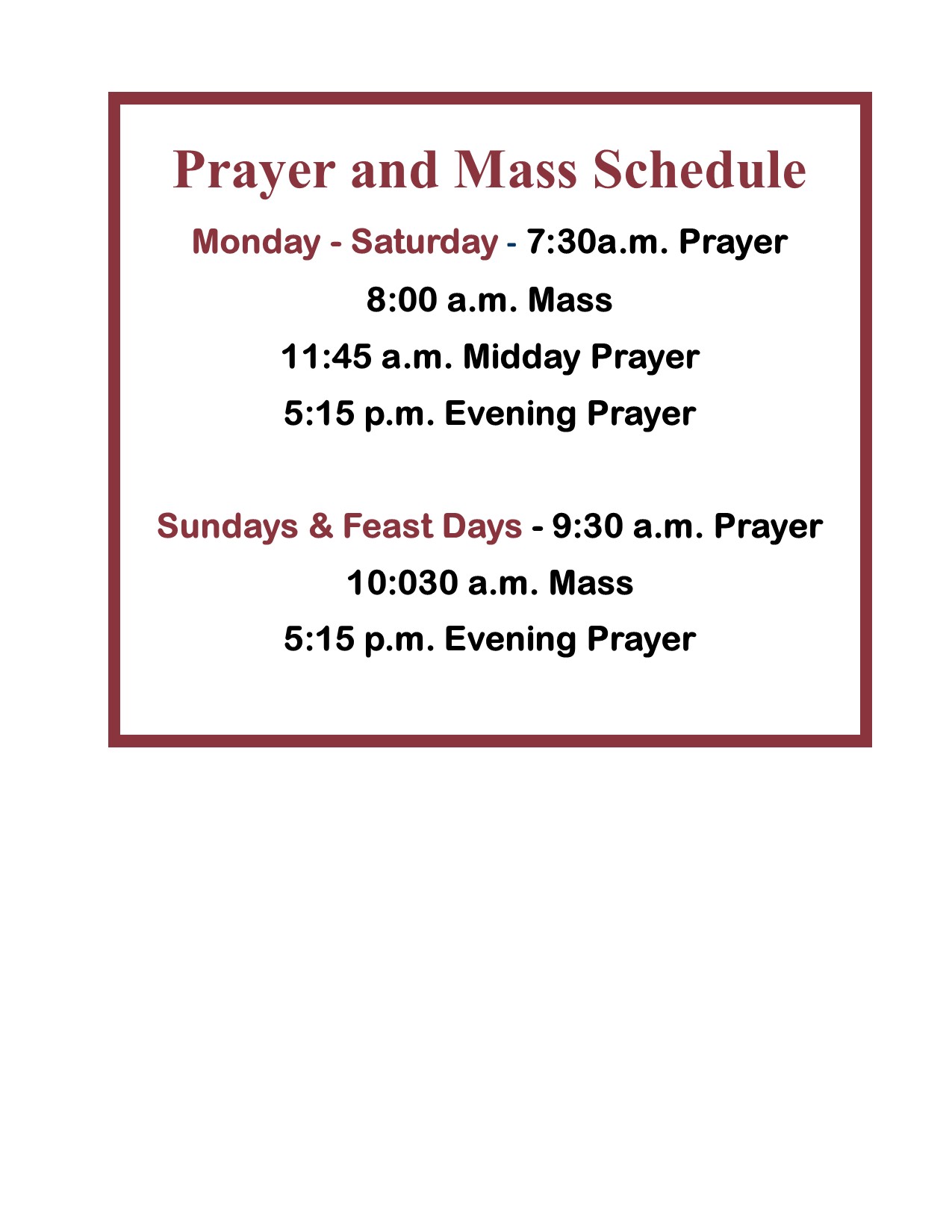
 Mass Schedule

Related Links

Copyright © 2026 · Benedictine Sisters of FL · Touching Lives Through Prayer and Service

Copyright © 2026 · Bendedictine Theme on Genesis Framework · WordPress · Log in