• Skip to primary navigation
  • Skip to main content
  • Skip to footer
Benedictine Sisters of FL

Holy Name Monastery
Founded 1889

Donate Now
  • Home
  • About Us
    • History
    • Being Benedictine
    • Benedictine Monasticism
    • Meet Our Community
    • Holy Name Academy-Alumnae
  • What We Do
    • Mission, Vision and Our Partners
    • Retreats
      • Invitation to Retreat
      • Accommodations
    • Volunteer Programs
    • Oblate Program
    • Spiritual Direction
    • Aqua/Hydroponics
    • More of Our Ministries
  • What’s Happening
    • Articles of Interest
    • Events
    • Newsletters
    • Brochures
    • Links
  • Support Us
    • Gifts of Support
    • Wish List
  • Stories Shared
  • Galleries
    • Photos
    • Videos
      • Benedictine Sisters of FL Videos
      • Other Videos
  • Contact Us

Gospel

PEACE

May 28, 2019 by Holy Name Monastery Leave a Comment

Reflection By Sister Roberta Bailey, OSB, Prioress

Memorial Day is an American holiday honoring the men and women who died while serving in the U.S. military.  It was originally called Decoration Day – a day to honor deceased soldiers by decorating their graves with flowers, flags and wreaths.  Although Memorial Day became its official title in the 1880s, the holiday wouldn’t legally be called Memorial Day until 1967 and its designation as a federal holiday came in 1971.

Enough history trivia!  The holiday prompts us to take some time to ponder the toll that war and violence have taken, and continues to take, on our society.  And lest that image overwhelm us we are moved to “raise our eyes to heaven; bow our heads in prayer” – hard to do at the same time.

In the Gospel we heard Jesus’ promise: “Peace I leave you, my peace I give you. … Do not let your hearts be troubled or afraid …You heard me tell you…”.  I suspect that one of Benedict’s favorite words must have been PAX, PEACE – The kind of peace Jesus gives, not as the world gives.  But, Benedict doesn’t promote an attitude of “peace at any cost.”  This is simply a false peace – smooth the surface of the waters and there’s churning beneath.  Agreeing with another simply to avoid conflict too often comes back to haunt us in the form of inner turmoil, headaches and stomach ailments and a long history of unrestful emotions.

The guidelines Benedict offers to his followers may involve great personal cost.  He seems to have an attitude of “nip it in the bud.”  Confronting isn’t easy for most folks.  Being the first to apologize can go against the grain.  And, gracefully accepting another’s expression of regret is a humbling exchange.  Benedict encourages us at the outset of our Benedictine journey: “Let peace be your quest and aim.”  [RB Prologue 17]  It’s difficult, some days more so than others.  We are a flawed people.  We have weaknesses, limitations, distractions that burden us and can cause us to be defensive, resentful and irritable.  (Remind you of the older brother in the parable of the Prodigal?”)

We know Benedict is right when he says that seeking peace is the way to heaven – heaven in the after-life and a little bit of heaven here on earth.  “If you wish to have true and eternal life, keep your tongue from evil and your lips from speaking deceit; turn from evil and do good; seek PEACE and pursue it.”  Another translation says, “Seek peace and go after it.”  And yet another says: “Chase peace and pursue it.”  Doesn’t that conjure up quite an image…   one that I imagine is depicted here in this drawing from What Do you Do With a Problem?  Can’t you see us – peace leading the way … dashing out of the chapel, into the dining room, down the halls, out the door, into the neighborhoods, climbing God’s holy mountain pursuing PEACE – never abandoning charity nor giving a false peace, peacefully performing whatever duties are entrusted to us and ensuring we have made peace before sundown.

Today, let us renew our commitment to make, to pursue PEACE so it is more than a concept that only we talk about.  Make a daily pledge to be people of peace, to be a peaceful people.  Make each day an echo of what Paul tells us in the Letter to the Corinthians “the old things have passed away; behold new things have come….  We have been reconciled through Christ and more than that, WE HAVE BEEN GIVEN A MINISTRY OF RECONCILATION.”  Peace is up to you and me.  Do you mean it when you sing: “Let there be peace on earth; and, let it begin with me?”

Another way to think about peace is expressed in this Chinese proverb.  It shows us the progression of light within to peace in the world…

If there is light in the soul,

There will be beauty in the person.

If there is beauty in the person,

There will be harmony in the house.

If there is harmony in the house,

There will be order in the nation.

If there is order in the nation,

There will be peace in the world.

(Chinese proverb)

Continue Reading

Filed Under: Blog, Front Page, Homily Tagged With: Benedict, Gospel, holiday, Jesus, Memorial Day, Peace, pusue, quest

Do You Recognize the Shepherd’s Voice?

May 14, 2019 by Holy Name Monastery Leave a Comment

Sunday, May 12th is designated Good Shepherd Sunday, a day of prayer for vocations.  We will certainly continue to pray for vocations to church ministries and for an increase in membership in religious communities.  In addition to that prayer, our community weekly intention is an intercessory prayer for MOTHERS – including all who mother others…  which in today’s society of broken families many daddies, too, serve in the role of both “mother” and “father” to their children.

The brief Gospel (just read) reveals Jesus as our unique “parent” – mother and father – our good shepherd.  Jesus is our means to salvation – the “sheep gate,” the gateway, the threshold to eternal life.  Jesus is the selfless, caring “shepherd” who provides protection and life itself.  How consoling and reassuring his words: “No one can take you out of my hand.  My Father, who has given you to me, is greater than all, and no one can take you out of my Father’s hand.”

A good shepherd’s life is not an easy one – the shepherd must be vigilant at all times, willing to keep the sheep close together (in community), lead them to green pastures and set a good pace sensitive to their endurance.  Jesus explains the difference between the concerned shepherd and the hireling.  The hireling is there only for the paycheck.  When trouble comes, he runs away and leaves the sheep to be devoured by the wolves.  The good shepherd, on the other hand, the shepherd who owns the sheep, has a vested interested in their welfare.  Therefore, the good shepherd is willing to pay any price to protect the sheep, even if it means that he has to give His very life for them.  Christ, the Chief Shepherd, knows our individual weaknesses and failings and watches over us with discerning love and sympathetic understanding.  With infinite concern He notes the doubts, fears, trials, conflicts, and defeats that disturb our peace, and He swiftly comes to our aid.

You’ve probably seen the painting titled “His Master’s Voice.”  It depicts a dog, looking with a cocked head, into an old gramophone.  It’s an apt symbol of what Jesus is saying to us or Benedict’s call to heed the voice of the Master.  Hear what Jesus says: “The sheep listen to his voice.  He calls his own sheep by name and leads them out.”

The spiritual writer, Tony Campolo tells the story of a census taker who went to the home of a rather poor family in the mountains of West Virginia to gather information.  He asked the mother how many dependents she had.  She began, “Well, there is Rosie, and Billy, and Lewella, Susie, Harry, and Jeffrey.  There’s Johnny, and Harvey, and our dog, Willie.”  The census taker interrupted her: “No, ma’am, that’s not necessary.  I only need the humans.” “Ah,” she said.  “Well, there is Rosie, and Billy, and Lewella, Susie, Harry, and Jeffrey, Johnny, and Harvey, and….”  At this the exasperated man interrupted, “No, ma’am, you don’t seem to understand.  I don’t need their names I just need the numbers.”  To which the old woman replied, “But I don’t know their numbers.  I only know them by name.”

Sounds like Jesus in today’s Gospel – Jesus says the good shepherd knows his sheep by name.  Although there may be several flocks sharing the same sheepfold, when the shepherds walk up to the gate and call their sheep, each one instantly recognizes the voice of its own shepherd or shepherdess.  When they hear the familiar voice, they instinctively follow (they are led and they follow, they are not driven, that’s for goats).  They will ignore the voice of a shepherd other than their own.  We will hear many voices competing for our attention, but there is a special note to the voice of Jesus that demands our immediate and full attention.

To the untrained eye, the individual sheep in a flock may all look alike.  A good shepherd, however, can tell them apart — often because of their defects and peculiar traits.  A man who was tending a large flock explained it this way: “See that sheep over there? Notice how it toes in a little.  The one behind it has a squint; the next one has a patch of wool off its back; ahead is one with a distinguishing black mark, while the one closest to us has a small piece torn out of its ear.”  Jesus says: “I know my sheep and they know me.”  (Reminds me of how we can detect who is coming down the hall by the sound of her footsteps.)

A man in Australia was arrested and charged with stealing a sheep.  But he claimed emphatically that it was one of his own that had been missing for many days.  When the case went to court, the judge was puzzled, not knowing how to decide the matter.  At last, he asked that the sheep be brought into the courtroom.  Then he ordered the plaintiff to step outside and call the animal.  The sheep made no response except to raise its head and look frightened.  The judge then instructed the defendant to go to the courtyard and call the sheep.  When the accused man began to make his distinctive call, the sheep bounded toward the door.  It was obvious that he recognized the familiar voice of his master.  “His sheep knows him,” said the judge. “Case dismissed!”

There is no question that Jesus is our Good Shepherd.  The only question that remains at this point is this: Do you know the Shepherd? Do you recognize His voice?

~Reflection by Sister Roberta Bailey, OSB, Prioress
First Reading:           Acts 13: 14, 43-52                      Second Reading: Revelation 7:9, 14b-17
Gospel: John1o: 27-30
Continue Reading

Filed Under: Blog, Front Page, Homily Tagged With: Chief Shepard, Father, good shepard, Gospel, Jesus, Mothers, sheep, Shepard

Foregiveness

May 7, 2019 by Holy Name Monastery Leave a Comment

PRAYER: “I know that God won’t give me anything I can’t handle.  I just wish He didn’t trust me so much.”  (Saint Teresa of Calcutta)


This past Thursday our nation celebrated the National Day of Prayer.  The Bill for the observance was initiated by Conrad Hilton, (founder of Hilton hotels) and was signed into law in April 1952 by President Truman.  Here’s an interest note: the president of the U.S. is required by law to sign a proclamation each year, encouraging all Americans to pray on the first Thursday in May.

Thinking about “prayer” – (but not directly connecting it to the Gospel just read) I find it curious that the disciples ask Jesus to teach them to pray “just as John taught his disciples.”  They wanted the words, didn’t they, for certainly Jesus had given them an example of prayer.  He had modeled time alone, told them to “go to your room and pray,” raised his eyes, hands and voice in intercessory prayer before miraculous healings.  But they, like we, wanted “the words to say.”  We forget sometimes that when we descend into our hearts in silent waiting that it is there we meet the Spirit who is already praying within us.

We look for “words,” don’t we … in a prayer book, on a holy card, in the life of a saint ….  We look for a guide, a director, a mentor.  I don’t mean to belittle the worthwhile role these companions play in our lives which is often critical to our spiritual growth and our salvation.  We just need to keep in mind, and really believe, the tremendous role that Scripture plays in our lives.  Jesus promised: “The Spirit of Truth will show you all things.”  St. Paul reminds us: “If you do these things you can be saved: be joyful at all times, pray without ceasing and give thanks for all things.”

Let’s look for a few minutes at the shortened version of what we call the “Lord’s Prayer.”  In it we pray “give us each day” EACH DAY – not a train load of blessings to last us all year – just today’s help, Lord, that’s all I am asking … not even tomorrow’s help … just get me through today – I trust you will be there tomorrow – even when I feel like Mother Teresa once prayed: “I KNOW GOD WON’T GIVE ME ANYTHING I CAN’T HANDLE …  I JUST WISH HE DIDN’T TRUST ME SO MUCH.”

In Luke’s version of the Lord’s Prayer, have you noticed the difference in the phrase regarding forgiveness?  We pray, “forgive us our sins for we ourselves forgive everyone in debt to us.”  A strong, firm statement of my willingness to forgive everyone.  In the traditional version we pray: forgive us our debts, or trespasses, as we forgive our debtors…”  It sounds as if God’s forgiveness to me is measured by my willingness to forgive others.

I like Luke’s version even while I feel it is a greater challenge.  I commit, I promise: I will forgive EVERYONE who is in debt to me.  No willy-nilly “this one I forgive but not that one, at least not today.”  When we pray Luke’s words we vow “I forgive EVERYONE.”  Think of that the next time you pray the Our Father … at Mass or in private prayer, you are agreeing to forgive EVERYONE.  What a huge and freeing commitment.

And we promise to do it day after day after day.  Repetitious practice isn’t just what we may have told our mothers seemed “stupid” and useless. Things like making the bed that we are only going to rumple up in a few hours or doing the dishes after every meal instead of collecting them until the cupboard is bare or cleaning the toilet that someone is going to mess up the minute I leave the bathroom.  Repetition perfects, and makes permanent skill in music, in handwriting, in the acquisition of good, or bad habits.  And, in the repetition of daily chores (even the tasks only God sees) there is a meaningful expression of hospitality to myself and my companions.  In the repetition of the Psalms, of favorite prayers, and liturgical actions there is a meaningful acknowledgment of our creaturely participation in God’s creative act, day after day, after day.

So, we pray day after day for vocations, for peace, for relief from suffering and war and for a forgiving heart.  Through our community and personal prayer we feed not only our own spirits, but we are, so to speak, attached by a spiritual cord to everyone we have ever come into contact with. We feed ourselves spiritually, and we also nourish all those contacts through our prayers.  Our prayer is universal.  We forgive everyone who is in debt to us.   Note, in Luke’s memory Jesus did not say “everyone to whom we owe a debt” … rather those who are in debt to us.  Who would that be?  And, why would someone be in debt to me?

~Reflection by Sister Roberta Bailey, OSB, Prioress


First reading Acts 5:27-32, 40b-41 Second Reading Revelation 5:11-14
Gospel John 21:1-14
Continue Reading

Filed Under: Blog, Front Page, Homily Tagged With: forgiveness, God, Gospel, Jesus, Lord's prayer, Mother Teresa, Prayer

Ask Yourself: Am I a mirror or a window?

April 16, 2019 by Holy Name Monastery Leave a Comment

I like this Gospel story from Luke – used on Palm Sunday for the Blessing of the Palms.  I find Jesus’ directive intriguing – has an ESP flavor.  The first reading in the Mass for tomorrow, from Isaiah tells me: “Morning after morning God opens my ear that I may hear.”  We know Luke wasn’t there on the first Palm Sunday or at the last supper.  So, this is an incident that he recalled his friends telling him.  His ear was open to hear their story and recognize its significance.

And, it’s a challenging one …  “Go into the village and immediately you will find an ass tethered, and a colt with her.  …  Untie the animals and bring them here to me.”  What a story of trust: Jesus trusts that the disciples will do exactly what he tells

them.  The disciples trust that what Jesus asks them can be done … for He never asks of us something that can’t be done.  The owners of the donkey and the supper room trust the disciples’ honesty in their request.  What implicit trust these men had in Jesus: you’ll see an ass, a donkey – take it.

In another gospel the story continues: Follow the man with the water jar – most likely a servant – to the house he enters – and ask the owner where the feast is being held or where we can prepare it.  The title “The Teacher” conveyed all the man needed to hear.  When Jesus comes to St. Leo looking for a place to eat a Passover meal with friends, do I open my door to say, “Come In – the place is yours – stay as long as you like?”

It reminds me of an old fable about the colt that carried Jesus on Palm Sunday.  It seems the colt thought that the reception was organized to honor him.  “I am a unique colt,” the excited animal thought.  When he asked his mother the next day if he could walk down the same street alone and be honored again, his mother said, “No, you are nothing without Him who was riding you.”  Five days later, the colt saw a huge crowd of people in the street.  It was Friday, and the soldiers were taking Jesus to Calvary.  The colt could not resist the temptation of another royal reception.  Ignoring the warning of his mother, he ran to the street, but he had to flee for his life as soldiers chased him and people stoned him.  Thus, the colt finally learned the lesson that he was only a poor donkey without Jesus to ride on him.

In the Gospel story, at least this time around, it appears what Jesus wants – Jesus gets!  At least today …  this time – but not for long.  Or, do I have that wrong?  Jesus may not have wanted the suffering (afterall he was human and could experience all our feelings of dread) but he does want what His Father wants – a procession with pomp and circumstance through the city streets, an event that shook the whole city.  The actual “quake” came later.  This is a foreshadowing of the quake that will shake the whole world 5 days later – at Jesus’ crucifixion.  Today, a procession with all the hoopla that surrounds a parade; five days later we witness a procession of ignominy with Jesus dragging a heavy cross.

I am reminded of another Palm Sunday story.  A little boy was sick and wasn’t able to go to church on Palm Sunday.  When his dad came home with a palm branch, the boy asked about it.  “Well, you see,” said his dad, “when Jesus came into town, everyone waved palm branches to honor him; so we got palm branches today at church.”  The child grimaced and responded “Wouldn’t you know it!  The one Sunday I can’t go to church, and Jesus shows up!”

Everyday concerns and obligations may fill the first few days of the coming week, but when the sacred Triduum opens on Thursday evening, let’s endeavor to personally and communally contribute to an atmosphere of quiet, solemn reflection …  to set a tone that says something of great religious significance is underway.  Let us be contemplative windows into the story we commemorate – an expression of gratitude, a repayment – or a paying forward, for Jesus’ expression of GREAT love for us!   Recall the story of the donkey.  As we enter Holy Week, let us examine our lives to see whether we carry Jesus and bear witness to him through our living or are we Christian in name only.

Tomorrow when we follow the palm-decorated cross in procession into the chapel…  or maybe later in the day when you weave a cross with your palm branch, ask yourself: “Am I a mirror or a window?  Do I reflect values or reveal them?  Am I opaque or translucent glass?  Is my life stained with the magnificent colors of God’s touches or filled in with more and more chunks of dulled or muted, blackened or smudged – ill-shaped light-resistant challenges to God’s voice?”

~Reflection by Sister Roberta Bailey, OSB, Prioress


First Reading:  Isaiah 50: 4-7  Second Reading: Philippians 2: 6-11
Gospel: The Passion According Luke 22:14—23:56
Gospel for Blessing of Palms Luke 19:28-40
Continue Reading

Filed Under: Blog, Front Page, Homily Tagged With: ass, donkey, Gospel, Jesus, Luke, mirror, Palm Sunday, quake, supper, window

The Prodigal Son

April 2, 2019 by Holy Name Monastery Leave a Comment

This Gospel says that while away the prodigal “came to himself.”   Developmental psychologists say that some young people need to reject their conventional faith (e.g. of their family) in order to come to their own faith.

Put another way, at least some may need to go to “a distant land” in order to “come to themselves.”  Note that the second son who stayed home also had his rebellion from conventional faith as he talks back to his Father, refusing to go to the feast.

Rather than having failed, parents of prodigals or rebels may have succeeded – in giving their young person the confidence to leave home to spread their wings and find their own faith.  You’ve probably heard the saying: “If you love something set it free, if it returns it was meant to be, if it continues to fly let it soar, and have faith that God has something better in store.”  And another one: “Sometimes, you just have to take the leap, and build your wings on the way down.”

The gospel suggests that the Prodigal Parent is on the look-out for their wandering child, scanning the horizon, hoping against hope for their return.   Upon sighting their child, the parent’s heart is “filled with compassion” and rushes out to welcome the one for whom they have yearned and prayed.   “Prodigals” of all ages need to know that we are hoping for their return and that they will always be welcome home – with open arms.

Our Gospel shows us the difference between “coming home” and a “home-coming.”  The son approached in fear and trepidation; the parent flung aside any resentment and ill-will.  The child was coming home to he knew-not-what kind of a reception.  The parent threw a spontaneous homecoming party.

The Parent welcomed and embraced the Prodigal before an apology crossed his lips.  What a picture of unconditional love!  Our diocesan motto “Live the Gospel Courageously” includes the theme of welcome to all, Saints and Sinner alike.

It doesn’t matter if prodigals don’t return to our particular expression of faith within God’s family.  We hear the expressions “fallen away Catholic” or “lapsed Catholic.”  We remain hopeful that they will make their way home to God.  The path may not be ours.  We pray that the good values that were instilled and modeled for them over the years – will sustain their journey, whatever road they take.  And, we pray that we remember: true “forgiveness” is present long before the embrace of a homecoming.

The waiting father, the renegade son and the “look at how good I have been” son … all knew peace at the end of the day.  The father seems to have completely forgotten his agitation, worry and concern as peace overwhelms him at the return of his younger son.  That wayward son must have been so very relieved at the response of his father that peaceful gratitude must have washed over him.  I suspect that the older brother forgot to sweep at his own front door – yes?   What peace must have invaded his attitude as his father – and younger brother – assured this embarrassed, humbled fellow of their never-ending love.

We believe Benedict when he says that seeking peace is the way to heaven – heaven in the after-life and a little bit of heaven here on earth.  In the Prologue to Benedict’s Rule we find the admonition: “If you wish to have true and eternal life, keep your tongue from evil and your lips from speaking deceit; turn from evil and do good; seek PEACE and pursue it.”  Another translation says, “seek peace and go after it.”  That conjures up quite an image…  dashing out of the chapel, into the dining room, down the halls, out the door, into the neighborhoods, climbing God’s holy mountain pursuing PEACE – never abandoning charity nor giving a false peace, peacefully performing whatever duties are entrusted to us, ensuring we have made peace before sundown.

Let us renew our commitment to make PEACE more than a concept that we talk about … let us make a daily pledge to be people of peace, to be a peaceful people.   Make each day an echo of what Paul tells us in the second reading: “the old things have passed away; behold new things have come….  We have been reconciled through Christ and (this is the punch line) WE HAVE BEEN GIVEN A MINISTRY OF RECONCILATION.”

~Reflection by Sister Roberta Bailey, OSB, Prioress


4th Sunday in Lent (March 31, 2019)
Joshua 5:9a; 10-12      2 Corinthians 5:17-21     Luke 15:1-3; 11-32


Continue Reading

Filed Under: Blog, Front Page, Homily Tagged With: Benedict, catholic, God, Gospel, Prodigal, Prodigal child

What is your BE-attitude?

February 18, 2019 by Holy Name Monastery Leave a Comment

Surely at least once in your life you’ve experienced a sinking sensation when your superior, your mentor or novice mistress, principal or boss sent for you, and maybe several others, looked you in the eyes, and said, “There’s something you need to understand….”  You felt quite literally like this was a “come to Jesus” moment.”  That’s the setting for the story in this Gospel reading.  This account according to Luke looks and sounds a lot like Matthew’s account of the Sermon on the Mount.  The difference is that in Matthew we find only the “blessings.”  Here in Luke we find a set of contrasts: blessings vs woes.

Why do you suppose this is?  Well, like most people who have many speaking engagements, Jesus had in mind several basic concepts he wanted to be sure to cover.  Jesus spoke without notes, repeating the same truths from various angles.  In this particular talk He may have styled his presentation on the writings of the prophet Jeremiah (that we’ll hear in tomorrow’s first reading) – the section on curses and blessings.

Over Jesus’ three-year public ministry the disciples would have heard the same parables, the same stories, the same truths with some variation.  And, like any human being, their memories would have taken on different colors.  Surely you’ve been at a family or community gathering where inevitably the “do you remember when” stories come up?  You may have listened in amazement as your sibling related her memory of an event.  You thought you were there when it happened, but, my goodness, do the details differ!

So, it shouldn’t surprise us when we hear differences between accounts in the four Gospels.  And, we shouldn’t get all worked up, jump in to correct Sister X when she tells a tale with embellishments we don’t recall.  It shouldn’t destroy our trust in the evangelists when we encounter differences in their accounts.  After all, one evangelist calls the occasion “the sermon on the PLAIN” and the other the “sermon on the MOUNT.”  So, maybe it was two different occasions.

The match up of the blessings and woes in Luke is interesting to note …  they’re separated by several verses in the text.  For example: In the first comparison we find Jesus’ words on the blessedness of the poor, and a hopeless future for the rich.  “Blessed are you who are poor, for yours is the kingdom of God.” (v.20) “But woe to you who are rich, for you have already received your comfort.” (v. 24).  Because of their faith and trust in God the poor are God’s beneficiaries.

The next parallel: “Blessed are you who hunger now, for you will be satisfied.” (v 21) paired with “Woe to you who are well fed now, for you will go hungry.” (v 25).  Jesus knows the people have experienced actual hunger… hunger for food and the necessities of life.  He contrasts it with being well-fed.  In our culture there are many overweight people.  But in a culture where poverty is rampant, only the rich are plump.  It’s easy to tell who is well-fed.  Jesus reminds us that there is something that is more valuable than “bread” – there is spiritual food that feeds our souls.

The third blessing/woe pair is weeping and laughing. “Blessed are you who weep now, for you will laugh.” (v 21).  “Woe to you who laugh now, for you will mourn and weep.” (v 25).  We have all felt the pain of disappointment and loss, or rejection and struggle.  But the typical depiction of the well-to-do is of someone who is always partying and enjoying themselves.  They laugh and joke now while tragedy takes place all around them.

You can find many self-help aids on Amazon and Goodreads… POD casts on the Internet, books and tapes and DVD in the public library … in our library.  The more you read, and hear, about happiness – the longer you live – the more you will realize the impact attitude makes in one’s life.

Attitude is more important than facts. (Are you measuring the depth of emptiness in your glass?  Or, do you smile as the fullness in the glass of life expands?)  Attitude is more important than the past, than one’s education, than money, than circumstances, than failures or successes, than what other people think or say or do.  Attitude can make or break a person’s spirit; can build up or destroy a community …  a parish … a home … family.

The remarkable thing is we have a choice every day regarding the attitude we will embrace.  You can’t change our past …  we cannot change the fact that people will act in a certain way.  We can’t change others’ attitudes.  The only thing we CAN do is adjust our own attitude.  It has been said that life is 10% what happens to you and 90% how we react to it.  We are each in charge of our own attitude.  What will be your attitude?  That is your BE-attitude.

~Reflection by Sister Roberta Bailey, OSB, Prioress
First Reading  Jeremiah 17:5-8
Second Reading  1 Corinthians 15:12, 16-20
Gospel Luke 6:17, 20-
Continue Reading

Filed Under: Blog, Front Page, Homily Tagged With: be-attitude, Gospel, Jesus, Luke, Matthew, sermon on the mount

  • « Go to Previous Page
  • Page 1
  • Interim pages omitted …
  • Page 9
  • Page 10
  • Page 11
  • Page 12
  • Page 13
  • Go to Next Page »

Footer

Prayer / Newsletter / Info

 Contact Info

Benedictine Sisters of Florida

PO Box 2450
12138 Wichers Road
St. Leo, FL 33574-2450
(352) 588-8320
(352) 588-8443

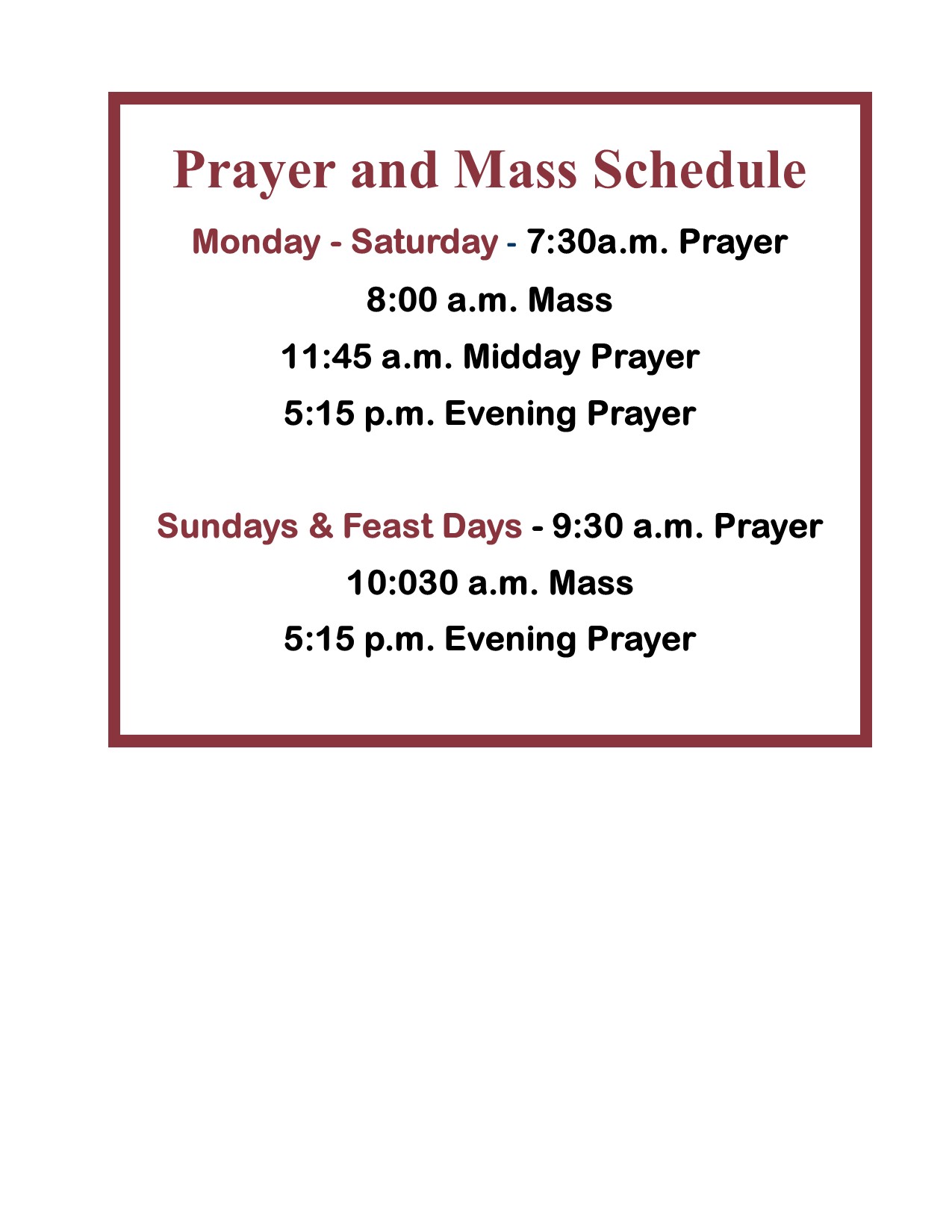
 Mass Schedule

Related Links

Copyright © 2026 · Benedictine Sisters of FL · Touching Lives Through Prayer and Service

Copyright © 2026 · Bendedictine Theme on Genesis Framework · WordPress · Log in