• Skip to primary navigation
  • Skip to main content
  • Skip to footer
Benedictine Sisters of FL

Holy Name Monastery
Founded 1889

Donate Now
  • Home
  • About Us
    • History
    • Being Benedictine
    • Benedictine Monasticism
    • Meet Our Community
    • Holy Name Academy-Alumnae
  • What We Do
    • Mission, Vision and Our Partners
    • Retreats
      • Invitation to Retreat
      • Accommodations
    • Volunteer Programs
    • Oblate Program
    • Spiritual Direction
    • Aqua/Hydroponics
    • More of Our Ministries
  • What’s Happening
    • Articles of Interest
    • Events
    • Newsletters
    • Brochures
    • Links
  • Support Us
    • Gifts of Support
    • Wish List
  • Stories Shared
  • Galleries
    • Photos
    • Videos
      • Benedictine Sisters of FL Videos
      • Other Videos
  • Contact Us

Homily

God’s Law – God’s Love

September 12, 2016 by Holy Name Monastery Leave a Comment

gods-lawFirst Reading  Exodus 32:7-11,13-14                 Second Reading 1 Timothy 1:12-17
Gospel Reading  Luke 15:1-32                            Intention Responsible Citizenship

An inner city church, located in an area of a large American city where there were few residents, was forced to a decision. A large corporation was offering them a great deal of money for their site, on which the corporation wanted to put a parking lot. The money would enable the parish to move to the inner city where they would find many more people to serve. Even though this was exciting to some of the congregation, other members were resistant to the idea. They pointed out that the church was the guardian of a building whose history and architecture reached back into the early part of the nineteenth century. History had been made in that building.

Eventually the congregation decided to sell the site and make the move to the inner-city neighborhood. The pastor said, “We had to decide whether we wanted to be in a museum or in mission, we couldn’t have it both ways.  It meant either staying on the original site, glorying in the past history and serving a few people, or giving up the past and gearing up ourselves for a significant ministry among the city’s people. We opted for mission status over museum status.

Something of this same struggle is indicated in this Gospel. The Pharisees and scribes came down on the side of museum religion. They wanted attention given to those who were stable, pious and not a liability if invited to the local country club. Their rationale was “Let’s have our synagogue programs be dependable for our like-minded types.”  Jesus disappointed them by insisting that the issue was one of mission: to reach out to those who needed great mercy and perhaps a bath.

The Pharisees’ love of God’s law made them forget about God’s love.   God loves us even more than a parent loves a child. God longs to rescue those who are lost.  (It’s like his favorite pastime.)  Our loving God will search for that which is lost. There’s no giving up, no quitting point. Just like looking for a lost coin – there’s no such thing as a life without worth. God doesn’t mind stooping down to find us and lift us up from the depths we have fallen into. Each time you stoop to pick up something that has fallen to the floor, however trivial a thing it may seem, that God does not disdain to stoop down to pick us up each and every time, after time that we fall.

In Jesus’ day when a husband took a bride, he gave her a headband with ten silver coins that were evenly spaced. She wore this headband in public to show that she was married. If she was unfaithful, one of the coins was removed, and the gap showed that she had disgraced her marriage vows. It was a shame and disgrace to lose any of these coins.

Loss of the coin in Jesus’ parable it seems was a result of carelessness, but not a moral disgrace. It was lost on a dirt floor in the darkness. People without God are the like that. They are not just lost, they are in the dirt and the dark. They need Jesus, the Light of the World – we all do.   Jesus looks for us, so He can bring us out of the darkness into the light!   Our community hospitality ministry helps people come into the light of welcome, friendship and compassion so that they in turn can be a light to those they associate with.   We feed their hunger for peace, camaraderie, spiritual growth, a prayerful liturgy and often top it with a good meal.

Let me end with a story that proves we never know what will bring people to their knees.

A minister was waiting in line at the Pearly Gates. Ahead of him there was a fellow who was dressed in sunglasses, a loud shirt, leather jacket and jeans. Saint Peter addressed the asked, “Who are you, so that I may know whether or not to admit you to the Kingdom of Heaven?”    “I’m Joe Cohen, taxi driver, of New York City”. Saint Peter consulted his list, smiled and said:  “Take this silken robe and enter.

Away he went.  Next in line was the minister. . He stood erect and boomed out, “I am Msgr Joseph, pastor of Saint Mary’s Cathedral for the last forty-three years.” Saint Peter consulted his list and said to the minister, “Here, take this cotton robe and you can come in.” Just a minute here,” said the minister. “That man was a taxi driver and he gets a silken robe. How can this be?” ”

“Up here,” said St. Peter, we work by results. While you preached, people slept. While he drove, people prayed.”

~Sister Roberta Bailey, OSB, Prioress
Continue Reading

Filed Under: Blog, Homily Tagged With: God, God's Law, God's Love, Gospel, Jesus, Pharisees

In Praise Of Work

September 6, 2016 by Holy Name Monastery Leave a Comment

In praise of work

Scripture is very clear about the place of work in human life. The Book of Genesis is explicit: we were put into the Garden “to till and to keep it.” We work to complete the work of God in the world. Work, then, may be the most sanctifying thing we do.

The implications of a spirituality of work in a world such as ours are clear, it seems. Work is my gift to the world. It is my social fruitfulness. It ties me to my neighbor and binds me to the future.

Work is the way I am saved from total self-centeredness. It gives me a reason to exist that is larger than myself. It makes me part of possibility. It gives me hope. Martin Luther wrote: “If I knew that the world would end tomorrow, I would plant an apple tree today.”

Work gives me a place in salvation. It helps redeem the world from sin. It enables creation to go on creating. It brings us all one step closer to what the reign of God is meant to be.

Work is meant to build community. When we work for others, we give ourselves and we can give alms as well. We never work, in other words, for our own good alone.

Work leads to self-fulfillment. It uses the gifts and talents we know we have and it calls on the gifts of which we are unaware.

Work is its own asceticism. When we face the work at hand, with all its difficulties and all its rigors and all its repetition and all its irritations and accept it, we do not need to traffic in symbolic penances. What today’s work brings is what is really due from me to God. And if we do it well, we will have spiritual discipline aplenty.

Finally, work is the way we really live in solidarity with the poor of the world. Work is our commitment not to live off others, not to sponge, not to shirk, not to cheat.

Work is our sign that God goes on working in the world through us. It is the very stuff of divine ambition. And it will never be over. God needs us to complete God’s work. Now.

-from In the Heart of the Temple by Joan Chittister (BlueBridge)

Continue Reading

Filed Under: Homily, Prayer Tagged With: Genesis, God, heart of the temple, in praise of work, Joan Chittister, Martin Luther

Comfort Zone

August 29, 2016 by Holy Name Monastery Leave a Comment

comfort zoneFirst Reading  Sirach 3:17-18,20,28-29     Second Reading   Hebrews 12:18-19,22-24
Gospel Reading   Luke 14:1,7-14      Intention End to terrorism

There is a term popular today that seems to me to fit with this message of Jesus. The term is “comfort zone” which refers to those situations in which the person feels comfortable, safe, and free from threat or even challenge. The comfort zone is, for the person involved, a thoroughly comfortable place. Life there is marked by ease and familiarity.

It’s natural to like one’s comfort zone, but most of us would admit that we should not remain there indefinitely. People do not become better or more mature or holier lingering in their comfort zone. That just doesn’t happen.

This, I think, appears to be a modern term for what concerns Jesus in today’s Gospel. The passage divides easily into two parts.

In the first part, Jesus cautions against sitting in the place of honor at a wedding banquet and advises taking the lowest place instead.

In the second part, he urges us to invite the crippled, lame, and blind when we give a luncheon or dinner, rather than friends, relatives, and rich people.

So there’s advice here for us when we’re the guest as well as when we are the ones hosting an event.  But it is about more than proper banquet etiquette.  Choosing the seat of honor for ourselves sounds a lot like craving our comfort zone. The best seat is the one where we feel comfortable: accepted, safe, free from threat, challenge or embarrassment or any sense of awkwardness.

Sharing a community meal, sitting at table should be less about power and all about sharing the joy of being together.   Even our legends acknowledge the power of a choice seat like King Arthur and the Knights of the Round Table. Sitting at a round table came to symbolize equality… because there was no head of the table. All had an equal seat and an equal say. Where you choose to sit matters. It matters in the way people perceive you and in the way you act in different environments.

Jesus challenges us against staying in our comfort zone. Rather than limiting our guest list to people who are clones of ourselves, people with whom we’re comfortable, who don’t threaten or challenge us, invite instead those who are different, people who make us uncomfortable, but whose difference from us may bring with it a blessing.  This is what I think is so significant about our Thanksgiving Day dinner.  We open our door, our hearts and our table expecting nothing in return.  The blessing of being in a position to share is its own reward.

Jesus not only teaches us this the lesson of stretching our comfort zone, he demonstrates it. His entire life, his public ministry, the passion and resurrection, is full of one episode after another of not remaining in a comfort zone.  Repeatedly Jesus takes the low seat and invites unlikely types to be his guests.

Finally he takes the worst seat of all––on the cross––and those who come to his banquet make it through the door (recall last Sunday’s Gospel)  because they claim no merit of their own. Finally he leaves the comfort zone of earth and expands his comfort zone forever, everywhere and with everyone – there are no strangers – all are welcome!

~Sister Roberta Bailey, OSB, Prioress
Continue Reading

Filed Under: Blog, Homily Tagged With: advice, comfort zone, equality, Gospel, high seats, Jesus, low seats, welcome

The Narrow Gate

August 22, 2016 by Holy Name Monastery Leave a Comment

gate21st Sunday in Ordinary Time, Sunday, August 21, 2016

First Reading  Isaiah 66:18-21                Second Reading  Hebrews 12:5-7,11-13
Gospel Reading  Luke 13:22-30

This Gospel may well be a loose collection of sayings of Jesus recalled by the author, uttered in several different contexts but brought together here under the general heading of “who will be saved?”

As this parable opens, Luke reminds us that Jesus is making his way to Jerusalem, teaching as he goes. When from out of the crowd he hears a question called out giving him a chance to make a prophetic statement. A few weeks ago, the question was “What must I do to inherit eternal life?” Today it’s “will only a few be saved?”

Jesus answers with two parables – referred to as the “narrow gate” and the “door” although the same Greek word is used for both gate and door.  It’s the translation that may be misleading.    It’s interesting to me that Jesus says many won’t be strong enough to get through the gate.  He doesn’t say slim enough.  It sounds as if the walls can be pressed aside if you just have enough strength.  To digress a moment … I thought of this image at the construction meeting earlier this week.  The discussion was about the well that has to be sunk to provide water for the fire sprinkler system.  The pipe will have a protective casing on it so it will not be subject to water erosion or enjoyed by underground rodents that visit our garden.  When drilling the well they ensure that the opening is wide enough to accommodate whatever diameter of pipe it takes to get the needed  water pressure ( 4’, 6’ 8’ pipe) before inserting the casing … in Jesus language, that it is strong enough to let the required flow of water get through.

Jesus says: “Many will seek to enter and will not be able” … so, maybe the overwhelming crowd will be too many all at the same time pushing and shoving to get through the opening?

This question to Jesus had people squirming: “Will only a few be saved?”  Will I be among them?  How can I be in that count?

The answer to the “will only a few be saved?” is no. In the end, many will be saved, but many who thought they would be saved will not be saved. The parable is a prophetic warning that it will take repentance, forgiveness, faith …   in order to be saved.  “Many are called but few are chosen.”

But, remember Jesus also said, “When once the master of the house has risen and shut the door, and you begin to stand outside and to knock at the door, saying, ‘Lord, open to us,’ then he will answer you, ‘I do not know where you come from.”  Don’t delay your planning to be among the chosen … what’s the saying: don’t put off to tomorrow what can be done today?  Lectio and personal prayer; some form of fasting whether from food, or technology or juicy gossip is a daily opportunity.

Jesus answer to the crowd lets his hearers (and us) know that the “door of opportunity” will not remain open indefinitely.  When the door is closed, it is closed and will not be reopened for persons whose only claim is that Jesus once visited their temple / their church, their town and village or preached in their streets or that they once saw Jesus in a crowd.   Remember the 10 virgins … 5 missed the boat due to a lack of “NRRO future planning.”  And, recall the Gospel lessons we heard this past week: the first shall be last … and the last will get the same reward as those who signed on to Jesus work crew early in the day.

We’ve all probably seen the famous painting of Jesus knocking at a door with knob …  the door to our hearts must be opened from the inside.   That’s true but there are also doors with visible knobs that we must have the courage to open from our side….  To let in the immigrant, the wanders, the seekers, the faithless, the weary.  Could we say we are on the inside listening for outsiders to lift the knocker asking entrance.  Or, there doors waiting for you to twist the knob on, or push aside, to get a glimpse of what’s on the other side? It takes courage, doesn’t it, to be on either side of the door:  A big breath before stepping up to knock on the door of a stranger and a gasp of apprehension to open the door to an unexpected knock, especially if there is no peep hole to reveal at least a shadowy shape of the caller.

Some years ago I belonged to a parish group that studied various styles of meditation.  One was “wall” or “gate” meditation.  I invite you to try it …  and then I will share my experience.

Get in a relaxed position … lying down risks dozing off but sitting runs that same risk … just don’t try this particular type of meditation standing up or walking …   So, relax your body, close your eyes and in your mind start walking along the edge of a wall or fence … not on it, beside it –  until you see an opening or door … walk through – who’s there – do you see Jesus? – who is with him?  What are they saying to each other or to you …  Just let the reflection go where it will …

In my first experience… as I crossed through a low stone wall, I sensed Jesus seated with a circle of 10 – 12 others – he motioned for me to come sit beside him …  looking around I recognized and could name all but one person …  I have no memory of who they were BUT several years later I was introduced to a Sister from another community and I startled and instantly realized she was the one who had been in that circle.

Here are some doors you may want to visualize, open and peer beyond  …  Lord, Lord, open to me.

church_cross-door doors brick1 old_door_double colored doors barn doors stone dooroffice door1
~Reflection by Sister Roberta Bailey, OSB, Prioress


Continue Reading

Filed Under: Blog, Homily Tagged With: Door, Gate, God, Jesus, Knocking, knowledge, Luke

These Were Benedictine Women With A Dream!

July 11, 2016 by Holy Name Monastery Leave a Comment

St. Leo Township 125th Anniversary

July 9, 2016


20160709_140120We preserve our stories because we want never to forget that the opportunities we have today were not simply lavished upon.  They were purchased at the great price of travel from home; cold, cracked work-worn knuckles; study by the light of midnight oil; stomachs that ached with hunger; raking, hoeing and watering groves and gardens – saving, scrimping and salvaging.

What firm faith and incredible courage our founding sisters must have had!  The records in the Pittsburg archives remind us of how adventurous and of the bravery of these young sisters who in 1889 set out for a long journey into the unknown.  There were clearly told if the venture did not work, they were not to return to Pennsylvania.  An examination of the papers shows us that of the five women who signed their severance papers on the evening of February 22, 1889, one never made it to Florida.  However, one of the Sisters who had served as a witness, must have decided overnight to join the mission band – she is named in the group of our five founders.

Imagine what daring it took to venture south into a faraway place.  These were Benedictine women with a dream!  In 1889 Rome considered the church in America “missionary territory.”  In relative terms, the slaves had only recently been freed.  Had our Sisters ever seen a person of color in their northern neighborhood?  Surely not an Indian and most assuredly not an alligator!

There is some evidence that the pioneer band traveled from Allegheny County (PA) to the Benedictine house in Covington, KY – then southward by train which would have deposited them in south GA or north FL.  It seems safe to me to guess that someone from San Antonio would have met the Sisters at the train to bring them in wagons or on horseback down along what is now Hwy 19 and 41 – parts of the Seminole trail.  Perhaps they met cattle drovers bringing their herds to Tampa or Punta Gorda.  By the time they reached San Antonio, traveling through the Florida wilderness – in February, probably not too many mosquitoes but surely they’d have heard or seen black bears and panthers, “Strange” birds, and had run across a snake or two…

On Thursday, February 28, I bet they breathed a sigh of relief to at last be among people they may not have personally known but whose northern cultural practices and manners, whose speech patterns were similar to their own.

Next day, March 1, being a Friday, and most probably a Lenten Friday, would have been a day was meat was NOT on the menu.  The sister would have partaken of very little, if any, breakfast.  They’d have prayer the Little Office of the blessed Virgin, an abbreviated for of the Divine Office they’d back home.  And as we know from our annals: “the great work was begun.”  Perhaps they had a main meal of fish fresh caught from Lake Jovita?  Evening came, and morning came, their second day in the mission land called “Land of the Flowers.”

The Sisters first home was a three-story wood-frame hotel which was located on the city park in San Antonio.   In 1911, the building was moved on logs to a location parallel to the shore of Lake Jovita in St. Leo.  In 1960, the “new” monastery building, which is now called Benedictine Hall and owned by Saint Leo University, replaced the original wood-frame building which the Sisters and academy boarders had called home for 71 years.

By March 11, less than two-week after their arrival, the Sisters had opened Holy Name Academy for girls and were teaching in St. Anthony School and St. Joseph School.  From 1929-59 they operated St. Benedict Preparatory for young boys.

In their history since 1889, the Sisters have served as town mayors and commissioners. At Saint Leo University, they have served as administrators, instructional staff, board members, campus ministers, directors of residential life and director of library services, archivist, clerical staff and food service managers.  From 1962 until 1997 they provided housing for university students.  Florida Benedictine women have staffed schools in Texas and Louisiana.  In Florida, they have been teachers and school principals, and worked in parish ministries, in San Antonio, St. Joseph, Lecanto, Jacksonville Beach, Miami, Quincy, Sarasota, Ocala, Lakeland, Venice, Beverly Hills, Apopka and Tampa.

The Benedictine Sisters have conducted summer religion programs at three diocesan camps.  They taught in summer Bible camps in DeLand, Plant City, Leesburg, Bartow and Naples, Florida.  Weekly religion (CCD) classes were taught by the Sisters in cities where they staffed schools and in Floral City, Brooksville, New Port Richey, Eustis, Arlington, Ponte Vedra, Masaryktown, Belleview, Reddick, West Ocala, Fruitland Park, Gainesville, Clermont, Dade City, Zephyrhills and at the Girls’ Detention Center in Ocala.

At the turn of the 20th century they attempted the founding of another motherhouse in Quincy, FL (which did not thrive) and within 10 years they had been invited to start a house in the Diocese of Birmingham, AL.  A year later 5 of “us” from FL joined with 5 Benedictine sisters from Kentucky to found the Benedictine convent in Cullman, Al.

At the present time, the Florida Benedictine Sisters continue to work on public, private and parochial school boards, and at Saint Leo University.  Individual Sisters are volunteers and serve on the boards of Catholic Charities, the Chamber of Commerce, Habitat for Humanity, Sunrise Spouse Abuse Shelter, Hospice, St. Vincent de Paul Society, soup kitchens and thrift stores.  Some of the Sisters minister within their community in administration, recruitment and formation of new members, business affairs, hospitality and retreat ministries, direct services to the poor, food service, horticulture.

And, now here we are at day 46,516 in the 127th year of our history – yes we were here before St. Leo was St. Leo Township!  And the Sisters have continued to happily be residents of St. Leo for all 125 years of the town’s incorporation.  And the GREAT WORK goes on.

As long as there are gaps between our ideals and our reality, there will always be great work to be done.  Our founding sisters, and the women who followed them into community, knew that they probably would not live to see all the changes they promoted.  Little did they know the hotel-turned-convent they so carefully hauled to the shores of Lake Jovita would be demolished in 1961, a new priory (as it was called then) erected and eventually sold to Saint Leo University.

We face challenges our foremothers could not have imagined.  And, our “daughters” will face challenges unimaginable to us.  This is part of our Florida Benedictine women’s experience – we still remember in the beginning our founders were told: if it doesn’t work, don’t come back.  We work to compassionate and caring, to preserve the earth and steward our resources, to keep faith with our founding ideals and to enflesh them into a reality worthy of those who will inherit what we build today.

~ Reflection by Sister Roberta Bailey, OSB, Prioress
Continue Reading

Filed Under: Blog, Homily Tagged With: 1889, Benedictine, Faith, journey, motherhouse, Saint Leo, San Antonio, St. Leo

When We Enter a House, Our Message Will Simply Be “Peace.”

July 5, 2016 by Holy Name Monastery 1 Comment

peace-to-this-householdJesus is warning us it is going to be difficult – that he is sending us out like lambs among wolves. Yet we are to bring nothing with us, not even a wallet or flip flops. We are to make no side trips along the way or greet bystanders on the way so as not to be distracted from our mission. When we enter a house, our message will be simply “peace.” The response we receive may be positive or negative. Either way, we are to know that the Kingdom of God is at hand. We are not to demand special treatment but eat and drink whatever is given to us. We are to stay in one house and are not look around for someone who can provide better accommodations. We are to ask a blessing for the sick as a sign that the Kingdom of God is at hand for them. If the locale will not receive us, we are to shake the dust from our feet and move on. Even in the case of such rejection we will know that the Kingdom of God is at hand.

In 2015, the world’s population was 7.2 billion.  Of that number there were reportedly 1.2 billion Catholics in the world with over 40% of those in Latin America and the fastest conversion rate in Africa.  Sounds like those early disciples clearly did not work in vain. Their “mustard seeds” grew from 12 into large branches, sprawling trees providing shelter for hundreds, thousands, millions, billions of souls living today – not counting all those who have gone before us.   That invisible yeast worked its influence dramatically on the seemingly inert dough.

Among those who call themselves Christians, how many could be deemed active labors in God’s vineyard?  The harvest is still great.  There is still a large population which profess to be agnostic or atheist – who have not met or who deny the existence of God.

But a common perception of “laborers” is priests, or religious brothers and sisters, those who have a “vocation”. One hears people expressing regret that today there are so few “vocations”. What will the Church do?    However, it is doubtful that Jesus was thinking of priests and religious when he spoke those words. In fact, in the world of the New Testament there were no priests or religious as we understand those terms today. In the mind of Jesus – and in the mind of the early evangelists – everyone who was known as a follower of Christ was expected to be a laborer in the harvest field.

How can one be a laborer?  Jesus told us our task is to be bringers of peace.  “Say first: Peace to this household.”  In early June of this year, Pope Francis, in his introduction to priests’ on a 2-day retreat, spoke about the first steps in understanding and practicing mercy.  He said: “If we start by feeling compassion for the poor and the outcast, surely we will come to realize that we ourselves stand in need of mercy.”  I would suggest that the same principle applies to peace-making.  If we start by providing a peaceful environment for our visitors and guests, surely they (and we) will come to realize how peace feels, how much we need it and how quickly it can spread among us.  And, what better way spread peace than by modeling peaceful living by our demeanor and interactions with others – a quiet, contemplative atmosphere in the hallways, conscientiously using an agreeable, non-threatening tone of voice, and performing simple random acts of kindness for each other.

What Jesus recommends is not to weigh ourselves down with all kinds of baggage. Our security is not to be in material possessions, in what we have. It is not in our status and standing in the eyes of others. It is not in the power and influence that we can wield. Our security comes from deep within, a peaceful security that no one or no circumstance can take away from us.

I read a funny story the other day about competing. It seems there was a barber in a small town who had been the only barber in town for years. Everyone went to this barber to get their hair cut. Then, one day a big, modern name-brand hair salon came to town and opened up shop. They advertised, “All Haircuts $3.00”   The old barber just couldn’t compete. In a last ditch effort to save his business, he hired a business consultant. The consultant spent a day pouring over the barber’s books and asking many questions. At the end of the day the barber asked the consultant, “So what do you think?  Should I close up shop?” The consultant said, “Not yet. I’ll be back tomorrow.” The next day the consultant showed up with a huge banner that he hung in front of the barber shop that said, “We Fix $3.00 Haircuts!” The competition doesn’t always win, do they?  We don’t need to compete – we just need to BE – be models of peace to each other, practice wise stewardship, believe in God’s goodness and mercy – and live it!

~ Reflection by Sister Roberta Bailey, OSB, Prioress
Continue Reading

Filed Under: Blog, Homily Tagged With: Jesus, Kingdom of God, laborers, mercy, mustard seeds, Peace, vocations

  • « Go to Previous Page
  • Page 1
  • Interim pages omitted …
  • Page 84
  • Page 85
  • Page 86
  • Page 87
  • Page 88
  • Interim pages omitted …
  • Page 92
  • Go to Next Page »

Footer

Prayer / Newsletter / Info

 Contact Info

Benedictine Sisters of Florida

PO Box 2450
12138 Wichers Road
St. Leo, FL 33574-2450
(352) 588-8320
(352) 588-8443

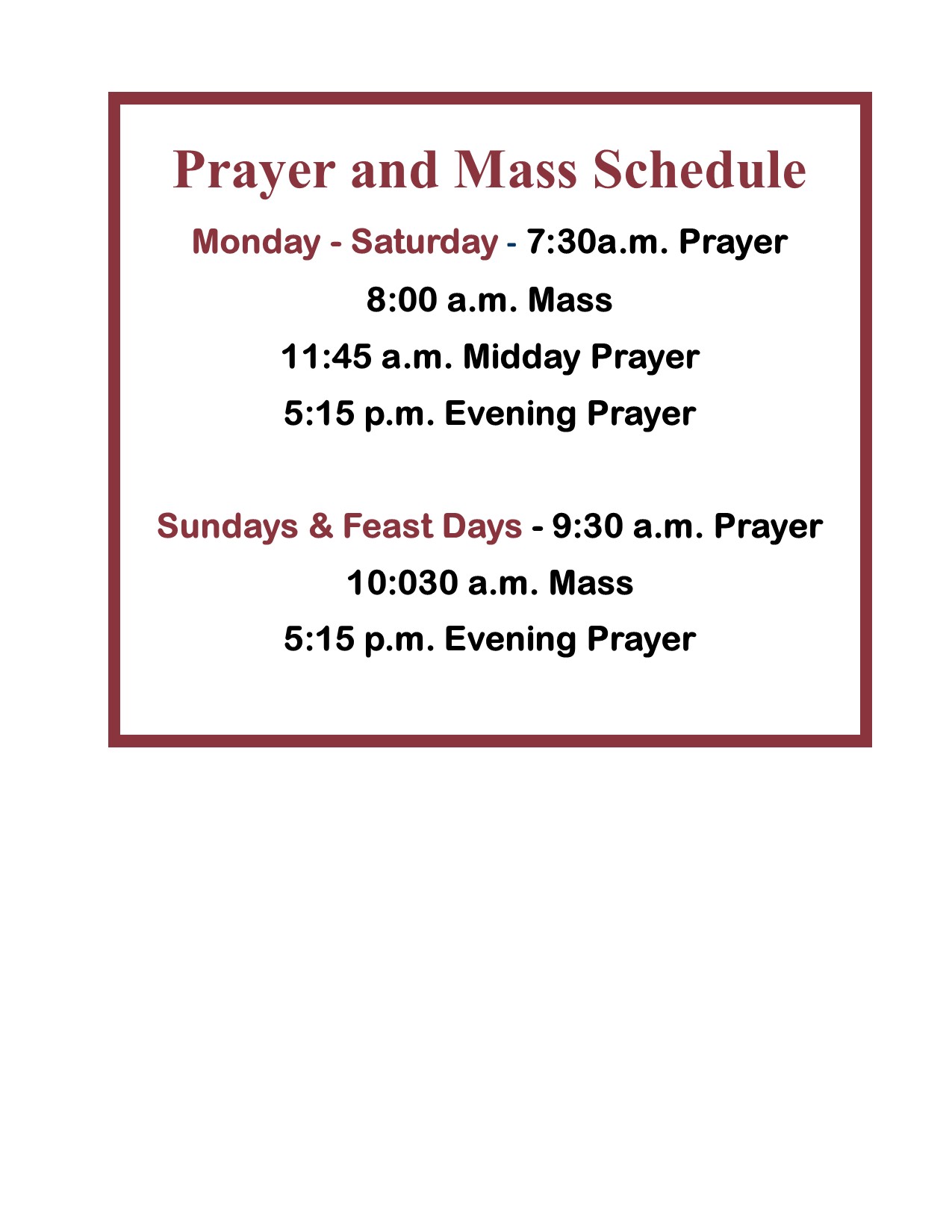
 Mass Schedule

Related Links

Copyright © 2026 · Benedictine Sisters of FL · Touching Lives Through Prayer and Service

Copyright © 2026 · Bendedictine Theme on Genesis Framework · WordPress · Log in