• Skip to primary navigation
  • Skip to main content
  • Skip to footer
Benedictine Sisters of FL

Holy Name Monastery
Founded 1889

Donate Now
  • Home
  • About Us
    • History
    • Being Benedictine
    • Benedictine Monasticism
    • Meet Our Community
    • Holy Name Academy-Alumnae
  • What We Do
    • Mission, Vision and Our Partners
    • Retreats
      • Invitation to Retreat
      • Accommodations
    • Volunteer Programs
    • Oblate Program
    • Spiritual Direction
    • Aqua/Hydroponics
    • More of Our Ministries
  • What’s Happening
    • Articles of Interest
    • Events
    • Newsletters
    • Brochures
    • Links
  • Support Us
    • Gifts of Support
    • Wish List
  • Stories Shared
  • Galleries
    • Photos
    • Videos
      • Benedictine Sisters of FL Videos
      • Other Videos
  • Contact Us

Homily

A Study of Contrasts

October 24, 2016 by Holy Name Monastery Leave a Comment

righteousnessFirst Reading  Sirach 35:12-14,16-      Second Reading  2 Timothy 4:6-8,16-18
Gospel  Luke 18:9-14

It is important to note at the outset of this particular reading to whom Jesus is speaking in this parable.  Luke says:  “Jesus also told this parable to some who trusted in themselves that they were righteous, and treated others with contempt.”

The whole parable is a study in contrasts between the prayer of the Pharisee and the prayer of the tax collector.  Jesus teaches us, his listeners, to pray in humility before God. He surprises his listeners, including us, by highlighting the tax collector as the example of faith – a model for prayer. He reminds us if we are too full of ourselves, there is too little room for God’s grace to work in us.

It’s interesting to notice that everything the Pharisee says is true. He has set himself apart from others by his faithful adherence to the law. He is, by the standards of his day what Luke and Jesus seem to term, righteous. So before we judge him too quickly, we might reframe his prayer slightly and wonder if we have uttered it ourselves. Maybe we haven’t said, “Lord, I thank you that I am not like other people…”, but what about, on seeing someone down on her luck, “There but for the grace of God go I”? It isn’t that the Pharisee is speaking falsely, but rather that the Pharisee misses the true nature of his blessing. As Luke says early on in this reading, he has trust in himself. His prayer of gratitude may be addressed to the God, but it is really about himself. He credits his righteousness entirely in his own actions.

The tax collector, on the other hand, does not even raise his eyes to heaven.  He knows that he possesses no means by which to claim righteousness. He declares he has done nothing of merit. So, he stands back, hardly daring to approach the Temple, and throws himself on the mercy of the Lord.  He seems not so much humble as desperate.  He is too overwhelmed by his plight to take time to divide people into categories.  He stakes is hope entirely on the mercy of God.

At the end of the day, the Pharisee will leave the Temple and return to his home righteous. This hasn’t changed; he was virtuous, honorable, and righteous when he came to the temple.  That hasn’t changed … he’s still righteous when he leaves the temple. His mistake, as Scott Peck says, is that he thinks that whenever he wants to he can pull “God out of his back pocket.”   On the other hand, the tax collector will leave the Temple and go back down to his home justified, that is, accounted righteous.  As Luke expresses it: he is exalted in God’s eyes because he humbled himself.

If you’re spiritually alive, and give credit where credit is due, you’re going to love this take on the parable.  If you’re spiritually dead, you won’t even want to hear / read it.
If you’re spiritually curious, there is still hope!

A Church goer wrote a letter to the editor of his hometown newspaper and
complained that it made no sense to him at all to go to church every Sunday………

He wrote: “I’ve gone for 30 years now, and in that time I have heard something like 3,000 sermons, but for the life of me, I can’t remember a single one of them.  So, I think I’m wasting my time, the preachers and priests are wasting their time by giving sermons at all”.

This started a real controversy in the “Letters to the Editor” column.  Much to the delight of the editor, it went on for weeks until someone wrote this clincher:

“I’ve been married for 30 years now….. In that time my wife has cooked some 32,000 meals…… But, for the life of me—- I cannot recall the entire menu for a single one of those meals.

[Or we might say: I’ve been in community x number of years… in that time I’ve been  nourished and supported by my Sisters thousands of times in hundreds of different ways …But, I can only recall a few instances in detail ….]

But I do know this: They all nourished me and gave me the strength I needed to do my work.   If my wife (my community) had not given me those meals, I would be physically dead today.

Likewise, if I had not gone to church – been faithful to my time of private and communal prayer – for nourishment, I would be spiritually dead today!”  AMEN!

~Reflection by Sister Roberta Bailey, OSB, Prioress
Continue Reading

Filed Under: Blog, Homily Tagged With: contrasts, God, Jesus, parable, Pharisee, Pharisees, righteous

Perseverance of Prayer

October 17, 2016 by Holy Name Monastery 1 Comment

luke-18-1-8-2First Reading    Exodus 17:8-13.                  Second Reading    2 Timothy 3:14—4:2
Gospel           Luke 18:1-8

Here we have a lesson about perseverance in prayer.  The point of the story is not that prayer is nagging God for what we want.  Nor is it meant to teach us that God is like the judge in the parable – worn down by requests and coerced to respond.

The key to understanding the meaning is found in the description of the judge as corrupt and unjust.  Since God can be neither, we must understand Jesus to be saying that if even an unjust judge responds to the persistence of the widow, how much more will God listen to our prayers.  God truly wants to hear our needs and respond generously.  Didn’t Jesus say: “Ask and you shall receive?”   Jesus is telling us that God wants us to be like the persistent widow, staying in relationship with God, confident that God hears and answers prayers.   And He understands how easy it is to lose heart.  He asks: “Will such faith, the faith of the widow, be found when the Son of Man returns?”

A beginning of the answer to the question appears to be that the Son of Man will find faith, but it may be in unexpected places, as it has been in the Gospel — not among the religious professionals or the ones certain of their own righteousness, but among the outsiders, the unlovely, the unclean, the ones certain of their sinfulness.

The parable suggests that a sign of faith will be a willingness to persist in prayer, as we see in this widow who persists against all odds in her fight for justice against the powerful judge.  Another sign may be in what we pray for: daily bread, the Holy Spirit, the coming of the kingdom, justice.

In his gospel, the evangelist Luke portrays widows as vulnerable but at the same time prophetic, active, and faithful.  The widow of this parable is forceful enough to get the justice she demands even from an utterly unjust judge.

If we could read the Greek version of this parable, we’d get a glimpse of Jesus sense of humor.  Now by “Greek” I don’t mean the language we refer to when we say “It’s all Greek to me.”  In the Greek Scriptures the judge gives in to the widow because if he doesn’t he fears she may give him a black eye.  Jesus uses a metaphor from boxing to make his point about the need to continue in prayer.  Be as persistent as a boxer in the ring when it comes to prayer.  Jesus gives a second teaching in the parable. If an unjust judge answers the pleas of a widow how much more will God answer our prayers.  We just don’t know WHEN.  Remember the words of the prophet Habakkuk?  “The vision still has its time and will not disappoint.”  God takes the long view … knows what is best and we may sometimes have to wait until we’re, as they say: “on the other side of the grass,” where we’ll understand that all along God knew best.

Luke seems to be very much aware of the real danger of giving up, of losing heart when we suffer injustice.  Luke is saying that if we pray hard enough and if we don’t lose heart, God will give us justice, right?  Well, does God?  Is there justice in the world?  In our country?  In our local communities, and (sadly) in our churches?  We have only to watch the evening news or read the day’s headlines to learn of multiple cases of brutality and injustice.

Could it be possible that God’s justice looks different than our justice?  Good question. Yet, somehow I trust that God gives us a righteous sense of justice–especially if it is a selfless sense of justice–one that is concerned with others.  Look at our widow. What does she do to obtain justice? She is persistent.  She is stubborn.  Perhaps we should call her attitude a kind of “holy stubbornness.”  She doesn’t give up – she doesn’t lose heart.  She keeps knocking at the judge’s door.

Now, I believe I don’t have to explain “stubbornness.”  Some of us had it sprinkled on us in our cradles!  We can prettify it, call it by another name, whatever we want: high principles, perseverance, tenacity, determination or just plain pigheadedness.  Yes, we seem to be naturally endowed with the “great gift of stubbornness” and the only thing God has to help us with is to learn how to be stubborn for the right causes — God’s justice.  In that case we may talk about a “holy stubbornness.”  That happens when we start not only to pray our prayers, but when we start to live our prayers.  In other words, we put our actions where our words are.  Victims of poverty, injustice or violence don’t want to hear about God’s commandments, about moral values, about self-denial, or even about justice.

Luke is right: it is easy to lose heart and go with the flow rather than go against the current.  It takes more than a petition at Mass to make our prayers effective. Think of all the corporate commitment action opportunities we are offered.  When we support our petitions with a donation to Christmas for the residents at Heritage, attend the Sunrise Prayer Vigil, write letters asking for legislative action on behalf of the poor, make a donation to the Soup Supper or volunteer at Daystar.

You may ask, or be asked: “can prayer move God’s arm?” Jesus turns this question back on us today and concludes his parable with the question: “Will the Son of man find faith when he returns?”  In other words he is asking: “Can prayer move your own arm?  Are you willing to put your actions where your words are?”  God always has relied on his children–people like you and me–to usher in His Kingdom.  God will give us strength, God will empower us, but we still need to stubbornly live out our prayers for justice.  The first reading reminds us we don’t have to be alone in our entreaties.  One of the beauties of living in community or being part of a faith community is that, like Moses’ (in tomorrow’s first reading) – we have friends who “hold our hands until sunset” – we have the prayer support of many others.  Are our prayers effective?  The answer lies squarely with us: “it depends on how effective we help make them.”


~Reflection by Sister Roberta Bailey, OSB, Prioress
Continue Reading

Filed Under: Blog, Homily Tagged With: Faith, God, Jesus, parable, perserverance, Prayer

Are You the One of Ten Who Found Salvation?

October 10, 2016 by Holy Name Monastery Leave a Comment

luke-17-11_19First Reading   2 Kings 5:14-17              Second Reading    2 Timothy 2:8-13
Gospel    Luke 17:11-19

This Gospel has much to say about gratitude and salvation.  All 10 of the lepers were given the gift of healing, but only one found salvation because he recognized the gifts he had been given and knew to whom he owed thanks.

At the outset of this story we know that these ten men are stuck – Stuck in a “no-man’s” land of being socially, religiously, and physically unclean having to distance themselves from but all other lepers.  By the end of the story, all ten were made well.  But one has something more. He has seen Jesus, recognized his blessing and rejoiced.  Because he saw what had happened, this man is not just healed, but is made whole, restored, drawn back into relationship with God, and his family, friends and neighbors. In all these ways he has won salvation.

Recently I heard a true story of gratitude that wrought salvation.  The lady who told the story works downtown in a large city.  Every morning, she encountered a middle‑aged woman in a shabby coat soliciting spare change from passers-by.  She greeted everyone with a smile and a pleasant “Good morning.”  The lady who told the story almost always gave her something.  After almost a year of this routine, however, the woman in the shabby coat disappeared.  My friend wondered what had happened to her.  .

Then, one beautiful morning, she was in her place in front of the church, still wearing the same, shabby coat. As folks reached into their purses or pockets for their usual donation, the woman stopped each of them. “Thank you for helping me all those days,” she said. “You won’t see me again because I’ve found a job.” With that, she reached into a bag and handed each one a wrapped package. She had been standing at her old spot waiting, not for a handout, but for the people she recognized so that she could give each of them a doughnut.  She recognized those who had given to her in her time of need. This is gratitude!

In our account today ten men encounter Jesus and called out (the scripture say “loudly” or yelled) “We want to be well!”  You may know that leprosy also attacks the vocal chords so that these men probably could only make a raspy sound. But that didn’t stop them from raising their voices and crying, “Jesus, Master, have mercy on us!” The gracious Lord Jesus will never turn a deaf ear to a cry like that!

Jesus appears to do nothing, but quietly directs the men:  “Go, show yourselves to the priests.”  Now, you have to understand that the local priest, besides leading worship services was also something of a health official – to test and certify a complete removal of the dread disease and then to announce that the person was healed.

As these men took heed of Jesus’ words and set out in search of the priest, one may have noticed his hand, once eaten away by the disease now tingled with life.  Or maybe he dropped his crutch when we saw his leg was back, healthy, whole and complete.  Their skin was beginning to clear and regain natural color.  One looked at the other, another looked at the rest, and the screaming started. The smiles broke into cheering, and a sweet madness. They raced off in the distance, hardly believing that the nightmare was finally over.

But in order for the miracle to happen, the men had to start a journey in faith before their circumstances had begun to change even one tiny bit. We are not told whether the ten lepers had a debate about whether or not to go. I can well imagine one of them arguing, “We’ll look like fools if we show up before the priest in our present condition!” Another countered, “Yes, but we’ve got nothing to lose; this is our only hope.” “But it hurts to walk on these leprous feet!” “I know, but if we do what He says, maybe we’ll be healed.” “But this isn’t the way He healed the other lepers. Why doesn’t He heal us in the same way?” “I don’t know, but we must obey.”

Maybe they didn’t have any such debate, since the text doesn’t record any, but at any rate, it says, “as they were going, they were cleansed.” It must have been a marvelous experience!

One of the men came back to Jesus.  The gospel does not make it clear whether he had seen the priest and been declared clean.  The evangelist tells us he praised God. He was thankful. He was public about it. He was loud – he wasn’t shy at all.

Why was he so loud? This guy had been forced to yell for as long as he’d had leprosy. Might have been years? He’d probably yelled so long, he didn’t know how to come to the Lord quietly, or even in a normal voice. When he came back and fell at the feet of Jesus, he was just louder than the normal person, and he was praising God.

He had reversed his steps, put his family on hold, put the priest on hold, and came back to the one who was the Cause of his celebration. His response, his thankfulness led to action.

Jesus asked: “Where are the other nine?”  They had got what they wanted from God in terms of healed bodies.  But, according to the story, they never returned to Jesus to receive salvation. They received the temporal benefit of healed bodies, but it is only to the one thankful leper who returned that Jesus proclaimed, “Your faith has saved you.” In the same way, it is possible to receive special blessings from God in answer to prayer, and yet to fall short of the best blessing of all. Thus when we realize that God has blessed us with some temporal blessing, we must not become satisfied with that and stop before we’ve thanked the Source of all blessings.

A story is told of a man who was lost in the woods. Later, he told how frightened he was and how he had even finally knelt and prayed. Someone said, “Well, obviously God answered your prayer?” “Oh, no,” the man replied. “Before God had a chance, a guide came along and showed me the way.”

~Reflection by Sister Roberta Bailey, OSB, Prioress
Continue Reading

Filed Under: Blog, Homily Tagged With: Faith, gift, God, gratitude, Healing, Jesus, lepers, priests, salvation

Which One Are You?

October 3, 2016 by Holy Name Monastery Leave a Comment

cookieman-personal-touches-matter27th Sunday (October 2)

First Reading  Habakkuk 1:2-3; 2:2-4      Second Reading  2 Timothy 1:6-8,13-14
Gospel  Luke 17:5-10

In this Gospel the disciples ask Jesus for an increase of faith. The faith that is being asked for is not to have a better knowledge of our catechism. What is being asked for is a much deeper and stronger trust and confidence that our God is near us – the firm conviction that God will always take care of his own.

Our participation in God’s plans is God’s grace to us—nothing more, nothing less. Even when God works wonders through us, with our mustard seed-sized faith, we must not seek praise.  When we are graced enough to cooperate with God, the work we do is nothing more than our obligation as faithful stewards of what God has given us.   And yet, our faith enables us to believe that what we have offered in service to God, as his servants, can be made to produce (like that mulberry tree in the midst of the sea) a hundredfold.

Our relationship with God is not about a bargaining agreement; a bartering or a buying and selling contract, about giving to God and getting in return. No, our relationship with God is one of total and unconditional love. The joy and satisfaction is not in what we can do to squeeze favors from God but in what we can give and share of ourselves.

The reason for this, of course, is that no matter what we do we are in God’s debt. The very energies with which we serve God are pure divine gift to us. We are “merely servants.” It’s not a 50/50 deal with God.  We can never do more than “our duty.” However much we give to God it is a small repayment for all that has already been showered on us.

We’ve heard many everyday heroes say something of this nature, haven’t we?  When they are awarded medals or accolades for a so-called heroic act, many say “I didn’t do anything special.  I just did what anyone in the same circumstance would do.”  But, would they?  Would we – jump into murky waters of an icy cold river, onto subway tracks in the path of an oncoming train, risk being attack by a vicious animal, rush into a burning building?  Would we respond to the need of the moment, let the Spirit, whom we sometimes call “adrenaline” kick in and come to the rescue?  Or, if we had the opportunity would we consistently perform  less noticeable actions like we’ve seen lately in the news: leaving a highly paid chef’s position to serve gourmet meals in a soup kitchen, insuring that 2000 poor families get Christmas gifts, spend our weekend to provide  free health and dental care to help make people smile and laugh.  We can hope that would not hesitate, and pray our faith would sustain us to respond: “we have done what we were obliged to do.”

Remember the story that goes: There were four people named Everybody, Somebody, Anybody and Nobody.  There was an important task to be done and Everybody was sure that Somebody would do it.  Anybody could have done it, but Nobody did.  Somebody got angry about that, because it was Everybody’s job.  Everybody thought Anybody could do it, but Nobody realized that Everybody wouldn’t do it.  It ended up that Everybody blamed Somebody when Nobody did what Anybody could have done. Which one are you?

Jesus’ story today indicates that lack of faith is not really the issue when we fail to respond to the needs of others. Faith is not measured by its quantity, but simply by its presence. A mustard seed sized faith will accomplish impossible things. The real need, Jesus says is for more obedience and humility. We should view ourselves as God’s slaves who owe Him simple and unquestioning obedience. And, when we have done what He requires, we should not get puffed up with pride in our great obedience, but should simply say, “We are unworthy slaves; we have done only that which we ought to have done.”  As Benedict says in his chapter on obedience: If you notice something good in yourself, give credit to God, not to yourself.”  Keep before you Benedict’s admonishment: “Do not aspire to be called holy before you really are, but first be holy that you may more truly be called so.”

It reassuring to know we can rely on God to uphold his promises.  Recall the words of Psalm 89 that we prayed earlier this week: “God promises: I will never take back my love; my faithfulness will not fail.  I will never break my covenant or go back on my promise.”   Or take as your mantra this week the words of Jeremiah the prophet:  “This I recall to my mind, therefore I have hope. The Lord’s loving kindnesses indeed never cease, for His compassions never fail. They are new every morning; great is God’s faithfulness.”  And perhaps spend some time contemplating whether, when there is a task to be done, you are a Somebody, an Anybody, a Nobody or one among Everybody….

~ Reflection by Sister Roberta Bailey, OSB, Prioress
Continue Reading

Filed Under: Blog, Homily Tagged With: anybody, everybody, Faith, God, Jesus, Luke, Mustard seed, nobody, servants, somebody

A Twist on a True-to-Life Story

September 26, 2016 by Holy Name Monastery Leave a Comment

luke16richmanFirst Reading  Amos 6:1,4-7   Second Reading  1 Timothy 6:11-16
Gospel Luke 16:19-31

The question is often asked, is this account of the rich man and Lazarus a historical account or is it a parable? Is there a difference?  Is it the true story of two men who lived and died during the time of Christ’s earthly ministry or is it a made-up story used by the Lord to drive home a point?  If we believe what most Scripture scholars hold true, we can say it describes an actual history of two men.

For you see, by definition, a parable is a true-to-life story used to illuminate a truth. This is true even if all of the details never occurred exactly as presented in the story. They are special stories that may, or may not, reflect historical events. Nevertheless, they must be true-to-life. By true-to-life we mean that a parable must be based on a real-life situation that the hearers are familiar with. In other words, the story itself has to be based on events that could have happened, whether they ever actually did or not.

Thus, a parable is a paralleled comparison.  It must be a true-to-life story in order for it to have any meaning to those who hear it. To try to use a fanciful story containing elements that have no basis to the world in which men and women live would only serve to confuse people rather than providing them with spiritual light.

A simple survey of Jesus’ use of parables reveals that He always used things that were familiar and commonplace in His time and to daily life of his listeners.  Recall the comparisons He used such as building of houses on rock or sand, using old or wine new skins, a farmer who sows seed that grow side by side with weeds until the harvest, yeast that permeates the dough, hidden treasures, fishing, a father’s forgiveness, a son’s regret and a jealous sibling, monetary debts, family life, weddings, a barren fig tree, a lost coin, a persistent neighbor, an unjust judge. While His hearers may not have made the connection to the truths the Lord was pointing out, they needed no explanation as to what the stories were about because they involved common everyday things to which they could relate. When the hearers of the parables perceived that there was an analogy between the story and their own situation, they were prompted to think about it and hopefully to respond by faith to the truth illustrated. Parables can be extraordinary and even shocking, but never unrealistic or fanciful.

When we come to this account of the rich man and Lazarus, we find a situation different from what is found in any of the other parables. Jesus’ hearers – which may have included the rich man’s brothers – could understand the contrast between the life of a rich man and a poor beggar. It was common to see beggars sitting by the road hoping for a handout, and they could easily identify the folks who had more than enough wealth to live comfortably. Then, as now, there was a stark difference between the lives of those who have an overabundance and those with nothing.  We can still grasp an idea of the great difference between the lifestyles of these two men. The vastness of the “great gulf” between them is not unknown to us.  Especially in third world nations people are literally starving to death living in the shadows of mansions and great wealth.

The hearers of this story could follow the contrast between these two men right up to the moment of their deaths. At that point, however, the situation changes drastically. The outcome was something that they could not relate to any life situations that they had ever witnessed. The state and location of the departed soul was beyond their life experiences.  What takes place after death is hidden from us. In this Gospel Jesus was revealing the reality of what takes place so He could drive home an important truth.  Many of Jesus’ hearers would have been familiar with the psalms but may not have made the connection to the words we read earlier this week: “They satisfied themselves while they lived; they will join the company of those who preceded them where the darkness lasts forever.”

Our dedication to our corporate commitment is living proof that we are learning the lesson Jesus is teaching … We share in the ministry of the compassion of Jesus when we provide hope and comfort to God’s people.  The moral of the story, I believe, is captured in the prompting of Joan Chittister when she asks: “What do we want to be caught dead doing?”

~Reflection by Sister Roberta Bailey, OSB, Prioress
Continue Reading

Filed Under: Blog, Homily Tagged With: Christ, God, Jesus, Lazarus, parable, rich man

Always There

September 19, 2016 by Holy Name Monastery Leave a Comment

fatheranddaughterFirst Reading  Amos 8:4-7            Second Reading  1 Timothy 2:1-8
Gospel (shorter form) Luke 16:10-13

The lesson here is trustworthiness: those who can be trusted in small things can also be trusted in great things. Benedict knew this lesson well – that’s why he instructs us: “treat all things as vessels of the altar.” If we handle furniture, dishes, sewing supplies and a paint brush with the same respect that we exhibit toward a chalice it is more likely that we will have that attitude of caring will extend to people.  When we hear stories of violence, abuse and disregard for persons, the root “red flag” behavior was often evidenced in childhood and behavior toward siblings or parents: hitting out, slamming doors, the classic “kicking the dog” behavior because the young person was mad at a classmate or the teacher.  The parent who withholds violence against an over-powering boss but deliberately runs over the bike in the driveway, or slaps his son or screams at her daughter for a triviality – that behavior can usually be traced back to disrespect and disregard for the toys, blocks and body-slamming in the guise of “we were just having fun.”

Respect has its seed in Benedict’s “treating all things as vessels of the altar.”   Think about it …  look at how  you treat and handle your belongings and community goods you’ve been given for use …  your personal spaces, the car you usually drive,  “common spaces” you use … are they as neat, clean and orderly as we expect the altar vessels and the chapel to be?

Respect for things matures into respect for persons which leads others to know they can depend upon us and trust us to “handle” them with respect.  We are trustworthy with the little things in life, thus we can be trusted in our interactions with each other.

The story goes that a little girl and her father were crossing a bridge. Her dad was actually kind of scared of heights so he asked his little daughter, ‘Sweetheart, please hold my hand so that you don’t fall into the river.’

The little girl said, ‘No, Dad. You hold my hand.’  ‘What’s the difference?’ asked the puzzled father.  ‘There’s a big difference,’ replied the little girl.  ‘If I hold your hand and something happens to me, chances are that I may let go of your hand. But if you hold my hand, I know for sure that no matter what happens, you will never let my hand go.’

In any relationship, the essence of trust is not in its bind, but in its bond.

When I was growing up in DeLand we lived 3 blocks from the main boulevard the best way to get from home to church – we had no car, we walked the two miles.  When, as an adult I drove the distance from the highway to where our house had been it seemed much shorter than my memory.  Why does that matter?  As is still typical today in parishes, our high school catechism classes were in the evening.   Until my 9th grade year, (I came to the academy when I was in 10th grade) my brother, three years my junior, and I had attended afternoon classes together.  Now, it was October and daylight savings time had ended and the walking home after class was in the dark – felt like the dead of night.  It wasn’t too scary until I reached the turn off to our street – no street lights, barking dogs that sounded like wolves, creepy noises of a rustle in the bushes.  I don’t know why, I didn’t have a flashlight.  I don’t recall that I talked about being scared … maybe rushed into the house like a banshee was chasing me?  But, the second week of classes, and every week thereafter until our clocks were sprung forward to daylight savings time, my father would magically appear at the corner of the main road to continue the journey home with me.    He sometimes made remarks about the foolishness of attending those classes when I already knew as much as the teachers… but he was there, and I knew I could depend on him to keep his vigil for my return.  And, I am sure that continues to confirm my belief that God is trustworthy and simply is “always there.”

~ Reflection by Sister Roberta Bailey, OSB, Prioress
Continue Reading

Filed Under: Blog, Homily Tagged With: always there, Benedict, God, respect, trust, trustworthines

  • « Go to Previous Page
  • Page 1
  • Interim pages omitted …
  • Page 83
  • Page 84
  • Page 85
  • Page 86
  • Page 87
  • Interim pages omitted …
  • Page 92
  • Go to Next Page »

Footer

Prayer / Newsletter / Info

 Contact Info

Benedictine Sisters of Florida

PO Box 2450
12138 Wichers Road
St. Leo, FL 33574-2450
(352) 588-8320
(352) 588-8443

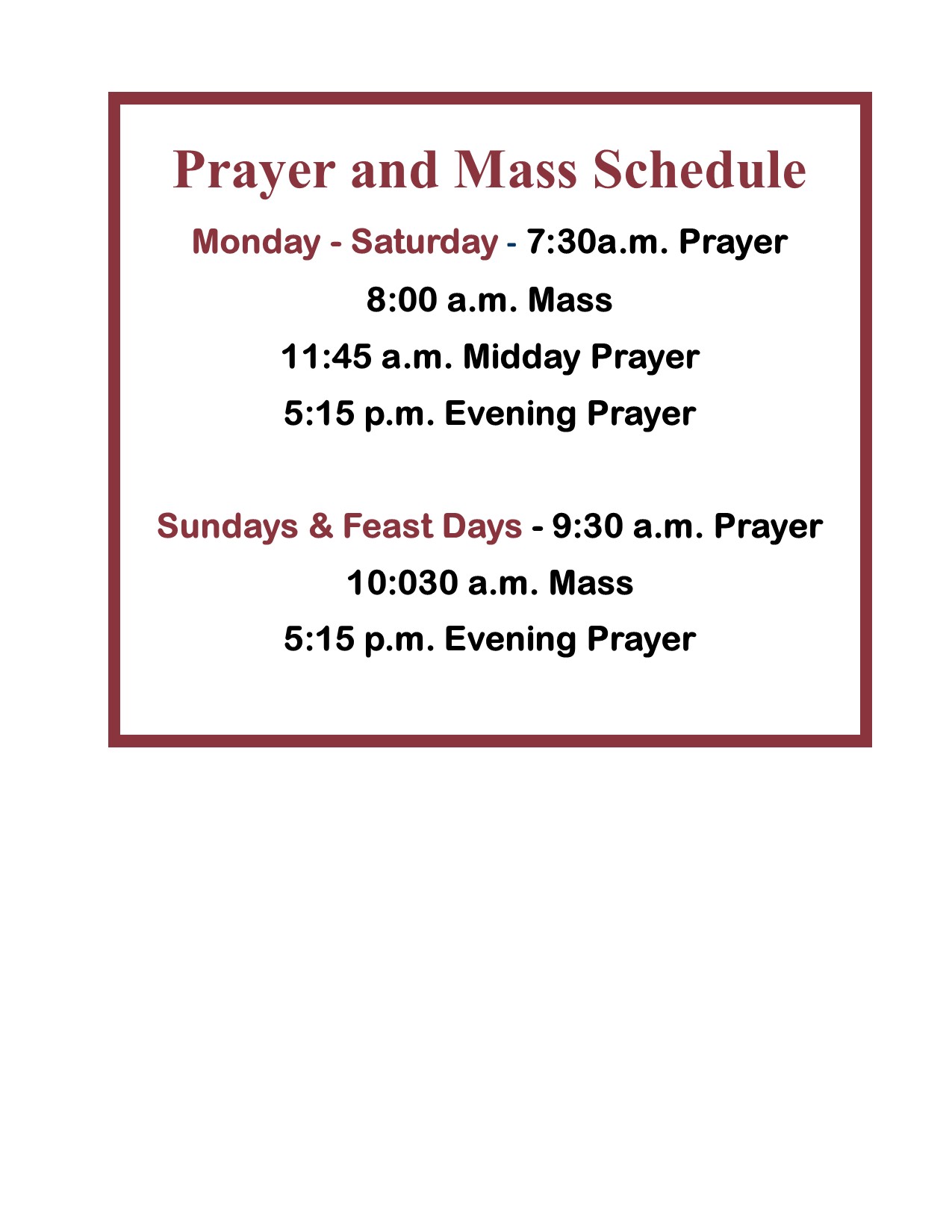
 Mass Schedule

Related Links

Copyright © 2026 · Benedictine Sisters of FL · Touching Lives Through Prayer and Service

Copyright © 2026 · Bendedictine Theme on Genesis Framework · WordPress · Log in