• Skip to primary navigation
  • Skip to main content
  • Skip to footer
Benedictine Sisters of FL

Holy Name Monastery
Founded 1889

Donate Now
  • Home
  • About Us
    • History
    • Being Benedictine
    • Benedictine Monasticism
    • Meet Our Community
    • Holy Name Academy-Alumnae
  • What We Do
    • Mission, Vision and Our Partners
    • Retreats
      • Invitation to Retreat
      • Accommodations
    • Volunteer Programs
    • Oblate Program
    • Spiritual Direction
    • Aqua/Hydroponics
    • More of Our Ministries
  • What’s Happening
    • Articles of Interest
    • Events
    • Newsletters
    • Brochures
    • Links
  • Support Us
    • Gifts of Support
    • Wish List
  • Stories Shared
  • Galleries
    • Photos
    • Videos
      • Benedictine Sisters of FL Videos
      • Other Videos
  • Contact Us

Homily

Second Sunday of Easter

April 4, 2016 by Holy Name Monastery Leave a Comment

christ is risen w tombWelcome to the Second Sunday of Easter.  Notice it’s “of”, not “after” .. because, you know this, Easter’s not a single day, or even an octave but a season of 50 days.

There’s no question that we know how to do Easter as an even: the question is … How are we at Easter as a way of life?

The great Easter truth we celebrate is not that we are going to live anew after death, but, by the power of Jesus’ resurrection we are new here and now!

“Here and now” – that’s easier said than done. If it’s any consolation, the first Christians: those who had the direct experience of our risen Lord don’t seem to have been much better at it than we are.  During the Easter season we’ll be reading a series of “post – resurrection” stories: the women at the tomb who seemed to have forgotten the “punchline”: that Jesus told them he would rise after three days. It took the angels to remind them of that rather important detail. And then they ran back to tell the disciples, but, the men didn’t believe them!  And, Mary in the garden?  She thought Jesus was the gardener

Imagine today’s Gospel scene.  It’s a week later.  Without warning, Jesus is in their midst – no time to run and hide under the table.  He’s THERE.  Someone’s first reaction was probably, who left that door open?  Immediately, Jesus “breathed on them”.

Some things we just can’t see. But we know they’re there anyway. Like the air when a gentle breeze caresses our cheek.  God’s love is sort of like the air, isn’t it? It fills us up –  even though we can’t see it – we can feel it in our hearts.  When Jesus breathed on them, Thomas who had missed Jesus’ first visit and wants to see Jesus with his very own eyes, expresses his belief. But Jesus reminds him of something very important.   Sometimes we just have to believe in things that we can’t see. We have a special name for that. We call it “faith.”

You may recall the words of several hymns that refer to the spirit breath of God: “Be our breath,” “fall afresh on me,” “whose breath is seed outpoured –  calling all things to birth,” “with your breath melt the frozen, warm the chill,”        One of my favorite Marian hymns often heard at Christmas, is sung by Amy Grant, entitled “Breath of Heaven.  It’s the story of Mary’s pondering the workings of the Incarnational Spirit within her.  Mary’s prayer becomes mine: “Breath of heaven, Hold me together, Be forever near me, Breath of heaven – Be with me now, lighten my darkness, Pour over me your holiness, for you are holy, breath of heaven.”

It has become for me a prayer: to be filled with the breath of God … And, that’s what Easter as a way of life is all about. And it’s a way of life we live one day at a time: one step at a time — trusting that even if we take a mis-step, we never journey so far from God that the life-giving breath of that Spirit is beyond our reach: even when that seems impossible to believe.

That’s the lesson we learn from Thomas who has gone down in history as “doubting Thomas” because he refused to accept the testimony of others, but demanded his own experience.  He has borne the brunt of almost two millennia of bad press because of His skepticism about the resurrection and Jesus’ appearance to the other disciples.  Yet, what did Thomas ask for that the others had not received?  They had seen Jesus. They had maybe had a chance to touch His wounds.  Why is Thomas ridiculed for his insistence that he see for himself?

I’m a little intrigued, actually, about how quick we are to make Thomas the poster child for faithless doubt. As a matter of fact, the rest of the bunch didn’t do any better.  Remember:  the women at the tomb, the men who didn’t believe the women’s story, Peter who runs back to see for himself …. and here are the “faithful” disciples, after the appearance of Jesus: still locked in the upper room.

Think about it:  why did Thomas come back at all. Whatever had taken him away from the community, he came back. And it was in the midst of the community that Jesus came to him, and without so much as a confession or absolution, offered him what he needed to believe: “Touch, me Thomas. Do not be faithless, but believing.”

One of Thomas’ great virtues was that he absolutely refused to say that he understood what he did not understand, or that he believed what he did not believe. There was an uncompromising honesty about him: he would never still his doubts by pretending they did not exist.

But, he refused to surrender to the fear, too, which kept the other disciples shut up in that locked room. He ventured out and then had the courage to come back – to face a community which had had an experience that he had not shared.  At first he insisted on his own experience of God.   Jesus knew what he needed – He extended his hand to him – not a hand out; but a hand up, the nudge Thomas’ needed to bolster his faith “my Lord and my God.”  This is our challenge, and our privilege, to figure out what people need –  to offer the comfort, security and peace that will bolster their faith in a loving God.  This, too, is the challenge the Good Shepherd extends to us on Divine Mercy Sunday: to lead people to green pastures, where, surely goodness and kindness and mercy may follow them all the days of their lives.”

With Thomas, and all whose faith wavers:  we pray, “Breathe on me breath of God, until my heart is pure. Until with you, my will and Yours are one – not my will but yours be done.”

~ Reflection by Prioress, S. Roberta Bailey, OSB


Continue Reading

Filed Under: Blog, Homily Tagged With: 50 days, Easter, God, Jesus, Lord, Mary, risen, Second Sunday, Thomas

Palm Sunday 2016

March 21, 2016 by Holy Name Monastery Leave a Comment

palm-sunday1There’s a saying you’ve surely heard:  “something just has to be said.”  In our Palm Sunday readings we discover those who are eager to say it, those who would say it if no one else did, and we see those who were determined that it not be said.

Let’s start with those who were eager to say it. The crowds who had seen Jesus’ ministry, his miracles, heard his teaching, even partially comprehended the meaning of what he was saying. Their lives had been touched and they were eager to speak and cry out “Blessed is he who comes in the name of the Lord.”  Their words were an acknowledgment that they were placing their hope in Jesus – their future, their security, their salvation.  They expressed that hope by throwing their cloaks in front of the donkey Jesus was sitting on. Loud words were on their lips in acknowledgement of Jesus as the Chosen One, the Messiah come to deliver them.   The palm branches that padded the path were, in and of themselves, but a symbol; their worship was in their words and actions.

We know there were also those in the time of Jesus who were determined that some things not be said – those who just had no stomach for acknowledging that Jesus was the Messiah – the one who deserved what they considered a bunch of “hoopla.”

That spirit is in our culture today to. We hear voices that say “Just keep your religion to yourself. And, whatever you do, don’t be loud about it.”   We hear it expressed in choices to ignore history, disbelieve the evidence of global warming, choose to turn their backs, or worse their hearts, against persons of other cultures, upbringing, and color. Modern-day Pharisees have learned not to listen to it; to remain silent – to let the chips fall where they will as long as they don’t land in their back yards.

Thank God for the Thomas Mertons and the Joan Chittisters and Pope Francis in our day; for websites and blogs like “Climate change” and others that keep us alert to issues of injustice and crimes against humanity and the very earth itself: immigration and trafficking and fracking and the list goes on.  If those who are divinely gifted with the ability to speak remain silent, then the voice-less gifts of creation will cry out in “silent speech.”   We recall that Scripture tells us that when Jesus died on the cross, the Pharisees did not want it acknowledged that this Jesus they’d crucified was the Son of God. Even the disciples had turned silent, fled and hid.

But, what did happen? The Sun cried out the only way it could – by becoming dark from the 6th to the 9th hour.  The rocks cried out the only way they could, the earth shook, graves were opened and saints arose to give glory to God.  The temple cried out in the only way it could by tearing in two, top to bottom, the curtain that separated the holy from the unholy rendering it a useless monument to a ministry that was no longer valid.

Even the cross on which Jesus was hanging spoke out, proclaiming to all who saw it:  “This is the king of the Jews.”  Now unbelievers like the Centurion would cry out “surely this was the Son of God

The point is this: If we remain silent, as they say: “to keep the peace” – if we refuse to put our faith into words, creation will have to speak out. Some things just have to be said, and they will be said even if we do not say them.  Will those who are gifted with words use that gift, or will the rest of creation have to do it the only way that it can, by upheaval?

Palm Card PicWhen you participate in the Palm Sunday procession, pray for those who have no sense of who Jesus is and what marvelous things He has done for us.  We’ll wave our palms: We’ll sing Hosanna and look ahead to the Easter miracle.  Keep the palm and use it to remind yourself of who you were on Palm Sunday.

Gaze on your palm frond this week as you take assessment on your personal Lenten resolutions.  Note its color, its tapering shape, its flexibility – think about what it can become: a decorative cross, a floweret or hat to shield us from the sun’s penetrating rays.  Did you see a difference this year in your participation in our community activities?  Was it as whole-hearted as it might have been?  Did you make generous donations to our collections for Daystar and AIM?  Did the Corporal Works of Mercy get a little more attention this Lent?  How do you foresee yourself carrying forward the changes that, with the help of God’s grace, you have practiced for 6 weeks – that’s how long it takes to form new habits.  So the question is: Did it take?  Will it be a lasting change?

When times get tough, gaze at your palm frond to remind yourself of who you could be. Not the person in the crowd who yells out what everyone else is yelling, but that person who believes what she said on Palm Sunday, and who will follow Christ on the journey wherever it leads.

~Reflection by Prioress, Sister Roberta Bailey, OSB
Continue Reading

Filed Under: Blog, Homily Tagged With: God, Jesus, Lent, Messiah, palm frond, Palm Sunday, Pope Francis

$1 Million Dollars Motivated a Boot Scoot’in Celebration!

March 14, 2016 by Holy Name Monastery Leave a Comment

CheckPresentationThe Benedictine Sisters of Florida’s Hoedown event on March 4th was over-the-top!  Over 160 attendees enjoyed good food, home-made desserts, square and line dancing, auction bidding and awesome entertainment.  It was fun for all ages!

With country music accompaniment, Faith Pridmore in boots and cowgirl hat boot-scooted across the stage to introduce John Picciano, chair of the Future is Now Campaign.  The purpose of the $1,650,000 campaign is to fund an additional wing onto Holy Name Monastery.  We have been challenged soon after the building the new Holy Name Monastery in 2014 to have enough rooms for large groups wanting to stay for a 2, 3, or 4 day retreat and women desiring a live-in experience with our Order.

As a graduate of Saint Leo University and former priest with the Orlando Diocese, John shared his feelings about the Sisters and their influence on his life.   Then he called Sister Roberta to the stage and presented a $1 Million check for the Sisters and their construction project!

 John Picciano has been a friend of the community since his days as a student at Saint Leo University.  He is the CEO of Oglethorpe, Inc., an inpatient multi-hospital system dedicated to substance abuse care and counseling.  John has been doing God’s work helping individuals and families throughout his career.  His profound gift brings the total raised for the campaign as of March 4, 2016 to $1,329,896.  God is good!

Of course with the presentation, a standing ovation followed, red napkins encircled heads and the party really got started!  $1 Million Dollars got lots of people up danc’in!

With just $320,104 to go, please consider being a part of helping the Benedictine Sisters of Florida spread God’s Word to all those who come seeking spiritual guidance, peace and love.

Continue Reading

Filed Under: Blog, Homily Tagged With: $1 million, $1 million dollar, Benedictine, donation, Future is Now, Hoedown, John Picciano, sisters

Are You In Danger of Becoming a Pharisee?

March 14, 2016 by Holy Name Monastery Leave a Comment

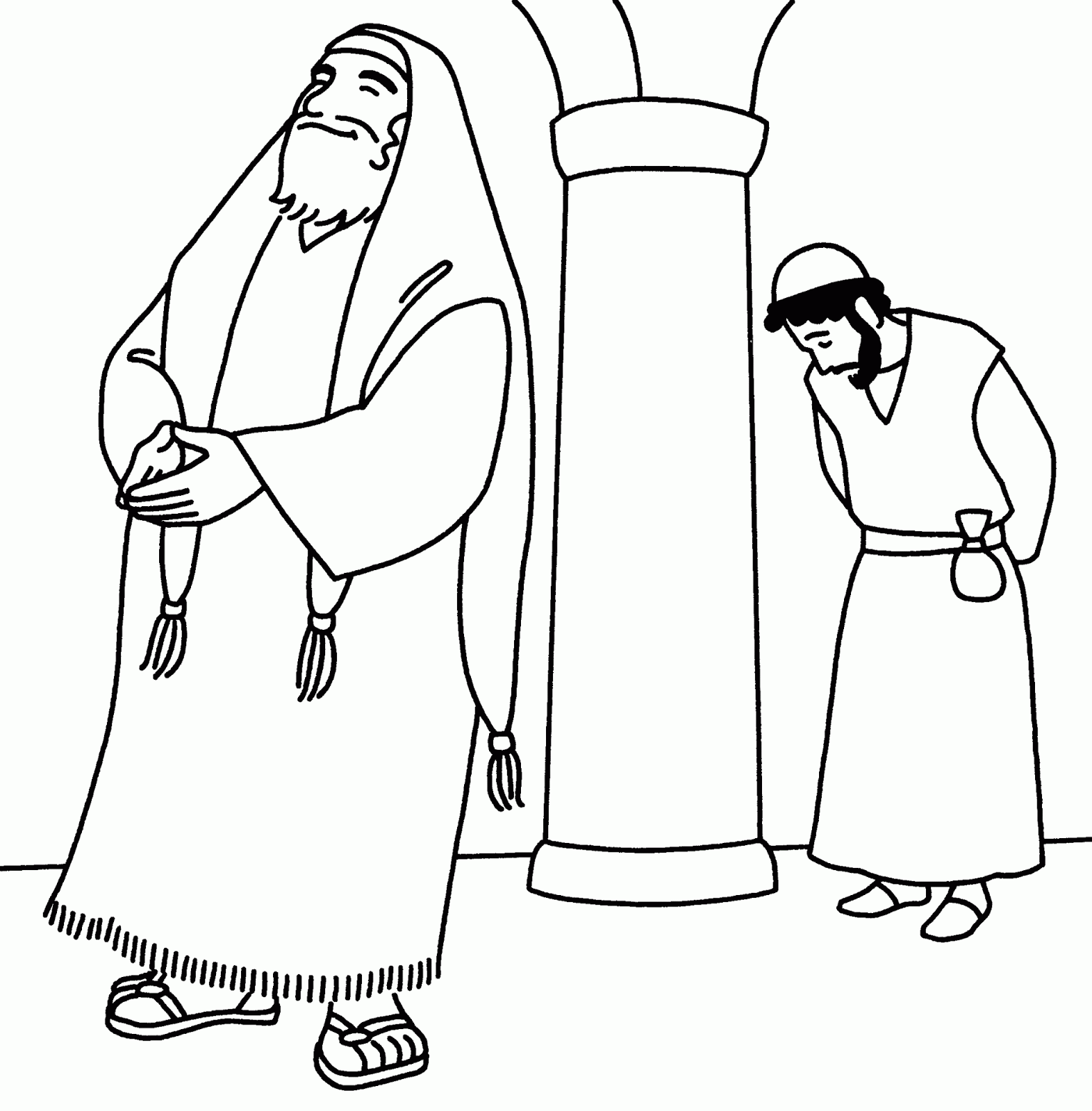
It’s pretty easy to spot a Pharisee, and we might not like it to admit it, but we can all behave like a Pharisee if we’re not careful.   How will you knowPharisees if you’re a Pharisee?

If your official title is longer than your given name.

  • If you’re willing to be merciful – once.
  • If you feel your rules are the REAL rules.
  • If everyone outside your immediate circle, and most within it, are always wrong.
  • If God’s still small voice… sounds exactly like your own.
  • If you feel all the apples are spilled out of your cart when a rule is bent.
  • If you know the Word of God, but not the God of the Word.

You see, the Pharisees of Jesus’ day had started out wanting TO PLEASE God. They began in a day when Israel was deeply tainted with immorality and unrighteousness and somebody needed to stand in the gap. And the Pharisees stepped up to fill that need. And in an era where many Jews had abandoned the law of God, the Pharisees became like prophets to their people pointing them back to the Law of Moses and obedience to God’s will.

The Pharisees were THE religious people of the day and they took their “faith” seriously. Any time people take their faith seriously, it’s not a big step over the line from pleasing God to disobeying God.

So we want to be careful WE don’t do that too.  You see the Pharisees didn’t set out to make God angry.   They wanted to obey every one of God’s commands. They didn’t wake up one morning saying: “I’m going to make God mad today!”  It was just that their thinking was warped.  Rules had become all-important – People were UNIMPORTANT.  When the Pharisees brought this adulterous woman to Jesus… they didn’t care about her. A rule had been broken. She needed to be exposed.  She was only a tool – an object lesson they wanted to use to get at Jesus. They really hated Jesus.

In their warped thinking, God’s agenda was what they decided. And, they believed as long as they kept the rules their personal sins could be covered up. In reality they had no intention of stoning the woman … she was just a prop.  In fact, they couldn’t stone her. Once Rome conquered Judah, Judah became a Roman territory, and under Roman law, only the Roman governors had the authority to condemn people to death. You only have to look at the Crucifixion of Jesus to see that truth.  Do you remember who’s approval the Pharisees and the teachers of the Law needed to have Jesus executed? That’s right – Pilate. He was the Roman Governor at the time.

It was a perfect trap.  They didn’t care about the woman. And they didn’t care about Jesus. In their minds both of them had broken their rules… and both needed to be destroyed.

You need to understand, these Pharisees saw Jesus as an enemy of THEIR god. Their god was on THEIR side… and so anyone who opposed them was opposing God.

We can end up making Jesus our enemy by substituting our personal agenda for His. And if you’re not careful… you’ll not even know you’ve done it.  BUT there is one symptom of this dangerous attitude. It should be like a road sign saying “Don’t go there.”

When you get mad people don’t listen to you. Your opinion is being ignored. Things aren’t going YOUR way.  That can make you really angry. YOUR agenda is obviously the right agenda.  If you’re right it follow the other must be wrong.  If you feel that’s happening, pay attention. It’s a sign that you’re in danger of becoming a Pharisee.

The Pharisees had convinced themselves that if they could “look” good on the outside, that was as good as “being good” on the inside.  They fooled themselves into thinking that obeying certain rules was just as good as being righteous before God.  In fact they got most of the rules right.  By contrast, a Pharisee could tell you were going to hell – and you could tell they were thinking “got what you deserved – glad you are on your way.”

As this true story illustrates, warped thinking can lead you down a Pharisee-like path:

A 4-year told his mother” “Mom, I’m not gonna be like those bad guys Jesus was talking to; I’m not going to sin anymore.”   “Well, that’s very nice,” (she said). “What made you decided not to sin anymore?”  He answered: “Cause Jesus said if you don’t sin, you can throw the first stone and I want to throw the first stone.”

Reflection by Prioress, Sr. Roberta Bailey, OSB
Continue Reading

Filed Under: Blog, Homily Tagged With: Faith, God, Jesus, Lent, Pharisee

The Prodigal Son

March 8, 2016 by Holy Name Monastery Leave a Comment

prodigalIf you were around before Vatican II for long Latin choir rehearsals, you may recall the melody of the antiphon that announced the Fourth Sunday of Lent.  It’s one of those that stays with you … (sing) Laetare translates from Latin to English “Rejoice”.   This is also known as “Refreshment Sunday” – a day when the austerity of Lent is relaxed a little, and the violet vestments of Lent can be replaced with rose-colored ones.   A special kind of fruit cake was often served on this Sunday modestly breaking the Lenten Fast.

According to another old tradition, although it probably is not on anyone’s list of approved feast days, is “Laugher Sunday” or “Holy Humor Sunday” – a day celebrating the big joke that God pulled on Satan.  Thus the name: God’s Joke or the Easter Laugh – a day to lighten up, relax, and recall the joy and the goodness of the Lord.  (We anticipated it a bit with our Hoedown!)  In honor of Laughter Sunday, here’s one to tickle your funny bone.    During a lesson on Easter, a religious education teacher asked the class, “What did Jesus do on this day?  Getting no response, she prompted: It begins with R. “I know!” blurted out a child: “Recycle.”

But on a more serious bent … The context of today’s Gospel is not to be made light of.  Sinners and social outcasts were “all seeking the company of Jesus to hear what he had to say”. The Pharisees and Scribes, who were the “good and religious” people, were shocked and disturbed. “This man welcomes sinners and [even worse] eats with them.” By their standards, a “good” person avoids “bad company”. To be quite honest, don’t we think the same? If so, then we are not thinking like Jesus.

We typically title this Gospel story the “Prodigal Son” but, in fact, the emphasis is less on the son than on the father, who clearly represents God and Jesus.

No one can deny the appalling behavior of the younger son in this Gospel. He took all that his father generously gave to him as his inheritance and used it in leading a life of total debauchery and self-centered indulgence. Eventually, he had nothing and was reduced to living with pigs, something utterly abhorrent to the Jewish mind, and even sharing their slops, something even we would find appalling. “Served him right,” might be the reaction of many, especially the good and morally respectable.

This, however, is not the reaction of the father, who has only one thought in his mind – how to get his son to come back to where he belongs. The father does not say: “This son has seriously offended me and brought disgrace on our family. He better not come crawling back here.  I disown him!”  Instead he says: “My son went away, is lost and I want so much to have him back.” He stands in the doorway of his house many long hours, watching, waiting, longing … His love for his wayward son has not changed one iota.

There is no force involved. The police are not sent out. There is not an “Amber” alert. Servants are not instructed to haul him back. No, the father waits. It is up to the son himself to make the crucial decision: does he want to be with his father or not?

Eventually he “came to his senses”, that is, he realized the wrongness of what he had done. He became aware of just how good his father had been. The process of repentance had begun. He felt deeply ashamed of his behavior and then, most significant of all, he turned around to make his way back to his father.

The father, for his part, filled with compassion for his son’s experiences, runs out to meet him, embraces him and brushes aside the carefully prepared speech the son had prepared. If the son had known his father better, he would have realized that such a speech was unnecessary. Immediately, orders are given to bring the very best things in the house and a banquet is laid out.   This is forgiveness on the part of both the father and the son – a return to where each ought to be in relationship to the other.

This is where the elder son comes in. He simply cannot understand what is happening. “It’s just not fair!” How many times have we heard this spoken or, be truthful, felt in our hearts?  “It’s not fair, just because she’s the baby; you didn’t let me stay out that late when I was her age!”  And the litany grows.  We challenge our parents and one another’s generosity, operating from the perspective of limited resources. If she gets it, perhaps there won’t be enough for me.

Jesus wants his hearers (us) to understand that this is not how it is with God’s mercy, love and forgiveness. God offers love to all of us in abundance. The forgiveness of the father in the parable is an image of God’s love for us: generosity beyond measure!

By our standards, even God is unjust.  In fact, he is corrupted by love! That’s fortunate for us!  Supposing we went to confession one day and the priest said, “Sorry, that’s it. No more forgiveness, no more reconciliation. You’ve used up your quota. Too bad! ” Of course, it’s not like that.  Thankfully there is no limit to God’s forgiveness, mercy and love.  God has a deep desire to forgive – to be totally reconciled with us when we’ve severed the bond of relationship.  There is always a place in God’s company for us.  The question is: Do you truly believe that God acts this way towards us?  Can we humbly accept divine mercy without jealousy, knowing that God’s love for another does not diminish the love shown and showered upon us?

4th sunday web

Continue Reading

Filed Under: Blog, Homily Tagged With: Easter, forgiveness, God, Jesus, Lent, love, mercy, Prodigal son

Trying Not To

February 15, 2016 by Holy Name Monastery Leave a Comment

boy-eating-cookieI think we all understand what temptation is.   Imagine there’s a little boy in a grocery store who walks by an open pack of peanut butter cookies. The clerk notices him eye the cookies.  “What are you doing there?” “Nothing,” replied the boy. “It looks to me like you’re trying to steal a cookie.” “No,” said the boy, “I’m trying not to.” That’s temptation!

We understand that temptation leads to trouble.  Such was the plight of the man that I read about in Reader’s digest.  This man said he was shopping in the mall with his wife when a shapely young woman is a short, form-fitting dress walked by.  He followed her with his eyes.  Without looking up from the item she was examining his wife asked, “Was it worth the trouble you are in?”  That’s the trouble with temptation.

How many of us have shrugged and said, “The devil made me do it!” and used that as an excuse when caught doing something we weren’t supposed to?  It’s a convenient defense.  But there’s one problem: the devil can’t MAKE us do anything.  He may be clever, but he’s not all powerful.  It may feel that way, however, when we’re dangling on temptation’s hook, because the devil has a tried and true strategy for luring us into his net.  First, he lays out the bait.  He knows us like a skilled fisherman knows fish.  He notes our habits, observes our hangouts; then he drops a custom-made lure right in front of our noses.

Then, comes the appeal.  He can’t make us bite, but he does know what happens when we catch a glimpse of the tantalizing bait … like the snapshot promo on TV.  We’re drawn in, we linger over it, we toy with the idea, roll it over in our minds until it consumes our imagination … we just HAVE to know what the gossip tid-bit was we overheard is all about.

Now the struggle really begins.  Our conscience jabs us in the ribs, the red flags go up, the warning sirens go off but the invitation looks so delightful.  What do we do?

Benedict knew about this, didn’t he?  Remember in chapter 43 where he warns if the monastic comes late for chapel, if though ashamed, she should still come inside lest she be tempted to return to bed and sleep.  Or, worse he says, settle down outside and engage in idle talk, thereby giving occasion to the Evil One.  They should come inside so that they will not lose everything and may amend in the future.”

Either we will resist or yield, swim away or swallow the temptation whole.  When you give in you know the feeling of emptiness and the pain that sticks in your neck.  But, be alert when you do resist – be ready for the temptation to come from a different direction.  However, when you’ve resisted you will know a feeling of freedom that envelopes you.

It seems there are three general kinds of temptations that our adversary still uses. He often tries to work his wiles on the heels of a spiritual high point in our life.  Or it may come at a time of physical weakness, or when we’re are alone and are more susceptible to temptation – then be prepared for a major attack.    Jesus experienced the devil’s temptation, just after his baptism and the Father’s affirmation; when he was hungry following his 40-day fast, when he was alone in the desert.  Thus he could sympathize, no, –  empathize with us,

This Gospel lesson alerts us to the dangers – the allurement of the devil – to be tempted to be independent – like a two-year-old’s “I’ll do it myself.”  Or we may give into temptation to take the easy way out.  It will be less suffering, no struggle, no sacrifice … why work to conquer our self-will when the world could be handed to you on a silver platter – give you a free ride?

The one thing common to all three of the temptations described is that Satan attempted to distract Jesus from his mission and to destroy his relationship with his Heavenly Father.  You may have to fight the battle more than once to win it.  Don’t give up!  There is truth in the story of what Martin Luther said when he was asked how he overcame the devil.  “When the devil comes knocking at the door of my heart, asking who lives there,” Jesus comes to the door says: “Martin Luther used to live here, but he has moved out.  Now I live here.”  When Christ fills our lives Satan just has no entrance.

You may have learned this little ditty of a prayer as a child.  It’s still a good one for nightly protection:  I liken it to a child’s compline (evening prayer) –

“Matthew, Mark, Luke, and John,
Bless this bed that I lie on.
Before I close my eyes in sleep,
I give my soul to Christ to keep.

Four corners to my bed,
Four angels ’round my head,
One to watch, one to pray,
And two to bear my soul away.

I go by sea, I go by land,
The Lord made me with his right hand,
If any danger come to me,
Sweet Jesus Christ, deliver me.

For he’s the branch and I’m the flower,
Pray God send me a happy hour,
And if I die before I wake,
I pray the Lord my soul to take.


Continue Reading

Filed Under: Homily, Prayer Tagged With: Benedict, devil, Jesus, Lent, Prayer, satan, temptation

  • « Go to Previous Page
  • Page 1
  • Interim pages omitted …
  • Page 86
  • Page 87
  • Page 88
  • Page 89
  • Page 90
  • Interim pages omitted …
  • Page 92
  • Go to Next Page »

Footer

Prayer / Newsletter / Info

 Contact Info

Benedictine Sisters of Florida

PO Box 2450
12138 Wichers Road
St. Leo, FL 33574-2450
(352) 588-8320
(352) 588-8443

 Mass Schedule

Related Links

Copyright © 2026 · Benedictine Sisters of FL · Touching Lives Through Prayer and Service

Copyright © 2026 · Bendedictine Theme on Genesis Framework · WordPress · Log in