• Skip to primary navigation
  • Skip to main content
  • Skip to footer
Benedictine Sisters of FL

Holy Name Monastery
Founded 1889

Donate Now
  • Home
  • About Us
    • History
    • Being Benedictine
    • Benedictine Monasticism
    • Meet Our Community
    • Holy Name Academy-Alumnae
  • What We Do
    • Mission, Vision and Our Partners
    • Retreats
      • Invitation to Retreat
      • Accommodations
    • Volunteer Programs
    • Oblate Program
    • Spiritual Direction
    • Aqua/Hydroponics
    • More of Our Ministries
  • What’s Happening
    • Articles of Interest
    • Events
    • Commemorative Bricks
    • Newsletters
    • Brochures
    • Links
  • Support Us
    • Gifts of Support
    • Wish List
  • Stories Shared
  • Galleries
    • Photos
    • Videos
      • Benedictine Sisters of FL Videos
      • Other Videos
  • Contact Us

Rule

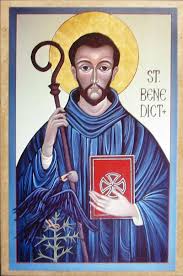
Summer Feast Day for Saint Benedict

July 11, 2022 by Holy Name Monastery Leave a Comment

Today we Benedictine will celebrate the summer feast of St. Benedict.   I’ll pass on the Gospel from Luke on Jesus’ lesson of the Good Samaritan and his lesson on being a good neighbor.  I’d like to share some thoughts on Benedict’s opening word LISTEN which seems like a first step to being a good neighbor.  Now, those who follow the calendar of the saints may question did we not celebrated St. Benedict back in March.  Yes, the very same one, the twin of St. Scholastica.  You see that date usually falls during Lent when the church does not smile on a grandiose celebration with Alleluias and full festivity.  In 1981, reaffirmed in 1989, the Council of Benedictine Abbots decreed that July 11th henceforth be celebrated as the Feast of Benedict, Patriarch of Western Monasticism.

Saint Benedict, in his Prologue to the Rule, addresses those who “long for life.”  His advice is “Keep your tongue free from vicious talk and your lips from all deceit; let peace be your quest and aim.” The gift of speech is one of the most powerful gifts God has given us, but it probably evokes less gratitude than any other.  We need to be aware that the habitual use of speech tends to make us unconscious of the many times our speech verges on being critical, or, to use the adjective in the psalm, “vicious” talk.  Even a benign phrase of speech can turn vicious sound like anger brewing when spoke in a harsh tone of voice.

Not many of us are humble enough to make amends for wounding words spoken.  We’d rather depend on time and the good will of the other to wipe out what has been said.  However, the truth is that the wounds of hurtful words or a harsh tone can never be totally erased.  Despite our best efforts to heal relationships, the scars remain.  In the latest issue of LCWR Occasional Papers one of the authors refers to Armand Gamache, the detective featured in a Louise Penny’s series of novels.  Gamache insists to his new detectives that there are four statements that are hard to admit, harder to say aloud.  But they are the key to opening ourselves to the truth and the beginning of effective communication.  What are they?  “I was wrong.”  “I’m sorry.”  I don’t know.” “I need help.”  But if our words do not come from a humble heart they will fall on deaf ears.  Says Benedict: “be serious, be brief, be gentle, be reasonable.”  A 20th century Russian Orthodox monk wrote: “When we listen to someone, we think we are silent because we are not speaking; but our minds continue to work, our emotions react, our will responds for or against what we are hearing.”   Oblate Rev. Donald Richmond, in his paper “The Fool with Words” offers this thought: “Living without speaking is better than speaking without Listening.”

The real silence that we must aim for as a starting point is a complete repose of mind and heart and will.  But then one wonders what happens to spontaneity if we engage in a chat without thinking? Jesus assures us that out of the contents of our heart our mouth will speak.  If we guard our hearts from evil and our minds from negative thoughts, our words will arise spontaneously without guilt, reflecting the goodness we have stored away.  God alone utters the perfect word, the speech without fault.  By pondering the perfections of Jesus, we come to own the good word of which the Psalmist speaks: “My heart overflows with a good theme; my tongue is ready like the pen of a scribe.” (Ps 45:1)

Oprah Winfrey in What I Know For Sure offers a very “Benedictine flavored” thought to ponder. When you make loving others the story of your life, there’s never a final chapter, because the legacy continues.  You lend your light to one person, she shines it on another and another and another. And …  in the final analysis of our lives – when the to-do lists are no more, when the frenzy is finished, when our e-mail boxes are empty – the only thing that will have lasting value is whether we’ve loved.

~Sister Roberta Bailey, OSB, Prioress

Continue Reading

Filed Under: Blog, Front Page, Homily Tagged With: Feast Day, July 11th, listen, Oprah, Oprah Winfrey, Rule, st. benedict, Summer Feast Day for St. Benedict

Give It a Second Chance

March 21, 2022 by Holy Name Monastery Leave a Comment

This weekend’s Gospel is asking us to take a good look at ourselves.  The tree in the parable is showing signs of life but it bears no fruit.  We ask ourselves: Is that me?  Am I barely managing to “hang in there?”   Am I being called to more than that?  Yes, God has higher hopes for each of us,  if we will but give grace a chance.

We can ask ourselves, for instance,

  • Am I a good or sour influence within my community (or my family circle)?
  • How do I relate with outsiders? Is my presence a positive element or do I fall into the gossip and negativity trap?  Do I pass judgment without giving God credit for knowing the whole story?
  • What is my attitude towards people I do not know or who aren’t “useful” to me?
  • What kind of contribution (including being physically present) do I make to the life of this community?
  • In general, what kind of contribution do I make to our greater society? What COULD I be doing?

We need to realize that God always and everywhere loves us.  But that love is only fully completed in us when we become a genuinely loving and caring person, one who loves both God and others in word and action.  We have the choice to open ourselves and come closer to God, to experience the gift of LOVE personified in Jesus.  The choice is up to us.  God’s love is there for the taking.  What are you waiting for?

Today we will celebrate St. Benedict’s day – in muted tones since it’s Lent.  Benedict is recognized as a man of great wisdom, compassion and common sense.  It is the spirit of Benedict’s Rule that has survived because Benedict, even in his youth, had a deep understanding of human psychology.  A glimpse into his early years lets us know he spent much time with his grandparents who lived a few miles from his home.  Along the hilly trek to their summer home, he and his twin sister Scholastica passed the huts and caves where hermits lived.  You can bet that their curiosity would have brought them back over the years to visit with both male and female hermits.  It is evident from the Rule that Benedict absorbed the wisdom and practical advice from this older generation.  He tempers discipline with compassion and he recognizes the spiritual quest as a joyful pursuit of God within the structures of ordinary life.  It is this joyous delight in everyday spirituality that makes the Rule come alive for so many.

Portions of his Rule shows us he had the cultivation traits of the gardener in our Gospel having mercy on his fruitless fig tree.  We know that after some time of living with his original Rule, he added advice based on his lived experience with a great variety of characters.  Imagine having to warn his men not to sleep with knives, to wear clean underwear on a trip.  His prudence shines through when, in so many words, he says: this is what works for us now – if our daily schedule and the details of communal living -don’t fit your situation, adapt it.

Pope Francis has reminded us more than once of something we know deep down – sometimes, especially in the midst of trouble – we tend to forget.  He says: “There are no situations we cannot get out of.  We are not condemned to sink into quicksand, in which the more we move the deeper we sink.  Jesus is (always) there, his hand extended, ready to reach out to us and pull us out of the mud, out of sin, out of the abyss of evil into which we have fallen.  We need only to ask for the grace to recognize ourselves as sinners.”

The barren fig tree in today’s reading is given a reprieve.  It is allowed another chance to respond favorably and to produce fruit.  Every Lenten season offers us a chance to fertilize our tree, the tree which is our life, and to see how it can be more fruitful.  For some of us, we just don’t know, this may indeed be the last-chance year, the last Lent to take care of our tree and coax it to produce new life.  Our God is tickling our finger tips.  What are we waiting for?

~ Reflection by Sister Roberta Bailey, OSB, Prioress


First Reading:  Exodus 3:1-8a,13-15     Second Reading:  1 Corinthians 10:1-6,10-12
Gospel:  Luke 13:1-9
Continue Reading

Filed Under: Front Page, Homily Tagged With: barren fig tree, fig tree, Give it a second chance, God's Love, love, Rule, st. benedict, St. Benedict's day

Saint Benedict’s Day – March 21st

March 21, 2022 by Holy Name Monastery Leave a Comment

Saint Benedict’s Day


Young Benedict was a seeker of Truth.  A well-kept, well-fed young man from a prosperous family, he attended university in his quest for the Truth.  But what he found there neither answered the questions he had nor satisfied his longings.  The life of hedonism that surrounded him there only disgusted him and left him bruised and empty.  He had searched for the meaning of life in an academic environment without success.

We thank God that Benedict did not give up on his search for life’s meaning on the day he abandoned his studies.  Instead he walked away from everything he had known to look elsewhere.  He constructed a solitary existence, far from the distractions of human society, to search for life’s purpose.  Alone, he besought God’s merciful presence, and God answered him.  When others came to him in the hope of joining him, he did not turn them away.  He recorded his experience as a spiritual mentor and his guidelines for the monastic life in his Rule.  We, the Benedictine Sisters of Florida, are the happy heirs of St. Benedict’s legacy.

Benedict’s life-long search for God required tremendous courage, faith and perseverance.  His willingness to leave his beloved solitude in order to share his wisdom with others was an act of self-sacrifice and generosity.  On this feast of St. Benedict’s passing to his heavenly home, let us ask God for a measure of those same qualities.  Let us prefer nothing to the love of Christ, and may He bring us all to everlasting life.  (RB 72:11)

~by Sister Eileen Dunbar, OSB
Continue Reading

Filed Under: Prayer Tagged With: Christ, everlasting life, God, love, March 21st, Rule, st. benedict, St. Benedict's day, The Rule

Holy Family

January 3, 2018 by Holy Name Monastery Leave a Comment

This weekend the Church celebrates the Feast of the Holy Family and, on Sunday evening, the Vigil of Feast of the Mother of God.  So, what does that mean for us as monastics?  We came from a family, we still have families and together we live in an intentional family.  Our life together as family is guided by the simple, yet profound, guidelines designed by St. Benedict.  He was a man of great wisdom, compassion and common sense.  We know that after some time of living in various settings with his original Rule, he added advice based on his observation of the interactions between those who chose monastic life.  Imagine having to warn his men not to sleep with knives, to wear clean underwear on a trip, for the learned to help those who could not read.  His prudence shines through when, in so many words, he says: this is what works for us now – if the schedule of psalmody, the horarium and other daily living details don’t fit your need, change it.

It is the spirit of the Rule that has survived because Benedict, even in his youth, had a deep understanding of human psychology.  A study of his early life lets us know he spent much time with his grandparents who lived a few miles from his home.  Walking along the ridge to their summer home he passed the huts and caves of hermits.  Before he was sent to Rome to pursue academics, he spent hours conversing with these solitary men … maybe women, too.  He absorbed the wisdom and practical advice from the older generations.  This is evident in the Rule –  he tempered discipline with compassion and he saw the spiritual quest as a joyful pursuit of God within the structures of ordinary life.  It is this joyous delight in everyday spirituality that kept his Rule for Monastics alive for over 1500 years.  His simple principles of living together under God’s love have been applied beyond monasteries to family life and especially Benedictine Oblates.

If we know only the first word of the Rule “LISTEN” what an impact it could make on our own happiness and create peace between peoples.  It’s interesting that Benedict uses the word LISTEN and not hear.  I don’t know about you, but it is only when I hear a noise in the night that I strain to listen for the next sound.  To truly listen to another requires perception, knowledge of human nature, biting the tongue before speaking and an open-hands approach in conversation.  To listen requires an attentive spirit … not a scramble to respond with advice, a witty or chiding remark or a one-upmanship story.  When we truly listen to another we can identify their feelings, let it resonant within and know that very often all the person wants is a listening heart that signals authentic caring.

Benedict’s Rule offers us a high ideal and when we breach the ideal we need to be humble enough to ask forgiveness both from God and from each other.  His down-to-earth advice survives because of its inner dynamic.  He wasn’t writing for honors students but for, as one author calls us “a motley crew”.  Benedict expected his followers to work hard, study hard and pray hard as they travel along a life-long path of falling down and getting up in a community where each member is valued and loved unconditionally.

From that first word in his Rule – “LISTEN” … to his advice to begin every good work with prayer … to keeping a lamp burning at night … to don’t loiter outside chapel if you are late … it is evident that Benedict saw God at work within the ordinary events of communal living – in the joys and sorrows of our everyday lives.

Tomorrow will be the eve of one year, and the dawning of a new one.  We recall with fond memory those who were with us last year and this year celebrated Christmas in the intimacy of heaven – we pray for those who in the coming year will, as the saying goes, enter into glory.

At the close of 2017, I invite you to take count of all the ways you have seen God’s glory –  when did THE WORD appear in your life, pierce your heart?  As the days go by, keep LISTENING to God speaking to your own heart, and to your comrades’ hungers and longings.  It may sound trite to say this, but we do have two ears and one tongue …  Maybe God intended us to listen twice as often as we use our words.  If we do this we are less likely toot our own horns or miss the other’s silent cue for a little attention.  When we cultivate silence and sincere listening we won’t step on others feelings, speak harshly or stir the pot by murmuring or spreading slander or spewing unpleasantness into the air we breathe.  Our current world is filled to overflowing with sound, with words, factual and fake. In many instances we do well to ask ourselves if a word is really called for or might silence serve the better part?    Remember the instruction you learned at your mother’s knee: “If you can’t say something nice, don’t say anything at all.”    In the end, our discernment is “what will most likely spread peace?”

As we step out into 2018, a whole new universe of grace lies open before us.  May the gift of faith enable us to see the invisible, believe the incredible and graciously receive the impossible … for with God, all things are possible.

~Reflection by Sister Roberta Bailey, OSB, Prioress
First Reading  Genesis 15:1-6; 21:1-3       Second Reading  Colossians 3:12-21)
Gospel  Luke 2:22-40


Continue Reading

Filed Under: Blog, Front Page, Homily Tagged With: Benedict, Feast of the Holy Family, God, Jesus, listen, Rule, Vigil of the Feast

We are Commissioned…

May 31, 2017 by Holy Name Monastery Leave a Comment

First Reading  Acts of the Apostles 1:1-11  Second Reading  Ephesians 1:17-23
Gospel Matthew 28:16-20

When someone commands you to do something, it is all on you.  You will either succeed or fail, but no matter how it turns out, it’s on you.  Even the consideration of whether you have the capacity to do it doesn’t necessarily factor into the equation.  You have been commanded, and now you must obey, sink or swim.

But being commissioned to do something, that’s different.  When you are commissioned you are not merely commanded but also equipped, empowered, and given the necessary authority to accomplish your duty.  Police officers and leaders in the military, for instance, are given many commands over the course of their careers, but before those commands come, they are commissioned into their offices – that is, invested with the necessary authority and support to accomplish their mission.

In life, maybe we’re most aware of this happening in religious life in community – we are often asked to do something that seems impossible.  It may be presented as if it is intended to be a request but it comes across as a command, certainly not a commission since it does not include a package of skills to complete the task.   Benedict in his Rule describes how the monk should respond when asked to perform what for them may seem an impossible task.  He apparently decided to include these directives after some time of living with the various characters who joined the ranks of community.  Chapter 68 is in the portion of the Rule thought to be a collection of after-thoughts.   It’s like “oh, and by the way, after what I said about obedience in Chapter 5, it could happen that: “A Sister may be assigned a burdensome task or something she cannot do. If so, she should, with complete gentleness and obedience, accept the order given her.   Should she see, however, that the weight of the burden is altogether too much for her strength, then she should choose the appropriate moment and explain patiently to the superior the reasons why she cannot perform the task.  This she ought to do without pride, obstinacy or refusal.  If after the explanation the superior is still determined to hold to her original order, then the junior must recognize that this is best for her. Trusting in God’s help, she must in love obey.”

We sing about the scene in today’s Gospel in the one of our hymns: “Lord, you gave the great commission … with the spirit’s gifts empowering us, for the work of ministry.”  The disciples, and we, are being entrusted and enabled to continue Jesus’ own work – to share the news of God’s love in word and deed.  And, not only that, but to invite those who receive it to be co-workers in bringing the kingdom to fruition. .

To be effective it takes willing teachers as well as willing pupils.  More than that, it takes disciples as well as students – pupils may be just there, students are open to learning – absorbing and putting into practice.  Everything we do in life initially begins with being directly or indirectly taught.  Children raised in environments where there is inadequate attention, care and interaction, suffer failure to thrive and many die at a young age.  We come into this world ready and willing to learn.  God gave us the power of reasoning that we might learn.  God sent us into this world to learn his will for our lives so that we might influence others to recognize God’s glory.  Remember the 2nd question in the Baltimore catechism?  “Why did God make you?  God made me to know, love and serve Him in this world and to be happy with him forever in the next.”

We are commissioned both as individuals and as a community.  Thus, we are accountable as individuals and as community.  Benedict places much of the burden of responsibility on the prioress.  However notice the role of mutual obedience in our lives … each one to each other.

If we are com-missioned then we have a mission.  But, it’s easy to lose sight of our mission.  We can get excited about proposed projects, ministerial opportunities, and personal pursuits.   New projects may have appeal but if they do not reflect our mission as Benedictine Sisters of FL, they are not for us.  Or, we need to discern and then endorse a new statement of mission.

This little story – maybe true – illustrates the principle of accountability – “inspect what you expect.”

The story goes: a young soldier was deployed for a minimum of a year.  When he left, his fiancé gave him a harmonica. Strange gift – but she said, “I want you to learn to play this: it will help to keep your mind off the war and the girls.”

He wrote to her often and told her that he was faithfully practicing his harmonica every evening.

After a year she met him at the airport, he grabbed her to kiss her and she pushed back and said, “Wait before you kiss me, I want to hear you play the harmonica.”

She was no fool.  She knew that the man’s love would be reflected in what he did. If he’d done what he’d promised – she’d know it by his actions.

So, too, does God know by our actions how sincere, how faithful we are to our God-given personal mission, and our community commitments.

~Reflection by Sister Roberta Bailey, OSB, Prioress


Continue Reading
Filed Under: Blog, Homily Tagged With: Benedict, commissioned, Community, God, Jesus, Rule, sisters, solemnity of the ascension

  • « Go to Previous Page
  • Page 1
  • Page 2

Footer

Prayer / Newsletter / Info

 Contact Info

Benedictine Sisters of Florida

PO Box 2450
12138 Wichers Road
St. Leo, FL 33574-2450
(352) 588-8320
(352) 588-8443

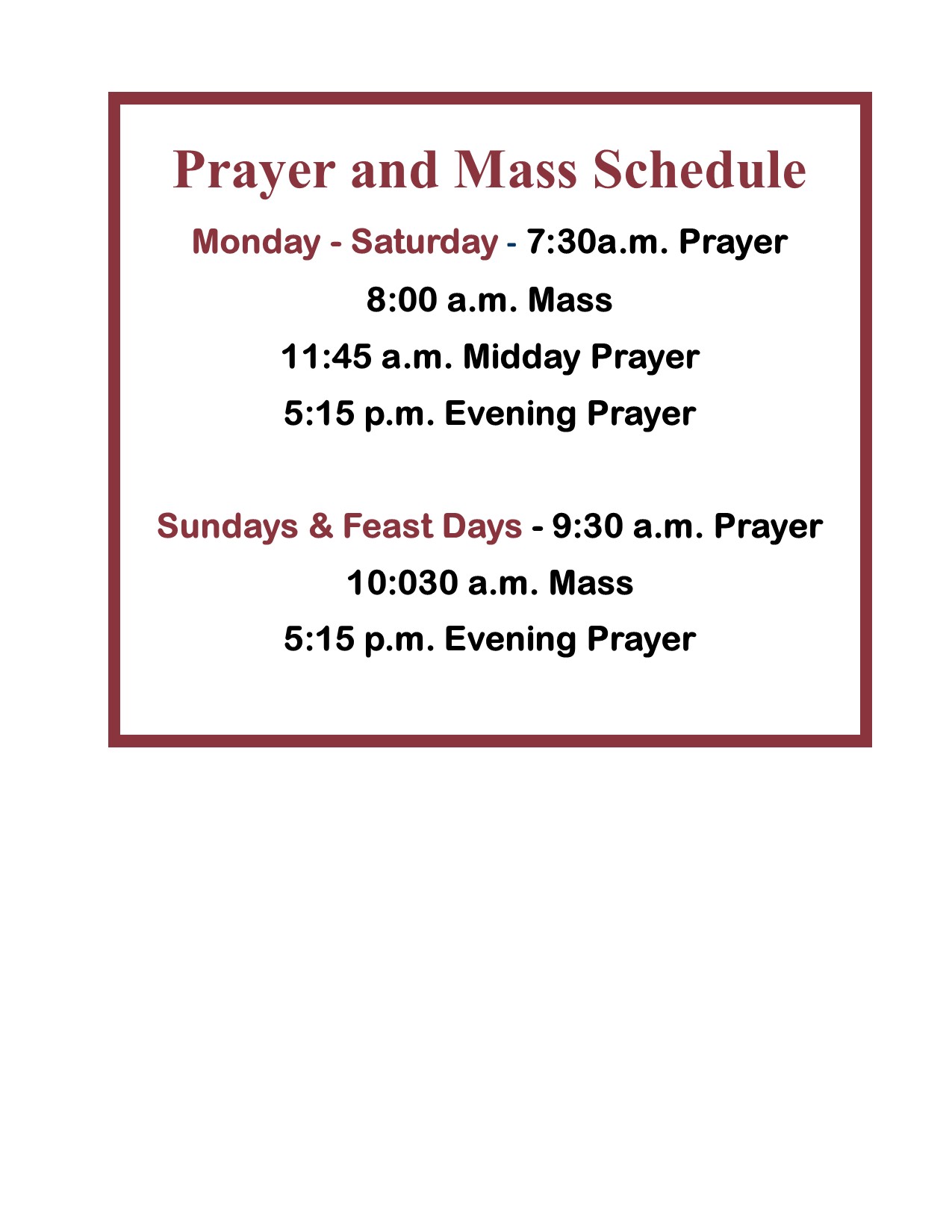
 Mass Schedule

Related Links

Copyright © 2026 · Benedictine Sisters of FL · Touching Lives Through Prayer and Service

Copyright © 2026 · Bendedictine Theme on Genesis Framework · WordPress · Log in