• Skip to primary navigation
  • Skip to main content
  • Skip to footer
Benedictine Sisters of FL

Holy Name Monastery
Founded 1889

Donate Now
  • Home
  • About Us
    • History
    • Being Benedictine
    • Benedictine Monasticism
    • Meet Our Community
    • Holy Name Academy-Alumnae
  • What We Do
    • Mission, Vision and Our Partners
    • Retreats
      • Invitation to Retreat
      • Accommodations
    • Volunteer Programs
    • Oblate Program
    • Spiritual Direction
    • Aqua/Hydroponics
    • More of Our Ministries
  • What’s Happening
    • Articles of Interest
    • Events
    • Commemorative Bricks
    • Newsletters
    • Brochures
    • Links
  • Support Us
    • Gifts of Support
    • Wish List
  • Stories Shared
  • Galleries
    • Photos
    • Videos
      • Benedictine Sisters of FL Videos
      • Other Videos
  • Contact Us

Lord

Even When You Say You Did Not Believe

September 28, 2020 by Holy Name Monastery Leave a Comment

I’ll repeat the last line of that Gospel reading: “Yet even when you saw, you did not later change your mind and believe.”

Speaking in St. Petersburg (FL) on Friday (September 25) Florida Gov. Ron DeSantis lifted all restrictions statewide that were imposed to control the spread of the virus that causes COVID-19.  In his words: “Every business has the right to operate.”  The executive order will stop cities and counties from fining people for not wearing mandated face coverings.  The governor says there are no signs of a possible “second wave of infections.”  I am a bit skeptical of what signs of the times this man and many others are reading?  And, who or what advice are they listening to?

In our country – in the U.S. – there have been more than 7 million confirmed COVID cases – and God only knows how many more unreported.  There have been more than 200,000 deaths.  In Florida there have close to 700,000 reported, confirmed cases (not counting those that go unreported) and 14,000 COVID-reported deaths.  That is approximately 4500 more than the combined populations of (nearby) St. Leo, San Antonio and Dade City.

The daily reading from the Holy Rule, this Gospel, and other words we’ve prayed this past week, warn us about paying mere lip service to directives and about the danger of letting our diligence slip.

We heard Jeremiah say: The Lord searches the heart and examines the mind, to reward each one according to what their deeds deserve.”  And the psalmist who reminded us: “God searches the hearts and minds … The Holy One knows our thoughts.”  In the words of Benedict: “The disciple’s obedience must be given gladly, for ‘God loves a cheerful giver.’”  If the disciple obeys grudgingly and grumbles, not only aloud but also in her heart, then, even though the order is carried out, their actions will not be accepted with favor by God, who sees that she is grumbling in her heart.  She will have no reward for service of this kind.”

The evidence is all around us – the virus is still present in our world.  We can’t dispute the fact that there is confusion, fear and challenges that cause us to reflect on how we interact with each other and the greater community.  There is much soul-searching and a heightened awareness of the “hungers of the people of God.” (BSoFL Corporate Commitment) We need look no further than across the highway to witness the challenges of having university students on campus.

Yet, we still hear comments like: “it’s all a hoax – it’s only another form of the flu – I’m strong, I can fight it – She is my friend, they wouldn’t be here if she thought she was sick – the virus can’t be passed if we’re outdoors – it’s not in our part of the county – I’ll take an ibuprofen tonight, just in case – I don’t follow rules I don’t agree with or don’t like.”  What is not said is: “I’m scared – I can’t think about it – I have too many other health issues – there is so much confusion, I gave up – it’s like climate change; the scientists will figure it out – I followed the CDC and our house restrictions for a while, but not anymore; if it comes, it comes – if God wants to take me, that’s OK – if I get sick it’ll be someone else’s problem – they’ll take care of me.”

That’s the sticking point.  In truth, in time of illness, death or distress, we do care for each other.  The question before each of us each day is: am I taking care of, not just myself, but am I taking the most solicitous care I can of the 14 others I live with?  Do I keep in mind Jesus’ admonition: “Don’t do to others, what you would not want done to you.  Love others as you love yourself.”

These are times when the yoke of obedience and submission can really pinch – more for some personalities than others.  Listening to the “abbot” is one thing – listening to an external source, quite another: the bishops, local governments, the CDC, health departments, medical professionals …  where do they rank in our promise of obedience???  Our “conversion of life”?

Hospitality to each other is another whole package.  But, we know we are (like it or lump it) in these times -TOGETHER – either we will survive it without scarring OR the enemy: lack of diligence, carelessness, or disregard for others (the REAL fatal virus), will break through cracks in our walls.   Even hands held tightly can weaken – so hold tight…. Try not to be the one who loses grip.   Let us hold each other tightly in prayer and patience in the trials of “Safe at Home.”  We’ve a “mile to go before we can sleep” – i.e. let up on our vigilance.  Know and believe that God has a plan.  Be patient with the divine timing in day-by-day revealing that plan.  Remind yourself “the best IS yet to come.” Our ancestors in community got through the 1918 pandemic – so will we!
Peace – and good health and many blessings.
We’ll be praying in particular all this week for all health care workers and on Monday joining in spirit the Bishops for International Day of Prayer for Migrants, Refugees, Immigrants and Sojourners.
God bless you each!

~Reflection by Sister Roberta Bailey, OSB, Prioress


First reading: Ezekiel 18:25-28       Second Reading: Philippians 2:1-11
Gospel: Matthew 21:28-32
Continue Reading

Filed Under: Blog, Front Page, Homily Tagged With: Benedict, Covid, Covid-19, DeSantis, God, Gospel, governor, Holy Rule, Lord

Better than a Biscuit

July 21, 2020 by Holy Name Monastery Leave a Comment

I invite you to consider, as you do lectio with this Gospel: Which am I?  Am I the sower, the seed, the soil or a plain old weed?  Or perhaps it would be better to ask: when am I like a weed needling others or jabbing them like a thorn?  When have I been the sower of good seed?  How have I been the seed that blossomed in another?  And, please, God, may I always be good soil, receptive to the good seed you freely scattered all around me… often right at my feet in the rhythm of my day.  May my ears be attentive to your voice, my eyes only take in the good and my voice be an instrument to further Your kingdom.

In Jesus’ story the sower spreads good seed in the field expecting a healthy wheat harvest.  But in the dark of night an enemy comes and sows weeds in among the wheat.  So when the seedlings begin to sprout the workers in the field see that something is amiss.  Those are not all wheat plants – what are they?  How’d they get there?

A little knowledge of botany will help us.   Matthew uses a Greek word for a botanical term that can be interpreted: wild rice grasses, or cockles.  Maybe in Florida it would remind us “sandspurs” – those icky, prickery round blooms – hard-to-get off with bare hands.  [A tip: wet your fingers before you try to grab hold of a sandspur.]  The difference between the wheat and cockles is evident only when the plants mature and the ears begin to appear.  With real wheat the ears will be so heavy they droop.  Cockle, on the other hand, has ears that stand up straight.

Now, when the field hands call this to the owner’s attention they are advised: “Let them grow up together until the harvest.”  That reminded me of the expression “accept the thorns among the roses” or “You gotta take a little bad along with the good.”  Intrigued, and with a little time to spare, I checked what Google could turn up.  This next one, Google said, only a born and bred Vermonter would say: “just because a cat has her kittens in the oven don’t make them biscuits.”

That reminded me of story that was related to me recently by a pastor-farmer-friend who had visited in a nearby town.  Before the days of COVID, he’d accepted an invitation to join the ministerial breakfast meeting.  It being March 16, and the feast of St. Isadore the farmer, they’d called upon a local pastor who was a member of one of Florida’s oldest ranching families to offer the invocation and meal blessing.

He was decked out in his typical attire: bib overalls, a baggy denim shirt, grasping a floppy straw hat.  “Please bow your heads as we ask God’s blessing,” he began and then waited for his table companion to clear his voice.  (Or, was he stifling a laugh?)  Our prayer leader went on: in a strong, reverent voice:

“Lord, you know I hate buttermilk”.  My friend opened one eye to peek at   the farmer and wondered where this was going.

The farmer loudly proclaimed, “And, Lord, I hate lard.”  Now my pastor-friend was growing concerned – wondered if those who knew him realized their friend was losing it.   Without missing a beat, the farmer continued, “And Lord, you know I don’t much care for raw white flour.”

My friend again opened an eye, but this time to glance around at everyone seated with him at table.  He realized that he wasn’t the only one beginning to feel uncomfortable.  The Pastor-Farmer just went right on: “But Lord, when you mix them all together and bake them, I do love those warm fresh biscuits.”

He paused a second,  lifted a hand, raised his eyes, and with a beatific smile, prayed on …”So Lord, when things come up that we don’t like, when life gets hard, when we don’t understand what you’re saying to us, help us to just relax and wait until you are done mixing.  It will probably be even better than biscuits.”   AMEN

~Reflection by Sister Roberta Bailey, OSB, Prioress

 

Wisdom 12-13, 16-19  Romans 8:26-27       Matthew 13:24-30


Continue Reading

Filed Under: Blog, Front Page, Homily Tagged With: Biscuits, God, good seed, Jesus, Kingdom, Lord, Matthew, seed, soil, sower

Do I Believe This?

July 16, 2019 by Holy Name Monastery Leave a Comment

(Homily – adapted – from Pope Francis – delivered in April 2016 – and reflection on Veronica – the 6th Station of the Cross – indicated by italics)

We know the parable of the Good Samaritan is a lesson to teach us that we must love our neighbor, and that there’s no one in the category of non-neighbor, but beyond that, have we also learned the parable’s lesson that God treats us with the compassion of the Samaritan?

In the gestures and the actions of the Good Samaritan we recognize God’s merciful action in the whole history of salvation.  It is the same compassion with which the Lord comes to meet each one of us: He does not ignore us, He knows our sorrows; He knows how much we need help and consolation.  He comes close to us and never abandons us.  Each one of us should ask himself the question and answer in his heart: “Do I believe this?  Do I believe that the Lord has compassion for me, just as I am, a sinner, with so many problems and so many things?’  Think of this and the answer is: ‘Yes!’  But each one must look into his heart to see if he has faith in this compassion of God, of the good God who comes close, who heals us, who caresses us.  And if we refuse Him, He waits: He is patient and is always at our side.”

It is not automatic that one who frequents God’s house and knows His mercy is able to love his neighbor.  It is not automatic!  One can know the whole Bible, one can know all the liturgical rubrics, one can know all the theology, but from knowing, loving is not automatic: loving has another way, intelligence is needed but also something more … “The priest and the Levite saw, but ignored; looked but did not provide.  Yet true worship does not exist if it is not translated into service to one’s neighbor.”

Compassion is the center of the parable, centering on this word that means ‘to share with’.  The Samaritan had compassion that is, his heart, was moved; he was moved within!  See the difference.  The other two ‘saw,’ but their hearts remained closed, cold.  Instead, the Samaritan’s heart was attuned to God’s heart itself.  In fact, “‘compassion’ is an essential characteristic of God’s mercy.  God shares with us – He suffers with us; He feels our sufferings.”

(Francis reminds us 🙂  the Samaritan’s concrete, personal actions teach us that compassion is not a vague feeling – it means to take care of the other even to paying in person.)  It means to commit oneself, taking all the necessary steps to ‘come close’ to the other, to the point of identifying oneself with him: “you shall love your neighbor as yourself.”

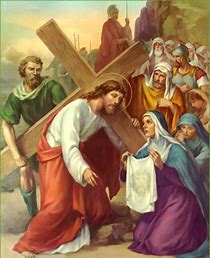
The story of Veronica that we recall in the 6th Station of the Cross points to the power of witness in an act of compassion.  What does Veronica do?  Not much – she steps from the crowd, wipes a man’s face.  What does Veronica mean to our spirit?  Close to everything.

The image on the veil stands forever as reminder of the unmitigated horror of which injustice is capable.  The image of the veil stands forever as a mute witness to the crime of all times – and the destruction of goodness at the center of us, in us, around us forever.

As Pope Francis says: “The parable of the Good Samaritan is a gift to all of us, and also a commitment.  Jesus repeats to each one of us what He said to the Doctor of the Law: ‘Go and do likewise’. …  Jesus bent over us, made Himself our servant, and thus He saved us, so that we too are able to love as He loved us.”

Veronica’s act of compassion puts us to shame.  Her unblinking action puts us all, and each, on notice: for the sake of what life lesson would you step out from the crowd and draw attention to yourselves?  To what kind of care would you bend your life so that the world will never forget?

~Reflection by Sister Roberta Bailey, OSB, Prioress
 

Continue Reading

Filed Under: Blog, Front Page, Homily Tagged With: 6th Station of the Cross, compassion, God, Good Samaritan, Lord, Pope Francis, Veronica

Four Weeks Suspended in Kairos

December 11, 2017 by Holy Name Monastery Leave a Comment

In her book, THE LITURGICAL YEAR, Joan Chittister makes the comment: “Advent, more than any other season of the church year, calls us to live simultaneously in the past, the present, and the future.  She elaborates: “We learn in Advent to stay in the present, knowing that only the present well-lived can possibly lead us to the fullness of life.  It takes an overview of the three-year cycle of Advent readings to make clear the multiple meanings of Advent.  Many of our Advent hymns keep this idea before us when we sing “Mara – natha – two words – The Lord has come … God of, and in, our) past, present and future are all lived together … soul.” (Chittister)

We eagerly await the coming of Christ as a baby in Bethlehem (the past), we are invited to welcome him into our hearts now (the present), and we look forward to his future coming as king of glory.  For four weeks of Advent we are suspended in kairos — God’s time — when expectations and reality are held in tension with each other.  We must hold on to a vision of what challenges the church (that’s all of us) should be dealing with today.  Dwelling in the past or wishing for a perfect future can keep us from hearing the will of God in our today.  Many recognize in Pope Francis a voice that is, like John the Baptist, crying in the wilderness … urging us forward in the present to mend the past as we confront the ills of today.

This Gospel introduces us to the man: John.  The opening lines in Mark’s gospel are “the beginning of the Gospel of Jesus Christ” but the first character he introducers is not Jesus, but John the Baptist, the fiery preacher who came out of the desert where he lived on honey and locusts.  And, he is no fashion plate, with his camel’s hair clothes, leather sandals, and leather girdle around his waist — very much like Elijah.  His diet was very simple: locusts (grasshoppers) and wild honey.  This is important, or it would not be here.  It is symbolic. But what does it symbolize?  Well, you cannot wear anything more fundamental in the way of clothing, or eat a more basic diet, than John did.  In other words, it is representative of his ministry — one of simple beginnings.  It is not the end; it is the beginning.  The beginning of the gospel of Jesus Christ, the Son of God is all about repentance.  This is the place to begin.  Even John’s clothing and his diet helped convey that message.

His diet, by the way, was balanced.  Food fanatics will quickly recognize that grasshoppers are protein, and honey is carb.  John’s diet was in perfect balance, so that he was a healthy man.  It was a simple sort of diet, just as his ministry was – nothing elaborate.  Furthermore, he’s very honest.  He says, “Don’t look to me for answers beyond what I have already told you.  Anything beyond that must come from Another, who is coming right after me.  He is so much greater than I that I am not even worthy to untie his shoes.  Remember, this was his cousin he was talking about!  John could bring people to God, but he could not take them beyond that.  John began his ministry in the wilderness, the worst possible place. But it worked!

The people of Jerusalem and Judea left their cities, their recreations and pleasures, and trekked through a howling wilderness to listen to a man preach.  They probably had to walk twenty or thirty miles to hear John, but did so willingly and in such increasing numbers that Mark records, in only slight exaggeration, that “all the country of Judea, and all the people of Jerusalem” came out to hear him.  Something drew these people into the desert to listen to this strange and rugged young preacher proclaim good news.  That is all he did!  He never told how it worked, or why; he just announced it.

How fitting it is that we have this message of forgiveness and repentance as a prologue to our Penance Service on Tuesday evening.  Then, as now, people need to know they can begin again.  God offers us, once again, an opportunity to truly repent.  We can change our attitude and stop defending ourselves and trying to blame everything on others.  There’s a saying: the whole world’s a critic.  Tuesday’s reconciliation service gives us a chance to be our own critic and say, “You know what, God?  I’ve finally realized it’s not those others, it is just me.  This is just the way I am — and I need help.”  In the quiet of your own heart, where God alone hears, you can say, “I repent, send me your Spirit.”

But keep in mind what the prophet Isaiah said about John’s message – this business of reconciliation will resemble a great bulldozer, building a highway in the desert.  John was God’s bulldozer to build that highway.  You know how roads are built – we see the process almost any direction we go on the highway.  Isaiah says: “Every mountain shall be brought low, and every valley shall be lifted up; the crooked places shall be made straight and the rough places plain.”  And, that is what repentance does.  It bulldozes down all the high peaks of pride that we stand on and refuse to admit we’re wrong.  It takes the depressed areas of our life, where we beat and torture and punish ourselves, and lifts them up.  It takes the crooked places, where we have lied and deceived, and straightens them out.  And it makes the rough places plain.  Then, there is God!  God comes to us so that we can come to God.

Our hope is in the promise of God, and God of the Promise… a promise that was fulfilled in Jesus Christ.  It is a hope that will not be disappointed because God may delay, He may tarry but He will not forget His promise.  He will not let us down.  Praise be God!

~Reflection by Sister Roberta Bailey, OSB, Prioress


Readings:      Isaiah 40: 1-5, 9-11               2 Peter 3:8-14              Mark 1:1-8
Intention:       Peoples of Central America
Continue Reading

Filed Under: Blog, Homily Tagged With: Advent, God's time, Gospel, Jesus, John, Kairos, Lord, Promise

Are You Heeding the Words?

November 14, 2017 by Holy Name Monastery 1 Comment

If you’ve ever driven south on I-75 through Tampa you’ve seen the signs: Check gas – long bridge ahead.  Well, this Gospel story could have been titled: check oil – long night ahead.

From the outset it is helpful to understand that these oil lamps (in the Gospel) were not like what we know as hurricane lamps.  There was no glass chimney, no neat wick or adjusting device, and no attached tank in which oil would be stored. It was more like a large, flat, bowl, with a rag or rope-like “wick.”  This kind of lamp could be attached to a pole, and used as an outdoor torch to light one’s way.

And, erase from your minds the idea that the five foolish virgins ran out of oil. The text is clear on this point; the five foolish virgins never brought any oil with them.  Otherwise, why would all five have run out at the same time?  It does seem quite possible if the ladies had been traveling in daylight they would not have needed their lamps to light the way – so they wouldn’t have had to carry an extra flask of oil.  What little oil was left in the bottom of the lanterns would have burned off quickly.  Then, POOF – they’d all go out in rapid succession.  To minimize their foolishness, the five described their predicament as “running out” of oil.

All ten virgins waited for the groom to come to the bride’s house …  remember these were the BRIDE’S maids … but the groom dallied, eyelids grew heavy, time passed and darkness set in.  Suddenly the cry was heard: “He’s coming, he’s here!” but now it’s midnight and its pitch dark.  Everyone scurries to their light lamps.

When the five foolish virgins realized their plight they asked the five wise virgins to share their oil, but their request is denied.  It wasn’t that the five wise virgins didn’t care; it was because there would not be enough oil for all ten lamps.  Better to have a torchlight parade with five working lamps than with ten non-functioning, lightless, lamps. The foolish virgins were told to go purchase their own oil, which they promptly scurried off to do.  But during their absence the torchlight parade took place, and the groom, accompanied by the five wise virgins entered the celebration hall.  The doors were then closed. Later, the five foolish virgins arrived, with a good supply of oil, but it was too late.  That part of the festivities had already been completed. There was no need for the services of these five virgins, and they were not allowed to enter and join in the wedding celebration.  Even though they pleaded, “Lord, Lord …,” they were sent away with the words, “I do not know you!” Jesus concludes the parable by applying it to His disciples (and thus to us and the church).  He urges His disciples to stay alert, because they do not know the day or the hour of His return.

I was having some trouble thinking of a contemporary example of what’s happening here.  The best I’ve come up with is drivers running out of gas.  According to Siri – you know her, the voice on Google – every year at least a half million people call “On Star” or AAA because they have run out of gas.  One might understand this happening 50 years ago, when gas gauges were not nearly as accurate as they are today.  Warning lights were pretty much non-existent. But now we have warning messages that the fuel level is running progressively lower.  One could say that most people have little excuse.  And, in our situation the Sisters have NO EXCUSE for calling for roadside service for gas since John fills our cars twice a week.

So you might say, “You’ve used a silly example.”  So to what should I compare the lack of oil?  I know: printer cartridge ink.  Modern day copiers warn us well head of the moment of critical need for ink reminding us: “prepare a new toner cartridge.”  But still we wait, coaxing every drop of ink even as the copies grow progressively fainter.  Until, like the car without gas, the printer says, Amen, that’s it – no more copies.

I believe that the five foolish virgins had no oil for the very same reasons people continue to run out of gas or ink. First, people don’t believe the warning signs.  They don’t think things are as bad as they are reported to be. Experience tells them, “I must have more gas than that!” Or, “I’ve gotten this same message before, and I’ve always been able to get to the gas station before running out.”

Those who run out of gas or printer’s ink are the kind of people Jesus is talking to.   Sticking with the analogy of the car, those who run out of fuel are those who wrongly suppose that they still have plenty of time to get to the next exit.  We know when our gas gauge is low.  Good grief, we can see the flashing lights on the dash. We know the signs of burn out – we get impatient with everyone about any little thing.  Or we fall asleep in chapel.  But we lull ourselves into thinking that there is still plenty of time to deal with the problem.  False confidence has gotten many people into trouble.  Those who think they will have other chances to come to faith in Jesus are making a very dangerous assumption.  The coming of our God may well be sudden and unexpected, when we are least ready.  All chances of changing our course will be forfeited.  The coming of our God ends our opportunity to turn to Him in faith, and it seals our doom or our reward in eternity.  We do well to pay heed of the words of the Gospel Acclamation, “Stay awake and be ready!   For you do not know on what day your Lord will come.”

~Reflection by Sister Roberta Bailey, OSB, Prioress
First Reading   Wisdom 6:12-16     Second Reading   1 Thessalonians 4:13-18
Gospel Matthew 25:1-13
Continue Reading

Filed Under: Blog, Homily Tagged With: coming of God, foolish virgins, Jesus, Lord, oil lamps

Second Sunday of Easter

April 4, 2016 by Holy Name Monastery Leave a Comment

christ is risen w tombWelcome to the Second Sunday of Easter.  Notice it’s “of”, not “after” .. because, you know this, Easter’s not a single day, or even an octave but a season of 50 days.

There’s no question that we know how to do Easter as an even: the question is … How are we at Easter as a way of life?

The great Easter truth we celebrate is not that we are going to live anew after death, but, by the power of Jesus’ resurrection we are new here and now!

“Here and now” – that’s easier said than done. If it’s any consolation, the first Christians: those who had the direct experience of our risen Lord don’t seem to have been much better at it than we are.  During the Easter season we’ll be reading a series of “post – resurrection” stories: the women at the tomb who seemed to have forgotten the “punchline”: that Jesus told them he would rise after three days. It took the angels to remind them of that rather important detail. And then they ran back to tell the disciples, but, the men didn’t believe them!  And, Mary in the garden?  She thought Jesus was the gardener

Imagine today’s Gospel scene.  It’s a week later.  Without warning, Jesus is in their midst – no time to run and hide under the table.  He’s THERE.  Someone’s first reaction was probably, who left that door open?  Immediately, Jesus “breathed on them”.

Some things we just can’t see. But we know they’re there anyway. Like the air when a gentle breeze caresses our cheek.  God’s love is sort of like the air, isn’t it? It fills us up –  even though we can’t see it – we can feel it in our hearts.  When Jesus breathed on them, Thomas who had missed Jesus’ first visit and wants to see Jesus with his very own eyes, expresses his belief. But Jesus reminds him of something very important.   Sometimes we just have to believe in things that we can’t see. We have a special name for that. We call it “faith.”

You may recall the words of several hymns that refer to the spirit breath of God: “Be our breath,” “fall afresh on me,” “whose breath is seed outpoured –  calling all things to birth,” “with your breath melt the frozen, warm the chill,”        One of my favorite Marian hymns often heard at Christmas, is sung by Amy Grant, entitled “Breath of Heaven.  It’s the story of Mary’s pondering the workings of the Incarnational Spirit within her.  Mary’s prayer becomes mine: “Breath of heaven, Hold me together, Be forever near me, Breath of heaven – Be with me now, lighten my darkness, Pour over me your holiness, for you are holy, breath of heaven.”

It has become for me a prayer: to be filled with the breath of God … And, that’s what Easter as a way of life is all about. And it’s a way of life we live one day at a time: one step at a time — trusting that even if we take a mis-step, we never journey so far from God that the life-giving breath of that Spirit is beyond our reach: even when that seems impossible to believe.

That’s the lesson we learn from Thomas who has gone down in history as “doubting Thomas” because he refused to accept the testimony of others, but demanded his own experience.  He has borne the brunt of almost two millennia of bad press because of His skepticism about the resurrection and Jesus’ appearance to the other disciples.  Yet, what did Thomas ask for that the others had not received?  They had seen Jesus. They had maybe had a chance to touch His wounds.  Why is Thomas ridiculed for his insistence that he see for himself?

I’m a little intrigued, actually, about how quick we are to make Thomas the poster child for faithless doubt. As a matter of fact, the rest of the bunch didn’t do any better.  Remember:  the women at the tomb, the men who didn’t believe the women’s story, Peter who runs back to see for himself …. and here are the “faithful” disciples, after the appearance of Jesus: still locked in the upper room.

Think about it:  why did Thomas come back at all. Whatever had taken him away from the community, he came back. And it was in the midst of the community that Jesus came to him, and without so much as a confession or absolution, offered him what he needed to believe: “Touch, me Thomas. Do not be faithless, but believing.”

One of Thomas’ great virtues was that he absolutely refused to say that he understood what he did not understand, or that he believed what he did not believe. There was an uncompromising honesty about him: he would never still his doubts by pretending they did not exist.

But, he refused to surrender to the fear, too, which kept the other disciples shut up in that locked room. He ventured out and then had the courage to come back – to face a community which had had an experience that he had not shared.  At first he insisted on his own experience of God.   Jesus knew what he needed – He extended his hand to him – not a hand out; but a hand up, the nudge Thomas’ needed to bolster his faith “my Lord and my God.”  This is our challenge, and our privilege, to figure out what people need –  to offer the comfort, security and peace that will bolster their faith in a loving God.  This, too, is the challenge the Good Shepherd extends to us on Divine Mercy Sunday: to lead people to green pastures, where, surely goodness and kindness and mercy may follow them all the days of their lives.”

With Thomas, and all whose faith wavers:  we pray, “Breathe on me breath of God, until my heart is pure. Until with you, my will and Yours are one – not my will but yours be done.”

~ Reflection by Prioress, S. Roberta Bailey, OSB


Continue Reading

Filed Under: Blog, Homily Tagged With: 50 days, Easter, God, Jesus, Lord, Mary, risen, Second Sunday, Thomas

  • « Go to Previous Page
  • Page 1
  • Interim pages omitted …
  • Page 3
  • Page 4
  • Page 5
  • Page 6
  • Go to Next Page »

Footer

Prayer / Newsletter / Info

 Contact Info

Benedictine Sisters of Florida

PO Box 2450
12138 Wichers Road
St. Leo, FL 33574-2450
(352) 588-8320
(352) 588-8443

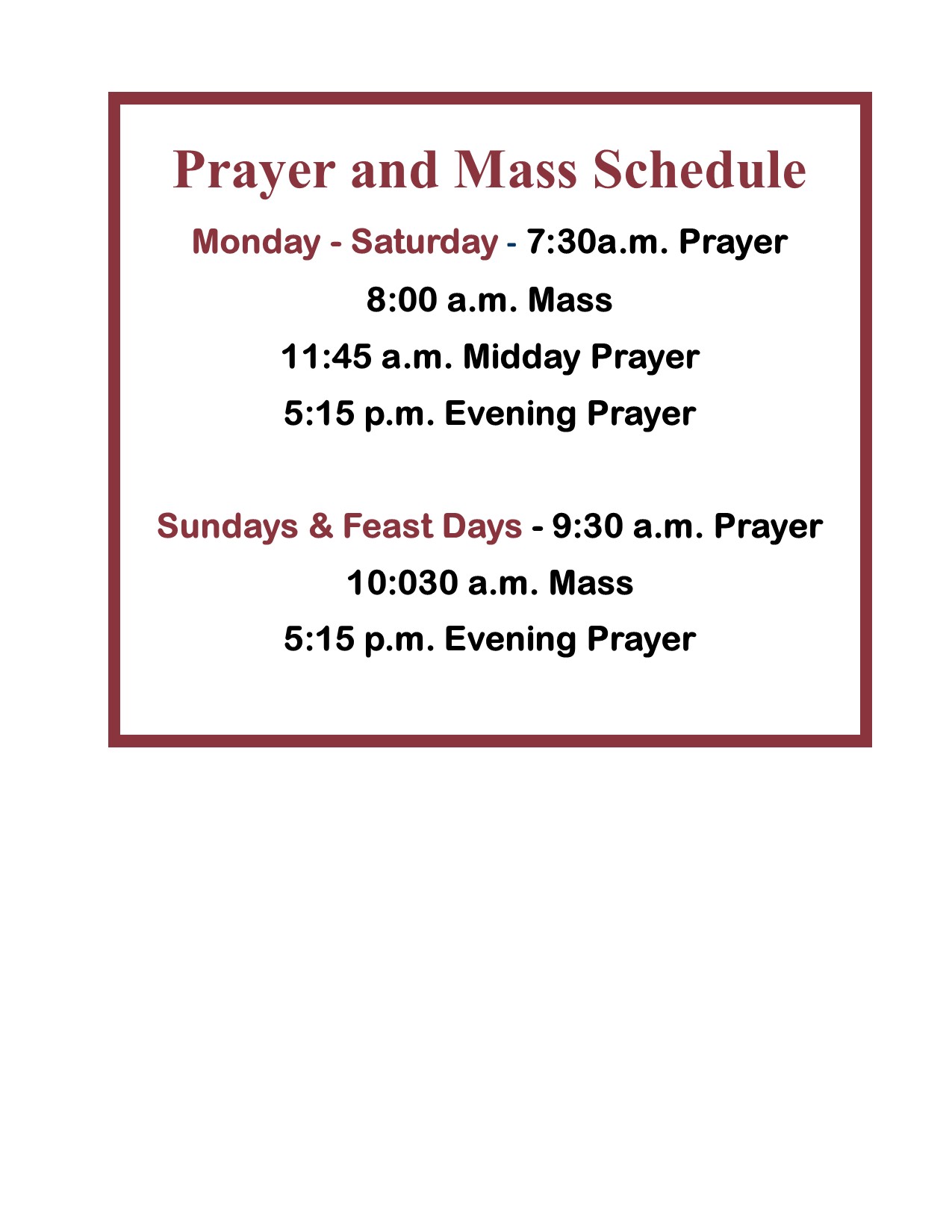
 Mass Schedule

Related Links

Copyright © 2026 · Benedictine Sisters of FL · Touching Lives Through Prayer and Service

Copyright © 2026 · Bendedictine Theme on Genesis Framework · WordPress · Log in