• Skip to primary navigation
  • Skip to main content
  • Skip to footer
Benedictine Sisters of FL

Holy Name Monastery
Founded 1889

Donate Now
  • Home
  • About Us
    • History
    • Being Benedictine
    • Benedictine Monasticism
    • Meet Our Community
    • Holy Name Academy-Alumnae
  • What We Do
    • Mission, Vision and Our Partners
    • Retreats
      • Invitation to Retreat
      • Accommodations
    • Volunteer Programs
    • Oblate Program
    • Spiritual Direction
    • Aqua/Hydroponics
    • More of Our Ministries
  • What’s Happening
    • Articles of Interest
    • Events
    • Commemorative Bricks
    • Newsletters
    • Brochures
    • Links
  • Support Us
    • Gifts of Support
    • Wish List
  • Stories Shared
  • Galleries
    • Photos
    • Videos
      • Benedictine Sisters of FL Videos
      • Other Videos
  • Contact Us

resurrection

Second Sunday of Easter

April 13, 2026 by Holy Name Monastery Leave a Comment

The Frailty of Easter  Based in part on a reflection by John Slattery  (adapted)

Easter is all about smallness.  That’s why we are drawn to reading and re-reading the Easter accounts in the Gospels each year.  Despite the ocean of books, songs, sermons, and lectures written about Easter or on Easter-themes, our Scripture includes just four small stories about this Jesus who rose from the dead.  The combined resurrection stories encompass about 3500 words–the equivalent of about 15 pages, the length of an average term paper.

Jesus’ resurrection was such a humble thing.  There were no angel trumpeteers or singers in the skies. It was more like the story in Psalm 119. “Without a word, without a sound, without a voice being heard, the message fills all the earth, resounding to the ends of the universe.”  First, Jesus surprised Mary in the garden.  She told a few other women, then they told a few men and soon Jesus appeared to them.  He spoke about peace, about the Spirit of God, about hope.  He showed his wounds.  He ate some food and then he drifted up into the clouds.  He didn’t march on Rome or lead a rebellion against those who brought him to Pilate.  After his resurrection He didn’t heal anyone else or preach to vast crowds as He had done previously.  He didn’t cast out any more demons, trade barbs with rabbis, or visit the Temple.  The resurrection, in many ways, was a quiet event.

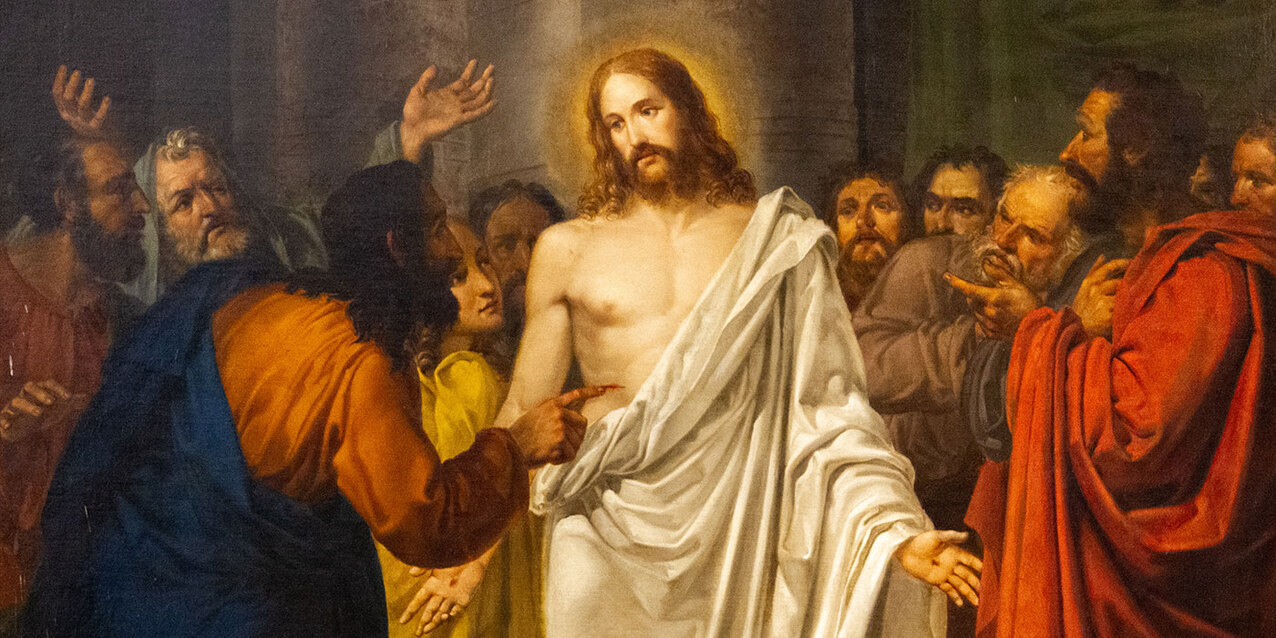
It challenges us to read that Jesus showed his followers his wounds.  “See,” he seems to say, “a broken body is not made whole by erasing the imperfections.  Feel this hole in my side,” he says to Thomas and to each of us.  “See, I have sanctified what the world calls spoiled.  A broken body is made whole not by removing the scars but by embracing the permanence of the wounds.”

We like this small and quiet resurrection where Jesus is not the definition of a contemporary superhero.  He doesn’t return triumphant and knock Pilate off his throne, bringing God’s wrath on the vicious Roman Empire.  He appears to his friends, simply showing his wounds and talking about love and peace.

Today’s story of Thomas illustrates our Christian experience. We are called to believe without seeing.  In fact, all Christians (after the first witnesses) have been called to believe without seeing. Thus, we sing “Without seeing you, we love you; without seeing you, we believe.”  Thomas’ doubt is hardly surprising; the news of Jesus’ appearance was incredible to the disciples who had seen him crucified and buried. Thomas’ human nature compelled him to want hard evidence that the Jesus, who appeared to the disciples after his death was indeed the same Jesus who had been crucified. Thomas is given the opportunity to act on that desire. He is our witness that Jesus is truly raised from the dead.  With him we proclaim: “We have been told, we’ve seen his face, and heard his voice alive in our hearts.”

Jesus wants us to be perfect, but not the kind of perfect that ninjas or Superman display.  Jesus wants us to be perfect “as our heavenly Father is perfect.”  God’s perfection and the message of Jesus’ Resurrection call us to an unconditional embrace of frailty, pain, and brokenness.

It is an embrace that calls us to resist all forms of violence, power, and hatred.  There is growing acknowledgement of that fact that TV and video game violence, like second-hand smoke affects one’s lungs, permanently affects our brains.  Many persons, families, and faith communities refuse to allow TV violence, fictionalized or news reports, to invade their living spaces.  Jesus did not arm his apostles with weapons for revenge — he armed them with prayer and baptized them in a spirit of hope and forgiveness.

We are surrounded today with so much sadness and fear and anger.  We who live in a peaceful community rejoice in the security and sanctity that empowers us to extend open arms in hospitality to those in the world who yearn for that same privilege.

At the end of our Gospel selection we read, “Jesus did many other signs that are not written in this book.  But these ARE written that you may come to believe …and through this belief you may have life in Jesus’ name.

We join the psalmist in singing: “By the Lord has this been done; it is wonderful in our eyes.  This is the day the Lord has made; let us be glad and rejoice in it.”

~Reflection by Sister Roberta Bailey, OSB


First Reading:   Acts of the Apostles 2:42-47         Second Reading:  1 Peter 1:3-9
Gospel:   John 20:19-31
Continue Reading

Filed Under: Blog, Front Page, Homily Tagged With: Easter, Gospel, gospels, Jesus, resurrection, Second Sunday of Easter, Thomas, wounds

Fifth Sunday of Lent

March 23, 2026 by Holy Name Monastery Leave a Comment

This story of Jesus raising Lazarus from the dead is so familiar that I’m curious what I may need to hear this Lenten season.  I feel the anguish of the sisters and friends of the deceased as they watch their loved one struggle with a terminal illness, and then watch life drain out of him.  I can feel their frustration when Jesus does not come at their call.  They are hoping against all hope that he would get there in time to keep Lazarus from dying.

We wander into a scene of much confusion.  The two sisters of the dead man had sent word to Jesus that his friend, their brother, was ill. Jesus is said to have loved the three siblings: Mary, Martha, and Lazarus, but he delays responding with the haste we and they might have expected.  To the puzzlement all who were aware of the situation, it is two days later that Jesus finally declares that he will make the journey to Bethany.  Thomas says to his companions: “Let us go with him.”  And he warns that they must be prepared to die with Jesus.

This is the seventh and final sign in John’s gospel.  It appears that the crowd has overheard the exchange between Jesus and Lazarus’ siblings.  It seems obvious Jesus was a frequent “drop in” at their house.  They seem very comfortable with chiding Jesus, weeping in his presence and engaging in a verbal back and forth with him.

Jesus’ delay heightens the drama.  We know the end of the story, so we can recognize that the delay was deliberate.  Jesus had to wait until Lazarus had succumbed to his illness for Jesus to glorify His father through Lazarus’ resurrection.

Can’t you see Jesus?  He elicits from Martha a profession of faith, probably amid many nodding heads of the bystanders, “Yes, Lord, I have come to believe that you are the Christ, the Son of God, the one who is coming into the world.”  (Do you hear the “but” coming?)   Then she runs for Mary – why?  Perhaps she thinks that Mary’s special friendship with Jesus will win his favorable response to their request to “do something!”   Touched by Mary’s tears, Jesus wept!  Then there is a preview of what will happen in a short while: Jesus asks that they roll aside the stone – sign of resurrection.

Don’t you love what happens next?  Raising his eyes Jesus says “Thanks, Father, for hearing me.  I’ve tried with this crowd. I need a little help here – that they may believe that you sent me.”  Then he says in a loud voice: “Lazarus! Come out!”  When Lazarus appears at the mouth of the cave, his burial place, Jesus orders: “Untie him and let him go.”

All through Lent this is what Jesus has been doing for us and calling to us:  He says in a loud voice “Come out!  Be your true self!  Let me untie you, and let you go.  I know you, I love you! And, I know what you are capable of doing and who you can be.  I have a special niche carved out for you.  You are in the palm of my hand.  You have a unique role I have carved out for you to play in the work of creation.  If you stay in the cave of your selfishness and self-interests, hidden behind your mistaken concept of humility, reluctant to respond to the call of my poor ones, the job will not get done.  I need YOU to be my hands on this one.  You say you believe my words.  Now it is time for you to COME OUT.  Let me untie the binding cloths (this is something you can’t do yourself), uncover your face – and let the world see the person that has existed in the mind of God for all eternity.  Don’t worry about the stench from the “four days” you’ve lain in the tomb of resistance to my call.  I invite you again, COME OUT!”


~Reflection by Sister Roberta Bailey, OSB


First Reading:   Ezekiel 37: 37: 12-14       Second Reading:  Romans 8: 8-11
Gospel:   John 11:3-7, 17, 20-27, 33b-45
Continue Reading

Filed Under: Blog, Front Page, Homily Tagged With: Fifth Sunday of Lent, Jesus, Lazarus, Lent, Martha, Mary, resurrection

Feast of Corpus Christi

June 12, 2023 by Holy Name Monastery Leave a Comment

Today we celebrate the Solemnity of the Most Holy Body and Blood of Christ – at one time called Corpus Christi and originally celebrated on the Thursday, 10 days after Pentecost.  Some of us of a certain generation may remember huge Corpus Christi processions which brought the body of Christ into the streets around our parishes.  Many of the faithful would pay visits to three different churches to attend Benediction services.  Today we still bring the body of Christ into our streets because we are there.

A little history about the feast:  In the 13th century, a Belgian nun named Juliana had a recurring dream of a brilliant full moon coming down to earth but with a black spot on it. Christ interpreted it for her in that the moon represented the calendar year of the church with all of its wonderful festivals, but the black spot showed that there was something missing, an occasion to remember the institution by Christ at the Lord’s Supper – the institution of the Eucharist. As fortune would have it, she had a friend in the Bishop of Liege.  He believed her vision and he subsequently became Pope Urban IV. As a result, the feast of Corpus Christi was first celebrated in 1264 with hymns and prayers written by Thomas Aquinas.  Such an awesome gift deserves its own feast!

This crowd that Jesus is speaking to in the Gospel had made a pilgrimage to see him instead of going to Jerusalem for the celebration of Passover.   It would have been easier to go to the nearby city, but something was drawing them to the great teacher.  Walking was their mode of transportation, and the distances were often across rough terrain or long detours around lakes.  Jesus and his apostles may have rowed across the lake but not all his followers found a ferry.  And in case you’re intrigued with numbers, someone has calculated that Jesus in his 3-year public ministry could have walked over 900 miles.

Meanwhile, the crowd wanted to take Jesus by force and make him their king.  In other words, Jesus is speaking to a crowd that has felt the pangs of deep longing for something much more than physical hunger.  They had glimpsed the possibilities of true satisfaction in Jesus. But they have misplaced the object of their yearning on “king,” when Jesus wants them to see that their true longing is for “living bread”. Today, our Gospel writer, John, wants us to see that our real longing is not for things that pass away but for things that endure, for an imperishable Light.  But, remember when Jesus is speaking it is before the Last Supper, the Crucifixion and the Resurrection.   Not even His closest apostles could have realized the full significance of His words.   Abbot Primate Notker Wolf has written “In times of individualism we need new ways to build a modern consciousness of community which revolves around the Eucharist as the central celebration of faith.”

The bottom line is that people are scrambling like crazy to find a diet that is right for them. And there is a such diet we hear too little about.  It’s the diet presented in today’s gospel.  Jesus says, “I am the bread of life.” And He gives us His word that people on His program “will never hunger or thirst again!” This is an extravagant claim!  But Jesus can deliver on what he promises!

~Sister Roberta Basiley, OSB


First Reading: Deuteronomy 8:2-3, 14-16    Second Reading: 1 Corinthians 10:16-18
Gospel Reading: John 6:51-58
Continue Reading

Filed Under: Blog, Front Page, Homily Tagged With: Corpus Christi, Crucifixion, Feast of Corpus Christi, Gospel, Jesus, King, Last Supper, Pentecost, resurrection

Active Contemplation

April 19, 2021 by Holy Name Monastery Leave a Comment

On this third Sunday of Easter, we continue to hear accounts of Jesus’ appearances following his Resurrection.  The first lines of this Gospel refer to the Emmaus story.  Two disciples were taking a Sunday stroll – well, a seven-mile walk – chatting about the events of the last several days.  Suddenly a stranger unceremoniously slipped into their company.  In today’s account, the two disciples hurry back to Jerusalem to report the glad news of how they recognized Jesus in the breaking of bread.  To their surprise, they discovered that the apostles, still hiding in the Upper Room, were already convinced of the resurrection of Jesus.  Mary of Magdala had told them and Simon also had seen Him.

Consistent with all the reports of Jesus’ post-Resurrection appearances, He greets the assembled disciples with the words, “Peace be with you.”  They have witnessed the death of someone they loved, and they fear for their own lives.  Peace is what they need more than anything else.  But, at Jesus’ sudden appearance they are startled and terrified.  They are uncertain about what to make of the figure before them.  Quite understandably, they mistake Jesus for a ghost.  Yet the figure before them is not a ghost; Jesus invites them to experience his resurrected body with their senses, to look and to touch.  They can’t forget his sufferings but peace begins to take root in their hearts, as their fears turn to joy and amazement.

This is Jesus: real and alive as he had been over the past three years.  He asks for something to eat – a sign they recognize and cannot deny.  It convinces them that they are not dreaming or having a mere vision or hallucination.  He goes on to explain to them how the prophecies are being fulfilled in him.  The evangelist says Jesus “opened their minds to understand the Scriptures.”  A lectio experience – one we ask for as we enter into a period of lectio or centering prayer or active contemplation.  Sounds like a contradiction: active contemplation?  But often it takes concerted effort to “quiet down” to let the Spirit come into our presence.  We actively say NO to all the distractions that may tempt us to do almost anything: read, do an act of charity, visit the sick, talk to the lonely, do a puzzle, clean a room, catch up on the news, – the devil calls us to do anything rather than center ourselves to give Jesus prime space and allow the Spirit to “open our minds, our ears, our hearts.”  As one author puts it: “contemplation is the gift given simply because we showed up.”  Like the disciples, we gather in mutual support.  We pray, we eat and Jesus steps into our midst saying: “Peace! See, it is I.”

This gospel, and all the appearances of the resurrected Jesus, show us not only how Jesus convinced his disciples of his resurrection, but this same Jesus prepares us to come together to listen to God’s words and offer ourselves along with our gifts of bread and wine.  And don’t minimize the parting message at Mass: “Go forth to share the message you have received.”  We can’t share what we do not have – so listen up, attune your mind and your heart, read the Scriptures ahead of time, let the message begin to steep like tea in the warmness of your heart.

The philosopher Soren Kierkegaard once told a story about a circus that caught fire.  The flames spread to the fields surrounding the circus grounds and began to burn toward the village below.  The circus master, convinced that the village would be destroyed and the people killed unless they were warned, asked if there was anybody who could go to the village and warn the people.  The clown, dressed in full costume, jumped on a bicycle and sped down the hill to the village below.  “Run for your lives!  Run for your lives!  “A fire is coming and the village is going to burn!” he shouted as he rode up and down the streets.  Curious, the villagers came out of their houses and shops and stood along the sidewalks.  They shouted back to the clown, laughing and applauding his performance.  The more desperately the clown shouted, the more the villagers cheered.  The village burned to the ground and the loss of life was great because no one took the clown seriously.  After all, he was just a clown.

When Jesus comes in our door, do we recognize Him?  Maybe he’s not dressed as a clown or shouting and waving.  How will we recognize Him?  Have we met Him often enough in our everyday lives that we immediately recognize Him?  Have we met Him in the wounds of the poor?  Or in the broken hearts of the bereaved?  In the victims of violence?  In people who live in dire poverty – maybe with ragged, smelly clothing because they have no place to wash up?  Maybe there are times when it is easier to see Jesus in the face of the stranger or the guest than it is in the face of the Sister (spouse, person) across from us at the dinner table or the chapel aisle or walking the hallways.  Jesus says: “Look at my hands and my feet (we can add: look at my face); see that it is I, your Lord.”

~Reflection by Sister Roberta Bailey, OSB, Prioress

First Reading:   Acts 3:13-15,17-19   Second Reading:  1 John 2:1-5a
Gospel:  Luke 24:35-48
Continue Reading

Filed Under: Blog, Front Page, Homily Tagged With: 3rd Easter Sunday, active contemplation, centering prayer, Emmaus, Jesus, Jesus' resurrection, lectio, Peace, post-resurrection, resurrection, See it is I

“Walk While You Have the Light”

March 22, 2021 by Holy Name Monastery Leave a Comment

Let’s step back a moment to recall the setting for this Gospel; maybe settle yourself into it.  It is six days before Passover.  We’re in Bethany, at the home of Martha, Mary and Lazarus.  The three siblings are sharing hospitality with Jesus, his disciples and some other guests.  We are reclining at the dinner table with them.  Martha is busy in the kitchen with the many hostess’ pre-dinner tasks.  Lazarus is keeping the conversation flowing among the guests hoping to keep they unaware of how late it is getting.  Mary hesitantly approaches Jesus to sit at his feet.  This is the occasion when Mary poured aromatic oil on the feet of Jesus and dried them with her long-flowing hair.  (I wonder how long that sweet smell will linger in her hair.)  Judas, the one who would later betray Jesus, muttered a snide remark (probably under his breath) about the wastefulness of such extravagance.  (Remember, he was the one who had charge of the groups’ money bag.)  Jesus was exasperated, he had had it with Judas.  “Leave her alone.  The poor you have always with you.  Tonight you have me.  Let her do this in anticipation of my burial.”

In his narrative, John moves to his abbreviated account of Jesus’ entry into Jerusalem riding a colt – the Palm Sunday narrative – that we will celebrate next weekend. 

So, back to our dinner.  The evening grows long, the dessert’s been served and the after dinner libation; chatter’s winding down.  We become aware that a crowd is gathering out in the yard.  Folks have heard Jesus is inside.  They’re hoping, too, to see Lazarus.  Word had spread that Jesus had recently raised him from the dead.  Some guests approach Philip.  (And, my goodness, talk about an unspoken chain of command!)  The Greeks spoke to Philip: “Sir, we would like to see Jesus.”  Phillip spoke to Andrew, then Andrew with Phillip in tow, went and told Jesus.  Jesus’ reaction did not disappoint.  He must have raised their hopes.  Sounds like he could have said: “Your timing is good.”  Yes.  “The hour has come for the Son of Man to be glorified.”

The guests may have experienced a bit of puzzlement or some trepidation, when Jesus continued speaking: “Amen, I say to you: Unless a grain of wheat falls to the ground and dies, it remains just a grain of wheat.”  But, hope must have risen up in them as Jesus continued: “But, if it dies, it produces much fruit.”  Then hope bounces around on the seesaw of mystery as Jesus continues: “Whoever loves his life loses it; whoever hates life in this world will preserve it for eternal life.”

What IS this man talking about???  He closes the gap when He tells them: “Whoever serves me must follow me.”  Now, that made sense.  Of course, if you want to serve, you’ll be a follower.  You’ll listen to every podcast, follow every eblast and purchase all their books.  It only makes good sense if you want to absorb the flavor of your hero’s life.

John, the beloved disciple, changes gears at this point in his Gospel.  In the retelling of his memories, John, in his tenderness for his intimate friend –  recalls Jesus saying: “I am troubled now.”  I wonder did Jesus pause at this point in time to ponder the source of his uneasiness?  “I am troubled now.”  He questions, “Yet what should I say?  Father, save me from this hour?”  Then, it is like he straightens himself up, thinking aloud: “Why should I ask the Father to save me from this?  It was for this very purpose that I came to this hour.”

You could hear a pin drop.  Is that thunder we hear in the distance; now it’s closer.  Some say it’s the voice of an angel.  Jesus speaks: “This voice did not come for my sake but for yours. … When I am lifted up, I will draw everyone to myself.”  Over 2000 years later, from our side of the story, we know Jesus was indicating the kind of death he would die; and his resurrection.  Our Easter!  Our understanding of Jesus’ remark, and the events commemorated during Holy Week, will always be colored with an assurance of a good ending, of Easter and resurrection.

A few lines later in his Gospel John will remind us of Jesus’ promise, (similar of the words he had said to Judas).  “The light will be among you only a little while.  Walk while you have the light, so that darkness may not overcome you.  Whoever walks in the dark does not know where he is going.  While you have the light, believe in the light, so that you may become children of the light.”

At this point in my preparation, I took a break and turned to my Lenten booklet.  This was the lesson God had planted there:  A young girl was watching her father, a pastor, preparing his Sunday sermon.  She knew she should keep quiet but curiosity won out.  She asked: “Daddy, how do you know what to say?”  “Why, God tells me,” her father replied.  “Ohhhh, then why do you keep crossing things out??”  Now, I love the techie computer function of “block, copy, cut, paste or save.”  But it was time to stop trying to refine what I had on paper.  So I looked to the Responsorial Psalm for a closing line: “Give me back the joy of your salvation, a willing spirit sustain in me.”  The church says:  AMEN.

~Reflection by Sister Roberta Bailey, OSB, Prioress

Today I wish  you a happy Saint Benedict’s day.  Benedict is the patron of a peaceful death – let us remember in particular all those who have died, or will die, during this time of pandemic.  May they, and all the departed, rest in peace.

Prayer to St. Benedict:  O, holy father Benedict, blessed by God both in grace and in name.  Who, while standing in prayer, with your hands raised to heaven, most happily yielded your angelic spirit  into the hands of your Creator, and promised zealously to defend against all the snares of the enemy, in the last struggle of death those who shall daily remind you of your glorious Father, this day and every day by your blessing that we may never be separated from our blessed Lord, from the society of yourself and all the blessed.  Amen. 

For information on the life of St. Benedict you may wish to refer to the Dialogues of St. Gregory, volume 2  https://www.osb.org/gen/greg/  For details about the circumstances that surrounded his death, refer especially to the final chapter on the aforementioned website. 

Have a good week and we prepare to slide into Holy Week next Sunday. 


Continue Reading

Filed Under: Blog, Front Page, Homily Tagged With: God, Holy Week, Jesus, Jesus' resurrection, John, Judas, Lazarus, Mary, Passover, resurrection, Saint Benedict, Walk While You Have the Light

Fifth Sunday of Lent

April 3, 2017 by Holy Name Monastery Leave a Comment

First Reading  Ezekiel 37:12-14           Second Reading  Romans 8:8-11
Gospel  John 11:1-45 (shorter version John 11:3-7,17,20-27,33b-45)

This story of Jesus raising Lazarus from the dead is so familiar I’m curious what I need to hear this Lenten season.  I feel the anguish of the sisters and friends of the deceased as they watched their loved one struggle with a terminal illness, and then watch the life drain from him.  I can feel their frustration when Jesus did not come at their call… hoping against all hope that he would get there in time to keep Lazarus from dying.

We’ve wandered into a scene of much confusion.  Two sisters of a dead man had sent word to Jesus that his friend, their brother, was ill. Jesus is said to love the three siblings:  Mary, Martha, and Lazarus, but he delays responding with the haste we and they might have expected.  To the puzzlement of his disciples it is two days later that Jesus finally declares that he will make the journey to Bethany.  His disciples fear for his life. Thomas even declares that he and the other disciples should be prepared to die with Jesus.

Jesus’ delay heightens the drama today.  Because we know the end of the story, we can recognize that the delay was deliberate.  Jesus had to wait until Lazarus had succumbed to his illness in order for Jesus to glorify His father through Lazarus’ resurrection.

Many elements of the story of raising of Lazarus foreshadow the good news of Jesus’ own Resurrection.  In raising Lazarus, Jesus shows his power over death so that when He dies, those who believe in him might remember that and take heart. Just as Jesus calls for the stone to be rolled away from Lazarus’ tomb, so too will the disciples find the stone rolled away from Jesus’ tomb.

Today, we see Jesus being fully human in relation to his friends.  This relationship was vividly portrayed In the Stations of the Cross we prayed last evening.   He was able to love these people and be loved by them. They were very special to him and his relationship to them made him a more fully human being.


Maybe what is even more important for us though, as we think about this humanness of Jesus, is how he had such deep compassion. When He stood there at the tomb, He was fully aware, as we become aware when we are burying someone close to us, that they’re gone, they’re dead, Jesus wept. He sobbed because he had such intimate love with Lazarus and Martha and Mary.  He shared in their suffering.

That’s important to know about Jesus, because there are those times where we have had to face the loss of someone very close to us.  For some, it’s in cruel and unexpected ways.  Or when someone dies after a long, slow illness, we think we are prepared but it’s still hard to accept.  In all these times, we can always know that Jesus shares our suffering and our sorrow and he weeps with us.

The other sign in today’s reading that is important is what Martha says about Jesus, “Yes, I know you are the Christ, the son of the living God. You’re the messiah, the anointed one, the one who is filled with the divinity of God.“

So we have the mystery of Jesus, fully human, one like us in every way except sin and yet also fully God.  He tells Martha, “Lazarus will rise again.” And Martha says, “Well, I know that!’  But she misunderstands Jesus. She thinks He’s talking a time in the far distant future, at the end of time, that Lazarus will rise. That’s when Jesus says to us the most important thing for us to hear today:  “I am the resurrection and the life, not just at the end of time but right now. Anyone who believes in me will live. If you believe in me now, you will never die. You have the life of God in you. The spirit of Jesus lives within you now.”

And, notice the sequence of events: Jesus has conversation with the two sisters, elicits a state of belief,  asks the guys standing around to roll away the stone … but Lazarus does not magically appear – his friends don’t enter the tomb to walk him out – Jesus, cries out in a loud voice  “Lazarus, come out!”  When we’ve buried ourselves beneath our doubts, our short-comings, our shame or guilt, from our family, our friends, our community – they can try all sorts of interventions including prayer … dispatch Benedict’s Senpectae, a member of mature years and wisdom to secretly console and counsel the distressed or disturbed member – but until we hear, recognize and respond to the voice of Jesus calling: “Come out!” what binds us can’t be untied.  We can’t “go free at another’s bidding alone.”  We have to close the gap to the hand reaching out to us.

We are wise to make a special effort to be in touch with that spirit of Jesus who assures us:  “I am the resurrection and the life. Anyone who believes in me will never die. And if you live and believe in me, you will have life forever” Jesus assures us.  What grave have I dug for myself?  Who will roll the stone for me?  In the recently released remake of the movie “Beauty and the Beast,” one of characters asks (actually sings):[ “How does a moment last a lifetime?” ??]  This is what happens when we dare to reach out to close the abyss we’ve created to be in touch with that spirit of Jesus who is within.

Like Thomas said to his companions: “Let us go with him.” Let’s go with Jesus and follow his way, the way of forgiveness, the way of love, the way of compassion, the way of goodness.  Don’t we promise that with our corporate commitment?  Let us then go with Jesus these last two weeks of Lent to discover the real love and life that can come to us through being joined to him by following his way – the way of nonviolence, peace, compassion and love.  We question ourselves: how can I live my life as a trusting witness to my faith and the embodiment of the sentiments expressed in our mission and corporate commitment?

Continue Reading

Filed Under: Blog, Homily Tagged With: compassion, human relation, Jesus, Lazarus, Mary and Martha, raining from the dead, resurrection, spirit of Jesus

Footer

Prayer / Newsletter / Info

 Contact Info

Benedictine Sisters of Florida

PO Box 2450
12138 Wichers Road
St. Leo, FL 33574-2450
(352) 588-8320
(352) 588-8443

 Mass Schedule

Related Links

Copyright © 2026 · Benedictine Sisters of FL · Touching Lives Through Prayer and Service

Copyright © 2026 · Bendedictine Theme on Genesis Framework · WordPress · Log in