 The Frailty of Easter Based in part on a reflection by John Slattery (adapted)
Easter is all about smallness. That’s why we are drawn to reading and re-reading the Easter accounts in the Gospels each year. Despite the ocean of books, songs, sermons, and lectures written about Easter or on Easter-themes, our Scripture includes just four small stories about this Jesus who rose from the dead. The combined resurrection stories encompass about 3500 words–the equivalent of about 15 pages, the length of an average term paper.
Jesus’ resurrection was such a humble thing. There were no angel trumpeteers or singers in the skies. It was more like the story in Psalm 119. “Without a word, without a sound, without a voice being heard, the message fills all the earth, resounding to the ends of the universe.” First, Jesus surprised Mary in the garden. She told a few other women, then they told a few men and soon Jesus appeared to them. He spoke about peace, about the Spirit of God, about hope. He showed his wounds. He ate some food and then he drifted up into the clouds. He didn’t march on Rome or lead a rebellion against those who brought him to Pilate. After his resurrection He didn’t heal anyone else or preach to vast crowds as He had done previously. He didn’t cast out any more demons, trade barbs with rabbis, or visit the Temple. The resurrection, in many ways, was a quiet event.
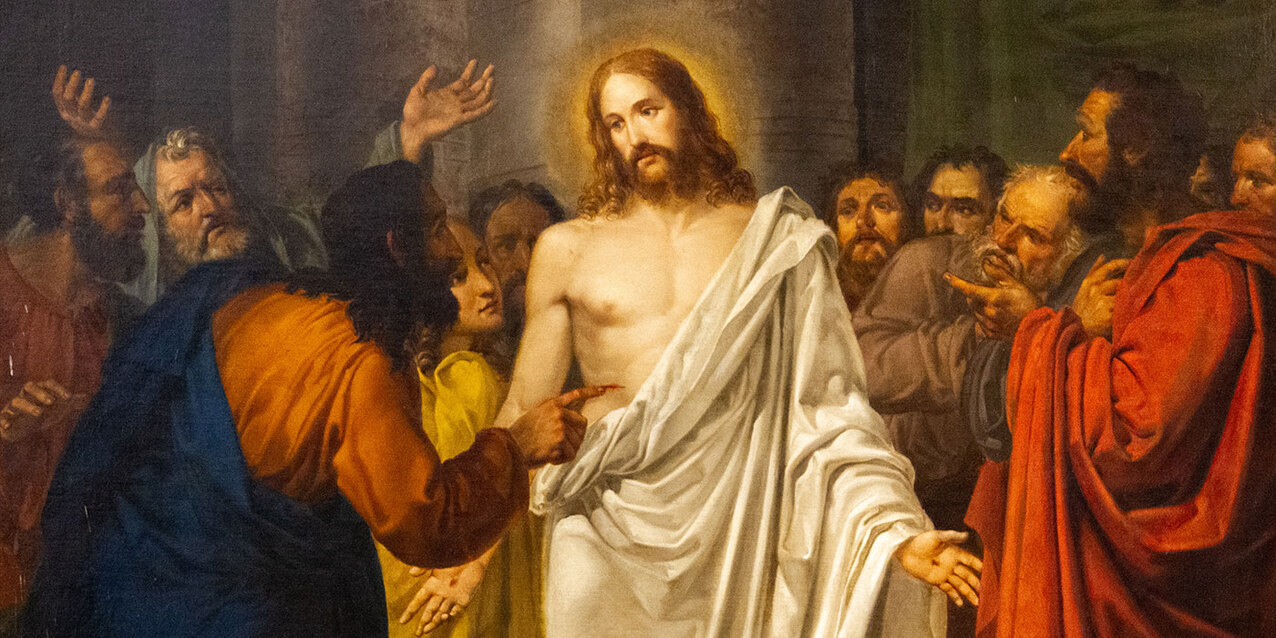
It challenges us to read that Jesus showed his followers his wounds. “See,” he seems to say, “a broken body is not made whole by erasing the imperfections. Feel this hole in my side,” he says to Thomas and to each of us. “See, I have sanctified what the world calls spoiled. A broken body is made whole not by removing the scars but by embracing the permanence of the wounds.”
We like this small and quiet resurrection where Jesus is not the definition of a contemporary superhero. He doesn’t return triumphant and knock Pilate off his throne, bringing God’s wrath on the vicious Roman Empire. He appears to his friends, simply showing his wounds and talking about love and peace.
Today’s story of Thomas illustrates our Christian experience. We are called to believe without seeing. In fact, all Christians (after the first witnesses) have been called to believe without seeing. Thus, we sing “Without seeing you, we love you; without seeing you, we believe.” Thomas’ doubt is hardly surprising; the news of Jesus’ appearance was incredible to the disciples who had seen him crucified and buried. Thomas’ human nature compelled him to want hard evidence that the Jesus, who appeared to the disciples after his death was indeed the same Jesus who had been crucified. Thomas is given the opportunity to act on that desire. He is our witness that Jesus is truly raised from the dead. With him we proclaim: “We have been told, we’ve seen his face, and heard his voice alive in our hearts.”
Jesus wants us to be perfect, but not the kind of perfect that ninjas or Superman display. Jesus wants us to be perfect “as our heavenly Father is perfect.” God’s perfection and the message of Jesus’ Resurrection call us to an unconditional embrace of frailty, pain, and brokenness.
It is an embrace that calls us to resist all forms of violence, power, and hatred. There is growing acknowledgement of that fact that TV and video game violence, like second-hand smoke affects one’s lungs, permanently affects our brains. Many persons, families, and faith communities refuse to allow TV violence, fictionalized or news reports, to invade their living spaces. Jesus did not arm his apostles with weapons for revenge — he armed them with prayer and baptized them in a spirit of hope and forgiveness.
We are surrounded today with so much sadness and fear and anger. We who live in a peaceful community rejoice in the security and sanctity that empowers us to extend open arms in hospitality to those in the world who yearn for that same privilege.
At the end of our Gospel selection we read, “Jesus did many other signs that are not written in this book. But these ARE written that you may come to believe …and through this belief you may have life in Jesus’ name.
We join the psalmist in singing: “By the Lord has this been done; it is wonderful in our eyes. This is the day the Lord has made; let us be glad and rejoice in it.”
~Reflection by Sister Roberta Bailey, OSB