• Skip to primary navigation
  • Skip to main content
  • Skip to footer
Benedictine Sisters of FL

Holy Name Monastery
Founded 1889

Donate Now
  • Home
  • About Us
    • History
    • Being Benedictine
    • Benedictine Monasticism
    • Meet Our Community
    • Holy Name Academy-Alumnae
  • What We Do
    • Mission, Vision and Our Partners
    • Retreats
      • Invitation to Retreat
      • Accommodations
    • Volunteer Programs
    • Oblate Program
    • Spiritual Direction
    • Aqua/Hydroponics
    • More of Our Ministries
  • What’s Happening
    • Articles of Interest
    • Events
    • Commemorative Bricks
    • Newsletters
    • Brochures
    • Links
  • Support Us
    • Gifts of Support
    • Wish List
  • Stories Shared
  • Galleries
    • Photos
    • Videos
      • Benedictine Sisters of FL Videos
      • Other Videos
  • Contact Us

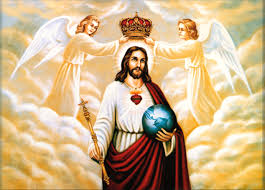
Christ

“Christ the King, the living face of the Father’s mercy.”

November 24, 2025 by Holy Name Monastery Leave a Comment

This weekend we observe the solemnity of Christ, the King. The celebration was first was proclaimed universally as a feast in 1925 by Pope Pius IX. In 2015, the prescribed date was moved from October to the last Sunday in the church year and the commemoration was raised to solemnity. At that time Pope Francis added a phrase to the title of the day.” (see title of reflection)

As the liturgical year draws to a close, we consider how Jesus is more than just a king. He is the King, the King of the Universe. We celebrate a ruler who, in mercy, was willing to die for us to give us true freedom. Jesus willingly exchanged the trappings of a king for a place among the poorest of the poor. In place of a red carpet, he’d had a rude stable floor strewn with hay. Later in his life, it was palm branches that lined the way beneath a donkey’s feet. His crown was not one of gems but a crown of thorns. His choice of transportation was usually on foot. In speaking of his home, Jesus said: “Foxes have holes and the birds of the air have nests, but the Son of Man has nowhere to lay His head.”

Some may wonder why we read a scene from the passion today. How does that help us understand what Jesus’ kingship means? We may always sense a vague uneasy feeling in calling Jesus “king” partly due to the changing attitudes toward kings throughout history. Today, distrust of authority is rampant – accelerated by the rise in belief that the only authority is the individual self. The idea of Christ as ruler, as king is resisted by many who believe that such titles are borrowed from oppressive systems of government. History proves that some kings have been oppressive. But when we allow this type of thinking to overtake us we miss the point that Christ’s kingship is one of humility and service. In contrast to the oppression so prevalent in Jesus’ day, he saw his role as king as one of humble service. He teaches us, his followers, to be servants as well. This is the behavior we must imitate. As Benedict teaches “Anticipate the needs of others and put them before our own; anticipating others’ needs in doing good works.”

This leads us to ponder: how is it that Jesus can be, at the same time, both Suffering Servant and King? That’s the very question that Jesus turns on Pilate: “Do you ask this (are you a king?) on your own? Or have others told you about me?” It pushes us to question ourselves: Is Jesus my King? Do I know him on my own, from my own experiences? Or is my relationship with Jesus based on borrowed thoughts from books I’ve read; homilies and retreat talks? Do I sing with conviction the sentiments of the kingly hymns that spring to mind: “Come, Christians, Join to Sing”; “Rejoice, the Lord Is King”, “All Hail the Power of Jesus’ Name”, “Hail, Redeemer, King Divine”, “The King of Glory”, “At the Lord’s high Feast”, we sing, praise to our victorious King”? And, let’s not overlook the triumphant echoing of a favorite Christmas carol: “Joy to the World! Let Earth receive her king!”

At the other end of this week, we will be jump-started into the Season of Advent: an experience of an “ending” that is a “beginning” – a time of waiting for the One who will come. He is the One who is promised to us in the Book of Revelation: “Behold, he is coming and everyone will see him; the Alpha and the Omega, the one who is and who was and who is to come.” In Paul’s letter to the Colossians, he writes: “He is before all things, and in him all things are held together; in him all the fullness is pleased to dwell!”

~Reflection by Sister Roberta Bailey, OSB


First Reading: 2 Samuel 5:1-3 Second Reading: Colossians 1:12-20
Gospel: Luke 23:35-43
Continue Reading

Filed Under: Blog, Front Page, Homily Tagged With: Christ, King, poor, Pope, Pope Francis, solemnity of Christ the King

25th Sunday in Ordinary Time

September 22, 2025 by Holy Name Monastery Leave a Comment

This parable is challenging to explain but, it came from the mouth of God’s Son so it must be important for us to grapple with. What might Christ be saying to us? Here is what I heard – colored by the recent readings from chapter 2 of Benedict’s Rule on the Qualities of the Prioress. The Gospel tells us if we can’t be trusted in little matters we certainly cannot be trusted with great ones. If you are not a leader in a Benedictine community it may be easy to breeze through chapter 2 with an attitude of ho, hum – that’s for them – glad it’s not me.

To say that Benedict lays down high standards for the superior may be an understatement. He places the chapter on leadership qualities early in the Rule, only after he defines the type of monk he is writing for. So we know he is writing about the qualities of the leaders of the “strongest kind of monastics” – the ones who have chosen to live under a Rule and a monastic leader.

I am thinking Benedict left it unsaid in Chapter 2, but he sprinkled exhortations regarding leadership for all the members elsewhere in the Rule. Benedict echoes Jesus when he presses home the “the person who is dishonest in very small matters will also be dishonest in great ones.” It does not require a great leap to apply this maxim to all of us – the youngest in community to the eldest. It seems to me Benedict is waving a banner before our eyes of what we each need to be so that a call to leadership does not include an abrupt change of lifestyle. Benedict knew from his own experience that the leader’s role in community is time-limited. He himself had experienced the call to leadership and call to a hermit’s life. He must have foreseen, perhaps with a nudge from his twin sister Scholastica, that the monastic must be prepared in all aspects of her life to move in and out of leadership roles. If the individual member does not engage in a lifelong endeavor to develop the attitudes, skills and qualities that Benedict laid out for the superior, (guess what?) an election or appointment to a leadership position will not ipso facto endow a saintly disposition. If a person has not learned to be accountable for her own actions (or at least tried to be), and to be solicitous for the welfare of those in her charge (as a teacher, principal, supervisor, kitchen manager, sacristan, chief floor scrubber, head nurse….), an imposition of hands or a community blessing, or even the bishop’s blessing will not infuse saintliness: responsibility, accountability, compassion or mercy.

You may remember the lesson of the geese who fly in V formation? As each bird flaps its wings, it creates an uplift for the bird following it. Combined, the whole flock adds 71% greater flying range than if the individual geese flew alone. Whenever a goose falls out of formation, it suddenly feels the drag and resistance of trying to fly alone and quickly gets back into formation. When the lead goose gets tired, it rotates back into the formation and another goose flies at the point position. The geese in the formation honk from behind to encourage those in front to keep up their speed.

Note that Benedict does not let the “honkers” off the hook. In speaking of the qualities of the abbot, Benedict intersperses words to the “monks in the pews.” If the prioress is to call the community or individuals to account, the member must be docile to listen. If the prioress is to be a shepherd, the sheep have to be willing to be corralled and led. It’s impossible to lead if no one follows.

Benedict reveals his keen insight into human nature when he talks about the cast of characters who can be gathered into one community. He reminds the leader, and by inclusion, all the members, to “accommodate and adapt themselves to the character and intelligence of their Sisters.” In conclusion, Benedict smiles upon the leader consoling her that she does not lack resources. He quotes Psalm 33: “Those who fear God lack nothing.” In helping others, the leader achieves the amendment of her own faults. Benedict does not mention, but I bet he knew, the gratifying support the prioress or the abbot, (or leaders of any sort) daily receives in unpretentious, quiet affirmations.

Like the story of the geese, in monastic life when the leader gets sick or is shot down (with arrows or words), individual members drop out of formation to help, protect and reaffirm the leader until she is either able to again take the lead or fly in formation with the other members. Jesus reminds us in this parable that, in the end, it doesn’t matter when you came into community, even when you came into the church. The reward for putting your hand to the plow will be the same: a day’s work in the kingdom for God’s daily wage … the last, the same as the first. It’s been that way for all eternity. You’ll find when you get there (I’m guessing) that your view from the mansion God is saving for you is just as magnificent as that of Moses or Adam and Eve or your favorite saints – everyone’s mansion has a “throne-side view” of heavenly glory.


P.S.  World Mission Sunday

World Mission Sunday is scheduled for the weekend of October 18-19, 2025, and this year’s theme is “Missionaries of Hope Among All Peoples.” During this Jubilee Year of Hope, the theme is most appropriate, and all are called to engage in missionary work in one form or another, thereby bringing hope to those in despair. This annual worldwide collection helps to provide aid to 1,124 dioceses that cannot sustain themselves because they are too poor, young, or actively persecuted.


~Reflection by Sister Roberta Bailey, OSB


First Reading:   Amos 8:4-7         Second Reading:  1 Timothy 2:1-8
Gospel:   Luke 16:1-13
Continue Reading

Filed Under: Blog, Front Page, Homily Tagged With: Benedict, Christ, geese, God, Gospel, st. benedict, The Rule, World Mission Sunday

Solemnity of Saints Peter and Paul

June 30, 2025 by Holy Name Monastery Leave a Comment

Saints Peter and Paul are probably the best known of all the saints in the Catholic Church.  Both of them were personally chosen by Jesus for the building up of the Mystical Body of Christ.  Peter’s mission was twofold: to lead the Catholic Church in the early stage and to lead the Jewish people into the new Covenant.   Saint Paul came into the picture a little later and played a major role for the Church in converting a great number of the Gentiles to follow Jesus.

Theirs is the same God who continues to reach out to us, calling us to spread God’s light throughout the world. To us, simple human beings, not angels, God gives the Holy Spirit to guide us and teach us according to the evolving needs of the Church – the people of God.

This evening I chose to proclaim the gospel given for the Vigil Mass rather than the one for tomorrow’s liturgy.  The Scripture selection highlights Peter, but Paul will get his solo turn later on.    Many look at the Gospel passage with wonderment. Why did Jesus ask Peter the same question over and over?

Seemingly out of the blue, Jesus says to Simon Peter, “Simon, son of John, do you love Me more than these?”  Peter responds, “Yes, Lord; You know that I love you.” I cannot imagine a more insulting way for Peter to answer!  Peter is sitting with the risen Jesus  who asks him “Tell me, Peter, do you love me with a selfless love?” and Peter responds using a verb that means: “I am really quite fond of you.”

We can only imagine how “out of place” Peter now felt being with Jesus. Where he had once been comfortable and self-assured as one of the chosen disciples; he now feels the shame of denying he is one of Jesus’ friends.  Self-confidence and faith had withered to self-doubt and a feeling of being an utter “failure.” How could he even bear to look into the face of the resurrected?

The rest of this passage shows Jesus’ compassion for, and continued confidence in, Peter.   “Truly, truly, I say to you, when you were younger, you used to gird yourself and walk wherever you wished; but when you grow old, you will stretch out your hands and someone else will gird you, and bring you where you do not wish to go.”  Jesus is confirming his love for Peter even though Peter had failed him.  Jesus gives Peter the opportunity to confess his love for Jesus in front of witnesses.

Jesus then told Peter that he was going to die for Him. What a wonderful piece of prophecy!  Jesus was telling Peter that he was going to have faith great enough to be the kind of man he thought himself to be when he said, “Even if I have to die with You, I will not deny You.”   He didn’t die WITH Jesus, but he knew now he was going to be allowed another chance; to LIVE FOR Him, and that he would eventually die for Jesus. We can only imagine the joy and relief that Peter felt!  Later, in different circumstances, Jesus will issue the same invitation to Paul.

What does this mean for you and me?   Even though we may have failed the Lord miserably, He is sharing GREAT news with us: it is not too late!  We have another chance to prove to the Lord, and to ourselves, what kind of Christians we really are.

~ Reflection by Sister Roberta Bailey


First Reading: Acts 12:1-11                       Second Reading: 2 Timothy 4:6-8, 17-18
Gospel: John 21:15-19
Continue Reading

Filed Under: Blog, Front Page, Homily Tagged With: Christ, Jesus, Paul, Peter, Solemnity of Saint Peter and Paul, St. Paul, St. Peter

2nd Sunday in Ordinary Time

January 20, 2025 by Holy Name Monastery Leave a Comment

The readings for this weekend, combined with the civic occasions we observe, present a challenge.  What to emphasize?  Today (Saturday) opened the annual Week of Prayer for Church Unity.  It has a history of over 100 years of prayer for the fulfillment of Jesus’ prayer at the Last Supper “that all may be one.”   We will continue our practice, when on Wednesday we welcome the Mayor of the Town of Saint Leo, Assistant Pastor of the Rock Church of Brooksville (and his congregation) HO will join us for a Unity prayer service based on this year’s theme “Do You Believe?”

Today and tomorrow the world is watching, with multitudes sending up a stream of prayers for the successful implementation of the Peace Pact for Israel and Gaza: the release of prisoners and relief convoys allowed into war-torn areas.  And, for the peaceful transfer of power in our country.

We pray:  Prince of peace, we cry out for Your divine intervention in Israel and the surrounding regions.  We earnestly petition You to bestow tranquility upon our land. May prosperity flourish, (but not at the cost of the poor and vulnerable).  May Your unwavering peace reign over the hearts of all people.

Now, switch your focus.   On Monday the workday-week begins with the rare coinciding of a Presidential Inauguration Day and Martin Luther King Jr. Day national holiday.  The two events aren’t expected to coincide again until January 2053.

Now, if that does offer us enough to pray about, let’s turn to the three readings in our liturgy.  They are, I believe, an example of a woven piece of God’s mysterious message-giving.  It creates a colorful piece with threads that weave the way from Isaiah, through Paul’s First Letter to the Corinthians, into the Gospel of John, laced with verses from the Responsorial Psalm 96.

From Isaiah (in the first reading) we hear: “I will not be silent; I will not be quiet.” (Mmm – didn’t Martin Luther King echo that same message?)  Now slip in a line from the Responsorial Psalm: “Announce God’s salvation day by day.” (sentiments of Unity Week and Peace Agreement). This leads us right into a touching Gospel story of a son’s response to an implied request of His mom.  Mary could not resist the impulse, the urge to encourage her Son to come to the rescue of the wedding couple’s embarrassment.  She’d raised this man/child.  She knew he’d take her hint.  Turning toward the wine-servers, she says simply: “Do what he tells you.”  And they did just that.

A question to ponder: Who could have observed that quiet exchange?  Scriptural Scholars tell us it was the beloved John, the only one of Christ’s original disciples who lived into old age and was the only one not martyred for the faith.  He can tell that story from an old man’s perspective laced with the wisdom and vision that is a gift of the elderly.  We know so well that stories are a gift given by older members to the newer ones.  The elders are the torch bears; the younger are the keepers of the torch.  It is they who are responsible for coaxing the sparks to keep the embers glowing, breathing new life into our legacy.  Stories of the “good ole days may get old but consider what we’d miss if John and the other evangelists had kept secret their experiences with Jesus.

In today’s world, much like the days of early Christianity, people are facing crises of migration, prejudice, hunger for food, companionship, health care services, violence and indifference. How can we show “unusual kindness” exemplified in Mary’s keen insight and Jesus’ quick response to her tip: “Do what He tells you.”   As Benedict advises us: “Show reverent love.  Be the first to pursue what you judge better for someone else.”  You know: Pass-it-on-Kindnesses” or “Pay it Forward” favors.  Kindness that is a witness to God’s loving providence for all people. When we invite people to “come and see” they are looking for more than a tour of our monastery building and a list of volunteer ministries. Our spirit of hospitality will have a ripple effect (positive or negative) that makes visible (or not) Jesus’ love in today’s world. We pray that we and all peoples of diverse backgrounds, cultures and religions, are enlightened to accept each other with open hands and hearts and that world peace will prevail in our lifetime.

~Reflection by Sister Roberta Bailey, OSB


First Reading:   Isaiah 62:1-5         Second Reading:  1 Corinthians 12:4-11
Gospel:   John 2:1-11
Continue Reading

Filed Under: Blog, Front Page, Homily Tagged With: Christ, gaza, Isaiah, israel, John, Martin Luther King, Martin Luther King Jr. Day, Prayer, Presidential inauguration, Unity

Transubstantiation

August 19, 2024 by Holy Name Monastery Leave a Comment

Have you ever met anyone, (or maybe you’ve been counted among those) who found the Catholic doctrine of transubstantiation a bit hard to accept?  Maybe just for a minute or two you may have wondered how Jesus could talk about eating his flesh and drinking his blood?  At the words in this Gospel, so many of Jesus’ disciples abandoned him that Jesus asked the twelve if they also planned to quit.

Jesus’ statements had caused arguments to break out within the crowd and gave Jesus the opportunity to move the conversation to the next level. The crowd begins to express confusion over how Jesus can give his flesh for them to eat.  Jesus senses the restlessness but does not avoid the topic.  Rather he makes an even more offensive statement: they will need to eat his flesh and drink his blood. He had spoken before about “eating” the bread from heaven, using a very common word.  Now He switches to a less common word that has a connotation closer to “munch” or “gnaw”, a graphic word noisy eating, the sort of eating like an animal or your brother crunching a mouthful of fresh potato chips.  But that is not the important point; this is eating that is urgent, even desperate. It is eating as though your life depends on it, because it does. 

So, how did the early Christians interpret Jesus’ challenging words?  History tells us that the pagan Romans made charges against the Christians for cannibalism. They had heard that when these people met, they ate and drank human blood.  Not many Christians themselves questioned the real presence of Christ’s body and blood in the Eucharist till the Middle Ages. In trying to explain how bread and wine are changed into the body and blood of Christ, several theologians went astray and needed to be corrected by Church authority. Then St. Thomas Aquinas came along and offered an explanation that became classic.  The Eucharist, he said, is the one instance of change we encounter in this world that is exactly the opposite. The appearances of bread and wine stay the same, but the very essence or substance of these realities, is totally transformed. What was once bread and wine are now Christ’s body and blood. A unique word “transubstantiation” was coined, and remains to this day, to an effort to explain the miracle of the changing of bread and wine into the Body and Blood of Jesus.

Such an awesome gift deserves its own feast. And that’s why, the feast of Corpus Christi was proposed by Thomas Aquinas to Pope Urban IV, who created a feast focused solely on the Holy Eucharist, emphasizing the joy of the Eucharist being the Body and Blood, Soul and Divinity of Jesus Christ.

When I ponder our Gospel reading, which is the same as that used for the Feast of Corpus Christi, it strikes me that with Christmas we were touched with joy and awe at the birth of the God-man Jesus.  At Easter we explode with ALLELUIA at the resurrection of our Savior.  The Ascension leaves us quietly looking upward, outward waiting in expectation for “what’s next?”  Then, comes the solemnity of the Trinity – the mystery that baffles us … that God is so great, so awesome that only in three persons can all the divine manifestations be expressed.  And, today, the solemnity of the Body and Blood of Christ – this touches, awakens in us feelings we can hardly express – that our God, our Jesus, our Savior would choose to gift us in such a personal, intimate way!  Our Creator-God chooses to be “assimilated within the body of the creature.”  His body and blood become, over and over, absorbed into my body – His blood courses in my veins … invading every fiber of my being.   When the priest (or Eucharist minister) presents the host or chalice, looks us in the eye and says: “Body of Christ!”  “Blood of Christ” – we are overcome with the awesomeness of this gift. All we can manage to say is “AMEN” – so be it – AMEN!

~Reflection by Sister Roberta Bailey, OSB


Pray for students beginning a new term …  for healthy friendships,  academic success, nurturing teachers and stimulating extracurricular activities.


First Reading:   Proverbs 9:1-6         Second Reading:  Ephesians 5:15-20
Gospel:   John 6:51-58
Continue Reading

Filed Under: Blog, Front Page, Homily Tagged With: Blood and Body of Christ, Body and Blood, catholic, Christ, doctrine, eucharist, feast, Jesus, Transubstantiation

Fifth Sunday of Easter

April 30, 2024 by Holy Name Monastery Leave a Comment

Our Gospel reading is taken from the middle of the Last Supper discourse when Jesus speaks about his relationship with his disciples – with each of us.  He teaches about the importance of the words He has taught and how he will remain with his disciples, with us.  Jesus promises to remain in a vision rich in intimacy that is profound and personal.

He uses an example to which His followers can easily relate to – fruit of the vine ripening for harvest.  He knew the details of pruning and removal of non-fruit bearing branches, throwing out and burning withered branches.  The people had asked him before to speak literally and not be so subtle.  When He spoke about vineyards the people of Judea knew what he was talking about.  It was their cash crop, not like grain which were raised purely for consumption.

He could have chosen any number of crops. However, I am glad He was attracted to the vineyards.  I like the ring “I am the vine, you are the branches.”  Imagine if he had used figs or olives, melons or cucumbers – I am a tree, you are the fig, the olive, the melons. The metaphor of the vine and the vine dresser made me curious about hidden symbolism beyond the obvious fact that the twigs are connected to the blossoms; the blossoms to the branches and the branches; to the vine, the vine to the root.

Grapes are one of the most ancient crops known to humans.  The form to which the grape vines are trained is limited only by the grower’s imagination and the vines-in-training themselves.  They must be pliant enough to yield to the contour God is shaping.

Grapes are sold as rooted cuttings.  Care must be taken to ensure that the cuttings are planted right-side up. Growers are advised to plant the vines in clearly marked rows in a north-south orientation to capture the most sunlight.  When the weather is cooler up to 90% of new growth is removed and young vines are typically not permitted to bear fruit for the first three years.

The pruning process reminds me of what we do every Lent.  We monitor our spiritual life to remove unwanted growth, pull and discard weeds, and through our resolutions we water fledging efforts to be strong Christians – good community members – worthy disciples.  Preventive action offers the greatest benefit in controlling the spread of disease from vine to vine.  Visit the vines often, screen cuttings for good potential, prune as needed, dispose of dead and diseased parts, rake the soil, scout for insects.

So, what are the “Big Five” community fungal diseases?  The Benedictine Mark Scott (our retreat director in 2016) suggests the big sins for Benedictines are forgetfulness, murmuring, laziness, resentment and neglect.   These, he says, are the things that damage relationships, complicate things, create chaos, instill mistrust and generally disturb the peace.

How can we prevent or combat the monastic fungus?  Benedict gives us 72 tools for a holy life.  Surprisingly he does not start with prayer but with very basic tools that promote healthy relationships: love of God, self and your neighbor.  In Chapter 4 of the Rule you can see that Benedict was intent on his followers being transparent, peace-loving, self-controlled, humble and willing to grow and change.  And he says you don’t need to look beyond the walls of the monastery.  You will have plenty of opportunities in community to be shaped, pruned and coaxed, like the grape vines, upward into the sunlight, which is Christ, the divine vine-grower.

As we advance in the way of monastic life, we come to recognize more keenly the intimate, loving, shaping influence of God which is the heart and core of our commitment.  Like wild vines, we may stumble around reaching for false sources of sunlight, maybe even seeing only glittering reflections of light on the ground.  Too often we may trudge along with our heads down looking at where we have been rather than where the divine Vine Dresser is gently training our spirits to look upward – gracing us to see beyond our dreams.

~Reflection by Sister Roberta Bailey, OSB


 Have a pleasant week!


First Reading:   Acts 49:26-31         Second Reading:  1 John 3:24-28
Gospel:   John 15:1-8
Continue Reading

Filed Under: Blog, Front Page, Homily Tagged With: Christ, Fifth Sunday of Easter, grapes, Jesus, monastic, pruning, Vine, vineyards

  • « Go to Previous Page
  • Page 1
  • Page 2
  • Page 3
  • Page 4
  • Interim pages omitted …
  • Page 10
  • Go to Next Page »

Footer

Prayer / Newsletter / Info

 Contact Info

Benedictine Sisters of Florida

PO Box 2450
12138 Wichers Road
St. Leo, FL 33574-2450
(352) 588-8320
(352) 588-8443

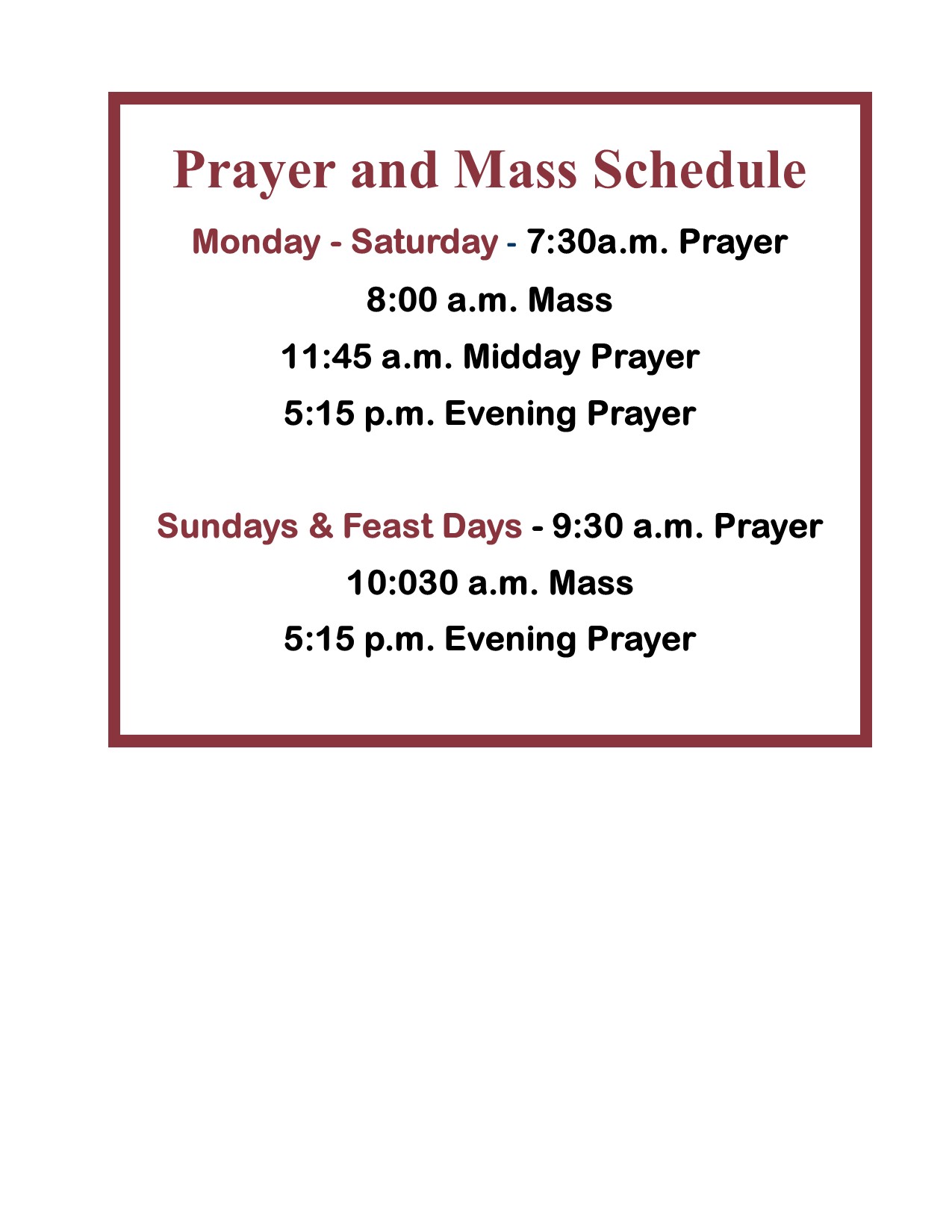
 Mass Schedule

Related Links

Copyright © 2026 · Benedictine Sisters of FL · Touching Lives Through Prayer and Service

Copyright © 2026 · Bendedictine Theme on Genesis Framework · WordPress · Log in