• Skip to primary navigation
  • Skip to main content
  • Skip to footer
Benedictine Sisters of FL

Holy Name Monastery
Founded 1889

Donate Now
  • Home
  • About Us
    • History
    • Being Benedictine
    • Benedictine Monasticism
    • Meet Our Community
    • Holy Name Academy-Alumnae
  • What We Do
    • Mission, Vision and Our Partners
    • Retreats
      • Invitation to Retreat
      • Accommodations
    • Volunteer Programs
    • Oblate Program
    • Spiritual Direction
    • Aqua/Hydroponics
    • More of Our Ministries
  • What’s Happening
    • Articles of Interest
    • Events
    • Newsletters
    • Brochures
    • Links
  • Support Us
    • Gifts of Support
    • Wish List
  • Stories Shared
  • Galleries
    • Photos
    • Videos
      • Benedictine Sisters of FL Videos
      • Other Videos
  • Contact Us

Blog

Are You the One of Ten Who Found Salvation?

October 10, 2016 by Holy Name Monastery Leave a Comment

luke-17-11_19First Reading   2 Kings 5:14-17              Second Reading    2 Timothy 2:8-13
Gospel    Luke 17:11-19

This Gospel has much to say about gratitude and salvation.  All 10 of the lepers were given the gift of healing, but only one found salvation because he recognized the gifts he had been given and knew to whom he owed thanks.

At the outset of this story we know that these ten men are stuck – Stuck in a “no-man’s” land of being socially, religiously, and physically unclean having to distance themselves from but all other lepers.  By the end of the story, all ten were made well.  But one has something more. He has seen Jesus, recognized his blessing and rejoiced.  Because he saw what had happened, this man is not just healed, but is made whole, restored, drawn back into relationship with God, and his family, friends and neighbors. In all these ways he has won salvation.

Recently I heard a true story of gratitude that wrought salvation.  The lady who told the story works downtown in a large city.  Every morning, she encountered a middle‑aged woman in a shabby coat soliciting spare change from passers-by.  She greeted everyone with a smile and a pleasant “Good morning.”  The lady who told the story almost always gave her something.  After almost a year of this routine, however, the woman in the shabby coat disappeared.  My friend wondered what had happened to her.  .

Then, one beautiful morning, she was in her place in front of the church, still wearing the same, shabby coat. As folks reached into their purses or pockets for their usual donation, the woman stopped each of them. “Thank you for helping me all those days,” she said. “You won’t see me again because I’ve found a job.” With that, she reached into a bag and handed each one a wrapped package. She had been standing at her old spot waiting, not for a handout, but for the people she recognized so that she could give each of them a doughnut.  She recognized those who had given to her in her time of need. This is gratitude!

In our account today ten men encounter Jesus and called out (the scripture say “loudly” or yelled) “We want to be well!”  You may know that leprosy also attacks the vocal chords so that these men probably could only make a raspy sound. But that didn’t stop them from raising their voices and crying, “Jesus, Master, have mercy on us!” The gracious Lord Jesus will never turn a deaf ear to a cry like that!

Jesus appears to do nothing, but quietly directs the men:  “Go, show yourselves to the priests.”  Now, you have to understand that the local priest, besides leading worship services was also something of a health official – to test and certify a complete removal of the dread disease and then to announce that the person was healed.

As these men took heed of Jesus’ words and set out in search of the priest, one may have noticed his hand, once eaten away by the disease now tingled with life.  Or maybe he dropped his crutch when we saw his leg was back, healthy, whole and complete.  Their skin was beginning to clear and regain natural color.  One looked at the other, another looked at the rest, and the screaming started. The smiles broke into cheering, and a sweet madness. They raced off in the distance, hardly believing that the nightmare was finally over.

But in order for the miracle to happen, the men had to start a journey in faith before their circumstances had begun to change even one tiny bit. We are not told whether the ten lepers had a debate about whether or not to go. I can well imagine one of them arguing, “We’ll look like fools if we show up before the priest in our present condition!” Another countered, “Yes, but we’ve got nothing to lose; this is our only hope.” “But it hurts to walk on these leprous feet!” “I know, but if we do what He says, maybe we’ll be healed.” “But this isn’t the way He healed the other lepers. Why doesn’t He heal us in the same way?” “I don’t know, but we must obey.”

Maybe they didn’t have any such debate, since the text doesn’t record any, but at any rate, it says, “as they were going, they were cleansed.” It must have been a marvelous experience!

One of the men came back to Jesus.  The gospel does not make it clear whether he had seen the priest and been declared clean.  The evangelist tells us he praised God. He was thankful. He was public about it. He was loud – he wasn’t shy at all.

Why was he so loud? This guy had been forced to yell for as long as he’d had leprosy. Might have been years? He’d probably yelled so long, he didn’t know how to come to the Lord quietly, or even in a normal voice. When he came back and fell at the feet of Jesus, he was just louder than the normal person, and he was praising God.

He had reversed his steps, put his family on hold, put the priest on hold, and came back to the one who was the Cause of his celebration. His response, his thankfulness led to action.

Jesus asked: “Where are the other nine?”  They had got what they wanted from God in terms of healed bodies.  But, according to the story, they never returned to Jesus to receive salvation. They received the temporal benefit of healed bodies, but it is only to the one thankful leper who returned that Jesus proclaimed, “Your faith has saved you.” In the same way, it is possible to receive special blessings from God in answer to prayer, and yet to fall short of the best blessing of all. Thus when we realize that God has blessed us with some temporal blessing, we must not become satisfied with that and stop before we’ve thanked the Source of all blessings.

A story is told of a man who was lost in the woods. Later, he told how frightened he was and how he had even finally knelt and prayed. Someone said, “Well, obviously God answered your prayer?” “Oh, no,” the man replied. “Before God had a chance, a guide came along and showed me the way.”

~Reflection by Sister Roberta Bailey, OSB, Prioress
Continue Reading

Filed Under: Blog, Homily Tagged With: Faith, gift, God, gratitude, Healing, Jesus, lepers, priests, salvation

Which One Are You?

October 3, 2016 by Holy Name Monastery Leave a Comment

cookieman-personal-touches-matter27th Sunday (October 2)

First Reading  Habakkuk 1:2-3; 2:2-4      Second Reading  2 Timothy 1:6-8,13-14
Gospel  Luke 17:5-10

In this Gospel the disciples ask Jesus for an increase of faith. The faith that is being asked for is not to have a better knowledge of our catechism. What is being asked for is a much deeper and stronger trust and confidence that our God is near us – the firm conviction that God will always take care of his own.

Our participation in God’s plans is God’s grace to us—nothing more, nothing less. Even when God works wonders through us, with our mustard seed-sized faith, we must not seek praise.  When we are graced enough to cooperate with God, the work we do is nothing more than our obligation as faithful stewards of what God has given us.   And yet, our faith enables us to believe that what we have offered in service to God, as his servants, can be made to produce (like that mulberry tree in the midst of the sea) a hundredfold.

Our relationship with God is not about a bargaining agreement; a bartering or a buying and selling contract, about giving to God and getting in return. No, our relationship with God is one of total and unconditional love. The joy and satisfaction is not in what we can do to squeeze favors from God but in what we can give and share of ourselves.

The reason for this, of course, is that no matter what we do we are in God’s debt. The very energies with which we serve God are pure divine gift to us. We are “merely servants.” It’s not a 50/50 deal with God.  We can never do more than “our duty.” However much we give to God it is a small repayment for all that has already been showered on us.

We’ve heard many everyday heroes say something of this nature, haven’t we?  When they are awarded medals or accolades for a so-called heroic act, many say “I didn’t do anything special.  I just did what anyone in the same circumstance would do.”  But, would they?  Would we – jump into murky waters of an icy cold river, onto subway tracks in the path of an oncoming train, risk being attack by a vicious animal, rush into a burning building?  Would we respond to the need of the moment, let the Spirit, whom we sometimes call “adrenaline” kick in and come to the rescue?  Or, if we had the opportunity would we consistently perform  less noticeable actions like we’ve seen lately in the news: leaving a highly paid chef’s position to serve gourmet meals in a soup kitchen, insuring that 2000 poor families get Christmas gifts, spend our weekend to provide  free health and dental care to help make people smile and laugh.  We can hope that would not hesitate, and pray our faith would sustain us to respond: “we have done what we were obliged to do.”

Remember the story that goes: There were four people named Everybody, Somebody, Anybody and Nobody.  There was an important task to be done and Everybody was sure that Somebody would do it.  Anybody could have done it, but Nobody did.  Somebody got angry about that, because it was Everybody’s job.  Everybody thought Anybody could do it, but Nobody realized that Everybody wouldn’t do it.  It ended up that Everybody blamed Somebody when Nobody did what Anybody could have done. Which one are you?

Jesus’ story today indicates that lack of faith is not really the issue when we fail to respond to the needs of others. Faith is not measured by its quantity, but simply by its presence. A mustard seed sized faith will accomplish impossible things. The real need, Jesus says is for more obedience and humility. We should view ourselves as God’s slaves who owe Him simple and unquestioning obedience. And, when we have done what He requires, we should not get puffed up with pride in our great obedience, but should simply say, “We are unworthy slaves; we have done only that which we ought to have done.”  As Benedict says in his chapter on obedience: If you notice something good in yourself, give credit to God, not to yourself.”  Keep before you Benedict’s admonishment: “Do not aspire to be called holy before you really are, but first be holy that you may more truly be called so.”

It reassuring to know we can rely on God to uphold his promises.  Recall the words of Psalm 89 that we prayed earlier this week: “God promises: I will never take back my love; my faithfulness will not fail.  I will never break my covenant or go back on my promise.”   Or take as your mantra this week the words of Jeremiah the prophet:  “This I recall to my mind, therefore I have hope. The Lord’s loving kindnesses indeed never cease, for His compassions never fail. They are new every morning; great is God’s faithfulness.”  And perhaps spend some time contemplating whether, when there is a task to be done, you are a Somebody, an Anybody, a Nobody or one among Everybody….

~ Reflection by Sister Roberta Bailey, OSB, Prioress
Continue Reading

Filed Under: Blog, Homily Tagged With: anybody, everybody, Faith, God, Jesus, Luke, Mustard seed, nobody, servants, somebody

A Twist on a True-to-Life Story

September 26, 2016 by Holy Name Monastery Leave a Comment

luke16richmanFirst Reading  Amos 6:1,4-7   Second Reading  1 Timothy 6:11-16
Gospel Luke 16:19-31

The question is often asked, is this account of the rich man and Lazarus a historical account or is it a parable? Is there a difference?  Is it the true story of two men who lived and died during the time of Christ’s earthly ministry or is it a made-up story used by the Lord to drive home a point?  If we believe what most Scripture scholars hold true, we can say it describes an actual history of two men.

For you see, by definition, a parable is a true-to-life story used to illuminate a truth. This is true even if all of the details never occurred exactly as presented in the story. They are special stories that may, or may not, reflect historical events. Nevertheless, they must be true-to-life. By true-to-life we mean that a parable must be based on a real-life situation that the hearers are familiar with. In other words, the story itself has to be based on events that could have happened, whether they ever actually did or not.

Thus, a parable is a paralleled comparison.  It must be a true-to-life story in order for it to have any meaning to those who hear it. To try to use a fanciful story containing elements that have no basis to the world in which men and women live would only serve to confuse people rather than providing them with spiritual light.

A simple survey of Jesus’ use of parables reveals that He always used things that were familiar and commonplace in His time and to daily life of his listeners.  Recall the comparisons He used such as building of houses on rock or sand, using old or wine new skins, a farmer who sows seed that grow side by side with weeds until the harvest, yeast that permeates the dough, hidden treasures, fishing, a father’s forgiveness, a son’s regret and a jealous sibling, monetary debts, family life, weddings, a barren fig tree, a lost coin, a persistent neighbor, an unjust judge. While His hearers may not have made the connection to the truths the Lord was pointing out, they needed no explanation as to what the stories were about because they involved common everyday things to which they could relate. When the hearers of the parables perceived that there was an analogy between the story and their own situation, they were prompted to think about it and hopefully to respond by faith to the truth illustrated. Parables can be extraordinary and even shocking, but never unrealistic or fanciful.

When we come to this account of the rich man and Lazarus, we find a situation different from what is found in any of the other parables. Jesus’ hearers – which may have included the rich man’s brothers – could understand the contrast between the life of a rich man and a poor beggar. It was common to see beggars sitting by the road hoping for a handout, and they could easily identify the folks who had more than enough wealth to live comfortably. Then, as now, there was a stark difference between the lives of those who have an overabundance and those with nothing.  We can still grasp an idea of the great difference between the lifestyles of these two men. The vastness of the “great gulf” between them is not unknown to us.  Especially in third world nations people are literally starving to death living in the shadows of mansions and great wealth.

The hearers of this story could follow the contrast between these two men right up to the moment of their deaths. At that point, however, the situation changes drastically. The outcome was something that they could not relate to any life situations that they had ever witnessed. The state and location of the departed soul was beyond their life experiences.  What takes place after death is hidden from us. In this Gospel Jesus was revealing the reality of what takes place so He could drive home an important truth.  Many of Jesus’ hearers would have been familiar with the psalms but may not have made the connection to the words we read earlier this week: “They satisfied themselves while they lived; they will join the company of those who preceded them where the darkness lasts forever.”

Our dedication to our corporate commitment is living proof that we are learning the lesson Jesus is teaching … We share in the ministry of the compassion of Jesus when we provide hope and comfort to God’s people.  The moral of the story, I believe, is captured in the prompting of Joan Chittister when she asks: “What do we want to be caught dead doing?”

~Reflection by Sister Roberta Bailey, OSB, Prioress
Continue Reading

Filed Under: Blog, Homily Tagged With: Christ, God, Jesus, Lazarus, parable, rich man

Always There

September 19, 2016 by Holy Name Monastery Leave a Comment

fatheranddaughterFirst Reading  Amos 8:4-7            Second Reading  1 Timothy 2:1-8
Gospel (shorter form) Luke 16:10-13

The lesson here is trustworthiness: those who can be trusted in small things can also be trusted in great things. Benedict knew this lesson well – that’s why he instructs us: “treat all things as vessels of the altar.” If we handle furniture, dishes, sewing supplies and a paint brush with the same respect that we exhibit toward a chalice it is more likely that we will have that attitude of caring will extend to people.  When we hear stories of violence, abuse and disregard for persons, the root “red flag” behavior was often evidenced in childhood and behavior toward siblings or parents: hitting out, slamming doors, the classic “kicking the dog” behavior because the young person was mad at a classmate or the teacher.  The parent who withholds violence against an over-powering boss but deliberately runs over the bike in the driveway, or slaps his son or screams at her daughter for a triviality – that behavior can usually be traced back to disrespect and disregard for the toys, blocks and body-slamming in the guise of “we were just having fun.”

Respect has its seed in Benedict’s “treating all things as vessels of the altar.”   Think about it …  look at how  you treat and handle your belongings and community goods you’ve been given for use …  your personal spaces, the car you usually drive,  “common spaces” you use … are they as neat, clean and orderly as we expect the altar vessels and the chapel to be?

Respect for things matures into respect for persons which leads others to know they can depend upon us and trust us to “handle” them with respect.  We are trustworthy with the little things in life, thus we can be trusted in our interactions with each other.

The story goes that a little girl and her father were crossing a bridge. Her dad was actually kind of scared of heights so he asked his little daughter, ‘Sweetheart, please hold my hand so that you don’t fall into the river.’

The little girl said, ‘No, Dad. You hold my hand.’  ‘What’s the difference?’ asked the puzzled father.  ‘There’s a big difference,’ replied the little girl.  ‘If I hold your hand and something happens to me, chances are that I may let go of your hand. But if you hold my hand, I know for sure that no matter what happens, you will never let my hand go.’

In any relationship, the essence of trust is not in its bind, but in its bond.

When I was growing up in DeLand we lived 3 blocks from the main boulevard the best way to get from home to church – we had no car, we walked the two miles.  When, as an adult I drove the distance from the highway to where our house had been it seemed much shorter than my memory.  Why does that matter?  As is still typical today in parishes, our high school catechism classes were in the evening.   Until my 9th grade year, (I came to the academy when I was in 10th grade) my brother, three years my junior, and I had attended afternoon classes together.  Now, it was October and daylight savings time had ended and the walking home after class was in the dark – felt like the dead of night.  It wasn’t too scary until I reached the turn off to our street – no street lights, barking dogs that sounded like wolves, creepy noises of a rustle in the bushes.  I don’t know why, I didn’t have a flashlight.  I don’t recall that I talked about being scared … maybe rushed into the house like a banshee was chasing me?  But, the second week of classes, and every week thereafter until our clocks were sprung forward to daylight savings time, my father would magically appear at the corner of the main road to continue the journey home with me.    He sometimes made remarks about the foolishness of attending those classes when I already knew as much as the teachers… but he was there, and I knew I could depend on him to keep his vigil for my return.  And, I am sure that continues to confirm my belief that God is trustworthy and simply is “always there.”

~ Reflection by Sister Roberta Bailey, OSB, Prioress
Continue Reading

Filed Under: Blog, Homily Tagged With: always there, Benedict, God, respect, trust, trustworthines

God’s Law – God’s Love

September 12, 2016 by Holy Name Monastery Leave a Comment

gods-lawFirst Reading  Exodus 32:7-11,13-14                 Second Reading 1 Timothy 1:12-17
Gospel Reading  Luke 15:1-32                            Intention Responsible Citizenship

An inner city church, located in an area of a large American city where there were few residents, was forced to a decision. A large corporation was offering them a great deal of money for their site, on which the corporation wanted to put a parking lot. The money would enable the parish to move to the inner city where they would find many more people to serve. Even though this was exciting to some of the congregation, other members were resistant to the idea. They pointed out that the church was the guardian of a building whose history and architecture reached back into the early part of the nineteenth century. History had been made in that building.

Eventually the congregation decided to sell the site and make the move to the inner-city neighborhood. The pastor said, “We had to decide whether we wanted to be in a museum or in mission, we couldn’t have it both ways.  It meant either staying on the original site, glorying in the past history and serving a few people, or giving up the past and gearing up ourselves for a significant ministry among the city’s people. We opted for mission status over museum status.

Something of this same struggle is indicated in this Gospel. The Pharisees and scribes came down on the side of museum religion. They wanted attention given to those who were stable, pious and not a liability if invited to the local country club. Their rationale was “Let’s have our synagogue programs be dependable for our like-minded types.”  Jesus disappointed them by insisting that the issue was one of mission: to reach out to those who needed great mercy and perhaps a bath.

The Pharisees’ love of God’s law made them forget about God’s love.   God loves us even more than a parent loves a child. God longs to rescue those who are lost.  (It’s like his favorite pastime.)  Our loving God will search for that which is lost. There’s no giving up, no quitting point. Just like looking for a lost coin – there’s no such thing as a life without worth. God doesn’t mind stooping down to find us and lift us up from the depths we have fallen into. Each time you stoop to pick up something that has fallen to the floor, however trivial a thing it may seem, that God does not disdain to stoop down to pick us up each and every time, after time that we fall.

In Jesus’ day when a husband took a bride, he gave her a headband with ten silver coins that were evenly spaced. She wore this headband in public to show that she was married. If she was unfaithful, one of the coins was removed, and the gap showed that she had disgraced her marriage vows. It was a shame and disgrace to lose any of these coins.

Loss of the coin in Jesus’ parable it seems was a result of carelessness, but not a moral disgrace. It was lost on a dirt floor in the darkness. People without God are the like that. They are not just lost, they are in the dirt and the dark. They need Jesus, the Light of the World – we all do.   Jesus looks for us, so He can bring us out of the darkness into the light!   Our community hospitality ministry helps people come into the light of welcome, friendship and compassion so that they in turn can be a light to those they associate with.   We feed their hunger for peace, camaraderie, spiritual growth, a prayerful liturgy and often top it with a good meal.

Let me end with a story that proves we never know what will bring people to their knees.

A minister was waiting in line at the Pearly Gates. Ahead of him there was a fellow who was dressed in sunglasses, a loud shirt, leather jacket and jeans. Saint Peter addressed the asked, “Who are you, so that I may know whether or not to admit you to the Kingdom of Heaven?”    “I’m Joe Cohen, taxi driver, of New York City”. Saint Peter consulted his list, smiled and said:  “Take this silken robe and enter.

Away he went.  Next in line was the minister. . He stood erect and boomed out, “I am Msgr Joseph, pastor of Saint Mary’s Cathedral for the last forty-three years.” Saint Peter consulted his list and said to the minister, “Here, take this cotton robe and you can come in.” Just a minute here,” said the minister. “That man was a taxi driver and he gets a silken robe. How can this be?” ”

“Up here,” said St. Peter, we work by results. While you preached, people slept. While he drove, people prayed.”

~Sister Roberta Bailey, OSB, Prioress
Continue Reading

Filed Under: Blog, Homily Tagged With: God, God's Law, God's Love, Gospel, Jesus, Pharisees

Comfort Zone

August 29, 2016 by Holy Name Monastery Leave a Comment

comfort zoneFirst Reading  Sirach 3:17-18,20,28-29     Second Reading   Hebrews 12:18-19,22-24
Gospel Reading   Luke 14:1,7-14      Intention End to terrorism

There is a term popular today that seems to me to fit with this message of Jesus. The term is “comfort zone” which refers to those situations in which the person feels comfortable, safe, and free from threat or even challenge. The comfort zone is, for the person involved, a thoroughly comfortable place. Life there is marked by ease and familiarity.

It’s natural to like one’s comfort zone, but most of us would admit that we should not remain there indefinitely. People do not become better or more mature or holier lingering in their comfort zone. That just doesn’t happen.

This, I think, appears to be a modern term for what concerns Jesus in today’s Gospel. The passage divides easily into two parts.

In the first part, Jesus cautions against sitting in the place of honor at a wedding banquet and advises taking the lowest place instead.

In the second part, he urges us to invite the crippled, lame, and blind when we give a luncheon or dinner, rather than friends, relatives, and rich people.

So there’s advice here for us when we’re the guest as well as when we are the ones hosting an event.  But it is about more than proper banquet etiquette.  Choosing the seat of honor for ourselves sounds a lot like craving our comfort zone. The best seat is the one where we feel comfortable: accepted, safe, free from threat, challenge or embarrassment or any sense of awkwardness.

Sharing a community meal, sitting at table should be less about power and all about sharing the joy of being together.   Even our legends acknowledge the power of a choice seat like King Arthur and the Knights of the Round Table. Sitting at a round table came to symbolize equality… because there was no head of the table. All had an equal seat and an equal say. Where you choose to sit matters. It matters in the way people perceive you and in the way you act in different environments.

Jesus challenges us against staying in our comfort zone. Rather than limiting our guest list to people who are clones of ourselves, people with whom we’re comfortable, who don’t threaten or challenge us, invite instead those who are different, people who make us uncomfortable, but whose difference from us may bring with it a blessing.  This is what I think is so significant about our Thanksgiving Day dinner.  We open our door, our hearts and our table expecting nothing in return.  The blessing of being in a position to share is its own reward.

Jesus not only teaches us this the lesson of stretching our comfort zone, he demonstrates it. His entire life, his public ministry, the passion and resurrection, is full of one episode after another of not remaining in a comfort zone.  Repeatedly Jesus takes the low seat and invites unlikely types to be his guests.

Finally he takes the worst seat of all––on the cross––and those who come to his banquet make it through the door (recall last Sunday’s Gospel)  because they claim no merit of their own. Finally he leaves the comfort zone of earth and expands his comfort zone forever, everywhere and with everyone – there are no strangers – all are welcome!

~Sister Roberta Bailey, OSB, Prioress
Continue Reading

Filed Under: Blog, Homily Tagged With: advice, comfort zone, equality, Gospel, high seats, Jesus, low seats, welcome

  • « Go to Previous Page
  • Page 1
  • Interim pages omitted …
  • Page 83
  • Page 84
  • Page 85
  • Page 86
  • Page 87
  • Interim pages omitted …
  • Page 89
  • Go to Next Page »

Footer

Prayer / Newsletter / Info

 Contact Info

Benedictine Sisters of Florida

PO Box 2450
12138 Wichers Road
St. Leo, FL 33574-2450
(352) 588-8320
(352) 588-8443

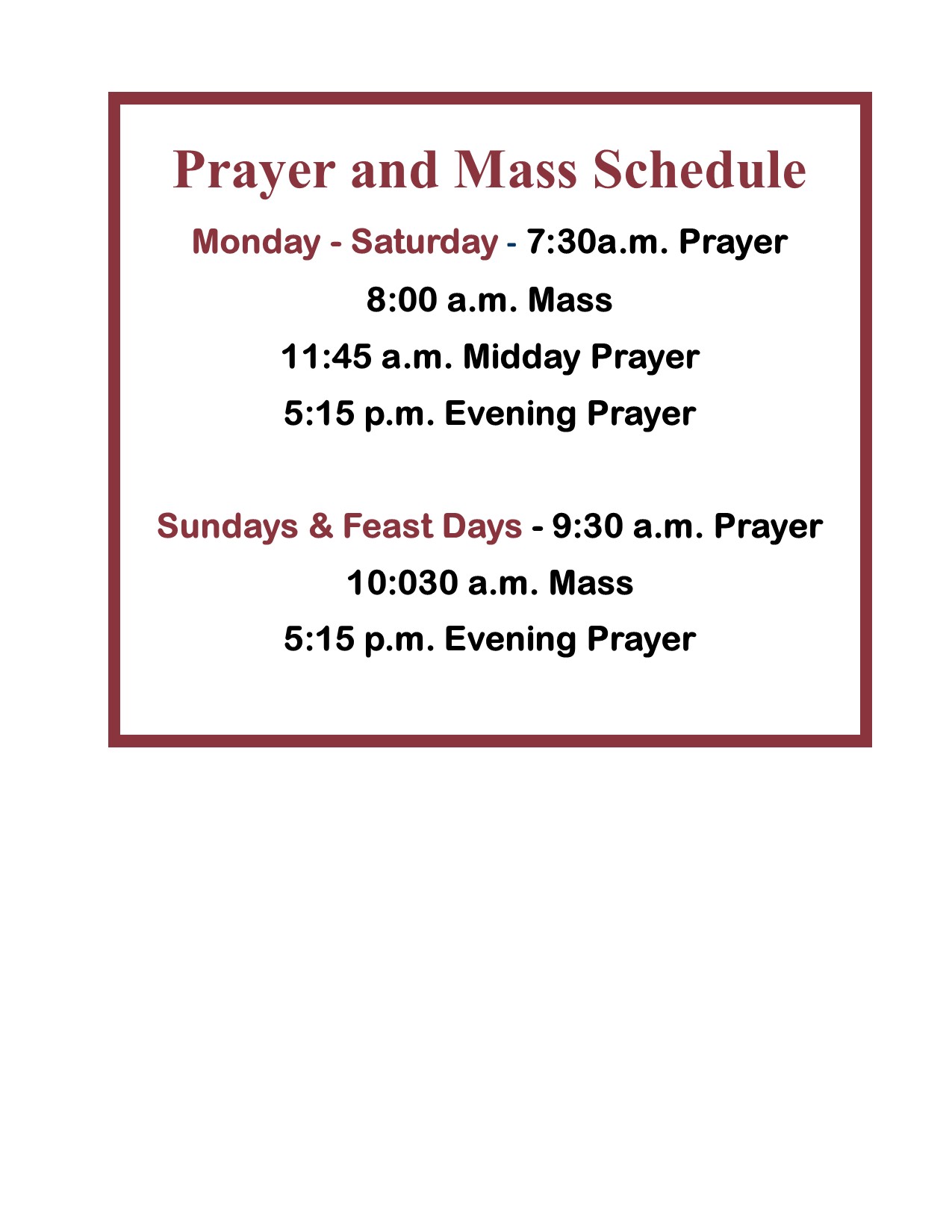
 Mass Schedule

Related Links

Copyright © 2026 · Benedictine Sisters of FL · Touching Lives Through Prayer and Service

Copyright © 2026 · Bendedictine Theme on Genesis Framework · WordPress · Log in