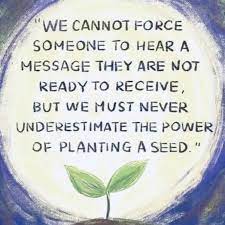
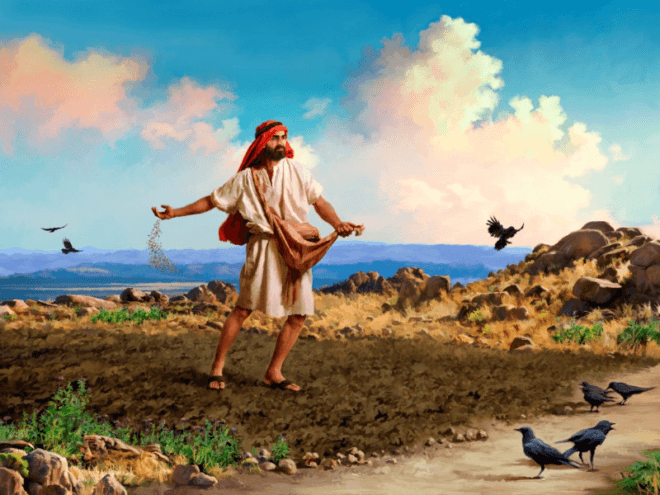
 Jesus’ parables are moments of grace to ply open our heart’s willingness to surrender to, and be enveloped in, the always surprising generosity of God.
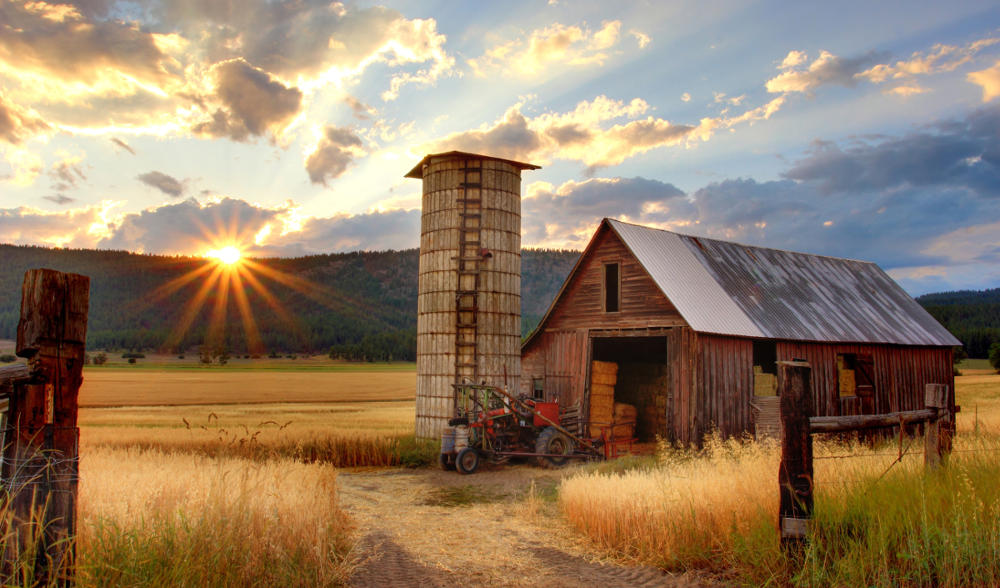
Here on our property, when we look out the windows we can see the greenhouse protecting the tilapia. After months of growth they will eventually surrender themselves and be on our dinner table. We can behold the life cycle of the hay field or blueberry patch and see first-hand in nature what Jesus’ is talking about. He extends the lesson to apply it to the human heart. He reminds us that there are folks whose hearts are like cement. It does not matter how much or how often seed is poured on these souls. Fertilize it, water it – nothing will cause those seeds to take root and sprout. They (or we) can listen to church and TV sermons 24/7 and still remain unfazed.
Do you remember times you were like this … not always … but a time or two when you just didn’t want to hear what God might have to say?
In contrast to the hardened-soil type person, the shallow-soil person is hyper-responsive to God’s word—but only for a wee tiny time. Like during a revival or a community retreat. Be careful so you’re not temporary one of these ‘all in’ folks gobbling up every book or internet idea. At times you may be lucky enough to have the seed sink in and burst through the pavement of your heart. But right away, birds or insects snatch the new growth so that it never comes to fruition. It can’t survive the heat of the give and take of daily community life.
When were you like this? Maybe in the novitiate … or the time in High School when the class made the senior retreat? God was SO real to you … but God’s voice grew more faint as the days went by? Remember those days? You were so fervent. But your fervor faded as time went by.
Then, there is a third type of soil – a thorny type – tightly entangled with the “thorns” “of the cares of the world and the deceitfulness of riches.” Matthew says these people are caught up in anxiety and get choked on the lure of the riches of the world that tug and yank at their minds and hearts until the seed suffocates, rendering them spiritually barren.
Was this ever the case in your life? Times when you were just too distracted to cultivate God’s word? Times when several days went by without a pause for Lectio or healthy self-care? Times when “thorny” remarks and obstinate behavior were your default mode? That’s when God planted a general sense of dissatisfaction in the garden of your soul.
Oh, but how gratifying it must be to Jesus when He finds “good soil people” – when we share the time God’s has given us to meditate on the Word, let it penetrate and bear fruit – then we hold fast to the word making it our own. Thus, we grow more Christ-like over time by absorbing and practicing the precepts of Benedict. Over the years, as the seeds continue to take root and blossom, the fruits and gifts of the Spirit flourish.
One author describes Benedictine life: we fall down, and we get up as we ascend the ladder of humility. We come not only to know, but to believe deep in our hearts that God can change hard, shallow, compromised patches of dirt into fertile garden soil. We read in Ezekiel; “I will give you a new heart, and a new spirit I will put within you. And I will remove your heart of stone and give you a heart of flesh.”
Some of us have, or have had, gardens. And all of us–whether we’re gardeners with a green thumb, or thumbs with only a tinge of green, or only a “wishful” thumb – or a thumb that only knows how to operate a TV remote or a computer mouse — all of us know the principle of planting: when we put a seed in the ground, we expect a plant to appear … some may even think it will sprout with a flower already on it. We also know that not all seeds will produce full-grown plants. They just don’t, for a variety of reasons.
We don’t have to ever coddled a plant in order to know the different landscapes of which Jesus speaks. We know the beaten path of own lives. We’ve stumbled through the rocky patches of life. We have been scratched and cut by the thorns of life. But we have planted our roots deep in the sacred soil of community life that feeds and matures us to become a harvest – whether it’s a thirty, sixty or a hundredfold – who’s counting?!! Given the right conditions apple seeds do become apples. Mango seeds become mangoes. God’s seeds become what we allow them to become.
Taking words from Matthew’s Gospel, why did Jesus speak in parables? Remember what He said: I speak to them in parables because they look but do not see and hear but do not listen or understand.
Paraphrasing the words from Deuteronomy, we ask: “let the soil of my heart hear the words of Your mouth. May Your instruction soak in like the rain and Your word permeate like the dew; like a gentle rain upon the grass and like a shower upon the crops.” Or borrowing the words of Jeremiah: we pray to be like a tree that stretches its roots to the waters of a nearby stream. May we stay green in the summer heat and in drought show no distress but still produce fruit.
~Reflection by Sister Roberta Bailey, OSB