• Skip to primary navigation
  • Skip to main content
  • Skip to footer
Benedictine Sisters of FL

Holy Name Monastery
Founded 1889

Donate Now
  • Home
  • About Us
    • History
    • Being Benedictine
    • Benedictine Monasticism
    • Meet Our Community
    • Holy Name Academy-Alumnae
  • What We Do
    • Mission, Vision and Our Partners
    • Invitation to Retreat
    • Accommodations
    • Volunteer Programs
    • Oblate Program
    • Spiritual Direction
    • Aqua/Hydroponics
    • More of Our Ministries
  • What’s Happening
    • Articles of Interest
    • Events
    • Newsletters
    • Brochures
    • Links
  • Support Us
    • Gifts of Support
    • Wish List
  • Stories Shared
  • Galleries
    • Photos
    • Videos
      • Benedictine Sisters of FL Videos
      • Other Videos
  • Contact Us

Articles of Interest

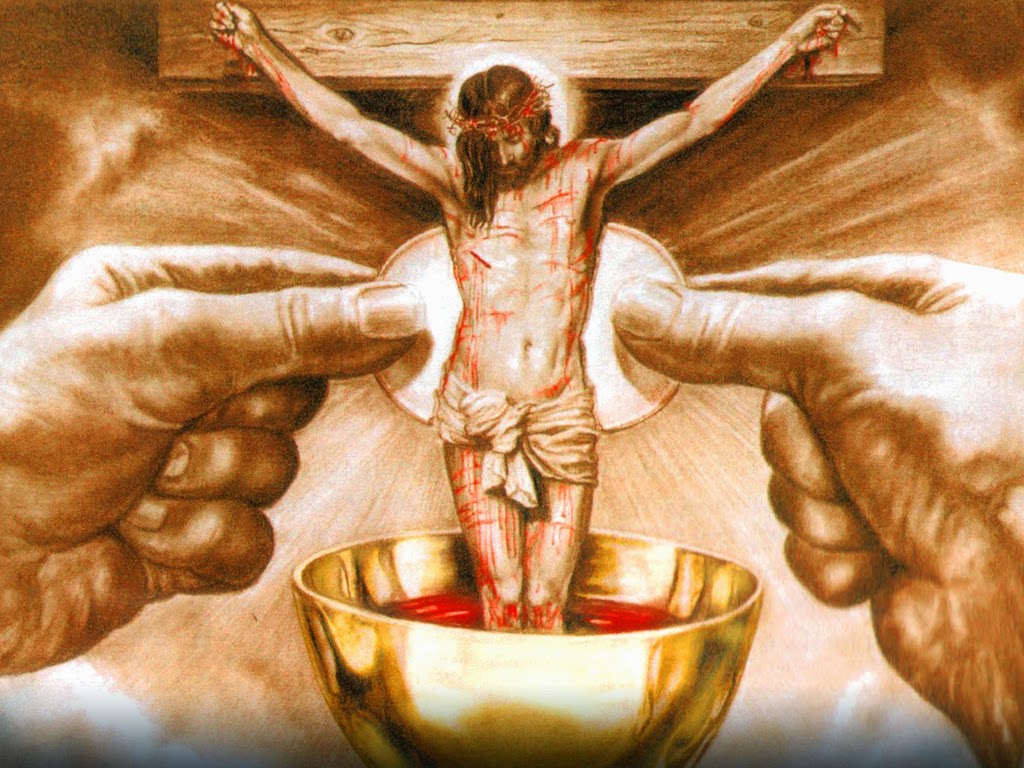
Transubstantiation

August 19, 2024 by Holy Name Monastery Leave a Comment

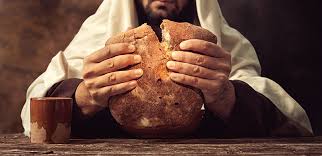
Have you ever met anyone, (or maybe you’ve been counted among those) who found the Catholic doctrine of transubstantiation a bit hard to accept?  Maybe just for a minute or two you may have wondered how Jesus could talk about eating his flesh and drinking his blood?  At the words in this Gospel, so many of Jesus’ disciples abandoned him that Jesus asked the twelve if they also planned to quit.

Jesus’ statements had caused arguments to break out within the crowd and gave Jesus the opportunity to move the conversation to the next level. The crowd begins to express confusion over how Jesus can give his flesh for them to eat.  Jesus senses the restlessness but does not avoid the topic.  Rather he makes an even more offensive statement: they will need to eat his flesh and drink his blood. He had spoken before about “eating” the bread from heaven, using a very common word.  Now He switches to a less common word that has a connotation closer to “munch” or “gnaw”, a graphic word noisy eating, the sort of eating like an animal or your brother crunching a mouthful of fresh potato chips.  But that is not the important point; this is eating that is urgent, even desperate. It is eating as though your life depends on it, because it does. 

So, how did the early Christians interpret Jesus’ challenging words?  History tells us that the pagan Romans made charges against the Christians for cannibalism. They had heard that when these people met, they ate and drank human blood.  Not many Christians themselves questioned the real presence of Christ’s body and blood in the Eucharist till the Middle Ages. In trying to explain how bread and wine are changed into the body and blood of Christ, several theologians went astray and needed to be corrected by Church authority. Then St. Thomas Aquinas came along and offered an explanation that became classic.  The Eucharist, he said, is the one instance of change we encounter in this world that is exactly the opposite. The appearances of bread and wine stay the same, but the very essence or substance of these realities, is totally transformed. What was once bread and wine are now Christ’s body and blood. A unique word “transubstantiation” was coined, and remains to this day, to an effort to explain the miracle of the changing of bread and wine into the Body and Blood of Jesus.

Such an awesome gift deserves its own feast. And that’s why, the feast of Corpus Christi was proposed by Thomas Aquinas to Pope Urban IV, who created a feast focused solely on the Holy Eucharist, emphasizing the joy of the Eucharist being the Body and Blood, Soul and Divinity of Jesus Christ.

When I ponder our Gospel reading, which is the same as that used for the Feast of Corpus Christi, it strikes me that with Christmas we were touched with joy and awe at the birth of the God-man Jesus.  At Easter we explode with ALLELUIA at the resurrection of our Savior.  The Ascension leaves us quietly looking upward, outward waiting in expectation for “what’s next?”  Then, comes the solemnity of the Trinity – the mystery that baffles us … that God is so great, so awesome that only in three persons can all the divine manifestations be expressed.  And, today, the solemnity of the Body and Blood of Christ – this touches, awakens in us feelings we can hardly express – that our God, our Jesus, our Savior would choose to gift us in such a personal, intimate way!  Our Creator-God chooses to be “assimilated within the body of the creature.”  His body and blood become, over and over, absorbed into my body – His blood courses in my veins … invading every fiber of my being.   When the priest (or Eucharist minister) presents the host or chalice, looks us in the eye and says: “Body of Christ!”  “Blood of Christ” – we are overcome with the awesomeness of this gift. All we can manage to say is “AMEN” – so be it – AMEN!

~Reflection by Sister Roberta Bailey, OSB


Pray for students beginning a new term …  for healthy friendships,  academic success, nurturing teachers and stimulating extracurricular activities.


First Reading:   Proverbs 9:1-6         Second Reading:  Ephesians 5:15-20
Gospel:   John 6:51-58
Continue Reading

Filed Under: Blog, Front Page, Homily Tagged With: Blood and Body of Christ, Body and Blood, catholic, Christ, doctrine, eucharist, feast, Jesus, Transubstantiation

Make a Will Month

August 15, 2024 by Holy Name Monastery Leave a Comment

Did you know August is

Make a Will Month?


People often put off making a will. Why? Some believe they don’t own enough to have a will. (They probably do.) Others believe that everything will automatically go to their spouse or children, so they don’t need to do anything. (It may not.) And still others simply don’t like to think about the fact that they’ll die someday. (But they will.)

August is Make a Will Month…and for good reason. If you don’t have a will, making one is the only way to ensure that everything you’ve built or been blessed with goes to those you intended to have it.

And if you do have a will, here are three quick things to check off your list:

  • Keep your will in a safe, secure place. Let a family member or two know where it is, and who prepared it for you. Be sure your Executor has a copy.
  • Pull it out every three to five years and see if anything needs to be changed. Sometimes your circumstances have changed. You may have sold some things or purchased others. Sometimes outside circumstances change. The person you named as Executor may no longer be able to serve in that capacity. You may have switched banks or insurance companies. So take a look.
  • Make sure you’ve named beneficiaries wherever you can — on insurance policies, investment and retirement accounts and so on. And check those to make sure they’re all up to date.

Here’s something else to ponder. As you think about your will and your legacy, consider including a gift to the Benedictine Sisters of Florida in your planning. There are lots of ways to do this, and all of them allow you to continue supporting the good work of the Sisters even after you’re gone.

Thank you for the love and support you’ve shown the Sisters. We thank God for you daily in our prayers. Please keep us in yours.


Continue Reading

Filed Under: Events Tagged With: August, Benedictine Sisters of Florida, executor, legacy, Make a Will Month, making a will, sisters, Will

Jesus Is the Bread That Is Broken Yet Never Divided

August 5, 2024 by Holy Name Monastery Leave a Comment

Admit it: We are a hungry people in a hungry world.  We crave something that will feed and energize us, fill us and satisfy more than our bellies. It’s not so much that we are hungry but it’s the kinds of bread we eat.  Think about the variety of bread we eat at our own table: wheat, multi-grain, plain white; pita pockets, hoagie rolls, English muffins, French bread and Jewish bagels and Challah bread; And, oh my goodness, the homemade varieties we get!  Saturday cooked breakfast may offer biscuits or scones, crescent rolls, pull-bread, sliced bread.  It may be toasted or plain, garlic sprinkled, seeded or stuffed.  Every Saturday is a surprise: dessert breads, nut breads, banana bread, raisin bread, cheese bread and don’t overlook all the gluten-free breads available in the markets.  The list goes on and on.

In war-torn countries both sides are eating the bread of violence and war. In our own country factions share the bread of negativity, hostility, and name-calling. In the corporate world both sides are eating the bread that objectifies and depersonalizes another human being. Many eat the bread of having to be right and get their own way. We eat the bread of hurt feelings and resentment. Sometimes we eat the bread of loneliness, fear, and isolation. There are times when we eat the bread of sorrow or guilt. Other times we eat the bread of power and control; or the bread of revenge or one-upmanship.

The world is full of bread and yet far too many live hungry, empty lives.  They wake day after day disappointed, asking God for a miracle.  It’s a sure sign that the bread we have eaten cannot give real life. It is perishable bread that nourishes only a perishable appetite.  We are left wanting more, more, more.

The bread we eat may fill our belly, may even bloat us but it’s not of lasting value.  It passes through our bodily system.  Not all bread is nutritious. If you want to know the nutritional value of bread, you have to look beyond the bread. Where did it come from? What are its ingredients?

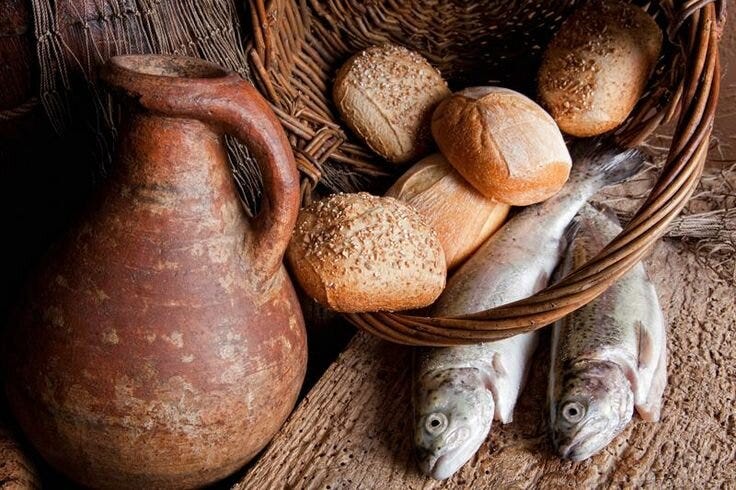
That’s what Jesus is teaching in this gospel. The people have shown up hungry. But just yesterday Jesus fed 5000 with five loaves and two fish. Today they show up and their first question is, “Rabbi, when did you come here?”

They do not marvel at yesterday’s miracle and give thanks for Jesus’ generosity, or even wonder who this rabbi was. They’re just worried they might have missed the next meal, that Jesus started without them and they are too late. They did not perceive the meaning of the sign, the miracle, in the first feeding. They either refused or were unable to see beyond the fish and bread. They are interested only in their own appetites.

Jesus knows this kind.  He calls them out: “Very truly, I tell you, you are looking for me, not because you saw signs, but because you ate your fill.” The people are concerned for their bellies; Jesus is concerned for their lives. The people want to feed themselves with bread; Jesus wants to feed them with God. “Do not work for the food that perishes,” he tells them, “but for food that endures for eternal life.”  Jesus himself is the bread that is broken and distributed for the life of the world. He is the bread that is broken yet never divided. He is the bread that is eaten and yet the value is never exhausted.

When we believe in Jesus: eating, ingesting, and taking him into our lives, we live differently. We see ourselves and one another as persons created in the image and likeness of God.  We trust the silence of our prayer life. We choose love and forgiveness and reconciliation.  We relate with intimacy and vulnerability. We listen with “the ear of our heart” for God’s voice.  “I am the bread of life,” Jesus tells us. “Whoever comes to me will never be hungry, and whoever believes in me will never thirst.” Jesus is offering us himself – the imperishable bread that nourishes and sustains imperishable life.  So, what bread will we offer our guests and co-workers?  What bread will you and I eat today?

~Reflection by Sister Roberta Bailey, O.S.B.


Stay informed, stay safe from the effects of the tropical storm and all the “storms” of life ….   As commentators are warning: “hide from the winds; run from rising water” and pray for safety and speedy damage recovery for all peoples.  God bless!


First Reading:   Exodus 16:2-4, 12-15         Second Reading:  Ephesians 4:17, 20-24
Gospel:   John 6:24-35
Continue Reading

Filed Under: Blog, Front Page, Homily Tagged With: bread, Gospel, hungry, Jesus, Rabbi, World

“Have the People Recline”

July 29, 2024 by Holy Name Monastery Leave a Comment

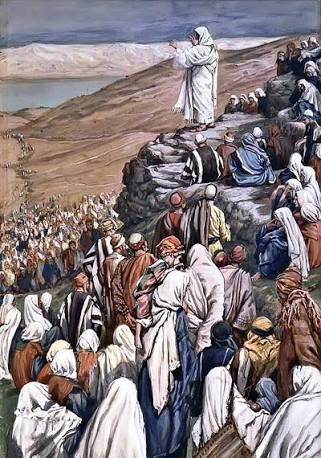
All four of the evangelists, Matthew, Mark, Luke and John, tell the story of this day when Jesus fed five thousand with five loaves of bread and two fish.  Each embellishes his version with his own details and emphases. Mark and Matthew tell us Jesus commanded the people out there in the wilderness to sit down on the green grass. I‘ll not probe the question, but why, I wonder, is there this reference to the color of the grass?  John’s version of the event reminds me of words in Psalm 23: “He beckons me to lie down in green pastures.”

We can relate to the generosity of the young boy who shared his five barley loaves and two fish.  We’re not told how it happened that the boy had the fish and the loaves.  Perhaps most people at that time would not dream of going out into the wilderness without at least a little something to eat and drink.

So, the story, it seems to me, (in today’s lingo) was a “pay forward” moment; you know, similar to the Dairy Queen drive-thru customer who paid the tab for the car coming up behind her. That started a chain reaction that lasted for 3 days and 200 thankful Dairy Queen customers!  The generosity of the young boy on the green grass at Jesus’ feet started a “pay-forward” reaction that enabled Jesus to feed the hungry crowd.  Some evangelists say it was 5000 people.  Others recalled “5000 not counting the women and children”.  I find it interesting that in John’s version Jesus tells the apostles to have the people recline and John says the men reclined.  What were the women doing?  I would venture a guess they were doing “women’s work” i.e. rounding up the kids, wondering if there’d be enough bread and what they were going to give the men to drink.

What trust!  What faith in Jesus the apostles showed in telling the people to relax! Be patient.  Sit down!  Surely, they could not fathom how all these people could be fed. Even when pooling all their supplies, they certainly did not have the resources to feed this crowd.  What were they to do now that they had people seated and waiting to see what would happen next?   That’s what you call FAITH! That’s obedience – trusting the wisdom of God to do the impossible!  We just need to take the first step: Listen and obey the prompting of the Spirit: “Tell the people to be seated”.

No doubt Jesus could have multiplied the available supplies if he wanted to.  But, as John asks, to what end?   The very next day the people would be hungry.  They’d likely not be clamoring “Speech! Speech! Share a good word! Let’s hear it!”  They’d be waiting for the apostles to open Jesus’ food distribution center.

On this day, out in the wilderness, John tells us that the people ate and were satisfied. Which would be more satisfying to you, a full belly for a single afternoon, or a glimpse, a vision of what life looks like when lived in the company of generous people under the reign of God?  What would our world be like if people acknowledged that they are called to be transformed?   What would happen if we were truly as open-handed with our possessions as the young boy on the hillside was with his? What would have been the status of the pandemic if everyone followed CDC advice: got vaccinated, wore a mask, washed their hands?  What would the stats be today if people continued to practice those sanitation protocols?  Hospital visits are on the rise while at the same time admissions remain relatively low.

And, what would happen if we really believed that Jesus still has the power to take the gifts we offer and to create from our generosity widespread outbreaks of sharing? As I watched the Olympics opening ceremony I was thinking “This is lovely – a testament to the ingenuity of computer whizzes!  Soon I wondered:  With the millions donated by sponsors and spent on the production to awe the crowds, much good could have been done. With the millions rolling in to support political campaigns, I daresay that the world could be transformed.  Over 3.1 million children a year (one child every 10 seconds) would not die of hunger.   Let us strive to reflect the attitude and directive of the apostles that long-ago day on that lush green hillside: “Tell the people to be seated.”


 ~Reflection by Sister Roberta Bailey, OSB


Let us pray together for safety and enjoyment for the crowds in France for the Olympics, and protection for thousands enduring the effects of inclement weather: Floods and too much rain, drought, low water table, loss of profitable crops, and high irrigating costs, and terror as fires approach homes, businesses and forests …  and pray for peace amid unsettling times over political issues and factions …… 

   God bless us all!


First Reading:   2 Kings 4:42-44         Second Reading:  Ephesians 4:1-6
Gospel:   John 6:1-15


Continue Reading

Filed Under: Blog, Front Page, Homily Tagged With: 2 fish, 5 loaves, 5000, apostles, forward, Jesus, John, Luke, Mark, Matthew, pay, pay it forward, recline

16th Sunday of Ordinary Time

July 22, 2024 by Holy Name Monastery Leave a Comment

These last few weeks seems like the church is singing the message of a Willie Nelson ballad, On the Road Again. “I just can’t wait to get on the road again.  Goin’ places that I’ve never been; seein’ things that I may never see again. The life I love is makin’ music with my friends.  Just can’t wait to get on the road again.”

This weekend the Evangelist Mark gives us an example of the kind of tension that exists in our own lives and in the life of every committed Christian.  On the one hand, we feel drawn away to a quiet place.  At the same time, we feel the almost constant demands on our commitment “to respond to the needs of God’s people.” We want to respond generously where there is a real need.  But, how do we know what is a ‘real need’ and what is just our own desire be needed, to “play savior”?  There are times when, no matter how weary we feel, we know we should say ‘Yes’. Other times, in spite of any criticism it may generate, we feel we are inclined to say ‘No’.  At times in the life of Jesus, we see him leaving the people, in spite of their demands, and going away to pray.  This kind of rest is not laziness or irresponsibility.  This is the Sabbath rest Fr. John recommends: mercy and compassion over sacrifice.

Last weekend the apostles were sent out two-by-two. Today, they are re-gathering two-by-two.  They are exhilarated, but exhausted. They are on their own for the first time without Jesus.  They had preached, cast out demons, anointed the sick, and called people to respond to Jesus’ message.   Now Jesus invites them (and us) to “come away to a deserted place, all by yourselves and rest a while.”  Notice there are four parts to Jesus’ invitation: “Come away – to a deserted place – all by yourself – and rest a while.”  Each phrase means something on its own, but no single phrase stands alone.  We have to accept the whole package.

We must be on guard that we don’t wear busy-ness as if it were a badge of honor.  Wearing a button that goes “blink, blink” and proclaims an implicit message:  “I’m worthwhile because I’m so busy and I’m always tired” equals “I’m important”.  But busy-ness is not a badge of honor!  On the contrary, it is the mark of a life way out of balance.  It is NOT Benedictine!

Jesus said: “Come away.”  He did not say “Go away.”  His is an invitation to a communal experience.   It’s “coming away” to be with Jesus.  What a beautiful invitation!  If we don’t rest, we won’t be able to take care of the self.  Without self-care we will be of no use to anyone, especially God.

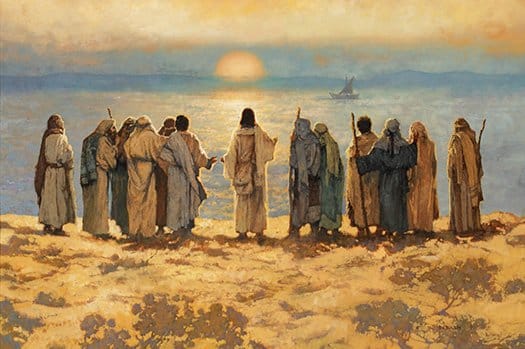
As Jesus listened to each of the two-by-two teams give their reports, he was moved by their tender stories of healing children, inspiring people, and boldly witnessing to Jesus’ words.  At the same time, He must have seen fatigue in their faces and so, in a gracious moment of concern, Jesus said to them: “Come away for a while and rest.” Jesus made no suggestion that their ministry of witness and compassion was over, but he offered them a respite. They got into a boat and headed off for the first Christian retreat.

And you know what greeted them!  Over 5,000 figured out where the boat was going and got there ahead of them.  Imagine how the disciples must have felt!  They had had visions of having a little quiet time with Jesus.  But like Jesus, the disciples’ hearts were moved to pity. They set personal wishes aside in deference to the needs of others as Benedict says in RB 72, “No one is to pursue what she judges better for herself, but instead, what she judges better for someone else.”

We know for sure, that there is weariness in ministry.  And we know as well that weariness is no excuse to quit and let others pick up the slack. Somehow, we must discover Jesus’ compassion for the crowd within our own heart.  It’s just not as easy as it sounds.

Several years ago a health study determined there are three main reasons people can’t cope with the demands in their lives:   1. they live in the past,  2. they have a low self-esteem and 3. they can’t laugh at themselves.   The study indicated that we need approximately 12 laughs a day to stay healthy! Yes, life throws us curve balls just when we least expect it (like being paged just when we finally got a chance to zone out for a few minutes).  To stay sane, we need to sit back and enjoy a good laugh.  So, here’s your laugh-vacation for today.  Not long ago a lady I know sent flowers to her friend who had opened a new restaurant. When she arrived at the grand opening, she looked for the flowers. Imagine her consternation when she found them, and saw that, in her haste in placing the order, she had sent a white wreath with a card that said, “May you rest in peace.” She panicked, of course, and called the florist who said, “Honey, I’m not worried about you because as we speak, there’s a lady being buried across town who got a dozen roses with a note that read, ‘Good luck in your new location!”

~Reflection by Sister Roberta Bailey, OSB


First Reading:   Jeremiah 23:1-6         Second Reading:  Ephesians 2:13-18
Gospel:   Mark 6:30-34
Continue Reading

Filed Under: Blog, Front Page Tagged With: apostles, Benedict, Come Away, Jesus, On the Road Again, rest a while, two-by-two, Willie Nelson

Tell All Around You of the Great Love of God

July 15, 2024 by Holy Name Monastery Leave a Comment

“Tell All Around You of the Great Love of God.

When All Else Fails, Use Words.”


Today’s Gospel continues the messages of the readings we’ve heard for the last ten days or so and goes hand in hand with the current daily selections from the Holy Rule.  We get glimpses into Jesus’ practice of conferring extraordinary responsibility on ordinary people.  For instance, consider the amazing features of Jesus’ ministry in His choice of closest disciples.  They are hardly the kind of people we’d choose to put on a ministry team: fishermen, a former tax collector, a couple known to have quick tempers, a revolutionary and a traitor. Some were always getting into trouble, missing the point of Jesus’ teachings, putting a foot in the mouth. At times, they revealed their jealousy when folks outside their circle got too close to Jesus or when so-called outsiders were trying to perform healings.  When the going got tough, most of them walked away or denied their commitment to Jesus. Despite all this, Jesus used them to turn the world upside down. Doesn’t knowing that give us cause for hope?

Readings from the Rule of Benedict remind us three times annually that our founder picked up on Jesus’ theme when he reminds his followers to be satisfied with what the monastery has to offer.  The monks “must not eat with outsiders, unless perhaps the superior has ordered it.”  Concerning their clothing, Benedict recognizes that a monk’s everyday clothes – the clothes on his back – might disgrace him in public. He directs that the members should not come across as though they were better than the people they encountered.  Is he saying that we need not dress like the poor in order to minister to them?  We show respect for others by wearing attire which in an unspoken message conveys ‘You are special, I value you and so I made a special effort in my appearance to be with you.’   You’ll notice also that when Jesus sends His new missionaries out, it’s always in the plural: in pairs, two by two showing that His mission, our mission, is a communal endeavor.

And, when Jesus told the disciples to shake the dust from their sandals if they found themselves in a village where their message was rejected, this was not something new.  Jews often did this when they returned from a foreign land across the border back into their homeland. It represented a total disassociation from pagans and pollution.

Jesus did not limit his power to His little company of disciples.  He gives us, too, the grace to carry His message to the world.  We may feel inadequate but Jesus’ power rests in us and on us. Jesus assures us “Don’t worry about what you are to say.  At that moment, the words will be given to you” (Matt 10:19).  As one of our hymns says: “His love and grace, that’s enough for me!”

Surely you remember St. Francis, the son of a wealthy merchant who became known as the poor man of Assisi. He serves as an example of a Christian who responded to God’s call: “Repair my Church.” Asking another friar to accompany him to preach to the townspeople, the two walked together through the streets and returned home without ever uttering a word. Questioned by the friar as to when they would begin to preach, Francis replied, “We just did. Tell all around you of the great love of God. When all else fails, use words.”

This is the kind of pilgrimage 40,000 believers are taking along four (4) routes that lead to Indianapolis for the 5-day Eucharistic Congress that begins on July 17th.   Staff from our diocesan pastoral center, and over 100 Tampa Bay parishes, will be gathering in Indianapolis for liturgies, impact sessions, concerts and other faith-filled experiences culminating in a Eucharistic Procession through downtown Indianapolis. Let us pray daily this week that pilgrims may travel in safety and that their lives may be enriched by their experience.

Join us as we pray in spirit with the pilgrims at the Congress.  Choose your own prayer time or slip away for a few minutes at the times the Sisters will be at prayer.


EUCHARISTIC REVIVAL

Join Crusade: Pray 10,000 Holy Hours in July

Optional Holy Hours in union with pilgrims

At The Eucharistic Revival Congress


Tuesday, July 16 (travel Day)        4:45 p.m. + Vespers    


Wednesday, July 17                        10:45 a.m. + 11:15 Mass    


Thursday, July 18                              3-4 p.m.


Friday, July 19                                    6:30 + Compline


Saturday, July 20                              4:30 p.m. + Vigil Service


Sunday, July 21                                  4:30 p.m. + Evening


~Reflection by Sister Roberta Bailey, OSB


First Reading:   Amos 7:12-15         Second Reading:  Ephesians 1:3-14
Gospel:   Mark 6:7-13


Continue Reading

Filed Under: Blog, Front Page, Homily Tagged With: disciples, Gospel, Jesus, Love of God, monk, Rule of Benedict, use words

  • « Go to Previous Page
  • Page 1
  • Interim pages omitted …
  • Page 23
  • Page 24
  • Page 25
  • Page 26
  • Page 27
  • Interim pages omitted …
  • Page 132
  • Go to Next Page »

Footer

Prayer / Newsletter / Info

 Contact Info

Benedictine Sisters of Florida

PO Box 2450
12138 Wichers Road
St. Leo, FL 33574-2450
(352) 588-8320
(352) 588-8443

 Mass Schedule

Related Links

Copyright © 2026 · Benedictine Sisters of FL · Touching Lives Through Prayer and Service

Copyright © 2026 · Bendedictine Theme on Genesis Framework · WordPress · Log in