• Skip to primary navigation
  • Skip to main content
  • Skip to footer
Benedictine Sisters of FL

Holy Name Monastery
Founded 1889

Donate Now
  • Home
  • About Us
    • History
    • Being Benedictine
    • Benedictine Monasticism
    • Meet Our Community
    • Holy Name Academy-Alumnae
  • What We Do
    • Mission, Vision and Our Partners
    • Invitation to Retreat
    • Accommodations
    • Volunteer Programs
    • Oblate Program
    • Spiritual Direction
    • Aqua/Hydroponics
    • More of Our Ministries
  • What’s Happening
    • Articles of Interest
    • Events
    • Newsletters
    • Brochures
    • Links
  • Support Us
    • Gifts of Support
    • Wish List
  • Stories Shared
  • Galleries
    • Photos
    • Videos
      • Benedictine Sisters of FL Videos
      • Other Videos
  • Contact Us

Jesus

The Narrow Gate

August 22, 2016 by Holy Name Monastery Leave a Comment

gate21st Sunday in Ordinary Time, Sunday, August 21, 2016

First Reading  Isaiah 66:18-21                Second Reading  Hebrews 12:5-7,11-13
Gospel Reading  Luke 13:22-30

This Gospel may well be a loose collection of sayings of Jesus recalled by the author, uttered in several different contexts but brought together here under the general heading of “who will be saved?”

As this parable opens, Luke reminds us that Jesus is making his way to Jerusalem, teaching as he goes. When from out of the crowd he hears a question called out giving him a chance to make a prophetic statement. A few weeks ago, the question was “What must I do to inherit eternal life?” Today it’s “will only a few be saved?”

Jesus answers with two parables – referred to as the “narrow gate” and the “door” although the same Greek word is used for both gate and door.  It’s the translation that may be misleading.    It’s interesting to me that Jesus says many won’t be strong enough to get through the gate.  He doesn’t say slim enough.  It sounds as if the walls can be pressed aside if you just have enough strength.  To digress a moment … I thought of this image at the construction meeting earlier this week.  The discussion was about the well that has to be sunk to provide water for the fire sprinkler system.  The pipe will have a protective casing on it so it will not be subject to water erosion or enjoyed by underground rodents that visit our garden.  When drilling the well they ensure that the opening is wide enough to accommodate whatever diameter of pipe it takes to get the needed  water pressure ( 4’, 6’ 8’ pipe) before inserting the casing … in Jesus language, that it is strong enough to let the required flow of water get through.

Jesus says: “Many will seek to enter and will not be able” … so, maybe the overwhelming crowd will be too many all at the same time pushing and shoving to get through the opening?

This question to Jesus had people squirming: “Will only a few be saved?”  Will I be among them?  How can I be in that count?

The answer to the “will only a few be saved?” is no. In the end, many will be saved, but many who thought they would be saved will not be saved. The parable is a prophetic warning that it will take repentance, forgiveness, faith …   in order to be saved.  “Many are called but few are chosen.”

But, remember Jesus also said, “When once the master of the house has risen and shut the door, and you begin to stand outside and to knock at the door, saying, ‘Lord, open to us,’ then he will answer you, ‘I do not know where you come from.”  Don’t delay your planning to be among the chosen … what’s the saying: don’t put off to tomorrow what can be done today?  Lectio and personal prayer; some form of fasting whether from food, or technology or juicy gossip is a daily opportunity.

Jesus answer to the crowd lets his hearers (and us) know that the “door of opportunity” will not remain open indefinitely.  When the door is closed, it is closed and will not be reopened for persons whose only claim is that Jesus once visited their temple / their church, their town and village or preached in their streets or that they once saw Jesus in a crowd.   Remember the 10 virgins … 5 missed the boat due to a lack of “NRRO future planning.”  And, recall the Gospel lessons we heard this past week: the first shall be last … and the last will get the same reward as those who signed on to Jesus work crew early in the day.

We’ve all probably seen the famous painting of Jesus knocking at a door with knob …  the door to our hearts must be opened from the inside.   That’s true but there are also doors with visible knobs that we must have the courage to open from our side….  To let in the immigrant, the wanders, the seekers, the faithless, the weary.  Could we say we are on the inside listening for outsiders to lift the knocker asking entrance.  Or, there doors waiting for you to twist the knob on, or push aside, to get a glimpse of what’s on the other side? It takes courage, doesn’t it, to be on either side of the door:  A big breath before stepping up to knock on the door of a stranger and a gasp of apprehension to open the door to an unexpected knock, especially if there is no peep hole to reveal at least a shadowy shape of the caller.

Some years ago I belonged to a parish group that studied various styles of meditation.  One was “wall” or “gate” meditation.  I invite you to try it …  and then I will share my experience.

Get in a relaxed position … lying down risks dozing off but sitting runs that same risk … just don’t try this particular type of meditation standing up or walking …   So, relax your body, close your eyes and in your mind start walking along the edge of a wall or fence … not on it, beside it –  until you see an opening or door … walk through – who’s there – do you see Jesus? – who is with him?  What are they saying to each other or to you …  Just let the reflection go where it will …

In my first experience… as I crossed through a low stone wall, I sensed Jesus seated with a circle of 10 – 12 others – he motioned for me to come sit beside him …  looking around I recognized and could name all but one person …  I have no memory of who they were BUT several years later I was introduced to a Sister from another community and I startled and instantly realized she was the one who had been in that circle.

Here are some doors you may want to visualize, open and peer beyond  …  Lord, Lord, open to me.

church_cross-door doors brick1 old_door_double colored doors barn doors stone dooroffice door1
~Reflection by Sister Roberta Bailey, OSB, Prioress


Continue Reading

Filed Under: Blog, Homily Tagged With: Door, Gate, God, Jesus, Knocking, knowledge, Luke

When We Enter a House, Our Message Will Simply Be “Peace.”

July 5, 2016 by Holy Name Monastery 1 Comment

peace-to-this-householdJesus is warning us it is going to be difficult – that he is sending us out like lambs among wolves. Yet we are to bring nothing with us, not even a wallet or flip flops. We are to make no side trips along the way or greet bystanders on the way so as not to be distracted from our mission. When we enter a house, our message will be simply “peace.” The response we receive may be positive or negative. Either way, we are to know that the Kingdom of God is at hand. We are not to demand special treatment but eat and drink whatever is given to us. We are to stay in one house and are not look around for someone who can provide better accommodations. We are to ask a blessing for the sick as a sign that the Kingdom of God is at hand for them. If the locale will not receive us, we are to shake the dust from our feet and move on. Even in the case of such rejection we will know that the Kingdom of God is at hand.

In 2015, the world’s population was 7.2 billion.  Of that number there were reportedly 1.2 billion Catholics in the world with over 40% of those in Latin America and the fastest conversion rate in Africa.  Sounds like those early disciples clearly did not work in vain. Their “mustard seeds” grew from 12 into large branches, sprawling trees providing shelter for hundreds, thousands, millions, billions of souls living today – not counting all those who have gone before us.   That invisible yeast worked its influence dramatically on the seemingly inert dough.

Among those who call themselves Christians, how many could be deemed active labors in God’s vineyard?  The harvest is still great.  There is still a large population which profess to be agnostic or atheist – who have not met or who deny the existence of God.

But a common perception of “laborers” is priests, or religious brothers and sisters, those who have a “vocation”. One hears people expressing regret that today there are so few “vocations”. What will the Church do?    However, it is doubtful that Jesus was thinking of priests and religious when he spoke those words. In fact, in the world of the New Testament there were no priests or religious as we understand those terms today. In the mind of Jesus – and in the mind of the early evangelists – everyone who was known as a follower of Christ was expected to be a laborer in the harvest field.

How can one be a laborer?  Jesus told us our task is to be bringers of peace.  “Say first: Peace to this household.”  In early June of this year, Pope Francis, in his introduction to priests’ on a 2-day retreat, spoke about the first steps in understanding and practicing mercy.  He said: “If we start by feeling compassion for the poor and the outcast, surely we will come to realize that we ourselves stand in need of mercy.”  I would suggest that the same principle applies to peace-making.  If we start by providing a peaceful environment for our visitors and guests, surely they (and we) will come to realize how peace feels, how much we need it and how quickly it can spread among us.  And, what better way spread peace than by modeling peaceful living by our demeanor and interactions with others – a quiet, contemplative atmosphere in the hallways, conscientiously using an agreeable, non-threatening tone of voice, and performing simple random acts of kindness for each other.

What Jesus recommends is not to weigh ourselves down with all kinds of baggage. Our security is not to be in material possessions, in what we have. It is not in our status and standing in the eyes of others. It is not in the power and influence that we can wield. Our security comes from deep within, a peaceful security that no one or no circumstance can take away from us.

I read a funny story the other day about competing. It seems there was a barber in a small town who had been the only barber in town for years. Everyone went to this barber to get their hair cut. Then, one day a big, modern name-brand hair salon came to town and opened up shop. They advertised, “All Haircuts $3.00”   The old barber just couldn’t compete. In a last ditch effort to save his business, he hired a business consultant. The consultant spent a day pouring over the barber’s books and asking many questions. At the end of the day the barber asked the consultant, “So what do you think?  Should I close up shop?” The consultant said, “Not yet. I’ll be back tomorrow.” The next day the consultant showed up with a huge banner that he hung in front of the barber shop that said, “We Fix $3.00 Haircuts!” The competition doesn’t always win, do they?  We don’t need to compete – we just need to BE – be models of peace to each other, practice wise stewardship, believe in God’s goodness and mercy – and live it!

~ Reflection by Sister Roberta Bailey, OSB, Prioress
Continue Reading

Filed Under: Blog, Homily Tagged With: Jesus, Kingdom of God, laborers, mercy, mustard seeds, Peace, vocations

“Pursue What We Judge is Better for the Other Rather than Self”

June 27, 2016 by Holy Name Monastery 1 Comment

who-do-you-say-i-amWhile there are a number of crucial spiritual questions, none is more important than this question asked:  “But you, who do you say that I am?  Peter might have answered “Son of Mary and Joseph” or “Son of the carpenter” or “A great teacher.”  Or he might have uttered one of descriptions he’d learned since childhood from the Torah – titles we heard in last night’s reading from Judith: “Creator of the rivers, king of all creation, protector of the people.”  But, in a graced moment Peter cut to the heart of Jesus’ identity:  “You are Messiah, the Christ, son of the Living God.”

It’s crucial for each individual person to answer correctly.   Peter got it right but he did not realize the full impact of his answer.   It is the first time a disciple refers to Jesus as Messiah.  But, he and the other disciples had the wrong notion of Messiah.  To them it connoted a reigning King. They did not understand it involves suffering and death.   Their idea of a Messiah was all glory; no guts.

Only one answer is objectively correct to Jesus query:  “Who do you say I am?”  Jesus didn’t say, “Great answer, Peter! Do any of the rest of you have anything to add?  You others, how do you feel?”  How you feel about Jesus doesn’t change who He is. There is a single correct answer to the question that is not based on feelings or personal opinions, but on objective revealed truth.

To stretch their understanding,  Jesus immediately mentions His impending death and resurrection and the cost of discipleship.  He’s hinted at it before but this is the first explicit mention of it. From here on, it will become a frequent theme as Jesus makes this intention known to go to Jerusalem.   The disciples still did not really comprehend this until after Jesus’ resurrection. Once they had a fuller understanding of what Jesus meant – they were enabled to go out as bold witnesses.

Think about how difficult it must have been for the disciples to commit themselves to Jesus as the Christ? For centuries, faithful Jews had been waiting and looking for the promised Messiah. Many lived and died without seeing that hope fulfilled. Sometimes prophets came on the scene, raising hopes that they might be the Messiah. But they died and the people kept waiting. Then, suddenly there came upon the scene this young upstart, a mere carpenter from Nazareth who began preaching and performing miracles. Could He be the one? He certainly didn’t fit popular image of what the Messiah would be like. But the disciples committed themselves to Jesus as that long-awaited Messiah.

Remember, they didn’t have the 2000 years of church history that we have to confirm their faith.   They were the first ones to say, “This is the One!” And they had to say it in the face of public opinion that didn’t agree with them. This fact is underscored by the contrast between Jesus’ first question, “Who do the multitudes say that I am?” and His second question, “But you, who do YOU say that I am?”

The disciples had to stand against strong currents to affirm their conviction that Jesus is the Christ. The Roman government didn’t care if Christians followed Jesus as long as they affirmed Caesar as Lord.

They also had to go against the opinions of the Jewish religious crowd, which had varying notions of who Jesus might be. The disciples had to stand apart from the Jewish religious crowd to affirm Jesus as Messiah.

Perhaps the most formidable ones that the disciples had to oppose were the Jewish religious leaders. The disciples were not formally educated as their leaders were in the Hebrew Scriptures.  They had no public influence; they were not the recognized interpreters of the Law of Moses nor were they guardians of the Jewish law. Who did this bunch of uneducated fishermen think they were to go against the opinion of that august body of scholars?

This question: “Who do you say I am?” still divides people. It takes a strong faith, firm conviction and undying loyalty to take your stand with Peter and the disciples.  And, it takes an unwavering friendship with Jesus to steadfastly affirm your conviction.

And, how do we do that AND follow Jesus directive: do not tell anyone?  He said the same thing on the mount of the Transfiguration: “Tell the vision to no one.”  I wonder, was it His way of saying: actions speak louder than words?

In the next few lines of the Gospel, Jesus cautions: If you are sincere in saying you want to follow Me, you must deny yourself to the point of losing your life.  That’s a tall order!  But, not much less that Benedict telling us to keep death daily before our eyes.  That doesn’t mean being preoccupied with death because Jesus adds “you will have life.” So, be preoccupied with life – the opportunities of the moment.

Think about all the little deaths Jesus endured along the way: spending hours with the crowds when he might have preferred a quiet get-away for prayer – taking time to feed the crowd when it might have been simpler to take the disciples to mom’s for a home cooked meal; taking the energy to clear the temple of the sellers of unnecessary and costly sacraficial offerings when He might have slipped in through the side door to avoid the commotion at the main entrance.

We have abundant, daily opportunities to “die” these kinds of deaths. All that is required according to Benedict (in RB 72) is that we “pursue what we judge is better for the other rather than self.”  Or as we challenge and promise each other (in one of our Benedictine Sisters’ Community statements):  “We seek to form bonds of mutual love and respect and to call forth the best in one another.”    When it is exhausting or especially trying, remember what Jesus promised: whoever takes up her daily crosses, gives up herself for my sake, will save herself – you will have life!

~ Reflection by Sister Roberta Bailey, OSB, Prioress


Continue Reading

Filed Under: Blog, Homily Tagged With: Benedict, Christ, Jesus, Messiah, Peter, Scripture

Availability

June 6, 2016 by Holy Name Monastery Leave a Comment

availabilityThroughout his Gospel, Luke demonstrates that God’s promises to Israel are fulfilled in the person of Jesus.  In this part of Luke’s story, Jesus and his disciples are approaching the city of Naim when they come upon a large funeral procession. Luke does not tell us how Jesus knows that the deceased is an only son of a widow.  Did He know the family or was the scene and the ritual all too familiar to him and his disciples?   Whatever the reason, had Jesus not been present to the moment and available to its significance it may have gone without noticed or ignored by the evangelist as well as the passersby.

Before I continue: a disclaimer is called for: Much of what follows is borrowed or adapted from Robert Wicks’ little volume entitled AVAILABLILTY.

The virtue, the gift of availability is indeed a simple but a great gift.  The freedom to be present when needed is something special.  It is an opportunity to be spiritual – to be open to relationship in the deepest, most elegant sense of the term.  However, this wonderful state of living often seems hidden or distorted.  Today, availability is a premium because it is not only a gift but also sometimes a great challenge for many of us – one that we need to more fully understand and address if we are to be able to continue to be present in the full sense of the word.  Availability is not only a gift; it is also a problem.

Some of us are “too available.”  Thus, true availability becomes watered down. We become too busy to pray, too tired to reflect, and, ironically, too stimulated interpersonally present to others.

Others among us pull back in anxiety.  Being available to God seems to raise too many questions or doubts.  Spending time alone is no longer relaxing; instead we feel lonely or preoccupied with our faults and failures.  And being with others doesn’t seem to help either; in some cases, we feel used, left out, or misunderstood.  The end result is that our expectations for intimacy are not realized and we feel the need to pull back more than ever.

The situation is not merely a sad one; it is a dangerous.  Without a sense of availability to self, others, and God, life loses it spirituality.  Relationships suffer, break down, and we are left with a void or sense of confusion.

We must address availability with the imperative that openness to the personal and interpersonal is essential if the Spirit is to be heard and felt. Any blocks to relationship must be removed if we are to prepare ourselves always for the continual coming of what is Good.  The very vitality of living out the Gospel depends on our being involved –  in an ongoing way – in the process.

When we spend time, especially unplanned time, with others it is not so much that we TAKE TIME OUT OUR DAY to be with them as that we had make the other part of our life.  For instance, today’s funeral for Kurt … because we generously welcomed them into our home God, through us, was enabled to share compassion, comfort and hospitality to a large group of mourners.

Jesus absorbed the widow’s sorry, made it his own and offered deep compassion and consolation to her even before he raised her boy from the funeral bier.  Did Mary witness this incident or did others relate to her?  Later when her son died do you think  she recalled he’d brought this Only son back, and Lazarus, too, back to life?  Did she live in hope that such a miracle would be granted her son?  Someday we may know.

Picking up cues, recognizing a silent need – reaching into self and out to others: this kind of attitude is at the heart of a life that reflects an appreciation of the gift of availability.  This attitude merits being kept in mind as we look at some of the basic problems we encounter in trying to be available to ourselves, others, and God.  Though the concept is simple, living a life of true availability isn’t easy for most of us.  It takes a conscious desire and effort to be present to all the nuances of the present moment.  Some people see only the dark clouds gathering; others see the rainbow emerging.  Let us be present to the moments when rainbows quietly and slowly are revealed in our lives.  Jesus would have missed the funeral scene if he had been too intent on getting to the farmer’s market in town.

~Reflection by Sister Roberta Bailey, OSB, Prioress


Continue Reading

Filed Under: Blog, Homily Tagged With: Availability, funeral, gift, God, Gospel, Jesus, Luke, Widow

Body of Christ; Blood of Christ

May 31, 2016 by Holy Name Monastery Leave a Comment

euch1With the singing of Vespers this evening we begin our celebration of the feast of the Body and Blood of Christ – once called Corpus Christi (but that only refers to the Body of Christ).

This one of my favorite feasts … it celebrates the ultimate in self-giving… not only to lay down one’s life for another but, further, to freely give its essence to another.

This particular version of the story of the feeding of the 5,000 is the only one of Jesus’ miracles to appear in all four Gospels. Luke places it between Herod’s question, “Who is this about whom I hear such things?” and Peter’s response to Jesus’ question about who he thought Jesus was.  In Luke’s version of the feeding of the crowd it is not the result of Jesus’ compassion for the crowd but is an incentive to the disciples to do something about the problem they perceive.  When they want Jesus to send the crowd away to so they (the crowd and themselves) can get something to eat, Jesus tells them to give the people some food on their own.

When we come to the Eucharistic table, hungry for the Word of God and the Body of Christ, what does the Jesus, in the person of the priest say?  “Take, you all, and eat of this.  Take, you all, and drink.”  How contradictory, then it is, a few minutes later to hear the same person say to the worshiping community:  “If you are not Catholic, fold your arms across your heart for a blessing.”

I recall in 1959-60 when our wood-frame convent was condemned by the fire department.  The local community responded with open hearts to us when they were asked: “May we live with you until we can build a new house?”  We certainly felt “welcomed as Christ” – the people viewed it a privilege to house the sisters and some of our boarding school students. They did not ask “are you Catholic” nor did we pick and choose a dwelling place based on a host’s church membership.

Today, everyday Jesus asks each of us … have you reserved a guest room in your heart for Me where I may rest, where I may eat a meal with you?   We think about Benedict’s words “guests are always present, wash their feet, acknowledge them with a greeting or a nod, set a special place at the table for them, reverence Christ in the person of the guest.  Our corporate commitment statement continues to challenge us to “respond with the compassion of Christ” to the variety of hungers of the human heart.

I agree with the author who says: “… Admittedly, hospitality won’t cure all of our ills.  It won’t erase underlying problems that promote a climate of division or create a magical panacea for human suffering.  But hospitality can help.  It can assist and guide us in the way we deal with, and the ultimately solve our problems.  It can allow us to function with grace and dignity.  Hospitality is a seed planted deep within us that awaits our attention and care.  Nurtured by willingness, watered by prayer, hospitality reflects the face of a loving, accepting, compassionate God.  Wherever we go, whatever we do, we can pray that a spirit of hospitality will permeate our thoughts and animate our actions.  (Everyday Hospitality by Thea Jarvis)

Pondering the significance of this feast, it strikes me that with Christmas we are touched with joy and awe at the birth of Christ.  At Easter we explode with ALLELUIA at the resurrection of our Savior.  The Ascension leaves us quietly looking upward, outward waiting in expectation for “what’s next?”  Then comes the Solemnity of the Trinity – the mystery that baffles us … that God is so great, so awesome that only in three persons can all the divine manifestations be expressed.  And, today; the solemnity of the Body and Blood of Christ – this touches, awakens in us feelings we can hardly express – that our God, our Jesus, our Savior would choose to gift us in such a personal, so intimate a way … the Creator chooses to be assimilated within the body of the creature.  His body and blood become, over and over, absorbed into my body – His blood courses in my veins.  Did you ever wonder how an aspirin knows where you ache is?  Or an antibiotic knows what to attack?  Is it heresy to say: Jesus attaches himself to every fiber of my being?  When the minister looks us in the eye and greets us: “Body of Christ; Blood of Christ”, we are stunned speechless except to respond as we’ve been taught: “AMEN!”

~Reflection by Sister Roberta Bailey, OSB, Prioress
Continue Reading
Filed Under: Blog, Homily Tagged With: Blood of Christ, Body of Christ, Corpus Christi, God, Jesus, Savior

What’s that you say?

May 26, 2016 by Holy Name Monastery Leave a Comment

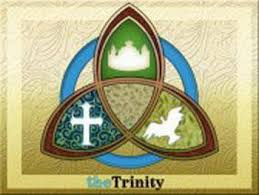
Trinity SundayTrinity Sunday

The Gospel just proclaimed comes near the end of Jesus’ discourse at the Last Supper and is an example of the implicit teaching on the Trinity.   Jesus tells his disciples, and us, there is much more He could tell us, but we cannot bear it now.  When the Spirit comes we will be guided to all truth – for the Spirit will take what is Jesus’ and declare it to us.  Elsewhere Jesus has told us, “The Father and I are one.”  If Jesus and the Father are one and the Spirit speaks what Jesus says, it follows that the three must be one.

In first reading God is revealed as wisdom.  The words of the Responsorial Psalm remind us that human beings are the work of God’s fingers, little less than the angels and crowned with glory.   In the 2nd reading, from the letter to the Romans,  We are reminded that the love of God has been poured into our hearts.  And, as you just heard in the gospel, the Spirit will make the revelation.

But, if one expects today’s readings to give a clear presentation of the doctrine of the Trinity – they will be sorely disappointed. In fact the word “Trinity” is not found in the Scripture.  One writer has said if Jesus were to ask the question today, “Who do you say that I am?”  A modern theologian might answer: “Thou art the Logos, existing in the Father as His rationality and then, by an act of His will, being generated, in consideration of the various functions by which God is related to his creation, but only on the fact that Scripture speaks of a Father, and a Son, and a Holy Spirit, each member of the Trinity being coequal with every other member, and each acting inseparably with and interpenetrating every other member, with only an economic subordination within God, but causing no division which would make the substance no longer simple.”  Jesus might have replied: “What’s that you say?”

You have most likely heard this incident attributed to St Augustine of Hippo, who wanted so much to understand the doctrine of the Trinity and to be able to explain it logically. One day as he was walking along the sea shore and reflecting on this, he suddenly saw a little child all alone on the shore. The child made a hole in the sand, ran to the sea with a little cup, filled her cup, came and poured it into her hole in the sand.  Back and forth she went to the sea, filled her cup and came and poured it into the hole. Augustine asked her, “Child, what are doing?” and she replied, “I am trying to empty the sea into this hole.” “How do you think,” Augustine asked her, “that you can empty this immense sea into this tiny hole and with this tiny cup?” To which she replied, “And you, how do you suppose that your small head you can comprehend the immensity of God?”  With that the child disappeared.

Like Augustine we may not be able to understand the how of the Trinity but it seems very important to understand why God revealed this mystery to us.  An overriding reason, it seems to me, is because we are made in the image of God. Therefore, the more we understand God the more we can understand ourselves. An important question for us today is: What does this doctrine of the Trinity tell us about the kind of God we worship and what kind of people we should be?

Remember the old saying “Two is company, three’s a crowd?” The Trinity shows us that three is community, three is love at its best; three is not a crowd.  Love when it becomes complete is a trinity.  We become fully human only when we are in relationship with God and in relationship with each other.  When we receive forgiveness and a new determination to live a life more purposefully in the service of others, then we have an experience of God’s redemption.  We have a more personal, more dynamic, experience of God – we come to more fully know the inner relationship of the Father, Son and Holy Spirit.  Our understanding grows but it’s still a dynamic that is incomprehensible to the human mind. It is a mystery!

In days gone past, more so than today or so it seems to me, Trinitarian symbolism held a significant place in family life and here at the monastery.  For example: parents signed the cross on their spouse’s and children’s foreheads as part of a goodnight or leaving the house ritual; at mealtime people would break a slice of bread into 3 pieces in honor of the Father, Son and Holy Spirit.  A tiny piece was left on the plate in remembrance of the poor who had no bread to eat.  Even today, three candles, three flowers or a bunch of three colors of flowers remind us of the Trinity.  Of course, there is also the lesson of the Trinity seen in St. Patrick’s clover.  In some cultures when a person blesses herself the ritual includes three smaller crosses.  In preparation for the reading of the Gospel we sign ourselves on the forehead, lips and heart praying: “May the Word of God be in my mind, on my lips and in my heart.”  Here at home, I recall one feast day when, in perfect silence, a large box of chocolates was being passed along the dining room table for each one of us to make her choice.  Suddenly Mother de Chantal’s stern voice was heard: “Sisters, You don’t need to honor the 7 sorrows of Mary or Jesus’ last words on the Cross;  three in honor of the Trinity will do just fine.”

Continue Reading

Filed Under: Blog, Homily Tagged With: Father, God, Holy Spirit, Jesus, Trinity, Trinity Sunday

  • « Go to Previous Page
  • Page 1
  • Interim pages omitted …
  • Page 57
  • Page 58
  • Page 59
  • Page 60
  • Page 61
  • Interim pages omitted …
  • Page 64
  • Go to Next Page »

Footer

Prayer / Newsletter / Info

 Contact Info

Benedictine Sisters of Florida

PO Box 2450
12138 Wichers Road
St. Leo, FL 33574-2450
(352) 588-8320
(352) 588-8443

 Mass Schedule

Related Links

Copyright © 2026 · Benedictine Sisters of FL · Touching Lives Through Prayer and Service

Copyright © 2026 · Bendedictine Theme on Genesis Framework · WordPress · Log in