• Skip to primary navigation
  • Skip to main content
  • Skip to footer
Benedictine Sisters of FL

Holy Name Monastery
Founded 1889

Donate Now
  • Home
  • About Us
    • History
    • Being Benedictine
    • Benedictine Monasticism
    • Meet Our Community
    • Holy Name Academy-Alumnae
  • What We Do
    • Mission, Vision and Our Partners
    • Retreats
      • Invitation to Retreat
      • Accommodations
    • Volunteer Programs
    • Oblate Program
    • Spiritual Direction
    • Aqua/Hydroponics
    • More of Our Ministries
  • What’s Happening
    • Articles of Interest
    • Events
    • Newsletters
    • Brochures
    • Links
  • Support Us
    • Gifts of Support
    • Wish List
  • Stories Shared
  • Galleries
    • Photos
    • Videos
      • Benedictine Sisters of FL Videos
      • Other Videos
  • Contact Us

Jesus

Novemeber 21st and 22nd was the Feast of Christ the King

November 23, 2015 by Holy Name Monastery Leave a Comment

pontius pilateThis Gospel is a very familiar incident in the life of Jesus – many reflections have been written about it – so, today I offer you a different perspective on the occasion …  this one was related to me by Claudia, the wife of Pilate [adapted]

I wonder sometimes, if they might have been friends this Jesus and my husband Pilate. If they had met in some other circumstances, I think they might have liked each other. Afterall, they were about the same age. They were both passionate, committed, opinionated. Bullheaded sometimes.  And intelligent too.   Except they thought so differently.  Jesus was a Jew. Pilate was a Roman. And Pilate never understood the Jews.  “You can’t get a clear answer out of them about anything,” he would fume. “Ask them a straight, logical question and they tell you a story or sing you a song!”

Pilate knew perfectly well he would never have gotten the appointment as Governor if he hadn’t been married to me, the granddaughter of the Emperor Augustus. And even at that, Judea wasn’t exactly a plum of an appointment. But Pilate hoped that his next appointment would be more prestige, a little closer to Rome; something he and I would both be proud of.

But in Judea things had gotten off to a bad start – he’d had a showdown with the Jewish leaders over whether Caesar’s image could be displayed in the temple area. It was a dumb thing to fight about and Pilate knew it. “But I’ve got to show them I am strong and resolute, Claudia,” he said to me. “If I show just a hint of weakness, if I back down even an inch, that snake of a high priest, Caiaphas, will take every slight advantage that I give him.”

Judea was a ‘no-win’ situation for him. The bureaucrats in Rome just read the bottom line. Did he collect his quota in taxes? Did he avoid any embarrassments? If the answer was “yes” to those questions, you stayed on and maybe eventually got promoted to a better posting. If “no” you were recalled to Rome and sent to shuffle papers in an office somewhere. Judea was so much more complicated than they realized.

Pilate tried. How he tried! He read that blessed policy manual every night and memorized every procedure. But of course the manual procedures never fit reality. “Who wrote this stuff anyway,” he fumed. “I bet they’ve never been outside of Rome. They sure as the dickens have never been out here in the boonies of Judea.”

And then the Jesus business broke. It was a recipe for disaster. Pilate couldn’t win this one and I knew it and I think he knew it. I even had dreams about it. “Get this man Jesus out of your life, Pilate,” I said, “No matter what you do, you’ll lose,”  “I’ll do what’s appropriate and necessary, Claudia,” Pilate said in his official voice, which meant that he was frightened. “I will interview the prisoner and judge him according to our Roman justice. He will be treated fairly.”  And there the conversation ended.

When they brought the prisoner up to the Prætorium. Pilate met them outside, a gesture of good will.  He interviewed Jesus there in front of the Jewish leaders.  “Look,” he finally said. “the guy is just a little crazy, and yes, a bit of a trouble-maker. But he hasn’t done anything to deserve execution. I mean, I can’t have him killed just because you people don’t like him. What I’ll do is have him flogged. That’ll straighten him out.”  Well, you should have heard the hullabaloo. “We want him dead!” they yelled. “Give us Barabus! We want him crucified!”

Listen. My husband has integrity. He wasn’t about to execute a man unless a crime had been committed, and blasphemy against the Hebrew God was no crime in Roman eyes. But Pilate was no fool either. He knew that Caiaphas had his ways of getting messages to Rome.  What followed was a mish-mash of political maneuvering and charges and counter charges. I don’t quite know what happened. I was in bed for most of it, fighting one of my migraines.

But I won’t not soon forget what happened when Pilate dragged this Jesus up into our quarters, away from all the yelling and screaming outside. That was when it struck me how alike they were, and yet how different. Two men of talent and integrity speaking to each across such vastly different realities.

In spite of all the pressure, Pilate still wanted to do the right thing. “Look,” he said to Jesus. “Give me a reason, give me something, anything that’ll satisfy that mob–something I can put in my report to Rome so I don’t have to have you killed.” Jesus looked right back at Pilate–looked through him. But he said nothing.

Pilate lost his cool. “Look, don’t you know I have the power of life and death over you. I can send you out to be torn apart by that mob, or I can save your hide.”  “You have no real power over me,” said Jesus. “No power that really counts. You and I are caught in this evil drama. You have your role to play and I have mine.  “All right,” said Pilate. “What is your role except to satisfy the blood-lust of that mob?”  “I am called to live the truth,” said Jesus.  “What is truth?” Pilate asked quietly, almost cynically. Jesus looked at him intently. And yes, compassionately. But he said nothing.   “Look, I asked you a question. What is truth?” Pilate lost his cool again. He paced around the room and banged his fist against the wall. But both men knew, I think, that Jesus could not reply in any way that Pilate could comprehend.

The conversation stopped. There was nothing else to say. Jesus would die. And Pilate knew he’d spend the rest of his life rehearsing that conversation. “Why couldn’t he just explain to me, logically and rationally what he was up to?” Pilate asked that question over and over.

I too have rehearsed that conversation. I am back in Rome now, by myself. Pilate has been banished from the capitol.  Pilate did not understand Jesus or any of the Jews.

And yet I wonder:  If Pilate and this Jesus had met some other way, perhaps they would have learned to like each other – if they had a chance to really talk, without the pressure. Pilate, the logical philosopher might have discovered the poetic dreamer deep inside himself. And Jesus the poetic dreamer, might have shown to Pilate the philosophy on which his dream was built.  There would have been respect at least. And just perhaps they might have seen themselves as brothers.

                                                                                                   Reflection by S. Roberta Bailey, OSB, Prioress
Continue Reading

Filed Under: Homily, Prayer Tagged With: Bible, Jesus, marriage, Pilate, understanding, wife

How Well Do You Read Signs?

November 16, 2015 by Holy Name Monastery 1 Comment

reading signsLast Sunday we heard Jesus’ observation about the contributions being made to the temple treasury and the example of sacrificial giving that he saw in the poor widow’s offering.  If we read Mark’s gospel continuously from that incident to yesterday’s Gospel, we also know about Jesus’ prediction about the destruction of the Temple, his teaching about the costs of discipleship, the woes that will accompany the end times and Jesus’ instruction to his disciples about the need for watchfulness so that they will not be caught unprepared for the final judgment.

This past Sunday’s Gospel continues Jesus’ teaching by offering signs to look for that will indicate that the coming of the Son of Man is near. His words and images draw upon Old Testament imagery, especially images found in the Book of Daniel.  In the historical context, Jesus is actually describing the coming destruction of the Temple and the ruination of the nation, as both fall under GOD’s judgment at the hands of the Roman Empire.

Next, Jesus says: “Learn a lesson from the fig tree.”  The emphasis, of course, is not on what kind of tree – the warning is: WATCH.  Jesus could have said citrus trees or olive trees.  But, he says “fig trees” and happily for us we have a lot of experience with fig trees that we had right outside our dining room windows at the old monastery. When the branch becomes tender and sprouts leaves, we know that another season of fruit is near.

After Jesus tells the parable of the fig tree, He gives several brief parables to show what the response one should have when the signs appear.

We know that Jesus’ words are not spoken to frighten his disciples, nor should they frighten us.   The prophetic Word of God is as sure and secure as the rest of His message.  They are offered to prepare us for the changes we will experience during our lifetime and at the end time. Our consolation and hope is found in the lasting nature of Jesus’ words and God’s never-ending love for us.

When you see the things happening that Jesus talks about, know that he is near, at the gates.  “But,” says Jesus, “of that day or hour, no one knows, neither the angels in heaven, nor the Son, but only the Father.”   Then, He assures us: “Heaven and earth will pass away, but my words will not pass away.”  Or, said still differently, the coming judgment and destruction that Jesus predicts will be the very signs that will vindicate his message.
Let’s drill down a little deeper into one phrase of the text — “of that day or hour no one knows.”   We do not know exactly what Jesus in his prophetic ministry would say to us in our moment of history, but we do know that the general thrust would be similar to what he has already said:  In the face of struggle, persecution and difficult times, when the tide of public popularity turns against God’s people, I tell you: remain faithful even though you do not know the future, even though you do not know the day or hour of your deliverance.

So, how, as followers of the Jesus, do we prepare?  In the face of struggle read the signs of the times.  How well do you read signs?  Can you train yourself to be more observant of the signs?  By personality do you notice signs in nature?  Road signs?  How well do you read non-verbal body language?   Do you work to sensitize yourself to recognize everyday signs?  How do you heighten your sensitivity to spirit signs?  Do you use Scripture, the Rule, the example of a favorite saint, a confessor or a friend-guide?  What helps you to listen more keenly to your heart?  In the quiet of the night – when sleep eludes you – or out walking or driving along a familiar road; riding alone in the elevator, climbing the stairs, passing through the hall at a leisurely pace; setting the table, readying yourself for communal prayer in the chapel – do you hear God’s whisper in your heart?

Cultivation of the inner spirit helps prepare us to see the direction of the cultural wind we face, whether agreeable or antagonistic.    God does not usually shout to us in fury or in a tumultuous hurricane.  Much of the time God speaks softly – so stay tuned.  In the face of cultural garbage and shifting government structures or a changing church, we steady ourselves not to be tempted to hoard food and possessions.  We guard against the temptation to build a hermitage and hide out.  We pray to be strengthened to stay in the fray?  Many things will just happen in our lives – things not scheduled by the calendar or our clock or our watches or the bell.  With all the scheduled things to do we are called by today’s Gospel to also keep our hearts attuned to the significance things that just happen.

As individuals that form this community I believe we make valiant efforts to sift through all that bombards us and continue to make the choice (our corporate commitment) to meet the needs of the left-out, locked-out and dropped-out?

How can we do this day in and day out and year after year?  By heeding Jesus’ directive to the disciples who accompanied Him in the garden the night before his death:  stay here, watch and pray.   Watch: seek GOD in and about the events of the day asking for GOD’s Wisdom to let us see GOD’s perspective so we discover our moment within our cultural context.

And, pray:  clear off space in our lives for GOD. Remember, to pray is not to read books about God, about spirituality or prayer, or to think about those topics.  To pray is simply – pray!  We don’t even have to start the conversation. Simply let God in and sit in expectant silence, with a listening heart.  A disciplined, determined prayer practice, sustains us (individually and as a community) in the battle of our heart’s faithfulness to the LORD.

Let us strive to keep in mind that we are called not so much to DO the Good News – though faith-in-action is important.  We are called to BE the Good News – a model of all that is implied when we call ourselves Christian and Benedictine.

                                                                                                                   Mass Reflection by S. Roberta Bailey, OSB, Prioress
Continue Reading

Filed Under: Homily, Prayer Tagged With: Disciple, God, Jesus, listen, pray, Signs, watch

Two Cents

November 9, 2015 by Holy Name Monastery 1 Comment

two centsI would venture to say that most hearers or readers think that this Gospel passage is only about the widow or about how honorable the poor are for being generous.  If we do, we’re missing the point.   Of course we cannot simply look at the story of the widow: (having lost her spouse – possibly at a young age given men’s’ life expectancy then – she might have had no children; now she’s considered a burden to both her parents and her in-laws.

Jesus commended her giving, in contrast to that of the scribes, because she gave everything she had! She could have kept one of those coins for herself, but she willingly gave everything she had to Jesus.  That widow could never have known what her gift would accomplish. She walked into the Temple, ignored by the rich, the religious and those caught up in the celebrity worship of the day. She walked in with her little gift and she gave it without fanfare – no trumpet blare, no applause. Everything that poor woman had earned for her own needs was given willingly to the Lord. She is an example of extravagant giving!

The rich gave, too.  Some came in with great fanfare, standing back and tossing in their gift for the greatest effect. Others gave with a frown on their face, holding onto their coins as tightly as they could to the very last second. Others probably stopped to make sure that everyone was watching them as they gave their offerings. They wanted to be recognized, honored and in control – they wanted a say in everything.  People like that are dangerous, divisive people! They are religious fools.

They received their applause and they walked proudly away. This poor widow gave her “two cents” and walked away, but her gift is still giving today. How many people have been challenged to go ahead and give their little because of this woman’s example?

Why would she bother to give such an insignificant gift? Her two cents among the thousands of dollars given by the wealthy seems so small. Why bother? This little lady is everything the religious scribes and the rich hypocrites were not. Why would she bother to give such an insignificant gift?

It’s her attitude that speaks volumes: humble, unassuming, unpretentious.   One’s attitude makes all the difference.  How we give is far more important than what we give!  Reminds me of a definition I heard many moon ago of the difference between cooperation and collaboration.  Cooperation is when all the stakeholders put their money on the table; collaboration happens when they put their hands in their laps.

In her quiet giving she was preaching a powerful sermon. Hear her as she humbly explains:

  • I give because God loves me and I love in return
  • I give because I trust God
  • I give because God has given to me

Three other lessons we might glean:

  • God will do great things with our small offerings –We do not know what any others giver put in the basket that week in the temple. But, after over 2,000 years the tiny gift of that widow has been multiplied into untold billions as people have been motivated to give out of their own poverty.
  • The Lord will settle His accounts one day – The scribes and the wealthy men there that day had their reward then and there – they blew their own trumpets – they got public attention and admiration. This widow will receive hers later! Do what you do for God – just keep it simple and silent.  Be honest: have you ever taken credit for a gift NOT given … failed to contribute to a collection (like we do for Daystar, the Heritage Christmas or AIM) but smiled as if you had contributed when the community is praised for its generosity?
  • God does not want our money; He wants us – He wants our love and our devotion and when He has that, He has everything else that we possess. When God has us, He has our pocketbooks.

So, in summary, the important lesson we might take from this story is: that real giving is sacrificial and reckless.  How much of your personal monthly allowance do you dedicate to doing good for someone else?  Do you contribute at the end of the month if you have something left over?  Or do you automatically designate 10% of your allowance to a cause each month?

If you remember nothing else, remember this: the attitude of your heart in giving makes all the difference.  How we give is far more important than what we give!

                                                                                                                Reflection by S. Roberta Bailey, OSB, Prioress
Continue Reading

Filed Under: Blog, Homily, Prayer Tagged With: gift, give, God, humble, Jesus, Two Cents, Widow

Our Blind Eyes Opened, Spread God’s Love

October 26, 2015 by Holy Name Monastery 2 Comments

eye for GodMark 10:46-57                                           Intention:  Jubilarians


The story of Bartimaeus rings with a familiarity of the plight of many people today.  He once had a family, a job, a house, kids, the whole works. He was active at the local synagogue. He would tell his children stories of their ancestors.  Then things started to change, he started to get these real bad headaches and his vision would become blurry. At first he did not allow this to bother him but kept on working and living, but eventually the blurred vision got worse and worse and eventually he could barely see his wife and children. He told them to leave because he wouldn’t be able to support them or protect them. Then things went black and that’s the way it was.

He would lay his cloak on the ground so people could throw their loose change on the ground next to him. Most people avoided him altogether because in those days many people felt that blindness was caused by sinfulness either by the person or by their parents, so they were avoided. That’s the way it was for years. He struggled to survive, always hungry and thirsty and everything always black.

Despite all the hardships that he faced he still loved God. He remember the stories that he told his children and he saw in his mind the people in those stories and how God always came through for them in the end. Now Bartimaeus sat daily next to the road listening to the people passing by. The conversation lately had been about this guy named Jesus who had healed people, even blind people. Some had even said that he was the messiah that had come to redeem Israel. Bartimaeus thought, “Wow, if only Jesus would come around here.”

Then one day there was a commotion. There were more people on the road than usual and then he heard the name, Jesus. He was coming. Should he say something? Would Jesus come to him? Could he restore his vision? Something deep inside said “Yes, call out the name.” Bartimaeus opened his mouth: the crowd around him tried to silence him. Yet Bartimaeus persised, calling out more loudly and with greater urgency. He will not be silenced or deterred from getting Jesus’ attention. We notice how quickly the crowd’s reaction changes when Jesus calls for Bartimaeus. Those who sought to quiet him now encourage him.

Bartimaeus recognized power and authority when he saw it. We do the same thing. If we had a broken leg we wouldn’t go to AutoZone to have it fixed.  If the doctor came in overalls, we might have a few questions, but if he was in a white coat, with a stethoscope and a pocket protector we would have no problem. Even though it might be some Joe Schmo from the street dressed as a doctor, we recognize the uniform as power and authority; we don’t ask for credentials or references, we simply accept what experience told us was the situation.

Bartimaeus recognized Jesus’ authority.  Jesus didn’t have on a uniform, even if he did Bartimaeus was blind he couldn’t see him anyway. He had heard stories, but he had heard false rumors, too. This recognition came from a place deep within him.

We have that some recognition of Jesus. We have never seen Him.  We’ve see artistic renditions of Jesus but our recognition originates from a different sense than sight..  It comes from a spiritual sense. It comes before anything. It is grace that allowed us to have that first moment with God, when God was not just a figure in religion classes or in the Bible but God became personal, a friend.

When Bartimaeus recognized Jesus, he still had a choice to make: act on that recognition or let it pass by.  Bartimaeus cries out, “Jesus, Son of David, have mercy on me!” He addressed Jesus by name and by title, Son of David, the messianic title reserved for the redeemer of Israel.   We cry out as well when we get to the last point, the straw that breaks the camel’s back.  We cry, “Help me, Jesus.” “Have mercy, Jesus” Or simply, “Jesus” “Got in Hiemel.”  “Mi Dios!”  We realize that only God can help us in whatever situation we are in. God’s grace not only gives us the ability to perceive God’s power and love. It also gives us the strength to respond to it. Unlike Bartimaeus however, we are not limited to a once in a lifetime response. We must continually respond to the gift of grace and power in our lives.

What is Jesus’ response to Bartimaeus? “Go; your faith has made you well.” It is interesting to see that Jesus says that it is Bartimaeus’ faith that produced his healing not Jesus’ faith that made him well.   Bartimaeus’ faith, and ours too, is not born out of nothing, it does not come out of thin air, but it is a response to the love and grace of God.  It was Bartimaeus’ response to God’s initial contact through grace that made him well – restored his sight. Our response to the power or grace is also a restoration and a reconnection.  We might not be blind, physically but spiritually we may be walking around aimlessly. Our spiritual vision may be black as night, but God still initiates the reconnection through grace and gives us the freedom to respond or reject His gift.

That’s the end of the story, right? Not quite. What does Bartimaeus do once he has been restored?  Immediately he follows Jesus on the way.  It is not the end, but the beginning of a journey.  We don’t receive the fire of the Holy Spirit, the connection with God, only to sit it in the corner or in the closet, or even the chapel.  Instead we must take up the invitation and follow Jesus on the way.  The question facing us is: Am I going to do for God today, or for myself?  Am I going to spend today in connection and in conversation with God or am I going to satisfy my own selfish wants and desires?  Our blind eyes opened, we have a unique opportunity to spread God’s love in the world.  Lord, we pray: open our eyes and strengthen us to following your prompt to be an expression of your compassion and mercy in our world.

                                                                                                                        By    Sister Roberta Bailey, O.S.B.
Continue Reading

Filed Under: Homily, Prayer Tagged With: Bartimaeus, Blind, Faith, family, God, Healing, Jesus, Mark

29th Sunday in Ordinary Time

October 19, 2015 by Holy Name Monastery Leave a Comment

humilityFirst Reading  Isaiah 53:10-11   Second Reading Hebrews 4:14-16
Gospel    Mark 10:35-45 (shorter form Mark 10:42-45)

Often, it is said, when looking for a job it is not what you know but whom you know that counts most.  In China, people often speak of guanxi, ” (guan-shee) connections” with people in the right places.

Today we see two brothers, who belong to the innermost circle of Jesus’ disciples, trying to exert their guanxi.   But listen to Jesus: the last be shall first and the first shall be last.”  He reminds us that the way to heaven is not in sitting on thrones, living in fine houses, driving luxury cars, having the latest tech gadgets or having holidays in exotic places.  Greatness consists not in what we have, or what we can get from others but in what we can give of ourselves to others.

Jesus asks us: Can you drink the cup I am going to drink?  These two brothers, in their eager ignorance, answer without hesitation:: “No problem!”

For us as Benedictines – in Benedict’s view, we are all called to cultivate a humble awareness of our place in creation.  Being humble brings the realization that we are capable of making gods of the very things that should be serving and enriching our lives.  It requires a humble trust in God’s providence.  For St. Benedict, everything a monastic does must be done for the glory of God – that is why we were created.  Remember your Baltimore catechism:  we were made to know, love and serve God.  A fifth century monk says it well: A proud monk needs no demon. He has turned into one, an enemy to himself.

In our own lifetime, Mother Teresa gives us a few ways to practice humility that sound much like Benedict’s steps of humility:

To speak as little as possible of one’s self.

To mind one’s own business.

Not to want to manage other people’s affairs.

To avoid curiosity.

To accept contradictions and correction cheerfully.

To pass over the mistakes of others.

To accept insults and injuries.

To accept being slighted, forgotten and disliked.

To be kind and gentle even under provocation.

Never to stand on one’s dignity.

To choose always the hardest.


This Prayer for Humility by an Anonymous Abbess is worth pondering line by line…:

Lord, you know better than myself that I am growing older and will soon be old. Keep me from becoming too talkative, and especially from the unfortunate habit of thinking that I must say something on every subject and at every opportunity.

Release me from the idea that I must straighten out other peoples’ affairs. With my immense treasure of experience and wisdom, it seems a pity not to let everybody partake of it. But thou know, Lord, that in the end I will need a few friends.

Keep me from the recital of endless details; give me wings to get to the point.

Grant me the patience to listen to the complaints of others; help me to endure them with charity. But seal my lips on my own aches and pains — they increase with the increasing years and my inclination to recount them is also increasing.

I will not ask you for improved memory, only for a little more humility and less self-assurance when my own memory doesn’t agree with that of others. Teach me the glorious lesson that occasionally I may be wrong.

Keep me reasonably gentle. I do not have the ambition to become a saint — it is so hard to live with some of them — but a harsh old person is one of the devil’s masterpieces.

Make me sympathetic without being sentimental, helpful but not bossy. Let me discover merits where I had not expected them, and talents in people whom I had not thought to possess any. And, Lord, give me the grace to tell them so.    AMEN

Just remember, as an ancient monk said: “When we become aware of our humility, we’ve lost it.”

                                                                                                                                        Sister Roberta Bailey, OSB

Continue Reading

Filed Under: Homily, Prayer Tagged With: Benedict, humble, Jesus, Lord, patience, Prayer

27th Sunday in Ordinary Time

October 9, 2015 by Holy Name Monastery Leave a Comment

I think it a shame that pastors have the option of omitting the last portion of the Gospel just proclaimed – the part about the children.  I hope they don’t exercise that option especially after Pope Francis’ display of affection and regard for children.

In this Gospel the people were bringing their children to Jesus, much like they did to Pope Francis.  It was the children (urged on by their parents) who could manage to break through security the lines and approach Pope Francis – the preoccupied attention of the disciples to get to Jesus.  Again the disciples just don’t get it.  This has been demonstrated in the readings for the last two Sundays. Jesus has summed up his lessons pointing out the value and importance of these “little ones” in the Kingdom of God.

But once again in today’s Gospel, the disciples try to prevent people from bringing their children to Jesus. Jesus reprimands them and welcomes these children.  Jesus offers the children as an example of the kind of complete trust and dependence upon God that ought to be the attitude of all believers.

The popular spiritual writer, Henri Nouwen, in his powerful meditations on Rembrandt’s painting of the Prodigal Son – says:

I saw a man in a great red cloak tenderly touching the shoulders of a disheveled boy kneeling before him.  I could not take my eyes away.  I felt drawn by the intimacy between the two figures, the warm red of the man’s cloak, the golden yellow of the boy’s tunic, and the mysterious light engulfing them both.  But, most of all, it was the hands – the old man’s hands – as they touched the boy’s shoulders, that reached me in a place where I had never been reached before.”

His attention moves to the elder brother and finally to the father’s role in the family dynamic.   Nouwen came to the realization that in life we all must mature from son (or child) to father (or parent and adult).   But, he says, there is a subtle pressure in church and society to remain a dependent child.   Who is it (in life) that truly challenges us to liberate ourselves from immature dependencies to accept the burden of responsible adults?

It would be comfortable, wouldn’t it, to remain in the warm embrace of childhood – on Jesus’ lap in the place of blessing.  But, we don’t really want to be a child all our lives using our role as child to keep us in a safe place distanced from others.  We grow in recognition that we have had blessings bestowed on us and now it is our turn to offer God’s immense love to others.

So how can we heed Jesus injunction to accept the kingdom of God like a child – or risk never entering it?  What does it mean to be childlike, and not childish?  What qualities is Jesus asking us to hang on to in order to enter the kingdom not only beyond the “pearly gates” but right here on earth, in our community, where God’s kingdom exists?

A few qualities I think he might encourage would be:

  • Live Spontaneously – taking in every moment and the opportunities in unplanned instants.
  • How about never letting a lack of qualifications deter you –If you’ve never done something before, be fearless like a child who pulls out a kitchen drawer to scramble up to the cabinet to get the peanut butter.  Isn’t this how Olympic gymnasts start?
  • Kids Know Exercise Can Be Fun –It’s just a matter of finding an active, healthy activity we actually enjoy doing.
  • Keep an Open Mind –  Keep a childlike wide open mind and you’ll learn something new every day – maybe more than one thing.  Don’t let force of habit slow you down.   Ask questions: you’ll never get an answer if you never ask.  So, she might say NO – but did you give her a chance to say YES?
  • Express your feelings – nurture and value relationships – Open, honest, direct face-to-face expression of feelings makes communication easier, maintains sincerity and integrity in your life.  Children like nothing better than to “hang out” with their friends.  Do you look forward to unstructured time with community members – your “sisters?”
  • Use Your Imagination –  Robert Kennedy get credit, but Walt Disney said it first::  If you can dream it, you can do it!  If you have a creative idea, share it.  If its aster, smarter or better and see what happens.  You’ll never know unless you try.
  • Learn by Imitation – have you ever seen a little boy walking behind this father, trying determinately to imitate his father’ stride?  Or a little girl who has practiced putting on make-up just like Mommy?  St. Benedict was a firm believer in the axiom: “fake it til you make it.”  Live monastic traits until they become part of you.
  • Play  – Sometimes it’s healthy to fool around and engage in recreation for the sole purpose of having fun.

Paul in his letter to the Corinthians says: When I was a child I used to speak like a child, think like a child, reason like a child; when I became an adult, I put away with childish things.  Jesus might respond: Yes, put away childish ways but hang on to the delightful child-like traits that are the keys to the kingdom.

Continue Reading

Filed Under: Homily, Prayer Tagged With: child-like, children, God, Jesus, Kingdom of God, Pope Francis

  • « Go to Previous Page
  • Page 1
  • Interim pages omitted …
  • Page 59
  • Page 60
  • Page 61
  • Page 62
  • Page 63
  • Go to Next Page »

Footer

Prayer / Newsletter / Info

 Contact Info

Benedictine Sisters of Florida

PO Box 2450
12138 Wichers Road
St. Leo, FL 33574-2450
(352) 588-8320
(352) 588-8443

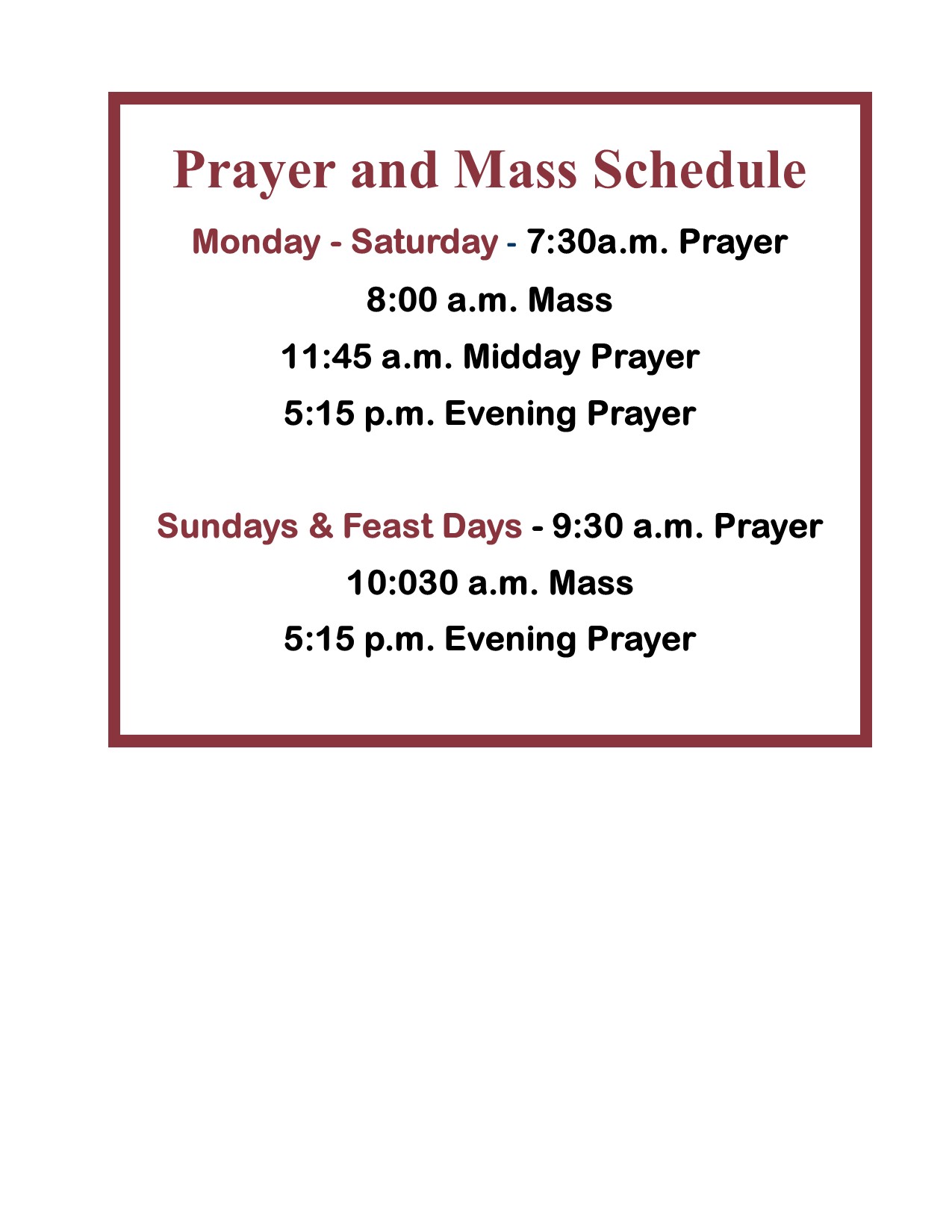
 Mass Schedule

Related Links

Copyright © 2026 · Benedictine Sisters of FL · Touching Lives Through Prayer and Service

Copyright © 2026 · Bendedictine Theme on Genesis Framework · WordPress · Log in