• Skip to primary navigation
  • Skip to main content
  • Skip to footer
Benedictine Sisters of FL

Holy Name Monastery
Founded 1889

Donate Now
  • Home
  • About Us
    • History
    • Being Benedictine
    • Benedictine Monasticism
    • Meet Our Community
    • Holy Name Academy-Alumnae
  • What We Do
    • Mission, Vision and Our Partners
    • Invitation to Retreat
    • Accommodations
    • Volunteer Programs
    • Oblate Program
    • Spiritual Direction
    • Aqua/Hydroponics
    • More of Our Ministries
  • What’s Happening
    • Articles of Interest
    • Events
    • Newsletters
    • Brochures
    • Links
  • Support Us
    • Gifts of Support
    • Wish List
  • Stories Shared
  • Galleries
    • Photos
    • Videos
      • Benedictine Sisters of FL Videos
      • Other Videos
  • Contact Us

Jesus

Why is Jesus called by this strange title, “the Lamb of God”?

January 17, 2017 by Holy Name Monastery 1 Comment

First Reading Isaiah 49:3,5-6    Second Reading  1 Corinthians 1:1-3
Gospel John 1:29-34
Today we hear the story of what John the Baptist witnessed when Jesus, his cousin, approached him in the river Jordan where John was baptizing those who came forward.   Last Monday we heard Matthew’s account of Jesus’ baptism.  The two accounts differ because the evangelist we hear today does not describe the baptism.  Instead, in John’s account, John the Baptist announces that he knows that Jesus is the Son of God. He cries out, giving witness about who Jesus is. He says that he saw the Spirit descend upon Jesus. By this sign, John the Baptist knew that Jesus was the one who was to come after him.

We hear two familiar titles for Jesus. John calls Jesus the “Lamb of God” and the “Son of God” identifying Jesus’ ultimate purpose is to redeem humanity. We need to know who Jesus is, if we want to be his disciples. We also need to know what his mission is, if we want to be good disciples.

Why is Jesus called by this strange title, the Lamb of God? It refers back to the origins of the great Jewish feast of the Passover that commemorates when the people were told, in order to escape punishment, that they should smear the doorposts of their houses with the blood of a lamb. When God’s angel struck, he passed over the blood-painted houses of the Israelites and their children were spared. They had, in effect, been saved by the “blood of the lamb.”  The lamb then becomes the sign and symbol of the liberation of God’s people from slavery and oppression. But for us – and this is what John the Baptist’s means – Jesus is the new Lamb which brings freedom and liberation.

The purpose of John’s baptism was to make Jesus known to Israel.  John’s witness is an excellent example of what it means to be a disciple. By our Baptism, we are called to be disciples – to make Jesus known to all the world by our words and by the witness of our lives.

This Wednesday we will begin the Week of Prayer for Christian Unity.  The theme for 2017, “Reconciliation – The Love of Christ Compels Us” was chosen to mark the 500th anniversary year of the beginning of the Reformation.  Two accents are reflected: the main concerns marked by Martin Luther’s Reformation and our recognition of the pain of the subsequent deep divisions which continue to afflict the unity of the Church.  Christians are encouraged to pray and to view this week as a first step toward reconciliation.

Each year on his birthday, our nation takes time to stand back and contemplate the impact of Martin Luther King on the course of history. It may be tempting to treat this day like any other.   But, many of us cannot forget; we grew up in a segregated society.  Most of us remember attending – or for that matter teaching in – racial segregated school. We went to all-white schools.  We can remember “whites only” water fountains, lunch counters and seats on the bus.  The name of Martin Luther King, Jr. represents the blood, sweat and tears of many, many people.  Praise God for people who live by the courage of their convictions.

Tuesday evening, in his farewell address, President Obama reminded our nation:  “For white Americans, it means acknowledging that the effects of slavery and Jim Crow didn’t suddenly vanish in the ’60s; that when minority groups voice discontent, they’re not just engaging in reverse racism or practicing political correctness; when they wage peaceful protest, they’re not demanding special treatment, but the equal treatment that our founders promised.”

In 1956, Rev. King realized just how parched he was, how needy he was for a drink from God’s fountain of live-giving water.  On January 27 of that year, he received a phone call: “Nigger, we are tired of you and your mess now, and if you are not out of Montgomery in three days, we’re going to blow your brains out and blow up your house.”  Dr. King was so disturbed by this threat to his family and was especially concerned for his newborn daughter.  He went to the kitchen seeking solace from a steaming cup of coffee.  As he began to muse he was confronted with a vision in the kitchen.

In his words: Rationality left me…and I started thinking about many things.  Something said to me, you can’t call on daddy now; he’s in Atlanta – You’ve got to call on that something, on that person that your daddy used to tell you about, that power that can make a way out of no way.  And I discovered then that religion had to become real to me and I had to know God for myself.  I bowed down over that cup of coffee, I never will forget it.  I prayed out loud: Lord, I’m down here trying to do what’s right.  I think the cause that we represent is right.  But Lord, I must confess that I’m faltering.  I’m losing courage.

Almost out of nowhere I heard a voice.  “Martin Luther, stand up for righteousness.  Stand up for justice.  Stand up for truth.  And lo, I will be with you, even until the end of the world.”   Dr. King recounts that he was ready for anything after this.  He experienced renewal from the fountain of life.

Tuesday is a national day of prayer for reconciliation and healing.  Let us take this opportunity to renew our baptismal commitment.  With all these celebrations (this week)  we are impelled to revisit our own “vision in the kitchen” and like genuine messengers of God to respond with the sentiments of tomorrow’s responsorial psalm: “I will announce your justice in the vast assembly; I will not restrain my lips, as you, O Lord, know.” Further, with the words of the psalmist we pray: “I waited, waited for the Lord, and God stooped toward me and heard my cry. He put a new song into my mouth, a hymn to our God. “

~Reflection by Sister Roberta Bailey, OSB, Prioress
Continue Reading

Filed Under: Blog, Homily Tagged With: Christian, God, Jesus, Lamb of God, National Prayer Day, Prayer, Rev. Martin Luther King, Son of God

The face of God on earth

December 21, 2016 by Holy Name Monastery 2 Comments

I believe that Jesus Christ,
the unique son of God,
is the face of God
on earth
in whom we see best
the divine justice,
divine mercy,
and divine compassion
to which we are all called.

Through Christ
we become new people,
called beyond
the consequences
of our brokenness
and lifted to the fullness of life.

By the power
of the Holy Spirit
he was born
of the woman Mary,
pure in soul
and single-hearted—
a sign to the ages
of the exalted place
of womankind
in the divine plan
of human salvation.

He grew as we grow
through all the stages of life.
He lived as we live
prey to the pressures of evil
and intent on the good.

He broke no bonds
with the world
to which he was bound.
He sinned not.
He never strayed
from the mind of God.

He showed us the Way,
lived it for us,
suffered from it,
and died because of it
so that we might live
with new heart, new mind,
and new strength
despite all the death
to which
we are daily subjected.

—edited from “A Creed,” In Search of Belief  by Joan Chittister
Continue Reading

Filed Under: Blog, Homily Tagged With: Chirst, God, Holy Spirit, Jesus, Joan Chittister, mercy, poem, The face of God on earth

The Waiting Begins

December 19, 2016 by Holy Name Monastery Leave a Comment

4th Sunday of Advent

First Reading:  Isaiah 7:10-14                  Second Reading: Romans 1:1-7

Gospel: Matthew 1:18-24

Each night for the octave before Christmas which begins tonight, we ask Christ to come, calling him by a different title in the Magnificat Antiphon, familiarly called the O Antiphons”.  These antiphons were developed during the Church’s first centuries, soon used widely in monasteries and by the 8th century they were in use in both the monastic and the Roman breviary (Divine Office).   They were originally in Latin and traditionally chanted. The O Antiphons are also used with the Alleluia for the Gospel Verse at Mass. The last one is sung at the Evening Office on December 23rd – there isn’t one for the evening service for Dec 24th because that is already the vigil of Christmas, so we are no longer waiting.

An interesting note that is not apparent in English, but it can be seen clearly in the Latin. Sometimes you see the phrase ERO CRAS on banners or cards listing the O Antiphons in Latin because if we take the first letter of each Latin title for Christ and write them in backwards order, we get “ERO CRAS, a Latin phrase that means “Tomorrow, I will Come.” Before tomorrow does come, Let’s take a stroll along the path of the O Antiphons …

O Wisdom!   Sirach (24:3) says:  “From the mouth of the Most High I came forth, and like mist covered the earth”.  Wisdom “reaches from end to end mightily and governs all things well”.  Wisdom is the foundation of fear of the Lord, of holiness, or right living: it is wisdom whom we bid to come to teach us prudence.


O Adonai and Ruler of the House of Israel! In Exodus (6:6) we read: “I will rescue you by my outstretched arm and with mighty acts of judgment”. With this second antiphon we progress from creation to the familiar story of God manifesting himself by name to Moses and giving his law to Israel as their way of life.


O Root of Jesse!  Isaiah (52:13-15) prophesied the restoration of David’s throne – a new branch budding out of the old root. Christ is the root of Jesse in a two-fold sense: he is the descendant of David, who was the youngest son of Jesse, and he inherited the royal throne.  The angel foretold to Mary, “The Lord God will give him the throne of David his father.”


 Key of David  Isaiah (22:22) makes a prophecy: “I will place the key of the House of David on his shoulder. When he opens, no one shall shut; when he shuts, no one shall open.”  The key and scepter are traditional symbols of kingly power and authority. Jesus shared his authority when He entrusted the power to “bind and to loose” to Peter and the ministers of his church. We look to Jesus to unlock the fetters of our shadow selves that keep us so tightly chained to bad habits and the stumbling blocks that impede our spiritual maturity.


O Rising Dawn!  Peter’s epistle echoes the sentiment of the prophet Malachi (2 Peter 1:19): “Keep your attention closely fixed on it, as you would on a lamp shining in a dark place, until the first streaks of dawn appear and the morning star rises in your heart”.  This title is variously translated “morning star”, “Dayspring”, “rising sun”, “radiant dawn”, “orient”.  All beautifully express the idea of light with its brightness bringing healing and warmth to cold hearts.  We pray this petition daily in the Benedictus: “the morning sun will rise upon us … guiding us in ways of peace.”


O King of the Gentiles and the Desired of all nations!  Thus says the prophet Isaiah: “Therefore, says the Lord God: See, I am laying a stone in Zion, a stone that has been tested, a precious cornerstone as a sure foundation”.  This sixth antiphon, in the words of Isaiah and Jeremiah, (Isaiah 28:16 and Jerimiah 10:7) clearly addresses the savior as the king of the gentiles and the Desired One of the nations, the cornerstone on whom our spiritual foundations are laid. We call on Christ to once again breathe new life into us.


O Emmanuel!   In this the seventh antiphon, we are reassured by the prophet Isaiah (Isaiah 7:14): “The Lord himself will give you this sign: the virgin shall be with child, and bear a son, and shall name him Emmanuel”.  With this last antiphon our expectation finds joy in the certainty of fulfillment.  We call Jesus by one of the most personal and intimate of his titles, Emmanuel, God-with-us.

Our Advent Scripture readings have been stressing the truth that Christ is the fulfillment not only of Old Testament hopes, but present ones as well. Our repeated use of the imperative “Come!” embodies the longing of all of us for the One who is to come in many ways – He came historically at Bethlehem in the fullness of time. He comes to us sacramentally.  He will come again at the end of time.  Christ comes to us also in the two-fold consecration of the Body and Blood of Christ and to us in Communion.  He comes in the words of Sacred Scripture and in the person of our confreres, our family and neighbors.  Christ comes in a special way through our corporate commitment actions – through the spiritual and corporal works of mercy.

In this final week of Advent we fix our attention on the messianic promises proclaimed by the ancient prophets.    The O Antiphons add a mood of eager expectation to the liturgy that builds throughout these seven days and climaxes at Christmas midnight Mass when the church sings: “I proclaim to you good news of great joy: today a Savior is born for us.”

~ Reflection by Sister Roberta Bailey, OSB, Prioress
Continue Reading

Filed Under: Blog, Homily Tagged With: Advent, Birth of Christ, Christ, God, Jesus, Week 4

All Saint’s Day – November 1st

November 1, 2016 by Holy Name Monastery Leave a Comment

all-saints-day-9-450x318While historians do not have a definitive date for the Christian beginnings of All Saints’ Day, it is believed by many, to have been initiated by the Greeks.  In the fourth century, they chose the first Sunday after Pentecost to honor all saints and martyrs.

In 837 CE, All Saints’ Day was authorized a holiday by Pope Gregory IV.

Continue Reading

Filed Under: Homily Tagged With: All Sain't Day, Jesus, November 1

The True Host

October 31, 2016 by Holy Name Monastery Leave a Comment

First Reading  Wisdom zacchaeus11:22—12:2       Second Reading 2 Thessalonians 1:11—2:2
Gospel Luke 19:1-10

Have you ever been to a parade, or a concert or a sports event where you couldn’t see much more that a sea of hats or heads?  When that happens, a periscope may be just what you need – you know, one of those things they use in submarines to see above the surface of the water … you can see over tall objects, even around corners.

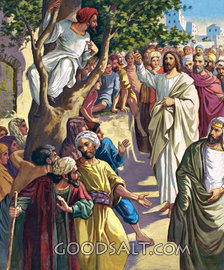
Well, today’s story is about such a situation.  A man went to a parade, but couldn’t see above the crowd.  The main attraction in this parade was man who had become quite famous because he had performed many miracles.  He had raised people from the dead and restored sight to the blind; he cured people of leprosy and drove out demons.  This man Jesus, Luke tells us, was passing through Jericho.  Notice He wasn’t intending to stay overnight.  The atmosphere was like a circus parade. People lined the streets hoping to get a glimpse of Jesus.  Zacchaeus REALLY wanted to see Jesus!  But he was small of stature and he didn’t have a periscope

Remember the song ….  Zacchaeus Was a Wee Little Man ….

So what’s a short guy to do? He runs on ahead of Jesus and climbs a sycamore tree.  Now, I’ve read that people in the Middle East do not generally run and they wouldn’t be caught climbing a tree.  Zacchaeus would have had to run a long way ahead of the crowd to have time to climb up this tree and get a view of Jesus.  The law – the city codes – did not allow the planting of sycamore trees within the city limits.  They had to be planted at least 75 feet outside the city walls. So, Zacchaeus had to run past everyone in town to climb up that tree.  Now, just imagine that parade of people surrounding Jesus.  Most had their attention focused on Jesus but surely some would have spotted the little thieving rich guy climbing up in the sycamore tree.

Jesus arrives under the tree and looks up to Zacchaeus.  Their eyes meet.  Jesus called Zacchaeus by name. He made eye contact, and spoke to him face to face.  Jesus communicated to Zacchaeus that he was glad to see him.  How embarrassing for Zacchaeus.  You can just hear the people taunting him, shouting insults, and calling him names.  Jesus knew everything there was to know about Zacchaeus, yet He still loved him and still had compassion on him.  What a picture of grace!  That’s how it is for us, too.  Jesus knows everything there is to know about us, but He still loves each of us.

Jesus silences the crowd and His voice rises above the din of their taunts and shouts.  He absorbs the ridicule and shame of Zacchaeus upon Himself and invites Himself over for supper.  The people in the crowd were shocked!  Zacchaeus was one of the most hated men in all of Jericho.  They considered him a thief and a cheat!  No observant Jew would dine with this sinner.  Yet, Jesus chooses to honor the tax collector by staying at his house.  The crowd couldn’t believe it!  Of course they grumble. Jesus, on the eve of the Passover, hadn’t planned to stay in town.  And now he’s going to stay and eat in an unclean house?  Jesus is defiling Himself.  Zacchaeus gets down from the tree and gives his famous speech.  He promises, if he has ever cheated anyone, to give half of his goods to the poor and restore four times the amount he has ever stolen.

That’s when Jesus makes the bold declaration, “Salvation has come to your house!” Zacchaeus got saved! He was born again!   Experiencing the love of Christ, he became more concerned about others.

Jesus doesn’t say that Zacchaeus is saved because he plans on repaying everyone. Salvation has come to Zacchaeus’ house because He is simply lost.  In his search for salvation, he humbled himself by making a spectacle of himself climbing up a tree.  Perhaps you have heard the saying, “To reach the fruit of a tree, you must go out on a limb.”  That’s exactly what Zacchaeus did.

One Biblical scholar has described the paradox in this story.  “Zacchaeus is spectacular because he is not like other characters who encountered Christ.  He was not called as the disciples were, nor was Zacchaeus suffering from some kind of affliction.  What makes Zacchaeus so special is that he was an average man.”  Most of the characters in the Bible experience a call from Christ either as a personal invitation or through the public preaching of Jesus.  Others sought Jesus because of some affliction.  Zacchaeus was different.  He was a successful business man – and a wealthy one!  An interesting part of this story is that, as far as we know, Zacchaeus did not change jobs after his encounter with Jesus.  He did not join the entourage that traveled with Jesus.  He was a tax collector before he met Jesus, and it seems he continued collecting taxes after he met Christ.  His job was the same, but his destiny was different.

The text says Zacchaeus was “seeking” Jesus.  But if I read the story right, Jesus really was seeking Zacchaeus.  He came to seek and save all the lost.  Zacchaeus tried to climb up to God, but he didn’t get past the lowest branches.  Zacchaeus gets to host Jesus that evening because Jesus invited Himself to celebrate the Passover meal. Jesus always ends up being the true host.  Jesus invites Himself here today. If you’ve come to seek good news, it’s the same the message Jesus spoke to Zacchaeus: “Come down; salvation has come to your house.  I want to dine with you this night.”

~Reflection by Sister Roberta Bailey, OSB, Prioress


Continue Reading

Filed Under: Blog, Homily Tagged With: God, Jericho, Jesus, salvation, sycamore tree, tax collector, Zacchaeus

A Study of Contrasts

October 24, 2016 by Holy Name Monastery Leave a Comment

righteousnessFirst Reading  Sirach 35:12-14,16-      Second Reading  2 Timothy 4:6-8,16-18
Gospel  Luke 18:9-14

It is important to note at the outset of this particular reading to whom Jesus is speaking in this parable.  Luke says:  “Jesus also told this parable to some who trusted in themselves that they were righteous, and treated others with contempt.”

The whole parable is a study in contrasts between the prayer of the Pharisee and the prayer of the tax collector.  Jesus teaches us, his listeners, to pray in humility before God. He surprises his listeners, including us, by highlighting the tax collector as the example of faith – a model for prayer. He reminds us if we are too full of ourselves, there is too little room for God’s grace to work in us.

It’s interesting to notice that everything the Pharisee says is true. He has set himself apart from others by his faithful adherence to the law. He is, by the standards of his day what Luke and Jesus seem to term, righteous. So before we judge him too quickly, we might reframe his prayer slightly and wonder if we have uttered it ourselves. Maybe we haven’t said, “Lord, I thank you that I am not like other people…”, but what about, on seeing someone down on her luck, “There but for the grace of God go I”? It isn’t that the Pharisee is speaking falsely, but rather that the Pharisee misses the true nature of his blessing. As Luke says early on in this reading, he has trust in himself. His prayer of gratitude may be addressed to the God, but it is really about himself. He credits his righteousness entirely in his own actions.

The tax collector, on the other hand, does not even raise his eyes to heaven.  He knows that he possesses no means by which to claim righteousness. He declares he has done nothing of merit. So, he stands back, hardly daring to approach the Temple, and throws himself on the mercy of the Lord.  He seems not so much humble as desperate.  He is too overwhelmed by his plight to take time to divide people into categories.  He stakes is hope entirely on the mercy of God.

At the end of the day, the Pharisee will leave the Temple and return to his home righteous. This hasn’t changed; he was virtuous, honorable, and righteous when he came to the temple.  That hasn’t changed … he’s still righteous when he leaves the temple. His mistake, as Scott Peck says, is that he thinks that whenever he wants to he can pull “God out of his back pocket.”   On the other hand, the tax collector will leave the Temple and go back down to his home justified, that is, accounted righteous.  As Luke expresses it: he is exalted in God’s eyes because he humbled himself.

If you’re spiritually alive, and give credit where credit is due, you’re going to love this take on the parable.  If you’re spiritually dead, you won’t even want to hear / read it.
If you’re spiritually curious, there is still hope!

A Church goer wrote a letter to the editor of his hometown newspaper and
complained that it made no sense to him at all to go to church every Sunday………

He wrote: “I’ve gone for 30 years now, and in that time I have heard something like 3,000 sermons, but for the life of me, I can’t remember a single one of them.  So, I think I’m wasting my time, the preachers and priests are wasting their time by giving sermons at all”.

This started a real controversy in the “Letters to the Editor” column.  Much to the delight of the editor, it went on for weeks until someone wrote this clincher:

“I’ve been married for 30 years now….. In that time my wife has cooked some 32,000 meals…… But, for the life of me—- I cannot recall the entire menu for a single one of those meals.

[Or we might say: I’ve been in community x number of years… in that time I’ve been  nourished and supported by my Sisters thousands of times in hundreds of different ways …But, I can only recall a few instances in detail ….]

But I do know this: They all nourished me and gave me the strength I needed to do my work.   If my wife (my community) had not given me those meals, I would be physically dead today.

Likewise, if I had not gone to church – been faithful to my time of private and communal prayer – for nourishment, I would be spiritually dead today!”  AMEN!

~Reflection by Sister Roberta Bailey, OSB, Prioress
Continue Reading

Filed Under: Blog, Homily Tagged With: contrasts, God, Jesus, parable, Pharisee, Pharisees, righteous

  • « Go to Previous Page
  • Page 1
  • Interim pages omitted …
  • Page 55
  • Page 56
  • Page 57
  • Page 58
  • Page 59
  • Interim pages omitted …
  • Page 64
  • Go to Next Page »

Footer

Prayer / Newsletter / Info

 Contact Info

Benedictine Sisters of Florida

PO Box 2450
12138 Wichers Road
St. Leo, FL 33574-2450
(352) 588-8320
(352) 588-8443

 Mass Schedule

Related Links

Copyright © 2026 · Benedictine Sisters of FL · Touching Lives Through Prayer and Service

Copyright © 2026 · Bendedictine Theme on Genesis Framework · WordPress · Log in