• Skip to primary navigation
  • Skip to main content
  • Skip to footer
Benedictine Sisters of FL

Holy Name Monastery
Founded 1889

Donate Now
  • Home
  • About Us
    • History
    • Being Benedictine
    • Benedictine Monasticism
    • Meet Our Community
    • Holy Name Academy-Alumnae
  • What We Do
    • Mission, Vision and Our Partners
    • Retreats
      • Invitation to Retreat
      • Accommodations
    • Volunteer Programs
    • Oblate Program
    • Spiritual Direction
    • Aqua/Hydroponics
    • More of Our Ministries
  • What’s Happening
    • Articles of Interest
    • Events
    • Newsletters
    • Brochures
    • Links
  • Support Us
    • Gifts of Support
    • Wish List
  • Stories Shared
  • Galleries
    • Photos
    • Videos
      • Benedictine Sisters of FL Videos
      • Other Videos
  • Contact Us

Christ

Growing Within US

June 14, 2021 by Holy Name Monastery Leave a Comment

Mark’s Gospel is full of stories, parables about the Kingdom of God.  The fourth chapter alone has three stories and all three are about seeds.  In one story Jesus tells of a farmer who planted seed in both good and not so good soil.  That’s the story Jesus elaborates on making it easy to understand. But the second, (which was the first parable that was just read) is a little more mysterious.  It describes how the seed grows without the farmer knowing how.  The third marvels at how large beautiful plants can grow from such tiny seeds.
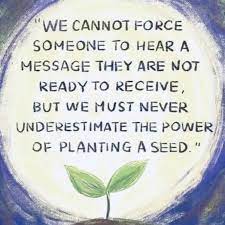
Literally, the word parable means “a riddle.”  Jesus told more than 40 riddles or parables during his ministry.  Usually when a person tells you a riddle, they eventually tell you the answer.  But Jesus only explained one parable to the crowds – the parable of the Sower and the Seed.  Mark lets us know that Jesus did explain everything to his disciples in private.  Then, Jesus ascended into heaven and took the answers with him!  So that leaves us, with a lot of figuring out to do.

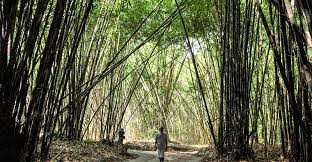
I’m told that one of the most amazing seeds in the world is Chinese bamboo.  It lies buried in the soil for five years before above-ground sprouts begin to appear leading one to believe it has died, is dormant, or stunted or defective seed.  During those long five-years it is important to cultivate, water and fertilize it regularly.  When the seedlings finally emerge from the ground, you can almost watch them grow before your very eyes  – growing at an astonishing rate, ninety feet into the air in just six weeks.  That’s fifteen feet a week, more than two feet a day, two inches every hour.  Why does it take so long to emerge, and then grow so fast once it does?  Plant experts say that during its first five years, the seed is busy building it’s elaborate root system underground that enables it to grow ninety feet in six weeks.
We can be tempted to want parables to unfold in neat little, decodable life-lessons.  But that’s not Jesus way.  He simply floats the parable out there, to rise or fall on ears of those who hear more than is said.  Those who have learned to really listen and read between the lines.

I am reminded of a short film that was popular in the 1970s – produced by a Canadian film maker: “The Parable.”  It was described by critics as “a very subtle Christian worldview.”  It raised eyebrows and questions about the prophetic role of the artist.  There were teachers’ guides galore explaining the symbolism in the story.  However, the film maker said he did not see Christ in the story.  It was not his intention to do anything other than tell a good short story and maybe win an award.

Parables are like dreams.  I can learn about universal symbolism but only the dreamer herself can discern the deep and hidden meaning of her dream.  We may both have dreams about rocks falling on us but each of us must interpret what the rocks represent.  You cannot explain for me what my dream about floating like a manatee down the Peace River means for me.  You may guess what it might mean for you if you had a similar dream.  If I am deathly afraid of water it may terrorize me while it may mean calm and serenity for you.

Remember the Chinese bamboo: God’s Kingdom grows within us in a similar way.  It takes a long time to emerge.  Sometimes it takes so long we wonder, “Did the seed of God’s kingdom planted in me at Baptism ever take root?  Maybe it fell on a rock in my heart and died.  Maybe it got choked by the thorns of my sins.”  More often than not, the seed of God’s Kingdom is building an elaborate root system inside.  Its growth may not be visible for a long time, but eventually something wonderful and beautiful will emerge.

This means that we need to trust God who in the first place planted the seed of the Kingdom in us.  He understands what’s happening inside us because he sees into the heart, even though we don’t.  We also need to be patient with ourselves and with each other.  Even though the Kingdom may not seem to have taken root in you, and you don’t seem to be getting any holier, there’s no need to be discouraged.  Keep on cultivating the seed with private and communal prayer, Eucharist and Lectio.  And, trust that others are making similar efforts to cultivate the seeds in their lives.  Hold in your mind the image of that bamboo … so much happening beneath the surface that the God of surprises patiently cultivates to bring to blossom in our lives!

~Reflection by Sister Roberta Bailey, OSB, Prioress


In your prayers, kindly remember S. Elizabeth and her family …  Sister’s nephew Janosh and his 3-year-old son, Daniel drowned over the week-end in a rip tide tragedy at Apollo Beach, FL. 

May they rest in peace!  And may the family be sustained in faith and the comfort of friends who mourn with them.  Sister is with the family in Riverview …  some information can be found on BayNews 9 and Facebook.

Elizabeth Mathai (srelizabeth@ymail.com)

Continue Reading

Filed Under: Blog, Front Page, Homily Tagged With: bamboo, Chinese bamboo, Christ, dreams, Growing Within Us, Jesus, Kingdom of God, Mark, parable, seeds

Divine Mercy Sunday

April 12, 2021 by Holy Name Monastery Leave a Comment

In a by-gone tradition, tomorrow was known as “Low Sunday” – a lesser Easter celebration – or “Quasi-modo Sunday” from the first two words of the Entrance antiphon at Mass: “Like newborn infants” referring to those baptized at Easter.  It is the day that the newly baptized officially put away their white robes, hence, it is known liturgically as the “Sunday of putting away the albs.”  And yes, the name of this feast, Quasi-Modo is the origin of the name in Victor Hugo’s “The Hunchback of Notre Dame.”  The foundling was so named because he was discovered at the cathedral on the second Sunday of Easter.

Another bit of trivia: in England, there was a strange custom on the Monday and Tuesday after Low Sunday, between the hours of 9 a.m. and noon.  These two days became known as “Hoke Day.”  (“Hoke” – related to “hocus pocus” is to perform in an exaggerated or overly sentimental way.)  On Monday, men “captured” women to auction.  On Tuesday, the women reciprocate by capturing the men for ransom and both days the money was given to the Church.

Now leap ahead to the Second Sunday of Easter in the Jubilee Year 2000.  At the Mass for the canonization of Faustina Kowalska, Pope John Paul II made a surprising announcement in his homily: …” from now on throughout the Church, the second Sunday of Easter will be called ‘Divine Mercy Sunday.’ ”  Thus, while it is clearly not a new feast, neither is it an optional title for this solemnity; rather, Divine Mercy is the integral name for the Second Sunday of Easter.  For centuries the Easter liturgies have proclaimed the mercy of God.  In tomorrow’s responsorial psalm we will sing four times, “His mercy endures forever.”

The Gospel for this feast begins with the risen Christ appearing to the apostles on Easter night.  Jesus calms his disciples by sharing with them “Peace.”  He shows them the scars of his Passion, his wounded hands and side, the evidence of his saving work through his suffering, death and resurrection.  Then he breathes on them and explains what the divine breathing means with the words, “Receive the holy Spirit.”  He gives to the apostles, from His treasury of divine mercy, the assurance there is nothing to fear.  So important to remember especially this year.  Think of it – this is our second celebration of Easter in pandemic times.

Pious devotions such as the rosary and the Divine Mercy chaplet foster the virtue of trust in God’s mercy making participation in the sacraments, especially the liturgy of Eucharist and Reconciliation, more vital and fruitful.

There is a trend of late among many media services (thankfully) to close the evening news with an effort to balance stories of violence, horror and tragedy with illustrations of volunteer service, almsgiving and one-on-one forgiveness and kindness and other examples of “divine mercy” in action.  Stories that stand out: heroism and neighborliness in times of COVID, floods and tornadoes, the expanding problem with world hunger, homelessness and closing of businesses; over-crowded hospitals, death, dying and stranded migrant children.  And it is likely you may recall earlier stories.  Like the one from 2006, the story of the Amish community that walked to the home of the man who had killed 5 of their children to tell his widow they forgave her husband for what he had done, and they consoled her for the loss of her spouse.  They buried their anger before they buried their children.

Another not-to-be-forgotten story of forgiveness, you may recall, was depicted on the cover of TIME magazine 1984.  Two men sit knee-to-knee, up close and personal in a prison cell.  The younger man wears a black turtleneck sweater, blue jeans and white running shoes.  The older man is dressed in a white robe and a white skullcap on his head.  The two spoke quietly so as to keep others from hearing their conversation.  The young man was an attempted assassin; the older man was Pope John Paul II, his intended victim.   The pope held the hand that had held the gun with the bullet that had torn into his body.  At the end of their 20-minute meeting, raising the pope’s hand, Ali pressed to his own forehead as a sign of respect.  John Paul shook Ali’s hand tenderly.  When the pope left the cell he said, “What we talked about must remain a secret between us.  I spoke to him as a brother whom I have pardoned and who has my complete trust.”  John Paul’s deed has become an icon of living mercy.

These, and other stories, teach us that forgiveness is central.  They show us in a real sense that God’s forgiveness depends on our being the first to extend forgiveness – starting with forgiveness of self for short-comings.  That’s what the mercy of God is all about.  These are but a few examples of God’s divine mercy in action.  This is the gift of mercy we celebrate on Divine Mercy Sunday.

~Reflection by Sister Roberta Bailey, OSB, Prioress


First Reading: Acts 4:232-35     Second Reading: John 5:1-6   Gospel: John 20:19-31
Continue Reading

Filed Under: Blog, Front Page, Homily Tagged With: Christ, Divine Mercy, Divine Mercy Sunday, Easter, Follow Him, Jesus, Pope, Pope John Paul II, prayer for forgiveness

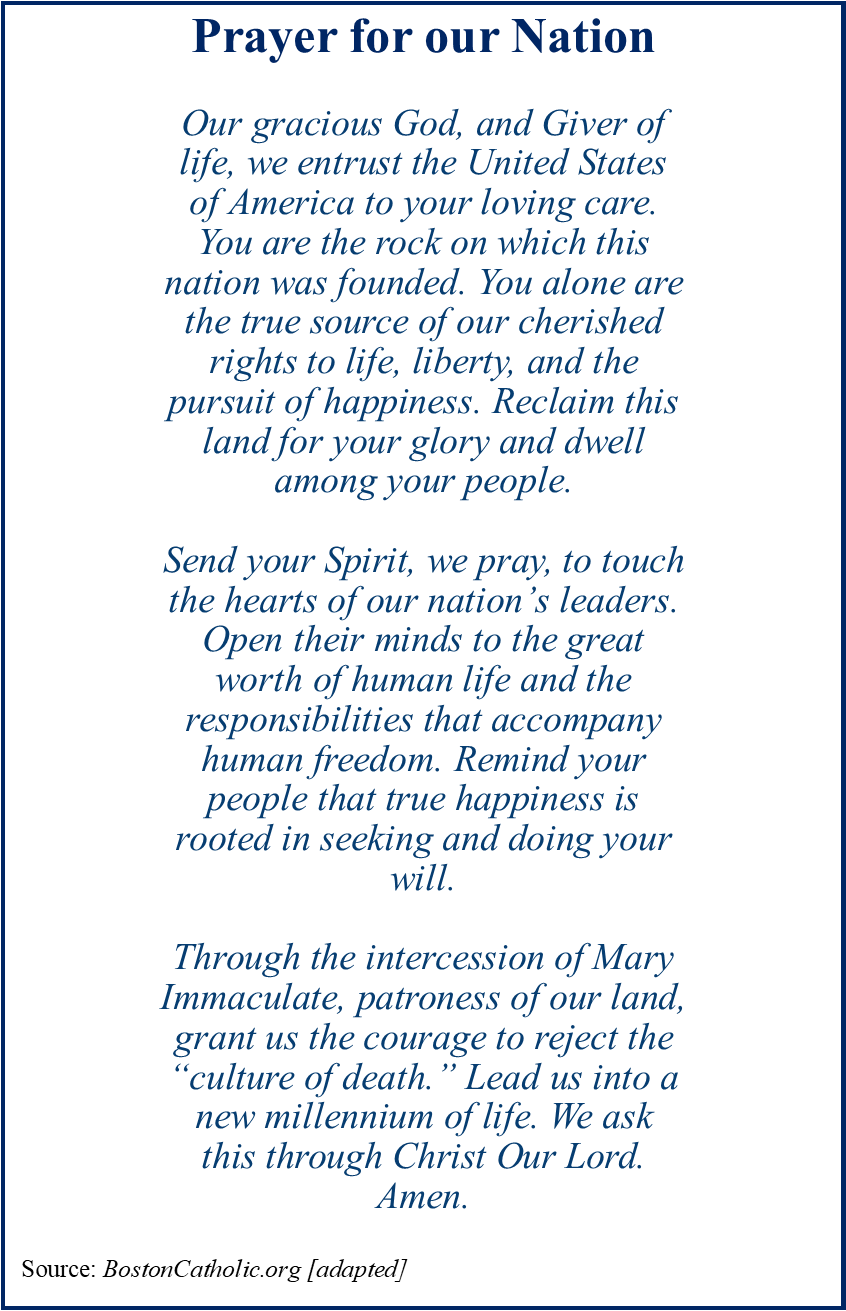
Prayer for the Nation

January 21, 2021 by Holy Name Monastery Leave a Comment


Continue Reading

Filed Under: Blog, Front Page, Homily Tagged With: Christ, God, nation, people, Prayer, prayer for the nation, Spirit, United States, United States of America

Rejoice! The God of Peace is at Work among Us!

December 14, 2020 by Holy Name Monastery Leave a Comment


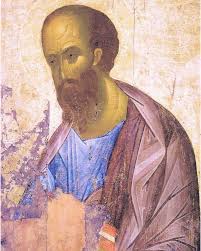
I don’t mean to slight or undervalue the testimony of John the Baptist that was just read (in John’s Gospel).  After all, he’s “The voice of one crying out in the desert.”  He was the star of the show last week with his cry: “Make ready the way of the Lord!”  This week let’s turn our attention to the admonitions of St. Paul – in our second reading – in his Letter to the people of Thessalonica about how to prepare the way of the Lord.  Paul says: “Rejoice always.  Pray without ceasing!  In all circumstances!”  IMPOSSIBLE!   You say.  Always?  Without ceasing?  In all circumstances?  Who can possibly do that in today’s world with all the violence, discord, illness and death?  But Paul has an answer for us.  “THIS IS THE WILL OF GOD.  DO NOT QUENCH THE SPIRIT.  Test everything; retain what is good.  Refrain from every kind of evil…..  the One who calls you is faithful, and will accomplish it.”

With his solicitous instructions, Paul sounds like “helicopter parents” as they drop their children at a new neighbor’s: “Remember what I’ve told you: Always be respectful. Listen closely.  Put away the toys you play with.  And, if you forget everything else, remember: ‘please’ and ‘thank you’ go a long way.  Call me if you need anything.”  Most times the kids know the spiel by heart, “Okay, Okay!  See yah Mom.”  Many of us may have memorized Paul’s exhortations.  Maybe our ears will perk up this round when we hear tomorrow’s reading proclaimed.

You may be surprised, if you consciously look for good, at all the positive things, all the surprises that God sends you each day – making Paul’s words ring true when he says: “The one who is faithful, will accomplish it.” In the 1950s the number one book on the New York best sellers list was Norman Vincent Peale’s: The Power of Positive Thinking – for 48 weeks – that’s almost a full year.

Peale said he wrote the book “with the sole objective of helping the reader achieve a happy, satisfying, and worthwhile life.”  His techniques were simple and, the best part, if you are serious about it, they were achievable.  For example:

  • Believe in yourself and in everything you do
  • Break the worry habit and achieve a relaxed life
  • Improve your personal relationships
  • Be kind to yourself

Bet you’re thinking, that sounds like advice of someone I know?  Like maybe John the Baptist, the Proverbs, my mother or grandmother… and certainly Jesus!

Perhaps one of the most reassuring statements in history is “Do not be afraid, for I am with you.”  I have not examined my Bible to prove it, but “Siri” tells me that the phrase “Do not be afraid” can be found 365 times in the Old and New Testament.”  Think about it: that’s one time per day, for a full year that the expression is recorded in Scripture.  Goodness only knows how many times in the short span of our own lives someone has said words meaning: “I’ll be with you; you don’t need to be afraid.”

Simple reminders like those given to a child before a first piano recital, or acting in play, or the first day at a new school.  Or right here in this house, assurances to the first-time table reader, or Lector, or cantor.  Sometimes the advice is silly, at other times, simplistic.  But, if we let it soak in, it works.  “Keep your eyes on me, I’ll be the one smiling.”  Sometimes it’s hard to believe …  like the person who says: “This dog doesn’t bite – I’ll hold him.  “Don’t be afraid!”  This one is from a movie but could have been heard in our back yard.  Julia Roberts and Richard Gere are pushing their way through a tall grass short-cut.  She says: “Watch out for snakes.”  He: “I don’t like snakes.”  She: “Then walk nice; snakes won’t get you.”

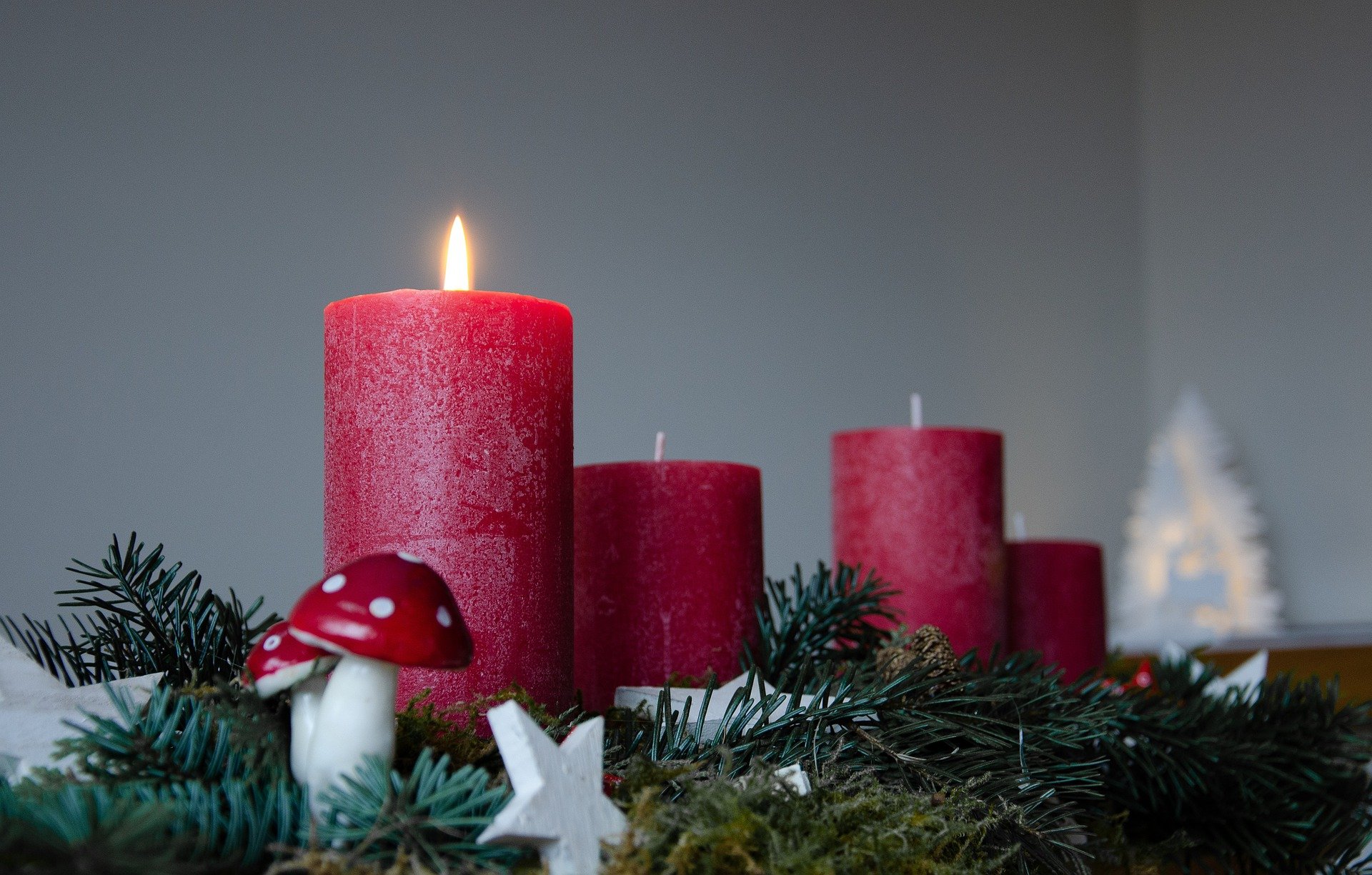
Now – here it is the 3rd week in Advent – rose candles and vestments to remind us: “Be joyful!”  The church offers us once again for our consideration – Paul’s admonitions as we await the celebration of Jesus’ birth and His final coming.  Paul is insistent that Christ will come again!  Pandemics, death, pain, suffering, turmoil, sadness do not get the last word.  We await a Savior who has conquered Death.  This period of waiting, though, is not a time to twiddle our thumbs.  The words, the phrasing that Paul uses are all active verbs (nothing passive about it).  Rejoice!  Pray!  Give thanks!  Test EVERYTHING.  Retain!  Refrain!  Model what is good and peaceful!  Allow God’s Spirit to shine in your midst.”  And why?  Because: “The God of peace is really at work among us.”

~Reflection by Sister Roberta Bailey, OSB, Prioress


First Reading: Isaiah 61:1-2a,10-11             Second Reading  1 Thessalonians 5:16-24
Gospel John 1:6-8, 19-28


Continue Reading

Filed Under: Blog, Front Page, Homily Tagged With: 3rd Advent Sunday, Advent, Christ, do not be afraid, God, helicopter parents, Jesus, John the Baptist, Paul, St. Paul

Advent is Upon Us

November 30, 2020 by Holy Name Monastery Leave a Comment

Advent is Upon Us!

Today, this year, Advent has already dawned, the sun is up in the east.  It arrived in a world in the midst of a pandemic in a way that reminds me of Carl Sandburg’s poem “Fog.”

Here, in our country, it seems, more so than usual, that Advent is being eclipsed to begin celebrating Christmas…. TV ads, house and yard light displays, Christmas music (What happened to the plaintive Advent songs?).  Others are experiencing anticipatory dread of a holiday separated from loved ones.  Thousands of heavy hearts daily grieve the loss of family members, neighbors and friends.  Circumstances have left many without work, no dependable source of income or the means of providing food and life’s necessities.  A pale of depression and loneliness hangs over people aching for a human touch, a phone call …  any sign that someone is aware of their pain.

Every Advent we have to delve into the Scriptures in order to feel the sense of the messages of hope, peace, love, and joy.  Our nighttime darkness will continue to lengthen until December 21 and the winter solstice moving us ever closer towards the celebration of Jesus’ birth.  The advent hymns we’ll sing – and the antiphons used at Morning and Evening Praise – keep impressing upon us the need to pray for “comfort for those who sit in darkness” and those whose “hearts yearn for the light of Christ.”  We must announce to a “world that waits in silence” that “our souls in stillness wait.”  We believe the words of the prophet Habakkuk:  The message I give you waits for the time I have appointed. It speaks about what is going to happen.  And all of it will come true.  It might take a while.  But wait for it.  You can be sure it will come.  It will happen when I want it to.

While Advent is certainly a time of waiting it is also a time of anticipation and celebration in its own rite.  It is the between-time that Karl Barth speaks of: “Unfulfilled and fulfilled promises are related to each other, as are dawn and sunrise.  Both are promise and in fact the same promise.  If anywhere at all, then it is precisely in the light of the coming of Christ that faith has become Advent faith, the expectation of future revelation.  But faith knows for whom and for what it is waiting.  It is fulfilled faith because it lays hold on the fulfilled promise.  This is the essence of Advent.”

We’ve all had experiences of waiting … that’s part of all our lives.  The season of Advent reminds us that waiting is often the cost of love.  In waiting for someone, our own everyday business becomes almost meaningless as we anticipate, worry, and prepare for a loved one’s return, or an estranged family member or the unknown visitor who becomes the friend we had just never before met and now recognize as Christ personified.  In waiting, we realize our own powerlessness; we realize our deepest hopes, and needs and yearnings.  People and events we didn’t know we missed until we encounter them.

More than ever, this year, in the midst of the pandemic, I suspect the spirit of Advent will pale in the face of the hurry to put up decorations and play some Christmas music.  People can’t wait for Christmas to come with the promised vaccine.

May our waiting for the coming of the Holy One this Christmas help us understand and carry on the mystery of compassionate and generous waiting.  Don’t expect a dramatic vision but do try to become more conscious of the Christ coming through our doors, in one another as each   enters our community room or are seated to “break bread” at mealtime.  In our corporate commitment we pledge to be the embodiment of the compassion of Christ.  And it is obvious from our visitors’ comments that this is one of our signature ministries.  Our guests, and we who live here, know that our companions care for us …  the question at times may be: “do we care about each other?”  One litmus test: “Until you know what hurts me, you cannot truly love me.”

In his 2020 Advent letter, Pope Francis reminds us: “Advent, a time of grace, tells us that it is not enough to believe in God: it is necessary to purify our faith every day.”  We pray: “O Holy Spirit, fill our hearts with Advent hope so that we may learn to cope with the delays and disappointments we encounter with patience and wisdom.  May a spirit of gratitude and humility guide us on our journey to your dwelling place, enabling us to endure, with joy, the costs of waiting for love, reconciliation, and peace.”

Ask yourself as you turn off the light each night…

+ To whom did I offer a word of hope, affirmation or comfort today?
+ How was I a ray of light to someone who felt the darkness of loneliness?
+ Tomorrow, how will I prepare for Christ to be born anew in my heart?

~Reflection by Sister Roberta Bailey, OSB, Prioress


First Reading  Isaiah 63:16b-17,19b;64:2-7                Second Reading 1 Corinthians 1:3-9
Gospel Mark 13:33-37


Continue Reading

Filed Under: Blog, Front Page, Homily Tagged With: Advent, Advent is Upon Us, Advent Sunday, Christ, Christmas, Holy One, pandemic, Peace, Pope Francis, season of hope

Solemnity of Christ the King

November 23, 2020 by Holy Name Monastery Leave a Comment

If you’ve ever had the good fortune to be in Rome.  And found yourself In St Peter’s square, you surely have seen the great obelisk that stands in the middle of the square.  [Whether you’ve been to Rome, or not, – it is really there.]  It about four and half thousand years old and originally stood in the temple of the sun in the Egyptian city of Heliopolis.  But it was bought to Rome by the dreadful Emperor Caligula and it was set right in the middle of a Roman racetrack known as the Circus of Nero.  It was in that Circus that St. Peter was martyred, and the obelisk may well have been the last thing on this Earth that Peter saw.  On top of the obelisk there now stands a cross representing the cross of Jesus’ crucifixion. But in ancient times there was a gold ball representing the sun.  On the pedestal of the obelisk there are two inscriptions.  The first of them in Latin, “Christus vincit, Christus regnat, Christus imperat”, freely translated in the words of a hymn “To Jesus Christ, Our Sovereign King:” Christ Jesus Victor! Christ Jesus Ruler!  Christ Jesus, Lord and Redeemer!  The other inscription, “The Lion of Judah has conquered.”  In the two we have the language of victory.  Christianity has triumphed by the power of the cross and triumphed over even the greatest power that the ancient world had known, the Roman Empire.  Here in the middle of St. Peter’s square stands the obelisk bearing those triumphant inscriptions.

In 1925, Pope Pius XI universally instituted the Feast of Christ the King to be celebrated on the last Sunday of October.  However, since the reform in the liturgical calendar in 1969, the feast falls on the last Sunday of Ordinary Time, the Sunday before Advent.

At the time of the institution of the feast, secularism and dictatorships in Europe were on the rise.  Respect for Christ and the Church was waning.  Today, we witness the same sense of distrust of authority – accelerated by political situations and the rise of individualism.  Some reject the titles of “lord” and “king” for Christ believing that such titles are borrowed from oppressive systems of government.  History proves that some kings have been oppressive.  Others have been converted to a more Christian style of ruling … often by the influence of a woman.

In 2015, during the Jubilee year of Mercy, Pope Francis added another part to the title: “…the living face of the Father’s mercy.”  The combined readings this year for the solemnity give us a glimpse of how Christ is at the same time both king and the face of the Father’s mercy.  In contrast to the oppression so prevalent in Jesus’ day, he connected his role as king to humble service, and taught his followers to be servants as well.  “You are my disciples if you do what I command you: love one another as I have loved you.”

As we observe the feast of Christ, the King, we are celebrating a ruler who was willing to die for us, for all humanity, to give us true freedom.  Jesus radically redefined the concept of kingship.  His example of love and kindness is lived out by us, his followers, in our reaching out to those in need – beginning with those we live with.

At the opening of every Eucharistic gathering, the celebrant greets us with the words: “The Lord be with you.”  In tomorrow’s opening hymn we will sing: “Praise, my soul, the King of Heaven.”  And in the responsorial psalm we’ll proclaim: “The Lord is my shepherd.”  We profess in the Creed: “I believe in one Lord Jesus Christ.”  We often raise a hand in benediction as we sing: “May the blessing of the Lord be upon you.”  Deep down do we believe JESUS IS LORD or is it just from force of habit that we say or sing those titles for Jesus?  If we believe it’s true Jesus is Lord, why do we sometimes scramble to find a substitute to replace the word “Lord?”

It strikes me that while we may struggle with the concept of Jesus as king … somehow, especially like on today’s feast (the Presentation of Mary) most of us have no problem calling Mary queen: queen of the universe, queen of heaven, Regina Caeli.

Our prayer intention this week is for the gift of a grateful heart.  Look at the person on either side of you – and across the aisle – with eyes filled with the compassion of Christ.  Let us pray that we can portray to the world the beneficence of a humble king, truly putting flesh on our Corporate Commitment “to respond with compassion to the hungers of the people of God.”

~Reflection by S. Roberta Bailey, OSB, Prioress

First Reading Ezekiel 34:11-12, 15-17             Second Reading1 Cor 15:20-26, 28
Gospel Matthew 25:31-46


Continue Reading

Filed Under: Blog, Front Page, Homily Tagged With: Christ, Eucharistic, King, Lord, Mary, Pope, Prayer, Rome, solemnity of Christ the King, St. Peter's Square

  • « Go to Previous Page
  • Page 1
  • Interim pages omitted …
  • Page 5
  • Page 6
  • Page 7
  • Page 8
  • Page 9
  • Page 10
  • Go to Next Page »

Footer

Prayer / Newsletter / Info

 Contact Info

Benedictine Sisters of Florida

PO Box 2450
12138 Wichers Road
St. Leo, FL 33574-2450
(352) 588-8320
(352) 588-8443

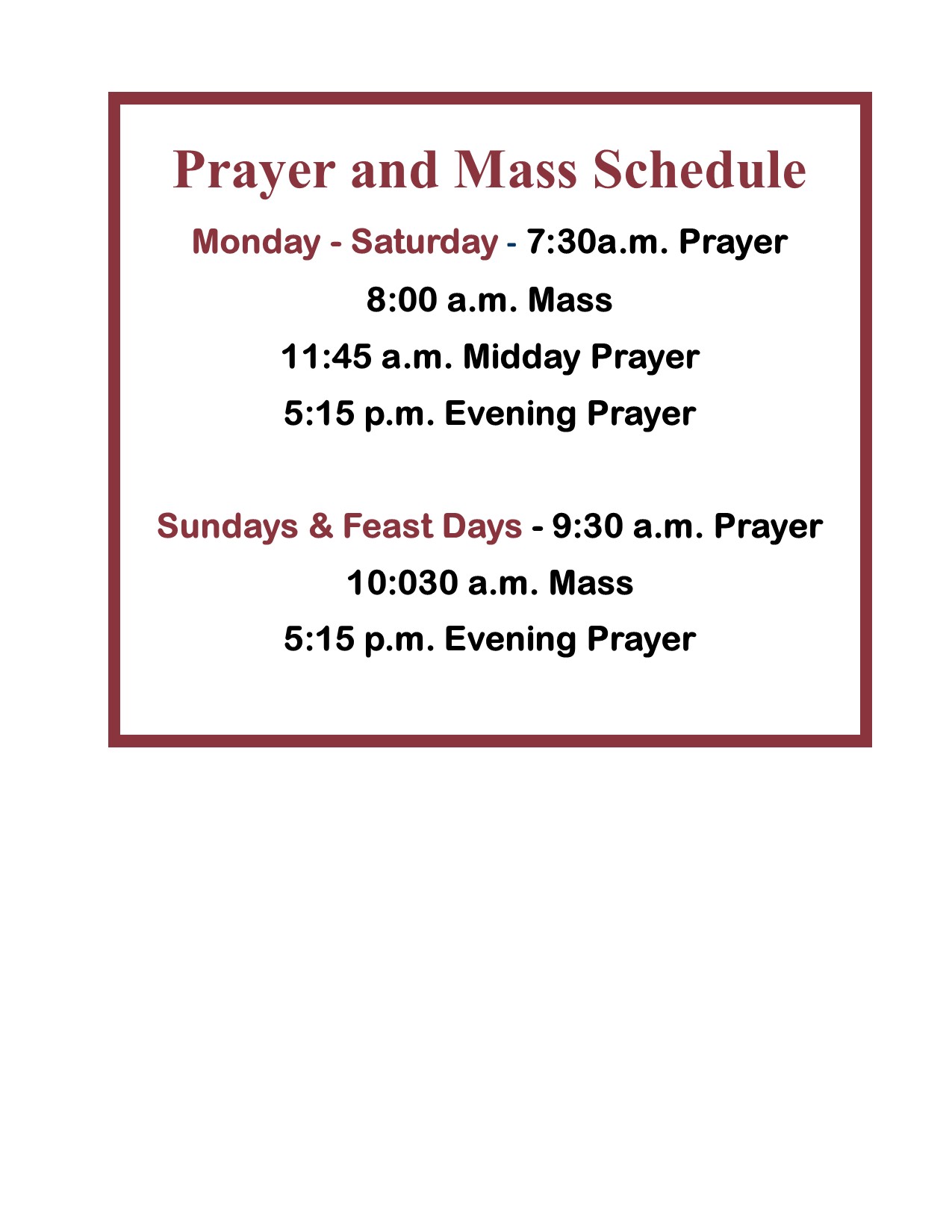
 Mass Schedule

Related Links

Copyright © 2026 · Benedictine Sisters of FL · Touching Lives Through Prayer and Service

Copyright © 2026 · Bendedictine Theme on Genesis Framework · WordPress · Log in