• Skip to primary navigation
  • Skip to main content
  • Skip to footer
Benedictine Sisters of FL

Holy Name Monastery
Founded 1889

Donate Now
  • Home
  • About Us
    • History
    • Being Benedictine
    • Benedictine Monasticism
    • Meet Our Community
    • Holy Name Academy-Alumnae
  • What We Do
    • Mission, Vision and Our Partners
    • Retreats
      • Invitation to Retreat
      • Accommodations
    • Volunteer Programs
    • Oblate Program
    • Spiritual Direction
    • Aqua/Hydroponics
    • More of Our Ministries
  • What’s Happening
    • Articles of Interest
    • Events
    • Newsletters
    • Brochures
    • Links
  • Support Us
    • Gifts of Support
    • Wish List
  • Stories Shared
  • Galleries
    • Photos
    • Videos
      • Benedictine Sisters of FL Videos
      • Other Videos
  • Contact Us

Christ

Have You Admitted It?

November 27, 2017 by Holy Name Monastery Leave a Comment

The feast of Christ the King was instituted by Pope Pius XI in 1925, during a time when respect for Christ and the Church was waning.  Today, the same distrust of authority exists.  The magnitude and the manifestations of the problem have evolved over the years to the point that Individualism has been embraced to such an extreme, that for many, the only authority is the SELF.  In such a system, the idea of Christ as King is rejected.  In our own liturgies we sometimes avoid the use of the title King and Lord.

The one and only time Jesus allowed himself to be treated like a king is recalled in the Holy Week liturgies.  Those Passion Gospels pointedly remind us that Jesus’ kingship is one of love and sacrifice, not power and domination.  In retrospect, the mocking, derisive jabs that Jesus endured served to proclaim his true identity: the messiah, the chosen one, the king of the Jews and our savior and the savior of all people.

Today’s particular Gospel (from Matthew), doesn’t use the word KING, but it does refer to Jesus in glory, seated on a glorious throne, with all the nations assembled before Him.  It makes it obvious, we won’t experience Christ’s reign all on our own.  We’re really part of something bigger than our own little selves, when we live “under” the reign of Christ.  We’re gathered with many people of varied kinds and you heard how Jesus described us – sheep and goats.

The full title of this celebration is “The Solemnity of Christ, the King of the Universe.” During the Jubilee year of Mercy, Pope Francis added another part to the title: “…the living face of the Father’s mercy.”  This title seems to be somewhat of a paradox.  When we think of the king of the world, let alone the king of the universe, we might tend to imagine a powerful, distant leader, disconnected from ordinary people.  But on the other hand, Christ is the face of the Father’s mercy, the one who binds up our wounds, heals us, blesses us, and saves us.  It may seem peculiar that He can be both the King of the universe, and the face of mercy.  However, the combined readings for the solemnity give us a glimpse of how Christ is both king and the face of the Father’s mercy, all at the same time.

The wonderful thing about Jesus’ use of parables is that we can identify ourselves with one or more of the characters in the story.  When we read or hear a parable it’s sort of like looking in a cloudy mirror.  There’s not much precision, but the general image is there.  You begin to squirm with the feeling: “This one’s about me.  He’s talking to me.” It’s that way with this parable of the sheep and the goats, the saved and the damned.  Both groups question:  When did we treat you, or not treat you, in the ways you describe?  And Jesus tells them straight forward: “Whenever you did (or did not do) for one of these least ones” – that’s how you treated me.

So, where do you see yourself in the story?  Do you belong to those that care, (the ones on the right), or those who simply didn’t have enough time to be bothered (those on the left)?  Or, like me, does it depend.  One day you see yourself on one side and wish you could honestly say you were on the other?  We’ve given of our time, our treasure, and our talent – and sometimes we’ve withheld them – depending upon a number of factors, some of which we’d be ashamed to identify.

But there’s another group in the parable that may be overlooked.  The message is so simple that we fail to see the BIG point.  There were those who helped, those who couldn’t be bothered, and then there were those who needed help!

So, here’s the BIG question for today.  Your salvation many hang on your answer.   When have you seen yourself as one who needed help?  The answer is awfully important because Jesus seems to identify Himself as those who are hungry or thirsty.   But, notice, He didn’t only identify Himself as one among many – NO, He identified Himself as living in those very people.  He was born poor and helpless, born in need and died in need.  He lived and moved and had His being in need.  Not among the poor ones – within each of those poor ones – no matter what features you see, Christ’s face speaks to us in the voice of each person.

Our connection is in this Gospel.  Christ will come and judge us by how merciful we have been to others.  The King of the universe wants us to be the face of his mercy to one another.  You heard how we will be judged.  Did we feed the hungry, clothed the naked, and visit the sick?  By giving mercy to others in the same way that Christ has given mercy to us we proclaim God’s mercy and Christ’s kingship to the world.  How will you proclaim his reign and his kingdom today?  Have you admitted that you are in need, that you’re not self-sufficient, that you`re on spiritual food stamps, and that you and Jesus find each other in need?  Jesus speaks in this parable in the first person: “when did YOU see ME in need?”

So which group DO you belong to in the parable?  Just how DO you identify yourself in it?  Could it be true that you just might have to change how you identify yourself not only in the parable but in real life?  Perhaps this is a moment of grace for you; perhaps you’re being touched again by God?

~Reflection by Sister Roberta Bailey, OSB, Prioress


34th Sunday  Feast of Christ the King
First Reading           Ezekiel34:11-12; 15-17                            Second Reading      1 Cor. 15:20-28
Gospel   Matthew 25:31-46
Continue Reading

Filed Under: Blog, Homily Tagged With: admit, Christ, God, Jesus, King, need, parable

Today’s Reflection

July 10, 2017 by Holy Name Monastery 1 Comment

First Reading: ZECHARIAH 9: 9-10
Second Reading: ROMANS 8: 9
Gospel: MATTHEW 11: 25-30

This Gospel is the same as that proclaimed on the Feast of the Sacred Heart.  Jesus offers rest to those “who labor and are burdened.”  Here’s the deal: if you will accept His “easy yoke” your burden will be light.  You did notice that Jesus says “Take my yoke upon you.”  It is a voluntary acceptance.  By declaring that his “yoke is easy” Jesus means that whatever God offers us is custom-made to fit exactly our individual needs and our abilities.  You know the story of the individual who asked God for a different cross.  So, Jesus took her to the storehouse of crosses where Sister examined every cross more than once.  When she finally chose one Jesus said, “My dear, that is the very cross I already gave you.”  Our cross will not fit on anyone else’s shoulders or heart.  It is mine alone and if I refuse it, the burden will stay abandoned with Jesus.

The second part of Jesus’ claim is: “My burden is light.”  Jesus does not mean that the burden is effortless to carry.  It does not mean we are foot-loose and fancy-free.  To be a disciple means to come under the discipline of a master.  It means voluntarily putting a yoke on one’s shoulders, and walking in a direction set by the master.  It just happens to be the direction that the master knows will lead to green pasture, refreshment, peace and true joy.  Jerome Kodell describes happiness as a gift from people and events outside ourselves.  Joy is a gift of the Spirit and is generated from within when we walk heart to heart with our God.  When oxen trudge ahead, they don’t necessarily see the pasture at the end of the trail.  All they see is a long, dusty road but that does not stop them.  Remember the beasts that toted our 3-story convent up the incline from San Antonio.  They plodded onward; the overseer knew the destination, but the animals did not.  The yoke, the burden that we take up in love is received from the hands of our loving God, placed on us in love and is meant to be carried in love for love makes even the heaviest burden light.  We only need to quiet down for a few moments in the green pasture of prayer and adoration to attune our heart once again to the voice of the Master.

Light burden – easy yoke!  You may reply that it sure doesn’t feel that way most of the time.  This could be for one of two reasons.  One: the yoke seems heavy because we are not allowing the Lord to help us carry the weight – remember Jesus let Simon help him with his cross.  Or it may seem heavy because we are not keeping God’s pace.  We could be dragging our heels or racing ahead.  Either way, we are chafing and straining.  A yoke is fashioned for a pair — for a team working together.  So we are not yoked alone to pull the plow solo but we are yoked together with Christ to work with Him using His strength.  Benedict challenges us in chapter 72 to lovingly carry each other’s burdens: “anticipate one another; patiently endure one another’s burdens, practice the most fervent love, tender charity chastely.”

The yoke chaffs when either member of the team tries to get ahead or lags on the job. – like when community members tug and pull against the group, when common practices are carelessly disregarded.  When conflicts are resolved, the yoke once again rests easy – the team, community members, walk side by side with the same aim in view – each lovingly regulating her step to keep pace with her sister.

A second reason the yoke may feel burdensome and cause weariness is that the yoke we are carrying is simply not the Lord’s yoke but one of our own choosing or one we have usurped from another.  There are many sources of tiredness, weariness, and fatigue.  Physical fatigue may be the most benign.  There is the fatigue that comes from stress, fatigue that comes from worry, fatigue that comes not only from worrying about the future, but also worrying about the past and fatigue that comes from trying to be perfect, to be something we are not.  Life’s greatest burden is not having too much to do, nor having too much to care about because some of the happiest folk are the busiest and those who care the most.  Rather, the greatest burden we have is our constant engagement with the trivial and the unimportant, with the temporary and the passing and with what is ultimately uncontrollable and unpredictable.

The issue in life is not whether we shall be burdened, but with what we shall be burdened.  The question is not “Shall we be yoked?” but “To what and with whom shall we be yoked?”  What we need, according to this wonderful gospel paradox, is a different yoke: the yoke of Christ.  Jesus is interested in lifting off our backs the burdens that drain us and suck the life out of us, so that we are freed to accept the burden he has prepared just for us – the yoke that is guaranteed to give us new life, new energy, new joy.  We are called, not only to find inner peace, refreshment and rest for ourselves, but also to live the kind of life through which others, too, may find God’s peace.  The solution is easy – as a popular saying goes: “Let go, let God.”

~Reflection by Sister Roberta Bailey, OSB, Prioress


Continue Reading

Filed Under: Blog, Homily Tagged With: adoration, burden, Christ, Feast of Sacred Heart, God, Jesus, love, Yoke

Message of His Holiness Pope Francis

May 8, 2017 by Holy Name Monastery Leave a Comment

[An adaptation of excerpts from] Pope Francis’

MESSAGE FOR THE 54th WORLD DAY OF PRAYER FOR VOCATIONS

Sunday, May 7, 2017


In the last few years, we have considered two aspects of the Christian vocation: the summons to “go out from ourselves” to hear the Lord’s voice, and the importance of the ecclesial community as the privileged place where God’s call is born, nourished and expressed.

Now, on this 54th World Day of Prayer for Vocations, I would like to reflect on the missionary dimension of our Christian calling. Those drawn by God’s voice and determined to follow Jesus soon discover within themselves an irrepressible desire to bring the Good News to their brothers and sisters through proclamation and the service of charity.

Commitment to mission is not something added on to the Christian life as a kind of decoration, but is instead an essential element of faith itself. A relationship with the Lord entails being sent out into the world as prophets of his word and witnesses of his love.

In the depths of their hearts, all disciples hear this divine voice bidding them to “go about,” as Jesus did, “doing good and healing all.”

To be a missionary disciple means to share actively in the mission of Christ. Jesus himself described that mission in the synagogue of Nazareth in these words: “The Spirit of the Lord is upon me, because he has anointed to bring good news to the poor. He has sent me to proclaim release to the captives and recovery of sight to the blind, to let the oppressed go free, and to proclaim the year of the Lord’s favor.” This is also our mission: to be anointed by the Spirit, and to go out to our brothers and sisters in order to proclaim the word and to be for them a means of salvation.

Our mission might appear to be mere utopian illusion or at least something beyond our reach. Yet if we contemplate the risen Jesus walking alongside the disciples of Emmaus, we can be filled with new confidence. Jesus transformed the disciples’ discouragement. He made their hearts burn within them, and he opened their eyes by proclaiming the word and breaking the bread. In the same way, we do not bear the burden of mission alone.  We come to realize, even amid weariness and misunderstanding, that “Jesus walks with us, speaks to us, breathes with us, works with us”.

The seed of the Kingdom, however tiny, unseen and at times insignificant, silently continues to grow, thanks to God’s tireless activity.  God surpasses all our expectations and constantly surprises us by his generosity. He makes our efforts bear fruit beyond all human calculation.

With this confidence born of the Gospel, we become open to the silent working of the Spirit. There can be no promotion of vocations apart from constant contemplative prayer.  Our life needs to be nourished by attentive listening to God’s word and, above all, by the cultivation of a personal relationship with the Lord in the Eucharist, our privileged encounter with God.

I wish heartily to encourage this kind of profound friendship with the Lord, above all for the sake of imploring from on high new vocations to the priesthood and the consecrated life. I ask parish communities, associations and the many prayer groups present in the Church, not to yield to discouragement but to continue praying that the Lord will send workers to his harvest.

Dear brothers and sisters, today too, we can regain fervor in preaching the Gospel and we can encourage young people in particular to take up the path of Christian discipleship. Despite a widespread sense that the faith is listless or reduced to mere “duties to discharge,” our young people desire to discover the perennial attraction of Jesus, to be challenged by his words and actions, and to cherish the ideal that he holds out: a life that is fully human, happy to spend itself in love.

Mary Most Holy, the Mother of our Savior, had the courage to embrace this ideal, placing her youth and her enthusiasm in God’s hands. Through her intercession, may we be granted that same openness of heart, that same readiness to respond, “Here I am,” to the Lord’s call, and that same joy in setting out, like her, to proclaim him to the whole world.

~Reflection by Sister Roberta Bailey, OSB, Prioress
Continue Reading

Filed Under: Homily Tagged With: Christ, Christian, God, Jesus, Pope Francis, Prayer, World Day of Prayer for Vocations

From Holy Week into the Rest of our Lives

April 10, 2017 by Holy Name Monastery Leave a Comment

Excerpts from “Opening Doors to Jesus & with Jesus”

A reflection inspired by a homily by St. Pope John Paul II

The liturgy of Palm Sunday is a kind of solemn entrance into Holy Week. Yet Holy Week itself is an entry into something greater. Palm Sunday combines a welcoming of Jesus and a welcoming of Jesus into our most sacred place. This is a place more our own than Jerusalem.   Jesus came to the so-called “city of peace” and was welcomed by a great crowd. In a certain way this city can symbolize the human race and its ambivalent reaction to the coming of Christ.

Today we want to belong to the crowd of welcomers. But if we welcome Jesus as our Lord then we must remember that he is Lord of truth, freedom, justice and love. We welcome him precisely as Lord insofar as we also welcome these realities with faith and joy, not just outside but inside ourselves. If we know what we are doing, we realize we are being called to work with Jesus, and one another, to build peace and justice and truth and love. That begins with our opening of ourselves to Jesus’ coming, and involves committing ourselves to work with him to build these realities within ourselves. This, at least, is the first step. But all are not ready to do this. So we have to be ready also to accompany Jesus to the cross. Who can guide us as we too climb the hill of Calvary with our Divine and Human Teacher? There is no better guide than Mary. What she teaches is part of the gift we receive when in accepting her as our spiritual Mother.

St. John has to open his home; we have to open ourselves, our most sacred inner place. We start by welcoming her but that will lead us to welcome others. Will we respond as generously as Mary to the Lord’s call? Will we persevere with joy and fidelity in the mission to others that this implies? Will we let Mary teach us this? O Mary, give us your eyes so that on the face of the crucified Jesus we may recognize that of the Risen One, the one who fears nothing when doing what the Heavenly Father has called him to be and do.

The first lesson is that of standing at the cross and joining Jesus’ love and forgiveness. The second lesson is that of opening our heart to all those who need love and forgiveness. This is our path into Holy Week and it is the path of our entire life as we come from Holy Week into the rest of our lives.

~ by Sister Roberta Bailey, OSB, Prioress
Continue Reading

Filed Under: Blog, Homily Tagged With: Christ, Holy Week, Jerusalem, Jesus, Mary, Palm Sunday

The Waiting Begins

December 19, 2016 by Holy Name Monastery Leave a Comment

4th Sunday of Advent

First Reading:  Isaiah 7:10-14                  Second Reading: Romans 1:1-7

Gospel: Matthew 1:18-24

Each night for the octave before Christmas which begins tonight, we ask Christ to come, calling him by a different title in the Magnificat Antiphon, familiarly called the O Antiphons”.  These antiphons were developed during the Church’s first centuries, soon used widely in monasteries and by the 8th century they were in use in both the monastic and the Roman breviary (Divine Office).   They were originally in Latin and traditionally chanted. The O Antiphons are also used with the Alleluia for the Gospel Verse at Mass. The last one is sung at the Evening Office on December 23rd – there isn’t one for the evening service for Dec 24th because that is already the vigil of Christmas, so we are no longer waiting.

An interesting note that is not apparent in English, but it can be seen clearly in the Latin. Sometimes you see the phrase ERO CRAS on banners or cards listing the O Antiphons in Latin because if we take the first letter of each Latin title for Christ and write them in backwards order, we get “ERO CRAS, a Latin phrase that means “Tomorrow, I will Come.” Before tomorrow does come, Let’s take a stroll along the path of the O Antiphons …

O Wisdom!   Sirach (24:3) says:  “From the mouth of the Most High I came forth, and like mist covered the earth”.  Wisdom “reaches from end to end mightily and governs all things well”.  Wisdom is the foundation of fear of the Lord, of holiness, or right living: it is wisdom whom we bid to come to teach us prudence.


O Adonai and Ruler of the House of Israel! In Exodus (6:6) we read: “I will rescue you by my outstretched arm and with mighty acts of judgment”. With this second antiphon we progress from creation to the familiar story of God manifesting himself by name to Moses and giving his law to Israel as their way of life.


O Root of Jesse!  Isaiah (52:13-15) prophesied the restoration of David’s throne – a new branch budding out of the old root. Christ is the root of Jesse in a two-fold sense: he is the descendant of David, who was the youngest son of Jesse, and he inherited the royal throne.  The angel foretold to Mary, “The Lord God will give him the throne of David his father.”


 Key of David  Isaiah (22:22) makes a prophecy: “I will place the key of the House of David on his shoulder. When he opens, no one shall shut; when he shuts, no one shall open.”  The key and scepter are traditional symbols of kingly power and authority. Jesus shared his authority when He entrusted the power to “bind and to loose” to Peter and the ministers of his church. We look to Jesus to unlock the fetters of our shadow selves that keep us so tightly chained to bad habits and the stumbling blocks that impede our spiritual maturity.


O Rising Dawn!  Peter’s epistle echoes the sentiment of the prophet Malachi (2 Peter 1:19): “Keep your attention closely fixed on it, as you would on a lamp shining in a dark place, until the first streaks of dawn appear and the morning star rises in your heart”.  This title is variously translated “morning star”, “Dayspring”, “rising sun”, “radiant dawn”, “orient”.  All beautifully express the idea of light with its brightness bringing healing and warmth to cold hearts.  We pray this petition daily in the Benedictus: “the morning sun will rise upon us … guiding us in ways of peace.”


O King of the Gentiles and the Desired of all nations!  Thus says the prophet Isaiah: “Therefore, says the Lord God: See, I am laying a stone in Zion, a stone that has been tested, a precious cornerstone as a sure foundation”.  This sixth antiphon, in the words of Isaiah and Jeremiah, (Isaiah 28:16 and Jerimiah 10:7) clearly addresses the savior as the king of the gentiles and the Desired One of the nations, the cornerstone on whom our spiritual foundations are laid. We call on Christ to once again breathe new life into us.


O Emmanuel!   In this the seventh antiphon, we are reassured by the prophet Isaiah (Isaiah 7:14): “The Lord himself will give you this sign: the virgin shall be with child, and bear a son, and shall name him Emmanuel”.  With this last antiphon our expectation finds joy in the certainty of fulfillment.  We call Jesus by one of the most personal and intimate of his titles, Emmanuel, God-with-us.

Our Advent Scripture readings have been stressing the truth that Christ is the fulfillment not only of Old Testament hopes, but present ones as well. Our repeated use of the imperative “Come!” embodies the longing of all of us for the One who is to come in many ways – He came historically at Bethlehem in the fullness of time. He comes to us sacramentally.  He will come again at the end of time.  Christ comes to us also in the two-fold consecration of the Body and Blood of Christ and to us in Communion.  He comes in the words of Sacred Scripture and in the person of our confreres, our family and neighbors.  Christ comes in a special way through our corporate commitment actions – through the spiritual and corporal works of mercy.

In this final week of Advent we fix our attention on the messianic promises proclaimed by the ancient prophets.    The O Antiphons add a mood of eager expectation to the liturgy that builds throughout these seven days and climaxes at Christmas midnight Mass when the church sings: “I proclaim to you good news of great joy: today a Savior is born for us.”

~ Reflection by Sister Roberta Bailey, OSB, Prioress
Continue Reading

Filed Under: Blog, Homily Tagged With: Advent, Birth of Christ, Christ, God, Jesus, Week 4

Advent – Guadete (Rejoice) Sunday

December 12, 2016 by Holy Name Monastery 1 Comment

This past week we celebrated some feasts that are frequently connected in our minds to the customs of Christmas time: St. Nicholas shoes, the Immaculate Conception of Mary, and next week we’ll honor our Lady of Guadalupe (roses in the snow) and St. Lucy, patron of the sight-limited and blind, with crowns of lit candles and cat cookies.  And, this weekend the liturgy says: “take a breather – we’re halfway to Christmas.”

Two figures, John the Baptist and Mary the Mother of God, stand out in the Advent Gospels as we prepare for Christ’s birth.  John’s purpose in preparing us for Christ is fourfold: to bring knowledge of salvation, to bring forgiveness of sins, to give light in the darkness, and to guide us in the way of peace.

First, John models for us simplicity.  He lived a simple life, keeping his focus on Christ in everything he did.  We, too, strive to keep our focus on the true purpose of Christmas – the celebration of the birth of our Lord – much more than gift-giving.

Second, John lived a life of fasting.  We too can make little sacrifices for others during Advent, thereby keeping the focus off of consumerism and placing it on relationships – with Christ and with others.

Third, John forgave others.  We too can make a commitment to forgive others this Advent.  In forgiveness therapy there is a belief that anger is due to a lack of forgiveness and a lack of forgiveness is due to anger.  The two feed off each other.  Thus, if you are feeling angry, practice forgiveness.  What a great time to offer the gift of forgiveness to a love one, a confrere, or a coworker.

Fourth, John lived a virtuous life.  We too can focus on increasing the positive in our lives and letting go of the negative. Following John’s lead is a great way to our lives peaceful.

The Blessed Virgin Mary is the other figure that prepares us for Christ’s birth.  Mary’s face in many sculptures, icons and images exemplifies the peace she must have exuded in her life.  Her peace came from putting Christ at the center of all she did.  Like Benedict says (in his Rule): put nothing whatever ahead of Christ.”  Mary’s “yes” was the ultimate gift she could give and she offered it peacefully.

We ask ourselves: what is my best?  What can I give to God this advent season?

This story, told in this month’s Catholic Digest illustrates the lesson that God cannot not be undone is generosity.  I quote:  When I was a child, my parents would have my siblings and me create a list of Christmas gifts we wanted that year.  Then, they would find children in need who were the same age and gender as we were.  My parents then asked us to give our No. 1 item to that child and cross it off our list.  It was a huge sacrifice for us – and a lesson in giving our best to God.

One year my brother wanted an action figure and was very upset that he was being asked to give that same action figure to another boy who had very few, if any, toys.  He balked at giving this best and did it only reluctantly that year.  Once it was gone, he knew it was off his list for the year, at least from my parents.  However, our aunt, not knowing our family practice, or what my brother’s best gift was and that he had given it away, gave him that same action figure for Christmas.  The joy on his face was radiant, as he exclaimed: “I’m giving God my best gift every year!”

What is your best give?  Just like the Blessed Virgin Mary, what can you give to Christ this year, knowing that the reward for giving is beautiful?

In tomorrow’s Entrance Antiphon (from Paul to the Philippians)  the Church exhorts us: “Rejoice in the Lord always; again I say, rejoice!”  The antiphon reminds me of a hymn made popular by S. Miriam Therese Winter, with her peppy guitar rendition of “God Loves a Cheerful Giver.”  You may remember it – if so, sing:

God loves a cheerful giver, give it all you’ve got,
He loves to hear you singing when you’re in an awkward spot,
When the odds are up against you,
It’s time to stop and sing – Praise God,
to praise Him is a joyous thing!

Do what the church says, “Rejoice in the Lord always; again I say, rejoice.”

(Disclaimer: in this reflection, I’ve borrowed a good bit from an article in this month’s Catholic Digest “Creating Advent Peace in Your Life” by Lisa Kiewicki)
~Relection by Sister Roberta Bailey, OSB, Prioress
Continue Reading

Filed Under: Blog, Homily Tagged With: Advent, Christ, Christmas, God, John, Mary, Peace

  • « Go to Previous Page
  • Page 1
  • Interim pages omitted …
  • Page 7
  • Page 8
  • Page 9
  • Page 10
  • Go to Next Page »

Footer

Prayer / Newsletter / Info

 Contact Info

Benedictine Sisters of Florida

PO Box 2450
12138 Wichers Road
St. Leo, FL 33574-2450
(352) 588-8320
(352) 588-8443

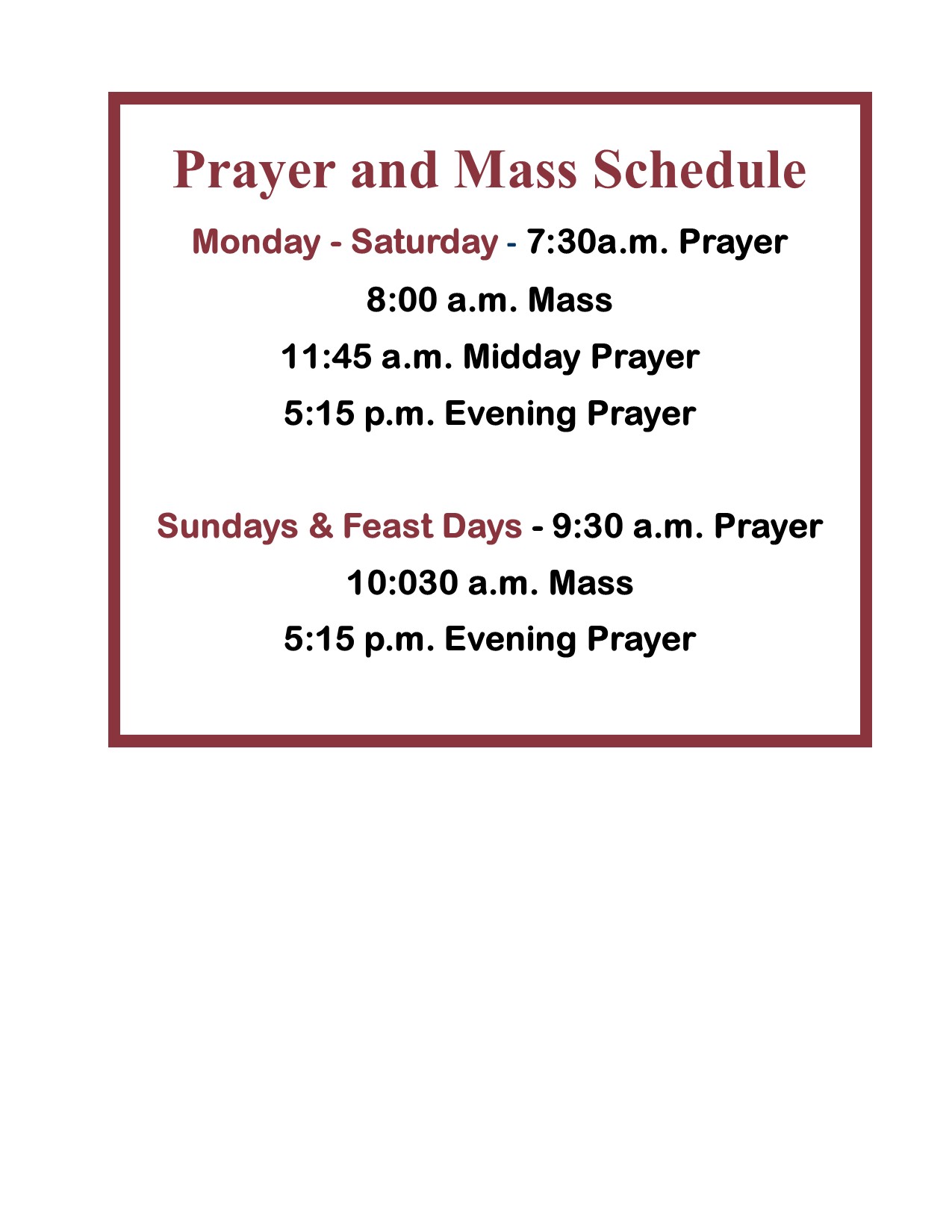
 Mass Schedule

Related Links

Copyright © 2026 · Benedictine Sisters of FL · Touching Lives Through Prayer and Service

Copyright © 2026 · Bendedictine Theme on Genesis Framework · WordPress · Log in