• Skip to primary navigation
  • Skip to main content
  • Skip to footer
Benedictine Sisters of FL

Holy Name Monastery
Founded 1889

Donate Now
  • Home
  • About Us
    • History
    • Being Benedictine
    • Benedictine Monasticism
    • Meet Our Community
    • Holy Name Academy-Alumnae
  • What We Do
    • Mission, Vision and Our Partners
    • Retreats
      • Invitation to Retreat
      • Accommodations
    • Volunteer Programs
    • Oblate Program
    • Spiritual Direction
    • Aqua/Hydroponics
    • More of Our Ministries
  • What’s Happening
    • Articles of Interest
    • Events
    • Commemorative Bricks
    • Newsletters
    • Brochures
    • Links
  • Support Us
    • Gifts of Support
    • Wish List
  • Stories Shared
  • Galleries
    • Photos
    • Videos
      • Benedictine Sisters of FL Videos
      • Other Videos
  • Contact Us

Follow Him

Consider the call

March 20, 2023 by Holy Name Monastery 1 Comment

Do You Hear the Call?

The woman said to him, “Sir give me this water, so that I may never be thirsty or have to keep coming here to draw water.” (John 4:15)

Imagine yourself at the well with Jesus.  Ask Him what He wants you to do.  What is the answer that you hear?

If you hear the gentle yet persistent call, “Follow me”, consider religious life.

The Benedictine Sisters of Florida are welcoming single women who are practicing Roman Catholics to spend some time with us to learn more about religious life.  You will have the opportunity to worship with us, pray with us, relax with us.  You will also be welcome to participate in our ministries and learn about the Benedictine charism.

Holy Name Monastery, our home, is located in Saint Leo, Florida, about a 40 minute drive north of Tampa on Interstate 75.

The time available is Holy Wek and the First Week of Easter (April 2-16, 2023).  You can stay for a few days, a week or longer.

To schedule a visit with us or to request further information, please email us at Vocations@saintleo.edu.


Continue Reading

Filed Under: Prayer Tagged With: bendictine sisters of florida, First Week of Easter, Follow Him, Follow Me, Holy Week, vocations

Divine Mercy Sunday

April 12, 2021 by Holy Name Monastery Leave a Comment

In a by-gone tradition, tomorrow was known as “Low Sunday” – a lesser Easter celebration – or “Quasi-modo Sunday” from the first two words of the Entrance antiphon at Mass: “Like newborn infants” referring to those baptized at Easter.  It is the day that the newly baptized officially put away their white robes, hence, it is known liturgically as the “Sunday of putting away the albs.”  And yes, the name of this feast, Quasi-Modo is the origin of the name in Victor Hugo’s “The Hunchback of Notre Dame.”  The foundling was so named because he was discovered at the cathedral on the second Sunday of Easter.

Another bit of trivia: in England, there was a strange custom on the Monday and Tuesday after Low Sunday, between the hours of 9 a.m. and noon.  These two days became known as “Hoke Day.”  (“Hoke” – related to “hocus pocus” is to perform in an exaggerated or overly sentimental way.)  On Monday, men “captured” women to auction.  On Tuesday, the women reciprocate by capturing the men for ransom and both days the money was given to the Church.

Now leap ahead to the Second Sunday of Easter in the Jubilee Year 2000.  At the Mass for the canonization of Faustina Kowalska, Pope John Paul II made a surprising announcement in his homily: …” from now on throughout the Church, the second Sunday of Easter will be called ‘Divine Mercy Sunday.’ ”  Thus, while it is clearly not a new feast, neither is it an optional title for this solemnity; rather, Divine Mercy is the integral name for the Second Sunday of Easter.  For centuries the Easter liturgies have proclaimed the mercy of God.  In tomorrow’s responsorial psalm we will sing four times, “His mercy endures forever.”

The Gospel for this feast begins with the risen Christ appearing to the apostles on Easter night.  Jesus calms his disciples by sharing with them “Peace.”  He shows them the scars of his Passion, his wounded hands and side, the evidence of his saving work through his suffering, death and resurrection.  Then he breathes on them and explains what the divine breathing means with the words, “Receive the holy Spirit.”  He gives to the apostles, from His treasury of divine mercy, the assurance there is nothing to fear.  So important to remember especially this year.  Think of it – this is our second celebration of Easter in pandemic times.

Pious devotions such as the rosary and the Divine Mercy chaplet foster the virtue of trust in God’s mercy making participation in the sacraments, especially the liturgy of Eucharist and Reconciliation, more vital and fruitful.

There is a trend of late among many media services (thankfully) to close the evening news with an effort to balance stories of violence, horror and tragedy with illustrations of volunteer service, almsgiving and one-on-one forgiveness and kindness and other examples of “divine mercy” in action.  Stories that stand out: heroism and neighborliness in times of COVID, floods and tornadoes, the expanding problem with world hunger, homelessness and closing of businesses; over-crowded hospitals, death, dying and stranded migrant children.  And it is likely you may recall earlier stories.  Like the one from 2006, the story of the Amish community that walked to the home of the man who had killed 5 of their children to tell his widow they forgave her husband for what he had done, and they consoled her for the loss of her spouse.  They buried their anger before they buried their children.

Another not-to-be-forgotten story of forgiveness, you may recall, was depicted on the cover of TIME magazine 1984.  Two men sit knee-to-knee, up close and personal in a prison cell.  The younger man wears a black turtleneck sweater, blue jeans and white running shoes.  The older man is dressed in a white robe and a white skullcap on his head.  The two spoke quietly so as to keep others from hearing their conversation.  The young man was an attempted assassin; the older man was Pope John Paul II, his intended victim.   The pope held the hand that had held the gun with the bullet that had torn into his body.  At the end of their 20-minute meeting, raising the pope’s hand, Ali pressed to his own forehead as a sign of respect.  John Paul shook Ali’s hand tenderly.  When the pope left the cell he said, “What we talked about must remain a secret between us.  I spoke to him as a brother whom I have pardoned and who has my complete trust.”  John Paul’s deed has become an icon of living mercy.

These, and other stories, teach us that forgiveness is central.  They show us in a real sense that God’s forgiveness depends on our being the first to extend forgiveness – starting with forgiveness of self for short-comings.  That’s what the mercy of God is all about.  These are but a few examples of God’s divine mercy in action.  This is the gift of mercy we celebrate on Divine Mercy Sunday.

~Reflection by Sister Roberta Bailey, OSB, Prioress


First Reading: Acts 4:232-35     Second Reading: John 5:1-6   Gospel: John 20:19-31
Continue Reading

Filed Under: Blog, Front Page, Homily Tagged With: Christ, Divine Mercy, Divine Mercy Sunday, Easter, Follow Him, Jesus, Pope, Pope John Paul II, prayer for forgiveness

There He Goes, Follow Him

January 18, 2021 by Holy Name Monastery Leave a Comment

For a moment, imagine, if you will, that you are an aspiring athlete, artist, musician, writer, chef or whatever…    By a stroke of good fortune, you manage to secure as your mentor the person you consider to be tops in the field.  At once you begin to study under that person and hone your skills, soaking up everything you can learn from your champion.

One day after your lesson your mentor introduces you to a person she considers THE expert in the field.  In fact, she suggests that if you really want to perfect your skills this is the person under whom you should study; leave your classes with her and follow that other person’s lead.

In a sense, this is what is happening here in this Gospel text.  John the Baptist is a great prophet.  Jesus himself once called him the greatest prophet who ever lived.  Naturally, John has picked up a few disciples, people who are devoted to him as their spiritual leader.  But now John has recognized that somebody else has come along who is far greater than he will ever be.  In fact, when Jesus shows up, John realizes that he is now in the presence of One whose sandals he is not even worthy to untie.  He may be a prophet, but this man is the Lamb of God, the Son of the Most High, the very Savior of the world.

This is astonishing, really, for what preacher would point his disciple to another preacher’s ministry?  Here we see that John recognizes his calling and that he is fully in agreement with his purpose, which is not self-promotion. Instead, as John explains in the early part of his gospel: “He must increase, I must decrease. His following must grow; my purpose is to point you to His way.  He is the chosen one of GOD, I am not worthy to even unloosen his shoes.”

If you’ve ever thought about it, (or think about it now) you may realize that one of life’s more challenging roles is to take the second place when once you’ve held first place.  School principals who step back into the classroom; heads of departments who now work the floor; a committee or commission chair who now is worker-bee; parents who cut the apron strings so their child can soar or, in a case close to home, a superior who rotates out of leadership.  Sister Lynn Marie McKenzie writes about this dynamic in her article on “Servant Leadership” in the Fall Issue of BENEDICTINES.  (And it fits right in this week with the reading from the Rule, chapter 2, on the Qualities of the Prioress.)  Sister Lynn reminds the reader that “one does not begin monastic life as a prioress but begins as a member of the community, and one usually does not end monastic life as a prioress but as a member of the community.

When in community we prepare for election of prioress, we often speak of the “grace of office”.  A smooth transition into, out of various roles is reliant on the grace John the Baptist showed in commending his disciples to focus on Jesus and His way.  He prepared his friends, his disciples to move on from his teaching and instead to devote themselves to Jesus.  This is so typical of John.  It was the whole purpose of his life.  Even before he was born, God had determined that John’s life would be spent pointing people towards Jesus.  An angel told his dad before he was born: “This child will be a joy and delight to you, and many will rejoice because of his birth, for he will be great in the sight of the Lord.  He will bring back many of the people of Israel to the Lord their God.  And he will go before the Lord, in spirit and power to make ready a people prepared for the Lord.”

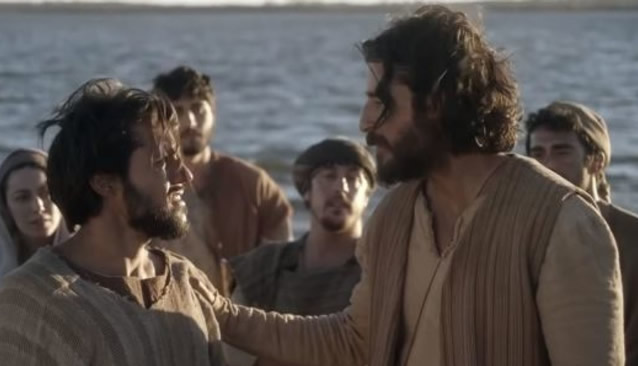
So look at John!  In your mind’s eye, follow his finger to whom he is pointing!  Hear what he’s saying!  In the story he’s standing with two of his friends when Jesus walks by.  He seizes the opportune moment.  He says to his friends, “Look, there goes the Lamb of God.  Here’s your chance.  What are you waiting for?  Go! Follow him!  He’s the one you’ve really been looking for.”

All they know is what John has told them about Jesus – they don’t really yet know Jesus.  They don’t know where he is going or if he wants them to follow.  But follow they do – at a distance.  That’s what’s so noteworthy about what happens that day.  As these two men follow him at a distance, Jesus turns around.  He initiates the exchange.  He confronts them.  “What are you looking for?  What are you after?  I see you following me, what are you hoping to find?  What do you think I can do for you?”

So what if, right now, Jesus stopped in his tracks, faced you, and asked point blank, “What are you looking for?  I see you’ve been following me.  I know you’ve been checking me out.  Well, what do you want?  What do you think I can do for you?  What do you want me to give you?  Where do you think I am leading you?  Do you think I have all the answers?  Can I fix your life?  Or are you just curious?

Will your answer be the same as John’s followers: “Teacher, where are you staying?”  You know what Jesus answers, “Come and see.”  This is so typical Jesus – always an invitation is extended, a gracious and wide open invitation.  And, what’s more, the invitation always comes with a promise.  Seek and you will find.  Knock and the door will be opened.  Ask and you will receive.  Come to me if you are weary and heavy burdened and I will give you rest.  You who are thirsty come to me and drink.  Come to the feast for I have prepared a place for you at the table.  Always Jesus invites us: come and see!

~Reflection by Sister Roberta Bailey, OSB


We remember Martin Luther King, Jr. today

and his bravery in helping

people around the world overcome.


 “Life’s most persistent and urgent question is,

what are you doing for others?

Dr. Martin Luther King, Jr.


First Reading  1 Samuel 3:3b–10,19           Second Reading  1 Corinthians 6:13c–15a,17–20
Gospel   John 1:35–42
Continue Reading

Filed Under: Blog, Front Page, Homily Tagged With: Benedictines, Follow Him, God, Jesus, John the Baptist, Lord, Sister Lynn Marie McKenzie, There He Goes

Footer

Prayer / Newsletter / Info

 Contact Info

Benedictine Sisters of Florida

PO Box 2450
12138 Wichers Road
St. Leo, FL 33574-2450
(352) 588-8320
(352) 588-8443

 Mass Schedule

Related Links

Copyright © 2026 · Benedictine Sisters of FL · Touching Lives Through Prayer and Service

Copyright © 2026 · Bendedictine Theme on Genesis Framework · WordPress · Log in