• Skip to primary navigation
  • Skip to main content
  • Skip to footer
Benedictine Sisters of FL

Holy Name Monastery
Founded 1889

Donate Now
  • Home
  • About Us
    • History
    • Being Benedictine
    • Benedictine Monasticism
    • Meet Our Community
    • Holy Name Academy-Alumnae
  • What We Do
    • Mission, Vision and Our Partners
    • Invitation to Retreat
    • Accommodations
    • Volunteer Programs
    • Oblate Program
    • Spiritual Direction
    • Aqua/Hydroponics
    • More of Our Ministries
  • What’s Happening
    • Articles of Interest
    • Events
    • Newsletters
    • Brochures
    • Links
  • Support Us
    • Gifts of Support
    • Wish List
  • Stories Shared
  • Galleries
    • Photos
    • Videos
      • Benedictine Sisters of FL Videos
      • Other Videos
  • Contact Us

Benedictine

March – Celebrating Women and their Accomplishments

March 5, 2021 by Holy Name Monastery Leave a Comment

We are excited to share a video on March 8th in celebration of National Catholic Sisters Week.  The video features the practices and ministries of several Benedictine monasteries across the country including the Benedictine Sisters of Florida.  In addition to how catholic organizations honor women religious during March, this is the fifth year that they are part of National Women’s History Month.  While Sisters and nuns do not seek recognition, making them a part of this annual celebration every March is only fitting.

Our country has been served since the early 1700s by Sisters and nuns who established exceptional schools and hospitals and have been remarkable in their out-reach to the poor.  Their history is closely tied to the very development of our nation.  Today there are 45,605 Sisters and nuns who are consoling, inspiring and praying for those who have lost loved ones during the Covid pandemic.  Now as in so many past crises, vowed women are a God-send.

This year’s theme for National Women’s History Month is “Valiant Women of the Vote,” focusing on those who worked for women’s right to vote.  Faith and religion played a significant role in the fight for fairness.  Suffrage was not only a legal issue, but certainly a moral one.  Journalist Elaine Weiss wrote “The Women’s Hour: the Great Fight to Win the Vote,” highlighting the fact that women of various faiths came together to organize and lobby.  They saw suffrage as a matter of divine justice as well as human rights.


Continue Reading

Filed Under: Blog, Front Page, Homily Tagged With: Benedictine, Celebrating Women, Elaine Weiss, March-Celebrating Women and their Accomplishments, National Women's History Month, sisters, with God all things are possible

The Best is Yet to Come

December 7, 2020 by Holy Name Monastery Leave a Comment

The Best is Yet to Come

To quote Notre Dame theology professor, Ralph Martin: “The page of a modern book that first catches our interest is the title page … Ancient books had no dust covers or words printed on the spine to arrest attention.  So the first page—or even, as here in (Mark’s) first sentence, (it) had to convey the writer’s main message.  This is exactly what Mark’s opening verse is trying to do: to alert the reader to what is to follow.  It is both his “table of contents” and title page brought together in a bold statement; “The beginning of the gospel of Jesus Christ the Son of God.” 

I suspect we’ve all had occasion to say, or hear, “You think this is great?  This is only the beginning.  The best is yet to come.”  Part of the surprise for us could be heard in this morning’s (Saturday) proclamation by the prophet Isaiah: “The harvest will come: rich and abundant; the towers will fall, the light of the moon will be like the sun and the light of the sun will be seven times greater like the light of seven days; the Lord will bind up the wounds of his people.”

While the opening line in Mark’s gospel points to Jesus, the first person he introduces is not Jesus, but the fiery preacher who came out of the desert resembling the Old Testament prophet Elijah.  Andrew Greeley observes that an important influence on Jesus was John the Baptist, whose ascetic lifestyle he continued to imitate.  John was no fashion plate, with camel hair clothing, leather sandals, and leather girdle around his waist.  His vegetarian diet was very simple: locusts (grasshoppers) and wild honey.  This information must have been important to the evangelist, or it would not have been noted.  So what might it symbolize?  Well, you cannot wear anything more fundamental in the way of clothing, or eat a more basic diet.  Could it be representative of John’s ministry of simple beginnings.  Like Mark says: The beginning of the gospel of Jesus Christ.”

And what a simple message John preached: “Don’t look to me for answers beyond what I have already told you.  Anything else will come from another, who is coming right after me.  He is so much greater than I that I am not even worthy to loosen his sandals straps.  (Remember, this was his younger cousin that he was talking about!)

John began his ministry in the wilderness, the worst possible place.  BUT IT WORKED!  Mark says: “all the country of Judea, and all the people of Jerusalem” came out to hear John.  What attracted them to trek 20-30 miles through the wilderness to listen to a man preach?!  That is all he did!  He never said how it would work, or why; he just announced it.  John’s preaching and charisma could bring people to God, but he could not take them beyond that.

How fitting, it strikes me, that we have John’s message of forgiveness and repentance as a prelude to our Penance Service this coming Wednesday evening.  God offers us, once again, an opportunity to sincerely repent.  To discern what it is that keeps “me” from being an effective channel of God’s compassion?  What are the “barnacles and burrs … the personality sandspurs” that keep others from seeing the God-image our Maker intended?  The reconciliation service will give us a chance, once again, to be our own critic and say, “You know what, God?  I’ve finally realized it’s not those others, it is just me.  This is just the way I’ve become — and I need help.”  In the quiet of your own heart, where God alone hears and listens, you can say, “I repent, send me your Spirit.”  The responsorial psalm (Psalm 85 adapted) promises us: “The Lord will give his benefits; kindness and truth shall meet; near indeed is God’s salvation.”

In the meanwhile, be mindful of Habakkuk’s prophecy (2:3).  “God may delay; He may tarry” … but God has a plan – God will not forget, but it will be done on God’s time.  Indeed, that is what the readings help us proclaim today, that the Holy Spirit has called each one of us to this place, at this time, for a divinely ordained purpose:  to embody the Benedictine charism and live out a specific mission – personally and communally.

~ Reflection by Sister Roberta Bailey, OSB, Prioress


Readings:  Isaiah 40: 1-5, 9-11     2 Peter 3:8-14     Mark 1:1-8


Continue Reading

Filed Under: Blog, Front Page, Homily Tagged With: 2nd Advent Sunday, Advent, Advent Sunday, Benedictine, Best is yet to come, Jesus, Jesus Christ, John, Mark, Second Advent Sunday

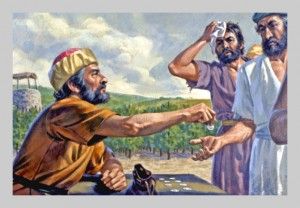
Are You Angry Because I Am Generous?

September 22, 2020 by Holy Name Monastery Leave a Comment

Growing up I recall my mother speaking from fond memory of her love for all her Benedictine Sister-teachers she knew from Ridgely, MD.  She had been double-promoted from seventh grade into high school.  But, there was no Catholic high school and she didn’t particularly like the public school setting.  At fourteen (14) she did what a lot of young people did.  She dropped out, got a work permit and joined her sister in Atlantic Beach to wait tables.  Later she became a nanny and housekeeper for a family that were loyal to her long after she married at age 33.  At some point I asked her why she hadn’t become a Sister since she obviously loved them – she could name them all from Sister Philomena in first grade to Sister Florentine (for whom she took her Confirmation name) in her last grade at St. Elizabeth’s.  Her answer to my query echoes that of the 5 o’clock men in this Gospel parable: “No one asked me.”  Adding – “I figured I wasn’t good enough.”  (“But, then, I wouldn’t have had you.”)

It strikes me that this Gospel must be a source of reassurance to those that some may describe as “late or delayed vocations.”  When the 5 o’clock whistle blew the men in the parable figured they’d been overlooked again.  “Don’t I look strong enough?  What will I say to my wife and children?”  The parable described these hopefuls as “standing around” but if you have seen day laborers gathered, hopefully waiting for a grove owner’s bus, you’ve seen some of them – already weary before the day has begun – sitting on a bench or crouched on their haunches.  Their experience warning them once again there’d be no room for them on the bus.

So, they’re there – well, into the day – 5 o’clock the parable says – discouraged – AGAIN – picturing their children with hunger in their eyes.  But, (wait) maybe (just maybe) they could pick up a few hours work but dark.  Either way, their ears pricked up when they heard the voice of the landowner, the Master: “Why are you still here?  You, too, go into my vineyard.”

What a surprise a short while later, when they looked into their pay envelopes to discover a full day’s wages!  (Now, unlike the parable of the 10 lepers made clean, Matthew does not tell us how many said “thank you.”)

Is it possible, they discretely peeked in their envelopes, thinking, “He’s usually generous – wonder how much I got – will it put supper on the table?  Mmmm, I better not act too surprised or delighted lest the early birds notice what’s occurred.   I would venture a guess that these “Johnny come lately” guys might decide they better not push their luck tomorrow …  lolly-gag or deliberately arrive late to join the guys on the bench.

(Enough of my imagining.)  The whole Gospel story harkens back to a line from the First Reading from Isaiah: (God speaks) –  “My thoughts are not your thoughts, nor are your ways my ways” … (God, the Lord or to use the term in the Gospel – the Master, continues emphasizing how far apart God’s thoughts are from ours).  “As high as the heavens are above the earth, so high are my ways above your ways, and my thoughts above your thoughts.”  With that consideration in mind, (that God’s thoughts are a far cry from our earth-bound thoughts) jump to the last line in the Gospel parable: … “Am I not free to do as I wish with my own riches?  Are you envious because I am generous?”  [Has God ever had to ask that question of you?]

Isn’t this exactly Benedict’s point when he reminds his followers (well, he directs much to the abbot or prioress … but even the “grace of office” can’t work a transformation if the one elected isn’t already steeped in these traits.)  As one of the speakers said in Thursday’s evening’s ZOOM presentation on Racism: “A change in attitude doesn’t guarantee in a change in behavior.”

While we are “sitting on the bench we call life” we should not be “standing around idle” waiting to be hired – there is much to be done.  The Rule offers us a good material for a personal check list:

(From RB 2) “Honor all persons.  Show no favoritism, but have respect for all.  (RB 27 and 34) Any favoritism should be shown for the weak.  (RB 2 and 27)   Accommodate a variety of lifestyles; don’t exercise any form of tyranny.  (RB 62)   Follow what you consider better for others.  No favoritism will be given due to rank or status.  (RB 3) Even the youngest should be heard with respect in community deliberations.  (RB 59) No distinction between rich and poor; respect all equally.”

In regard to respect for individual pathways to holiness, Benedict says in RB 73: there is always more you can do.  Those who can do more, should do so.  “As observant and obedient monk, we blush for shame at being so slothful, so unobservant, so negligent.  Are you hastening toward your heavenly home?  Then, with Christ’s help, keep this little rule …  After that, you can set out for the loftier summits of teaching and the virtues, and under God’s protection you will reach them.”

Can you hear the landowner asking: “Why are you standing here idle all day?  Go into my vineyard and I will give you what is just.”

~Reflection by Sister Roberta Bailey, OSB


First Reading Isaiah 55:6-9                 Second Reading   Philippians 1:20-24, 27a
Gospel   Matthew 20:1-16a
Continue Reading

Filed Under: Blog, Front Page, Homily Tagged With: angry, Benedictine, generous, Mother, Mother Teresa, parable, sisters

Abbot Primate’s Circular Letter

May 26, 2020 by Holy Name Monastery Leave a Comment

This week I offer for consideration an abbreviated version of the “Circular Letter” from our Abbot Primate Gregory Polan, O.S.B.  Abbot Gregory was our retreat director in the summer 2019.  He resides in Rome at Sant’ Anselmo, the Benedictine College.  Shortly after resigning as Abbot of Conception Abbey he was elected to the international position.

Dear Brothers and Sisters in Saint Benedict and Saint Scholastica,

Jesus said: Peace be with you.  This Easter peace (that) Jesus gives is not a freedom from anxiety, but a freedom to live amid anxious times with faith in God’s presence, and trust in ways that will open up a manner to face and live into the future.  That is a great encouragement .. in this moment of anxiety and insecurity.  Despite the fears and worries, there is something quietly stirring in (our) hearts.  The Holy Spirit within us guides us in ways that are so simple and good, so touching and transforming.  It is a “peace” that is subtle and quiet, humble and gracious, wise, noble, and advantageous.  This is the mysterious Easter peace that Christ left to us, his Benedictine disciples, and to all who follow the Gospel message.

 How easy it is to name the challenges that have come our way with this pandemic: fear for the present moment, unexpected death, uncertainty about the future, living with an invisible enemy, financial pressures, distance from loved ones, praying in unfamiliar ways, and many more challenges.  But isn’t it important for us, to search deeply to discover the blessings that have come to us? 

 First, we have come to see what a blessing our Benedictine tradition and calling has been for us during these days.  While many people live alone in a small place, isolated and without another human face to encounter, we have been blessed with our monastic community.  The human desire that resides in all of us to be connected with others stands as a distinguishing characteristic of our daily life.  With social distancing, we have been forced to live somewhat apart, but clearly, not alone.  Again with social distancing from one another, there has grown a kind of unique closeness that happens when challenges unite people in a way that bonds them by their willingness to do together what is for the good of all.  Sacrifice is rarely an easy act, but when it is done by a whole community, it possesses a unique character that binds people in a joy that is both satisfying and enriching, and sometimes, life-changing.  While in community our fears actually become moments when courage builds up within us, our anxieties develop into moments of trust because of the strength we experience in the midst of our community life together.

 Second, both our community and private prayer take on new dimensions.  We regret that in most instances, our oblates and friends who usually pray with us are not present.  Yet, their absence fosters a true concern for them in our hearts.  It is easy in our daily intercessions to remember the Church, the world, and our governments; yet now, knowing the challenges which they face for the good of the people they serve, there is a greater sense of the worldwide communion which we share, not only as members of the Body of Christ, but as brothers and sisters in the human family.  Both men and women Benedictines have shown genuine concern for those who usually pray with them.

Third, the environment of our monasteries …  provides us with places to be grateful for the beauty of creation, the gifts of God’s earth, and the opportunity to reflect on how important our care for the earth’s resources really are. … (I share one example) .. Here in Rome, with the lockdown, from our tower, you can see the Mediterranean Sea; that is how clear the air has become in Rome, a city known for its pollution. … During this pandemic, we have experienced a short-term effect of seeing how we can be better … guardians of what has been given us.

Fourth, an element of the monastic life that has intensified during these weeks and months has been part of Saint Benedict’s spiritual doctrine on silence.  Until a few months ago, our lives have been caught up in the fast pace of society, which can have the tendency to diminish the time devoted to silence and reflection.  These weeks have awakened in us the importance of silence and reflection.  We have sometimes come to see how uncomfortable we are with more silence in our lives; and it has taken both time and effort to use the silence that has been forced upon us as something that really is a “gift in disguise.”  The moments of silence and reflection are precious times for communion with God, whether in the practice of lectio divina, adoration, or stillness before the divine presence already within us.  There is no doubt that God has many important things to say to us in the midst of this crisis – what is important is that we can take this time and realize how silence and solitude are “gifts” that are there for us to use wisely even after the time of this pandemic.

Fifth, we are living in a moment of inspiring heroism.  On the larger scale, we have seen the sacrifice of their very lives by dedicated doctors, (and) nurses, vigilant public servants who have all put their lives in harm’s way to fulfill the calling they have received.  Likewise, there has been a more silent, yet still dedicated heroism in the fervent prayer, generous service, and creative ways of assistance through the internet, email, and phone conversations.  The beautiful challenge that now stands before us is to keep this kind of generosity and creativity growing certainly to one another, and to all who come to us as guests, in the figure of Jesus Christ.  The heroism of our lives as Benedictines is often not as well known or widespread yet, it is heroic in the living of our tradition according to the Gospel and the Rule of Saint Benedict with a sense of mission that is vibrant and life-giving for one another and for whomever we may serve.

To each of you, I offer sincere thanks for the ways in which you have witnessed to the monastic spirit of prayer, stability, obedience, charity, generosity, sacrifice, and openness to the movement of the Holy Spirit in this unexpected pandemic.  May our testimony as Benedictine men and women of the Gospel and the Rule lead us forward into the future, yet unknown, yet known in the mind and heart of God who walks with us each and every day.

Sincerely in the risen Christ, our great Hope and Strength,

Gregory Polan, O.S.B.

[Abbreviated for distribution by Benedictine Sisters of Florida]

Continue Reading

Filed Under: Blog, Front Page, Homily Tagged With: Abbot, Abbot Gregory Polan, Abbot Polan, Benedictine, Circular Letter, sisters

Pope Praises Evangelization Through Prayer, Care For Creation, Welcome

September 9, 2018 by Holy Name Monastery Leave a Comment

Pope Francis speaks during a Sept. 8 meeting with a group of Benedictine sisters at the Vatican. Forming a community of women from different backgrounds and uniting them in prayer, in care for the earth and in hospitality to others is a powerful witness of Gospel values, Pope Francis said. (Credit: CNS photo/Vatican Media.)

ROME – Forming a community of women from different backgrounds and uniting them in prayer, in care for the earth and in hospitality to others is a powerful witness of Gospel values, Pope Francis told a group of Benedictine sisters.

“Today there are many people in the world who seek to reflect in their lives the tenderness, compassion, mercy and acceptance of Christ,” the pope said Sept. 8. “To them you offer the precious gift of your witness, as you are instruments of God’s tenderness to those who are in need.”

The pope met about 120 Benedictine nuns and sisters from a variety of independent monasteries and congregations participating in a symposium in Rome. The theme was the admonition from the Rule of St. Benedict, “Let all be welcomed as Christ.”

Making a monastery a place of “welcome, prayer and generous hospitality” is an “essential work of evangelization” that always must be expanded and strengthened, the pope told the women.

He also thanked them “for the special care you show toward the environment and for your efforts to protect the gifts of the earth, so that they can be shared by all.”

Many of the Benedictine monasteries are found “in places of great beauty where people go to pray, to find silence and to contemplate the marvels of creation. I encourage you to continue this style and service, so that God’s wonderful works can be admired and speak of him to many persons.”

The life the women live within the monastery walls, lives and relationships that visitors can observe and sense, also is a Gospel witness, the pope said.

“Your life in community bears witness to the importance of mutual love and respect,” he told them. “You come from different places and experiences, and each of you is different, and so the way you accept one another is the first sign you offer in a world that finds it hard to live out this value.

“We are all children of God,” Francis said, “and your prayer, your work, your hospitality, your generosity, all combine to reveal a communion in diversity that expresses God’s hope for our world: a unity made of peace, mutual welcome and fraternal love.”

Continue Reading

Filed Under: Blog, Front Page Tagged With: Benedictine, Christ, monastery, nuns and sisters, Pope, Pope Francis, sisters

These Were Benedictine Women With A Dream!

July 11, 2016 by Holy Name Monastery Leave a Comment

St. Leo Township 125th Anniversary

July 9, 2016


20160709_140120We preserve our stories because we want never to forget that the opportunities we have today were not simply lavished upon.  They were purchased at the great price of travel from home; cold, cracked work-worn knuckles; study by the light of midnight oil; stomachs that ached with hunger; raking, hoeing and watering groves and gardens – saving, scrimping and salvaging.

What firm faith and incredible courage our founding sisters must have had!  The records in the Pittsburg archives remind us of how adventurous and of the bravery of these young sisters who in 1889 set out for a long journey into the unknown.  There were clearly told if the venture did not work, they were not to return to Pennsylvania.  An examination of the papers shows us that of the five women who signed their severance papers on the evening of February 22, 1889, one never made it to Florida.  However, one of the Sisters who had served as a witness, must have decided overnight to join the mission band – she is named in the group of our five founders.

Imagine what daring it took to venture south into a faraway place.  These were Benedictine women with a dream!  In 1889 Rome considered the church in America “missionary territory.”  In relative terms, the slaves had only recently been freed.  Had our Sisters ever seen a person of color in their northern neighborhood?  Surely not an Indian and most assuredly not an alligator!

There is some evidence that the pioneer band traveled from Allegheny County (PA) to the Benedictine house in Covington, KY – then southward by train which would have deposited them in south GA or north FL.  It seems safe to me to guess that someone from San Antonio would have met the Sisters at the train to bring them in wagons or on horseback down along what is now Hwy 19 and 41 – parts of the Seminole trail.  Perhaps they met cattle drovers bringing their herds to Tampa or Punta Gorda.  By the time they reached San Antonio, traveling through the Florida wilderness – in February, probably not too many mosquitoes but surely they’d have heard or seen black bears and panthers, “Strange” birds, and had run across a snake or two…

On Thursday, February 28, I bet they breathed a sigh of relief to at last be among people they may not have personally known but whose northern cultural practices and manners, whose speech patterns were similar to their own.

Next day, March 1, being a Friday, and most probably a Lenten Friday, would have been a day was meat was NOT on the menu.  The sister would have partaken of very little, if any, breakfast.  They’d have prayer the Little Office of the blessed Virgin, an abbreviated for of the Divine Office they’d back home.  And as we know from our annals: “the great work was begun.”  Perhaps they had a main meal of fish fresh caught from Lake Jovita?  Evening came, and morning came, their second day in the mission land called “Land of the Flowers.”

The Sisters first home was a three-story wood-frame hotel which was located on the city park in San Antonio.   In 1911, the building was moved on logs to a location parallel to the shore of Lake Jovita in St. Leo.  In 1960, the “new” monastery building, which is now called Benedictine Hall and owned by Saint Leo University, replaced the original wood-frame building which the Sisters and academy boarders had called home for 71 years.

By March 11, less than two-week after their arrival, the Sisters had opened Holy Name Academy for girls and were teaching in St. Anthony School and St. Joseph School.  From 1929-59 they operated St. Benedict Preparatory for young boys.

In their history since 1889, the Sisters have served as town mayors and commissioners. At Saint Leo University, they have served as administrators, instructional staff, board members, campus ministers, directors of residential life and director of library services, archivist, clerical staff and food service managers.  From 1962 until 1997 they provided housing for university students.  Florida Benedictine women have staffed schools in Texas and Louisiana.  In Florida, they have been teachers and school principals, and worked in parish ministries, in San Antonio, St. Joseph, Lecanto, Jacksonville Beach, Miami, Quincy, Sarasota, Ocala, Lakeland, Venice, Beverly Hills, Apopka and Tampa.

The Benedictine Sisters have conducted summer religion programs at three diocesan camps.  They taught in summer Bible camps in DeLand, Plant City, Leesburg, Bartow and Naples, Florida.  Weekly religion (CCD) classes were taught by the Sisters in cities where they staffed schools and in Floral City, Brooksville, New Port Richey, Eustis, Arlington, Ponte Vedra, Masaryktown, Belleview, Reddick, West Ocala, Fruitland Park, Gainesville, Clermont, Dade City, Zephyrhills and at the Girls’ Detention Center in Ocala.

At the turn of the 20th century they attempted the founding of another motherhouse in Quincy, FL (which did not thrive) and within 10 years they had been invited to start a house in the Diocese of Birmingham, AL.  A year later 5 of “us” from FL joined with 5 Benedictine sisters from Kentucky to found the Benedictine convent in Cullman, Al.

At the present time, the Florida Benedictine Sisters continue to work on public, private and parochial school boards, and at Saint Leo University.  Individual Sisters are volunteers and serve on the boards of Catholic Charities, the Chamber of Commerce, Habitat for Humanity, Sunrise Spouse Abuse Shelter, Hospice, St. Vincent de Paul Society, soup kitchens and thrift stores.  Some of the Sisters minister within their community in administration, recruitment and formation of new members, business affairs, hospitality and retreat ministries, direct services to the poor, food service, horticulture.

And, now here we are at day 46,516 in the 127th year of our history – yes we were here before St. Leo was St. Leo Township!  And the Sisters have continued to happily be residents of St. Leo for all 125 years of the town’s incorporation.  And the GREAT WORK goes on.

As long as there are gaps between our ideals and our reality, there will always be great work to be done.  Our founding sisters, and the women who followed them into community, knew that they probably would not live to see all the changes they promoted.  Little did they know the hotel-turned-convent they so carefully hauled to the shores of Lake Jovita would be demolished in 1961, a new priory (as it was called then) erected and eventually sold to Saint Leo University.

We face challenges our foremothers could not have imagined.  And, our “daughters” will face challenges unimaginable to us.  This is part of our Florida Benedictine women’s experience – we still remember in the beginning our founders were told: if it doesn’t work, don’t come back.  We work to compassionate and caring, to preserve the earth and steward our resources, to keep faith with our founding ideals and to enflesh them into a reality worthy of those who will inherit what we build today.

~ Reflection by Sister Roberta Bailey, OSB, Prioress
Continue Reading

Filed Under: Blog, Homily Tagged With: 1889, Benedictine, Faith, journey, motherhouse, Saint Leo, San Antonio, St. Leo

  • « Go to Previous Page
  • Page 1
  • Page 2
  • Page 3
  • Go to Next Page »

Footer

Prayer / Newsletter / Info

 Contact Info

Benedictine Sisters of Florida

PO Box 2450
12138 Wichers Road
St. Leo, FL 33574-2450
(352) 588-8320
(352) 588-8443

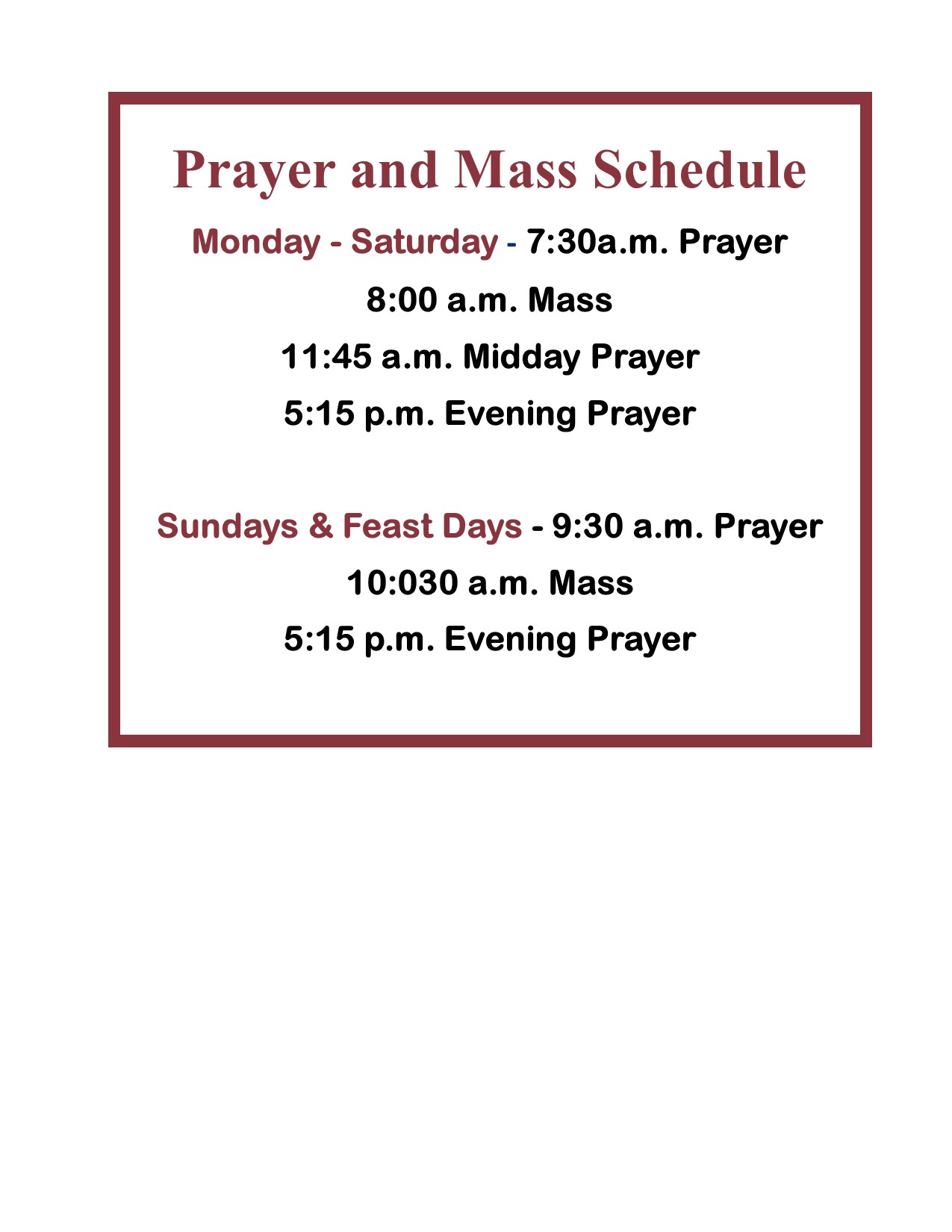
 Mass Schedule

Related Links

Copyright © 2026 · Benedictine Sisters of FL · Touching Lives Through Prayer and Service

Copyright © 2026 · Bendedictine Theme on Genesis Framework · WordPress · Log in