• Skip to primary navigation
  • Skip to main content
  • Skip to footer
Benedictine Sisters of FL

Holy Name Monastery
Founded 1889

Donate Now
  • Home
  • About Us
    • History
    • Being Benedictine
    • Benedictine Monasticism
    • Meet Our Community
    • Holy Name Academy-Alumnae
  • What We Do
    • Mission, Vision and Our Partners
    • Retreats
      • Invitation to Retreat
      • Accommodations
    • Volunteer Programs
    • Oblate Program
    • Spiritual Direction
    • Aqua/Hydroponics
    • More of Our Ministries
  • What’s Happening
    • Articles of Interest
    • Events
    • Newsletters
    • Brochures
    • Links
  • Support Us
    • Gifts of Support
    • Wish List
  • Stories Shared
  • Galleries
    • Photos
    • Videos
      • Benedictine Sisters of FL Videos
      • Other Videos
  • Contact Us

Homily

Third Sunday in Ordinary Time

January 25, 2016 by Holy Name Monastery Leave a Comment

Epiphany3_YearC_scrollAfter the opening verses in today’s Gospel, Luke leap frogs over the chapters where we would find the Infancy Narratives, Jesus’ baptism by John, the temptations Jesus faced in the desert, and the beginning of Jesus’ public ministry.  The writer picks up in chapter four where we find Jesus in the synagogue on the Sabbath – it seems obvious this was his custom.  No one seems surprised to see him there.  What does raise some eyebrows is when he stands and reads from the scroll handed to him.  He announces his mission is in continuity with Israel’s prophetic tradition.  He speaks of a “year acceptable to the Lord” making reference to the Jewish tradition of Sabbath every 7th year and jubilees celebrated every 50th year – times when the land was left fallow and food stores were to be shared equally with all.  A time of renewal in which debts were forgiven and slaves were freed.

Luke clearly acknowledges that he himself never saw Jesus. His gospel was written at least 50 years after Jesus’ death and resurrection. Yet he wants to assure his readers that what he writes is accurate and is based on the experiences of people who did know Jesus personally. At the same time he lets us know he is not writing a biography. His purpose is not to relate a chronology but to tell us the meaning of Jesus’ life, death and resurrection for our personal lives and why we should accept and follow Jesus as our King and Lord.

People get different things out of going to church, depending, it would seem, on what they expect to get when they go there.  There’s a story about an elderly couple that was walking out of church one Sunday. The wife said to the husband, “Did you see the strange hat Mrs. O’Brien was wearing?” “No, I didn’t,” replied her husband. “Bill Smith badly needs a haircut, doesn’t he?”  “Sorry, I didn’t notice.” “You know John,” said the wife impatiently,” Sometimes I wonder if you get anything at all out of going to church”.

I wonder what the people who were in the synagogue that day when Jesus read aloud expected to get out of the service. Certainly they didn’t expect to see Jesus stand and read a portion of Scripture, let alone comment on it.

What did this message mean to the people in the synagogue? What does it mean to us today? It meant that day what it means today: that Jesus in the promised Messiah, the anointed one sent by God to redeem his people. It means that Jesus frees His listeners from the bonds of sin and guilt.  He came then, and He continues to come each and every day, to set us free. Why do we continue to try to solve our problems by ourselves instead of turning to God?

We are all captives to something, whether it is our ministry, our role in community, favorite TV shows, certain foods especially ones that aren’t good for us, shopping or something else. All of us can awaken to God’s anointing power. It constantly inspires, enlivens and guides us.  It soothes, comforts, welcomes and transforms us.

We can listen to that still small Voice of God within or in the words of a mentor and spiritual director or our comrade in community.  Or we can refuse to listen, we can refuse to believe, and we can refuse to let it make a difference for us, but it is still true. The Word of God stands forever!   Jesus’ one-sentence sermon that day in the synagogue was the shortest in history, but it is also one of the most powerful.

And, we believe it because we believe in the one who spoke it.  We love the man Jesus and believe he is the Son of God.  When Jesus taught in the synagogue, people listened but they did not understand everything, and perhaps they understand nothing at all. However, they were struck by a word, a sentence and they remembered it.  They continued to think about it…  Sounds like our lectio experience.  That’s when the Spirit goes into action and enlightens us, at first only a little, and later on more powerfully and persuasively.  That’s why it is important to spend open-ended time with the Word, with God.  We may have some favorite prayers we say that someone else wrote.  But how would you feel if one you call “friend” only shared with you something they’d memorized as a child or words from someone else’s pen?

We decide how to nourish our minds and feed our spirits by choosing what to read and to watch, what to reflect on.  And, we decide how to protect our minds and spirits by not reading or watching what does not uplift us and make a positive impact on our lives and those we engage with in conversation.  Like Scholastica and Benedict on that memorable night, we want to spend time in “holy conversation.”

Sometimes we forget how precious the Word of God is.  A powerful example is in this true story.  In 1964 the Romanian government released religious and political prisoners. Among them was one who had spent nearly three of his fourteen years in prison in solitary confinement. After his release, he wrote a book entitled In God’s Underground in which he describes how one day a new prisoner was brought in. The upper part of his body was in a plaster cast. When the guards withdrew, he slipped out a small tattered book secretly hidden between his skin and the plaster cast. None of the other prisoners had seen a book for years. They asked him what the book was. It was the Gospel of John.  The author of the story writes that he took the book in his hand and no life-saving drug could have been more precious to him. From that day the tattered little book went from hand to hand, many learned it by heart and each day they would discuss it among themselves. That reminds us that sometimes we forget the importance of the Word of God in our lives.

                                                                                                 Reflection by Sister Roberta Bailey, OSB, Prioress


Continue Reading

Filed Under: Blog, Homily Tagged With: God, Jesus, John, Luke, scroll, Word of God

The First Miracle

January 19, 2016 by Holy Name Monastery Leave a Comment

water to wine(John tells us that Jesus and his disciples were invited to this wedding at Cana, as was Jesus’ mother, Mary.) There is no parallel report of this miracle at Cana in the other three Gospels. Don’t you think it is significant that John included the story – about Jesus and his disciples at a wedding – at a PARTY – as the very first miracle Jesus performs? Of all that Jesus said and did in his three years of ministry, this is first – Jesus at a party, turning water into wine. (and not communion size wine but party size wine)

John must have kept his eye on Mary whenever he was in her company.  Even after Jesus’ death, at Jesus, behest he took Mary into his home and heart until her own death.  Though in relating this story he does not call her by name, he must have been deeply touched by her gentleness and gutsiness; keen intuition and comfortableness in staying in the background.  Only Mary, Jesus and the wine steward (and, of course, our writer John) apparently noticed the exchange between Jesus and his mother – and the miraculous result.  There is no mention about whether the other wedding guests are aware of what happened.  This lavish response to a simple human need is a vision for us of the abundance of God’s workings in our lives. Jesus got involved in a BIG WAY – those six jars of wine would fill 6 to 9 HUNDRED bottles.  That’s a lot of wine, even for a wedding party that would, in Jesus’ time, last a week.

Jesus quiet generosity challenges us to respond generously when confronted with human need today – simply, quietly without looking for credit or announcing the “miracle.”   We respond as best we can, fully confident that God can transform our “water of humility into wine of unselfish generosity” bringing the Kingdom of God to fulfillment among us.

Do you know people who ‘feel bad about feeling good’?   (Or are you one of them?)  Do you feel that Jesus should have just attended the wedding ceremony (the ‘religious part’) and kept away from the festivities?  Do you have a problem with Mary enjoying a glass of wine or two?  There are some people, maybe more than we know, who seem to feel that, in order to be a ‘good’ person they always have to be denying themselves, always ‘making sacrifices’ or putting themselves down and minimizing their God-given talents.  If they think they are really enjoying life, there must be something wrong. They are in a constant state of waiting for the other shoe to drop.

To echo Pope Francis’ thinking: “Our religion is a religion of joy.”  But people miss his point when they spend their time living Lent but without Easter.  Pope Francis says in his introduction to THE JOY OF THE GOSPEL,” Joy adapts and changes, but it always endures!”   He continues: “I understand the grief of people who have to endure great suffering, yet slowly but surely we all have to let the joy of faith slowly revive as a quiet yet firm trust, even amid the greatest distress.”

And, we really do have much to celebrate, to be joyful and be thankful for in so far as so many people have used their gifts to promote our well-being and support  our community.

I quote here Max Lucado from When God Whispers Your Name:”

Why would Jesus, on his first journey, take his followers to a party? Didn’t they have work to do? Didn’t he have principles to teach? Wasn’t his time limited? How could a wedding fit with his purpose on earth? Why did Jesus go to the wedding?

The answer? It’s found in the second verse of John 2. “Jesus and his followers were also invited to the wedding.”

Why did they invite him? I suppose they liked him.  Big deal? I think so. I think it’s significant that common folk in a little town enjoyed being with Jesus. I think it’s noteworthy that the Almighty didn’t act high and mighty. The Holy One wasn’t holier-than-thou. You just don’t get the impression that his neighbors grew sick of his haughtiness and asked, “Well, who do you think made you God?” His faith made him likable, not detestable. Would that ours would do the same!

Lucado asks:  May I state an opinion that may raise an eyebrow? May I tell you why I think Jesus went to the wedding? I think he went to the wedding to-now hold on, hear me out, let me say it before you heat the tar and pluck the feathers-I think Jesus went to the wedding to have fun.”

So here’s a question for us:  Jesus took time for a party.  So, shouldn’t we?

How are you going to party?  And who is God using – like Mary speaking to Jesus – to give us a nudge in the right direction?  If you don’t know – as Benedict says:  listen more carefully.  And, if you do know – take the hint!

                                                                                                        Reflection by Sister Robert Bailey, OSB, Prioress


Continue Reading

Filed Under: Homily Tagged With: Cana, Jesus, John, Mary, Miracle, Second Sunday, Water, Wine

Fourth Sunday of Advent 2015

December 21, 2015 by Holy Name Monastery Leave a Comment

May the last few days building up to Christmas not become too hectic doing for others …  save time for you and the Babe whose birth we will celebrate on Friday! 

In thbethlehem2is Gospel reading Mary, the girl-mother goes to visit Elizabeth, her cousin, who, in advanced age, is also with child.  She traveled approximately 103 miles over not the kindest terrain.  It sounds like perhaps Elizabeth learned of Mary’s approaching arrival.  Whether or not, Elizabeth greets Mary with full recognition of the roles that they, and their unborn children, will play in God’s plan for salvation

Thus, it is appropriate in this season of Advent that we consider the role of Mary. Mary is the one who believed that God’s word to her would be fulfilled.    Mary shows us “blind” faith, deep trust and an abiding peace.   She ask only, how can this be – listens to the angel’s reply …. nods her head and sets off across the hill country to be midwife to her cousin.  Her faith enabled her to recognize the work of God in her people’s history and in her own life. Her openness to God allowed God to work through her so that salvation might come to everyone: those who had gone before her and all of us who come after.

Martin Luther King, Jr once described faith as: ”taking the first step even when you don’t see the whole stair case.”   This is Mary … the angel sent by God said it can happen, so who am I to question God?   At this stage, she has no idea what is in store but she has said her Yes and she will be faithful to it.  May we always be like Mary, open and cooperative in God’s plan for salvation.

A few years ago there was a TV ad that ended with the question: Have you said ‘Yes’ yet?”   It is a question that tomorrow’s Mass are asking each one of us.  Have we made the most important preparation of all? Yes to the Father, Yes to Jesus, Yes to all that we will experience in the coming year, Yes to every call that God makes and will make of us?  We learn from Mary, and her son Jesus, how to say an unqualified, unconditional and unreserved YES!  That’s where the real joy and happiness of Christmas lies. All the rest is (so to speak) tinsel on the tree of our lives!

As Advent time winds down it is almost impossible not to be sucked into celebrating the feast before it occurs.  We struggle to remain grounded in the spirit of Advent.  Like children we just can’t wait for the big birthday party.  It’s as though even the most beautiful liturgies and symbols fail to communicate, because God is so much greater than all our frail efforts.  But, God doesn’t need our feeble attempts in order to communicate with astonishing clarity.    If we look and listen closely – like we look forward to the rising sun each morning from the breakfast table – we remember God is greater than any Advent wreath.  When the rich melodies of the O Antiphons course through us we are reminded we do indeed stand on holy ground.

On Monday we will mark the shortest day of the year.  Isn’t it strange that we refer to it as “shortest day” not the longest night?   The light of day gradually increases and we witness the sunrise earlier and earlier each day.

And, the Advent wreath’s purple candles increase until all four give light to our darkness and hinting at the more brilliant light that God promised: “The people who walked in darkness have seen a great light.”  God hasn’t forgotten or given up on us.  How fitting to have had the Penitential Service this past week … Any debt or guilt we may have felt or imagined is erased: the jail door sprung. The prison gate opens as wide as a proverbial smiley face!   The light within us is even more dazzling than you can imagine!

In the words of Dietrich Bonhoeffer we hear a message of hope and reassurance:

“Just when everything is bearing down on us to such an extent that we can scarcely withstand it, the Christmas message comes to tell us that all our ideas are wrong, and that what we take to be evil and dark is really good and light because it comes from God.  Our eyes are at fault, that is all.  God is in the manger, wealth in poverty, light in darkness, succor in abandonment.  No evil can befall us; whatever others may do to us, they cannot but serve the God who is secretly revealed as love and rules the world and our lives.”

Let’s not be counted among the people who miss out on the gift that God sent to them. You see, God’s Gift didn’t come in a beautifully wrapped package. God sent Jesus, His only Son, as His gift to us. Jesus’ mother was young virgin…his earthly father was a poor carpenter…he was not born in a beautiful palace…he was born in a manger. Not a very pretty package, is it? But do you know what? It was the greatest gift the world has ever known. It was the gift of salvation and it had your name on it.

Our prayer bubbles forth in the words of Psalm 40 (which we prayed in Noon Prayer yesterday) “O God, your wonders and designs are beyond imagining; you have no equal.  Should I proclaim your blessings, they are more that I can tell!”

Continue Reading

Filed Under: Homily, Prayer Tagged With: Advent, Birth of Christ, Christ, Christmas, God, Jesus, Joseph, Mary

Second Sunday in Advent 2015

December 7, 2015 by Holy Name Monastery Leave a Comment

Friendships can grow apart unless…..

friend driftReading about John the Baptist reminded me of the evening, long ago during the liturgical transition, when we were using “purple pages” for prayer services.  Liturgists often provided a focal visual in the chapel.  For Vespers, I had designed a desert area, low on the floor, with sand (on a sheet thank goodness!) and rocks and cactus plants.  The display included a sign (not very large) that read, in the words of the entrance hymn, “What did you go out to see.”   When our elderly, arthritic Sister Annunciata came into the chapel, Sister Anna Marie (her peer) was already seated.  She watched as Sister Annunciata inched forward step by step and bent down until she could read the sign.  What happened next set all of us laughing, Sister Anna Marie said aloud:  “What did you go out to see?”

Luke’s Gospel quotes the prophet Isaiah, describing the road we must travel throughout Advent (and our whole lives) in order to see the signs of the times and reach the One foretold: our Emmanuel.

Like Mary and Joseph we must travel through valleys, between hills and over mountains in order to be counted.  We weather life’s troubles, storms of despair and disappointment, look out over the vista from the joyful mountain peaks of our lives to view the beauty God has laid out for us.

Like the Magi we bring gold, incense and myrrh for our Infant King – the gold of charitable deeds, our incense arising from prayerful hearts, minds and voices; and the myrrh of illnesses, infirmities and troubles to unite with the redemptive sufferings of Jesus.

Our community stationery proclaims: we are “touching lives through prayer and service.” But, without deliberate attention, daily practices can become pro forma, only a formality repeated by heart, a mindless routine UNLESS we are continually in touch with the workings of God within through a rich prayer life – faithful to the practices of lectio and meditation, Eucharist, private and communal prayer – not simply seasonal: Advent, Lent and annual retreat …  but daily.   It may be helpful to make a pie chart of your 24-hour day … what percentage do you give to keeping company with God.  We may be tempted to say “all my work is a prayer.”  That can be true if you start and end the day with the Sign of the Cross.  But, friendships can drift unless we do the work of keeping them alive. We need a jolt of spiritual energy at intervals during the day.  We want to guard against making a sham of people’s trust that we are a prayerful people.  Benedict knew this when he laid out times for gathering for Divine Office, times to read and study, times for rest, manual labor, eating, conversation and quiet.  Today we are personally responsible for what we do with much of our time.   Remember, what S. Bernie quoted from CALL to LIFE: we listen DAILY to God’s call and respond with good zeal.”   Group meditation for us is a practice of the past.  But, a strong community can count on the group, assured that each individual member has taken time each day to reflect on the Word, and be with the Word, and discern its significance in her own life as well as power and push of the Word in the life of the community.  That’s how we are able to grow in the ability to come to consensus, refine relational skills, and nurture the gifts of mutual forbearance and forgiveness…   in reciprocated love and respect.  It takes dedication, determination and perseverance not to be the bad apple in the barrel.

On the road to Bethlehem, we will meet construction along the way, or be the one under construction.   In the Gospel last week, Jesus warned us to be alert, watching for God’s unexpected activity in our lives.  In this weekend’s readings, we see sign we dread: Road Construction Ahead.  We mutter: “Didn’t they just finish working on this road?” We get impatient when we see road construction signs, because they speak to us more of inconvenience, hassles, and delays, rather than the benefits that are hidden in the distant future.  The sign reminds us: Proceed with Caution.

We can hear John the Baptist shouting with the powerful words of the prophet Isaiah, almost like a highway foreman, “Prepare the way of the Lord! Make that path straight! Fill that valley! Get that mountain outta here! What happened over there? It’s all crooked! Make it straight! Smooth out that rough place! We gotta show everyone the salvation of God. Get busy!”  Time is running out – the day of the Lord is near!  In three short weeks Christmas will be here – our Emmanuel will appear!

                                                                                                                 Reflection by S. Roberta Bailey, OSB, Prioress


Continue Reading

Filed Under: Homily, Prayer Tagged With: Advent, Community, Friendship, John the Baptist, Luke, Prayer

First Sunday in Advent 2015

November 30, 2015 by Holy Name Monastery Leave a Comment

waiting-on-god-bannerHAPPY NEW YEAR!  Welcome to the Year of Luke!  This year we celebrate the full cycle (minus one day) of Advent!  Just as a reminder of a piece of Catholic trivia ..  Advent begins on the Sunday closest to the Feast of St. Andrew … since the feast is on a Tuesday, the closest Sunday is before the feast.

The opening article in the most recent LCWR newsletter entitled: “What Do We Do While We’re Waiting?” reminded me of my 3-year-old niece who was patiently waiting through what her mom had told her was my private time with God.  She had lasted through her first lectio experience with her books for 40 minutes.  She sat just outside the doorway where I was, heaved a heavy sigh and said: “OK, what do I do now God; she’s still talking to You!”

Advent is all about waiting.  But not waiting for someone else who is talking to God.  Is it wonderful that we do not have to take turns – we don’t have to wait to be in touch!  Advent is active waiting – that is what is at the heart of it. Even when we don’t know that we are waiting, we’re waiting. Even when we can’t find words for what we are waiting for, we’re waiting.

One of the ancient Advent prayers supplies us with a sentiment that Benedict echoes: “Give us grace that we may cast off the works of darkness and put upon us the armor of light.”    Many Advent hymns express the same theme.  For example: “When the darkness closes in, courage fails and hopes grow dim, clear the shadows from our sight, set our troubled world aright, fill our eyes with radiant light.  Come Lord Jesus, come!

We are waiting not just at Advent, but at all times for the advent of light, that ultimate light that is redemptive and terrifying at the same time. It is redemptive because it puts an end to the darkness, and that is also why it is terrifying because the light reveals all that was hidden in the darkness.  For so long, actually for most of our lives, the darkness has been home.  We’ve become comfortable in our incompleteness.   Now to leave home is downright scary. Change my ways of interacting with God and God’s people?  Whew!  Allow my rough edges to be smoothed – mmmm, sounds irritating (no pun intended).  We are gifted with Advent time to do personal “Isaiah work” of filling in every valley; leveling every mountain so the hills will become a plain, and the rough country will be made smooth.  As the familiar banner asks:  If not now, when?

Have you ever watched, or heard about the reality shows Restaurant Impossible or American Diner Revival.  Depending on which show you’re watching there’s a well-known renovation contractor and/or a chef that comes to a failing restaurant or diner and helps turn it around.  The premise is this:

Turning around a failing restaurant or diner is a daunting challenge under the best of circumstances. Attempting to do it in less than 36 hours, even with the help of the townsfolk, may be impossible.  But they’re ready to take on the challenge.  Can it be done?

From outdated décor to hip interior, from canned food to fresh ingredients, from surly employees to service-oriented staff, they attempt to overhaul the whole shebang with straight talk, great cooking skills, innovative, creative interior decorators and an excited team of mostly volunteers.  But, most importantly, when the TV crew arrives, the expectation is that the local staff will be ready with their own litany of what is going well and what needs to change.

This chef is no Christ figure, but there is an analogy here between our Advent Scriptures and theme of this human example of a dramatic overhaul driven by someone who knows what he’s doing.  The overhaul of the dilapidated restaurant and our personal overhaul is only possible if we’ll allow our premises to be placed under new management.

That turns our attention on the person who’s coming to town in the Advent scriptures.  The Gospel from Luke connotes a double reference to the already and the not yet.  Jesus berates the crowd for knowing how to interpret the weather, but not the present time.  This is where we, too, may fall short.  We listen to the weather reports and dress accordingly.  We gather in supplies and hunker down for the onslaught of a hurricane.  We see the waxing moon and wait patiently for the night of the full moon.  Such waiting requires discernment and alertness to natural signs.  Waiting for Jesus’ presence requires a deeper discernment and alertness to the signs of His appearance – the signs of the times.  And, so we question: do our community Directional Goals reflect awareness of God in our midst –  as well as in the signs of the times and what is to come

The hymn I referenced earlier reminds us how foolish we can be to overlook signs of the coming Christ: “Wise and foolish, still we wait. Is our Bridegroom at the gate? At his voice, our hearts have stirred, listening for his healing word, confident our cries are heard. Come, Lord Jesus, come!

Advent offers us time to waken to the signs of the times – Jesus, in the voice of Luke, reminds us we must remain on high alert awaiting the coming of the kingdom – it will be dramatic but that there will be little advance warning: “The kingdom of God is not coming with things that can be observed…  the kingdom of God is among you!   Remember:  “Heaven and earth will pass away, but God’s words will not pass away.”  The last Gospel we heard as the liturgical year ended (this morning) and the first Gospel for the New Year impress upon us the same warning: Beware that your hearts do not become drowsy!

                                                                                                       Reflection by S. Roberta Bailey, OSB, Prioress
Continue Reading

Filed Under: Homily, Prayer Tagged With: Advent, Christ, Faith, God, Waiting, Year of Luke

Novemeber 21st and 22nd was the Feast of Christ the King

November 23, 2015 by Holy Name Monastery Leave a Comment

pontius pilateThis Gospel is a very familiar incident in the life of Jesus – many reflections have been written about it – so, today I offer you a different perspective on the occasion …  this one was related to me by Claudia, the wife of Pilate [adapted]

I wonder sometimes, if they might have been friends this Jesus and my husband Pilate. If they had met in some other circumstances, I think they might have liked each other. Afterall, they were about the same age. They were both passionate, committed, opinionated. Bullheaded sometimes.  And intelligent too.   Except they thought so differently.  Jesus was a Jew. Pilate was a Roman. And Pilate never understood the Jews.  “You can’t get a clear answer out of them about anything,” he would fume. “Ask them a straight, logical question and they tell you a story or sing you a song!”

Pilate knew perfectly well he would never have gotten the appointment as Governor if he hadn’t been married to me, the granddaughter of the Emperor Augustus. And even at that, Judea wasn’t exactly a plum of an appointment. But Pilate hoped that his next appointment would be more prestige, a little closer to Rome; something he and I would both be proud of.

But in Judea things had gotten off to a bad start – he’d had a showdown with the Jewish leaders over whether Caesar’s image could be displayed in the temple area. It was a dumb thing to fight about and Pilate knew it. “But I’ve got to show them I am strong and resolute, Claudia,” he said to me. “If I show just a hint of weakness, if I back down even an inch, that snake of a high priest, Caiaphas, will take every slight advantage that I give him.”

Judea was a ‘no-win’ situation for him. The bureaucrats in Rome just read the bottom line. Did he collect his quota in taxes? Did he avoid any embarrassments? If the answer was “yes” to those questions, you stayed on and maybe eventually got promoted to a better posting. If “no” you were recalled to Rome and sent to shuffle papers in an office somewhere. Judea was so much more complicated than they realized.

Pilate tried. How he tried! He read that blessed policy manual every night and memorized every procedure. But of course the manual procedures never fit reality. “Who wrote this stuff anyway,” he fumed. “I bet they’ve never been outside of Rome. They sure as the dickens have never been out here in the boonies of Judea.”

And then the Jesus business broke. It was a recipe for disaster. Pilate couldn’t win this one and I knew it and I think he knew it. I even had dreams about it. “Get this man Jesus out of your life, Pilate,” I said, “No matter what you do, you’ll lose,”  “I’ll do what’s appropriate and necessary, Claudia,” Pilate said in his official voice, which meant that he was frightened. “I will interview the prisoner and judge him according to our Roman justice. He will be treated fairly.”  And there the conversation ended.

When they brought the prisoner up to the Prætorium. Pilate met them outside, a gesture of good will.  He interviewed Jesus there in front of the Jewish leaders.  “Look,” he finally said. “the guy is just a little crazy, and yes, a bit of a trouble-maker. But he hasn’t done anything to deserve execution. I mean, I can’t have him killed just because you people don’t like him. What I’ll do is have him flogged. That’ll straighten him out.”  Well, you should have heard the hullabaloo. “We want him dead!” they yelled. “Give us Barabus! We want him crucified!”

Listen. My husband has integrity. He wasn’t about to execute a man unless a crime had been committed, and blasphemy against the Hebrew God was no crime in Roman eyes. But Pilate was no fool either. He knew that Caiaphas had his ways of getting messages to Rome.  What followed was a mish-mash of political maneuvering and charges and counter charges. I don’t quite know what happened. I was in bed for most of it, fighting one of my migraines.

But I won’t not soon forget what happened when Pilate dragged this Jesus up into our quarters, away from all the yelling and screaming outside. That was when it struck me how alike they were, and yet how different. Two men of talent and integrity speaking to each across such vastly different realities.

In spite of all the pressure, Pilate still wanted to do the right thing. “Look,” he said to Jesus. “Give me a reason, give me something, anything that’ll satisfy that mob–something I can put in my report to Rome so I don’t have to have you killed.” Jesus looked right back at Pilate–looked through him. But he said nothing.

Pilate lost his cool. “Look, don’t you know I have the power of life and death over you. I can send you out to be torn apart by that mob, or I can save your hide.”  “You have no real power over me,” said Jesus. “No power that really counts. You and I are caught in this evil drama. You have your role to play and I have mine.  “All right,” said Pilate. “What is your role except to satisfy the blood-lust of that mob?”  “I am called to live the truth,” said Jesus.  “What is truth?” Pilate asked quietly, almost cynically. Jesus looked at him intently. And yes, compassionately. But he said nothing.   “Look, I asked you a question. What is truth?” Pilate lost his cool again. He paced around the room and banged his fist against the wall. But both men knew, I think, that Jesus could not reply in any way that Pilate could comprehend.

The conversation stopped. There was nothing else to say. Jesus would die. And Pilate knew he’d spend the rest of his life rehearsing that conversation. “Why couldn’t he just explain to me, logically and rationally what he was up to?” Pilate asked that question over and over.

I too have rehearsed that conversation. I am back in Rome now, by myself. Pilate has been banished from the capitol.  Pilate did not understand Jesus or any of the Jews.

And yet I wonder:  If Pilate and this Jesus had met some other way, perhaps they would have learned to like each other – if they had a chance to really talk, without the pressure. Pilate, the logical philosopher might have discovered the poetic dreamer deep inside himself. And Jesus the poetic dreamer, might have shown to Pilate the philosophy on which his dream was built.  There would have been respect at least. And just perhaps they might have seen themselves as brothers.

                                                                                                   Reflection by S. Roberta Bailey, OSB, Prioress
Continue Reading

Filed Under: Homily, Prayer Tagged With: Bible, Jesus, marriage, Pilate, understanding, wife

  • « Go to Previous Page
  • Page 1
  • Interim pages omitted …
  • Page 87
  • Page 88
  • Page 89
  • Page 90
  • Page 91
  • Page 92
  • Go to Next Page »

Footer

Prayer / Newsletter / Info

 Contact Info

Benedictine Sisters of Florida

PO Box 2450
12138 Wichers Road
St. Leo, FL 33574-2450
(352) 588-8320
(352) 588-8443

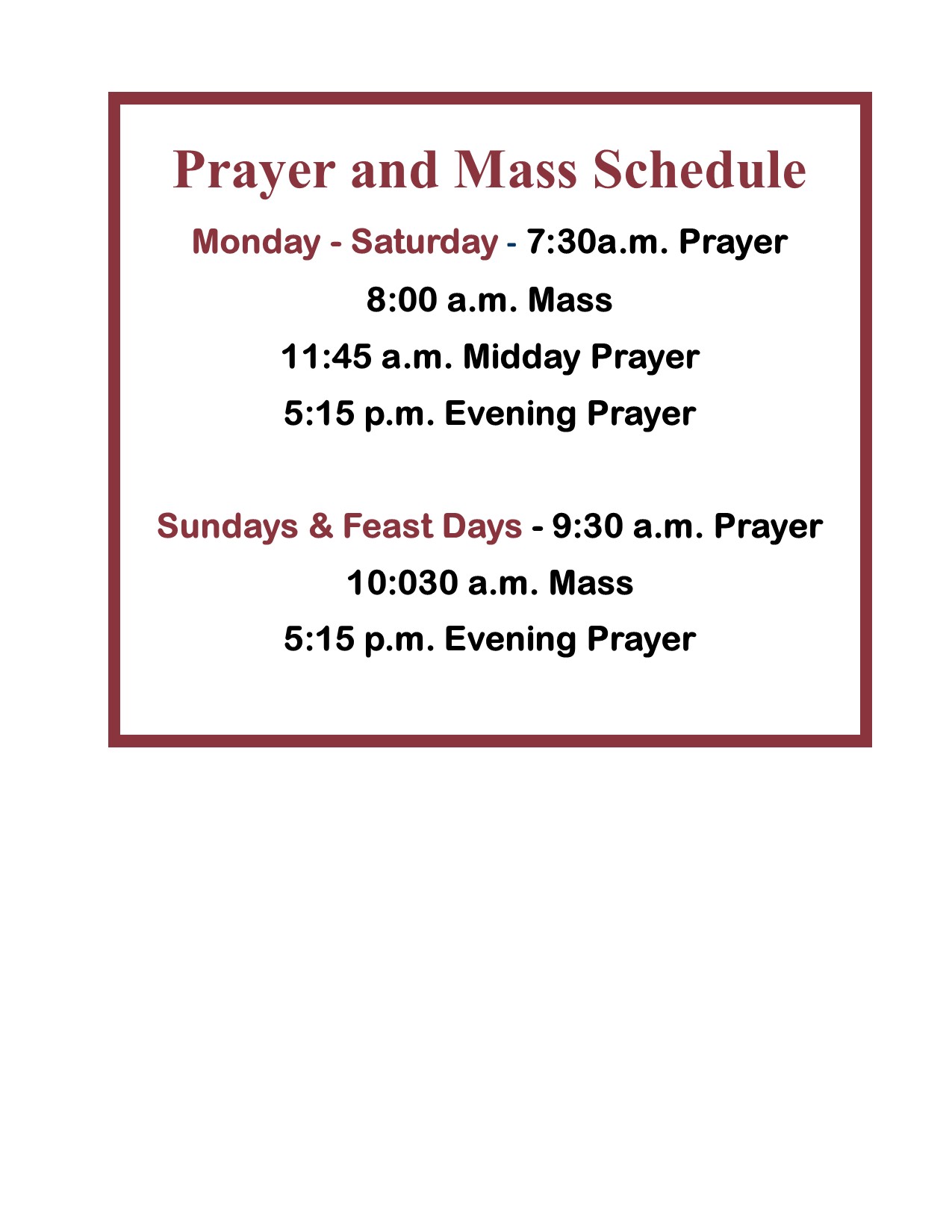
 Mass Schedule

Related Links

Copyright © 2026 · Benedictine Sisters of FL · Touching Lives Through Prayer and Service

Copyright © 2026 · Bendedictine Theme on Genesis Framework · WordPress · Log in