“Hope does not disappoint us, because God’s love has been poured into our hearts through the Holy Spirit that has been given to us.” Alleluia!
Romans 5:5

Continue Reading

Holy Name Monastery
Founded 1889
Romans 5:5
Continue Reading
Has it really been 50 days since Easter? It seems to me, maybe especially this past year, when I try to recall when something happened either it seems ages ago or a couple days ago. A review of the readings reminds me of all that happened in Jesus’ life and his interactions with his disciples during the 50 days following his resurrection.
 A few minutes ago we concluded this year’s Novena to the Holy Spirit – the Church’s first novena. For Mary and the eleven Apostles it was nine days of waiting (they did not know how long). For us, it is nine days of anticipation for the Solemnity of Pentecost. Between the extended Vigil Celebration and what is termed “Mass During the Day” there are eleven (11) selections for the readings.
In this reflection I’ll circle through the messages in Paul’s Letters to the Galatians, the Romans and the Corinthians. I wondered: what would Paul say to us today? I suspect he would say much the same things he wrote to the audience of his time. He might personalize it a bit to highlight the gifts (he’d say “peculiar”) to the body of people he was addressing. He’d speak of the group’s gifts – why? – because they are manifestation of the Spirit for the edification and benefit of the community.
I could hear him saying, of thinking to himself as he put pen to parchment:
You do know that to all of you – each of you – is given the gift of faithfulness to prayer, stability to each other and an endeavor for life-long learning. To one of you may be given the aptitude of expressing psalmody in musical settings; to another the skills to lift the notes off the page in song and to another the gift of prayer in poetry. To one is given the gift of sensitivity to the needs of the poor and to others the gift of touching the heart of the weary, the aged, the infirmed. One may have the gift of never knowing a stranger, and another the flair and daring to entertain the community as emcee for a party. To one is given the gift of calligraphy and to another the proficiency to write icons. To one is given the gift of fingers that dance across the keyboard and to another a green thumb that provides food for the table; to a gardener the knack to raise flowers from the dirt and to another the gift of arranging bouquets that inspire prayer. To some there is given ease in outreach ministries; to others the gift of keeping the home fires burning in internal ministries. To some there is given a volunteer’s heart. Some have the gift of quiet presence; to others the gift of keeping a conversation in play.
And never forget nor minimize that you are daily graced to witness each other’s perseverance in a life-long commitment to THIS community and your combined efforts to feed the hungers of the people of God.
Paul speaks again to us: “There is diversity of gifts, but the same Spirit distributes them. There are different kinds of service, but the same Lord. There are different kinds of working, but in all of them and in everyone it is the same God at work. Now to each one the manifestation of the Spirit is given (why?) – for the common good.”
In your midst there presently are those who respond to the ring of the doorbell; to others, the ring of a phone. There are those who serve as “personalized shoppers.” There are those who wield a mop and those who sweep; those who run the dish washer and those who scrub pots and those who restore order wherever they see a need. There are bell ringers, and weed pullers and mail carriers; those who write, those who read and those who watch. Some share the news, some inspirational stories and others a “Lady of Guadalupe or “Mountain Men” episode. Some set up the chapel, others the kitchen or buffet table or a meeting space. Some seek companionship; others are happy in solitude – some indoors, others outdoors; some walk the halls, others the driveway and some mark their steps going up the road apiece. Some like the later schedule, others still get up at 5 a.m. to catch the sunrise while others prefer to put the sun to bed at night.
Remember what Paul really said: “There is diversity of gifts, but the same Spirit distributes them.” Listen to the voice in your heart: “My child, you always have the gift of prayer … that doesn’t change … the words you use, silent or voiced, whether you sit or stand or kneel, the method you practice are all conversations with God. Remember the old Chinese proverb: “A Bird Does Not Sing Because It Has an Answer. It Sings Because It Has a Song.” As needs and station in life and health permits, your “song” may change over the years. Then, change your tune and let the world hear it. Sing your song with your life just because you have a song! It is one of the polyphonic parts in the grand harmony of the miracle of Pentecost – “They were filled with the Holy Spirit and began to sing in different voices, as the Spirit enabled them to proclaim the mighty acts of God.”
~Reflection by Sister Roberta Bailey, OSB
Continue Reading
This week our prayer intention is the 2021 Graduates. The Gospel is about the Commencement story for Jesus’ Apostles. It’s the same message (not the same exact words) that graduates across our country will be hearing: “Go into the whole world and proclaim the fruits of your education! Signs will accompany those who are influenced by you and your words. Be true to the ethics, the values, the attitudes that have been modeled for you. Drive out demons by refusing to be any less than you are called to be. Be sensitive to the voices that call out to you from the trenches. Lay your hands on the sick, the sorrowing, the poor; the victims of racism, inequity of services and opportunity.” Each year, we return to this story of Jesus’ ascension, we celebrate the event, and try to make meaning for our own lives. That’s what our graduates are charged with doing.
Jesus impressed upon his Apostles the same message that 2000 years later we know we can depend on. He tells us: “apart from me you can do nothing” and “I will be with you always.” He may have disappeared from sight, but he has not abandoned us. He kept assuring the Apostles that they had not imagined it – it was not a borrowed memory from someone else’s story: Jesus really had been among them and at least on two occasions he had something to eat with them. Remember, when he appeared in the upper room and asked: “Do you have anything here to eat?” And, again, on the seashore when he had breakfast already cooking for them when they hauled in that net-breaking catch of fish. This was a beautiful and very human thing to do; something that the disciples, and we, could completely relate to.
Among Jesus’ last words on this earth, is a powerful lesson in mutual sharing. It sounds a bit like ‘What’s mine is yours; what’s yours is mine.’ We hear Jesus say: “Everything that the Father has, is mine. When the Spirit comes, he will take from what is mine and declare it to you.” And, what is declared? “Peace I give you; my peace I leave with you.” Jesus wanted his disciples, He wants us, to understand, for all time, that the purpose of his life on earth, why he had to suffer and die the way he did – was all part of God’s plan. Jesus wants to impress upon us, that there is a lot of work to be done and not to worry if things aren’t always easy.
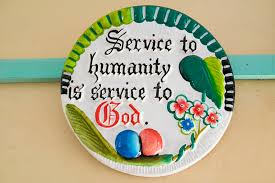 He has commissioned us, all his followers, to a life of service. In Jesus we are we empowered to do what He himself did. He sends us out to preach, to heal, and to drive out unclean spirits. Jesus continues to help us as we try to live as his followers – to call on our reserves of resiliency, holy dependence, and firm trust.
We recall that when Jesus was buried it was women who solemnly formed a funeral procession to the newly hewn grave. They anointed Jesus’ body with the customary herbs and spices that filled the walk-in tomb, and the surrounding air, with a pungent perfume that lingers on, even to this day’s atmosphere. You know that sensation you get in the chapel or our community room or a public elevator. Someone walks in and almost immediately thinks or remarks that someone must have Vicks cough drops. Or looks around wondering who’s been in the company of a smoker. Or asks who has on scented hand lotion. Or wrinkles her nose in puzzlement trying to figure out just what is that scent? For now, we turn in all directions to detect and track the aroma of the One who continues to guide us; leading us forward into unknown places, ministries, services. It’s that familiar fragrance we follow that leads us to Jesus. One day it will lead us to our eternal home with Him. Even before we’re fully aware we’re in his presence, we’ll have found Him. Like Mary Magdalene on Jesus’ resurrection morn, we’ll hear Him speak our name.
~Reflection by Sister Roberta Bailey, OSB

The theme of this Gospel is clearly love but not the kind of love we see on film or on TV, hear on the radio or a CD. In church hymns, too, we frequently sing about love. But, as Oliver sings in the musical based on Charles Dickens’ story, “Where is love?” We ask: What is love?
Father Andrew reminded us the other day, love is a gift freely given. If we receive it freely, dare we do anything less. For just a minute, let’s step aside to look at where John places this teaching. It fits squarely between the Gospel readings from this morning (Saturday) and yesterday (Friday) and immediately after the Gospel proclaimed last Sunday: the vine and branches where we were reminded that it is only in our union with Jesus that we can render fruitful service.
Sometimes we hear this word “love” used in such a way that we degrade, lessen or weaken its significance. The way Jesus, or in this case John, uses the word for love just doesn’t apply to chocolate, a long drink or an afternoon nap. We may like and enjoy those things a lot, but we don’t “love” them in the way we love our neighbor.
It is notable, I think, that Jesus gives us just ONE love commandment. He does not say, “Love me, love my father or love God as I have loved you.” No, he says, “If you want to be my disciple, then you must love one another.” If we really love our brothers and sisters we do not have to worry if we love God. But, if we do not love everyone unconditionally, then there is no other way we can claim to love Jesus. We need to love like God loves – without exception.
We have the perfect model in the love between the Father and the Son – selfless giving. The Father has given all things to the Son. The Son lays down his life in obedience to the Father. One scholar writes that, “Love is the will to good…One who loves promotes the good, or wills the benefit and strength, of the beloved – this is the nature of God.”
Deep down, we all want to love and be loved. We like people to be our friends. Yet, because of our past experiences, the influence of parents and other people around us, the pressures of our society and our traditions, and plain bad habits, we often do not know how to love, do not know how to forgive, do not know how to be reconciled. We do not practice the skills we know that promote healthy relationships.
Sometimes people will love us back, sometimes they will not. People learn to love by being loved. We learn to share love and communicate our feelings by imitating the models we live with. Remember your mom coaxing you when you received a gift or a compliment: “What do you say?”
When I genuinely love others, there will always be some who cannot love me back but there will be others who will really respond in love. And it may be that my love has empowered them to be loving too. Benedict reminds us in the Prologue to the Rule – we heard it read just yesterday: “See how the Lord in his love shows us the way of life…. What is not possible to us by nature, let us ask the Holy One to supply by the help of grace … while there is still time, while we are in this body and have time to accomplish all these things … we must run and do now what will profit us forever.” We know, but too often forget, that Jesus never told his disciples to LIKE each other. He said, “LOVE one another.” And how does Jesus express love? We know it is freely and without reserve. He gives us a “how to” when He says: “I am gentle and humble of heart.” This is how we are to love one another: in humility with gentleness. Just as we cradle and carry a precious glass object, we value and treasure our free gift of love with special caring.
It’s a life-long journey, isn’t it? We may have fleeting moments when “perfect love” rises to the surface of our motivation to action. I think it was St. Irenaeus who said a very long time ago that “The glory of God is a person fully alive.” (John Powell)
 You see, love is God’s very nature – God cannot not love. How does God love? Full hearted and unconditionally. Jesus gives us just one commandment that encompasses all the others. He does not say, “Love Me as I have loved you.” No, he says, “If you want to be my disciple, then you must love one another, as I have loved you.” If we really love our brothers and sisters, including strangers and even enemies, we do not have to worry if we love God. In one of our “love” hymns, we sing “Where love abides, our God is ever there.”
St. John does not say to us, “Wherever there are Christians, there is God” or “Wherever there is a Christian church, there is God.” No, he says, “Wherever there is love, there is God.” Wherever there is a person filled with love for others, God is there.
Continue Reading

