• Skip to primary navigation
  • Skip to main content
  • Skip to footer
Benedictine Sisters of FL

Holy Name Monastery
Founded 1889

Donate Now
  • Home
  • About Us
    • History
    • Being Benedictine
    • Benedictine Monasticism
    • Meet Our Community
    • Holy Name Academy-Alumnae
  • What We Do
    • Mission, Vision and Our Partners
    • Retreats
      • Invitation to Retreat
      • Accommodations
    • Volunteer Programs
    • Oblate Program
    • Spiritual Direction
    • Aqua/Hydroponics
    • More of Our Ministries
  • What’s Happening
    • Articles of Interest
    • Events
    • Commemorative Bricks
    • Newsletters
    • Brochures
    • Links
  • Support Us
    • Gifts of Support
    • Wish List
  • Stories Shared
  • Galleries
    • Photos
    • Videos
      • Benedictine Sisters of FL Videos
      • Other Videos
  • Contact Us

Prayer

Why is Jesus called by this strange title, “the Lamb of God”?

January 17, 2017 by Holy Name Monastery 1 Comment

First Reading Isaiah 49:3,5-6    Second Reading  1 Corinthians 1:1-3
Gospel John 1:29-34
Today we hear the story of what John the Baptist witnessed when Jesus, his cousin, approached him in the river Jordan where John was baptizing those who came forward.   Last Monday we heard Matthew’s account of Jesus’ baptism.  The two accounts differ because the evangelist we hear today does not describe the baptism.  Instead, in John’s account, John the Baptist announces that he knows that Jesus is the Son of God. He cries out, giving witness about who Jesus is. He says that he saw the Spirit descend upon Jesus. By this sign, John the Baptist knew that Jesus was the one who was to come after him.

We hear two familiar titles for Jesus. John calls Jesus the “Lamb of God” and the “Son of God” identifying Jesus’ ultimate purpose is to redeem humanity. We need to know who Jesus is, if we want to be his disciples. We also need to know what his mission is, if we want to be good disciples.

Why is Jesus called by this strange title, the Lamb of God? It refers back to the origins of the great Jewish feast of the Passover that commemorates when the people were told, in order to escape punishment, that they should smear the doorposts of their houses with the blood of a lamb. When God’s angel struck, he passed over the blood-painted houses of the Israelites and their children were spared. They had, in effect, been saved by the “blood of the lamb.”  The lamb then becomes the sign and symbol of the liberation of God’s people from slavery and oppression. But for us – and this is what John the Baptist’s means – Jesus is the new Lamb which brings freedom and liberation.

The purpose of John’s baptism was to make Jesus known to Israel.  John’s witness is an excellent example of what it means to be a disciple. By our Baptism, we are called to be disciples – to make Jesus known to all the world by our words and by the witness of our lives.

This Wednesday we will begin the Week of Prayer for Christian Unity.  The theme for 2017, “Reconciliation – The Love of Christ Compels Us” was chosen to mark the 500th anniversary year of the beginning of the Reformation.  Two accents are reflected: the main concerns marked by Martin Luther’s Reformation and our recognition of the pain of the subsequent deep divisions which continue to afflict the unity of the Church.  Christians are encouraged to pray and to view this week as a first step toward reconciliation.

Each year on his birthday, our nation takes time to stand back and contemplate the impact of Martin Luther King on the course of history. It may be tempting to treat this day like any other.   But, many of us cannot forget; we grew up in a segregated society.  Most of us remember attending – or for that matter teaching in – racial segregated school. We went to all-white schools.  We can remember “whites only” water fountains, lunch counters and seats on the bus.  The name of Martin Luther King, Jr. represents the blood, sweat and tears of many, many people.  Praise God for people who live by the courage of their convictions.

Tuesday evening, in his farewell address, President Obama reminded our nation:  “For white Americans, it means acknowledging that the effects of slavery and Jim Crow didn’t suddenly vanish in the ’60s; that when minority groups voice discontent, they’re not just engaging in reverse racism or practicing political correctness; when they wage peaceful protest, they’re not demanding special treatment, but the equal treatment that our founders promised.”

In 1956, Rev. King realized just how parched he was, how needy he was for a drink from God’s fountain of live-giving water.  On January 27 of that year, he received a phone call: “Nigger, we are tired of you and your mess now, and if you are not out of Montgomery in three days, we’re going to blow your brains out and blow up your house.”  Dr. King was so disturbed by this threat to his family and was especially concerned for his newborn daughter.  He went to the kitchen seeking solace from a steaming cup of coffee.  As he began to muse he was confronted with a vision in the kitchen.

In his words: Rationality left me…and I started thinking about many things.  Something said to me, you can’t call on daddy now; he’s in Atlanta – You’ve got to call on that something, on that person that your daddy used to tell you about, that power that can make a way out of no way.  And I discovered then that religion had to become real to me and I had to know God for myself.  I bowed down over that cup of coffee, I never will forget it.  I prayed out loud: Lord, I’m down here trying to do what’s right.  I think the cause that we represent is right.  But Lord, I must confess that I’m faltering.  I’m losing courage.

Almost out of nowhere I heard a voice.  “Martin Luther, stand up for righteousness.  Stand up for justice.  Stand up for truth.  And lo, I will be with you, even until the end of the world.”   Dr. King recounts that he was ready for anything after this.  He experienced renewal from the fountain of life.

Tuesday is a national day of prayer for reconciliation and healing.  Let us take this opportunity to renew our baptismal commitment.  With all these celebrations (this week)  we are impelled to revisit our own “vision in the kitchen” and like genuine messengers of God to respond with the sentiments of tomorrow’s responsorial psalm: “I will announce your justice in the vast assembly; I will not restrain my lips, as you, O Lord, know.” Further, with the words of the psalmist we pray: “I waited, waited for the Lord, and God stooped toward me and heard my cry. He put a new song into my mouth, a hymn to our God. “

~Reflection by Sister Roberta Bailey, OSB, Prioress
Continue Reading

Filed Under: Blog, Homily Tagged With: Christian, God, Jesus, Lamb of God, National Prayer Day, Prayer, Rev. Martin Luther King, Son of God

Perseverance of Prayer

October 17, 2016 by Holy Name Monastery 1 Comment

luke-18-1-8-2First Reading    Exodus 17:8-13.                  Second Reading    2 Timothy 3:14—4:2
Gospel           Luke 18:1-8

Here we have a lesson about perseverance in prayer.  The point of the story is not that prayer is nagging God for what we want.  Nor is it meant to teach us that God is like the judge in the parable – worn down by requests and coerced to respond.

The key to understanding the meaning is found in the description of the judge as corrupt and unjust.  Since God can be neither, we must understand Jesus to be saying that if even an unjust judge responds to the persistence of the widow, how much more will God listen to our prayers.  God truly wants to hear our needs and respond generously.  Didn’t Jesus say: “Ask and you shall receive?”   Jesus is telling us that God wants us to be like the persistent widow, staying in relationship with God, confident that God hears and answers prayers.   And He understands how easy it is to lose heart.  He asks: “Will such faith, the faith of the widow, be found when the Son of Man returns?”

A beginning of the answer to the question appears to be that the Son of Man will find faith, but it may be in unexpected places, as it has been in the Gospel — not among the religious professionals or the ones certain of their own righteousness, but among the outsiders, the unlovely, the unclean, the ones certain of their sinfulness.

The parable suggests that a sign of faith will be a willingness to persist in prayer, as we see in this widow who persists against all odds in her fight for justice against the powerful judge.  Another sign may be in what we pray for: daily bread, the Holy Spirit, the coming of the kingdom, justice.

In his gospel, the evangelist Luke portrays widows as vulnerable but at the same time prophetic, active, and faithful.  The widow of this parable is forceful enough to get the justice she demands even from an utterly unjust judge.

If we could read the Greek version of this parable, we’d get a glimpse of Jesus sense of humor.  Now by “Greek” I don’t mean the language we refer to when we say “It’s all Greek to me.”  In the Greek Scriptures the judge gives in to the widow because if he doesn’t he fears she may give him a black eye.  Jesus uses a metaphor from boxing to make his point about the need to continue in prayer.  Be as persistent as a boxer in the ring when it comes to prayer.  Jesus gives a second teaching in the parable. If an unjust judge answers the pleas of a widow how much more will God answer our prayers.  We just don’t know WHEN.  Remember the words of the prophet Habakkuk?  “The vision still has its time and will not disappoint.”  God takes the long view … knows what is best and we may sometimes have to wait until we’re, as they say: “on the other side of the grass,” where we’ll understand that all along God knew best.

Luke seems to be very much aware of the real danger of giving up, of losing heart when we suffer injustice.  Luke is saying that if we pray hard enough and if we don’t lose heart, God will give us justice, right?  Well, does God?  Is there justice in the world?  In our country?  In our local communities, and (sadly) in our churches?  We have only to watch the evening news or read the day’s headlines to learn of multiple cases of brutality and injustice.

Could it be possible that God’s justice looks different than our justice?  Good question. Yet, somehow I trust that God gives us a righteous sense of justice–especially if it is a selfless sense of justice–one that is concerned with others.  Look at our widow. What does she do to obtain justice? She is persistent.  She is stubborn.  Perhaps we should call her attitude a kind of “holy stubbornness.”  She doesn’t give up – she doesn’t lose heart.  She keeps knocking at the judge’s door.

Now, I believe I don’t have to explain “stubbornness.”  Some of us had it sprinkled on us in our cradles!  We can prettify it, call it by another name, whatever we want: high principles, perseverance, tenacity, determination or just plain pigheadedness.  Yes, we seem to be naturally endowed with the “great gift of stubbornness” and the only thing God has to help us with is to learn how to be stubborn for the right causes — God’s justice.  In that case we may talk about a “holy stubbornness.”  That happens when we start not only to pray our prayers, but when we start to live our prayers.  In other words, we put our actions where our words are.  Victims of poverty, injustice or violence don’t want to hear about God’s commandments, about moral values, about self-denial, or even about justice.

Luke is right: it is easy to lose heart and go with the flow rather than go against the current.  It takes more than a petition at Mass to make our prayers effective. Think of all the corporate commitment action opportunities we are offered.  When we support our petitions with a donation to Christmas for the residents at Heritage, attend the Sunrise Prayer Vigil, write letters asking for legislative action on behalf of the poor, make a donation to the Soup Supper or volunteer at Daystar.

You may ask, or be asked: “can prayer move God’s arm?” Jesus turns this question back on us today and concludes his parable with the question: “Will the Son of man find faith when he returns?”  In other words he is asking: “Can prayer move your own arm?  Are you willing to put your actions where your words are?”  God always has relied on his children–people like you and me–to usher in His Kingdom.  God will give us strength, God will empower us, but we still need to stubbornly live out our prayers for justice.  The first reading reminds us we don’t have to be alone in our entreaties.  One of the beauties of living in community or being part of a faith community is that, like Moses’ (in tomorrow’s first reading) – we have friends who “hold our hands until sunset” – we have the prayer support of many others.  Are our prayers effective?  The answer lies squarely with us: “it depends on how effective we help make them.”


~Reflection by Sister Roberta Bailey, OSB, Prioress
Continue Reading

Filed Under: Blog, Homily Tagged With: Faith, God, Jesus, parable, perserverance, Prayer

One Minute of Prayer Every Night!

July 12, 2016 by Holy Name Monastery 2 Comments

This sounds like a worthy idea … we can’t imagine the power of prayer:

hands clasped in prayer over a Bible

During WWII, there was an advisor to Churchill, who organized a group of people who dropped what they were doing every night at a prescribed hour for one minute, to collectively pray for the safety of England, its people and peace. This had an amazing effect, as bombing stopped.

There is now a group of people organizing the same thing here in America. The United States of America, and our citizens, need prayer more than ever!!! If you would like to participate, each evening at 9:00 P.M. Eastern Time (8 PM Central, 7 PM  Mountain, 6 PM Pacific), stop whatever you’re doing, and spend one minute praying for the safety of the United States, our troops, our citizens, for peace in the world, the upcoming election, that the Bible will remain the basis for the laws governing our land, and that Christianity will grow in the U.S.

If you know anyone who would like to participate, please pass this along. Someone said if people really understood the full extent of the power we have available through prayer, we might be speechless. Our prayers are the most powerful asset we have. Thank you.

Please pass this on to anyone who you think will want to join us.

God Bless You!!!

~Sister Roberta Bailey, OSB, Prioress
Continue Reading

Filed Under: Blog, Prayer Tagged With: America, Christianity, Churchill, Daily, Night, one minute, Prayer

Trying Not To

February 15, 2016 by Holy Name Monastery Leave a Comment

boy-eating-cookieI think we all understand what temptation is.   Imagine there’s a little boy in a grocery store who walks by an open pack of peanut butter cookies. The clerk notices him eye the cookies.  “What are you doing there?” “Nothing,” replied the boy. “It looks to me like you’re trying to steal a cookie.” “No,” said the boy, “I’m trying not to.” That’s temptation!

We understand that temptation leads to trouble.  Such was the plight of the man that I read about in Reader’s digest.  This man said he was shopping in the mall with his wife when a shapely young woman is a short, form-fitting dress walked by.  He followed her with his eyes.  Without looking up from the item she was examining his wife asked, “Was it worth the trouble you are in?”  That’s the trouble with temptation.

How many of us have shrugged and said, “The devil made me do it!” and used that as an excuse when caught doing something we weren’t supposed to?  It’s a convenient defense.  But there’s one problem: the devil can’t MAKE us do anything.  He may be clever, but he’s not all powerful.  It may feel that way, however, when we’re dangling on temptation’s hook, because the devil has a tried and true strategy for luring us into his net.  First, he lays out the bait.  He knows us like a skilled fisherman knows fish.  He notes our habits, observes our hangouts; then he drops a custom-made lure right in front of our noses.

Then, comes the appeal.  He can’t make us bite, but he does know what happens when we catch a glimpse of the tantalizing bait … like the snapshot promo on TV.  We’re drawn in, we linger over it, we toy with the idea, roll it over in our minds until it consumes our imagination … we just HAVE to know what the gossip tid-bit was we overheard is all about.

Now the struggle really begins.  Our conscience jabs us in the ribs, the red flags go up, the warning sirens go off but the invitation looks so delightful.  What do we do?

Benedict knew about this, didn’t he?  Remember in chapter 43 where he warns if the monastic comes late for chapel, if though ashamed, she should still come inside lest she be tempted to return to bed and sleep.  Or, worse he says, settle down outside and engage in idle talk, thereby giving occasion to the Evil One.  They should come inside so that they will not lose everything and may amend in the future.”

Either we will resist or yield, swim away or swallow the temptation whole.  When you give in you know the feeling of emptiness and the pain that sticks in your neck.  But, be alert when you do resist – be ready for the temptation to come from a different direction.  However, when you’ve resisted you will know a feeling of freedom that envelopes you.

It seems there are three general kinds of temptations that our adversary still uses. He often tries to work his wiles on the heels of a spiritual high point in our life.  Or it may come at a time of physical weakness, or when we’re are alone and are more susceptible to temptation – then be prepared for a major attack.    Jesus experienced the devil’s temptation, just after his baptism and the Father’s affirmation; when he was hungry following his 40-day fast, when he was alone in the desert.  Thus he could sympathize, no, –  empathize with us,

This Gospel lesson alerts us to the dangers – the allurement of the devil – to be tempted to be independent – like a two-year-old’s “I’ll do it myself.”  Or we may give into temptation to take the easy way out.  It will be less suffering, no struggle, no sacrifice … why work to conquer our self-will when the world could be handed to you on a silver platter – give you a free ride?

The one thing common to all three of the temptations described is that Satan attempted to distract Jesus from his mission and to destroy his relationship with his Heavenly Father.  You may have to fight the battle more than once to win it.  Don’t give up!  There is truth in the story of what Martin Luther said when he was asked how he overcame the devil.  “When the devil comes knocking at the door of my heart, asking who lives there,” Jesus comes to the door says: “Martin Luther used to live here, but he has moved out.  Now I live here.”  When Christ fills our lives Satan just has no entrance.

You may have learned this little ditty of a prayer as a child.  It’s still a good one for nightly protection:  I liken it to a child’s compline (evening prayer) –

“Matthew, Mark, Luke, and John,
Bless this bed that I lie on.
Before I close my eyes in sleep,
I give my soul to Christ to keep.

Four corners to my bed,
Four angels ’round my head,
One to watch, one to pray,
And two to bear my soul away.

I go by sea, I go by land,
The Lord made me with his right hand,
If any danger come to me,
Sweet Jesus Christ, deliver me.

For he’s the branch and I’m the flower,
Pray God send me a happy hour,
And if I die before I wake,
I pray the Lord my soul to take.


Continue Reading

Filed Under: Homily, Prayer Tagged With: Benedict, devil, Jesus, Lent, Prayer, satan, temptation

Second Sunday in Advent 2015

December 7, 2015 by Holy Name Monastery Leave a Comment

Friendships can grow apart unless…..

friend driftReading about John the Baptist reminded me of the evening, long ago during the liturgical transition, when we were using “purple pages” for prayer services.  Liturgists often provided a focal visual in the chapel.  For Vespers, I had designed a desert area, low on the floor, with sand (on a sheet thank goodness!) and rocks and cactus plants.  The display included a sign (not very large) that read, in the words of the entrance hymn, “What did you go out to see.”   When our elderly, arthritic Sister Annunciata came into the chapel, Sister Anna Marie (her peer) was already seated.  She watched as Sister Annunciata inched forward step by step and bent down until she could read the sign.  What happened next set all of us laughing, Sister Anna Marie said aloud:  “What did you go out to see?”

Luke’s Gospel quotes the prophet Isaiah, describing the road we must travel throughout Advent (and our whole lives) in order to see the signs of the times and reach the One foretold: our Emmanuel.

Like Mary and Joseph we must travel through valleys, between hills and over mountains in order to be counted.  We weather life’s troubles, storms of despair and disappointment, look out over the vista from the joyful mountain peaks of our lives to view the beauty God has laid out for us.

Like the Magi we bring gold, incense and myrrh for our Infant King – the gold of charitable deeds, our incense arising from prayerful hearts, minds and voices; and the myrrh of illnesses, infirmities and troubles to unite with the redemptive sufferings of Jesus.

Our community stationery proclaims: we are “touching lives through prayer and service.” But, without deliberate attention, daily practices can become pro forma, only a formality repeated by heart, a mindless routine UNLESS we are continually in touch with the workings of God within through a rich prayer life – faithful to the practices of lectio and meditation, Eucharist, private and communal prayer – not simply seasonal: Advent, Lent and annual retreat …  but daily.   It may be helpful to make a pie chart of your 24-hour day … what percentage do you give to keeping company with God.  We may be tempted to say “all my work is a prayer.”  That can be true if you start and end the day with the Sign of the Cross.  But, friendships can drift unless we do the work of keeping them alive. We need a jolt of spiritual energy at intervals during the day.  We want to guard against making a sham of people’s trust that we are a prayerful people.  Benedict knew this when he laid out times for gathering for Divine Office, times to read and study, times for rest, manual labor, eating, conversation and quiet.  Today we are personally responsible for what we do with much of our time.   Remember, what S. Bernie quoted from CALL to LIFE: we listen DAILY to God’s call and respond with good zeal.”   Group meditation for us is a practice of the past.  But, a strong community can count on the group, assured that each individual member has taken time each day to reflect on the Word, and be with the Word, and discern its significance in her own life as well as power and push of the Word in the life of the community.  That’s how we are able to grow in the ability to come to consensus, refine relational skills, and nurture the gifts of mutual forbearance and forgiveness…   in reciprocated love and respect.  It takes dedication, determination and perseverance not to be the bad apple in the barrel.

On the road to Bethlehem, we will meet construction along the way, or be the one under construction.   In the Gospel last week, Jesus warned us to be alert, watching for God’s unexpected activity in our lives.  In this weekend’s readings, we see sign we dread: Road Construction Ahead.  We mutter: “Didn’t they just finish working on this road?” We get impatient when we see road construction signs, because they speak to us more of inconvenience, hassles, and delays, rather than the benefits that are hidden in the distant future.  The sign reminds us: Proceed with Caution.

We can hear John the Baptist shouting with the powerful words of the prophet Isaiah, almost like a highway foreman, “Prepare the way of the Lord! Make that path straight! Fill that valley! Get that mountain outta here! What happened over there? It’s all crooked! Make it straight! Smooth out that rough place! We gotta show everyone the salvation of God. Get busy!”  Time is running out – the day of the Lord is near!  In three short weeks Christmas will be here – our Emmanuel will appear!

                                                                                                                 Reflection by S. Roberta Bailey, OSB, Prioress


Continue Reading

Filed Under: Homily, Prayer Tagged With: Advent, Community, Friendship, John the Baptist, Luke, Prayer

29th Sunday in Ordinary Time

October 19, 2015 by Holy Name Monastery Leave a Comment

humilityFirst Reading  Isaiah 53:10-11   Second Reading Hebrews 4:14-16
Gospel    Mark 10:35-45 (shorter form Mark 10:42-45)

Often, it is said, when looking for a job it is not what you know but whom you know that counts most.  In China, people often speak of guanxi, ” (guan-shee) connections” with people in the right places.

Today we see two brothers, who belong to the innermost circle of Jesus’ disciples, trying to exert their guanxi.   But listen to Jesus: the last be shall first and the first shall be last.”  He reminds us that the way to heaven is not in sitting on thrones, living in fine houses, driving luxury cars, having the latest tech gadgets or having holidays in exotic places.  Greatness consists not in what we have, or what we can get from others but in what we can give of ourselves to others.

Jesus asks us: Can you drink the cup I am going to drink?  These two brothers, in their eager ignorance, answer without hesitation:: “No problem!”

For us as Benedictines – in Benedict’s view, we are all called to cultivate a humble awareness of our place in creation.  Being humble brings the realization that we are capable of making gods of the very things that should be serving and enriching our lives.  It requires a humble trust in God’s providence.  For St. Benedict, everything a monastic does must be done for the glory of God – that is why we were created.  Remember your Baltimore catechism:  we were made to know, love and serve God.  A fifth century monk says it well: A proud monk needs no demon. He has turned into one, an enemy to himself.

In our own lifetime, Mother Teresa gives us a few ways to practice humility that sound much like Benedict’s steps of humility:

To speak as little as possible of one’s self.

To mind one’s own business.

Not to want to manage other people’s affairs.

To avoid curiosity.

To accept contradictions and correction cheerfully.

To pass over the mistakes of others.

To accept insults and injuries.

To accept being slighted, forgotten and disliked.

To be kind and gentle even under provocation.

Never to stand on one’s dignity.

To choose always the hardest.


This Prayer for Humility by an Anonymous Abbess is worth pondering line by line…:

Lord, you know better than myself that I am growing older and will soon be old. Keep me from becoming too talkative, and especially from the unfortunate habit of thinking that I must say something on every subject and at every opportunity.

Release me from the idea that I must straighten out other peoples’ affairs. With my immense treasure of experience and wisdom, it seems a pity not to let everybody partake of it. But thou know, Lord, that in the end I will need a few friends.

Keep me from the recital of endless details; give me wings to get to the point.

Grant me the patience to listen to the complaints of others; help me to endure them with charity. But seal my lips on my own aches and pains — they increase with the increasing years and my inclination to recount them is also increasing.

I will not ask you for improved memory, only for a little more humility and less self-assurance when my own memory doesn’t agree with that of others. Teach me the glorious lesson that occasionally I may be wrong.

Keep me reasonably gentle. I do not have the ambition to become a saint — it is so hard to live with some of them — but a harsh old person is one of the devil’s masterpieces.

Make me sympathetic without being sentimental, helpful but not bossy. Let me discover merits where I had not expected them, and talents in people whom I had not thought to possess any. And, Lord, give me the grace to tell them so.    AMEN

Just remember, as an ancient monk said: “When we become aware of our humility, we’ve lost it.”

                                                                                                                                        Sister Roberta Bailey, OSB

Continue Reading

Filed Under: Homily, Prayer Tagged With: Benedict, humble, Jesus, Lord, patience, Prayer

  • « Go to Previous Page
  • Page 1
  • Interim pages omitted …
  • Page 5
  • Page 6
  • Page 7

Footer

Prayer / Newsletter / Info

 Contact Info

Benedictine Sisters of Florida

PO Box 2450
12138 Wichers Road
St. Leo, FL 33574-2450
(352) 588-8320
(352) 588-8443

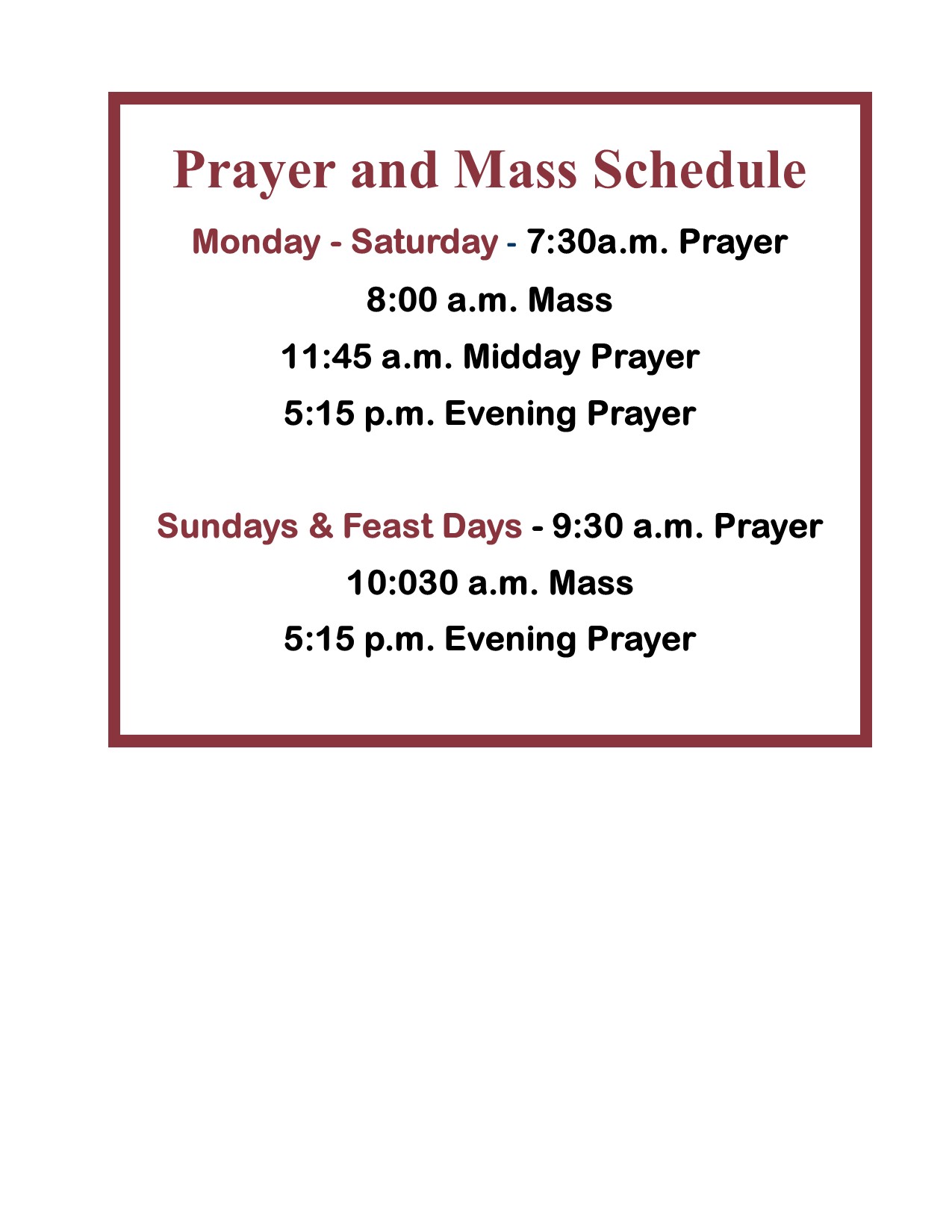
 Mass Schedule

Related Links

Copyright © 2026 · Benedictine Sisters of FL · Touching Lives Through Prayer and Service

Copyright © 2026 · Bendedictine Theme on Genesis Framework · WordPress · Log in