• Skip to primary navigation
  • Skip to main content
  • Skip to footer
Benedictine Sisters of FL

Holy Name Monastery
Founded 1889

Donate Now
  • Home
  • About Us
    • History
    • Being Benedictine
    • Benedictine Monasticism
    • Meet Our Community
    • Holy Name Academy-Alumnae
  • What We Do
    • Mission, Vision and Our Partners
    • Retreats
      • Invitation to Retreat
      • Accommodations
    • Volunteer Programs
    • Oblate Program
    • Spiritual Direction
    • Aqua/Hydroponics
    • More of Our Ministries
  • What’s Happening
    • Articles of Interest
    • Events
    • Newsletters
    • Brochures
    • Links
  • Support Us
    • Gifts of Support
    • Wish List
  • Stories Shared
  • Galleries
    • Photos
    • Videos
      • Benedictine Sisters of FL Videos
      • Other Videos
  • Contact Us

John

Leadership through Service

October 24, 2018 by Holy Name Monastery Leave a Comment

This lesson we just heard from Mark is interesting in that it differs from how Matthew related it.  Maybe it tells us something about the two evangelists.  In Matthew’s version of the story, it was the mother of James and John, who asks Jesus to give her sons positions of importance in the coming Kingdom.  Matthew must have thought that it was unbecoming for an apostle to make such a bold request.  Mark, however, appears to be more honest.  He wants us to understand that the disciples were very ordinary people.

Mark also gives us some insight into the character of James and John.  They may have been lowly fishermen but they certainly were not shy about taking this opportunity to look out for their future.  Like the other disciples, they believed in Jesus.  They were confident of his leadership – they just wanted be sure they were included.  They wanted to ride on his coat tails.  We all have seen that … people who are impressed with titles – who want to be buddy-buddy with the boss just because she has the title and they think she has the power.  Jesus did have the power but He wanted to impress upon the two brothers the price they’d have to pay for the privilege they wanted …  the service they’d have be prepared to render.

Jesus’ response to James and John reveals what He means when he speaks of greatness.  His definition is inevitably linked to service.  That which makes a person great is not their ability to rule over others.  Rather, it is the ability to invest one’s self for the welfare of others.  In a world where most people want to put as little as is possible into life and to get out as much as possible, our Lord speaks of a better way.

Jesus calls us to that “better way” today.  Only when we are willing to put more into life than we take out – to put service to others in a place of honor-only then, Jesus tells us, are we worthy to be called his followers.

The author Sue Monk Kidd says in her memoirs: we humans need stories almost as much as we need the air to breath.  Jesus often began: Sit down, let me tell you a story.  So, listen now to a new story with the same meaning as the gospel we just heard.

Once upon a time (that tells you it’s going to be a pretend story or a fable)… Well, once upon a time, in a far-off country, a king had twin sons.  One was strong and handsome.  The other was intelligent and wise.  As the ruler aged, everyone speculated about which son would be the king’s successor – the strong son or the wise son.

In this land, the sign of kingship was a royal ring.  Just before the king died, he had a copy of the royal ring made and presented one ring to each of his twin sons.  The chief advisors to the king asked him, “How shall we know which son wears the authentic royal ring?”

“You shall know,” answered the king, “because the chosen one will reveal his right to rule by his self-giving service to our people.”

[Richard Carl Hoefler, Insights, October 1988]

Sitting down, Jesus called the twelve and said to them, “If anyone wants to be first, he shall be last of all and servant of all.”

~Reflection by Sister Roberta Bailey, OSB, Prioress
First Reading   Isaiah 53:10-11             Second Reading   Hebrews 4:14-16    
Gospel Reading  Mark 10:35-45 (shorter form Mark 10:42-45)
Continue Reading

Filed Under: Blog, Front Page, Homily Tagged With: believe, disciples, James, Jesus, John, Mark, Matthew

Four Weeks Suspended in Kairos

December 11, 2017 by Holy Name Monastery Leave a Comment

In her book, THE LITURGICAL YEAR, Joan Chittister makes the comment: “Advent, more than any other season of the church year, calls us to live simultaneously in the past, the present, and the future.  She elaborates: “We learn in Advent to stay in the present, knowing that only the present well-lived can possibly lead us to the fullness of life.  It takes an overview of the three-year cycle of Advent readings to make clear the multiple meanings of Advent.  Many of our Advent hymns keep this idea before us when we sing “Mara – natha – two words – The Lord has come … God of, and in, our) past, present and future are all lived together … soul.” (Chittister)

We eagerly await the coming of Christ as a baby in Bethlehem (the past), we are invited to welcome him into our hearts now (the present), and we look forward to his future coming as king of glory.  For four weeks of Advent we are suspended in kairos — God’s time — when expectations and reality are held in tension with each other.  We must hold on to a vision of what challenges the church (that’s all of us) should be dealing with today.  Dwelling in the past or wishing for a perfect future can keep us from hearing the will of God in our today.  Many recognize in Pope Francis a voice that is, like John the Baptist, crying in the wilderness … urging us forward in the present to mend the past as we confront the ills of today.

This Gospel introduces us to the man: John.  The opening lines in Mark’s gospel are “the beginning of the Gospel of Jesus Christ” but the first character he introducers is not Jesus, but John the Baptist, the fiery preacher who came out of the desert where he lived on honey and locusts.  And, he is no fashion plate, with his camel’s hair clothes, leather sandals, and leather girdle around his waist — very much like Elijah.  His diet was very simple: locusts (grasshoppers) and wild honey.  This is important, or it would not be here.  It is symbolic. But what does it symbolize?  Well, you cannot wear anything more fundamental in the way of clothing, or eat a more basic diet, than John did.  In other words, it is representative of his ministry — one of simple beginnings.  It is not the end; it is the beginning.  The beginning of the gospel of Jesus Christ, the Son of God is all about repentance.  This is the place to begin.  Even John’s clothing and his diet helped convey that message.

His diet, by the way, was balanced.  Food fanatics will quickly recognize that grasshoppers are protein, and honey is carb.  John’s diet was in perfect balance, so that he was a healthy man.  It was a simple sort of diet, just as his ministry was – nothing elaborate.  Furthermore, he’s very honest.  He says, “Don’t look to me for answers beyond what I have already told you.  Anything beyond that must come from Another, who is coming right after me.  He is so much greater than I that I am not even worthy to untie his shoes.  Remember, this was his cousin he was talking about!  John could bring people to God, but he could not take them beyond that.  John began his ministry in the wilderness, the worst possible place. But it worked!

The people of Jerusalem and Judea left their cities, their recreations and pleasures, and trekked through a howling wilderness to listen to a man preach.  They probably had to walk twenty or thirty miles to hear John, but did so willingly and in such increasing numbers that Mark records, in only slight exaggeration, that “all the country of Judea, and all the people of Jerusalem” came out to hear him.  Something drew these people into the desert to listen to this strange and rugged young preacher proclaim good news.  That is all he did!  He never told how it worked, or why; he just announced it.

How fitting it is that we have this message of forgiveness and repentance as a prologue to our Penance Service on Tuesday evening.  Then, as now, people need to know they can begin again.  God offers us, once again, an opportunity to truly repent.  We can change our attitude and stop defending ourselves and trying to blame everything on others.  There’s a saying: the whole world’s a critic.  Tuesday’s reconciliation service gives us a chance to be our own critic and say, “You know what, God?  I’ve finally realized it’s not those others, it is just me.  This is just the way I am — and I need help.”  In the quiet of your own heart, where God alone hears, you can say, “I repent, send me your Spirit.”

But keep in mind what the prophet Isaiah said about John’s message – this business of reconciliation will resemble a great bulldozer, building a highway in the desert.  John was God’s bulldozer to build that highway.  You know how roads are built – we see the process almost any direction we go on the highway.  Isaiah says: “Every mountain shall be brought low, and every valley shall be lifted up; the crooked places shall be made straight and the rough places plain.”  And, that is what repentance does.  It bulldozes down all the high peaks of pride that we stand on and refuse to admit we’re wrong.  It takes the depressed areas of our life, where we beat and torture and punish ourselves, and lifts them up.  It takes the crooked places, where we have lied and deceived, and straightens them out.  And it makes the rough places plain.  Then, there is God!  God comes to us so that we can come to God.

Our hope is in the promise of God, and God of the Promise… a promise that was fulfilled in Jesus Christ.  It is a hope that will not be disappointed because God may delay, He may tarry but He will not forget His promise.  He will not let us down.  Praise be God!

~Reflection by Sister Roberta Bailey, OSB, Prioress


Readings:      Isaiah 40: 1-5, 9-11               2 Peter 3:8-14              Mark 1:1-8
Intention:       Peoples of Central America
Continue Reading

Filed Under: Blog, Homily Tagged With: Advent, God's time, Gospel, Jesus, John, Kairos, Lord, Promise

Advent – Guadete (Rejoice) Sunday

December 12, 2016 by Holy Name Monastery 1 Comment

This past week we celebrated some feasts that are frequently connected in our minds to the customs of Christmas time: St. Nicholas shoes, the Immaculate Conception of Mary, and next week we’ll honor our Lady of Guadalupe (roses in the snow) and St. Lucy, patron of the sight-limited and blind, with crowns of lit candles and cat cookies.  And, this weekend the liturgy says: “take a breather – we’re halfway to Christmas.”

Two figures, John the Baptist and Mary the Mother of God, stand out in the Advent Gospels as we prepare for Christ’s birth.  John’s purpose in preparing us for Christ is fourfold: to bring knowledge of salvation, to bring forgiveness of sins, to give light in the darkness, and to guide us in the way of peace.

First, John models for us simplicity.  He lived a simple life, keeping his focus on Christ in everything he did.  We, too, strive to keep our focus on the true purpose of Christmas – the celebration of the birth of our Lord – much more than gift-giving.

Second, John lived a life of fasting.  We too can make little sacrifices for others during Advent, thereby keeping the focus off of consumerism and placing it on relationships – with Christ and with others.

Third, John forgave others.  We too can make a commitment to forgive others this Advent.  In forgiveness therapy there is a belief that anger is due to a lack of forgiveness and a lack of forgiveness is due to anger.  The two feed off each other.  Thus, if you are feeling angry, practice forgiveness.  What a great time to offer the gift of forgiveness to a love one, a confrere, or a coworker.

Fourth, John lived a virtuous life.  We too can focus on increasing the positive in our lives and letting go of the negative. Following John’s lead is a great way to our lives peaceful.

The Blessed Virgin Mary is the other figure that prepares us for Christ’s birth.  Mary’s face in many sculptures, icons and images exemplifies the peace she must have exuded in her life.  Her peace came from putting Christ at the center of all she did.  Like Benedict says (in his Rule): put nothing whatever ahead of Christ.”  Mary’s “yes” was the ultimate gift she could give and she offered it peacefully.

We ask ourselves: what is my best?  What can I give to God this advent season?

This story, told in this month’s Catholic Digest illustrates the lesson that God cannot not be undone is generosity.  I quote:  When I was a child, my parents would have my siblings and me create a list of Christmas gifts we wanted that year.  Then, they would find children in need who were the same age and gender as we were.  My parents then asked us to give our No. 1 item to that child and cross it off our list.  It was a huge sacrifice for us – and a lesson in giving our best to God.

One year my brother wanted an action figure and was very upset that he was being asked to give that same action figure to another boy who had very few, if any, toys.  He balked at giving this best and did it only reluctantly that year.  Once it was gone, he knew it was off his list for the year, at least from my parents.  However, our aunt, not knowing our family practice, or what my brother’s best gift was and that he had given it away, gave him that same action figure for Christmas.  The joy on his face was radiant, as he exclaimed: “I’m giving God my best gift every year!”

What is your best give?  Just like the Blessed Virgin Mary, what can you give to Christ this year, knowing that the reward for giving is beautiful?

In tomorrow’s Entrance Antiphon (from Paul to the Philippians)  the Church exhorts us: “Rejoice in the Lord always; again I say, rejoice!”  The antiphon reminds me of a hymn made popular by S. Miriam Therese Winter, with her peppy guitar rendition of “God Loves a Cheerful Giver.”  You may remember it – if so, sing:

God loves a cheerful giver, give it all you’ve got,
He loves to hear you singing when you’re in an awkward spot,
When the odds are up against you,
It’s time to stop and sing – Praise God,
to praise Him is a joyous thing!

Do what the church says, “Rejoice in the Lord always; again I say, rejoice.”

(Disclaimer: in this reflection, I’ve borrowed a good bit from an article in this month’s Catholic Digest “Creating Advent Peace in Your Life” by Lisa Kiewicki)
~Relection by Sister Roberta Bailey, OSB, Prioress
Continue Reading

Filed Under: Blog, Homily Tagged With: Advent, Christ, Christmas, God, John, Mary, Peace

Third Sunday in Ordinary Time

January 25, 2016 by Holy Name Monastery Leave a Comment

Epiphany3_YearC_scrollAfter the opening verses in today’s Gospel, Luke leap frogs over the chapters where we would find the Infancy Narratives, Jesus’ baptism by John, the temptations Jesus faced in the desert, and the beginning of Jesus’ public ministry.  The writer picks up in chapter four where we find Jesus in the synagogue on the Sabbath – it seems obvious this was his custom.  No one seems surprised to see him there.  What does raise some eyebrows is when he stands and reads from the scroll handed to him.  He announces his mission is in continuity with Israel’s prophetic tradition.  He speaks of a “year acceptable to the Lord” making reference to the Jewish tradition of Sabbath every 7th year and jubilees celebrated every 50th year – times when the land was left fallow and food stores were to be shared equally with all.  A time of renewal in which debts were forgiven and slaves were freed.

Luke clearly acknowledges that he himself never saw Jesus. His gospel was written at least 50 years after Jesus’ death and resurrection. Yet he wants to assure his readers that what he writes is accurate and is based on the experiences of people who did know Jesus personally. At the same time he lets us know he is not writing a biography. His purpose is not to relate a chronology but to tell us the meaning of Jesus’ life, death and resurrection for our personal lives and why we should accept and follow Jesus as our King and Lord.

People get different things out of going to church, depending, it would seem, on what they expect to get when they go there.  There’s a story about an elderly couple that was walking out of church one Sunday. The wife said to the husband, “Did you see the strange hat Mrs. O’Brien was wearing?” “No, I didn’t,” replied her husband. “Bill Smith badly needs a haircut, doesn’t he?”  “Sorry, I didn’t notice.” “You know John,” said the wife impatiently,” Sometimes I wonder if you get anything at all out of going to church”.

I wonder what the people who were in the synagogue that day when Jesus read aloud expected to get out of the service. Certainly they didn’t expect to see Jesus stand and read a portion of Scripture, let alone comment on it.

What did this message mean to the people in the synagogue? What does it mean to us today? It meant that day what it means today: that Jesus in the promised Messiah, the anointed one sent by God to redeem his people. It means that Jesus frees His listeners from the bonds of sin and guilt.  He came then, and He continues to come each and every day, to set us free. Why do we continue to try to solve our problems by ourselves instead of turning to God?

We are all captives to something, whether it is our ministry, our role in community, favorite TV shows, certain foods especially ones that aren’t good for us, shopping or something else. All of us can awaken to God’s anointing power. It constantly inspires, enlivens and guides us.  It soothes, comforts, welcomes and transforms us.

We can listen to that still small Voice of God within or in the words of a mentor and spiritual director or our comrade in community.  Or we can refuse to listen, we can refuse to believe, and we can refuse to let it make a difference for us, but it is still true. The Word of God stands forever!   Jesus’ one-sentence sermon that day in the synagogue was the shortest in history, but it is also one of the most powerful.

And, we believe it because we believe in the one who spoke it.  We love the man Jesus and believe he is the Son of God.  When Jesus taught in the synagogue, people listened but they did not understand everything, and perhaps they understand nothing at all. However, they were struck by a word, a sentence and they remembered it.  They continued to think about it…  Sounds like our lectio experience.  That’s when the Spirit goes into action and enlightens us, at first only a little, and later on more powerfully and persuasively.  That’s why it is important to spend open-ended time with the Word, with God.  We may have some favorite prayers we say that someone else wrote.  But how would you feel if one you call “friend” only shared with you something they’d memorized as a child or words from someone else’s pen?

We decide how to nourish our minds and feed our spirits by choosing what to read and to watch, what to reflect on.  And, we decide how to protect our minds and spirits by not reading or watching what does not uplift us and make a positive impact on our lives and those we engage with in conversation.  Like Scholastica and Benedict on that memorable night, we want to spend time in “holy conversation.”

Sometimes we forget how precious the Word of God is.  A powerful example is in this true story.  In 1964 the Romanian government released religious and political prisoners. Among them was one who had spent nearly three of his fourteen years in prison in solitary confinement. After his release, he wrote a book entitled In God’s Underground in which he describes how one day a new prisoner was brought in. The upper part of his body was in a plaster cast. When the guards withdrew, he slipped out a small tattered book secretly hidden between his skin and the plaster cast. None of the other prisoners had seen a book for years. They asked him what the book was. It was the Gospel of John.  The author of the story writes that he took the book in his hand and no life-saving drug could have been more precious to him. From that day the tattered little book went from hand to hand, many learned it by heart and each day they would discuss it among themselves. That reminds us that sometimes we forget the importance of the Word of God in our lives.

                                                                                                 Reflection by Sister Roberta Bailey, OSB, Prioress


Continue Reading

Filed Under: Blog, Homily Tagged With: God, Jesus, John, Luke, scroll, Word of God

The First Miracle

January 19, 2016 by Holy Name Monastery Leave a Comment

water to wine(John tells us that Jesus and his disciples were invited to this wedding at Cana, as was Jesus’ mother, Mary.) There is no parallel report of this miracle at Cana in the other three Gospels. Don’t you think it is significant that John included the story – about Jesus and his disciples at a wedding – at a PARTY – as the very first miracle Jesus performs? Of all that Jesus said and did in his three years of ministry, this is first – Jesus at a party, turning water into wine. (and not communion size wine but party size wine)

John must have kept his eye on Mary whenever he was in her company.  Even after Jesus’ death, at Jesus, behest he took Mary into his home and heart until her own death.  Though in relating this story he does not call her by name, he must have been deeply touched by her gentleness and gutsiness; keen intuition and comfortableness in staying in the background.  Only Mary, Jesus and the wine steward (and, of course, our writer John) apparently noticed the exchange between Jesus and his mother – and the miraculous result.  There is no mention about whether the other wedding guests are aware of what happened.  This lavish response to a simple human need is a vision for us of the abundance of God’s workings in our lives. Jesus got involved in a BIG WAY – those six jars of wine would fill 6 to 9 HUNDRED bottles.  That’s a lot of wine, even for a wedding party that would, in Jesus’ time, last a week.

Jesus quiet generosity challenges us to respond generously when confronted with human need today – simply, quietly without looking for credit or announcing the “miracle.”   We respond as best we can, fully confident that God can transform our “water of humility into wine of unselfish generosity” bringing the Kingdom of God to fulfillment among us.

Do you know people who ‘feel bad about feeling good’?   (Or are you one of them?)  Do you feel that Jesus should have just attended the wedding ceremony (the ‘religious part’) and kept away from the festivities?  Do you have a problem with Mary enjoying a glass of wine or two?  There are some people, maybe more than we know, who seem to feel that, in order to be a ‘good’ person they always have to be denying themselves, always ‘making sacrifices’ or putting themselves down and minimizing their God-given talents.  If they think they are really enjoying life, there must be something wrong. They are in a constant state of waiting for the other shoe to drop.

To echo Pope Francis’ thinking: “Our religion is a religion of joy.”  But people miss his point when they spend their time living Lent but without Easter.  Pope Francis says in his introduction to THE JOY OF THE GOSPEL,” Joy adapts and changes, but it always endures!”   He continues: “I understand the grief of people who have to endure great suffering, yet slowly but surely we all have to let the joy of faith slowly revive as a quiet yet firm trust, even amid the greatest distress.”

And, we really do have much to celebrate, to be joyful and be thankful for in so far as so many people have used their gifts to promote our well-being and support  our community.

I quote here Max Lucado from When God Whispers Your Name:”

Why would Jesus, on his first journey, take his followers to a party? Didn’t they have work to do? Didn’t he have principles to teach? Wasn’t his time limited? How could a wedding fit with his purpose on earth? Why did Jesus go to the wedding?

The answer? It’s found in the second verse of John 2. “Jesus and his followers were also invited to the wedding.”

Why did they invite him? I suppose they liked him.  Big deal? I think so. I think it’s significant that common folk in a little town enjoyed being with Jesus. I think it’s noteworthy that the Almighty didn’t act high and mighty. The Holy One wasn’t holier-than-thou. You just don’t get the impression that his neighbors grew sick of his haughtiness and asked, “Well, who do you think made you God?” His faith made him likable, not detestable. Would that ours would do the same!

Lucado asks:  May I state an opinion that may raise an eyebrow? May I tell you why I think Jesus went to the wedding? I think he went to the wedding to-now hold on, hear me out, let me say it before you heat the tar and pluck the feathers-I think Jesus went to the wedding to have fun.”

So here’s a question for us:  Jesus took time for a party.  So, shouldn’t we?

How are you going to party?  And who is God using – like Mary speaking to Jesus – to give us a nudge in the right direction?  If you don’t know – as Benedict says:  listen more carefully.  And, if you do know – take the hint!

                                                                                                        Reflection by Sister Robert Bailey, OSB, Prioress


Continue Reading

Filed Under: Homily Tagged With: Cana, Jesus, John, Mary, Miracle, Second Sunday, Water, Wine

  • « Go to Previous Page
  • Page 1
  • Interim pages omitted …
  • Page 4
  • Page 5
  • Page 6

Footer

Prayer / Newsletter / Info

 Contact Info

Benedictine Sisters of Florida

PO Box 2450
12138 Wichers Road
St. Leo, FL 33574-2450
(352) 588-8320
(352) 588-8443

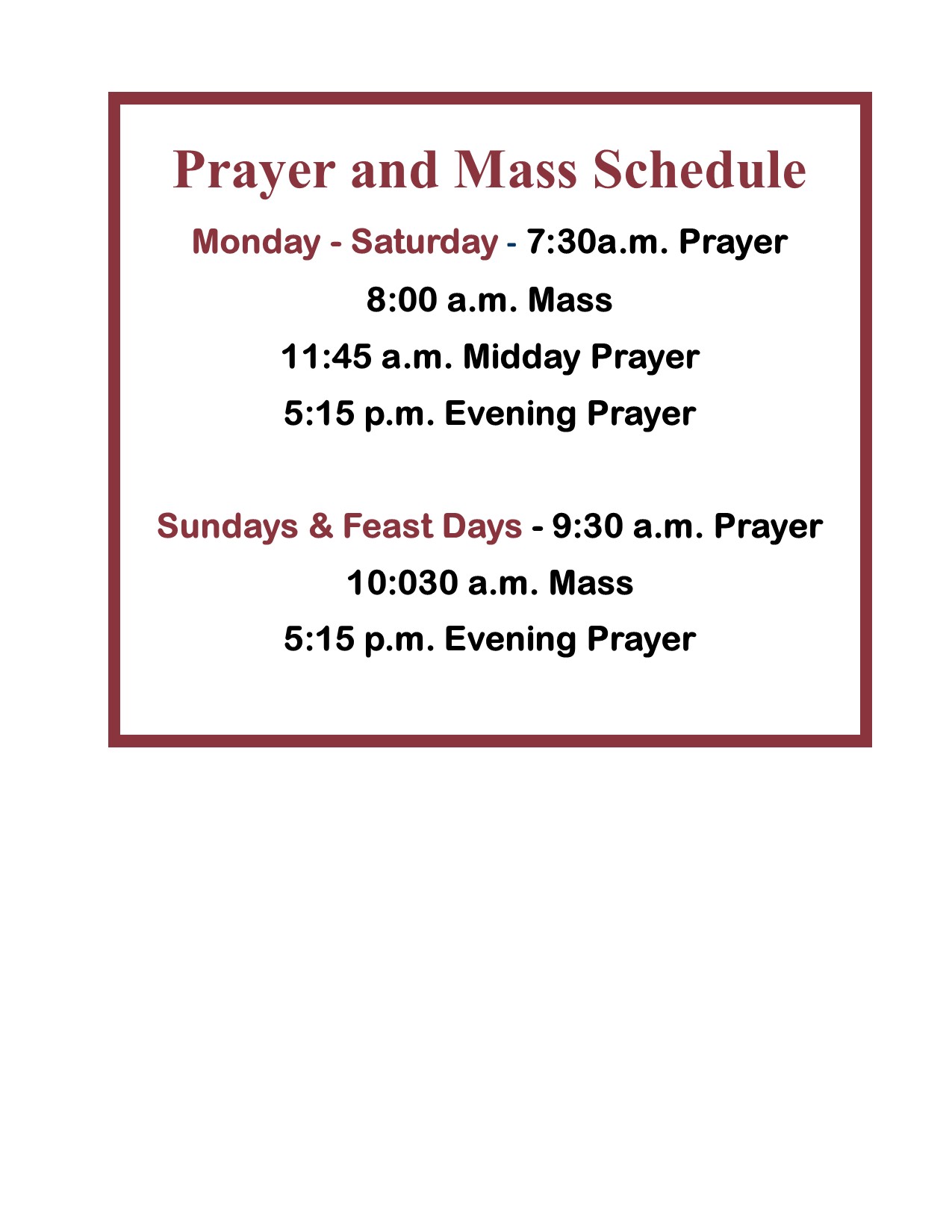
 Mass Schedule

Related Links

Copyright © 2026 · Benedictine Sisters of FL · Touching Lives Through Prayer and Service

Copyright © 2026 · Bendedictine Theme on Genesis Framework · WordPress · Log in