• Skip to primary navigation
  • Skip to main content
  • Skip to footer
Benedictine Sisters of FL

Holy Name Monastery
Founded 1889

Donate Now
  • Home
  • About Us
    • History
    • Being Benedictine
    • Benedictine Monasticism
    • Meet Our Community
    • Holy Name Academy-Alumnae
  • What We Do
    • Mission, Vision and Our Partners
    • Invitation to Retreat
    • Accommodations
    • Volunteer Programs
    • Oblate Program
    • Spiritual Direction
    • Aqua/Hydroponics
    • More of Our Ministries
  • What’s Happening
    • Articles of Interest
    • Events
    • Newsletters
    • Brochures
    • Links
  • Support Us
    • Gifts of Support
    • Wish List
  • Stories Shared
  • Galleries
    • Photos
    • Videos
      • Benedictine Sisters of FL Videos
      • Other Videos
  • Contact Us

Jesus

Mercy Over Merit

October 27, 2025 by Holy Name Monastery Leave a Comment

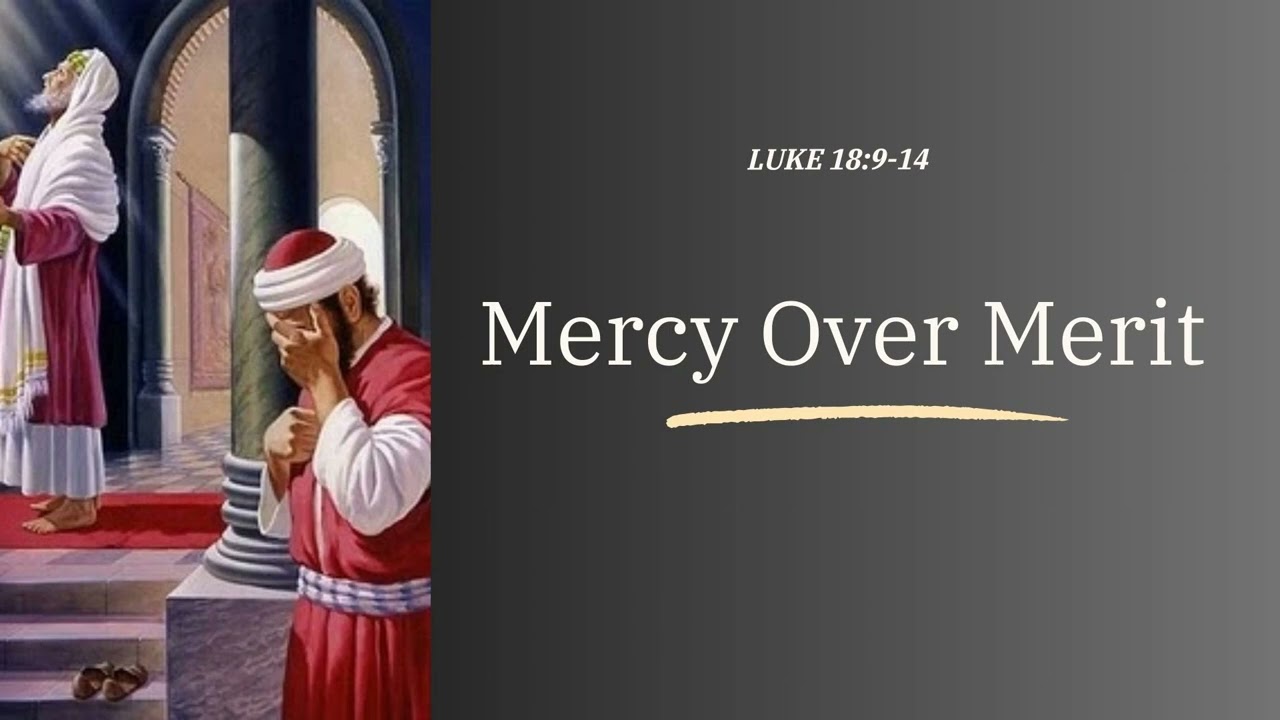
It is important to note at the outset of this particular reading just who it is that Jesus is speaking to.  Luke says: “Jesus told this parable to some who trusted in themselves that they were righteous and treated others with contempt.”

But, then there’s this.  Elsewhere in Scripture, Proverbs tells us: “To do righteousness is more acceptable to the Lord than sacrifice” and “Blessings are on the head of the righteous.”  Turning to Isaiah we read: “The work of righteousness will be peace, and the effect of righteousness, quietness and assurance forever.”

So, why does Jesus seem to be criticizing the righteous one?  One little word makes the difference.  Jesus is talking to the self-righteous; those who trusted in themselves. They’re a little too sure they are right and anyone who thinks differently must be wrong.  They (or is it we?) are so full of self that there’s little room for God’s grace to filter in.

It’s interesting when you think about it that everything the Pharisee says is true. He has set himself apart from others by his faithful adherence to the law. He is, by the standards of his day, a righteous man.   It isn’t that the Pharisee is speaking falsely, but rather that the Pharisee misses the true nature of his blessing. As Luke says he has trust in himself. His prayer of gratitude may be addressed to God, but it is really about himself. He credits his righteousness entirely in his own actions.

The tax collector, on the other hand, does not even raise his eyes to heaven.  He knows that he possesses no means by which to claim righteousness. He declares he has done nothing of merit. So, he stands back, hardly daring to approach the Temple, and throws himself on the mercy of the Lord.  He seems not so much humble as desperate.  He stakes his hope entirely on the mercy of God.

At the end of the day, the Pharisee will leave the Temple and return to his home the same virtuous, honorable man he was when he came to the temple.  That hasn’t changed.  The Pharisee’s mistake, as Scott Peck says, is that he thinks that whenever he wants, he can pull “God out of his hip pocket.”   On the other hand, the tax collector will go back to his home exalted in God’s eyes because he humbled himself.

If you’re spiritually alive, and give credit where credit is due, you’re going to love this take on the parable.  If you’re spiritually dead, you won’t even want to hear it.  If you’re spiritually curious, there is still hope!

A Church goer wrote a letter to the editor of his hometown newspaper and complained that it made no sense to him at all to go to church every Sunday.  He wrote: “I’ve gone for 30 years now, and in that time I have heard something like 3,000 sermons, but for the life of me, I can’t remember a single one of them.  So, it’s been a waste of my time and on the part of homilists a waste of their time by giving sermons at all”.

This started a real controversy in the “Letters to the Editor” column.  Much to the delight of the editor, it went on for weeks until someone wrote a real clincher:  “I’ve been married for 30 years now. In that time my wife has cooked some 32,000 meals. But, for the life of me, I cannot recall the entire menu for a single one of those meals.  But I do know this: they all nourished me and gave me the strength I needed to do my work.   If my wife had not given me those meals, I would be physically dead today.”

We might say: I’ve been in community x number of years.  In that time, I’ve been nourished and supported by my Sisters thousands of times in hundreds of different ways. But sadly, I can only recall a few, if any, instances in full detail. This much I DO know, without their support my spirit would have withered long ago.  Likewise, if I had not gone to Mass and been faithful to my time of private and communal prayer, I would be spiritually dead today!

~Reflection by Sister Roberta Bailey, OSB


Sending from home of OSB sisters in Pittsburgh PA where I am on vacation for a month – sunny 43 degree, some Fall colors.

Unsure if for next few weekends will be sending reflections …  Know that I will remembering you and your intentions in prayer.


First Reading:   Sirach 35:12-14, 16-18         Second Reading:  2 Timothy 4:6-8, 16-18
Gospel:   Luke 18:9-14
Continue Reading

Filed Under: Blog, Front Page, Homily Tagged With: God, Jesus, Luke, mercy, Mercy over merit, merit, Pharisee, Pharisees, temple

Perseverance in Prayer

October 20, 2025 by Holy Name Monastery Leave a Comment

In the Gospel we have a lesson about perseverance in prayer.  The point of the story is not that prayer is nagging God for what we want.  Nor is it meant to teach us that God is like the judge in the parable – worn down by requests and coerced to respond.

The key to understanding the meaning is found in the description of the judge as corrupt and unjust. Since God can be neither, we must understand Jesus to be saying that if even an unjust judge responds to the persistence of the widow, how much more will God listen to our prayers. God truly wants to hear our needs and respond generously.  Didn’t Jesus say: “Ask and you shall receive?”   Jesus is telling us that God wants us to be like the persistent widow, staying in relationship with God, confident that God hears and answers prayers.   And He understands how easy it is to lose heart.  He asks: “Will such faith, the faith of the widow, be found when the Son of Man returns?”

A beginning of the answer to the question appears to be that the Son of Man will find faith, but it may be in unexpected places, as it has been in the Gospel — not among the religious professionals or the ones certain of their own righteousness, but among the outsiders, the unlovely, the unclean, the ones certain of their sinfulness.

The parable suggests that a sign of faith will be a willingness to persist in prayer, as we see in this widow who persists against all odds in her fight for justice against the powerful judge. Another sign may be in what we pray for: daily bread, the Holy Spirit, the coming of the kingdom, justice.

In his gospel, the evangelist Luke portrays widows as vulnerable but at the same time prophetic, active, and faithful.  The widow of this parable is forceful enough to get the justice she demands even from an utterly unjust judge.

If we could read the Greek version of this parable, we’d get a glimpse of Jesus sense of humor.   Now by “Greek” I don’t mean the language we refer to when we say “It’s all Greek to me.”  In the Greek Scriptures the judge gives in to the widow because if he doesn’t, he fears she may give him a black eye.  Jesus uses a metaphor from boxing to make his point about the need to continue in prayer. Be as persistent as a boxer in the ring when it comes to prayer. Jesus gives a second teaching in the parable. If an unjust judge answers the pleas of a widow how much more will God answer our prayers.  We just don’t know WHEN.  Remember the words of the prophet Habakkuk?  “The vision still has its time and will not disappoint.”   God takes the long view,  knows what is best and we may sometimes have to wait until we’re, as they say: “on the other side of the grass,” where we’ll understand that all along God knew best.

Luke seems to be very much aware of the real danger of giving up, of losing heart when we suffer injustice.  Luke is saying that if we pray hard enough and if we don’t lose heart, God will give us justice, right? Well, does God? Is there justice in the world?  In our country?   In our local communities, and (sadly) In our churches?  We have only to watch the evening news or read the day’s headlines to learn of multiple cases of brutality and injustice.

Could it be possible that God’s justice looks different than our justice?  Good question. Yet, somehow I trust that God gives us a righteous sense of justice–especially if it is a selfless sense of justice–one that is concerned with others.  Look at our widow. What does she do to obtain justice? She is persistent. She is stubborn. Perhaps we should call her attitude a kind of “holy stubbornness.” She doesn’t give up – she doesn’t lose heart. She keeps knocking at the judge’s door.

Now, I believe I don’t have to explain “stubbornness.”  Some of us had it sprinkled on us in our cradles!  We can prettify it, call it by another name, whatever we want: high principles, perseverance, tenacity, determined or just plain pig-headedness.  Yes, we seem to be naturally endowed with the “great gift of stubbornness” and the only thing God has to help us with is to learn how to be stubborn for the right causes — God’s justice. In that case we may talk about a “holy stubbornness.”  That happens when we start not only to pray our prayers, but when we start to live our prayers.  In other words, we put our actions where our words are.  Victims of poverty, injustice or violence don’t want to hear about God’s commandments, about moral values, about self-denial, or even about justice.

Luke is right: it is easy to lose heart and go with the flow rather than go against the current.   It takes more than a petition at Mass to make our prayers effective. Think of all the corporate commitment action opportunities we are offered.  When we support our petitions with a donation to Christmas for the residents at Heritage, attend the Sunrise Prayer Vigil, write letters asking for legislative action on behalf of the poor, make a donation to the Soup Supper or volunteer at Daystar.

You may ask, or be asked: “can prayer move God’s arm?” Jesus turns this question back on us today and concludes his parable with the question: “Will the Son of man find faith when he returns?” In other words, he is asking: “Can prayer move your own arm?  Are you willing to put your actions where your words are?” God always has relied on his children–people like you and me–to usher in His Kingdom. God will give us strength, God will empower us, but we still need to stubbornly live out our prayers for justice. The first reading reminds us we don’t have to be alone in our entreaties.  One of the beauties of living in community or being part of a faith community is that, like Moses’ (in tomorrow’s first reading) – we have friends who “hold our hands until sunset” – we have  the prayer support of many others.  Are our prayers effective? The answer lies squarely with us: “it depends on how effective we help make them.”

~Reflection by Sister Roberta Bailey, OSB


First Reading:   Exodus 17:8-13         Second Reading:  2 Timothy 3:14 – 4:2
Gospel:   Luke18:1-8
Continue Reading

Filed Under: Blog, Front Page, Homily Tagged With: Faith, God, Gospel, Holy Spirit, Jesus, perseverance in prayer, persistent widow, Prayer

One Came Back

October 13, 2025 by Holy Name Monastery Leave a Comment

“And, one of them, realizing he had been healed, returned, glorifying God

in a loud voice; and he fell at the feet of Jesus and thanked him.”

What prompted this one man in ten to turn back to Jesus as soon as he realized the scourge of leprosy had vanished?  Had the group discerned what they ought to do: continue as instructed to go to the priests, run rejoicing to show themselves to their families, or go back to thank Jesus?   Was it only this one that figured out it was Jesus that had healed them?  We’ll never know.  What we do know, according to the story, is that Jesus noticed that only one returned in gratitude and that the grateful one “glorified God in a loud voice!”  And, as Jesus pointed out, this one was a foreigner.

I am reminded of the words of Hosea, the words that inspired the Weston Priory hymn: “Come back to me with all your heart, don’t let fear keep us apart.”   It took courage for the now-cleansed man to retrace his steps back to Jesus, to publicly – loudly – glorify God and proclaim his thanks to Jesus.  Deep in his heart he must have sensed the spirit of the words of Hosea: “Come back to me.”

This week we will be praying for the success of humanitarian efforts.  We ask God’s blessing on the people and the projects intended to relieve the scourge of the contemporary leprosies of poverty, hunger, homelessness, unemployment – the scourge of trying to rebuild lives and homes and villages after fires, floods, tornadoes, earthquakes, tsunamis.

With Jesus, with God, as our touchstone, all of us, not just those involved in notable humanitarian projects, will often “turn back” to glorify God – to give thanks for every success in our efforts.  Few successes will be as spectacular as being cleansed of leprosy – but we keep turning back to give thanks for God’s working among us and throughout the world.  Media sources are to be commended for reporting “pay it forward deeds” – “random acts of kindness” – highlighting the charity of sports and movie stars and corporations.   Maybe, like Jesus, we wonder “where are the other nine?”   And, the cynic in us may question the givers’ motivations.  But, like Jesus, we have to move beyond that reaction and give credit where credit is due.  With Jesus we say “stand up, keep up the good work – your faith has saved you.”

For ourselves, we say: Lord, I do believe.  Please, Sir, help my unbelief!  Cleanse us of our cynicism and pessimism.  Open our eyes to your miraculous actions among us.  Move us to great gratitude for the goodness in nature and in the generous nature of our sisters and all who work to relieve the suffering of “leprosy” in our times.  Remind us to take the time to heed your call to “turn back” with all our hearts.  Take our fears away and instill in us your courage to face and shape our future. Give success to the work of our hands – Lord, give success to our work.  Thank you!

~Reflection by Sister Roberta Bailey, OSB


First Reading:   2 Kings 5:14-17         Second Reading:  2 Timothy 2:8-13
Gospel:   Luke 17:11-19
Continue Reading

Filed Under: Blog, Front Page, Homily Tagged With: believe, God, Jesus, Jesus heals ten men with leprosy, leprosy, One Came Back

Faith the size of a Mustard Seed

October 7, 2025 by Holy Name Monastery Leave a Comment

In this Gospel Jesus offers his disciples two related teachings his disciples when they cry out for an increase in faith. The first is the familiar reminder that faith, even just a little, will enable the followers of Jesus to do wondrous things. But this uplifting and inspiring teaching is quickly followed by the second teaching, a caution about knowing one’s place in God’s plans. Even when God works wonders through us, with our mustard seed-sized faith, we must not seek praise. Our participation in God’s plans is God’s grace to us—nothing more, nothing less. Pope Francis reminds us: “Our life is not all written down; it means going, walking, doing, searching, seeing … We must enter into the adventure of the quest for meeting God; we must let God search and encounter us.” When we are graced enough to cooperate with God, the work we do is nothing more than our obligation to God as faithful stewards. And yet, our faith enables us to believe that what we have offered in service to God, as his servants, can be made to produce a hundredfold.

Last week we celebrated St. Francis Day so I want to tell you a St. Francis story – maybe only part truth. This is not the story of how his father disowned him, and he stripped naked in court and walked away. It’s not the story of how he received the stigmata. Nor is it the story of the Wolf of Gubbio. This is a story you may not have heard; this is the story of St. Francis and the Sultan Al-Kamil. It takes place during the Fifth Crusade – when Francis’ pilgrimage took him across the battle lines in ancient Egypt. He was immediately captured and brought before Sultan. According to some versions of the story, he challenged the Muslim clerics to a trial by fire: both he and they would preach from the heart of a bonfire and whoever was not burned alive would be the one preaching the true God. The Muslim clerics declined the challenge. Francis then offered to go into the fire by himself, with the proviso that if he was not burned up the Sultan and all his followers would have to convert to Christianity. The Sultan did not take Francis up on this offer.

Whether or not that’s true, it is known that Francis preached to the Sultan and his household, who were so impressed by Francis that the Sultan offered him numerous gifts — which Francis refused — and gave him safe conduct back to the Crusader camp. When in time the Crusader Kingdoms fell, the Muslim rulers granted permission for Christians to tend the Christian holy sites in the Holy Land, but that permission was not given to the Church as a whole, it was given specifically to the Franciscans. In fact this arrangement persists to this day — there is a Catholic office called “Custodian of the Holy Land,” and it is always held by a Franciscan; and in places where custody is shared by different Christian denominations — like the Church of the Holy Sepulcher — it is Franciscans who represent the Roman Catholic church. All because of that one visit between St. Francis and the Sultan.

It may seem a stretch from the Gospel story to tell a tale about Francis of Assisi. So, why you may ask, tell it? A convergence of awareness led me to share this with you.

Jesus says, “If you had faith the size of a mustard seed, you could say to this mulberry tree, ‘Be uprooted and planted in the sea,’ and it would obey you.” St. Francis acted out of this spirit of courage and faith when he crossed the battle lines in Egypt. He had no idea what would happen to him; he had every reason to expect to be taken prisoner at the very least. Afterward, he doubtless thought his mission had failed. But — he had made a connection — a moment of authentic human connection, two people meeting each other face to face — that has had consequences to this very day – over 800 years!

The world is full of people who are divided from us, even opposed to us — because of religion, nationality, ethnicity, or political views, or any of a thousand things. God calls us to reach out to these people in a spirit of courage and love, unashamed of our testimony about our Lord and our mission, our way of life. We may not convince them — we may not bring them around to our point of view. We may not even make peace. The world being what it is, the odds are against it.

But if we can just make that one moment of connection, that one moment where we see each other face to face as human beings, as St. Francis did with the Sultan— that’s the mustard seed. That’s the opportunity for God to act and do something unexpected and miraculous.

The big problems in the world — hunger, war, religious conflict, and so on — often seem too big for us. Maybe they are. But we have to have faith that if we can move the pebble — then God will move the mountain.

Pope Francis once said in an interview said, “Instead of being just a church that welcomes and receives by keeping the doors open, let us try also to be a church that finds new roads, that are able to step outside itself…” Sounding like his patron Francis, he says: “We need to proclaim the Gospel on every street corner, preaching the good news of the kingdom and healing… focusing on the essentials… We have to find a new balance; otherwise we will lose the freshness and fragrance of the Gospel.”

A Sufi story tells of disciples who were despairing because their leader was about to die. They asked him, “If you leave us, Master, how will we know what to do?” The master replied, “I am nothing but a finger pointing at the moon. Perhaps when I am gone you will see the moon.”

~Reflection by Sister Roberta Bailey, OSB


First Reading: Habakkuk 1:2-3; 2:2-4 Second Reading: 2 Timothy 1:6-8,13-14
Gospel: Luke 17: 5-10
Continue Reading

Filed Under: Blog, Front Page, Homily Tagged With: Faith, Gospel, Jesus, Mustard seed, St. Francis, Sultan

30th Sunday in Ordinary Time

September 29, 2025 by Holy Name Monastery Leave a Comment

It is important to note at the outset of this particular reading just who it is that Jesus is speaking to. Luke says: “Jesus told this parable to some who trusted in themselves that they were righteous and treated others with contempt.”

But, then there’s this. Elsewhere in Scripture, Proverbs tells us: “To do righteousness is more acceptable to the Lord than sacrifice” and “Blessings are on the head of the righteous.” Turning to Isaiah we read: “The work of righteousness will be peace, and the effect of righteousness, quietness and assurance forever.”

So, why does Jesus seem to be criticizing the righteous one? One little word makes the difference. Jesus is talking to the self-righteous; those who trusted in themselves. They’re a little too sure they are right and anyone who thinks differently must be wrong. They (or is it we?) are so full of self that there’s little room for God’s grace to filter in.

It’s interesting when you think about it that everything the Pharisee says is true. He has set himself apart from others by his faithful adherence to the law. He is, by the standards of his day, a righteous man. It isn’t that the Pharisee is speaking falsely, but rather that the Pharisee misses the true nature of his blessing. As Luke says, he has trust in himself. His prayer of gratitude may be addressed to God, but it is really about himself. He credits his righteousness entirely to his own actions.

The tax collector, on the other hand, does not even raise his eyes to heaven. He knows that he possesses no means by which to claim righteousness. He declares he has done nothing of merit. So, he stands back, hardly daring to approach the Temple, and throws himself on the mercy of the Lord. He seems not so much humble as desperate. He stakes his hope entirely on the mercy of God.

At the end of the day, the Pharisee will leave the Temple and return to his home the same virtuous, honorable man he was when he came to the temple. That hasn’t changed. The Pharisee’s mistake, as Scott Peck says, is that he thinks that whenever he wants, he can pull “God out of his hip pocket.” On the other hand, the tax collector will go back to his home exalted in God’s eyes because he humbled himself.

If you’re spiritually alive, and give credit where credit is due, you’re going to love this take on the parable. If you’re spiritually dead, you won’t even want to hear it. If you’re spiritually curious, there is still hope!

A churchgoer wrote a letter to the editor of his hometown newspaper and complained that it made no sense to him at all to go to church every Sunday. He wrote: “I’ve gone for 30 years now, and in that time I have heard something like 3,000 sermons, but for the life of me, I can’t remember a single one of them. So, it’s been a waste of my time and on the part of homilists a waste of their time by giving sermons at all”.

This started a real controversy in the “Letters to the Editor” column. Much to the delight of the editor, it went on for weeks until someone wrote a real clincher: “I’ve been married for 30 years now. In that time my wife has cooked some 32,000 meals. But, for the life of me, I cannot recall the entire menu for a single one of those meals. But I do know this: they all nourished me and gave me the strength I needed to do my work. If my wife had not given me those meals, I would be physically dead today.”

We might say: I’ve been in community x number of years. In that time, I’ve been nourished and supported by my Sisters thousands of times in hundreds of different ways. But sadly, I can only recall a few, if any, instances in full detail. This much I DO know: without their support my spirit would have withered long ago. Likewise, if I had not gone to Mass and been faithful to my time of private and communal prayer, I would be spiritually dead today!

~Reflection by Sister Roberta Bailey, OSB


Yesterday was Oblate Sunday at the Monastery. We welcomed 15 Oblates for Mass, Dinner and an instructive gathering for an exchange of ideas based on assigned “Homework.”

A Benedictine oblate is a lay Christian who has made a spiritual commitment to live according to the Rule of Saint Benedict and be affiliated with a Benedictine monastery, though they do not take religious vows or live in the monastery. Oblates integrate Benedictine values of prayer, work, hospitality, and community into their daily lives in the world, forming an “extended family” to the monastery. For more information contact S. Mary David at mary.david.hydro@saintleo.edu or call 352-588-7176.


First Reading: Sirach 35:12-14, 16-18 Second Reading: 2 Timothy 4:6-8, 16-18
Gospel: Luke 18:9-14
Continue Reading

Filed Under: Blog, Front Page, Homily Tagged With: Jesus, Luke, Oblate, Oblate Sunday, Pharisee, Proverbs

23rd Sunday in Ordinary Time

September 8, 2025 by Holy Name Monastery Leave a Comment

Wow!  Talk about conflicts!  Jesus keeps teaching us to love our neighbors as ourselves, love our enemies and do good to those who hate us.  Now he says, “Hate your mother and father, your brother and sister, your wife and children, even your own life.”   Obviously, you cannot have it both ways: Love everybody and hate your family.

Jesus is inviting us to think it over seriously.  Listen to Him: “To be my disciple is unusually difficult. You must make a TOTAL commitment.  Nobody, absolutely nothing, can come before me. I am your one Lord and God. In case of conflict, your nearest and dearest must take second place.”

I’ll share now what Richard Rohr has to say on taking that first step to discipleship: recognize, acknowledge and accept the truth that we are everywhere and at all times in the presence of God.

We cannot attain the presence of God because we’re already totally in the presence of God. What’s absent is awareness.  Each time you take another breath, realize that God is choosing you again and again—and yet again. We have nothing to work up to or even learn. We do, however, need to unlearn some things, and most especially we must let go of any thought that we have ever been separated from God. Religion is to help us let go of illusions and pretenses so we can be more and more present to what actually is. We have to learn to see what is already here.

Such a simple directive is hard for us to understand. We have a “merit badge” mentality. We worship success. We believe that we get what we deserve, what we work hard for, and what we are worthy of. It’s hard for Western people to think in any other way.

Experiencing radical grace is like living in a different world. It’s not a world in which I labor to get God to notice me and like me. It’s not a world in which I strive for spiritual success.  Unfortunately, many good people are afraid of gratuity.  But God cannot be seen through such a small and dirty lens.

I suggest that this week we check our spiritual spectacles, clean off any smudges and be open to receiving the radical graces God has ready waiting for us.   In the Gospel, the two brief parables (a person constructing a tower and a king marching into battle) make Jesus’ lesson obvious – don’t start what you cannot finish. Jesus is asking us for TOTAL commitment.  We can only commit if we are prepared to put God before everything else.

We pray with words of the Responsorial Psalm: “In every age, O Lord, you have been our refuge; teach us to number our days aright, that we may gain wisdom of heart.  Fill us at daybreak with your kindness that we may shout for joy and gladness all our days.”

~Reflection by Sister Roberta Bailey, OSB


Please remember in prayer our Sister Jerome Leavy whose funeral we will celebrate Tuesday morning, Sept 9th at 10am.  Wake service and visitation will be 7pm Monday in our monastic chapel.

May Sister Jerome rest in eternal peace!


First Reading:   Wisdom 9:13-18b         Second Reading:  Philemon 9-10, 12-17
Gospel:   Luke 14:25-33
Continue Reading

Filed Under: Blog, Front Page, Homily Tagged With: conflict, disciples, God, Jesus, Richard Rohr, total commitment

  • « Go to Previous Page
  • Page 1
  • Interim pages omitted …
  • Page 5
  • Page 6
  • Page 7
  • Page 8
  • Page 9
  • Interim pages omitted …
  • Page 64
  • Go to Next Page »

Footer

Prayer / Newsletter / Info

 Contact Info

Benedictine Sisters of Florida

PO Box 2450
12138 Wichers Road
St. Leo, FL 33574-2450
(352) 588-8320
(352) 588-8443

 Mass Schedule

Related Links

Copyright © 2026 · Benedictine Sisters of FL · Touching Lives Through Prayer and Service

Copyright © 2026 · Bendedictine Theme on Genesis Framework · WordPress · Log in
