• Skip to primary navigation
  • Skip to main content
  • Skip to footer
Benedictine Sisters of FL

Holy Name Monastery
Founded 1889

Donate Now
  • Home
  • About Us
    • History
    • Being Benedictine
    • Benedictine Monasticism
    • Meet Our Community
    • Holy Name Academy-Alumnae
  • What We Do
    • Mission, Vision and Our Partners
    • Invitation to Retreat
    • Accommodations
    • Volunteer Programs
    • Oblate Program
    • Spiritual Direction
    • Aqua/Hydroponics
    • More of Our Ministries
  • What’s Happening
    • Articles of Interest
    • Events
    • Newsletters
    • Brochures
    • Links
  • Support Us
    • Gifts of Support
    • Wish List
  • Stories Shared
  • Galleries
    • Photos
    • Videos
      • Benedictine Sisters of FL Videos
      • Other Videos
  • Contact Us

Jesus

When We Choose to Be a Servant, We Give Up the Right to Be in Charge

July 21, 2025 by Holy Name Monastery Leave a Comment

In this Gospel we hear: “As Jesus entered a certain village a woman named Martha welcomed Him into her home…. Her sister Mary sat beside the Lord at his feet listening to him speak.”  Tomorrow’s first reading from Genesis tells a similar story with Sarah slaving in the kitchen while Abraham entertains their three guests.  Bowing in greeting, Abraham sends the guests to wash up while he scurries about getting a choice steer and giving Sarah orders on what and how to prepare the meal which he alone hosts for his new buddies.

Both Scripture readings show the contrast between the two activists.  Martha is behind the scenes; Abraham busy arranging many details of hospitality.  In the background we find the more reticent, but no less active ladies, Mary and Sarah.   The incidents illustrate more than hostesses doing what they do best to make an evening delightful.  There is a bit of these characters in each of us – one or the other prevails from day to day, and situation to situation.

Jesus’ response to Martha’s “Don’t you even care that I am stuck in the kitchen?” reminds us “only one thing is necessary.”  It causes us to realize that I, as an individual, do not have to do it all.  This is evident in our practice of taking only one role at a time in the dining room or in a single liturgy – we acknowledge (for instance) that liturgy is a communal act where all present are on the same level: differing in gifts but equal in importance.  Everything needs to get done, there are plenty of roles to share: leaders and readers, cooks and servers, singers and keyboardists, prayer leaders and bell ringers, gift bearers and petitioners, Eucharistic ministers and the celebrant.   At times our ranks may be slim, especially when members are away or illness prohibits or limits our participation, but we strive to engage everyone in the communal roles.

This is the attitude we strive to express also in the distribution of daily chores.  No single person needs to do it all – choices have to be made.  Self-importance can get in the way if I do not consider the impression I will make if I try single-handedly to assume the burden of chores and fail to ask for assistance.  There are times, certainly, when we have to double up on duties, but we need to be conscious of enabling others to offer service.   Thus, we show them respect by recognizing their capabilities.

The Gospel also gives us a glimpse of Jesus as a gracious guest.  He is the object of Mary’s attention and the recipient of Martha’s service.  Jesus knew his role as servant and as the one being served – the contrast between serving and being served i.e. resting gently and securely in either the role of being a servant or a guest.

To paraphrase some thoughts from Richard Foster in his book Celebration of Discipline:

There is a difference between choosing to serve and choosing to be a servant (with emphasis on the word CHOOSING).    When we choose to serve, we are still in charge.  We decide whom we will serve and where we will serve and when we will serve.  And if we are in charge, we will worry a great deal about anyone stepping on us, that is taking charge over us.

But when we choose to be a servant, we give up the right to be in charge.  There is a great freedom in this.  When we choose to be a servant, we surrender the right to decide who and where and when we will serve.  We become available and vulnerable.

May we learn to be both the servant who serves and the open, receptive, gracious guest to whom others render service.  We pray for the grace to balance both roles in our lives.

~Reflection by Sister Roberta Bailey, OSB


First Reading: Genesis 18:1-10                              Second Reading: Colossians 1:24-28
Gospel: Luke 10:38-42
Continue Reading

Filed Under: Blog, Front Page, Homily Tagged With: Abraham, charge, Jesus, Martha, Mary, Sarah, servant, serve

Fifteenth Sunday in Ordinary Time

July 14, 2025 by Holy Name Monastery Leave a Comment

The dialogue in this Gospel starts with a question: “Teacher, what must I do to inherit eternal life?” It seems like a reasonable question, something you would ask a visiting rabbi.  But what was behind the question? On the one hand it may have been idle curiosity.   Or perhaps the person wanted to trick Jesus by poking fun at Him in front of the crowd.  Maybe, just maybe, the questioner thought that God might let anyone and everyone, including the riffraff, into heaven.  Was the raised voice from the crowd an enemy of Jesus, who was just out to get him?  Or might it have been pride? In his heart he may have been feeling: “Hey, look at me! I’ll be one of the few saved! These poor souls surrounding me – I hope they realize how pleased God is with me.”

It seems possible, too, that the question was neither purely academic nor a trick to entrap Jesus. It could have been a sincere question on a very personal level. Maybe the fellow was worried sick about himself, that he wouldn’t make it. Despair could have driven his question.  He was looking for the slightest sliver of hope.

In any case, we’re not told the outspoken one’s motivation. What we do know is how Jesus answered (or didn’t answer).  Instead of a direct answer, Jesus gives us another story, a very human story, a story that changed the world.

Often near the end of the TV evening news we hear news castors make reference to “Good Samaritan” stories.  For instance, a traffic accident witness stepped forward to offer assistance.

Here in our diocese, we know the Good Samaritan Society, perhaps best, through summer volunteerism.  The Good Samaritan Project (GSP), is a week-long service retreat led by the Office of Youth and Young Adult Ministry.   Middle and high school teens gather from across our Diocese to serve, pray, and have fun together for the betterment of the community and the Glory of God.  Our monastic community has been the beneficiary of services of youth and young adult groups from Las Vegas, California.  They have come from Catholic high schools and parish faith formation programs as well as our nearby university.  Local food banks and the Daystar Hope Center in Dade City have also benefited from initiatives such as  “Food for the World” Saturday and “Pack a Bag”.

Who knows how many trillions of dollars in charitable giving this one story from Jesus has inspired over the years? More than that, it has inspired countless small acts of human kindness that have made our world a more livable place.

Good Samaritans are people who open their schedules to accommodate another’s need.  They are persons who open their wallets or keep a fistful of fast food gift certificates to hand out the car window to the empty hands seen many mornings at the busiest of intersections.

Even people who are not God-followers or believers appreciate this ethical parable of Jesus. Re-read it.  Let it seep in.  Look at the words with fresh eyes.  Listen to the story. Read it aloud with open ears, hands and heart. (Read it now ….   ) “On one occasion an expert in the law stood up to test Jesus. Teacher,” he asked, “what must I do to inherit eternal life?”  Jesus replied: “What is written in the Law? How do you read it?”

~Reflection by Sister Roberta Bailey, OSB


First Reading:   Deuteronomy 30:10-14         Second Reading:  Colossians 1:15-20
Gospel:   Luke 10:25-37
Continue Reading

Filed Under: Blog, Front Page, Homily Tagged With: God, Good Samaritan, Gospel, Jesus, Luke, volunteer, volunteerism

Let All The Earth Cry Out To God With Joy

July 7, 2025 by Holy Name Monastery Leave a Comment

(At the outset let it be understood that what follows may appear to be fiction but it is not. St. Luke shared this with me.)

One day, when the man of God Benedict was doing Lectio and pondering how to incorporate his set of values into his manuscript directed to his followers, St. Luke entered his reverie.  What an inspiration!  Luke and Benedict chatted with each other for a spell.  Look Ben, (said Luke) you’ve consulted the writings of the one you call the Master.  May I suggest you look at my record of the sayings of THE Master.  Compare it with the 10th chapter of my Gospel. Sure enough!  Very many of our special Benedictine values are put forth by THE Master Jesus.  For instance:

+ A SPIRIT of POVERTY: take nothing with you (is how Jesus puts it) No money bags, no suitcase, no canvas bag or pretty tote and no sandals.  Or as you say it in your Rule: “No one may presume to give, receive or retain anything as her own, nothing at all, in short not a single item … no one shall presume ownership of anything. “

+ A SENSE of STABILITY: Jesus advises his followers: Into whatever house you enter, stay in the same house; don’t be moving from one house to another.   Benedict, you describe the first kind of monastics called cenobites.  From what you say, I sense this may be your preferred type of members.  “Those who belong to a particular monastery, where they serve under the rule of a superior.”

+ Further, Benedict, you expect these cenobites to follow Jesus’ way of life, personally and communally, practicing a SPIRIT of SIMPLICITY and ACCEPTANCE of WHATEVER IS AVAILABLE:  In your words:  Eating and drinking whatever is offered to you; whatever is set before you.

Benedict, my friend, you have an obvious understanding of human nature. Could we attribute that to your twin sister’s influence?  She took her turn as cook for her group of women whom she loved as ardently as you looked after the rough and tough gang of men that lived with you. It’s evident in your words: Taking turns serving one another, using an unvoiced system of gestures when anything is required.  And (yes, PLEASE God) it will save you a heap of trouble if you designate a weekly reader to proclaim the Holy Word throughout the meal.

In studying your Rule, Benedict, it seems to go without saying that there will likely be no harmony in the group unless the members all strive to AVOID EVIL and CLING to PEACE.   I (that is Luke) remind my readers: Remember what Jesus said (It’s right there in verse 9). “If peace is not present in the house where you find yourself, go out into the streets and shake the dust from your feet and leave that town.”  When you feel evil rising in you, get in touch with the cause – shame the devil – leave the occasion of sin.

In this weekend’s second reading St. Paul reminds us that we bear the marks of Jesus in our body.  Jesus conquered evil so that we, too, might be part of the new creation. We rejoice with the disciples, reveling as they did in first fervor.  We rejoice because “our names are written in heaven.”  Sing with Isaiah in the First Reading: We rely on the gentle care God has for us: we shall be carried in God’s arms, comforted as a mother comforts her child and fondles the child in her lap and delights in nursing the babe.  That’s the joy that can erupt in the words of tomorrow’s responsorial psalm: LET ALL THE EARTH CRY OUT TO GOD WITH JOY.

~Reflection by Sister Roberta Bailey, OSB


Let us remember each other in prayer on Friday, July 11th, the Summer feast of St. Benedict.


First Reading: Isaiah  66:10-14                     Second Reading: Galatians 6:14-18
Gospel: Luke 10:1-12, 17-20
Continue Reading

Filed Under: Blog, Front Page, Homily Tagged With: Benedict, Gospel, Jesus, poverty, sense, Spirit, st. benedict, St. Luke, stability

Solemnity of Saints Peter and Paul

June 30, 2025 by Holy Name Monastery Leave a Comment

Saints Peter and Paul are probably the best known of all the saints in the Catholic Church.  Both of them were personally chosen by Jesus for the building up of the Mystical Body of Christ.  Peter’s mission was twofold: to lead the Catholic Church in the early stage and to lead the Jewish people into the new Covenant.   Saint Paul came into the picture a little later and played a major role for the Church in converting a great number of the Gentiles to follow Jesus.

Theirs is the same God who continues to reach out to us, calling us to spread God’s light throughout the world. To us, simple human beings, not angels, God gives the Holy Spirit to guide us and teach us according to the evolving needs of the Church – the people of God.

This evening I chose to proclaim the gospel given for the Vigil Mass rather than the one for tomorrow’s liturgy.  The Scripture selection highlights Peter, but Paul will get his solo turn later on.    Many look at the Gospel passage with wonderment. Why did Jesus ask Peter the same question over and over?

Seemingly out of the blue, Jesus says to Simon Peter, “Simon, son of John, do you love Me more than these?”  Peter responds, “Yes, Lord; You know that I love you.” I cannot imagine a more insulting way for Peter to answer!  Peter is sitting with the risen Jesus  who asks him “Tell me, Peter, do you love me with a selfless love?” and Peter responds using a verb that means: “I am really quite fond of you.”

We can only imagine how “out of place” Peter now felt being with Jesus. Where he had once been comfortable and self-assured as one of the chosen disciples; he now feels the shame of denying he is one of Jesus’ friends.  Self-confidence and faith had withered to self-doubt and a feeling of being an utter “failure.” How could he even bear to look into the face of the resurrected?

The rest of this passage shows Jesus’ compassion for, and continued confidence in, Peter.   “Truly, truly, I say to you, when you were younger, you used to gird yourself and walk wherever you wished; but when you grow old, you will stretch out your hands and someone else will gird you, and bring you where you do not wish to go.”  Jesus is confirming his love for Peter even though Peter had failed him.  Jesus gives Peter the opportunity to confess his love for Jesus in front of witnesses.

Jesus then told Peter that he was going to die for Him. What a wonderful piece of prophecy!  Jesus was telling Peter that he was going to have faith great enough to be the kind of man he thought himself to be when he said, “Even if I have to die with You, I will not deny You.”   He didn’t die WITH Jesus, but he knew now he was going to be allowed another chance; to LIVE FOR Him, and that he would eventually die for Jesus. We can only imagine the joy and relief that Peter felt!  Later, in different circumstances, Jesus will issue the same invitation to Paul.

What does this mean for you and me?   Even though we may have failed the Lord miserably, He is sharing GREAT news with us: it is not too late!  We have another chance to prove to the Lord, and to ourselves, what kind of Christians we really are.

~ Reflection by Sister Roberta Bailey


First Reading: Acts 12:1-11                       Second Reading: 2 Timothy 4:6-8, 17-18
Gospel: John 21:15-19
Continue Reading

Filed Under: Blog, Front Page, Homily Tagged With: Christ, Jesus, Paul, Peter, Solemnity of Saint Peter and Paul, St. Paul, St. Peter

Solemnity of the Most Holy Body and Blood of Christ

June 23, 2025 by Holy Name Monastery Leave a Comment

This is one of my favorite feasts.  It celebrates the ultimate in self-giving, not only to lay down one’s life for another but, further, to freely give one’s essence to another.  This story of the feeding of the 5,000 is the only one of Jesus’ miracles that appears in all four Gospels. In Luke’s version the feeding of the crowd is not the result of Jesus’ compassion for the crowd.  It is an incentive to the disciples to do something about the problem they perceive.  When they want Jesus to send the crowd away so they (the crowd and themselves) can get something to eat, Jesus tells them,  “Give the people some food on your own.”  When we come to the Eucharistic table, hungry for the Word of God and the Body of Christ, what does the Jesus, in the person of the priest say?  “Take this, all of you, and eat of this.  Take this, all of you, and drink.”

That’s the challenge before us.  What, exactly, does Jesus mean by “food.”?  The story is about food for the body in a deserted place.  People who live in fear and hiding lest they be persecuted or killed over the practice of their religion certainly live in a deserted place.  The “food” they desire is the courage, the support to sustain them in faith.  We pray that all people of goodwill will find strength in hope, convinced that, as St. Paul wrote to the Romans, “the sufferings of the present time are not worthy to be compared with the glory to come.” (Romans 8:18)  In the midst of current challenges may they, and we, seek the kingdom and find strength in hope.

I recall in 1959-60 when our wood-frame convent was condemned by the fire department.  The townspeople responded with open hearts when they were asked: “May we live with you until we can build a new house?”  We certainly felt “welcomed as Christ” – the people viewed it a privilege to house the sisters and some of our boarding school students.

PS     I will share another true little story with a Eucharist theme.

One day (in a Montessori class of 4-5 year-olds) I had shown a filmstrip.  (Remember them?  They were the precursors of PowerPoint and Smart Boards.)    After the class had viewed the story of the Miracle of the Loaves and Fishes, I asked them to tell me the story.  Martha was so animated that the rest of the class sat mesmerized as she explained how it happened.  “There was a little boy named Benjamin who had some bread.  He gave it to Jesus.  Jesus raised his eyes to heaven, thanked his Heavenly Father, and said (click your fingers) Bing!  And there was enough for everyone!”  He said what?  “You heard him – he said BING and there was enough for everyone!” (Clue: The cue to move to the next picture frame.)

I think it is safe to predict you won’t hear Fr. Pat (our celebrant) at Mass say “BING” – although it may ring in your head.  However, at the sacred words of consecration there will be enough for everyone – enough of Jesus for our whole world!  He is only depending on us to make room in our hearts and in our lives to respond generously and without hesitance to his query: “Where may I eat today? Where may I rest?”

~Sister Roberta Bailey, OSB


Have a good week! In your kindness: pray for protection for violent weather, good growing season, and for adequate health care benefits and food for  ALL the hungers of the body and heart.


First Reading: Genesis 14:18-20              Second Reading: 1 Corinthians 11:23-26
Gospel Reading: Luke 9:11b-17
Continue Reading

Filed Under: Blog, Front Page, Homily Tagged With: Blood and Body of Christ, body, Corpus Christi, Feast of Corpus Christi, feeding, food, God, Jesus, Solemnity of the Most Holy Body and Blood of Christ

Trinity Sunday

June 16, 2025 by Holy Name Monastery Leave a Comment

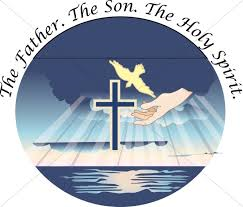
What does this doctrine of the Trinity tell us about the kind of God we worship and the kind of people we should be?

The Gospel just proclaimed comes near the end of Jesus’ discourse at the Last Supper and is an example of the implicit teaching on the Trinity.   Jesus tells his disciples that the Spirit will declare what the Spirit hears from Jesus.  Elsewhere Jesus says, “The Father and I are one.”  If Jesus and the Father are one and the Spirit speaks what Jesus says, it follows that the three must be one.  Further evidence found in Scripture regarding the doctrine of the Trinity is found in the other readings for the feast but if one expects today’s readings to give a clear presentation of the doctrine of the Trinity – they will be disappointed.

The important question for us is: What does this doctrine of the Trinity tell us about the kind of God we worship and what does this say about the kind of people we should be?   With our three-fold vows, we are reminded of our commitment to a balance of prayer, labor and leisure.   We pray many times a day, in various ways, the familiar words of one of the first prayers many of us learned: the “Glory Be” in honor of, and thanksgiving for, the revelation of the Trinity:  Father, Son and Spirit.

This inner relationship of the Father, Son and Holy Spirit is such that each of them is fully and equally God, yet there are not three Gods but one God.  This is incomprehensible to the human mind. It is a mystery.  Together the three Persons in the Trinity, Father, Son and Spirit represent the fullness of love. The Father loves the Son, the Son loves the Father. The Spirit is their love for each other. But love is only a word until someone gives it meaning.  We are made in the image of a triune God – God the Father, who created us, his Son who saved us, and the Holy Spirit who continues to guide us.  To be true to our calling we must be the ones who give meaning to Love in our world.  As Paul says in the second reading to the Romans: We did not receive the spirit of slavery, but of adoption …  we are heirs of God with Christ and destined to be glorified with him.”

On this Solemnity of the Holy Trinity, we are privileged, not merely in commemorating a doctrine, but in celebrating and entering into a communion of Persons who have loved us into being, redeemed us from ourselves, and continue to call us each day to a fuller experience, a deeper lived knowledge, of God. As long as we have our feet planted “this side of the grass” it makes sense that we might not be able to completely understand how something can be “one” and “three” at the same time.  One last comparison: Consider the egg you might have had for breakfast: yolk, white and shell – three parts, one egg.  Your personal interpretation will ultimately be your best guide, and the only answer you need.

~Reflection by Sister Roberta Bailey, OSB


First Reading: Proverbs 8:22-31             Second Reading: Romans 5:1-5
Gospel:  John 16:12-15
Continue Reading

Filed Under: Blog, Front Page, Homily Tagged With: Father, Jesus, Solemnity of the Trinity, Son, Spirit, Trinity, Trinity Sunday

  • « Go to Previous Page
  • Page 1
  • Interim pages omitted …
  • Page 7
  • Page 8
  • Page 9
  • Page 10
  • Page 11
  • Interim pages omitted …
  • Page 64
  • Go to Next Page »

Footer

Prayer / Newsletter / Info

 Contact Info

Benedictine Sisters of Florida

PO Box 2450
12138 Wichers Road
St. Leo, FL 33574-2450
(352) 588-8320
(352) 588-8443

 Mass Schedule

Related Links

Copyright © 2026 · Benedictine Sisters of FL · Touching Lives Through Prayer and Service

Copyright © 2026 · Bendedictine Theme on Genesis Framework · WordPress · Log in