• Skip to primary navigation
  • Skip to main content
  • Skip to footer
Benedictine Sisters of FL

Holy Name Monastery
Founded 1889

Donate Now
  • Home
  • About Us
    • History
    • Being Benedictine
    • Benedictine Monasticism
    • Meet Our Community
    • Holy Name Academy-Alumnae
  • What We Do
    • Mission, Vision and Our Partners
    • Retreats
      • Invitation to Retreat
      • Accommodations
    • Volunteer Programs
    • Oblate Program
    • Spiritual Direction
    • Aqua/Hydroponics
    • More of Our Ministries
  • What’s Happening
    • Articles of Interest
    • Events
    • Newsletters
    • Brochures
    • Links
  • Support Us
    • Gifts of Support
    • Wish List
  • Stories Shared
  • Galleries
    • Photos
    • Videos
      • Benedictine Sisters of FL Videos
      • Other Videos
  • Contact Us

God

Always There

September 19, 2016 by Holy Name Monastery Leave a Comment

fatheranddaughterFirst Reading  Amos 8:4-7            Second Reading  1 Timothy 2:1-8
Gospel (shorter form) Luke 16:10-13

The lesson here is trustworthiness: those who can be trusted in small things can also be trusted in great things. Benedict knew this lesson well – that’s why he instructs us: “treat all things as vessels of the altar.” If we handle furniture, dishes, sewing supplies and a paint brush with the same respect that we exhibit toward a chalice it is more likely that we will have that attitude of caring will extend to people.  When we hear stories of violence, abuse and disregard for persons, the root “red flag” behavior was often evidenced in childhood and behavior toward siblings or parents: hitting out, slamming doors, the classic “kicking the dog” behavior because the young person was mad at a classmate or the teacher.  The parent who withholds violence against an over-powering boss but deliberately runs over the bike in the driveway, or slaps his son or screams at her daughter for a triviality – that behavior can usually be traced back to disrespect and disregard for the toys, blocks and body-slamming in the guise of “we were just having fun.”

Respect has its seed in Benedict’s “treating all things as vessels of the altar.”   Think about it …  look at how  you treat and handle your belongings and community goods you’ve been given for use …  your personal spaces, the car you usually drive,  “common spaces” you use … are they as neat, clean and orderly as we expect the altar vessels and the chapel to be?

Respect for things matures into respect for persons which leads others to know they can depend upon us and trust us to “handle” them with respect.  We are trustworthy with the little things in life, thus we can be trusted in our interactions with each other.

The story goes that a little girl and her father were crossing a bridge. Her dad was actually kind of scared of heights so he asked his little daughter, ‘Sweetheart, please hold my hand so that you don’t fall into the river.’

The little girl said, ‘No, Dad. You hold my hand.’  ‘What’s the difference?’ asked the puzzled father.  ‘There’s a big difference,’ replied the little girl.  ‘If I hold your hand and something happens to me, chances are that I may let go of your hand. But if you hold my hand, I know for sure that no matter what happens, you will never let my hand go.’

In any relationship, the essence of trust is not in its bind, but in its bond.

When I was growing up in DeLand we lived 3 blocks from the main boulevard the best way to get from home to church – we had no car, we walked the two miles.  When, as an adult I drove the distance from the highway to where our house had been it seemed much shorter than my memory.  Why does that matter?  As is still typical today in parishes, our high school catechism classes were in the evening.   Until my 9th grade year, (I came to the academy when I was in 10th grade) my brother, three years my junior, and I had attended afternoon classes together.  Now, it was October and daylight savings time had ended and the walking home after class was in the dark – felt like the dead of night.  It wasn’t too scary until I reached the turn off to our street – no street lights, barking dogs that sounded like wolves, creepy noises of a rustle in the bushes.  I don’t know why, I didn’t have a flashlight.  I don’t recall that I talked about being scared … maybe rushed into the house like a banshee was chasing me?  But, the second week of classes, and every week thereafter until our clocks were sprung forward to daylight savings time, my father would magically appear at the corner of the main road to continue the journey home with me.    He sometimes made remarks about the foolishness of attending those classes when I already knew as much as the teachers… but he was there, and I knew I could depend on him to keep his vigil for my return.  And, I am sure that continues to confirm my belief that God is trustworthy and simply is “always there.”

~ Reflection by Sister Roberta Bailey, OSB, Prioress
Continue Reading

Filed Under: Blog, Homily Tagged With: always there, Benedict, God, respect, trust, trustworthines

God’s Law – God’s Love

September 12, 2016 by Holy Name Monastery Leave a Comment

gods-lawFirst Reading  Exodus 32:7-11,13-14                 Second Reading 1 Timothy 1:12-17
Gospel Reading  Luke 15:1-32                            Intention Responsible Citizenship

An inner city church, located in an area of a large American city where there were few residents, was forced to a decision. A large corporation was offering them a great deal of money for their site, on which the corporation wanted to put a parking lot. The money would enable the parish to move to the inner city where they would find many more people to serve. Even though this was exciting to some of the congregation, other members were resistant to the idea. They pointed out that the church was the guardian of a building whose history and architecture reached back into the early part of the nineteenth century. History had been made in that building.

Eventually the congregation decided to sell the site and make the move to the inner-city neighborhood. The pastor said, “We had to decide whether we wanted to be in a museum or in mission, we couldn’t have it both ways.  It meant either staying on the original site, glorying in the past history and serving a few people, or giving up the past and gearing up ourselves for a significant ministry among the city’s people. We opted for mission status over museum status.

Something of this same struggle is indicated in this Gospel. The Pharisees and scribes came down on the side of museum religion. They wanted attention given to those who were stable, pious and not a liability if invited to the local country club. Their rationale was “Let’s have our synagogue programs be dependable for our like-minded types.”  Jesus disappointed them by insisting that the issue was one of mission: to reach out to those who needed great mercy and perhaps a bath.

The Pharisees’ love of God’s law made them forget about God’s love.   God loves us even more than a parent loves a child. God longs to rescue those who are lost.  (It’s like his favorite pastime.)  Our loving God will search for that which is lost. There’s no giving up, no quitting point. Just like looking for a lost coin – there’s no such thing as a life without worth. God doesn’t mind stooping down to find us and lift us up from the depths we have fallen into. Each time you stoop to pick up something that has fallen to the floor, however trivial a thing it may seem, that God does not disdain to stoop down to pick us up each and every time, after time that we fall.

In Jesus’ day when a husband took a bride, he gave her a headband with ten silver coins that were evenly spaced. She wore this headband in public to show that she was married. If she was unfaithful, one of the coins was removed, and the gap showed that she had disgraced her marriage vows. It was a shame and disgrace to lose any of these coins.

Loss of the coin in Jesus’ parable it seems was a result of carelessness, but not a moral disgrace. It was lost on a dirt floor in the darkness. People without God are the like that. They are not just lost, they are in the dirt and the dark. They need Jesus, the Light of the World – we all do.   Jesus looks for us, so He can bring us out of the darkness into the light!   Our community hospitality ministry helps people come into the light of welcome, friendship and compassion so that they in turn can be a light to those they associate with.   We feed their hunger for peace, camaraderie, spiritual growth, a prayerful liturgy and often top it with a good meal.

Let me end with a story that proves we never know what will bring people to their knees.

A minister was waiting in line at the Pearly Gates. Ahead of him there was a fellow who was dressed in sunglasses, a loud shirt, leather jacket and jeans. Saint Peter addressed the asked, “Who are you, so that I may know whether or not to admit you to the Kingdom of Heaven?”    “I’m Joe Cohen, taxi driver, of New York City”. Saint Peter consulted his list, smiled and said:  “Take this silken robe and enter.

Away he went.  Next in line was the minister. . He stood erect and boomed out, “I am Msgr Joseph, pastor of Saint Mary’s Cathedral for the last forty-three years.” Saint Peter consulted his list and said to the minister, “Here, take this cotton robe and you can come in.” Just a minute here,” said the minister. “That man was a taxi driver and he gets a silken robe. How can this be?” ”

“Up here,” said St. Peter, we work by results. While you preached, people slept. While he drove, people prayed.”

~Sister Roberta Bailey, OSB, Prioress
Continue Reading

Filed Under: Blog, Homily Tagged With: God, God's Law, God's Love, Gospel, Jesus, Pharisees

In Praise Of Work

September 6, 2016 by Holy Name Monastery Leave a Comment

In praise of work

Scripture is very clear about the place of work in human life. The Book of Genesis is explicit: we were put into the Garden “to till and to keep it.” We work to complete the work of God in the world. Work, then, may be the most sanctifying thing we do.

The implications of a spirituality of work in a world such as ours are clear, it seems. Work is my gift to the world. It is my social fruitfulness. It ties me to my neighbor and binds me to the future.

Work is the way I am saved from total self-centeredness. It gives me a reason to exist that is larger than myself. It makes me part of possibility. It gives me hope. Martin Luther wrote: “If I knew that the world would end tomorrow, I would plant an apple tree today.”

Work gives me a place in salvation. It helps redeem the world from sin. It enables creation to go on creating. It brings us all one step closer to what the reign of God is meant to be.

Work is meant to build community. When we work for others, we give ourselves and we can give alms as well. We never work, in other words, for our own good alone.

Work leads to self-fulfillment. It uses the gifts and talents we know we have and it calls on the gifts of which we are unaware.

Work is its own asceticism. When we face the work at hand, with all its difficulties and all its rigors and all its repetition and all its irritations and accept it, we do not need to traffic in symbolic penances. What today’s work brings is what is really due from me to God. And if we do it well, we will have spiritual discipline aplenty.

Finally, work is the way we really live in solidarity with the poor of the world. Work is our commitment not to live off others, not to sponge, not to shirk, not to cheat.

Work is our sign that God goes on working in the world through us. It is the very stuff of divine ambition. And it will never be over. God needs us to complete God’s work. Now.

-from In the Heart of the Temple by Joan Chittister (BlueBridge)

Continue Reading

Filed Under: Homily, Prayer Tagged With: Genesis, God, heart of the temple, in praise of work, Joan Chittister, Martin Luther

The Narrow Gate

August 22, 2016 by Holy Name Monastery Leave a Comment

gate21st Sunday in Ordinary Time, Sunday, August 21, 2016

First Reading  Isaiah 66:18-21                Second Reading  Hebrews 12:5-7,11-13
Gospel Reading  Luke 13:22-30

This Gospel may well be a loose collection of sayings of Jesus recalled by the author, uttered in several different contexts but brought together here under the general heading of “who will be saved?”

As this parable opens, Luke reminds us that Jesus is making his way to Jerusalem, teaching as he goes. When from out of the crowd he hears a question called out giving him a chance to make a prophetic statement. A few weeks ago, the question was “What must I do to inherit eternal life?” Today it’s “will only a few be saved?”

Jesus answers with two parables – referred to as the “narrow gate” and the “door” although the same Greek word is used for both gate and door.  It’s the translation that may be misleading.    It’s interesting to me that Jesus says many won’t be strong enough to get through the gate.  He doesn’t say slim enough.  It sounds as if the walls can be pressed aside if you just have enough strength.  To digress a moment … I thought of this image at the construction meeting earlier this week.  The discussion was about the well that has to be sunk to provide water for the fire sprinkler system.  The pipe will have a protective casing on it so it will not be subject to water erosion or enjoyed by underground rodents that visit our garden.  When drilling the well they ensure that the opening is wide enough to accommodate whatever diameter of pipe it takes to get the needed  water pressure ( 4’, 6’ 8’ pipe) before inserting the casing … in Jesus language, that it is strong enough to let the required flow of water get through.

Jesus says: “Many will seek to enter and will not be able” … so, maybe the overwhelming crowd will be too many all at the same time pushing and shoving to get through the opening?

This question to Jesus had people squirming: “Will only a few be saved?”  Will I be among them?  How can I be in that count?

The answer to the “will only a few be saved?” is no. In the end, many will be saved, but many who thought they would be saved will not be saved. The parable is a prophetic warning that it will take repentance, forgiveness, faith …   in order to be saved.  “Many are called but few are chosen.”

But, remember Jesus also said, “When once the master of the house has risen and shut the door, and you begin to stand outside and to knock at the door, saying, ‘Lord, open to us,’ then he will answer you, ‘I do not know where you come from.”  Don’t delay your planning to be among the chosen … what’s the saying: don’t put off to tomorrow what can be done today?  Lectio and personal prayer; some form of fasting whether from food, or technology or juicy gossip is a daily opportunity.

Jesus answer to the crowd lets his hearers (and us) know that the “door of opportunity” will not remain open indefinitely.  When the door is closed, it is closed and will not be reopened for persons whose only claim is that Jesus once visited their temple / their church, their town and village or preached in their streets or that they once saw Jesus in a crowd.   Remember the 10 virgins … 5 missed the boat due to a lack of “NRRO future planning.”  And, recall the Gospel lessons we heard this past week: the first shall be last … and the last will get the same reward as those who signed on to Jesus work crew early in the day.

We’ve all probably seen the famous painting of Jesus knocking at a door with knob …  the door to our hearts must be opened from the inside.   That’s true but there are also doors with visible knobs that we must have the courage to open from our side….  To let in the immigrant, the wanders, the seekers, the faithless, the weary.  Could we say we are on the inside listening for outsiders to lift the knocker asking entrance.  Or, there doors waiting for you to twist the knob on, or push aside, to get a glimpse of what’s on the other side? It takes courage, doesn’t it, to be on either side of the door:  A big breath before stepping up to knock on the door of a stranger and a gasp of apprehension to open the door to an unexpected knock, especially if there is no peep hole to reveal at least a shadowy shape of the caller.

Some years ago I belonged to a parish group that studied various styles of meditation.  One was “wall” or “gate” meditation.  I invite you to try it …  and then I will share my experience.

Get in a relaxed position … lying down risks dozing off but sitting runs that same risk … just don’t try this particular type of meditation standing up or walking …   So, relax your body, close your eyes and in your mind start walking along the edge of a wall or fence … not on it, beside it –  until you see an opening or door … walk through – who’s there – do you see Jesus? – who is with him?  What are they saying to each other or to you …  Just let the reflection go where it will …

In my first experience… as I crossed through a low stone wall, I sensed Jesus seated with a circle of 10 – 12 others – he motioned for me to come sit beside him …  looking around I recognized and could name all but one person …  I have no memory of who they were BUT several years later I was introduced to a Sister from another community and I startled and instantly realized she was the one who had been in that circle.

Here are some doors you may want to visualize, open and peer beyond  …  Lord, Lord, open to me.

church_cross-door doors brick1 old_door_double colored doors barn doors stone dooroffice door1
~Reflection by Sister Roberta Bailey, OSB, Prioress


Continue Reading

Filed Under: Blog, Homily Tagged With: Door, Gate, God, Jesus, Knocking, knowledge, Luke

Availability

June 6, 2016 by Holy Name Monastery Leave a Comment

availabilityThroughout his Gospel, Luke demonstrates that God’s promises to Israel are fulfilled in the person of Jesus.  In this part of Luke’s story, Jesus and his disciples are approaching the city of Naim when they come upon a large funeral procession. Luke does not tell us how Jesus knows that the deceased is an only son of a widow.  Did He know the family or was the scene and the ritual all too familiar to him and his disciples?   Whatever the reason, had Jesus not been present to the moment and available to its significance it may have gone without noticed or ignored by the evangelist as well as the passersby.

Before I continue: a disclaimer is called for: Much of what follows is borrowed or adapted from Robert Wicks’ little volume entitled AVAILABLILTY.

The virtue, the gift of availability is indeed a simple but a great gift.  The freedom to be present when needed is something special.  It is an opportunity to be spiritual – to be open to relationship in the deepest, most elegant sense of the term.  However, this wonderful state of living often seems hidden or distorted.  Today, availability is a premium because it is not only a gift but also sometimes a great challenge for many of us – one that we need to more fully understand and address if we are to be able to continue to be present in the full sense of the word.  Availability is not only a gift; it is also a problem.

Some of us are “too available.”  Thus, true availability becomes watered down. We become too busy to pray, too tired to reflect, and, ironically, too stimulated interpersonally present to others.

Others among us pull back in anxiety.  Being available to God seems to raise too many questions or doubts.  Spending time alone is no longer relaxing; instead we feel lonely or preoccupied with our faults and failures.  And being with others doesn’t seem to help either; in some cases, we feel used, left out, or misunderstood.  The end result is that our expectations for intimacy are not realized and we feel the need to pull back more than ever.

The situation is not merely a sad one; it is a dangerous.  Without a sense of availability to self, others, and God, life loses it spirituality.  Relationships suffer, break down, and we are left with a void or sense of confusion.

We must address availability with the imperative that openness to the personal and interpersonal is essential if the Spirit is to be heard and felt. Any blocks to relationship must be removed if we are to prepare ourselves always for the continual coming of what is Good.  The very vitality of living out the Gospel depends on our being involved –  in an ongoing way – in the process.

When we spend time, especially unplanned time, with others it is not so much that we TAKE TIME OUT OUR DAY to be with them as that we had make the other part of our life.  For instance, today’s funeral for Kurt … because we generously welcomed them into our home God, through us, was enabled to share compassion, comfort and hospitality to a large group of mourners.

Jesus absorbed the widow’s sorry, made it his own and offered deep compassion and consolation to her even before he raised her boy from the funeral bier.  Did Mary witness this incident or did others relate to her?  Later when her son died do you think  she recalled he’d brought this Only son back, and Lazarus, too, back to life?  Did she live in hope that such a miracle would be granted her son?  Someday we may know.

Picking up cues, recognizing a silent need – reaching into self and out to others: this kind of attitude is at the heart of a life that reflects an appreciation of the gift of availability.  This attitude merits being kept in mind as we look at some of the basic problems we encounter in trying to be available to ourselves, others, and God.  Though the concept is simple, living a life of true availability isn’t easy for most of us.  It takes a conscious desire and effort to be present to all the nuances of the present moment.  Some people see only the dark clouds gathering; others see the rainbow emerging.  Let us be present to the moments when rainbows quietly and slowly are revealed in our lives.  Jesus would have missed the funeral scene if he had been too intent on getting to the farmer’s market in town.

~Reflection by Sister Roberta Bailey, OSB, Prioress


Continue Reading

Filed Under: Blog, Homily Tagged With: Availability, funeral, gift, God, Gospel, Jesus, Luke, Widow

Body of Christ; Blood of Christ

May 31, 2016 by Holy Name Monastery Leave a Comment

euch1With the singing of Vespers this evening we begin our celebration of the feast of the Body and Blood of Christ – once called Corpus Christi (but that only refers to the Body of Christ).

This one of my favorite feasts … it celebrates the ultimate in self-giving… not only to lay down one’s life for another but, further, to freely give its essence to another.

This particular version of the story of the feeding of the 5,000 is the only one of Jesus’ miracles to appear in all four Gospels. Luke places it between Herod’s question, “Who is this about whom I hear such things?” and Peter’s response to Jesus’ question about who he thought Jesus was.  In Luke’s version of the feeding of the crowd it is not the result of Jesus’ compassion for the crowd but is an incentive to the disciples to do something about the problem they perceive.  When they want Jesus to send the crowd away to so they (the crowd and themselves) can get something to eat, Jesus tells them to give the people some food on their own.

When we come to the Eucharistic table, hungry for the Word of God and the Body of Christ, what does the Jesus, in the person of the priest say?  “Take, you all, and eat of this.  Take, you all, and drink.”  How contradictory, then it is, a few minutes later to hear the same person say to the worshiping community:  “If you are not Catholic, fold your arms across your heart for a blessing.”

I recall in 1959-60 when our wood-frame convent was condemned by the fire department.  The local community responded with open hearts to us when they were asked: “May we live with you until we can build a new house?”  We certainly felt “welcomed as Christ” – the people viewed it a privilege to house the sisters and some of our boarding school students. They did not ask “are you Catholic” nor did we pick and choose a dwelling place based on a host’s church membership.

Today, everyday Jesus asks each of us … have you reserved a guest room in your heart for Me where I may rest, where I may eat a meal with you?   We think about Benedict’s words “guests are always present, wash their feet, acknowledge them with a greeting or a nod, set a special place at the table for them, reverence Christ in the person of the guest.  Our corporate commitment statement continues to challenge us to “respond with the compassion of Christ” to the variety of hungers of the human heart.

I agree with the author who says: “… Admittedly, hospitality won’t cure all of our ills.  It won’t erase underlying problems that promote a climate of division or create a magical panacea for human suffering.  But hospitality can help.  It can assist and guide us in the way we deal with, and the ultimately solve our problems.  It can allow us to function with grace and dignity.  Hospitality is a seed planted deep within us that awaits our attention and care.  Nurtured by willingness, watered by prayer, hospitality reflects the face of a loving, accepting, compassionate God.  Wherever we go, whatever we do, we can pray that a spirit of hospitality will permeate our thoughts and animate our actions.  (Everyday Hospitality by Thea Jarvis)

Pondering the significance of this feast, it strikes me that with Christmas we are touched with joy and awe at the birth of Christ.  At Easter we explode with ALLELUIA at the resurrection of our Savior.  The Ascension leaves us quietly looking upward, outward waiting in expectation for “what’s next?”  Then comes the Solemnity of the Trinity – the mystery that baffles us … that God is so great, so awesome that only in three persons can all the divine manifestations be expressed.  And, today; the solemnity of the Body and Blood of Christ – this touches, awakens in us feelings we can hardly express – that our God, our Jesus, our Savior would choose to gift us in such a personal, so intimate a way … the Creator chooses to be assimilated within the body of the creature.  His body and blood become, over and over, absorbed into my body – His blood courses in my veins.  Did you ever wonder how an aspirin knows where you ache is?  Or an antibiotic knows what to attack?  Is it heresy to say: Jesus attaches himself to every fiber of my being?  When the minister looks us in the eye and greets us: “Body of Christ; Blood of Christ”, we are stunned speechless except to respond as we’ve been taught: “AMEN!”

~Reflection by Sister Roberta Bailey, OSB, Prioress
Continue Reading

Filed Under: Blog, Homily Tagged With: Blood of Christ, Body of Christ, Corpus Christi, God, Jesus, Savior

  • « Go to Previous Page
  • Page 1
  • Interim pages omitted …
  • Page 35
  • Page 36
  • Page 37
  • Page 38
  • Page 39
  • Interim pages omitted …
  • Page 41
  • Go to Next Page »

Footer

Prayer / Newsletter / Info

 Contact Info

Benedictine Sisters of Florida

PO Box 2450
12138 Wichers Road
St. Leo, FL 33574-2450
(352) 588-8320
(352) 588-8443

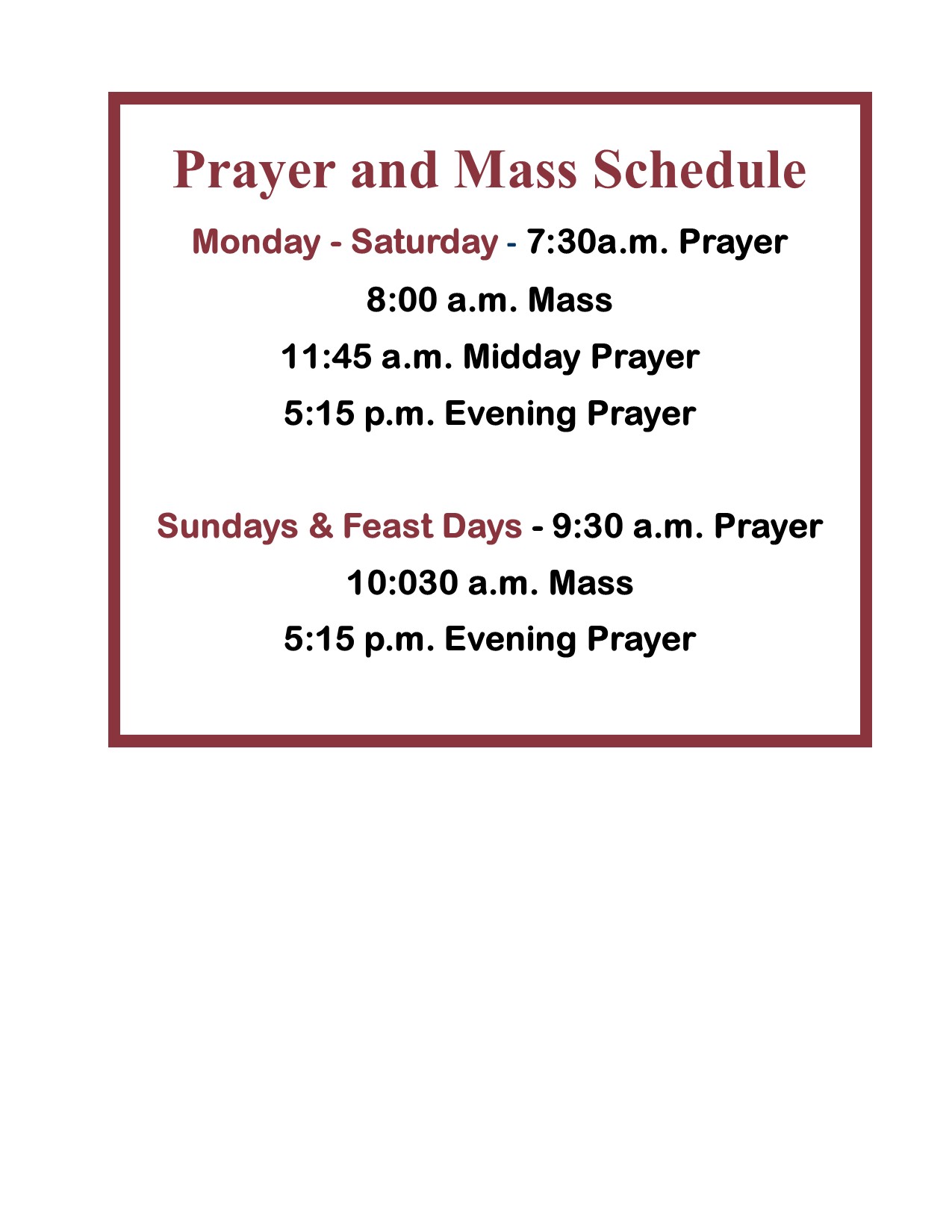
 Mass Schedule

Related Links

Copyright © 2026 · Benedictine Sisters of FL · Touching Lives Through Prayer and Service

Copyright © 2026 · Bendedictine Theme on Genesis Framework · WordPress · Log in