• Skip to primary navigation
  • Skip to main content
  • Skip to footer
Benedictine Sisters of FL

Holy Name Monastery
Founded 1889

Donate Now
  • Home
  • About Us
    • History
    • Being Benedictine
    • Benedictine Monasticism
    • Meet Our Community
    • Holy Name Academy-Alumnae
  • What We Do
    • Mission, Vision and Our Partners
    • Retreats
      • Invitation to Retreat
      • Accommodations
    • Volunteer Programs
    • Oblate Program
    • Spiritual Direction
    • Aqua/Hydroponics
    • More of Our Ministries
  • What’s Happening
    • Articles of Interest
    • Events
    • Newsletters
    • Brochures
    • Links
  • Support Us
    • Gifts of Support
    • Wish List
  • Stories Shared
  • Galleries
    • Photos
    • Videos
      • Benedictine Sisters of FL Videos
      • Other Videos
  • Contact Us

God

Are You In Danger of Becoming a Pharisee?

March 14, 2016 by Holy Name Monastery Leave a Comment

It’s pretty easy to spot a Pharisee, and we might not like it to admit it, but we can all behave like a Pharisee if we’re not careful.   How will you knowPharisees if you’re a Pharisee?
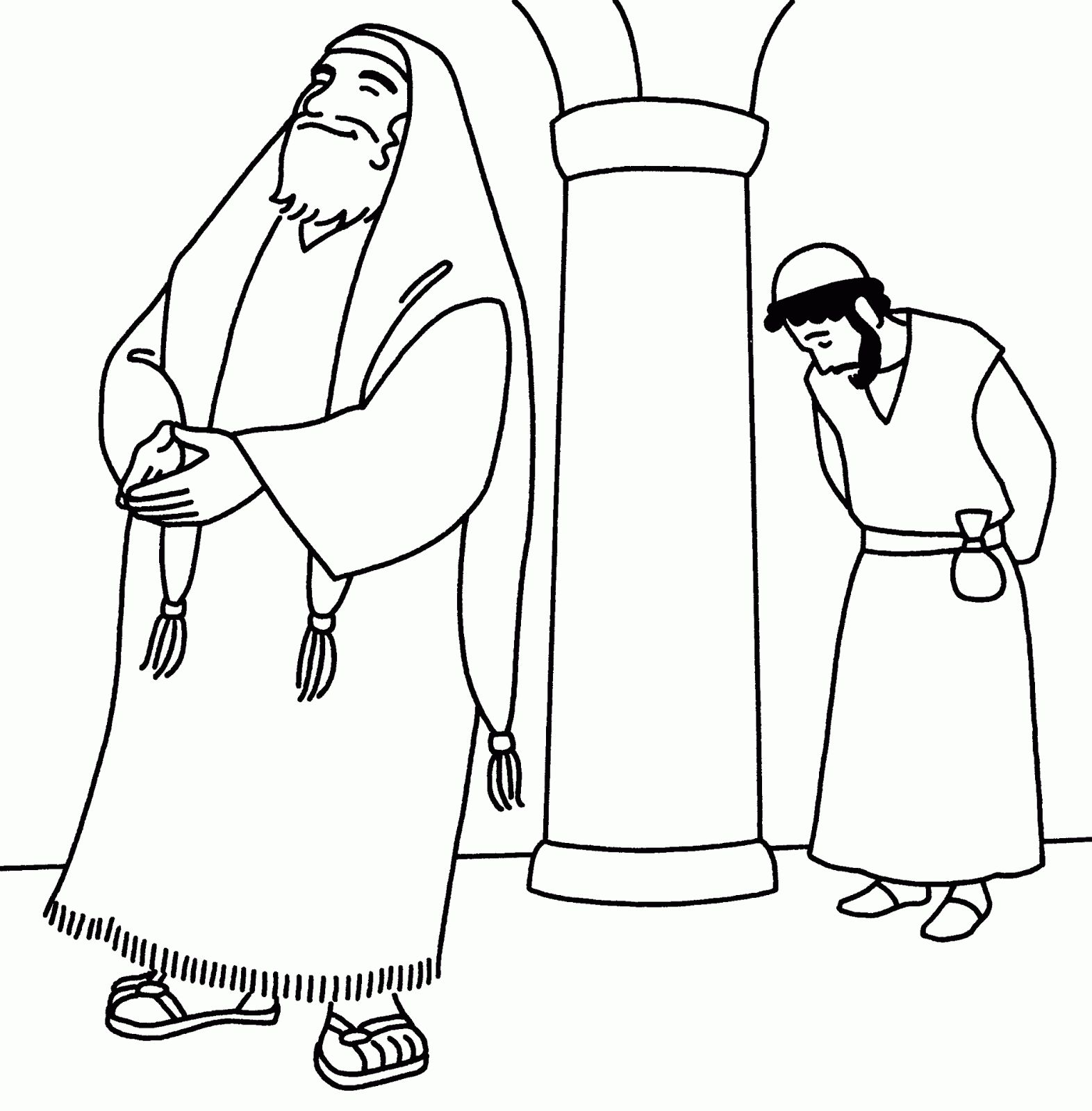
If your official title is longer than your given name.

  • If you’re willing to be merciful – once.
  • If you feel your rules are the REAL rules.
  • If everyone outside your immediate circle, and most within it, are always wrong.
  • If God’s still small voice… sounds exactly like your own.
  • If you feel all the apples are spilled out of your cart when a rule is bent.
  • If you know the Word of God, but not the God of the Word.

You see, the Pharisees of Jesus’ day had started out wanting TO PLEASE God. They began in a day when Israel was deeply tainted with immorality and unrighteousness and somebody needed to stand in the gap. And the Pharisees stepped up to fill that need. And in an era where many Jews had abandoned the law of God, the Pharisees became like prophets to their people pointing them back to the Law of Moses and obedience to God’s will.

The Pharisees were THE religious people of the day and they took their “faith” seriously. Any time people take their faith seriously, it’s not a big step over the line from pleasing God to disobeying God.

So we want to be careful WE don’t do that too.  You see the Pharisees didn’t set out to make God angry.   They wanted to obey every one of God’s commands. They didn’t wake up one morning saying: “I’m going to make God mad today!”  It was just that their thinking was warped.  Rules had become all-important – People were UNIMPORTANT.  When the Pharisees brought this adulterous woman to Jesus… they didn’t care about her. A rule had been broken. She needed to be exposed.  She was only a tool – an object lesson they wanted to use to get at Jesus. They really hated Jesus.

In their warped thinking, God’s agenda was what they decided. And, they believed as long as they kept the rules their personal sins could be covered up. In reality they had no intention of stoning the woman … she was just a prop.  In fact, they couldn’t stone her. Once Rome conquered Judah, Judah became a Roman territory, and under Roman law, only the Roman governors had the authority to condemn people to death. You only have to look at the Crucifixion of Jesus to see that truth.  Do you remember who’s approval the Pharisees and the teachers of the Law needed to have Jesus executed? That’s right – Pilate. He was the Roman Governor at the time.

It was a perfect trap.  They didn’t care about the woman. And they didn’t care about Jesus. In their minds both of them had broken their rules… and both needed to be destroyed.

You need to understand, these Pharisees saw Jesus as an enemy of THEIR god. Their god was on THEIR side… and so anyone who opposed them was opposing God.

We can end up making Jesus our enemy by substituting our personal agenda for His. And if you’re not careful… you’ll not even know you’ve done it.  BUT there is one symptom of this dangerous attitude. It should be like a road sign saying “Don’t go there.”

When you get mad people don’t listen to you. Your opinion is being ignored. Things aren’t going YOUR way.  That can make you really angry. YOUR agenda is obviously the right agenda.  If you’re right it follow the other must be wrong.  If you feel that’s happening, pay attention. It’s a sign that you’re in danger of becoming a Pharisee.

The Pharisees had convinced themselves that if they could “look” good on the outside, that was as good as “being good” on the inside.  They fooled themselves into thinking that obeying certain rules was just as good as being righteous before God.  In fact they got most of the rules right.  By contrast, a Pharisee could tell you were going to hell – and you could tell they were thinking “got what you deserved – glad you are on your way.”

As this true story illustrates, warped thinking can lead you down a Pharisee-like path:

A 4-year told his mother” “Mom, I’m not gonna be like those bad guys Jesus was talking to; I’m not going to sin anymore.”   “Well, that’s very nice,” (she said). “What made you decided not to sin anymore?”  He answered: “Cause Jesus said if you don’t sin, you can throw the first stone and I want to throw the first stone.”

Reflection by Prioress, Sr. Roberta Bailey, OSB
Continue Reading

Filed Under: Blog, Homily Tagged With: Faith, God, Jesus, Lent, Pharisee

The Prodigal Son

March 8, 2016 by Holy Name Monastery Leave a Comment

prodigalIf you were around before Vatican II for long Latin choir rehearsals, you may recall the melody of the antiphon that announced the Fourth Sunday of Lent.  It’s one of those that stays with you … (sing) Laetare translates from Latin to English “Rejoice”.   This is also known as “Refreshment Sunday” – a day when the austerity of Lent is relaxed a little, and the violet vestments of Lent can be replaced with rose-colored ones.   A special kind of fruit cake was often served on this Sunday modestly breaking the Lenten Fast.

According to another old tradition, although it probably is not on anyone’s list of approved feast days, is “Laugher Sunday” or “Holy Humor Sunday” – a day celebrating the big joke that God pulled on Satan.  Thus the name: God’s Joke or the Easter Laugh – a day to lighten up, relax, and recall the joy and the goodness of the Lord.  (We anticipated it a bit with our Hoedown!)  In honor of Laughter Sunday, here’s one to tickle your funny bone.    During a lesson on Easter, a religious education teacher asked the class, “What did Jesus do on this day?  Getting no response, she prompted: It begins with R. “I know!” blurted out a child: “Recycle.”

But on a more serious bent … The context of today’s Gospel is not to be made light of.  Sinners and social outcasts were “all seeking the company of Jesus to hear what he had to say”. The Pharisees and Scribes, who were the “good and religious” people, were shocked and disturbed. “This man welcomes sinners and [even worse] eats with them.” By their standards, a “good” person avoids “bad company”. To be quite honest, don’t we think the same? If so, then we are not thinking like Jesus.

We typically title this Gospel story the “Prodigal Son” but, in fact, the emphasis is less on the son than on the father, who clearly represents God and Jesus.

No one can deny the appalling behavior of the younger son in this Gospel. He took all that his father generously gave to him as his inheritance and used it in leading a life of total debauchery and self-centered indulgence. Eventually, he had nothing and was reduced to living with pigs, something utterly abhorrent to the Jewish mind, and even sharing their slops, something even we would find appalling. “Served him right,” might be the reaction of many, especially the good and morally respectable.

This, however, is not the reaction of the father, who has only one thought in his mind – how to get his son to come back to where he belongs. The father does not say: “This son has seriously offended me and brought disgrace on our family. He better not come crawling back here.  I disown him!”  Instead he says: “My son went away, is lost and I want so much to have him back.” He stands in the doorway of his house many long hours, watching, waiting, longing … His love for his wayward son has not changed one iota.

There is no force involved. The police are not sent out. There is not an “Amber” alert. Servants are not instructed to haul him back. No, the father waits. It is up to the son himself to make the crucial decision: does he want to be with his father or not?

Eventually he “came to his senses”, that is, he realized the wrongness of what he had done. He became aware of just how good his father had been. The process of repentance had begun. He felt deeply ashamed of his behavior and then, most significant of all, he turned around to make his way back to his father.

The father, for his part, filled with compassion for his son’s experiences, runs out to meet him, embraces him and brushes aside the carefully prepared speech the son had prepared. If the son had known his father better, he would have realized that such a speech was unnecessary. Immediately, orders are given to bring the very best things in the house and a banquet is laid out.   This is forgiveness on the part of both the father and the son – a return to where each ought to be in relationship to the other.

This is where the elder son comes in. He simply cannot understand what is happening. “It’s just not fair!” How many times have we heard this spoken or, be truthful, felt in our hearts?  “It’s not fair, just because she’s the baby; you didn’t let me stay out that late when I was her age!”  And the litany grows.  We challenge our parents and one another’s generosity, operating from the perspective of limited resources. If she gets it, perhaps there won’t be enough for me.

Jesus wants his hearers (us) to understand that this is not how it is with God’s mercy, love and forgiveness. God offers love to all of us in abundance. The forgiveness of the father in the parable is an image of God’s love for us: generosity beyond measure!

By our standards, even God is unjust.  In fact, he is corrupted by love! That’s fortunate for us!  Supposing we went to confession one day and the priest said, “Sorry, that’s it. No more forgiveness, no more reconciliation. You’ve used up your quota. Too bad! ” Of course, it’s not like that.  Thankfully there is no limit to God’s forgiveness, mercy and love.  God has a deep desire to forgive – to be totally reconciled with us when we’ve severed the bond of relationship.  There is always a place in God’s company for us.  The question is: Do you truly believe that God acts this way towards us?  Can we humbly accept divine mercy without jealousy, knowing that God’s love for another does not diminish the love shown and showered upon us?

4th sunday web

Continue Reading

Filed Under: Blog, Homily Tagged With: Easter, forgiveness, God, Jesus, Lent, love, mercy, Prodigal son

Third Sunday in Ordinary Time

January 25, 2016 by Holy Name Monastery Leave a Comment

Epiphany3_YearC_scrollAfter the opening verses in today’s Gospel, Luke leap frogs over the chapters where we would find the Infancy Narratives, Jesus’ baptism by John, the temptations Jesus faced in the desert, and the beginning of Jesus’ public ministry.  The writer picks up in chapter four where we find Jesus in the synagogue on the Sabbath – it seems obvious this was his custom.  No one seems surprised to see him there.  What does raise some eyebrows is when he stands and reads from the scroll handed to him.  He announces his mission is in continuity with Israel’s prophetic tradition.  He speaks of a “year acceptable to the Lord” making reference to the Jewish tradition of Sabbath every 7th year and jubilees celebrated every 50th year – times when the land was left fallow and food stores were to be shared equally with all.  A time of renewal in which debts were forgiven and slaves were freed.

Luke clearly acknowledges that he himself never saw Jesus. His gospel was written at least 50 years after Jesus’ death and resurrection. Yet he wants to assure his readers that what he writes is accurate and is based on the experiences of people who did know Jesus personally. At the same time he lets us know he is not writing a biography. His purpose is not to relate a chronology but to tell us the meaning of Jesus’ life, death and resurrection for our personal lives and why we should accept and follow Jesus as our King and Lord.

People get different things out of going to church, depending, it would seem, on what they expect to get when they go there.  There’s a story about an elderly couple that was walking out of church one Sunday. The wife said to the husband, “Did you see the strange hat Mrs. O’Brien was wearing?” “No, I didn’t,” replied her husband. “Bill Smith badly needs a haircut, doesn’t he?”  “Sorry, I didn’t notice.” “You know John,” said the wife impatiently,” Sometimes I wonder if you get anything at all out of going to church”.

I wonder what the people who were in the synagogue that day when Jesus read aloud expected to get out of the service. Certainly they didn’t expect to see Jesus stand and read a portion of Scripture, let alone comment on it.

What did this message mean to the people in the synagogue? What does it mean to us today? It meant that day what it means today: that Jesus in the promised Messiah, the anointed one sent by God to redeem his people. It means that Jesus frees His listeners from the bonds of sin and guilt.  He came then, and He continues to come each and every day, to set us free. Why do we continue to try to solve our problems by ourselves instead of turning to God?

We are all captives to something, whether it is our ministry, our role in community, favorite TV shows, certain foods especially ones that aren’t good for us, shopping or something else. All of us can awaken to God’s anointing power. It constantly inspires, enlivens and guides us.  It soothes, comforts, welcomes and transforms us.

We can listen to that still small Voice of God within or in the words of a mentor and spiritual director or our comrade in community.  Or we can refuse to listen, we can refuse to believe, and we can refuse to let it make a difference for us, but it is still true. The Word of God stands forever!   Jesus’ one-sentence sermon that day in the synagogue was the shortest in history, but it is also one of the most powerful.

And, we believe it because we believe in the one who spoke it.  We love the man Jesus and believe he is the Son of God.  When Jesus taught in the synagogue, people listened but they did not understand everything, and perhaps they understand nothing at all. However, they were struck by a word, a sentence and they remembered it.  They continued to think about it…  Sounds like our lectio experience.  That’s when the Spirit goes into action and enlightens us, at first only a little, and later on more powerfully and persuasively.  That’s why it is important to spend open-ended time with the Word, with God.  We may have some favorite prayers we say that someone else wrote.  But how would you feel if one you call “friend” only shared with you something they’d memorized as a child or words from someone else’s pen?

We decide how to nourish our minds and feed our spirits by choosing what to read and to watch, what to reflect on.  And, we decide how to protect our minds and spirits by not reading or watching what does not uplift us and make a positive impact on our lives and those we engage with in conversation.  Like Scholastica and Benedict on that memorable night, we want to spend time in “holy conversation.”

Sometimes we forget how precious the Word of God is.  A powerful example is in this true story.  In 1964 the Romanian government released religious and political prisoners. Among them was one who had spent nearly three of his fourteen years in prison in solitary confinement. After his release, he wrote a book entitled In God’s Underground in which he describes how one day a new prisoner was brought in. The upper part of his body was in a plaster cast. When the guards withdrew, he slipped out a small tattered book secretly hidden between his skin and the plaster cast. None of the other prisoners had seen a book for years. They asked him what the book was. It was the Gospel of John.  The author of the story writes that he took the book in his hand and no life-saving drug could have been more precious to him. From that day the tattered little book went from hand to hand, many learned it by heart and each day they would discuss it among themselves. That reminds us that sometimes we forget the importance of the Word of God in our lives.

                                                                                                 Reflection by Sister Roberta Bailey, OSB, Prioress


Continue Reading

Filed Under: Blog, Homily Tagged With: God, Jesus, John, Luke, scroll, Word of God

Fourth Sunday of Advent 2015

December 21, 2015 by Holy Name Monastery Leave a Comment

May the last few days building up to Christmas not become too hectic doing for others …  save time for you and the Babe whose birth we will celebrate on Friday! 

In thbethlehem2is Gospel reading Mary, the girl-mother goes to visit Elizabeth, her cousin, who, in advanced age, is also with child.  She traveled approximately 103 miles over not the kindest terrain.  It sounds like perhaps Elizabeth learned of Mary’s approaching arrival.  Whether or not, Elizabeth greets Mary with full recognition of the roles that they, and their unborn children, will play in God’s plan for salvation

Thus, it is appropriate in this season of Advent that we consider the role of Mary. Mary is the one who believed that God’s word to her would be fulfilled.    Mary shows us “blind” faith, deep trust and an abiding peace.   She ask only, how can this be – listens to the angel’s reply …. nods her head and sets off across the hill country to be midwife to her cousin.  Her faith enabled her to recognize the work of God in her people’s history and in her own life. Her openness to God allowed God to work through her so that salvation might come to everyone: those who had gone before her and all of us who come after.

Martin Luther King, Jr once described faith as: ”taking the first step even when you don’t see the whole stair case.”   This is Mary … the angel sent by God said it can happen, so who am I to question God?   At this stage, she has no idea what is in store but she has said her Yes and she will be faithful to it.  May we always be like Mary, open and cooperative in God’s plan for salvation.

A few years ago there was a TV ad that ended with the question: Have you said ‘Yes’ yet?”   It is a question that tomorrow’s Mass are asking each one of us.  Have we made the most important preparation of all? Yes to the Father, Yes to Jesus, Yes to all that we will experience in the coming year, Yes to every call that God makes and will make of us?  We learn from Mary, and her son Jesus, how to say an unqualified, unconditional and unreserved YES!  That’s where the real joy and happiness of Christmas lies. All the rest is (so to speak) tinsel on the tree of our lives!

As Advent time winds down it is almost impossible not to be sucked into celebrating the feast before it occurs.  We struggle to remain grounded in the spirit of Advent.  Like children we just can’t wait for the big birthday party.  It’s as though even the most beautiful liturgies and symbols fail to communicate, because God is so much greater than all our frail efforts.  But, God doesn’t need our feeble attempts in order to communicate with astonishing clarity.    If we look and listen closely – like we look forward to the rising sun each morning from the breakfast table – we remember God is greater than any Advent wreath.  When the rich melodies of the O Antiphons course through us we are reminded we do indeed stand on holy ground.

On Monday we will mark the shortest day of the year.  Isn’t it strange that we refer to it as “shortest day” not the longest night?   The light of day gradually increases and we witness the sunrise earlier and earlier each day.

And, the Advent wreath’s purple candles increase until all four give light to our darkness and hinting at the more brilliant light that God promised: “The people who walked in darkness have seen a great light.”  God hasn’t forgotten or given up on us.  How fitting to have had the Penitential Service this past week … Any debt or guilt we may have felt or imagined is erased: the jail door sprung. The prison gate opens as wide as a proverbial smiley face!   The light within us is even more dazzling than you can imagine!

In the words of Dietrich Bonhoeffer we hear a message of hope and reassurance:

“Just when everything is bearing down on us to such an extent that we can scarcely withstand it, the Christmas message comes to tell us that all our ideas are wrong, and that what we take to be evil and dark is really good and light because it comes from God.  Our eyes are at fault, that is all.  God is in the manger, wealth in poverty, light in darkness, succor in abandonment.  No evil can befall us; whatever others may do to us, they cannot but serve the God who is secretly revealed as love and rules the world and our lives.”

Let’s not be counted among the people who miss out on the gift that God sent to them. You see, God’s Gift didn’t come in a beautifully wrapped package. God sent Jesus, His only Son, as His gift to us. Jesus’ mother was young virgin…his earthly father was a poor carpenter…he was not born in a beautiful palace…he was born in a manger. Not a very pretty package, is it? But do you know what? It was the greatest gift the world has ever known. It was the gift of salvation and it had your name on it.

Our prayer bubbles forth in the words of Psalm 40 (which we prayed in Noon Prayer yesterday) “O God, your wonders and designs are beyond imagining; you have no equal.  Should I proclaim your blessings, they are more that I can tell!”

Continue Reading

Filed Under: Homily, Prayer Tagged With: Advent, Birth of Christ, Christ, Christmas, God, Jesus, Joseph, Mary

First Sunday in Advent 2015

November 30, 2015 by Holy Name Monastery Leave a Comment

waiting-on-god-bannerHAPPY NEW YEAR!  Welcome to the Year of Luke!  This year we celebrate the full cycle (minus one day) of Advent!  Just as a reminder of a piece of Catholic trivia ..  Advent begins on the Sunday closest to the Feast of St. Andrew … since the feast is on a Tuesday, the closest Sunday is before the feast.

The opening article in the most recent LCWR newsletter entitled: “What Do We Do While We’re Waiting?” reminded me of my 3-year-old niece who was patiently waiting through what her mom had told her was my private time with God.  She had lasted through her first lectio experience with her books for 40 minutes.  She sat just outside the doorway where I was, heaved a heavy sigh and said: “OK, what do I do now God; she’s still talking to You!”

Advent is all about waiting.  But not waiting for someone else who is talking to God.  Is it wonderful that we do not have to take turns – we don’t have to wait to be in touch!  Advent is active waiting – that is what is at the heart of it. Even when we don’t know that we are waiting, we’re waiting. Even when we can’t find words for what we are waiting for, we’re waiting.

One of the ancient Advent prayers supplies us with a sentiment that Benedict echoes: “Give us grace that we may cast off the works of darkness and put upon us the armor of light.”    Many Advent hymns express the same theme.  For example: “When the darkness closes in, courage fails and hopes grow dim, clear the shadows from our sight, set our troubled world aright, fill our eyes with radiant light.  Come Lord Jesus, come!

We are waiting not just at Advent, but at all times for the advent of light, that ultimate light that is redemptive and terrifying at the same time. It is redemptive because it puts an end to the darkness, and that is also why it is terrifying because the light reveals all that was hidden in the darkness.  For so long, actually for most of our lives, the darkness has been home.  We’ve become comfortable in our incompleteness.   Now to leave home is downright scary. Change my ways of interacting with God and God’s people?  Whew!  Allow my rough edges to be smoothed – mmmm, sounds irritating (no pun intended).  We are gifted with Advent time to do personal “Isaiah work” of filling in every valley; leveling every mountain so the hills will become a plain, and the rough country will be made smooth.  As the familiar banner asks:  If not now, when?

Have you ever watched, or heard about the reality shows Restaurant Impossible or American Diner Revival.  Depending on which show you’re watching there’s a well-known renovation contractor and/or a chef that comes to a failing restaurant or diner and helps turn it around.  The premise is this:

Turning around a failing restaurant or diner is a daunting challenge under the best of circumstances. Attempting to do it in less than 36 hours, even with the help of the townsfolk, may be impossible.  But they’re ready to take on the challenge.  Can it be done?

From outdated décor to hip interior, from canned food to fresh ingredients, from surly employees to service-oriented staff, they attempt to overhaul the whole shebang with straight talk, great cooking skills, innovative, creative interior decorators and an excited team of mostly volunteers.  But, most importantly, when the TV crew arrives, the expectation is that the local staff will be ready with their own litany of what is going well and what needs to change.

This chef is no Christ figure, but there is an analogy here between our Advent Scriptures and theme of this human example of a dramatic overhaul driven by someone who knows what he’s doing.  The overhaul of the dilapidated restaurant and our personal overhaul is only possible if we’ll allow our premises to be placed under new management.

That turns our attention on the person who’s coming to town in the Advent scriptures.  The Gospel from Luke connotes a double reference to the already and the not yet.  Jesus berates the crowd for knowing how to interpret the weather, but not the present time.  This is where we, too, may fall short.  We listen to the weather reports and dress accordingly.  We gather in supplies and hunker down for the onslaught of a hurricane.  We see the waxing moon and wait patiently for the night of the full moon.  Such waiting requires discernment and alertness to natural signs.  Waiting for Jesus’ presence requires a deeper discernment and alertness to the signs of His appearance – the signs of the times.  And, so we question: do our community Directional Goals reflect awareness of God in our midst –  as well as in the signs of the times and what is to come

The hymn I referenced earlier reminds us how foolish we can be to overlook signs of the coming Christ: “Wise and foolish, still we wait. Is our Bridegroom at the gate? At his voice, our hearts have stirred, listening for his healing word, confident our cries are heard. Come, Lord Jesus, come!

Advent offers us time to waken to the signs of the times – Jesus, in the voice of Luke, reminds us we must remain on high alert awaiting the coming of the kingdom – it will be dramatic but that there will be little advance warning: “The kingdom of God is not coming with things that can be observed…  the kingdom of God is among you!   Remember:  “Heaven and earth will pass away, but God’s words will not pass away.”  The last Gospel we heard as the liturgical year ended (this morning) and the first Gospel for the New Year impress upon us the same warning: Beware that your hearts do not become drowsy!

                                                                                                       Reflection by S. Roberta Bailey, OSB, Prioress
Continue Reading

Filed Under: Homily, Prayer Tagged With: Advent, Christ, Faith, God, Waiting, Year of Luke

How Well Do You Read Signs?

November 16, 2015 by Holy Name Monastery 1 Comment

reading signsLast Sunday we heard Jesus’ observation about the contributions being made to the temple treasury and the example of sacrificial giving that he saw in the poor widow’s offering.  If we read Mark’s gospel continuously from that incident to yesterday’s Gospel, we also know about Jesus’ prediction about the destruction of the Temple, his teaching about the costs of discipleship, the woes that will accompany the end times and Jesus’ instruction to his disciples about the need for watchfulness so that they will not be caught unprepared for the final judgment.

This past Sunday’s Gospel continues Jesus’ teaching by offering signs to look for that will indicate that the coming of the Son of Man is near. His words and images draw upon Old Testament imagery, especially images found in the Book of Daniel.  In the historical context, Jesus is actually describing the coming destruction of the Temple and the ruination of the nation, as both fall under GOD’s judgment at the hands of the Roman Empire.

Next, Jesus says: “Learn a lesson from the fig tree.”  The emphasis, of course, is not on what kind of tree – the warning is: WATCH.  Jesus could have said citrus trees or olive trees.  But, he says “fig trees” and happily for us we have a lot of experience with fig trees that we had right outside our dining room windows at the old monastery. When the branch becomes tender and sprouts leaves, we know that another season of fruit is near.

After Jesus tells the parable of the fig tree, He gives several brief parables to show what the response one should have when the signs appear.

We know that Jesus’ words are not spoken to frighten his disciples, nor should they frighten us.   The prophetic Word of God is as sure and secure as the rest of His message.  They are offered to prepare us for the changes we will experience during our lifetime and at the end time. Our consolation and hope is found in the lasting nature of Jesus’ words and God’s never-ending love for us.

When you see the things happening that Jesus talks about, know that he is near, at the gates.  “But,” says Jesus, “of that day or hour, no one knows, neither the angels in heaven, nor the Son, but only the Father.”   Then, He assures us: “Heaven and earth will pass away, but my words will not pass away.”  Or, said still differently, the coming judgment and destruction that Jesus predicts will be the very signs that will vindicate his message.
Let’s drill down a little deeper into one phrase of the text — “of that day or hour no one knows.”   We do not know exactly what Jesus in his prophetic ministry would say to us in our moment of history, but we do know that the general thrust would be similar to what he has already said:  In the face of struggle, persecution and difficult times, when the tide of public popularity turns against God’s people, I tell you: remain faithful even though you do not know the future, even though you do not know the day or hour of your deliverance.

So, how, as followers of the Jesus, do we prepare?  In the face of struggle read the signs of the times.  How well do you read signs?  Can you train yourself to be more observant of the signs?  By personality do you notice signs in nature?  Road signs?  How well do you read non-verbal body language?   Do you work to sensitize yourself to recognize everyday signs?  How do you heighten your sensitivity to spirit signs?  Do you use Scripture, the Rule, the example of a favorite saint, a confessor or a friend-guide?  What helps you to listen more keenly to your heart?  In the quiet of the night – when sleep eludes you – or out walking or driving along a familiar road; riding alone in the elevator, climbing the stairs, passing through the hall at a leisurely pace; setting the table, readying yourself for communal prayer in the chapel – do you hear God’s whisper in your heart?

Cultivation of the inner spirit helps prepare us to see the direction of the cultural wind we face, whether agreeable or antagonistic.    God does not usually shout to us in fury or in a tumultuous hurricane.  Much of the time God speaks softly – so stay tuned.  In the face of cultural garbage and shifting government structures or a changing church, we steady ourselves not to be tempted to hoard food and possessions.  We guard against the temptation to build a hermitage and hide out.  We pray to be strengthened to stay in the fray?  Many things will just happen in our lives – things not scheduled by the calendar or our clock or our watches or the bell.  With all the scheduled things to do we are called by today’s Gospel to also keep our hearts attuned to the significance things that just happen.

As individuals that form this community I believe we make valiant efforts to sift through all that bombards us and continue to make the choice (our corporate commitment) to meet the needs of the left-out, locked-out and dropped-out?

How can we do this day in and day out and year after year?  By heeding Jesus’ directive to the disciples who accompanied Him in the garden the night before his death:  stay here, watch and pray.   Watch: seek GOD in and about the events of the day asking for GOD’s Wisdom to let us see GOD’s perspective so we discover our moment within our cultural context.

And, pray:  clear off space in our lives for GOD. Remember, to pray is not to read books about God, about spirituality or prayer, or to think about those topics.  To pray is simply – pray!  We don’t even have to start the conversation. Simply let God in and sit in expectant silence, with a listening heart.  A disciplined, determined prayer practice, sustains us (individually and as a community) in the battle of our heart’s faithfulness to the LORD.

Let us strive to keep in mind that we are called not so much to DO the Good News – though faith-in-action is important.  We are called to BE the Good News – a model of all that is implied when we call ourselves Christian and Benedictine.

                                                                                                                   Mass Reflection by S. Roberta Bailey, OSB, Prioress
Continue Reading

Filed Under: Homily, Prayer Tagged With: Disciple, God, Jesus, listen, pray, Signs, watch

  • « Go to Previous Page
  • Page 1
  • Interim pages omitted …
  • Page 37
  • Page 38
  • Page 39
  • Page 40
  • Page 41
  • Go to Next Page »

Footer

Prayer / Newsletter / Info

 Contact Info

Benedictine Sisters of Florida

PO Box 2450
12138 Wichers Road
St. Leo, FL 33574-2450
(352) 588-8320
(352) 588-8443

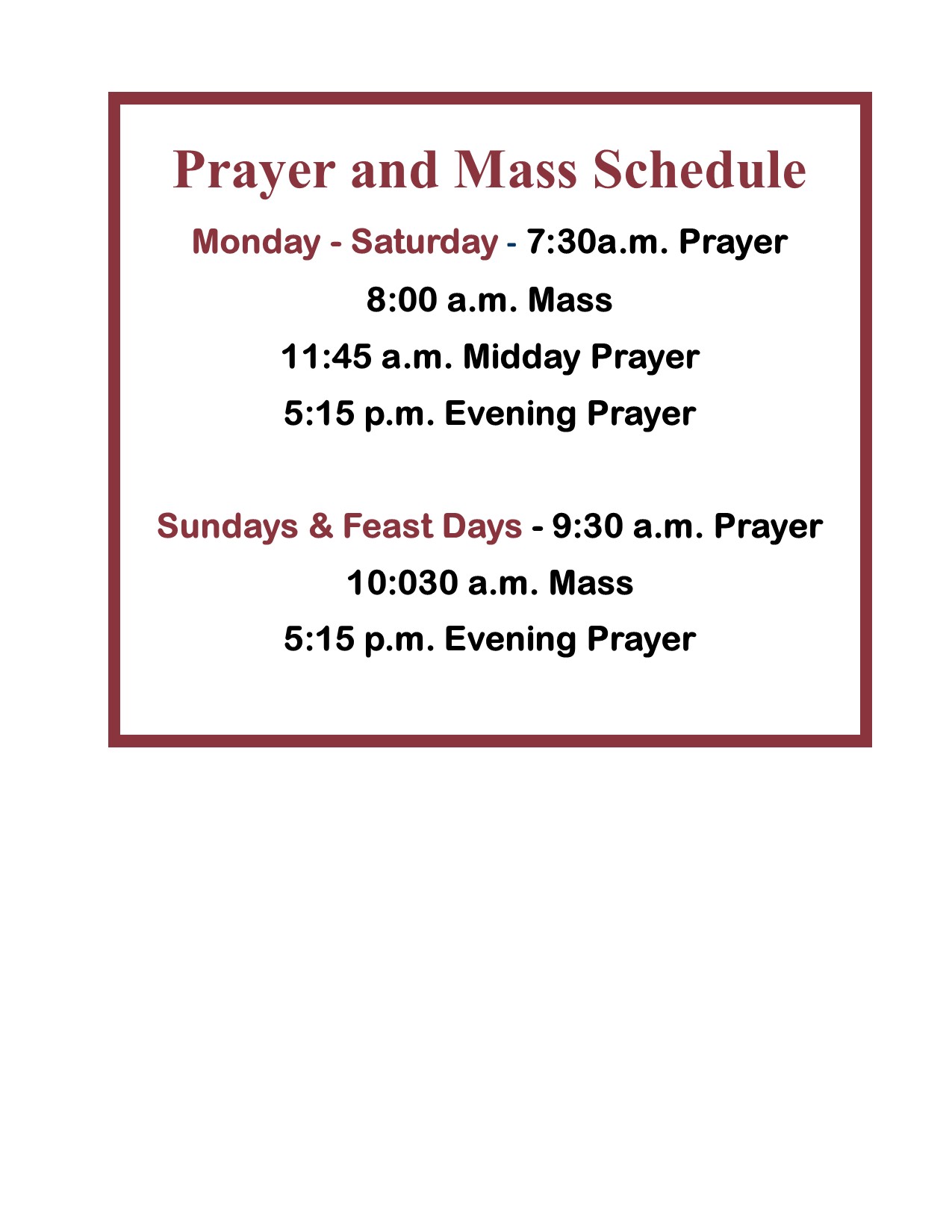
 Mass Schedule

Related Links

Copyright © 2026 · Benedictine Sisters of FL · Touching Lives Through Prayer and Service

Copyright © 2026 · Bendedictine Theme on Genesis Framework · WordPress · Log in