• Skip to primary navigation
  • Skip to main content
  • Skip to footer
Benedictine Sisters of FL

Holy Name Monastery
Founded 1889

Donate Now
  • Home
  • About Us
    • History
    • Being Benedictine
    • Benedictine Monasticism
    • Meet Our Community
    • Holy Name Academy-Alumnae
  • What We Do
    • Mission, Vision and Our Partners
    • Invitation to Retreat
    • Accommodations
    • Volunteer Programs
    • Oblate Program
    • Spiritual Direction
    • Aqua/Hydroponics
    • More of Our Ministries
  • What’s Happening
    • Articles of Interest
    • Events
    • Newsletters
    • Brochures
    • Links
  • Support Us
    • Gifts of Support
    • Wish List
  • Stories Shared
  • Galleries
    • Photos
    • Videos
      • Benedictine Sisters of FL Videos
      • Other Videos
  • Contact Us

God

What Is Your Journey Question?

November 20, 2017 by Holy Name Monastery Leave a Comment

In last week’s Gospel, Jesus emphasized that there is no way to predict His final coming to each individual.  He reminded us that we must remain vigilant and ready to receive our God and Savior at any time.  Now, in the weekend’s Gospel Jesus talks about the same concept this time using economic metaphors.  As he describes it, before the master leaves on a journey, he entrusts to his servants with various “allowances.”  He discerns the amount of the gift according to each servant’s ability.  But, you know the story.  Upon his return, he finds that the first and second servants have doubled their money, and, thus, both recipients are rewarded.  The third servant, however, afraid that he would lose his allowance, only conserved what he received.  He risked nothing; he did not even deposit the money in a bank to earn interest.  This servant is chastised, his money taken back and instead given to the servant who brought the greatest return.

We can’t be reminded too often that our gifts, or talents, are given to us for the service of others.  If we fail to use these gifts, God’s judgment on us will be severe.  On the other hand, if we make use of these gifts in service to others we will be rewarded and entrusted with even more responsibilities.  Sadly, some people deliberately fail at a job or chore they don’t like so they won’t get asked to do it again.

What about us and our talents?  Do we let dislike of a job, or the threat of failure, or someone else’s critical eye hold us back from exercising a God-given talent?  Or a more mundane question: We get an earthly allowance each month – do we bury it or use it for the good of others so it keeps moving forward, good upon good…

Benedict teaches us several lessons about “journeys.”  He speaks most directly to, and about, those who go on the journey … He doesn’t pass out money to those left to tend the vineyard, but he certainly leaves them a legacy.

Beginning with the opening words of his Rule one can sense a journey motif.  Benedict bids us: “Listen! The labor of obedience will bring you back (“coming back” requires a journey, doesn’t it?)  You’ll come to him from whom you have drifted…”  “Let us get up then (he says) at long last, (journey from the land of our dreams) for the Scriptures rouse us when they say: “It is high time for us to arise from sleep… run (speed along on your journey) while you have the light… go out (leave the familiar territory you call home) to seek workers in the multitude of the people ….”  Listen to Benedict: “moving on in your journey of faith, (and life in the monastery) “You will say, Here I am Lord.”  And, then he tells us how to prepare for our journey: “Clothed with faith and the performance of good works, let us set out on this way, with the Gospel for our guide…. Be just in all your dealings, speak the truth from the heart and do not practice deceit or listen to slander.”

Beyond the Prologue of the Rule, Benedict offers guidance for our conduct on the voyage of life.  After giving us an overview of what we will need in our toolkit, Benedict hastens us on our journey when he tells us: RUN on the path of God’s commandments, never swerving.”

By the time Benedict wrote chapter 67 one can tell he’s had some experience with monks who journeyed afar from the home monastery.  We know that Benedict, in his youth, has escaped “big city life.”  So he wanted to protect his monks from the evils and temptations of the prevailing society.  Notice he does not say … those who go on a journey.  Rather, those who are sent on a journey.  Those at home are to remember the absent ones in prayer … which means the gathered community may have “counted” noses” but not for the sake of taking roll but to pray for their confreres safety and protection from temptation.

I have to smile when I read what Benedict cautions next.  He certainly knew human nature: “no one should presume to relate what was seen or heard outside the monastery.”  Sounds to me like he’s witnessed some cases where “curiosity killed the cat.”  Benedict didn’t want stories of the world to creep in and cause dissension or dissatisfaction with the home experience to rankle or upset his community.  Times haven’t changed much over the passing years, we still need to on guard that we balance chartable interest in each other versus the drive to know every intimate detail about what was seen or heard by the other.

Benedict is solicitous of his monks on a journey that they not appear embarrassingly shabby.  He makes provision that they be LOANED underwear (that’s right with their long tunics their everyday wear might not have included underwear).

In line with the admonition to pray always, Benedict reminds his monks on a journey to keep an eye on the sun … listen for the bells from neighboring abbeys announcing prayer times.  … so, (Benedict reminds them) though at a distance too far to join the community they might “observe the prescribed hours” as best they can.  Thus, probably began the custom of the Angelus … the dialogue between Angel Gabriel and Mother Mary, a modified version of Sext (or Noon Prayer) that could be memorized so as not to neglect their “measure of service.”

The Rule closes with this journey-question: “Are you hastening toward your heavenly home?  Then keep this little rule … as you set out for loftier summits of the teaching and virtues we’ve mentioned.” Then Benedict echoes his message first heard in the Prologue with this promise: “under God’s protection” (together) we “will reach” our heavenly home … this is the self-same promise Jesus extends to us in the Gospel: Because “You were faithful in small matters … come, share your Master’s joy.”

~Reflection by Sister Roberta Bailey, OSB, Prioress
Thirty-Third Sunday in Ordinary Time   Sunday, November 19, 2017
First Reading  Selected verses Proverbs31   Second Reading  1 Thessalonians 5:1-6
Gospel Reading  Matthew 25:14-30
Continue Reading

Filed Under: Blog, Homily Tagged With: Benedict, God, Jesus, journey, Monks, pray, The Rule

All Saints Day and All Souls Day

October 31, 2017 by Holy Name Monastery Leave a Comment

This week we will celebrate All Saints Day and All Souls day.  The Festival of All Saints is a reminder of ordinary people who became extraordinary.  This feast reminds us also that we who are ordinary are called to be extraordinary. We take care not to water down this hard challenge Jesus holds out to us.

At first the celebration of All Saints was strictly the celebration of the martyrs, the thousands who were faithful, whatever the cost, through the church’s humble, terrible early years of persecution.  Did you know, or ever stop to think that more Christians were martyred in the past hundred years than in all previous history combined.  Most of these martyrs are unnamed.

Another group of “saints” we do well to remember this week are all the innocent victims of abortion and of war – civilians and soldiers.  And the staggering number of victims of domestic violence: 1 in 3 women and 1 in 5 men.  Since Sept. 11, 2001, more women have been killed by “intimate partners” than all of the victims in 9/11 and the American victims in the wars in Iraq and Afghanistan.  In Pasco County alone, in the past year there were 3700 reported cases of domestic violence.

These people are especially in our minds this week.  We acknowledge our debt to them and we thank God for making us members of such a family, with such a heritage – causing us to be proud and humble in the same instant.

The sign by which you can recognize our “living saints” is the readiness with which their water-pots, like the woman at the well, are lowered to quench another’s thirst.  The cup of cold water is offered in Christ’s name for only He can give the living water for the human soul.  We, his people, imitate him in pouring out the oil of kindness to any who need it.

Which finally brings us to the message in this weekend’s Gospel.  The whole lesson in Jesus’ teachings is summed up in two commandments: Love the Lord, your God with your whole being and love your neighbor as yourself.”

I invite you this week to ponder how well you fulfill these two commandments – which is really one mandate.  With that background, ponder the Beatitudes in the Gospel from Matthew for All Saints day.  Imagine, then, yourself on that hillside with Jesus – seated in the midst of the crowd with a good view of Jesus.  Now write down what you hear – your own version of the Beatitudes.

(For example BEATITUDES)

Looking at the rich man and his wife in peasant dress, who have a reputation for generosity, Jesus said: Blessed are the poor in spirit, the kingdom of God is theirs.

Seeing the family whose mother had recently died in childbirth, Jesus said: Bless are the sorrowing, they shall be comforted.

Turning to the family caring so compassionately for their only child who is in a wheelchair, Jesus said: Blessed are the lowly; they shall inherit the land.

Seeing some of John’s disciples, and sensing the people’s hunger for His words – inattentive to their own bodily hunger and thirst, Jesus said: Blest are they who hunger and thirst for holiness, they shall have their fill.

And seeing an old woman gently soothing a fretting infant so a young mother can rock her toddler to sleep, Jesus said: Bless are they who show mercy, mercy shall be theirs.

And looking at his disciples, knowing their desire to be always in His presence, Jesus said: Blest are the single-hearted for they shall see God.

Spotting a young father rolling a yarn ball back and forth to his two young sons who were squabbling over the ball, Jesus said: Blest are the peacemakers; they shall be called children of God.

Looking at the church officials who dared to follow him, Jesus said: Blessed are those who are persecuted for holiness sake; the reign of God is theirs.

Then Jesus speaks to you and to all the people: Blest are YOU when they insult you and persecute and have every kind of slander uttered against you because of me:  Be glad and rejoice, for your reward is great in heaven!

~Reflection by Sister Roberta Bailey, OSB, Prioress
30th Sunday – October 29, 2017              First Reading: Exodus 22:20-26                Second Reading: 1 Thessalonians 1:5c-10
Gospel Matthew 22:34-40   (Also see All Saints Day Matthew 5:1-12a)
Continue Reading

Filed Under: Blog, Homily Tagged With: All Saints Day, All Souls Day, God, Jesus

What are you Wearing to the Banquet?

October 16, 2017 by Holy Name Monastery Leave a Comment

Have you ever watched a make-over program on TV?  I’ve watched a few on house make-overs.  While pondering this week’s Gospel I recalled a time when channel surfing that I was attracted by this girl’s plea to get her boyfriend to dress appropriately for a wedding they were going to attend. It was one of those makeover shows where a person gets their entire wardrobe revamped by some hip and fashionable person who does this sort of thing for a living.  Seems like it could be a good alternative for the man who got thrown out of the wedding in today’s Gospel.  Though some guys might think the odds were even: forced into a make-over or getting to escape the whole ordeal – bound hand and foot, yes, but at least he could get away.

The commentator on the TV show was relating the guy’s background.  Seems he had no fashion sense.  As these shows go, they took him – he seemed to go without protest – to an up-scale clothing store for a new wardrobe that would make him acceptable at the wedding – at least in the eyes of his girlfriend.  He watched helplessly as his favorite clothes were thrown in the trash and replaced with more “fashionable items.”  These people didn’t care what this person did for a living; how he treated his friends and neighbors.  They didn’t ask about his spiritual life or his financial situation.  Fashion was paramount!

The party in today’s Gospel would have been a highlight in many people’s lives.  FREE food, hobnobbing with people whose names they’d only heard in passing.  Why would they not jump at the chance to be a guest at such a fantastic occasion?  But, you just throw a party yourself and you will quickly figure out that some who say “yes” won’t show and a goodly number will figure you knew they’d come so they did not really need to RSVP.

The people Jesus was telling this parable to were not stupid. They understood the absurdity of the situation. They knew that Jesus was not simply telling them a strange story but that he was telling them something about their own lives.  He was in essence telling them that they were the invited guests and that they had refused the invitation. They understood that the servants who came to tell them about the banquet were the prophets.  They understood that Jesus was telling them that the kingdom of God is open to EVERYONE, to the outcasts and the sinners and to them.

But Jesus doesn’t stop his parable with that. He goes on to say that once the street-people had been invited in to the banquet the king spotted someone who wasn’t properly dressed.  When asked why, the man was speechless.  The king demanded that he be handcuffed and thrown into the outer darkness.  How are we to understand this part of the parable?  Why was lack of a certain type of garment such a big deal?

Some say the king invited everyone so people should come just as they happen to be when they decided to join the banquet.  Others argue it means we should be given a special robe at the door of the church to wear during the service.  Of course, these answers miss the point. This is a story that has a deeper meaning.  Yes, it is a story, but remember parables are earthly stories with heavenly ­ meanings.

I find it intriguing that the last group brought into the wedding came from the hedgerows and byways but the main character was still expected to be wearing a wedding garment.  This let us know, doesn’t it, that we better be ready at all times to come to the wedding.

The point, of course, is not what type of clothing covers our nakedness.  At some stage in life we’ve all learned that although not the most important thing in life, fashion is not something to be totally ignored either.  Just ask anyone who is getting married, or celebrating a jubilee or going to a funeral, if what people wear isn’t of some significance.  At one end of the spectrum, there are folks who believe brand name labels are the key to admittance into their coveted social circle.  But for others, fashion is just not a big deal at all.  It’s pretty obvious they probably don’t own a full-length mirror.

The wedding garment Jesus is talking about was probably just a nice set of clothes used for special occasions, much like today we’d call our “Sunday-go-go-meeting” clothes.  If this is the case, then the guest without a wedding garment is an underdressed attendee.  The gesture would be an offensive sign that the guest is oblivious to the significance of the occasion and the prestige of being included on the guest list.

Even though everyone is invited into the banquet of the kingdom of heaven, there will be some who simply don’t send back their RSVP card.  There will be those who show up but do so without the proper spiritual clothing and are sent away.  The reading leaves us with that same probing question we first heard in our mother’s voice: “You’re wearing that?!”  We quickly recognized it was not really a question but an order.

Maybe a good place to start redoing our spiritual wardrobes would be to heed St. Paul’s admonition to the Colossians (3:13): “As God’s chosen people … clothe yourselves with compassion, kindness, humility, gentleness and patience.”  Just be sure you’re wearing the proper attire when Jesus makes His final call.  When He says: “Come in, Friend, there’s a seat with your name on it.“

~Reflection by S. Roberta Bailey, OSB, Prioress
October 12, 2014  First Reading Isaiah 25:6-10a         Second Reading  Philippians 4:12-14,19-20
Gospel Matthew 22:1-14
Continue Reading

Filed Under: Blog, Homily Tagged With: banquet, Fashion makeover, God, Jesus, parable, Wedding

Why Care?

October 13, 2017 by Holy Name Monastery Leave a Comment

This parable reminds us that we are all tenants in God’s creation.  All of us have different circumstances, gifts, and resources that were given to us by God not just for our own sakes.  They are gifts from God to allow us to work on His behalf to the best of our abilities and circumstances.  It seems to me this parable is perfectly timed in the church year to coincide with the Fall planting season as well as St. Francis Day celebrations.  The parable speaks of stewardship on a variety of levels even though it was originally aimed at a congregation that never heard such language.  We are the “other tenants” to whom the “vineyard” has been given when it was given to us when Jerusalem lost it due to mismanagement.

So, it seems to me to appropriate to spend a few minutes reflecting on our individual efforts at practicing stewardship, care for the earth, ecology, the environment and climate change in light of the words in our creation story: God saw that it was good.”

Why should we care about creation?  It’s a good question.  Some may react: Aren’t people more important than nature?  Doesn’t taking care of the earth distract from sharing the Gospel?  Isn’t earth care just a liberal political issue?  Shouldn’t I be more concerned about other causes?  If we turn the conversation on its head we’ll see an entirely different viewpoint.

First of all, we should care about creation because it brings glory to God.  From the very beginning, in Genesis, we read that God looked at creation and said this is “very good.”  Scripture depicts praise to God coming from trees, fields, the seas; the sun, moon and stars; lightning, hail and snow; wild animals, cattle, birds and all the creatures of the earth.  If these bring glory to God, then who are we to carelessly destroy them?  Why care?  Because caring for God’s creation means caring for that which brings God praise and worship.

Second, we care about creation because doing so helps other people.  The second greatest commandment is to love your neighbor as yourself.  The majority of major world problems today are rooted in environmental issues.  For example, polluted drinking water and deforestation all play a significant role in increased poverty, hunger, and human trafficking.  The bottom line is that caring for God’s creation produces positive results for people.  Why care?  Because God calls us to put the needs of others before our own needs.

Third, environmental issues are ethical issues.  The way that we treat the earth reflects our values.  There are ethical questions that directly correspond to environmental issues, and like it or not, the world is watching to see how God-fearing, God-loving persons respond.  By living out of our corporate commitment to feed the hungers of the people of God we have a powerful opportunity to “be Christ” to a needy world.  Why care?  Because as Benedictines, as Christ-followers we aim to do what is right and wish to point others to God through our individual and communal living.

Fourth, we should care because God told us to.  One of the first directives in Scripture is to do what God told Adam and Eve: tend and keep the garden.  In creating us in his own image, God gave us a great privilege, and a great responsibility.  Why care?  Because God’s Word told us to care.  Beyond that, as Benedictines we live with Benedict’s reminder to keep all things that belonging to the monastery clean and regard all goods as sacred vessels of the altar, aware that nothing is to be neglected.

I’m sure there are other answers you could give to the question: Why care?  Simply put, stewardship values extend, through our cooperation, God’s care for creation – the work of the Divine Hand.  A truly caring people strive to look to the needs of others, seek to be educated and react ethically to environmental issues, as Benedict reminds us, without murmuring, to our call to care for the earth.

We can’t do everything, but we can do something.  We can’t do it all alone, but together we can make an impact.  Look at something as simple as recycling bottle caps, aluminum cans and plastic bottles.  We can limited the accumulation of “stuff” we personally create … perhaps only a handful alone but if we each contribute what we’ve used or collected from “around”, look at what we’ve kept from landfills and at the same time contributed to the project of St. Leo students to project to collect funds for purchase of a wheelchair for a needy child.  And we can support our talk with our actions.

We can make an honest effort to consolidate trips to town, wait until we have several errands or passengers for the trips we do make.  The gas we save, the wear and tear on the car may seem minimal but the “minimals” add up, just like pennies and coins in a jar where we throw our extra change.  If you wait until Christmastime to count and wrap them … well – it makes a tidy contribution to the gifts for the elderly.  If not all the time at least some of the time.  If not in all ways, at least in some ways.  We can take baby steps that turn into hops and skips and then dare to risk giant steps.

Despite the Saint Francis’ and all the statues in gardens, for generations of believers Francis’ feeling for nature has been admired rather than to emulated.  Let us do more than simply admire.  Let us strive to remember God gave us the privilege of caring and tending this garden we call Earth.

I believe we see a glimmer of hope this week that more people are waking up to the reality gun violence and the possibility of nuclear destruction. No one can close their eyes to the devastation of the Las Vegas massacre.  In the wake of that reality, though, we have news on the side of peace.  The Norwegian Nobel Committee has announced their decision to award the 2017 Nobel Peace Prize to ICAN:  the International Campaign to Abolish Nuclear Weapons “for its efforts to stigmatize, prohibit and eliminate nuclear weapons which could destroy the planet.”

ICAN exemplifies the thinking of Dietrich Bonhoeffer, a German theologian martyr: “It is in keeping with being a saint to go beyond the call of duty, to dare to be a bit ridiculous, to be a little more extravagant … to try something beyond the ordinary. Action”, he said, “springs not from thought, but from a readiness for responsibility.”   So let us pray for the insight and courage to dare to be ridiculous and a little extravagant.

~Reflection by S. Roberta Bailey, OSB, Prioress
First Reading  Isaiah 5:1-7   Second Reading  Philippians 4:6-9
Gospel Reading  Matthew 21:33-43
Continue Reading

Filed Under: Blog, Homily Tagged With: creation, earth, environment, Genesis, God, God's creation, other tenants, recycle, vineyard

Actions speak louder than words

October 3, 2017 by Holy Name Monastery 1 Comment


The overriding theme of all of the Mass readings, it seems to me, is “honest sincerity.”  In the Gospel account we just heard the younger brother tell his father: “Yes, I’ll go and work” while the older brother said: “No, not me.” Both used words contrary to their actions.

This an age-old story.  The dynamic happens in families, between friends, in the work force and in monastic community.   The situation Jesus poses is rather straightforward. Two sons are given the same task by their father: one asserts his objection, his intent to disobey right up front, but then in the end obeys his father’s wish.  The second son obeys in his words, but disobeys in his actions. For both, what they say with their words is not in their hearts – the head said one thing; the heart another.

The story reminds us that talk is cheap and actions speak louder than words.  You’ve all heard the phrase: “Don’t just talk the talk; walk the walk.”  Be slow to dismiss these truisms.  We’ve all been hurt by promises given and then broken.  Or, on occasions we have been given words that have hurt us, really hurt us, not because they were nasty but because we relied on them and were later betrayed. Intentions are too often little more than wishful thinking; appearances are deceptive. Being honest and then acting in honesty are sometimes tough things to do. You know where the path of good intentions leads, right?

The question that Jesus poses is pointed and direct: Which son did what the father wanted?  Jesus could ask us the same question. Do our words indicate our obedience to God? If not our words, do our actions? God desires a full conversion of heart, that our actions (and our words as well) will give evidence of our love for God.  The older brother had no intention of working and had the honesty of saying so. He was wrong, but he was honest. The younger brother was the opposite. He said the expedient thing knowing what his father wanted to hear but he had no integrity.

Yes, talk can be cheap. The younger brother simply didn’t live up to his words; the older brother changed his mind. The older brother had integrity; the younger brother gave valueless words to his father while having no intention at all of working.   With which brother do your words or actions identify?

For Benedictines obedience is central – we’ve come to the monastery to hear, to listen, to seek God but to do that we have to be willing to listen and then obey God’s voice as heard in your personal prayer, in the voice of the superior and spiritual guide and in communal discernments and in our interactions with each other.  As Benedict describes it, for those who have chosen to live in cenobitic community, our obedience must be open, prompt and positive, (even if it is painful) and given without murmuring.

We would do well to recall both this gospel story, and Benedict’s words about obeying with alacrity when we are asked to do a favor for one of our sisters or a co-worker.  Do we mumble OK and then put it on the back burner so far back that the pot boils away and the need goes up in the waves of evaporation?  Do you say YES and honestly add “but not right now” and make a sincere effort to perform the action when we said we would?  Are you like the son who said “no can do” but later realize your selfish response and go back to do the favor after all?  Or, do you render the favor but tell the neighborhood about the unfairness of what you had to do?  We know that for Benedict, murmuring was an abomination, anathema, a curse in community and any sign of murmuring was to be censured.

In one of her first books on the Rule, Joan Chittister suggests: “Say to the member who signs up for a task but then complains, please don’t sign up.  Kindly give the community the gift of not murmuring about it.  The rest of the community will get the job done.  Please just stay home and keep a smile on your face.  Don’t do the work and then poison the environment of the house with murmuring.”

Oh, you may think: it’s easy for you to talk about obedience – you’re the prioress, who do you have to obey?   But, think about it, for the monastic leader, actually, any leader, may have some authority with her position, but the power lies in the hands and will of the membership.  Obedience in monastic life is mutual – it springs from the bloom of mutual respect.  Without both there is no community – there is just a group of women living under the same roof.

So, what enables us to mature to a higher level of obedience?   First how do you know what level of obedience is operating in your life?  You may recall Piaget’s and Kohlberg’s stages of moral development – moving from obedience for fear of punishment to the highest stage which some never reach and those who do rarely can consistently operate at that level.  We are at the level of moral maturity where we cease to fully comprehend what the stage description is talking about.  Another insight is how you work on a committee.  How we function in community is also based on our level of moral development.  How you believe a thing ought to be done will say a great deal about where you are on the scale.

Thankfully for all of us, in life growth is always possible – “It isn’t over, til it’s over!”   Another expression may pop to mind: “it ain’t over til the fat lady sings.”    It isn’t how we start that matters, it’s how we finish!

~Reflection by S. Roberta Bailey, OSB, Prioress


Twenty-Sixth Sunday in Ordinary Time, Cycle A   October 1, 2017
First Reading  Ezekiel 18:25-28               Second Reading  Philippians 2:1-Be like
Gospel Matthew 21:28-32        


Continue Reading

Filed Under: Blog, Homily Tagged With: Benedictines, broken promises, God, Gospel, Jesus, Mass readings, obedience

Patches of Dirt or Fertile Soil

July 19, 2017 by Holy Name Monastery Leave a Comment

First Reading  Wisdom 12:13,16-19                    Second Reading  Romans 8:26-27

Gospel (short form)  Matthew 13:24-30

Jesus’ parables aren’t meant to test our human intelligence.  They are moments of grace to ply open our heart’s willingness to surrender to, and be enveloped in, the always surprising generosity of God.

Here on our property, when we look out the window and behold the life cycle of the hay field or blueberry patch, we see first-hand in nature what Jesus is talking about.  He extends the lesson applying it to the human heart.  He reminds us here that there are folks whose hearts are like cement.  It does not matter how much or how often seed is poured on these souls.  Fertilize it, water it – nothing will cause those seeds to take root and sprout.  Listen to church and TV sermons 24/7, they remain unfazed.

Do you remember times you were like this …  not always … but a time or two when you just didn’t want to hear what God might have to say?

In contrast to the hardened-soil person, the shallow-soil person is hyper-responsive to God’s word—but only for a wee tiny time.  Like during a revival or summer retreat.  Don’t be one of these temporary ‘all in’ folks gobbling up every word and reading every book suggested by the retreat director.  But, sometimes the seed eventually sinks in and bursts through the pavement.  And right away, birds or insects snatch the new growth and it never comes to fruition.  It can’t survive the heat of the give and take of daily community life.

When were you like this?  Maybe in the novitiate … or the time in high school when the class made the senior retreat?  God was SO real to you … but God’s voice grew more faint as the days went by?

Then, there is a third type of soil – a thorny type – so tightly entangled with “thorns” that their thorns have become their identity.  Jesus calls these thorns “the cares of the world and the deceitfulness of riches.” Matthew says these people are caught up in anxiety and get choked on the lure of the riches of the world that tug and yank at their minds and hearts until the seed suffocates, rendering them spiritually barren.

When was this the case in your life?  Times when you were just too distracted to cultivate God’s word …  when several days went by without a space for Lectio or healthy self-care – when “thorny” remarks and obstinate behavior was your default mode?  That’s when God planted a general sense of dissatisfaction in the garden of your soul.

Oh, but how gratifying it must be to Jesus when He finds “good soil people” – when we share the time God has given us to meditate on the Word, let it penetrate and bear fruit – then we hold fast to the word making it our own.  Thus we grow more Christ-like over time by absorbing and practicing the precepts of Benedict.  Over the years, as the seeds continue to take root and blossom, the fruits and gifts of the Spirit flourish.  As one author describes Benedictine life: they fall down, and they get up … and fall down and they get up … as they ascend the ladder of humility.

We come not only to know, but to believe deep in our hearts that God can change hard, shallow, compromised patches of dirt into fertile garden soil.  As we read in Ezekiel: “And I will give you a new heart, and a new spirit I will put within you.  And I will remove the heart of stone and give you a heart of flesh.”

Many of us have, or have had, gardens.  And all of us–whether we’re gardeners with a green thumb, or thumbs with only a tinge of green, or only a “wishful” thumb – or a thumb that only knows how to operate a TV remote or a computer mouse — all of us know the principle of planting: when we put a seed in the ground, we expect a plant to appear …  some may even think it will sprout with a flower already on it J . We also know that not all seeds will produce full-grown plants. They just don’t, for a variety of reason.

We don’t have to ever have plowed fields for forty cents a day in order to know the different landscapes of which Jesus speaks. We know the beaten path of our own lives.   We’ve stumbled through the rocky patches of life.  We have been scratched and cut by the thorns of life.  But we have planted our roots deep in the sacred soil of life that feeds and grows us to become a harvest – whether it’s a thirty, sixty or a hundredfold – who’s counting?! – it’s all a harvest!  Given the right conditions apple seeds do become apples.  Mango seeds become mangoes.  God’s seeds become what we allow them to become.

Paraphrasing the words from Deuteronomy, we ask: “let the soil of my heart hear the words of Your mouth.  May Your instruction soak in like the rain and Your word permeate like the dew; like a gentle rain upon the grass and like a shower upon the crops.”

~Reflection by Roberta Bailey, OSB, Prioress
Continue Reading

Filed Under: Blog, Homily Tagged With: fertile, God, God's word, hay, Jesus, seeds, soil

  • « Go to Previous Page
  • Page 1
  • Interim pages omitted …
  • Page 31
  • Page 32
  • Page 33
  • Page 34
  • Page 35
  • Interim pages omitted …
  • Page 41
  • Go to Next Page »

Footer

Prayer / Newsletter / Info

 Contact Info

Benedictine Sisters of Florida

PO Box 2450
12138 Wichers Road
St. Leo, FL 33574-2450
(352) 588-8320
(352) 588-8443

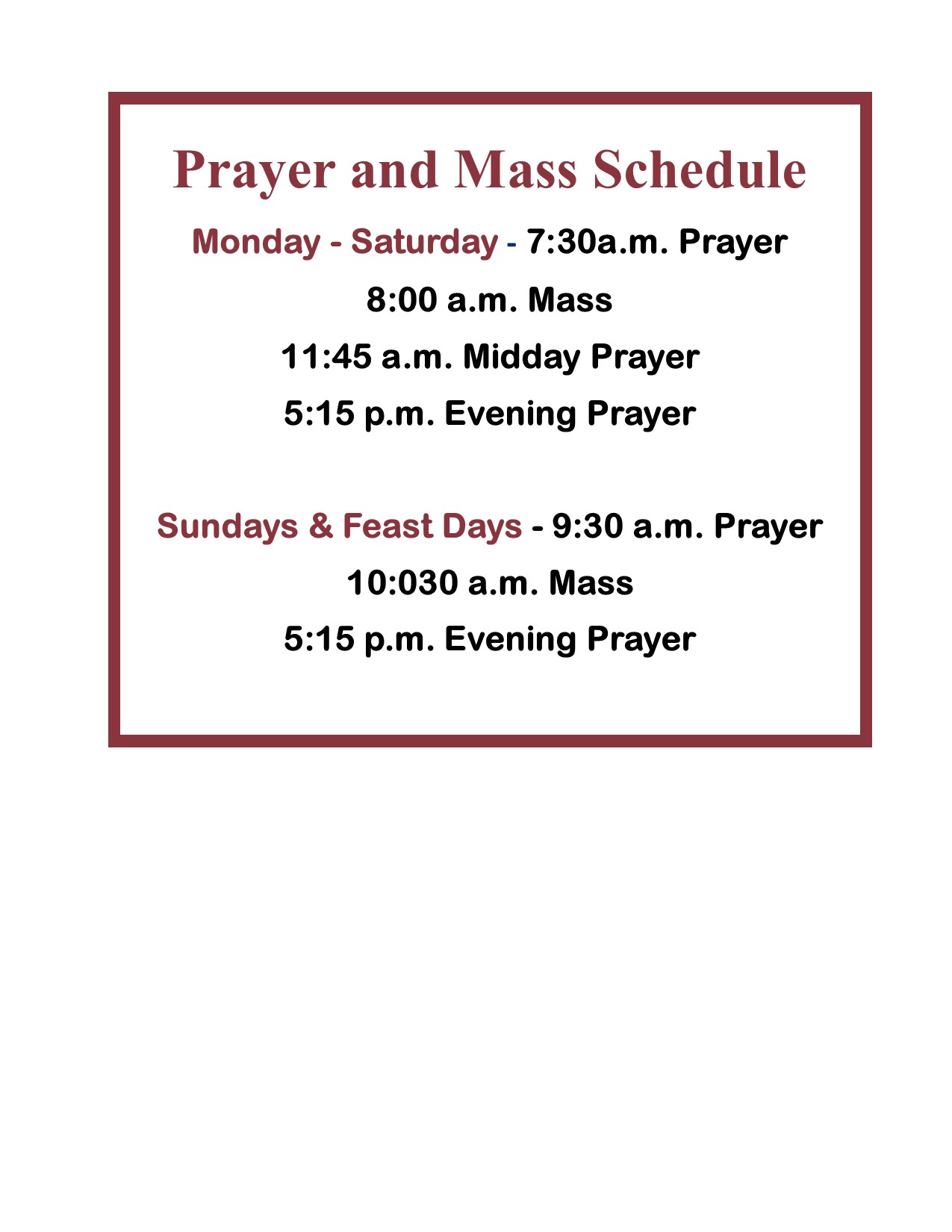
 Mass Schedule

Related Links

Copyright © 2026 · Benedictine Sisters of FL · Touching Lives Through Prayer and Service

Copyright © 2026 · Bendedictine Theme on Genesis Framework · WordPress · Log in