• Skip to primary navigation
  • Skip to main content
  • Skip to footer
Benedictine Sisters of FL

Holy Name Monastery
Founded 1889

Donate Now
  • Home
  • About Us
    • History
    • Being Benedictine
    • Benedictine Monasticism
    • Meet Our Community
    • Holy Name Academy-Alumnae
  • What We Do
    • Mission, Vision and Our Partners
    • Invitation to Retreat
    • Accommodations
    • Volunteer Programs
    • Oblate Program
    • Spiritual Direction
    • Aqua/Hydroponics
    • More of Our Ministries
  • What’s Happening
    • Articles of Interest
    • Events
    • Newsletters
    • Brochures
    • Links
  • Support Us
    • Gifts of Support
    • Wish List
  • Stories Shared
  • Galleries
    • Photos
    • Videos
      • Benedictine Sisters of FL Videos
      • Other Videos
  • Contact Us

God

“I Will Teach You How to Fish for People”

January 23, 2024 by Holy Name Monastery Leave a Comment

A variety of motives influence people to exchange their old lives for new ones. What convinces a “seeker” that it’s worth leaving behind life as they know it?   Most of us know from our own and each other’s vocation stories, it’s the relationships we witness and experience within a community much more than our ministries that prompt newcomers to “test the waters.”

We, (individually and as a community), can put our full energy into the production all kinds of “lures” and “bait” … retreats and workshops, attractive vocation materials, holy cards, videos, websites and other social media … but that’s only part of what Jesus meant when he promised to teach us how to fish for people.  But, keep in mind that vocation – to any and every state in life – is GIFT!   And, remember fishing from our boat requires that each one has to do her assigned task of mending the nets, casting the line or preparing bait … no slackers allowed.  And, all of us have to row in sync lest we tangle oars or go in perpetual circles.   Look to Jesus – how did He fish?  He taught, He gave witness, He invited; He did not disappoint, He was (and is) faithful to His word.

So, what kind of witness do we need to be constantly giving?  What do we need to leave behind (individually and communally) to convince an observer that our community is worth a further look?  It’s an exceptional challenge in these pandemic times.  But the phone calls and email messages; the ZOOM Oblate Meetings, the videos on our website, the personal letters, the eblasts from our Advancement Staff keep our readers coming back.  In current lingo, the “soft touches” are ways to seal the friendships and supportive interest that last a life time.  What is the bait, the lure that will prompt more questions, extended visits, developing relationships and finally prompt someone to dare to say, “This is where I feel God is calling me; I’m willing to follow His lead, to leave all behind for the sake of Jesus’ call, with these Sisters (whom I now call my own) here at Holy Name Monastery.”

~Reflection by Sister Roberta Bailey, OSB


Have a good week…   Be good Fishers for Christ…   God Bless


First Reading:   Jonah 3:1-5,10         Second Reading:  1 Corinthians 7:29-31
Gospel:   Mark 1:14-20


Continue Reading

Filed Under: Blog, Front Page, Homily Tagged With: Community, Fisher of Men, fishers, Fishers for Christ, God, Jesus, Lord

Prayer Service for Christian Unity

January 8, 2024 by Holy Name Monastery Leave a Comment

The Benedictine Sisters of Florida invite you to a Prayer Service for Christian Unity on Wednesday, January 24, 2024 at 7p.m.

The theme this year for the traditional Week of Prayer for Unity is based on Luke’s Gospel 10:27 “You shall love the Lord your God…and your neighbor as yourself.”

The service will include congregational singing and Scriptural based prayers, the spoken Word and time for reflection.

Social, refreshments and tours of the monastery will be offered following the service.


Continue Reading

Filed Under: Prayer Tagged With: Christian Unity, God, Luke, prayer service, Prayer Service for Christian Unity, week of prayer for unity

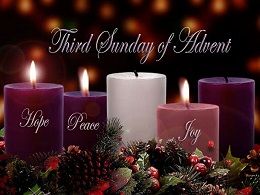
Third Sunday of Advent

December 18, 2023 by Holy Name Monastery Leave a Comment

LOOK for JOY!


This Third Sunday of Advent is familiarly known as Gaudete Sunday – a Latin word that means “rejoice” – the first word of the Entrance Antiphon (at Mass): “Rejoice in the Lord always; again I say, rejoice.  Indeed, the Lord is near.”  As you know, we mark Gaudete Sunday by lighting a pink candle (in the Advent wreath).  Also, the celebrant at Mass wears rose colored vestments.  The church – we –  rejoice because the Promised One is little more than a week away.

We are called to live as people of joy. But in everyday life, I get the impression that “joy” is on the decline.  What is often the response when someone asks: “How was your day?”  My sense is that the theme of joy is something of a rare commodity.  I hear responses such as “It was OK” or “Could have been better.” or “I’m just so tired of so and so doing such and such.”  Or, “I’m exhausted.  Or “Don’t ask.”  To have joy or – or as they would say in slang – to do joy – is to have a deep sense of delight. The Greek origin of the word literally means “for the heart, in its deepest place of passion and feelings, to be well.”  That’s what it’s like to have joy.

So why is joy so rare? Well, it occurs to me (and not me alone), that to experience joy in one’s life four qualities must be found.  First, joy takes time. Joy comes of living a “savored” life.  It comes of having time and taking time to smell the roses, to observe the pace of a sandhill crane as it crosses the street, to glory in a sunset.  Joy needs time. There is this old monastic saying about living a joy-filled life.  If you are sipping tea or watering a plant, or gazing at an icon, do just that.   We call this “being there” or being “in the moment”.  We know – and more than that, we believe, that each moment is pregnant with God’s real presence and promise and providential care.   Look for it; wait for it; savor it. Don’t just visit life; life needs time to be lived abundantly.

Joy requires acceptance – a “yes” to life, the life we’ve been given. We may have discovered at some point that the script we’ve been handed in the play of life is not the part we thought we were trying out for. We have to be content that “where God has placed us, that is our pulpit.”  Joy requires a deep willingness to accept we are God’s creature and that God is at work according to God’s good pleasure.  Joyful persons accept the good gifts of life that actually are there.  They do not live in a state of resentment for what might have been or what “used to be.”  In God’s plan, there is a reason why today is not tomorrow. We need all of today to prepare us to receive the promise of tomorrow.

So, being joyful takes time and acceptance.  Joy, a gift of the Spirit, has to be desired. If you want the gift of joy, ask God for the gift with open heart and hands to accept the gift as God shapes it.

To be joyful we need stability, patience and endurance.   Maybe that’s why Jesus says: “Truly I tell you: you will have sorrow, but your sorrow will turn into joy.

Life for most people is not picture perfect, but there is so much joy to be found If we simply look for joy.  Be on the lookout – See and reflect the joy right before your eyes.  The more we dwell on our everyday blessings, the more they seem to multiply. And by experiencing more joy in my own life, I have more joy to give away.  Joy is a beautiful gift to embrace, celebrate and give away at Christmastime.  And, in doing so, we increase our own joy.


~by Sister Roberta Bailey, OSB


First Reading  Isaiah 61:1-2a, 10-11                       
Second Reading 1 Thessalonians 5:16-24  
Gospel Reading  John 1:6-8, 19-28
Continue Reading

Filed Under: Blog, Front Page, Homily Tagged With: Advent, Gaudete Sunday, God, Jesus, third Sunday of Advent

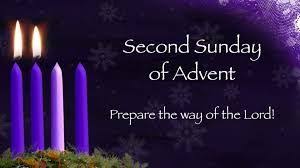
Second Sunday of Advent

December 12, 2023 by Holy Name Monastery Leave a Comment

Our God of the Promise


In Advent, like the child we once were, we eagerly await the coming of Christ as an infant in Bethlehem.  At the same time, we invite him into our hearts in the present, the “now” of our lives. And we look forward to his future coming as king of glory. Dwelling in the past or wishing for a perfect future can keep us from hearing the will of God NOW, in our today.  Many recognize in Pope Francis a voice that is, like that of John the Baptist, crying in the wilderness … urging us forward in the present to mend the past as we confront the life as it greets us today, in the NOW of our lives.

The opening lines in Mark’s gospel greet us with the words: “the beginning of the Gospel of Jesus Christ”.  But, the first character we meet is not Jesus, but John the Baptist, the fiery preacher who came out of the desert where he lived on honey and locusts.   And, he is no fashion plate, with his camel’s hair clothes, leather sandals, and leather girdle around his waist. His diet was very simple: locusts (grasshoppers) and wild honey. This is important, or it would not be here.  It is symbolic. But what does it symbolize? Well, you cannot wear anything more fundamental in the way of clothing, or eat a more basic diet, than John did. It is representative of his ministry — one of simple beginnings. It is not the end; it is the beginning.

John is very honest. He says, “Don’t look to me for answers beyond what I have already told you.  That must come from another, who is coming right after me. He is so much greater than I.  I am not even worthy to untie his shoes.”  Remember, this was Jesus’ cousin, his elder by six months, that he was talking about!  You’ll recall John jumped for joy, (maybe he was dancing) in his mother’s womb when he was introduced to Mary and Jesus.  John could bring people to God, but he could not take them beyond that.   Something drew these people into the desert to listen to this strange and rugged young preacher proclaim good news.  That’s all he did! He never told how it worked, or why; he just announced it.  And, this was in a desert in the wilderness.  But it worked, in part because In John’s day, as now in ours, people needed to know they can begin again.

But, keep in mind what the prophet Isaiah said about John’s message. This business of reconciliation will resemble a great bulldozer, building a highway in the middle of nowhere.  (I wonder if they put in roundabouts?)  John was God’s bulldozer to build that highway.  We know how roads are built; we see the process in almost any direction we go on the highway.  Isaiah says: “Every mountain shall be brought low, and every valley shall be lifted up; the crooked places shall be made straight and the rough places plain.”  And, that is what repentance does. It bulldozes down all the high peaks of pride that we stand on and refuse to admit we’re wrong. It takes the depressed areas of our life and lifts them up. It takes the crooked places and straightens them out. And it makes the rough places plain. Then, there is God!  God comes to us so that we can come to God.

Our hope is in the promise of God; in our God of the Promise.  It is a promise that was fulfilled in Jesus Christ.  It is a hope that will not be disappointed because God, although He may delay or tarry, He will not forget His promise.  Be assured: God will never let us down!


~by Sister Roberta Bailey, OSB


First Reading  Isaiah 40:1-5, 9-11                        
Second Reading 2 Peter 3:8-14  
Gospel Reading  Mark 1:1-8
Continue Reading

Filed Under: Blog, Front Page, Homily Tagged With: 2nd Sunday of Advent, God, Jesus, John, Mary

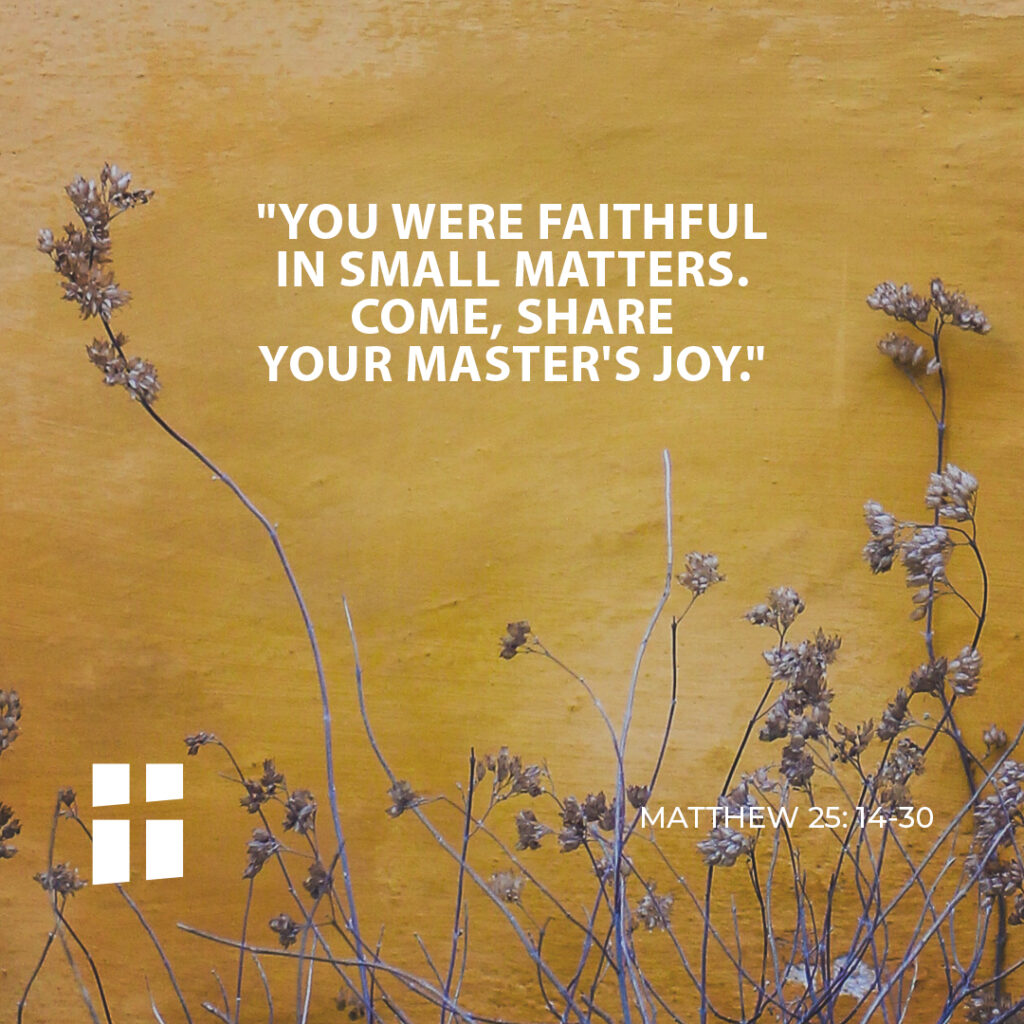
Because you were faithful in small matters…

November 20, 2023 by Holy Name Monastery Leave a Comment

Because you were faithful in small matters…

come, share your Master’s joy.

Like the Master in this Gospel, St. Benedict teaches us “journey lessons.”  We sense a journey motif from the opening words of Benedict’s Rule when he bids us: “Listen! The labor of obedience will bring you back (“coming back” requires a journey, doesn’t it?)  “Let us get up then (he says) at long last, for the Scriptures rouse us when they say: “It is high time for us to arise from sleep… (come from the land of your dreams) …run while you have the light… go out to seek workers in the multitude of the people …”.  Listen to Benedict: “moving on in your journey of faith, (and life in the monastery) “You will say, ‘Here I am Lord’.”   Then he tells us how to prepare for our journey: “Clothed with faith and the performance of good works, let us set out on this way, with the Gospel for our guide…. Be just in all your dealings, speak the truth from the heart and do not practice deceit or listen to slander.”

By the time Benedict wrote Chapter 67 one can tell he’s had some experience with monks who journeyed far from the home monastery.  We know that Benedict, in his youth, had escaped “big city life.”  So, he wanted to protect his monks from the evils and temptations of the prevailing society.  Those at home are to remember the absent ones in prayer for their confrere’s safety and protection from temptation.

I have to smile when I read what Benedict cautions next.  He certainly knew human nature: “No one should presume to relate what was seen or heard outside the monastery.”  Benedict didn’t want stories of the world to creep in and cause dissension or dissatisfaction to rankle or upset his community.  We need to be on guard that we balance charitable interest in each other versus the drive to know every intimate detail about what was seen or heard on the other’s journey.

Benedict is solicitous of his monks sent on a journey that they appear neither embarrassingly shabby nor be clad in “rich folks” clothing.  He charges the superior with checking that hemlines are a decent length and the members’ clothing be suited to the weather.   And, it’s obvious that times were different when Benedict walked the earth.  He makes provision that the members be LOANED underwear from the wardrobe that is to be laundered and returned after the trip.

In line with his admonition to pray always, Benedict reminds his monks when they are on a journey to keep an eye on the sun and listen for the bells from neighboring abbeys announcing prayer times. Benedict reminds them though at a distance too far to join the community, they should “observe the prescribed hours” as best they can.  Thus, probably began the custom of the Angelus.

The Rule closes with this journey-question: “Are you hastening toward your heavenly home?  Then keep this little rule … as you set out for loftier summits of the teaching and virtues we’ve mentioned.”  Benedict, in his own unique way, shares Paul’s message to the Philippians: “Whatever you have learned or received or heard from me or seen in me—put it into practice. And the God of peace will be with you.”   Benedict adds this promise: “Under God’s protection” (together) we will reach our heavenly home.”  That’s the same promise Jesus makes to his trustworthy followers: Because “You were faithful in small matters … come, share your Master’s joy.”

~Reflection by Sister Roberta Bailey, OSB


Have a pleasant Thanksgiving… give thanks for all that has been and open your heart to all that will be…give another a reason to rejoice on this day.


First Reading:   Proverbs 31         Second Reading:  1 Thessalonians 5:1-6
Gospel:   Matthew 25:14-30
Continue Reading

Filed Under: Blog, Front Page, Homily Tagged With: Benedict, God, Jesus, Master, monastery, small matters, st. benedict, The Rule

Service, not status, is the measure of a true Christian

November 6, 2023 by Holy Name Monastery Leave a Comment

In this Gospel we see Jesus under fire.  In turn, He speaks sternly to the religious leaders of Israel accusing the scribes and Pharisees of seeking the glory that rightly belongs to God.  In their misguided zeal for religion, they sought respect and honor for themselves rather than for God.

Jesus raises three objections.  They do not practice what they preach, they adopt a very narrow and burdensome interpretation of the Torah, and they seek public acknowledgment of their presumed spiritual superiority.  Instead of allowing any relaxation, they “built a fence around the Law.”  They fail to realize the truth that when religion becomes a depressing affair of burdens and prohibitions, individualistic dictums or endless rote prayers it ceases to be true religion.  Jesus condemns the lack of compassion of religious leaders, evidenced in their unwillingness to apply laws in a way that would make obedience less oppressive.  By contrast, Jesus says: “My yoke is easy; my burden is light and I will give you rest.”

The Pharisees Jesus is speaking to liked to be seated in places of privilege, prized seats on the left and right of their host.  You remember the request posed by the mother of James and John?  “Command that these two sons of mine sit, one at your right and the other at your left, in your kingdom.”

The Pharisees preferred to be addressed as “Rabbi.”  They liked to be called “Father”, to be known as the fathers of the faith.  They overlooked that respect has to be earned.  However, in spite of their personal failings, Jesus recognizes that the scribes and Pharisees are stewards of a great spiritual treasure.  He teaches respect for them for their role as official teachers and interpreters of the Torah.  Jesus demands that his disciples honor the office that these men occupy and to do what they teach, at least insofar as their teachings accord with the Torah.  Jesus taught, honored and applied two principles: reverence and respect i.e. reverence for God, the name of God and God’s due.  Jesus modeled respect for one’s parents and for a person’s life, the other’s possessions, and good name, lessons sadly lacking in many segments of our society today.

Jesus’ criticism was mainly a warning to future Christian leaders about possible abuses of authority in their ministry.  His words are a strong invitation and challenge to render humble, loving service without expecting honor or rewards.  Benedict echoes this attitude in The Rule in the opening lines of Chapter 7 on humility recalling the words of Scripture: “Whoever exalts themselves shall be humbled, and whoever humbles themselves shall be exalted.”  Jesus and Benedict remind us that service, not status, is the measure of a true Christian.  It’s not how many servants we have, but how many persons we serve.  

In today’s society where smear campaigning and negative comparative advertising are rampant, it is easy to unconsciously assimilate this style of language and attitude as acceptable.  Jesus may not have used these words but remember what you learned as a child: “When you point one finger at someone else, you have three fingers pointing back at yourself.”  Beware of being the “pot” calling the “kettle” black.  The Gospel message reminds us that whatever we are and have is not simply a birthright, but a gift given to us by our loving God.  Hence, let us use everything we are and have for the greater honor and glory of God.

~Reflection by Sister Roberta Bailey, OSB


Have a good week.


First Reading:   Malachi 1:14- 2:2, 8-10         Second Reading:  James 2:14-18
Gospel:   Matthew 23:1-12
Continue Reading

Filed Under: Blog, Front Page, Homily Tagged With: Christian, God, Jesus, My yoke is easy and my burden is light, Pharisees, respect

  • « Go to Previous Page
  • Page 1
  • Interim pages omitted …
  • Page 8
  • Page 9
  • Page 10
  • Page 11
  • Page 12
  • Interim pages omitted …
  • Page 41
  • Go to Next Page »

Footer

Prayer / Newsletter / Info

 Contact Info

Benedictine Sisters of Florida

PO Box 2450
12138 Wichers Road
St. Leo, FL 33574-2450
(352) 588-8320
(352) 588-8443

 Mass Schedule

Related Links

Copyright © 2026 · Benedictine Sisters of FL · Touching Lives Through Prayer and Service

Copyright © 2026 · Bendedictine Theme on Genesis Framework · WordPress · Log in