• Skip to primary navigation
  • Skip to main content
  • Skip to footer
Benedictine Sisters of FL

Holy Name Monastery
Founded 1889

Donate Now
  • Home
  • About Us
    • History
    • Being Benedictine
    • Benedictine Monasticism
    • Meet Our Community
    • Holy Name Academy-Alumnae
  • What We Do
    • Mission, Vision and Our Partners
    • Retreats
      • Invitation to Retreat
      • Accommodations
    • Volunteer Programs
    • Oblate Program
    • Spiritual Direction
    • Aqua/Hydroponics
    • More of Our Ministries
  • What’s Happening
    • Articles of Interest
    • Events
    • Commemorative Bricks
    • Newsletters
    • Brochures
    • Links
  • Support Us
    • Gifts of Support
    • Wish List
  • Stories Shared
  • Galleries
    • Photos
    • Videos
      • Benedictine Sisters of FL Videos
      • Other Videos
  • Contact Us

God

Gaudete Sunday

December 19, 2025 by Holy Name Monastery Leave a Comment

This Third Sunday of Advent is known as Gaudete Sunday, meaning Rejoice!  Seems to me one might be tempted to sing for the Open Hymn “Pretty in Pink” as the celebrant comes reverently to the altar in rose-colored vestments and the altar server lights the one rose or pink candle in the Advent wreath.  The candle and vestments remind us that the coming of Christ is very near. The focus is joy — not a fleeting feeling, but deep down spiritual gladness rooted in God’s goodness. This week encourages us to recognize the ways God is at work in our lives and to share that joy with others, especially those who are burdened or discouraged.  The story that follows is not AI generated but it is adapted from the Internet.

“One cold rainy night at 4 a.m. a young girl entered the diner where I worked.  The lass was trembling. She looked fragile, like she’d been crying, and she had no money. When I asked if she needed help, she stayed silent whether from the cold or fright.  I gave her a cup of warm cider and a muffin to calm her down.

My boss saw it and fired me on the spot for “giving away free items.” I was devastated. That job was the only way I had to support myself and my baby.

Before she left, the girl handed me a clean green sock — just one — and said, “This will save you one day.  Someday you’ll get the matching green sock.”

 I didn’t understand, but I kept it.  5 weeks later, I found the matching green sock on my doorstep. Mmmm! It was heavy. Inside was $30,000 in cash and a small note with a phone number. When I called, a man answered and said, “You don’t know me, but you saved my daughter. This is my ’thank you’!”

He explained that the night she came to the diner, her boyfriend had thrown her out with no phone and no wallet. My simple act of kindness kept her safe until her father found her. Later on, she told her dad everything and begged him to help me because I’d lost my job for helping her.  The money was his way of thanking me. He said, “Good people are rare. My daughter was lucky to meet one. So, I asked about you and found your address.”

That unexpected money truly saved me. It helped me open a small bakery — something I had dreamed of for years. The girl still visits whenever she’s in town. She’s now happily married, and her daughter is thriving.  I’m grateful every day that our paths crossed.”

In our fast and unpredictable world, even small gestures can create big shifts. A quiet act of compassion, a burst of empathy, or a wholesome moment can brighten any day.  Heartwarming stories highlight inspiring acts of kindness. Uplifting experience reminds us how powerful human connection and everyday good deeds can be. What did you do today to bring a smile to the face of the one God placed in your path?

~by Sister Roberta Bailey, OSB


First Reading:  Isaiah 35:1-6a, 10                  
Second Reading: James 5:7-10
Gospel Reading:  Matthew 11:2-11
Continue Reading

Filed Under: Blog, Front Page, Homily Tagged With: Advent, Advent Week 3, Christ, God, Joy, pink candle, third Sunday of Advent

John the Baptizer

December 8, 2025 by Holy Name Monastery Leave a Comment

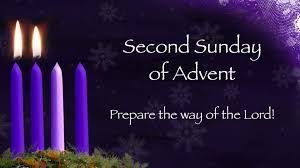
In our Gospel account for the second Sunday of Advent, John the Baptizer is the voice of prophecy in a world where such voices had been silent for nigh on 400 years.  It’s hard for us to realize as we read the Old Testament and turn to the New Testament, that there is this lengthy period of time between the prophetic word of the Old Testament and the prophetic voice of John the Baptist.  Now, in the Scriptures we hear the echo of John’s voice sounding once again through the voice of modern day prophets.

Jesus’ cousin had a message that people were ready to hear.   Is the same true today? The key is when I perceive that voice to reply, “Yes, I believe that the Lord is coming! The Kingdom of heaven is near!”  The oppressed Jews looked forward eagerly to the coming Messiah.  Many listened to what John had to say.  His was a teaching firmly anchored in their religious traditions.  John was speaking their language, and they understood what he had to say.  The practice of baptism which earned John his nickname “John the Baptizer” was not new to the Jews. It was a frequent practice used to mark atonement for sin and a renewed and purified spirit, to show that one who had been unclean was made ritually clean again.

John was an inspired preacher, one in whom could clearly be seen the power of God. After all, who would live like John out in the wilderness on locust and wild honey?  Well, take a look around!   Look at the effects of climate change and just plain selfishness!  Hundreds, thousands go to bed hungry.  They wake up (if they ever got any sleep) hungry and freezing or exhausted from the heat. If we listen with an open heart, we can hear their cries.   Do we act on it?  Do we take heed, and put flesh on our Corporate Commitment?  Or do we apply “band aids” (a stamp and a dollar) while we stuff our monthly allowance in our purses and pockets?  Do we remain blind to what surrounds our 39 acres?   Are we true to our word that we “respond to the hungers of the people of God.”  And pay honor to the slogan “Think global, act local.”

We must take care that we do not become complacent when we hear an overlay of quiet unassuming accounts of today’s inspired, even unaware, leaders. Or we don’t listen to the news because it just may “rattle our cages.”   We can’t just admire others’ good deeds or simply shake our heads when we see newscasters talking about how cold it is across the country as they stand there in a cozy warm newsroom smiling in a short-sleeve shirt while the homeless huddle shivering under bridges or cardboard huts.

On the one hand, one can clearly see the power of a giving, and forgiving, heart, influencing our world.  But, are you, are we, simply admiring the kindness of folks OUT THERE who are part of a “pay it forward” movement? Are we the recipients only of others’ kindness and generosity?  Keep in mind “if we are not part of the solution, we are part of the problem.”  What will be our legacy?

~Reflection by Sister Roberta Bailey, OSB


First Reading:   Isaiah 11:1-10         Second Reading:  Romans 15:4-9
Gospel:   Matthew 3:1-12
Continue Reading

Filed Under: Blog, Front Page, Homily Tagged With: Advent, Advent Week 2, God, Jesus, John, John the Baptizer, Second Sunday of Advent

“By your perseverance you will secure your lives.”

November 17, 2025 by Holy Name Monastery Leave a Comment

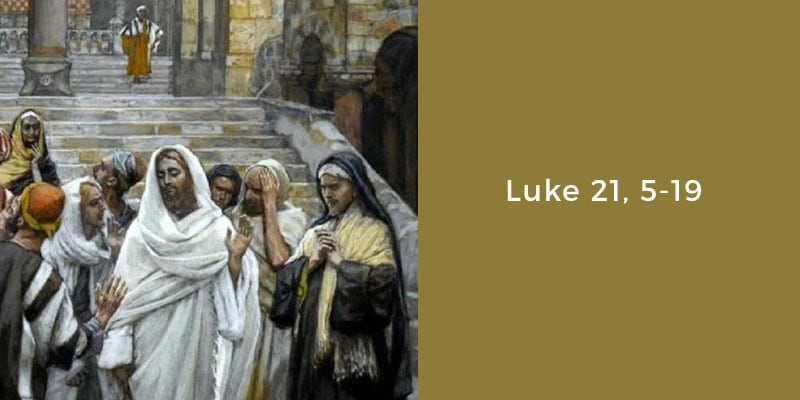
“Remember you are not to prepare your defense beforehand, for I shall give you a wisdom in speaking that all your adversaries will be powerless to resist or refute.  … By your perseverance you will secure your lives.”  In another translation we read: “This will be your chance to tell the Good News. Do not worry about what to say in court. For I will give you wise words. None of your enemies will be able to prove that you are wrong. They will not be able to say that your words are false.”

Much is written in support of the practice of imagining or role-playing various scenarios before actually confronting someone or being caught in a confrontational situation.  I don’t mean to belittle the value that might have to ease the knots in your stomach but these words of Jesus quoted by Luke remind us, when we actually get in a situation we can depend on God for Jesus says: “I myself will give you a wisdom, wise words, in speaking.”

A few months back my sign (Scorpio) read: “Worry is like a rocking chair: it gives you something to do but gets you nowhere.”  Sometimes that “rocking chair” could work ruts in the carpet…

One group of researchers have evidence to proof that we worry about – (commentary is mine.)

40% of our worries are things that will never happen [Whew, that’s a huge chunk we can let go of]

30% are about the past – which can’t be changed anyway – so dump the gunny sack and look to today

12 % are about criticism by others, mostly untrue – and many imaginary – why do we so often assume that other people are going to spend time their precious time thinking about “me”?

10% are about health, which only gets worse with stress – better to relax, loosen up and let our bodies work their own magic on the knots (I hear you: “that’s easier said than done.”)

8% are about real problems that can be solved – so here is where we need to spend our energy and focus our prayer.  Remember Jesus’ promise (and He is a person of his word): “By your perseverance you will secure your lives!”  So, “hands off” and “zip the lip” offering God the right solution because our limited eyesight most likely will see only a rather self-serving solution …  “God-sight” knows the key to the best fix for all concerned.

 Worry and fretting allows what we see as problems to come between us and God.   It is the view that God has somehow lost control of the situation and we’ve lost trust in God’s omnipotent care for us.  A legitimate concern should draw us closer to God and cause us to rely on His providential love for us.

By our Corporate Commitment we profess to respond to the needs of the people of God with the “compassion of Christ.”  But how can we do that if we have not learned to depend on the compassion of Christ?   Saying the words is one thing; living with a firm conviction that compassion begets compassion is all together another matter.   Let us seek ways to be compassionate. Not wishy, washy – for COM-passion means “with passion” – with fervor, excitement, enthusiasm, even obsession.  Compassion is a component of the good zeal our Holy Rule commends.

Mother Evangelista Kremiter – founding superior of the Atchison Benedictines and certainly was a mover and shaker in founding our federation – is quoted as saying: “Our lives, not words, make us credible.  Words move but example motivates.”  May our lives, individually and collectively, be an example that motives all who meet us to be people of compassion.

~Reflection by Sister Roberta Bailey, OSB


As we prepare to celebrate Thanksgiving ….   Consider what you are doing for someone(s) less fortunate that you and your family ..  donate money or canned goods to a food bank or place a surprise in their mailbox or on the doorstep, work a church event ….. or invite a live-alone person for a meal and conversation ….  or  how long has it been since  you’ve worn some things hanging in the closet for eons ….

  “Bend a knee”  a whisper THANK YOU!


First Reading:   Malachi 8:19-20a         Second Reading:  2 Thess 3:7-12
Gospel:   Luke 21:5-19
Continue Reading

Filed Under: Blog, Front Page, Homily Tagged With: "By your perseverance you will secure your lives.", Corporate Commitment, defense, God, Good News, Jesus, love, Luke

You don’t need a building to represent God’s presence – God is ever near

November 10, 2025 by Holy Name Monastery Leave a Comment

Have you ever had the experience of talking to someone who is behind you?   You think you are having a really good conversation only to discover the other person has long since left the room or fallen asleep in the back seat.  Not long ago I experienced this when trying to converse with a friend as we walked down a long busy hallway.  What my friend did not realize was that someone had stepped between us while she continued speaking over her shoulder. “Let’s go into town tonight, find a good dancing place; maybe have a drink or two.”  Imagine her surprise when a male voice responded: “I’d like that – Is it OK if I bring my wife?”

That’s similar to what is happening in this Gospel story.  Folks are going through all kinds of activities directed to a God who has long stopped paying attention to all of their religious rituals, performances and pretenses.  What was taking place in the Temple was all the outward activity with none of the genuine reality. The motives had become mixed: it was much more about what they could get from the Temple rather than responding in gratitude for what God has done for them and their ancestors.

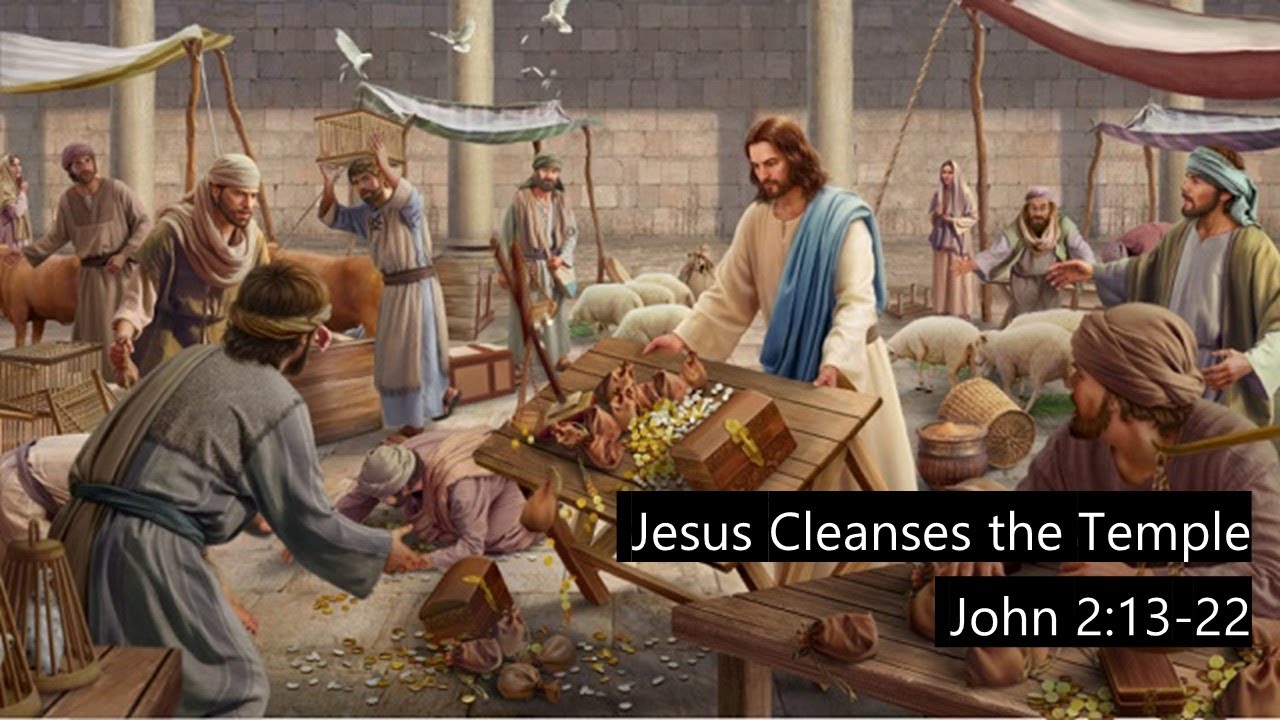
The picture here is not a gentle, soft-spoken Jesus – not the smiling Jesus calmly confronting the religious establishment with authoritative teaching and divine wisdom.  He does not ask the vendors to kindly remove their display tables outside the temple.  Nor does he ask the buyers to hold on to their money and put it in the donation basket.  Rather, he appears with His sleeves rolled up ready for a fight. He makes his own whip and chares through the heart of the religious establishment striking forcefully and aggressively at a religious system that has become skewed. Imagine it! Jesus is opening the cages of sheep, and doves with one hand, while, wielding a whip of cords in the other. He is driving animals and people alike into confusion and retreat.

The Jewish leaders ask Jesus for his credentials: what sign does he offer for taking this radical action?  Their demand is amazing but it seems a fair question.  They are checking what right He has to clear the Temple. Even among those who trusted Jesus, there is something that is not trustworthy. Jesus knew that even among those who believe, there is something fundamentally wonky. We are prone to get it wrong. Even among those who have true faith in Jesus, there is the possibility that we will let ritual replace reality.

Recall Jesus’ response to his critics in the temple?  “You want proof that I have the right to condemn religious pretension.   Let me give you the sign that I have the authority to condemn the Temple. You are going to kill me, and when you destroy me, I will raise it up again.” He is saying that resurrection is the ultimate authentication that he is who he says he is.  The religious leaders were incredulous.

He’s telling them and us: You don’t need a building to represent My presence because I am the connecting point between you and God.  In just a little more a month we will be celebrating Christmas and singing about Emmanuel, God with us. Authentic worship is not attached to Jerusalem or any other place. It is attached to Jesus. You / we won’t be making a pilgrimage to Jerusalem. But, we will be moving through Advent – a movement of the heart.  Turn away, Jesus says, from all that detracts from Me and our relationship.

So, if the Gospel message is that we don’t need a building to find and worship God, why are we celebrating the dedication a basilica today?  Parishes commemorate their founding dates but that’s usually a local celebration.  Why does the dedication of a building in a faraway city supersede the 32nd Sunday liturgy?  This church, the Lateran Basilica, not St. Peter’s, is a diocesan cathedral, the pope’s church, in his role as bishop of Rome.  It was built in the 4th century on donated land.  The structure has suffered fire, earthquake and ravages of war.  The present structure was commissioned 1200 years later, in 1646.  Beneath its high altar rests the remains of a small wooden table, on which according to tradition, St. Peter celebrated Mass.  The building may have been repaired and its role changed since the fourth century, but Jesus Christ remains its cornerstone.  This is our mother church, the spiritual home of the people who are the church.

Shortly before his death, Pope Francis give us insight into his concept of Church:

“I would like a more missionary church, not so much a tranquil church, but a beautiful church that goes forward in joy.”    At the opening of the Synod on the Family Pope Francis made it clear no question would be out of place, Discussion was not to be censored; no topics or questions were to be off the table. He wanted full, robust debate.   Then, in his closing remarks at the Synod he challenged the bishops with homework: “We still have one year to mature, to find concrete solutions to so many difficulties and innumerable challenges to confront; to give answers to the many discouragements that surround and suffocate.”

Our gospel is not a bedtime pretend story about some long-ago hypocritical religious leaders. It’s really our story too.  Our covenant relationship with Jesus, with God is not just about becoming a better version of ourselves through self-improvement.  It’s not about following a set of rules, reading the words of someone else’s prayers, being on our knees or sitting down, genuflecting or bowing.  It’s about becoming the best we can be – living to our full potential – not putting ourselves down in false humility or denying God’s free gifts to us.

A very real question is whether we believe that the resurrection fact or fiction?  Do we truly believe the sign that Jesus gives us, that He rose after three days buried in the earth?   If you believe He did, then we need to pay attention, because this is no ordinary man.  Let us, pray, then THAT our community, that every community of faith gathering to worship, may go forth from church buildings into their everyday lives to share their faith and resources with those in need.

~Reflection by Sister Roberta Bailey, OSB


First Reading:   Ezekiel 47:1-2,8-9,12        Second Reading:  1 Corinthians 3:9-13,16-17
Gospel:   John 2:13-22
Continue Reading

Filed Under: Blog, Front Page, Homily Tagged With: building, God, God's presence, Gospel, Jesus, leaders, Pope Francis, temple

Mercy Over Merit

October 27, 2025 by Holy Name Monastery Leave a Comment

It is important to note at the outset of this particular reading just who it is that Jesus is speaking to.  Luke says: “Jesus told this parable to some who trusted in themselves that they were righteous and treated others with contempt.”

But, then there’s this.  Elsewhere in Scripture, Proverbs tells us: “To do righteousness is more acceptable to the Lord than sacrifice” and “Blessings are on the head of the righteous.”  Turning to Isaiah we read: “The work of righteousness will be peace, and the effect of righteousness, quietness and assurance forever.”

So, why does Jesus seem to be criticizing the righteous one?  One little word makes the difference.  Jesus is talking to the self-righteous; those who trusted in themselves. They’re a little too sure they are right and anyone who thinks differently must be wrong.  They (or is it we?) are so full of self that there’s little room for God’s grace to filter in.

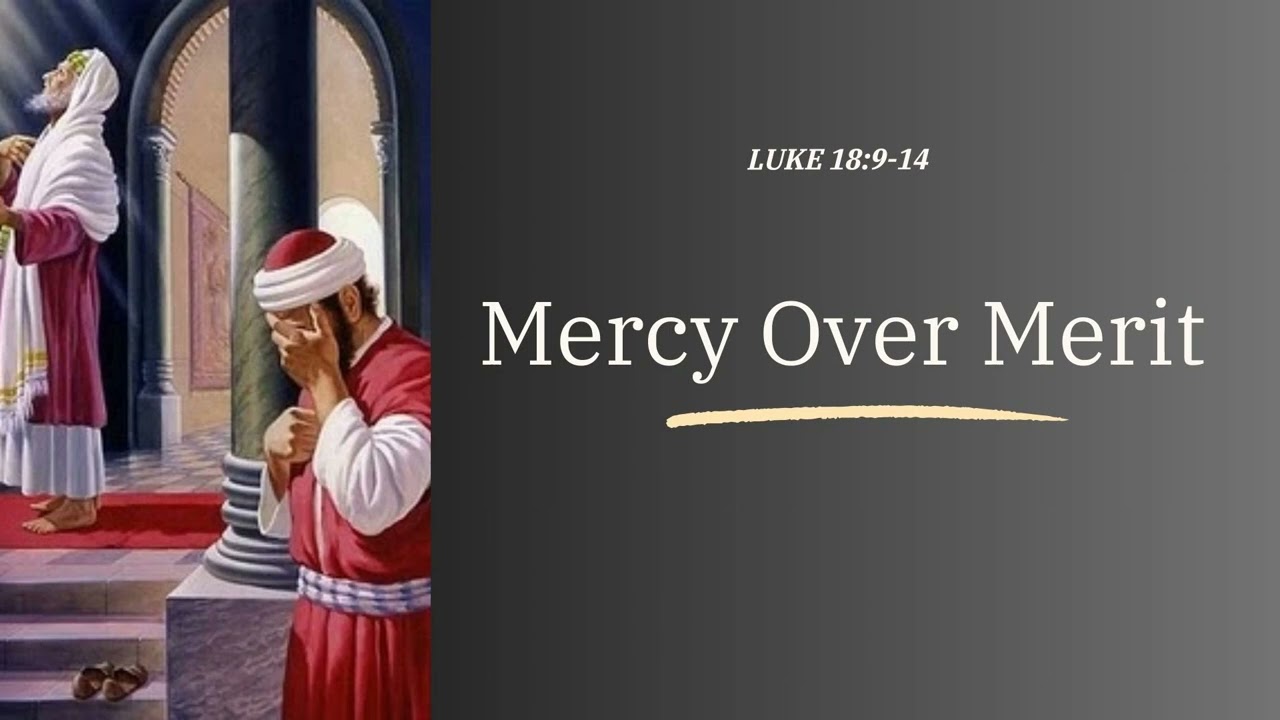
It’s interesting when you think about it that everything the Pharisee says is true. He has set himself apart from others by his faithful adherence to the law. He is, by the standards of his day, a righteous man.   It isn’t that the Pharisee is speaking falsely, but rather that the Pharisee misses the true nature of his blessing. As Luke says he has trust in himself. His prayer of gratitude may be addressed to God, but it is really about himself. He credits his righteousness entirely in his own actions.

The tax collector, on the other hand, does not even raise his eyes to heaven.  He knows that he possesses no means by which to claim righteousness. He declares he has done nothing of merit. So, he stands back, hardly daring to approach the Temple, and throws himself on the mercy of the Lord.  He seems not so much humble as desperate.  He stakes his hope entirely on the mercy of God.

At the end of the day, the Pharisee will leave the Temple and return to his home the same virtuous, honorable man he was when he came to the temple.  That hasn’t changed.  The Pharisee’s mistake, as Scott Peck says, is that he thinks that whenever he wants, he can pull “God out of his hip pocket.”   On the other hand, the tax collector will go back to his home exalted in God’s eyes because he humbled himself.

If you’re spiritually alive, and give credit where credit is due, you’re going to love this take on the parable.  If you’re spiritually dead, you won’t even want to hear it.  If you’re spiritually curious, there is still hope!

A Church goer wrote a letter to the editor of his hometown newspaper and complained that it made no sense to him at all to go to church every Sunday.  He wrote: “I’ve gone for 30 years now, and in that time I have heard something like 3,000 sermons, but for the life of me, I can’t remember a single one of them.  So, it’s been a waste of my time and on the part of homilists a waste of their time by giving sermons at all”.

This started a real controversy in the “Letters to the Editor” column.  Much to the delight of the editor, it went on for weeks until someone wrote a real clincher:  “I’ve been married for 30 years now. In that time my wife has cooked some 32,000 meals. But, for the life of me, I cannot recall the entire menu for a single one of those meals.  But I do know this: they all nourished me and gave me the strength I needed to do my work.   If my wife had not given me those meals, I would be physically dead today.”

We might say: I’ve been in community x number of years.  In that time, I’ve been nourished and supported by my Sisters thousands of times in hundreds of different ways. But sadly, I can only recall a few, if any, instances in full detail. This much I DO know, without their support my spirit would have withered long ago.  Likewise, if I had not gone to Mass and been faithful to my time of private and communal prayer, I would be spiritually dead today!

~Reflection by Sister Roberta Bailey, OSB


Sending from home of OSB sisters in Pittsburgh PA where I am on vacation for a month – sunny 43 degree, some Fall colors.

Unsure if for next few weekends will be sending reflections …  Know that I will remembering you and your intentions in prayer.


First Reading:   Sirach 35:12-14, 16-18         Second Reading:  2 Timothy 4:6-8, 16-18
Gospel:   Luke 18:9-14
Continue Reading

Filed Under: Blog, Front Page, Homily Tagged With: God, Jesus, Luke, mercy, Mercy over merit, merit, Pharisee, Pharisees, temple

Perseverance in Prayer

October 20, 2025 by Holy Name Monastery Leave a Comment

In the Gospel we have a lesson about perseverance in prayer.  The point of the story is not that prayer is nagging God for what we want.  Nor is it meant to teach us that God is like the judge in the parable – worn down by requests and coerced to respond.

The key to understanding the meaning is found in the description of the judge as corrupt and unjust. Since God can be neither, we must understand Jesus to be saying that if even an unjust judge responds to the persistence of the widow, how much more will God listen to our prayers. God truly wants to hear our needs and respond generously.  Didn’t Jesus say: “Ask and you shall receive?”   Jesus is telling us that God wants us to be like the persistent widow, staying in relationship with God, confident that God hears and answers prayers.   And He understands how easy it is to lose heart.  He asks: “Will such faith, the faith of the widow, be found when the Son of Man returns?”

A beginning of the answer to the question appears to be that the Son of Man will find faith, but it may be in unexpected places, as it has been in the Gospel — not among the religious professionals or the ones certain of their own righteousness, but among the outsiders, the unlovely, the unclean, the ones certain of their sinfulness.

The parable suggests that a sign of faith will be a willingness to persist in prayer, as we see in this widow who persists against all odds in her fight for justice against the powerful judge. Another sign may be in what we pray for: daily bread, the Holy Spirit, the coming of the kingdom, justice.

In his gospel, the evangelist Luke portrays widows as vulnerable but at the same time prophetic, active, and faithful.  The widow of this parable is forceful enough to get the justice she demands even from an utterly unjust judge.

If we could read the Greek version of this parable, we’d get a glimpse of Jesus sense of humor.   Now by “Greek” I don’t mean the language we refer to when we say “It’s all Greek to me.”  In the Greek Scriptures the judge gives in to the widow because if he doesn’t, he fears she may give him a black eye.  Jesus uses a metaphor from boxing to make his point about the need to continue in prayer. Be as persistent as a boxer in the ring when it comes to prayer. Jesus gives a second teaching in the parable. If an unjust judge answers the pleas of a widow how much more will God answer our prayers.  We just don’t know WHEN.  Remember the words of the prophet Habakkuk?  “The vision still has its time and will not disappoint.”   God takes the long view,  knows what is best and we may sometimes have to wait until we’re, as they say: “on the other side of the grass,” where we’ll understand that all along God knew best.

Luke seems to be very much aware of the real danger of giving up, of losing heart when we suffer injustice.  Luke is saying that if we pray hard enough and if we don’t lose heart, God will give us justice, right? Well, does God? Is there justice in the world?  In our country?   In our local communities, and (sadly) In our churches?  We have only to watch the evening news or read the day’s headlines to learn of multiple cases of brutality and injustice.

Could it be possible that God’s justice looks different than our justice?  Good question. Yet, somehow I trust that God gives us a righteous sense of justice–especially if it is a selfless sense of justice–one that is concerned with others.  Look at our widow. What does she do to obtain justice? She is persistent. She is stubborn. Perhaps we should call her attitude a kind of “holy stubbornness.” She doesn’t give up – she doesn’t lose heart. She keeps knocking at the judge’s door.

Now, I believe I don’t have to explain “stubbornness.”  Some of us had it sprinkled on us in our cradles!  We can prettify it, call it by another name, whatever we want: high principles, perseverance, tenacity, determined or just plain pig-headedness.  Yes, we seem to be naturally endowed with the “great gift of stubbornness” and the only thing God has to help us with is to learn how to be stubborn for the right causes — God’s justice. In that case we may talk about a “holy stubbornness.”  That happens when we start not only to pray our prayers, but when we start to live our prayers.  In other words, we put our actions where our words are.  Victims of poverty, injustice or violence don’t want to hear about God’s commandments, about moral values, about self-denial, or even about justice.

Luke is right: it is easy to lose heart and go with the flow rather than go against the current.   It takes more than a petition at Mass to make our prayers effective. Think of all the corporate commitment action opportunities we are offered.  When we support our petitions with a donation to Christmas for the residents at Heritage, attend the Sunrise Prayer Vigil, write letters asking for legislative action on behalf of the poor, make a donation to the Soup Supper or volunteer at Daystar.

You may ask, or be asked: “can prayer move God’s arm?” Jesus turns this question back on us today and concludes his parable with the question: “Will the Son of man find faith when he returns?” In other words, he is asking: “Can prayer move your own arm?  Are you willing to put your actions where your words are?” God always has relied on his children–people like you and me–to usher in His Kingdom. God will give us strength, God will empower us, but we still need to stubbornly live out our prayers for justice. The first reading reminds us we don’t have to be alone in our entreaties.  One of the beauties of living in community or being part of a faith community is that, like Moses’ (in tomorrow’s first reading) – we have friends who “hold our hands until sunset” – we have  the prayer support of many others.  Are our prayers effective? The answer lies squarely with us: “it depends on how effective we help make them.”

~Reflection by Sister Roberta Bailey, OSB


First Reading:   Exodus 17:8-13         Second Reading:  2 Timothy 3:14 – 4:2
Gospel:   Luke18:1-8
Continue Reading

Filed Under: Blog, Front Page, Homily Tagged With: Faith, God, Gospel, Holy Spirit, Jesus, perseverance in prayer, persistent widow, Prayer

  • Page 1
  • Page 2
  • Page 3
  • Interim pages omitted …
  • Page 39
  • Go to Next Page »

Footer

Prayer / Newsletter / Info

 Contact Info

Benedictine Sisters of Florida

PO Box 2450
12138 Wichers Road
St. Leo, FL 33574-2450
(352) 588-8320
(352) 588-8443

 Mass Schedule

Related Links

Copyright © 2025 · Benedictine Sisters of FL · Touching Lives Through Prayer and Service

Copyright © 2025 · Bendedictine Theme on Genesis Framework · WordPress · Log in