• Skip to primary navigation
  • Skip to main content
  • Skip to footer
Benedictine Sisters of FL

Holy Name Monastery
Founded 1889

Donate Now
  • Home
  • About Us
    • History
    • Being Benedictine
    • Benedictine Monasticism
    • Meet Our Community
    • Holy Name Academy-Alumnae
  • What We Do
    • Mission, Vision and Our Partners
    • Retreats
      • Invitation to Retreat
      • Accommodations
    • Volunteer Programs
    • Oblate Program
    • Spiritual Direction
    • Aqua/Hydroponics
    • More of Our Ministries
  • What’s Happening
    • Articles of Interest
    • Events
    • Newsletters
    • Brochures
    • Links
  • Support Us
    • Gifts of Support
    • Wish List
  • Stories Shared
  • Galleries
    • Photos
    • Videos
      • Benedictine Sisters of FL Videos
      • Other Videos
  • Contact Us

Homily

Four Weeks Suspended in Kairos

December 11, 2017 by Holy Name Monastery Leave a Comment

In her book, THE LITURGICAL YEAR, Joan Chittister makes the comment: “Advent, more than any other season of the church year, calls us to live simultaneously in the past, the present, and the future.  She elaborates: “We learn in Advent to stay in the present, knowing that only the present well-lived can possibly lead us to the fullness of life.  It takes an overview of the three-year cycle of Advent readings to make clear the multiple meanings of Advent.  Many of our Advent hymns keep this idea before us when we sing “Mara – natha – two words – The Lord has come … God of, and in, our) past, present and future are all lived together … soul.” (Chittister)

We eagerly await the coming of Christ as a baby in Bethlehem (the past), we are invited to welcome him into our hearts now (the present), and we look forward to his future coming as king of glory.  For four weeks of Advent we are suspended in kairos — God’s time — when expectations and reality are held in tension with each other.  We must hold on to a vision of what challenges the church (that’s all of us) should be dealing with today.  Dwelling in the past or wishing for a perfect future can keep us from hearing the will of God in our today.  Many recognize in Pope Francis a voice that is, like John the Baptist, crying in the wilderness … urging us forward in the present to mend the past as we confront the ills of today.

This Gospel introduces us to the man: John.  The opening lines in Mark’s gospel are “the beginning of the Gospel of Jesus Christ” but the first character he introducers is not Jesus, but John the Baptist, the fiery preacher who came out of the desert where he lived on honey and locusts.  And, he is no fashion plate, with his camel’s hair clothes, leather sandals, and leather girdle around his waist — very much like Elijah.  His diet was very simple: locusts (grasshoppers) and wild honey.  This is important, or it would not be here.  It is symbolic. But what does it symbolize?  Well, you cannot wear anything more fundamental in the way of clothing, or eat a more basic diet, than John did.  In other words, it is representative of his ministry — one of simple beginnings.  It is not the end; it is the beginning.  The beginning of the gospel of Jesus Christ, the Son of God is all about repentance.  This is the place to begin.  Even John’s clothing and his diet helped convey that message.

His diet, by the way, was balanced.  Food fanatics will quickly recognize that grasshoppers are protein, and honey is carb.  John’s diet was in perfect balance, so that he was a healthy man.  It was a simple sort of diet, just as his ministry was – nothing elaborate.  Furthermore, he’s very honest.  He says, “Don’t look to me for answers beyond what I have already told you.  Anything beyond that must come from Another, who is coming right after me.  He is so much greater than I that I am not even worthy to untie his shoes.  Remember, this was his cousin he was talking about!  John could bring people to God, but he could not take them beyond that.  John began his ministry in the wilderness, the worst possible place. But it worked!

The people of Jerusalem and Judea left their cities, their recreations and pleasures, and trekked through a howling wilderness to listen to a man preach.  They probably had to walk twenty or thirty miles to hear John, but did so willingly and in such increasing numbers that Mark records, in only slight exaggeration, that “all the country of Judea, and all the people of Jerusalem” came out to hear him.  Something drew these people into the desert to listen to this strange and rugged young preacher proclaim good news.  That is all he did!  He never told how it worked, or why; he just announced it.

How fitting it is that we have this message of forgiveness and repentance as a prologue to our Penance Service on Tuesday evening.  Then, as now, people need to know they can begin again.  God offers us, once again, an opportunity to truly repent.  We can change our attitude and stop defending ourselves and trying to blame everything on others.  There’s a saying: the whole world’s a critic.  Tuesday’s reconciliation service gives us a chance to be our own critic and say, “You know what, God?  I’ve finally realized it’s not those others, it is just me.  This is just the way I am — and I need help.”  In the quiet of your own heart, where God alone hears, you can say, “I repent, send me your Spirit.”

But keep in mind what the prophet Isaiah said about John’s message – this business of reconciliation will resemble a great bulldozer, building a highway in the desert.  John was God’s bulldozer to build that highway.  You know how roads are built – we see the process almost any direction we go on the highway.  Isaiah says: “Every mountain shall be brought low, and every valley shall be lifted up; the crooked places shall be made straight and the rough places plain.”  And, that is what repentance does.  It bulldozes down all the high peaks of pride that we stand on and refuse to admit we’re wrong.  It takes the depressed areas of our life, where we beat and torture and punish ourselves, and lifts them up.  It takes the crooked places, where we have lied and deceived, and straightens them out.  And it makes the rough places plain.  Then, there is God!  God comes to us so that we can come to God.

Our hope is in the promise of God, and God of the Promise… a promise that was fulfilled in Jesus Christ.  It is a hope that will not be disappointed because God may delay, He may tarry but He will not forget His promise.  He will not let us down.  Praise be God!

~Reflection by Sister Roberta Bailey, OSB, Prioress
 

Readings:      Isaiah 40: 1-5, 9-11               2 Peter 3:8-14              Mark 1:1-8
Intention:       Peoples of Central America
Continue Reading

Filed Under: Blog, Homily Tagged With: Advent, God's time, Gospel, Jesus, John, Kairos, Lord, Promise

Until you know what hurts me…

December 4, 2017 by Holy Name Monastery 1 Comment

Scholars believe that Mark’s Gospel was written 30-40 years after Jesus’ death. His audience would have been Christians who were living in a difficult social and political time, a time of conflict.  They were likely to be facing persecution because they were followers of Jesus.  These early Christians took courage in Jesus’ warning to remain alert and watchful.  It strengthened them to persevere through the sufferings they encountered.

By the 6th century, Advent was tied to the coming of Christ.  But the “coming” they had in mind was not Christ’s first coming in the manger in Bethlehem, but his second coming in the clouds as the judge of the world.  It was not until the Middle Ages that the Advent season was explicitly linked to Christ’s first coming at Christmas.  In our contemporary church year Advent begins at the Vigil of the Sunday nearest the Feast of St. Andrew – sometime between November 27 and December 3rd.  We stretched it to the max this year.

Like the disciples and the faithful in Mark’s community, we must also stay alert and watchful.  Our faithfulness to God, and our experience of God’s faithful to us, through the good times as well as the difficult times, keeps us in a state of readiness for the coming of God in our daily lives and for Christ’s second coming.  It is special time when we strive to counterbalance the challenges in our environment: noise, speed and busyness.  Advent is a sacramental moment – an extended moment spanning 4 weeks.  It is a time for increased prayer, observances of the beauty and the needs in our everyday environment, and a honing of the discipline to respond to what God places in our paths.  It’s not a time to curl into ourselves, look at the pretty Christmas lights and dream of a “white Christmas with every Christmas card we write.”

Advent is certainly a time of waiting and of celebration and anticipation of Christ’s birth.  And it’s more than that.  It is only in the shadow of Advent that the miracle of Christmas can be fully understood and appreciated.  It is only in the light of Christmas that the Christian life makes any sense.  It is the between-time that Karl Barth speaks of when he writes: “Unfulfilled and fulfilled promises are related to each other, as are dawn and sunrise.  Both are promise and in fact the same promise.  If anywhere at all, then it is precisely in the light of the coming of Christ that faith has become Advent faith, the expectation of future revelation.  But faith knows for whom and for what it is waiting.  It is fulfilled faith because it lays hold on the fulfilled promise.  This,” says Barth, “is the essence of Advent.”

The Christmas story reminds us that it was in the midst of the busy stop-over city of Bethlehem that God slipped visibly into our world: a squalling infant to a humble, unpretentious couple.  In those days, Bethlehem was a place where business was conducted quickly, camels were exchanged, horses were watered, travelers would stop to have a meal and maybe spend a night.  Sheep grazed on the hillsides, shepherds kept watch for hungry wolves and marauders on the take.  Bethlehem’s fame was based on a has-been history … it was King David’s hometown.

It was here that the Christmas miracle happened … a God-moment that proves for those who have eyes to see and ears to hear that even a smelly cave can be heaven on earth – a sacred place – God’s house.

We have all had experiences of waiting … that’s part of all our lives.  This season of Advent reminds us that waiting is often the cost of love: in waiting for someone, our own everyday business becomes almost meaningless as we anticipate, worry, and prepare for our loved one’s return.  In waiting, we realize our own powerlessness; we realize our deepest hopes and needs; we realize the gift of the person we are awaiting is to us.

While it is difficult to keep the spirit of Advent in mind in the midst of holiday celebrations, shopping, lights and decorations, and joyful carols, Advent is intended to be a season of fasting, but not the penitential fasting we associate with Lent.  You’ll notice the liturgical color is lavender, not the deep purple of Lent.  Advent is anticipatory fasting of waiting, waiting for the glorious miracle of Christmas.  This is fasting when you’re too excited to do anything else, except sit-on-the-the-edge of the your seat, listen for the sound of approaching footsteps, stare at the door knob so you’ll be the first to see it turn and you keep asking: “Is it time yet?  Is He here?”

May our waiting for the coming of the Holy One this Christmas help us understand and carry on the mystery of compassionate and generous waiting.  Don’t expect a dramatic vision but do try to become more conscious of the Christ coming through our doors, in the ones who enter our community room, our retreat space and share a meal with us.  In our corporate commitment we pledge to be the embodiment of the compassion of Christ.  And it is obvious from our visitors’ comments that this is one of our signature ministries.  Our guests, and we who live here, know that our companions care for us …  the question may be do we care about each other.  One litmus test: until you know what hurts me, you cannot truly love me.“

We pray: fill our hearts with Advent hope so that we may learn to cope with the delays and disappointments we encounter with patience and wisdom.   May a spirit of gratitude and humility guide us on our journey to your dwelling place, enabling us to endure, with joy, the costs of waiting for love, reconciliation, and peace.

What has been your most difficult experience of waiting?  In the end how was your long vigil rewarded?

~Reflection by Sister Roberta Bailey, OSB, Prioress


First Reading  Isaiah 63:16b-17,  19b;64:2-7               Second Reading 1 Corinthians 1:3-9
Gospel Mark 13:33-37
Continue Reading

Filed Under: Blog, Homily Tagged With: Advent, Bethlehem, Christ's birth, coming of Christ, God, Holy One, Jesus, Mark

Have You Admitted It?

November 27, 2017 by Holy Name Monastery Leave a Comment

The feast of Christ the King was instituted by Pope Pius XI in 1925, during a time when respect for Christ and the Church was waning.  Today, the same distrust of authority exists.  The magnitude and the manifestations of the problem have evolved over the years to the point that Individualism has been embraced to such an extreme, that for many, the only authority is the SELF.  In such a system, the idea of Christ as King is rejected.  In our own liturgies we sometimes avoid the use of the title King and Lord.

The one and only time Jesus allowed himself to be treated like a king is recalled in the Holy Week liturgies.  Those Passion Gospels pointedly remind us that Jesus’ kingship is one of love and sacrifice, not power and domination.  In retrospect, the mocking, derisive jabs that Jesus endured served to proclaim his true identity: the messiah, the chosen one, the king of the Jews and our savior and the savior of all people.

Today’s particular Gospel (from Matthew), doesn’t use the word KING, but it does refer to Jesus in glory, seated on a glorious throne, with all the nations assembled before Him.  It makes it obvious, we won’t experience Christ’s reign all on our own.  We’re really part of something bigger than our own little selves, when we live “under” the reign of Christ.  We’re gathered with many people of varied kinds and you heard how Jesus described us – sheep and goats.

The full title of this celebration is “The Solemnity of Christ, the King of the Universe.” During the Jubilee year of Mercy, Pope Francis added another part to the title: “…the living face of the Father’s mercy.”  This title seems to be somewhat of a paradox.  When we think of the king of the world, let alone the king of the universe, we might tend to imagine a powerful, distant leader, disconnected from ordinary people.  But on the other hand, Christ is the face of the Father’s mercy, the one who binds up our wounds, heals us, blesses us, and saves us.  It may seem peculiar that He can be both the King of the universe, and the face of mercy.  However, the combined readings for the solemnity give us a glimpse of how Christ is both king and the face of the Father’s mercy, all at the same time.

The wonderful thing about Jesus’ use of parables is that we can identify ourselves with one or more of the characters in the story.  When we read or hear a parable it’s sort of like looking in a cloudy mirror.  There’s not much precision, but the general image is there.  You begin to squirm with the feeling: “This one’s about me.  He’s talking to me.” It’s that way with this parable of the sheep and the goats, the saved and the damned.  Both groups question:  When did we treat you, or not treat you, in the ways you describe?  And Jesus tells them straight forward: “Whenever you did (or did not do) for one of these least ones” – that’s how you treated me.

So, where do you see yourself in the story?  Do you belong to those that care, (the ones on the right), or those who simply didn’t have enough time to be bothered (those on the left)?  Or, like me, does it depend.  One day you see yourself on one side and wish you could honestly say you were on the other?  We’ve given of our time, our treasure, and our talent – and sometimes we’ve withheld them – depending upon a number of factors, some of which we’d be ashamed to identify.

But there’s another group in the parable that may be overlooked.  The message is so simple that we fail to see the BIG point.  There were those who helped, those who couldn’t be bothered, and then there were those who needed help!

So, here’s the BIG question for today.  Your salvation many hang on your answer.   When have you seen yourself as one who needed help?  The answer is awfully important because Jesus seems to identify Himself as those who are hungry or thirsty.   But, notice, He didn’t only identify Himself as one among many – NO, He identified Himself as living in those very people.  He was born poor and helpless, born in need and died in need.  He lived and moved and had His being in need.  Not among the poor ones – within each of those poor ones – no matter what features you see, Christ’s face speaks to us in the voice of each person.

Our connection is in this Gospel.  Christ will come and judge us by how merciful we have been to others.  The King of the universe wants us to be the face of his mercy to one another.  You heard how we will be judged.  Did we feed the hungry, clothed the naked, and visit the sick?  By giving mercy to others in the same way that Christ has given mercy to us we proclaim God’s mercy and Christ’s kingship to the world.  How will you proclaim his reign and his kingdom today?  Have you admitted that you are in need, that you’re not self-sufficient, that you`re on spiritual food stamps, and that you and Jesus find each other in need?  Jesus speaks in this parable in the first person: “when did YOU see ME in need?”

So which group DO you belong to in the parable?  Just how DO you identify yourself in it?  Could it be true that you just might have to change how you identify yourself not only in the parable but in real life?  Perhaps this is a moment of grace for you; perhaps you’re being touched again by God?

~Reflection by Sister Roberta Bailey, OSB, Prioress


34th Sunday  Feast of Christ the King
First Reading           Ezekiel34:11-12; 15-17                            Second Reading      1 Cor. 15:20-28
Gospel   Matthew 25:31-46
Continue Reading

Filed Under: Blog, Homily Tagged With: admit, Christ, God, Jesus, King, need, parable

What Is Your Journey Question?

November 20, 2017 by Holy Name Monastery Leave a Comment

In last week’s Gospel, Jesus emphasized that there is no way to predict His final coming to each individual.  He reminded us that we must remain vigilant and ready to receive our God and Savior at any time.  Now, in the weekend’s Gospel Jesus talks about the same concept this time using economic metaphors.  As he describes it, before the master leaves on a journey, he entrusts to his servants with various “allowances.”  He discerns the amount of the gift according to each servant’s ability.  But, you know the story.  Upon his return, he finds that the first and second servants have doubled their money, and, thus, both recipients are rewarded.  The third servant, however, afraid that he would lose his allowance, only conserved what he received.  He risked nothing; he did not even deposit the money in a bank to earn interest.  This servant is chastised, his money taken back and instead given to the servant who brought the greatest return.

We can’t be reminded too often that our gifts, or talents, are given to us for the service of others.  If we fail to use these gifts, God’s judgment on us will be severe.  On the other hand, if we make use of these gifts in service to others we will be rewarded and entrusted with even more responsibilities.  Sadly, some people deliberately fail at a job or chore they don’t like so they won’t get asked to do it again.

What about us and our talents?  Do we let dislike of a job, or the threat of failure, or someone else’s critical eye hold us back from exercising a God-given talent?  Or a more mundane question: We get an earthly allowance each month – do we bury it or use it for the good of others so it keeps moving forward, good upon good…

Benedict teaches us several lessons about “journeys.”  He speaks most directly to, and about, those who go on the journey … He doesn’t pass out money to those left to tend the vineyard, but he certainly leaves them a legacy.

Beginning with the opening words of his Rule one can sense a journey motif.  Benedict bids us: “Listen! The labor of obedience will bring you back (“coming back” requires a journey, doesn’t it?)  You’ll come to him from whom you have drifted…”  “Let us get up then (he says) at long last, (journey from the land of our dreams) for the Scriptures rouse us when they say: “It is high time for us to arise from sleep… run (speed along on your journey) while you have the light… go out (leave the familiar territory you call home) to seek workers in the multitude of the people ….”  Listen to Benedict: “moving on in your journey of faith, (and life in the monastery) “You will say, Here I am Lord.”  And, then he tells us how to prepare for our journey: “Clothed with faith and the performance of good works, let us set out on this way, with the Gospel for our guide…. Be just in all your dealings, speak the truth from the heart and do not practice deceit or listen to slander.”

Beyond the Prologue of the Rule, Benedict offers guidance for our conduct on the voyage of life.  After giving us an overview of what we will need in our toolkit, Benedict hastens us on our journey when he tells us: RUN on the path of God’s commandments, never swerving.”

By the time Benedict wrote chapter 67 one can tell he’s had some experience with monks who journeyed afar from the home monastery.  We know that Benedict, in his youth, has escaped “big city life.”  So he wanted to protect his monks from the evils and temptations of the prevailing society.  Notice he does not say … those who go on a journey.  Rather, those who are sent on a journey.  Those at home are to remember the absent ones in prayer … which means the gathered community may have “counted” noses” but not for the sake of taking roll but to pray for their confreres safety and protection from temptation.

I have to smile when I read what Benedict cautions next.  He certainly knew human nature: “no one should presume to relate what was seen or heard outside the monastery.”  Sounds to me like he’s witnessed some cases where “curiosity killed the cat.”  Benedict didn’t want stories of the world to creep in and cause dissension or dissatisfaction with the home experience to rankle or upset his community.  Times haven’t changed much over the passing years, we still need to on guard that we balance chartable interest in each other versus the drive to know every intimate detail about what was seen or heard by the other.

Benedict is solicitous of his monks on a journey that they not appear embarrassingly shabby.  He makes provision that they be LOANED underwear (that’s right with their long tunics their everyday wear might not have included underwear).

In line with the admonition to pray always, Benedict reminds his monks on a journey to keep an eye on the sun … listen for the bells from neighboring abbeys announcing prayer times.  … so, (Benedict reminds them) though at a distance too far to join the community they might “observe the prescribed hours” as best they can.  Thus, probably began the custom of the Angelus … the dialogue between Angel Gabriel and Mother Mary, a modified version of Sext (or Noon Prayer) that could be memorized so as not to neglect their “measure of service.”

The Rule closes with this journey-question: “Are you hastening toward your heavenly home?  Then keep this little rule … as you set out for loftier summits of the teaching and virtues we’ve mentioned.” Then Benedict echoes his message first heard in the Prologue with this promise: “under God’s protection” (together) we “will reach” our heavenly home … this is the self-same promise Jesus extends to us in the Gospel: Because “You were faithful in small matters … come, share your Master’s joy.”

~Reflection by Sister Roberta Bailey, OSB, Prioress
Thirty-Third Sunday in Ordinary Time   Sunday, November 19, 2017
First Reading  Selected verses Proverbs31   Second Reading  1 Thessalonians 5:1-6
Gospel Reading  Matthew 25:14-30
Continue Reading

Filed Under: Blog, Homily Tagged With: Benedict, God, Jesus, journey, Monks, pray, The Rule

Are You Heeding the Words?

November 14, 2017 by Holy Name Monastery 1 Comment

If you’ve ever driven south on I-75 through Tampa you’ve seen the signs: Check gas – long bridge ahead.  Well, this Gospel story could have been titled: check oil – long night ahead.

From the outset it is helpful to understand that these oil lamps (in the Gospel) were not like what we know as hurricane lamps.  There was no glass chimney, no neat wick or adjusting device, and no attached tank in which oil would be stored. It was more like a large, flat, bowl, with a rag or rope-like “wick.”  This kind of lamp could be attached to a pole, and used as an outdoor torch to light one’s way.

And, erase from your minds the idea that the five foolish virgins ran out of oil. The text is clear on this point; the five foolish virgins never brought any oil with them.  Otherwise, why would all five have run out at the same time?  It does seem quite possible if the ladies had been traveling in daylight they would not have needed their lamps to light the way – so they wouldn’t have had to carry an extra flask of oil.  What little oil was left in the bottom of the lanterns would have burned off quickly.  Then, POOF – they’d all go out in rapid succession.  To minimize their foolishness, the five described their predicament as “running out” of oil.

All ten virgins waited for the groom to come to the bride’s house …  remember these were the BRIDE’S maids … but the groom dallied, eyelids grew heavy, time passed and darkness set in.  Suddenly the cry was heard: “He’s coming, he’s here!” but now it’s midnight and its pitch dark.  Everyone scurries to their light lamps.

When the five foolish virgins realized their plight they asked the five wise virgins to share their oil, but their request is denied.  It wasn’t that the five wise virgins didn’t care; it was because there would not be enough oil for all ten lamps.  Better to have a torchlight parade with five working lamps than with ten non-functioning, lightless, lamps. The foolish virgins were told to go purchase their own oil, which they promptly scurried off to do.  But during their absence the torchlight parade took place, and the groom, accompanied by the five wise virgins entered the celebration hall.  The doors were then closed. Later, the five foolish virgins arrived, with a good supply of oil, but it was too late.  That part of the festivities had already been completed. There was no need for the services of these five virgins, and they were not allowed to enter and join in the wedding celebration.  Even though they pleaded, “Lord, Lord …,” they were sent away with the words, “I do not know you!” Jesus concludes the parable by applying it to His disciples (and thus to us and the church).  He urges His disciples to stay alert, because they do not know the day or the hour of His return.

I was having some trouble thinking of a contemporary example of what’s happening here.  The best I’ve come up with is drivers running out of gas.  According to Siri – you know her, the voice on Google – every year at least a half million people call “On Star” or AAA because they have run out of gas.  One might understand this happening 50 years ago, when gas gauges were not nearly as accurate as they are today.  Warning lights were pretty much non-existent. But now we have warning messages that the fuel level is running progressively lower.  One could say that most people have little excuse.  And, in our situation the Sisters have NO EXCUSE for calling for roadside service for gas since John fills our cars twice a week.

So you might say, “You’ve used a silly example.”  So to what should I compare the lack of oil?  I know: printer cartridge ink.  Modern day copiers warn us well head of the moment of critical need for ink reminding us: “prepare a new toner cartridge.”  But still we wait, coaxing every drop of ink even as the copies grow progressively fainter.  Until, like the car without gas, the printer says, Amen, that’s it – no more copies.

I believe that the five foolish virgins had no oil for the very same reasons people continue to run out of gas or ink. First, people don’t believe the warning signs.  They don’t think things are as bad as they are reported to be. Experience tells them, “I must have more gas than that!” Or, “I’ve gotten this same message before, and I’ve always been able to get to the gas station before running out.”

Those who run out of gas or printer’s ink are the kind of people Jesus is talking to.   Sticking with the analogy of the car, those who run out of fuel are those who wrongly suppose that they still have plenty of time to get to the next exit.  We know when our gas gauge is low.  Good grief, we can see the flashing lights on the dash. We know the signs of burn out – we get impatient with everyone about any little thing.  Or we fall asleep in chapel.  But we lull ourselves into thinking that there is still plenty of time to deal with the problem.  False confidence has gotten many people into trouble.  Those who think they will have other chances to come to faith in Jesus are making a very dangerous assumption.  The coming of our God may well be sudden and unexpected, when we are least ready.  All chances of changing our course will be forfeited.  The coming of our God ends our opportunity to turn to Him in faith, and it seals our doom or our reward in eternity.  We do well to pay heed of the words of the Gospel Acclamation, “Stay awake and be ready!   For you do not know on what day your Lord will come.”

~Reflection by Sister Roberta Bailey, OSB, Prioress
First Reading   Wisdom 6:12-16     Second Reading   1 Thessalonians 4:13-18
Gospel Matthew 25:1-13
Continue Reading

Filed Under: Blog, Homily Tagged With: coming of God, foolish virgins, Jesus, Lord, oil lamps

All Saints Day and All Souls Day

October 31, 2017 by Holy Name Monastery Leave a Comment

This week we will celebrate All Saints Day and All Souls day.  The Festival of All Saints is a reminder of ordinary people who became extraordinary.  This feast reminds us also that we who are ordinary are called to be extraordinary. We take care not to water down this hard challenge Jesus holds out to us.

At first the celebration of All Saints was strictly the celebration of the martyrs, the thousands who were faithful, whatever the cost, through the church’s humble, terrible early years of persecution.  Did you know, or ever stop to think that more Christians were martyred in the past hundred years than in all previous history combined.  Most of these martyrs are unnamed.

Another group of “saints” we do well to remember this week are all the innocent victims of abortion and of war – civilians and soldiers.  And the staggering number of victims of domestic violence: 1 in 3 women and 1 in 5 men.  Since Sept. 11, 2001, more women have been killed by “intimate partners” than all of the victims in 9/11 and the American victims in the wars in Iraq and Afghanistan.  In Pasco County alone, in the past year there were 3700 reported cases of domestic violence.

These people are especially in our minds this week.  We acknowledge our debt to them and we thank God for making us members of such a family, with such a heritage – causing us to be proud and humble in the same instant.

The sign by which you can recognize our “living saints” is the readiness with which their water-pots, like the woman at the well, are lowered to quench another’s thirst.  The cup of cold water is offered in Christ’s name for only He can give the living water for the human soul.  We, his people, imitate him in pouring out the oil of kindness to any who need it.

Which finally brings us to the message in this weekend’s Gospel.  The whole lesson in Jesus’ teachings is summed up in two commandments: Love the Lord, your God with your whole being and love your neighbor as yourself.”

I invite you this week to ponder how well you fulfill these two commandments – which is really one mandate.  With that background, ponder the Beatitudes in the Gospel from Matthew for All Saints day.  Imagine, then, yourself on that hillside with Jesus – seated in the midst of the crowd with a good view of Jesus.  Now write down what you hear – your own version of the Beatitudes.

(For example BEATITUDES)

Looking at the rich man and his wife in peasant dress, who have a reputation for generosity, Jesus said: Blessed are the poor in spirit, the kingdom of God is theirs.

Seeing the family whose mother had recently died in childbirth, Jesus said: Bless are the sorrowing, they shall be comforted.

Turning to the family caring so compassionately for their only child who is in a wheelchair, Jesus said: Blessed are the lowly; they shall inherit the land.

Seeing some of John’s disciples, and sensing the people’s hunger for His words – inattentive to their own bodily hunger and thirst, Jesus said: Blest are they who hunger and thirst for holiness, they shall have their fill.

And seeing an old woman gently soothing a fretting infant so a young mother can rock her toddler to sleep, Jesus said: Bless are they who show mercy, mercy shall be theirs.

And looking at his disciples, knowing their desire to be always in His presence, Jesus said: Blest are the single-hearted for they shall see God.

Spotting a young father rolling a yarn ball back and forth to his two young sons who were squabbling over the ball, Jesus said: Blest are the peacemakers; they shall be called children of God.

Looking at the church officials who dared to follow him, Jesus said: Blessed are those who are persecuted for holiness sake; the reign of God is theirs.

Then Jesus speaks to you and to all the people: Blest are YOU when they insult you and persecute and have every kind of slander uttered against you because of me:  Be glad and rejoice, for your reward is great in heaven!

~Reflection by Sister Roberta Bailey, OSB, Prioress
30th Sunday – October 29, 2017              First Reading: Exodus 22:20-26                Second Reading: 1 Thessalonians 1:5c-10
Gospel Matthew 22:34-40   (Also see All Saints Day Matthew 5:1-12a)
Continue Reading

Filed Under: Blog, Homily Tagged With: All Saints Day, All Souls Day, God, Jesus

  • « Go to Previous Page
  • Page 1
  • Interim pages omitted …
  • Page 77
  • Page 78
  • Page 79
  • Page 80
  • Page 81
  • Interim pages omitted …
  • Page 92
  • Go to Next Page »

Footer

Prayer / Newsletter / Info

 Contact Info

Benedictine Sisters of Florida

PO Box 2450
12138 Wichers Road
St. Leo, FL 33574-2450
(352) 588-8320
(352) 588-8443

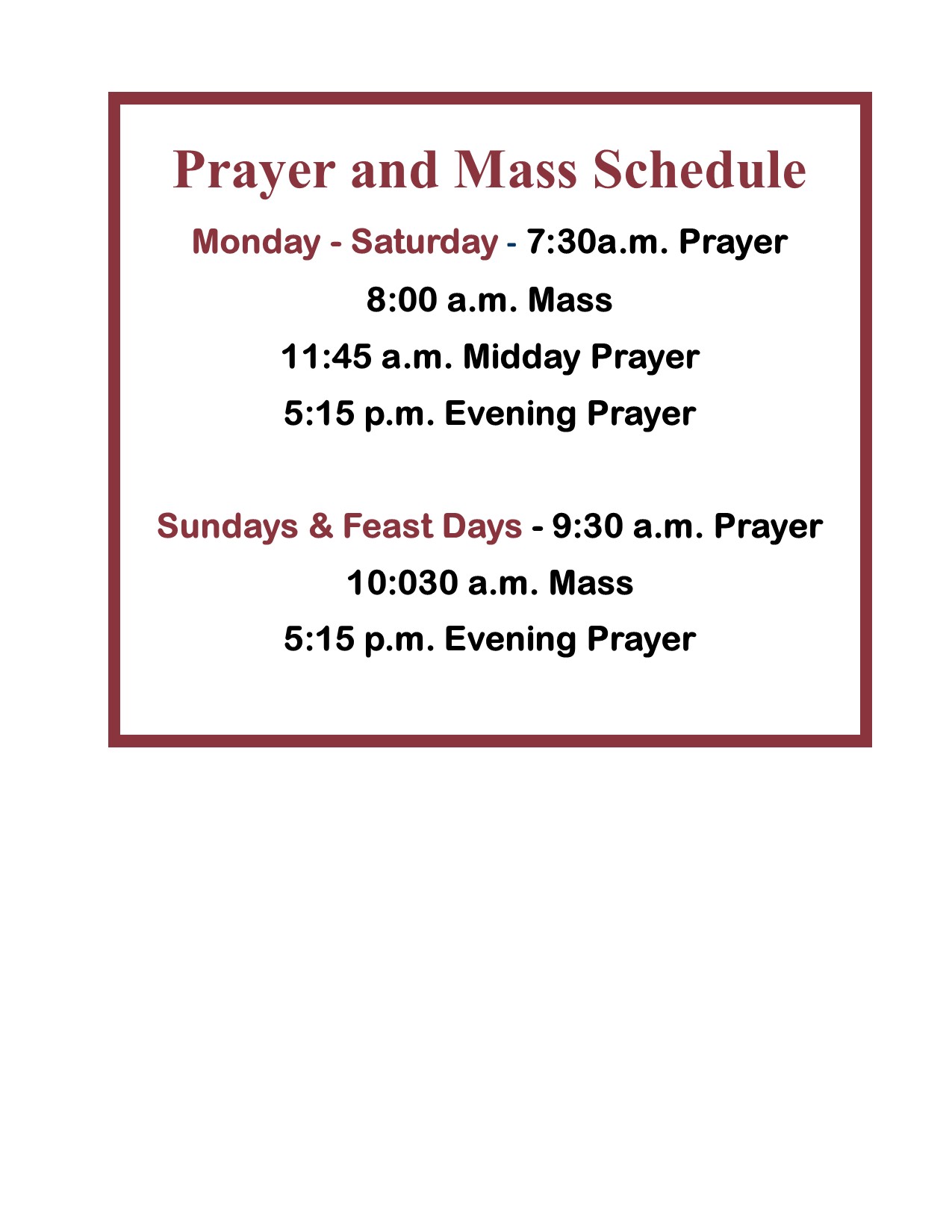
 Mass Schedule

Related Links

Copyright © 2026 · Benedictine Sisters of FL · Touching Lives Through Prayer and Service

Copyright © 2026 · Bendedictine Theme on Genesis Framework · WordPress · Log in