• Skip to primary navigation
  • Skip to main content
  • Skip to footer
Benedictine Sisters of FL

Holy Name Monastery
Founded 1889

Donate Now
  • Home
  • About Us
    • History
    • Being Benedictine
    • Benedictine Monasticism
    • Meet Our Community
    • Holy Name Academy-Alumnae
  • What We Do
    • Mission, Vision and Our Partners
    • Retreats
      • Invitation to Retreat
      • Accommodations
    • Volunteer Programs
    • Oblate Program
    • Spiritual Direction
    • Aqua/Hydroponics
    • More of Our Ministries
  • What’s Happening
    • Articles of Interest
    • Events
    • Newsletters
    • Brochures
    • Links
  • Support Us
    • Gifts of Support
    • Wish List
  • Stories Shared
  • Galleries
    • Photos
    • Videos
      • Benedictine Sisters of FL Videos
      • Other Videos
  • Contact Us

Homily

Is Your Badge a Badge of Busyness?

July 23, 2018 by Holy Name Monastery Leave a Comment

It seems to me we would be hard put to find a more appropriate Gospel to lead into our annual retreat at Holy Name.  Jesus invites us: “Come away by yourself to a deserted place and rest awhile.”

We would think it bizarre for a traveler not to be prepared for a journey.  We would feel pity for the poor traveler who never read his/her itinerary.  Which of these hundreds of aircraft is my flight?  Usually we have a destination in mind when we set out.  It is rare that the journey is the destination.  But it is a great feeling to just relax and enjoy the drive without wondering “are we there yet?”

This week Jesus invites us, “come away to a deserted place all by yourselves and rest a while.”  There are four different parts to that statement – each one means something on its own:  Come away.  To a deserted place.  All by yourselves.  And rest a while.

Some people (surely not any of us) wear a badge of busyness as if it were a badge of honor.  “How are things going?”  “Well, it’s been pretty crazy, I’ve been busy all day.  Not enough time for everything.”  The implicit message being: “I’m worthwhile because I’m busy.”  But, you and I know it’s not a badge of honor – it a sign of an imbalanced life … Remember the little saying: “all work and no play makes Jill a dull person.”  There’s a better one: “Never get so busy making a living that you forget to make a life.”

Let’s pick apart Jesus’ invitation.  Come away, he says. It’s not just “going away,” but it’s “coming away” with Jesus, the one whose yoke is easy, whose burden is light; the embodiment of refreshment.  Come away from the daily grind whatever that may be.

To a deserted place.  Our retreat director, Abbot Primate Gregory Polan has written: “It is my conviction that monasteries are among the most important places to our world today …  what we offer is a warm welcome, whoever you are and whatever your story in life tells; we say, ‘come and be with us and find healing in the Word of God that we offer you’.”  During our days of retreat we have the opportunity to recharge our spiritual batteries – to get out of the busyness trenches – to keep company with God.

From the street our grounds are an oasis for world-weary guests.  But the seeds we plant must be sown more deeply than the grass.  How good would a farm be if the owners only painted the silos and mended the fences?  If the farmer never sowed seeds: no veggies, no fruit, no dinner.  Retreat is a time to steep ourselves in Scripture and the words of the retreat director, to have a head-conversation with an author you’ve been anxious to meet or take time to get better acquainted with a confrere.

In case you missed it, the invitation Jesus extends to us for this time of retreat is to be “All by yourselves.”  Jesus really means it.  Thus especially during retreat we foster an environment of quietness and prayer, alone and together in chapel, so that each of us can delve into spiritual practices that “tightened the bonds that bind us ever closer to God and each other.”

And finally, Jesus says: Rest a while.  This isn’t laziness.  It’s not a perpetual state.  It’s temporary.  It’s for a while.  But, for that while, it’s about rest.  We cannot just minister to others day by day, month by month.  We won’t be able to take care of others if we don’t make time to cater to ourselves and our own needs.  We need to embrace the spiritual practice of rest.  And, while some may think you’re a little crazy…you’ll be crazy in all the right ways.

So, how will you prepare for your journey into our annual retreat?

First, forget technology exists – except maybe for some soft, calming music.  Use the down-time in the retreat schedule to explore your feelings and get to the core of changes you need to make.  Seize the opportunity to enjoy nature, try new exercises physical and spiritual, time to just BE.

The retreat time gives you the excuse to try something different, to step out of your comfort zone and experience something new – to read about, pray about new things, new ways of living, and give yourself options for how you may want to make changes when you get back to “the real world” of everyday.  In other words, a retreat can lift you out of a rut and be restorative for body and soul.

During these graced days of retreat let us pray for each other – and for all who will benefit from our “time apart by ourselves.”


~Reflection by Sister Roberta Bailey, OSB, Prioress
First Reading  Jeremiah 23:1-6           Second Reading  Ephesians 2:13-18
Gospel Mark 6:30-34
Continue Reading

Filed Under: Blog, Front Page, Homily Tagged With: Come Away, Gospel, holy name, Jesus, pray, rest a while, Retreat

Stay the Course

July 16, 2018 by Holy Name Monastery Leave a Comment

Luke and Matthew relate the same story heard in this gospel from Mark.  With Luke, you realize, it was hearsay …  he was not there to give an eye-witness account.  It’s interesting to see the minor, but specific differences in the three accounts.  For example, where Mark says, “take no money,” Matthew specifies, “take no silver, gold or copper coins.”  He was covering all the bases, not just the currency in current use.  He notes other details that let you know he was there and must have been a high sensate on the Myers-Briggs scale.  He begins the story with Jesus reminding the disciple-missionaries: “You received without paying, so now give without being paid.”  Where Mark says, “whatever house you enter,” Matthew is more aggressive: “Look for someone to welcome you.”  And, if when you wish them peace and it is not returned, “take back your greeting.”  Both Luke and Matthew, in the list of what not to take on their journey, quote Jesus saying: “take no beggar’s bag.”  They were to live dependent on the hospitality of the community, just as Jesus depended on others to provide for his needs.  Remember what he told one of his potential followers – “Foxes have dens and birds have nests, but the Son of Man has no place to lay his head.”  Jesus expected his disciples to “eat what is served, be satisfied with the bedding provided, follow their schedule, and don’t try to go it alone.”  Remind you of Benedict’s norms?

But, that’s enough about what NOT to take on your life’s journey.  Let’s look at what Jesus says is appropriate for our journey in order to carry on the mission of Jesus.

The first thing Jesus recommends that we travel two by two – life is not a solo venture.  He is reminding us not to try to go it alone.  We need a good support system as we experience life’s ups and downs.  Sharing the good times is as important as it is to share the not so great times.  Benedict recommends the same when, in the first chapter of the Rule, he describes the kinds of monks:  “First, there are the cenobites, those who belong to a (community) a monastery.”  Jesus sent the twelve in pairs not only for safety but for companionship, encouragement and help.

Remember that God is always with us, so we are never really alone.  But Jesus acknowledges that just as he is a member of the trinity, so we humans, social creatures made in God’s likeness draw life from companionship.

Jesus recommends sandals for our feet and a tunic, but not a second one.  Jesus asks us not to carry so much.  Take off that extra tunic – the worries that we carry can bring us down.  Stuffing them in our gunny sacks does nothing to change the situation – just adds wrinkles to our brow and sours our spirit.  Do what Jesus says: “shake the dust off your feet” and don’t look back and wonder what might have been, or might you have done.

Jesus asks us to carry and use a walking stick, so we can keep moving when we encounter ruts and pebbles in the road or to hold us up when we became worn out, tired and weary.  Maybe we even wander off the edge of the road until we hear the sound from the rumble strips.  A good walking stick helps us stay upright and get past mistakes which could hinder our spiritual growth and practice of conversio.  And, beyond that, it’s a fact that in order to do what we say in our Corporate Commitment (that is) “to meet the hungers of the people of God with the compassion of Christ” we must first be compassionate with ourselves.

Today Jesus sends us out again, with authority over unclean spirits … over the rancor, the violence, the rudeness, the degrading language and actions, the insensitivity …  the list can go on and on …  we can conquer the darkness with a refusal to lower our behavior, language and standards.  We can “shake that dust from our feet” and support actions on behalf of justice and peace because we are traveling “two by two,” with the sturdy walking stick of community and prayer, and wearing the sandals of our vows.  Like the disciples, we heed Jesus’ admonition to stay put in the house where they took us in, we can anoint others with inclusivity and peace.  Pray God we stay the course…

~Reflection by Sister Roberta Bailey, OSB, Prioress
First Reading    Amos 7:12-15                      Second Reading  Ephesians 1:3-14 
Gospel Mark 6:7-13
Continue Reading

Filed Under: Blog, Front Page, Homily Tagged With: Benedict, gosel from Mark, Jesus, life's journey, Luke, Matthew, pray

Are You Who You Say You Are?

July 10, 2018 by Holy Name Monastery Leave a Comment

This Gospel tells us that Jesus is hampered from performing miracles in Nazareth because of the people’s lack of faith.  We see a very human side of Jesus.  He seems to be taken by surprise.  His family seems to be sending the message every child dreads to hear, especially from mom or dad: “Stop embarrassing us.  Act your age.”

Can you recall a time when a parent, teacher, novice mistress or maybe a friend seemed surprised by your words or an action that showed a level of maturity beyond their expectations?  In family life, and hopefully in our community, we rightfully expect a safe place to discover who we are and who God is calling us to be.

Does a time come to mind when you were surprised by someone you thought you knew saying something really wise, insightful or maybe just plain “off the wall” but so smart?  Why were you surprised?  Or was it not surprise, but impressive and pleasant to see a different aspect of that person.  It happens in my role frequently – A Sisters’ sharing gives me a peak into her depth of lectio, her expression of a deep spirituality puts me to shame or at the very least reminds me what a treasure we have in community.

Now it is interesting to note, that where the evangelist uses the word “offense” the Greek origin is “stumbling block.”  And that it seems to me is closer to what is happening here.  Jesus’ audience were scratching their heads and tripping over themselves trying to understand how this young whippersnapper from Nazareth could be so wise.  Up to this point, like most good Jews, he had kept a low profile.  Jesus’ family and friends were scared for him.   There was an emotional stumbling block interfering with them openly being a Jesus follower.

What stumbling block sometimes prevents you from speaking up in defense of Jesus, of our faith or our Benedictine values?

I was drawn back to the first reading from Ezekiel.  I wanted to say to Jesus when he seemed stymied by the crowd’s reaction to his teaching – Remember what Ezekiel said: The spirit entered into me and set me on my feet, and I heard the one who was speaking say to me: Son of man, I am sending you to the Israelites…  whether they resist or rebel or are obstinate of heart, it is you I am sending.  Say to them, whether you heed or resist, it is I whom God has sent – I am a prophet among you.”

The crowds used all the time-honored dismissive ways …  we know them, we have been targets – or sadly we may have employed them: belittling remarks, the covert laugh, the rolled eyes, the turning away of attention, or making light of the other’s knowledge – the attitude that says: who does she think she is?

Ultimately, what didn’t happen in Nazareth: no healings, no mighty deeds, is not much of a surprise.  After all a miracle is not just an event but it is an interpreted event.  If Jesus is not reputed to be capable of healing, any healing that does take place won’t be attributed to him.  So the crowd’s attitude is “there’s nothing here to see.  Let’s just move along, move along… and find some other excitement.”

Such is true with us, with our community.  Our guests don’t experience peace and harmony, generosity of spirit and light-heartedness, beauty in nature and liturgy if they don’t find it in each of us.  They come expecting a miracle – the miracle happens in our interactions – first with each other, then between us and our guests.

Remember Jesus question to this disciples: Who do people say I am?  And, you: who do you say I am?”  Who do you say these Benedictine Sisters of Florida are?

If I remembered well the music, I’d sing to you the tune from the rock opera popular in the 1970’s –

“Jesus Christ, Superstar – Do you think you’re what they say you are?”

Benedictine Sisters of Florida, do you think you’re what they say you are?

Are you really who you say you are?

Are you really who they say you are?

~Reflection by Sister Roberta Bailey, OSB, Prioress
First Reading  Ezekiel 2:2-5                Second Reading  2 Corinthians 12:7-10
Gospel Mark 6:1-6
Continue Reading

Filed Under: Blog, Front Page, Homily Tagged With: Ezekiel, Faith, God, Jesus, Miracle, Nazareth, stumbling block

Ever brought to your knees?

July 2, 2018 by Holy Name Monastery Leave a Comment

This Gospel reports two stories of healing.  One story tells us about a father’s great love for his dying daughter.  The other story, the one I have chosen to focus on, tells us about a desperate woman who risks much in a courageous act of faith to seek healing from Jesus.  This woman has lost everything to find a cure to a condition that has separated her from the community.  We women can commiserate with her.  We may have memories of “those days” or know someone who understood why some referred to a woman’s “gift of God” as “the curse of Eve.”

This woman’s is a true story, not one of Jesus parables.  This woman had suffered from bleeding for 12 long years.  Whether this hemorrhaging was constant or irregular, it caused the woman much suffering, and with the loss of blood much weakness as well.  She also suffered a great deal at the hands of the many doctors she consulted for a cure.  Not only didn’t she get better, she actually got worse.  In addition, she didn’t have good health insurance so now she was broke and wasn’t eligible for food stamps.

We need to realize, too, that this woman would have been quite isolated:  lonely, shunned and shamefully treated because she was considered ceremonially unclean under the Law of Moses.  She could never perform the rituals that would have reconnected her with society.

What a suffering!  Broke.  Required to live as unclean, in isolation and shame.  She had very little hope for a better future.

I have to tell you, earlier in the week I had gotten this far in putting thoughts on paper when God literally dropped a reflection on this Scriptural episode into my lap …  the book I’m reading here in chapel by Basil Pennington, fell open to a chapter entitled “Who Touched Me.”   Here is an adapted summary of Pennington’s reflection.

Jesus was setting out for the house of Jariaus where he had promised to see the desperate man’s daughter.  He and his apostles are being knocked about from every side.  Suddenly Jesus stops and asks: “Who touched me?”

Peter in his usual obtuse way responds: How can you ask, who touched me?  Everyone is touching us.  Everybody is pushing us about.

 On our part (says Pennington) The increase of media and people contact – the over-scheduled day, the relentless demands on our time – almost necessarily means a decrease in spiritual contact, unless all our contact is grounded in contemplation and the operation of the gifts of the Spirit that are set free to work in our lives by contemplative prayer.

 We do not need to go out and about to find meaning.  It is all here within.  And when we go out, we find the same Reality.  Whether within or without, it fills us with presence, joy, and completeness.  Grounded in prayer, we can truly touch the lives of others and be touched by them. (Basil Pennington)

So, it seems to me, the final fact in the woman’s story – remember it’s a true story – is Jesus’ affirmation of her faith and daring.  Jesus knew she had touched him and his power had healed her.  The woman knew what had happened.  The power of the miracle dropped her to her knees.  The response of Jesus is so encouraging.  He calls her “daughter” affirming that she is very precious to him.  He reminds her: your faith has healed you.”  Many others that day touched Jesus, jostled him, shoved him but only this one woman touched Jesus with faith.  Finally Jesus tells her: Go in peace and be freed from your suffering.”

What incident in your life brought you to your knees knowing that you were healed … and more than that, assured that you are loved?

~Reflection by Sister Roberta Bailey, OSB, Prioress
First Reading  Wisdom 1:13-15; 2:23-24     Second Reading 2 Corinthians 8:7,9,13-15
Gospel Mark 5:21-43 ( shorter form, Mark 5:21-24,35b-43)


Continue Reading

Filed Under: Blog, Front Page, Homily Tagged With: apostles, Faith, Hemorrhagic Woman, Jesus, suffering

Who is Family?

June 11, 2018 by Holy Name Monastery Leave a Comment

A crowd so large has gathered that Jesus and his disciples are not even able to eat their bread.  His family comes to take him away because they think he is beside himself.  This gives Jesus the opportunity to point out that family for him is not based on results from a search on Ancestry.com.

Have you ever accused someone of being out of their mind?  Probably…. but then you might remind yourself, you can’t judge a book by its cover.   And, remember the ancient American Indian proverb: “Before you judge another person, walk a mile in that person’s moccasins.”  If you lived in that person’s head, if you had the identical life-experiences you’d really have no other choice than to do exactly what she did.  It’s advisable to refrain from statements that begin: she “coulda, woulda, shoulda….”  And, obey the maxim “thou shalt not should upon thyself.”  Crazy is how some people viewed Jesus during his early ministry.

The evangelists tell us that some people were quite alarmed by Jesus’ behavior.  His family was certainly alarmed.  Mark reports that when his family and friends heard about his preaching and behavior they went out to seize him: for they said, “He is insane.”

We might take a benevolent interpretation of their action and suggest that the family was taking an intervention action out of loving concern and support for him.  They wanted to make sure he was eating right, getting enough sleep and not working too hard.  But, it seems unlikely that was the honest motivation for the intervention.

In his youth, most of the time his family probably thought of Jesus as a normal boy.  His cousins and friends accepted him as one of the neighborhood kids, just one of them.

I suspect he might have tried to keep their nonsense under control and lead them down the right path.  So, they were not overly surprised when he began street preaching, but now he had gone overboard.  He was so often in the public eye, things were getting a little out of control and they urged him to quit.

In the instance reported in his Gospel reading, several of them came as a group ready to distract and get him away from the crowds.  But, their attempt at an intervention wasn’t working.  They tried sending him a message that his family was waiting to talk to him.  He left them standing on the outside.  He seemed to dummy up; he threw the messengers a zinger with the question:  “Who are my mother and my brothers?”

His family is frustrated with him, or just plain worried about him.  They hear that Jesus is drawing crowds again, and they go to rescue him — because people are talking about “our boy.”  Some of the people think he’s loony.   His family is embarrassed and worried of what might become of him.  But, Jesus doesn’t seem to mind at all.  After all, he knows how badly it’s all going to turn out.

He tells the crowd, and us, mine is an extended family – everyone is welcome.  I embrace anyone and everyone.  These people may look like a group of misfits, but they’re family.

So, I wonder: who might be at our door, looking to get in, to speak to us?   Be a part of our family, preserve our reputation and tell the world what a great place we have here and what a pleasant group of people we are?

Our oblates come immediately to mind.  You probably realize this, there are more Benedictine Oblates in the U.S. than the combined number of professed Benedictine men and women living in communities.  Worldwide there are currently 25,000 oblates compared to 21,000 Benedictine monks and sisters.

You see it here on Oblate Sunday.  We could have upwards of 30 Oblates gather for the day.  That’s almost 3 times the size of our community.  In the interim between meetings, they are reaching out into the greater community, telling our story, often better than we do.  They are immersed in “the world,” living out the values and mission of our community.  It’s true that they come to us to get refueled, to learn more about the Benedictine charism, but it’s equally true, as Joan Chittister says in the recent issue of BENEDICTINES, “Oblates are the hope in this century that the life and values of the Benedictine vision can be born … again and anewed.”

So, when we hear the summons, “Your family is outside asking for you,” how shall we respond, what shall we do?

~Reflection by Sister Roberta Bailey, OSB, Prioress
First Reading Genesis 3:9–15   Second Reading  2 Corinthians 4:13—5:1
Gospel Mark 3:20–35
Continue Reading

Filed Under: Blog, Front Page, Homily Tagged With: Benedictines, family, Gospel, Jesus, Oblates

SOLEMNITY of the TRINITY

May 29, 2018 by Holy Name Monastery 1 Comment

May 27, 2018

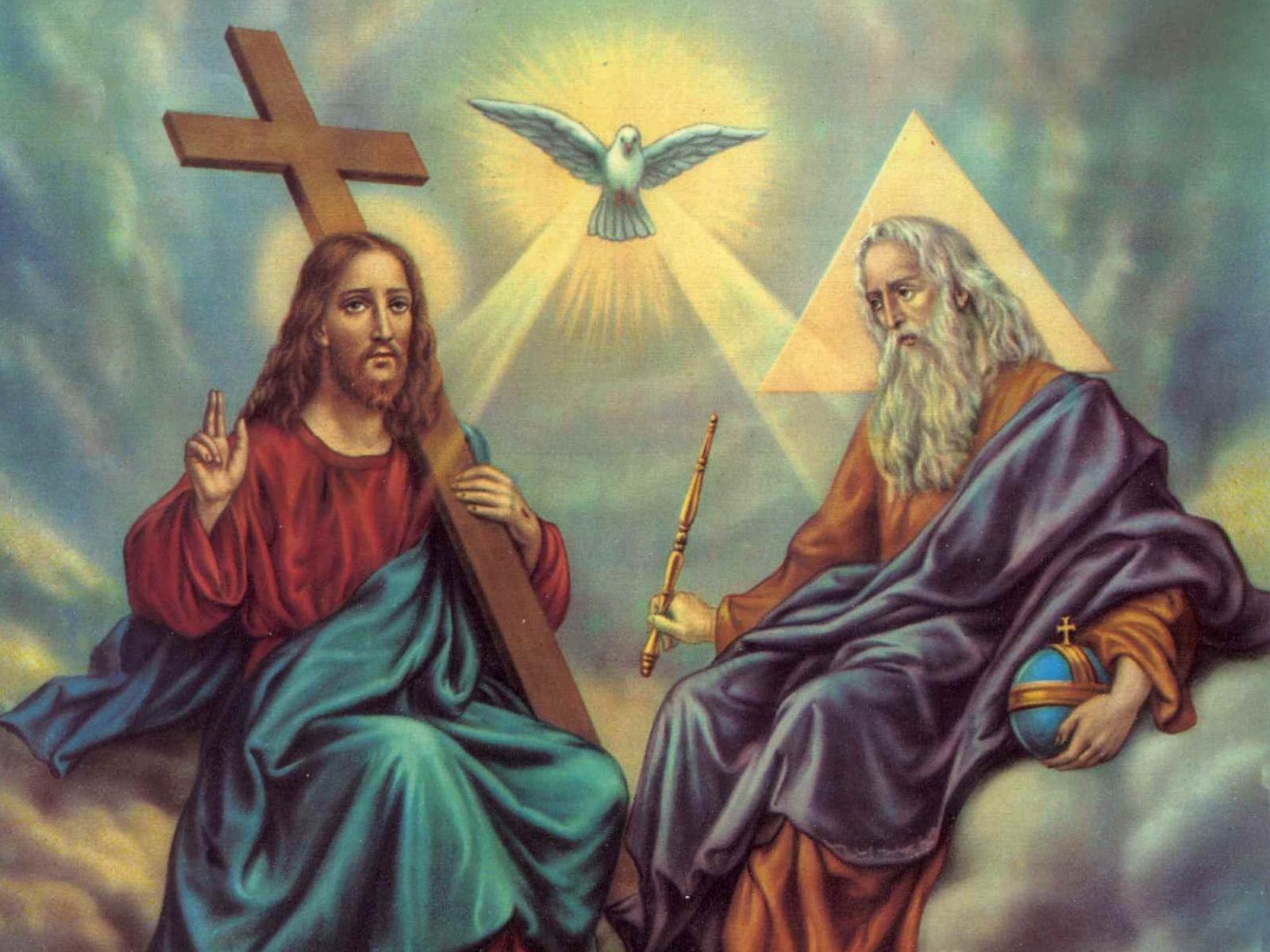
You may have heard the expression, when referring to age: 70 is the new 50.  Well, in Scripture seven is considered to be a sacred, perfect number.  But today’s feast, the solemnity of the Trinity, tempts me to say “3 is the new 7.”

Some say that “Two’s company; three’s a crowd” but today’s feast would have it otherwise.  In this instance, the figure three symbolizes completeness and perfect symmetry.  The Holy Trinity is a mystery beyond the grasp of human reasoning.  It reminds us of some key moments of the Christ story.  For example, when Jesus stood before John in the River Jordan, the Spirit hovered and the Father’s voice was heard: “This is my beloved Son.”

Recall the Christmas nativity scene.  There were three figures: the Holy Family – Mary, the mother, Joseph, the guardian, the stand-in father, and the infant Jesus.  And, according to tradition, who tracked them down through the desert and into Egypt – the three wise men.  33 or so years later, when Jesus was preparing for his public life he went back to a desert.  And, there he was tempted three times by the devil.

All of us like a good story.  And, Jesus was a story-teller par excellence.   He learned early on at his mother’s knee, or watching her bake bread for the day, or from his favorite bedtime stories that every good story has a beginning, a middle and an end.

We see this in Jesus parables.  The story of the Prodigal Son is about a father and his two sons.  How many passersby were in the story of the Good Samaritan?  A priest, a Levite and the Samaritan.  And, what about the farmer who went out to sow his seed?  Jesus talks about three different types of terrain yielding three different levels of harvest.

At the end of Jesus’ life, like at the beginning, we see the three motif.  During his Passion, Peter denied him thrice.  On the road to Calvary, he fell three times.  In the Crucifixion scene, you’ll recall we see three figures, Christ between two thieves.  At the foot of the cross stood Mary, his mother, and two other Mary’s.  Before his resurrection, he spent three days in the tomb.

Scripture does not explicitly teach the doctrine of the Holy Trinity; it is rather assumed especially through the story of Jesus’ baptism.  The early Christians struggled to explain their understanding that Jesus was God on earth as a human being.  “Trinity” or ‘tri-unity’ was the term that developed in an attempt to explain the relationship between God, Jesus Christ and the Holy Spirit.  The Apostles Creed predates the Nicene Creed which was decreed in AD 325, to formalize the teaching about the Trinity.  Either Creed is approved by the Church to be recited during the Eucharistic liturgy.  “We believe in one God.  We believe in one Lord, Jesus Christ, the only Son of God.  We believe in the Holy Spirit, the given of life.”

This inner relationship of the Father, Son and Holy Spirit is such that each of them is fully and equally God, yet there are not three Gods but one God.  This is incomprehensible to the human mind.  It is a mystery.  Together the three Persons in the Trinity, the Father the Son and the Holy Spirit represent the fullness of love.  The Father loves the Son, the Son loves the Father.  The Holy Spirit is their love for each other.

But love is only a word until someone gives it meaning.  We are made in the image of a triune God – God the Father, who created us, his Son who saved us, and the Holy Spirit who continues to guide us.  To be true to our calling we must be the ones who give meaning to Love in our world.  As Paul says in the second reading to the Romans: We did not receive the spirit of slavery, but of adoption …  we are heirs of God with Christ and destined to be glorified with him.”

A “Trinitarian- like movement” in our prayer life echoes the rhythm of our whole lives.  In Lectio we go up the mountain with Jesus, we have conversation with Him there, and we return to life among his people.  In our community prayer, (again a three-fold movement) we bow, we sit, we stand.  In our chants, we don’t always have to harmonize but we do strive to keep our voices in harmony with each other – one heart, one voice.

In tomorrow’s Responsorial Psalm we will sing: “Blessed the people (that’s us) the people the Lord has chosen to be His own!”  Our lives, individually and as a community, reflect the Trinity.  We are called to be creative like the Father, compassionate like God the Son, and, like the Holy Spirit to use our gifts and talents in service to others.

For “There are three things that last: faith, hope and love.  And the greatest of these is Love!”

~Reflection by Sister Roberta Bailey, OSB, Prioress
Continue Reading

Filed Under: Blog, Front Page, Homily Tagged With: Father, God, Holy Spirit, Jesus, Joseph, Mary, Son, Trinity

  • « Go to Previous Page
  • Page 1
  • Interim pages omitted …
  • Page 74
  • Page 75
  • Page 76
  • Page 77
  • Page 78
  • Interim pages omitted …
  • Page 92
  • Go to Next Page »

Footer

Prayer / Newsletter / Info

 Contact Info

Benedictine Sisters of Florida

PO Box 2450
12138 Wichers Road
St. Leo, FL 33574-2450
(352) 588-8320
(352) 588-8443

 Mass Schedule

Related Links

Copyright © 2026 · Benedictine Sisters of FL · Touching Lives Through Prayer and Service

Copyright © 2026 · Bendedictine Theme on Genesis Framework · WordPress · Log in