• Skip to primary navigation
  • Skip to main content
  • Skip to footer
Benedictine Sisters of FL

Holy Name Monastery
Founded 1889

Donate Now
  • Home
  • About Us
    • History
    • Being Benedictine
    • Benedictine Monasticism
    • Meet Our Community
    • Holy Name Academy-Alumnae
  • What We Do
    • Mission, Vision and Our Partners
    • Retreats
      • Invitation to Retreat
      • Accommodations
    • Volunteer Programs
    • Oblate Program
    • Spiritual Direction
    • Aqua/Hydroponics
    • More of Our Ministries
  • What’s Happening
    • Articles of Interest
    • Events
    • Newsletters
    • Brochures
    • Links
  • Support Us
    • Gifts of Support
    • Wish List
  • Stories Shared
  • Galleries
    • Photos
    • Videos
      • Benedictine Sisters of FL Videos
      • Other Videos
  • Contact Us

Homily

Christian Unity

January 22, 2020 by holyname Leave a Comment

The three readings we have this week are, I believe, an example of a woven piece of God’s mysterious message-giving.  It creates a colorful piece with threads that weave the way from Isaiah, through the Letter to the Corinthians, into the Gospel of John, laced with verses from the Responsorial Psalm 40.

From Isaiah we hear: “I will make you a light to the nations, that my salvation may reach the ends of the earth.”  Then Paul tells us who the “you” is: “You who are called to be holy with all who call upon the name of Jesus.”  Now slip in a line from Psalm 40: “Sacrifice or offerings you wish not, but ears open to obedience you gave me.”  This leads us right into the Gospel and a declaration of obedience to listening.  John the Baptist speaks: “I did not know him (that is, when Jesus came to the River Jordan for baptism). I saw the Spirit and the one who sent me to baptize with water told me, ‘On whomever you see the Spirit come down and remain, he is the one’…”  Then slide back to Psalm 40 “To do your will, O my God, (to be obedient) is my delight.”  Obedience is the psalmist’s delight – John’s, Jesus’ and ours.

Today is the opening of the Week of prayer for Christian unity.  The theme is captured by the presence of the two groups at the Jordan, John’s and Jesus’ followers coming together in combination with the presence of our Triune God = the voice of the Father, Jesus in the Jordan, and the hovering Spirit in the form of a dove.

A question: How did John (the evangelist) come to know so many intimate details about John the Baptist’s encounter with Jesus at the Jordan?  It is generally assumed that James and his younger brother John were among the followers of the Baptist.   It is likely this is how they, along with Peter and Andrew, first met Jesus.  John was the only one of Christ’s original disciples who lived into old age and the only one who was not martyred for his faith.  He can tell the story of Jesus from an old man’s perspective laced with the wisdom and vision that is a gift of the elderly…. pondering the essentials, sifting out the riff raft of gossip, suppositions and guess work [or, spicing up the stories with borrowed memories and supposed tidbits].

As we in community (and in our families) know so well, stories are a gift given by older members to newer members – the elders are the torch bearers; the younger the keepers of the torch who coax the sparks to keep the flame burning.  Our future will be enriched by those who keenly listen and preserve the traditional word-of-mouth stories.  This is what enriches our present by helping us better understand the past and the people who gave shape to our present.  Stories of the “good old days” may get “old” but consider what we’d miss if John and the other evangelists had kept secret their experiences with Jesus.

As I said earlier: today we begin the Week of Prayer for Christian Unity with the 2020 theme: “They showed us unusual kindness.” This week has a 100-year history in which Christians around the world pray for the fulfillment of Jesus’ prayer at the Last Supper “that they all may be one.”   It seems appropriate, too, that we have Teams of Our Lady sharing our space today.  Our Lady graciously shared her Son with everyone without distinction.

In today’s world, much like the days of early Christianity, people are facing crises of migration, prejudice, violence and indifference. How can we show “unusual kindness” that is a witness to God’s loving providence for all people? When we invite people to “come and see” they are looking for more than a tour of our parish and monastery buildings and a list of the volunteer ministries. Our spirit of hospitality will have a ripple effect that makes visible Jesus love in today’s world.

Reflection by Sister Roberta Bailey, OSB, Prioress

Isaiah 49: 3, 5-6          1 Corinthians 1: 1-3          John 1:29-34

Continue Reading

Filed Under: Blog, Front Page, Homily

Why Baptism …

January 16, 2020 by holyname Leave a Comment

Traditionally, this feast of the Baptism of Jesus presents us with the 3rd epiphany or manifestation of our Lord: His birth, the adoration by the Magi and now the baptism by John in the River Jordan – (which today is so polluted John would have second thoughts about stepping in). But, next Sunday we will see a 4th manifestation at the Wedding in Cana when water is changed into wine.    In these latter two moments Jesus passed from relative obscurity in the village in Nazareth onto the public stage of his mission of proclaiming the God’s Kingdom.  It was, so to speak, His coming out party – that led eventually to his crucifixion and death.

This is an event that made it into all four Gospels – every author of every gospel found this event so inspiring and important that it was included. It’s an unusual story because there doesn’t seem to be any reason for Jesus to be baptized. For three and a half years, he did His thing and it ended with crucifixion. His baptism was the inauguration of that process.  It was an act of humility to submit to John’s baptism in the presence the people.   It was a commitment to His Father’s plan.  And this event was a baptism of identification: Jesus affirmed his Cousin John’s ministry and identified Himself with the people He’d come to save.

Our baptism is also about humility, commitment, identification and obedience: that’s really what it is all about.   When people witness a baptism their expectation level goes way up.  The same is true when they witness a profession of religious vows or an ordination of a deacon or to the priesthood.  People expect the one making the commitment to walk the talk.  Just like Jesus who was baptized to identify with us, we’re committed to identify with Him.

An understanding of baptism is really important to us as Christians, as Catholic Christians. It is doubly important to us as religious to comprehend the dimensions of this commitment because our pledge in vows is an extension of our baptismal promises – whether spoken by or for us.  The former understanding of the theology of the vows referred to religious profession as a “second baptism” and thus a new name was imposed.  The final vow profession ceremony had the newly professed rising from under the funeral pall symbolically to a new life – the new life originally conferred on us in baptism.  With a clearer understanding of baptism and the theology of the vows all that has changed.

Do you remember what happened when Jesus came out of the water?  “The heavens were opened and He saw the Spirit of God descending like a dove coming down on Him.  And there came a voice from heaven: ‘This is my beloved Son in whom I take great delight’.”   Humble obedience and commitment and identification with God always lead to His affirmation – usually not as dramatically as with Jesus – but it happens, always!

Simply put: Baptism is not just about where you find Jesus.  What is important is what you do once you’ve found Him. It opens up to us the possibility of finding God.  But it does not guarantee it.   It makes it a possibility, not a promise.   At best, (just like our vows) it’s a means, not the end.  It’s not where we find Jesus, it’s what we do after we’ve found Him.

Have you heard the story about the poor wandering soul who stumbled upon a baptismal service one Sunday afternoon.  This was a “down by the river” sort of baptism.  It was down south, back in the day, and this guy walked right down into the water and stood next to the Preacher. The minister finally noticed the older gent and asked, “Are you ready to find Jesus?”  “Yes, Preacher. I sure am.” The minister then dunked the fellow under the water and pulled him right back up.

“Have you found Jesus?” “No, I haven’t!” The preacher then dunked him under for a bit longer, brought him up and said, “Now, brother, have you found Jesus?” “No, I haven’t, Preacher.” The preacher in disgust held the man under for at least 30 seconds this time, brought him out of the water and said in a harsh tone, “Friend, are you sure you haven’t found Jesus yet?” The old man wiped his eyes gasping for breath and said to the preacher, “Naw, preacher, are you sure this is where he fell in?”


Continue Reading

Filed Under: Blog, Front Page, Homily

“SAYING YES”

December 23, 2019 by holyname Leave a Comment

At the beginning of the first century, women were considered second-class citizens.  Their sworn testimony was inadmissible in court; they were considered the property of their spouses with no legal claim to property of their own.  So the only “property” a woman could call her own was her reputation.  At a precise moment in history, God entered the life of one member of the chosen people, a woman by the name of Mary, and asked her to sacrifice that one thing – her reputation – and become the mother of Jesus.  Surprisingly and at the initial consternation of her fiancé, Mary said yes to God and became the “God bearer,” the first and greatest title she continues to bear as a member of the human race.

God’s voracious enthusiasm and lavish gift-giving erupts in the person of Mary’s son, Jesus.  He called it “the kingdom.”  …  The kingdom was manifest, and, to this very day, we are on the way to experiencing the fulfillment of God’s long-range plan.”                                       By Albert Haase, O.F.M.


If we are alert, we witness or hear most every day stories of the spread of God’s kingdom.   It happens at Daystar. It happens when the Dade City police pay off lay-away charges so children get their Christmas gifts.  It happens when you discover that your tab in a restaurant has been paid or the person in the checkout lane at a grocery store tells the clerk, “put her items on my ticket.” It happens when you find a ride you were hoping for but reluctant to ask.  It happens when the mess you made is cleaned up before you can grab a rag.  It happens when your name is erased and someone else’s appears on the dish washing list.  It happens when you are able to surprise someone.  Like in this story I’ll tell you now … let it touch your heart and inspire you to “pay it forward.”

Paul received an automobile from his brother as a Christmas present. On Christmas Eve when Paul came out of his office, a street urchin was walking around the shiny new car, admiring it. “Is this your car, Mister?” he asked.

Paul nodded. “My brother gave it to me for Christmas.” The boy was astounded. “You mean your brother gave it to you and it didn’t cost you nothing? Boy, I wish…” He hesitated. Of course Paul knew what he was going to wish for. He was going to wish he had a brother like that. But what the lad said jarred Paul all the way down to his heels.

“I wish,” the boy went on, “that I could be a brother like that.” Paul looked at the boy in astonishment, then impulsively he added, “Would you like to take a ride in my automobile?” “Oh yes, I’d love that.”

After a short ride, the boy turned and with his eyes aglow, said, “Mister, would you mind driving in front of my house?” Paul smiled a little. He thought he knew what the lad wanted. He wanted to show his neighbors that he could ride home in a big automobile. But Paul was wrong again.

“Will you stop where those two steps are?” 
the boy asked. He ran up the steps. Then in a little while Paul heard him coming back, but he was not coming fast. He was carrying his little crippled brother. He sat him down on the bottom step, then sort of squeezed up against him and pointed to the car. “There she is, Buddy, just like I told you upstairs. His brother gave it to him for Christmas and it didn’t cost him a cent. And some day I’m gonna give you one just like it…then you can see for yourself all the pretty things in the Christmas windows that I’ve been trying to tell you about.”

Paul got out and lifted the lad to the front seat of his car. The shining-eyed older brother climbed in beside him and the three of them began a memorable holiday ride.


Reflection of 4th Sunday of Advent 2019

Sister Roberta Bailey, OSB, Prioress

Benedictine Sisters of Florida

Continue Reading

Filed Under: Blog, Front Page, Homily

Living in Joy

December 16, 2019 by Holy Name Monastery Leave a Comment

This third Sunday of Advent is familiarly known as Gaudete Sunday – a Latin word that means “rejoice” – the first word of the Entrance Antiphon (at Mass): “Rejoice in the Lord always; again I say, rejoice.  Indeed, the Lord is near.”  As you know, we mark Gaudete Sunday by lighting a pink candle (in the Advent wreath) and the celebrant at Mass wears rose colored vestments.  I wonder why “rose”?  Yes, it’s a “happy” color but I wonder if it might be because when you dilute the ‘blue-ness” with the red that makes purple, the red shades are left lightly tinged with blue which creates more of a rose color.  The church rejoices because we are halfway to Christmas.  The Promised One is nearer at hand.  And, we are called to live as people of joy.

But in everyday life I get the impression that “joy” is on the decline.  Often what is the response when someone asks: “How was your day?”  My sense is that the theme of joy is something of a rare commodity.  I hear responses such as “It was OK” or “Could have been better.”  Or “I’m just so tired of so and so doing such and such.”  Or, “I’m exhausted.  Or “Don’t ask.”  To have joy or – or as they would say in slang – to do joy – is to have a deep sense of delight.  The Greek origins of the word literally means “for the heart, in its deepest place of passion and feelings, to be well.”  That’s what it’s like to have joy.

So why is joy so rare?  Well, it occurs to me (and not me alone), that for the experience of joy in one’s life, four qualities must also be found.  First, joy takes time.  Joy comes of living a “savored” life…of having time and taking time to smell the roses, to observe the pace of a Sandhill Crane as it crosses the street, to glory in a sunset.  Joy needs time.  There is this old monastic saying about living a joy-filled life.  If you are sipping tea or watering a plant, or gazing at an icon, to do just that.  We call this “being there” or being “in the moment.”  We know – and more than that, we believe, that each moment is pregnant with God’s real presence and promise and providential care.  Look for it; wait for it; savor it. Don’t just visit life; life needs time to be lived abundantly.

Secondly, to know joy requires acceptance – a “yes” to life –  to the life we’ve been given.  We may have discovered at some point that the script we’ve been handed in the play of life is not the part we thought we were trying out for.  Joy requires a deep willingness to accept we are God’s creatures and that God is at work according to God’s good pleasure.  Joyful persons accept the good gifts of life that actually are there.  They do not live in a state of resentment for what might have been or what “used to be.”  In God’s plan, there is a reason why today is not tomorrow.  We need all of today to prepare us to receive the promise of tomorrow.

So, to be joyful takes time and acceptance.  Third, it also requires desire.  We have to want joy.  Joy is a gift, a gift of the Spirit.  If you want the gift of joy, ask God for the gift with your heart open and hands to accept the gift.

And, fourth to be joyful we need stability, patience and endurance.  Maybe that’s why Jesus says: “Truly I tell you… you will have sorrow… but your sorrow will turn into joy.

Life for most people is not picture perfect, but there is so much joy to be found If we simply LOOK for JOY.  Be on the lookout – SEE and REFLECT on the JOY right before your eyes.  The more we dwell on everyday blessings, the more they seem to multiply.  And by experiencing more joy in my own life, I have more JOY to give away.  JOY is a beautiful gift to embrace, celebrate and give away at Christmastime.  And, in doing so, increase our own joy.

~Reflection by Sister Roberta Bailey, OSB, Prioress


First Reading   Isaiah 35:1-6, 10   Second Reading   1 Thessalonians 5:16-24
Gospel  Matthew 11:2-11
Continue Reading

Filed Under: Blog, Front Page, Homily Tagged With: Gaudete Sunday, God, Jesus, Joy, Living in Joy, pink candle, third Sunday of Advent

What New Road?

December 10, 2019 by Holy Name Monastery Leave a Comment

This Gospel introduces us to the man John; John the Baptist, the voice of prophecy in a world where such a voice had been silent for 400 years.  Now John is: “The voice (that Isaiah described), the voice crying in the wilderness, ‘Prepare the way for the Lord, make straight His paths’.”

The highlight of John’s ministry was the fantastic success he enjoyed way out in the wilderness.  This guy doesn’t care what people think.  And, his style worked!

We still hear about it, don’t we?  When the people of Jerusalem and Judea left their cities to hear John preach, they probably had to walk twenty or thirty miles.  They did so in such increasing numbers that Scripture tells us (with only slight exaggeration) that “all the country of Judea, and all the people of Jerusalem” came out to hear this young preacher proclaim: “The Kingdom of heaven is near!  Repent and be baptized.”  That is all he did – he announced!  He never told them how it worked, or why.

And, he certainly was no fashion plate, with his camel hair clothing, leather sandals and the girdle around his waist.  His diet was very simple: locusts (grasshoppers) and wild honey.  This note is important, or it wouldn’t be here.  It is symbolic.  You can’t wear anything more simple in the way of clothing, or eat a more basic diet.  In other words, it is representative of his ministry — one of very simple beginnings – the beginning of the gospel of Jesus Christ.

What is all this saying to us?  What new road is God building in our lives?  When our life’s valley is filled in and the road made straight, will we be ready to “see the Son of Man coming in a cloud.”  As we approach the off-ramp of life – will we be so attuned to the divine whisper that we hear clearly the voice of the One crying out – Look!  The “salvation of our God” is at hand!

So what kind of forklift will it take to raise our weariness to a conscientious attention to those with whom we live?  What kind of backhoe does it take to crack the ridged set in our ways?  How many hosing-downs does it take to quiet a hot temper or a sharp tongue?  How tall a crane do we need for us to see the bigger picture?  What kind of work goggles do we need to protect our eyes from worldliness?  What kind of binoculars will it take to pinpoint and zero in on the evils we want to eradicate?  Are we keeping the traffic strips on the edges of our souls bright enough to protect us from running off the road to goodness?  How tough are the rumble strips that we put down to remind us of “danger ahead”?  Is our prayer life regular enough, strong enough and sincere enough to be the barricades we need to protect us from on-coming temptations?

And, then we have the task of repairing old roads.  In our lives, no matter how we might like to think that we’ve got it all together, sooner or later we all need to have a little “heavenly highway repair.”  Our God promises to fix what’s broken in our lives.  When a hurtful word breaks away a slab of our self-confidence, or when an extended period of neglecting our prayer life creates a pothole of emptiness and isolation, God is there to put out the orange cones.  When we are battered by life’s challenges and we feel that our bridge supports are beginning to fail, God promises to strengthen those areas of weakness that plague us so.

We are called to be prophets in today’s world.  Each of us has a mission to communicate Christ’s message of hope, love, freedom and peace.  We can help people fill in their valleys and make their rough paths smoother.

As we go along, day by day … driving through the work site we call “life,” imagine you see John the Baptist shouting with the powerful words of the prophet Isaiah, almost like a highway foreman, “Prepare the way of the Lord!  Make that path straight!  Fill in that valley!  Get that mountain outta here!  Hey, what happened over there?  It’s all crooked!  Make it straight!  Smooth out that rough place!  Get busy – do your part.  We gotta show everyone the salvation of God is coming.”


~Reflection by Sister Roberta Bailey, OSB, Prioress
Second Sunday in Advent 2019
First Reading Isaiah 11:1-10                      Second Reading   Romans 13:4-9
Gospel  Matthew 3:1-17
Continue Reading

Filed Under: Blog, Front Page, Homily Tagged With: God, Jesus, John, John the Baptist, What new road

Meaningful Advent

December 2, 2019 by Holy Name Monastery Leave a Comment

So, it’s Advent again.  Among the general populace, Advent remains an opportunity that is too often little appreciated, little understood and commonly ignored.  Advent is about learning to wait.  It is about not having to know exactly what is coming tomorrow.  Advent teaches us the difference between expectation, anticipation and waiting; suspense, eagerness and “twiddling your thumbs to pass the time.”

Advent is about the power of emptiness and the spiritual meaning of smallness.  We strive to live with the basics rather than hoard what, in God’s eyes anyway, after all is not ours.  When we have little to begin with, we have even less to lose.  When we have fewer possessions, fewer clothes in our closets and fewer books (even the holy ones) and papers that we MIGHT need someday, we spend fewer minutes caring for them.  It means that we have less to protect or to fight over and even less to boast about.  We can be more open to possibility.

Our conversations can turn to stories and concerns focused outward, on the other rather than the self.  There is a rare sprinkling of “I” and “my” and “mine.”  Attention is directed away from the self to shine our light on others.  We radiate the blessings of life, not the gloom of sadness, sickness, tiredness and woe.  We become more fully human, full of compassion and full of consciousness.  Our community Advent practices help hone the attitude of prayerfulness, almsgiving and compassion.

Take a stroll down memory lane and feel again the anticipation and impatience you felt for the night Santa Claus would come.  That’s the feeling we still need to be filled with as we await the coming of Christmas – the commemoration of the night Jesus opened His eyes and beheld the tender love of his earthly mother and his foster father Joseph; heard the voices of the angels singing praises and felt the warmth of the breath of curious animals.

I invite you to live again, the moment you discovered the reality of the Santa myth.  You’d probably had plenty of hints for a long time from older siblings or classmates.  In fact you might have known from the beginning that there was no one who was “Santa.”  But, you were slow to relinquish the fantasy of the jolly fellow enjoying the cookies you’d left for him and emptying his sack of toys to find the gift with your name on it.  Even children who are aware that their families are “dirt poor” cling to the dream of a Santa figure.

As we mature, so do our hopes and dreams.  The final line of the selection from Matthew’s Gospel reminds us first: we do not know what day the Lord will appear.  Then, “You must be prepared, for at an hour you do not expect, the Son of Man will come.”  That does not refer only to the hour of our death.  Remember the story of the Abbot who visited his Rabbi friend who shared with him a valuable lesson: “the messiah is among the ranks of your community.”  We are challenged to be Messiah to each other.  To treat each other, those who walk through the door, with gentleness and courtesy – that one may be the Messiah among us.  Now, in place of eager children looking forward to Santa bringing us gifts, we conger ways to be “Santa” to others.

So, we pray: “May the God of Israel increase our longing for Jesus our Savior and give each and all of us the strength to grow in love, that the dawn of Jesus’ coming may find us rejoicing in his presence and welcoming the light of Truth.”

~Reflection by Sister Roberta Bailey, O.S.B., Prioress


Isaiah 2:1-5                   Romans 13:11-14    Matthew 24:37-44
Intention:  Meaningful Advent
Continue Reading

Filed Under: Blog, Front Page, Homily Tagged With: Advent, Christmas, compassion, God, Jesus, love, Mary and Joseph, prayerfulness, wait

  • « Go to Previous Page
  • Page 1
  • Interim pages omitted …
  • Page 64
  • Page 65
  • Page 66
  • Page 67
  • Page 68
  • Interim pages omitted …
  • Page 92
  • Go to Next Page »

Footer

Prayer / Newsletter / Info

 Contact Info

Benedictine Sisters of Florida

PO Box 2450
12138 Wichers Road
St. Leo, FL 33574-2450
(352) 588-8320
(352) 588-8443

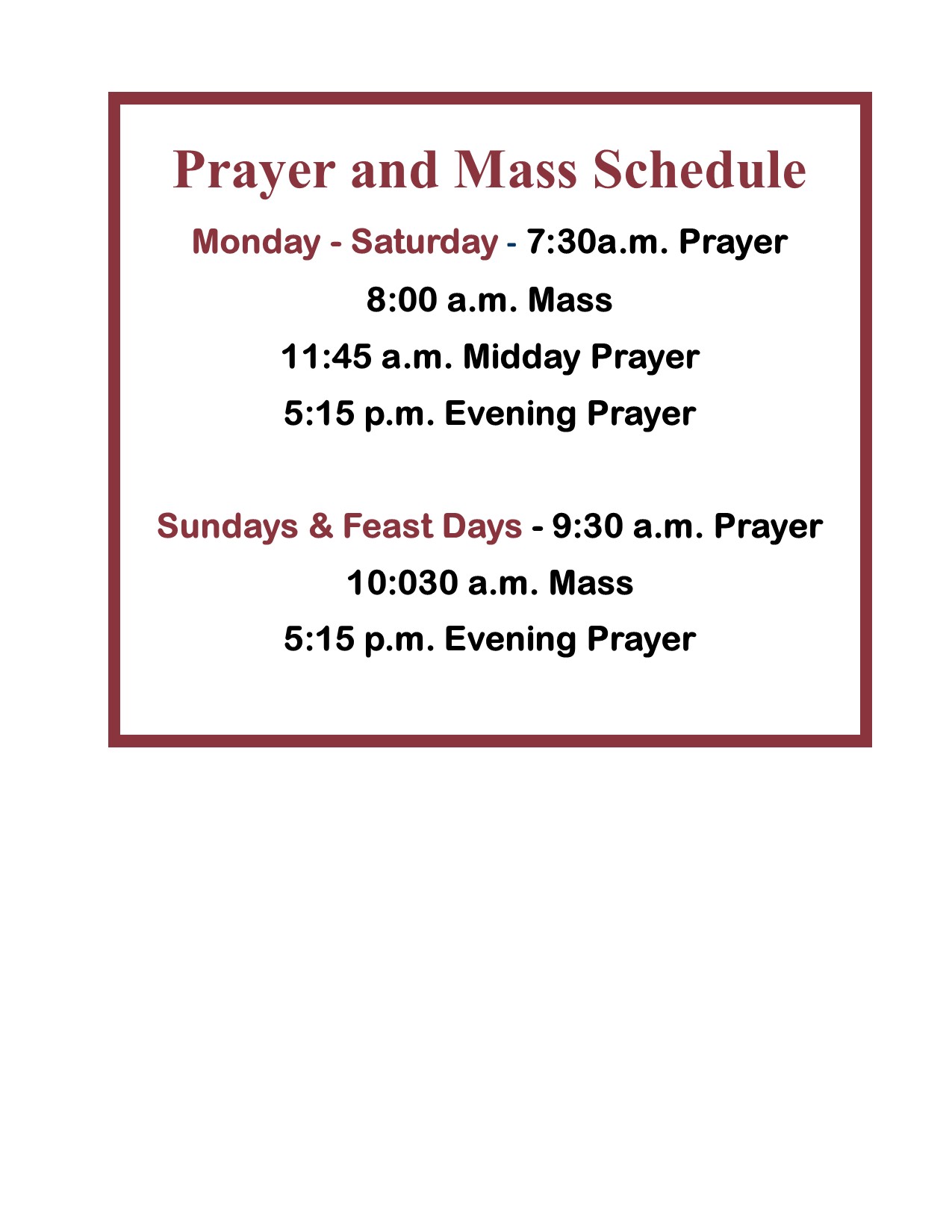
 Mass Schedule

Related Links

Copyright © 2026 · Benedictine Sisters of FL · Touching Lives Through Prayer and Service

Copyright © 2026 · Bendedictine Theme on Genesis Framework · WordPress · Log in