• Skip to primary navigation
  • Skip to main content
  • Skip to footer
Benedictine Sisters of FL

Holy Name Monastery
Founded 1889

Donate Now
  • Home
  • About Us
    • History
    • Being Benedictine
    • Benedictine Monasticism
    • Meet Our Community
    • Holy Name Academy-Alumnae
  • What We Do
    • Mission, Vision and Our Partners
    • Retreats
      • Invitation to Retreat
      • Accommodations
    • Volunteer Programs
    • Oblate Program
    • Spiritual Direction
    • Aqua/Hydroponics
    • More of Our Ministries
  • What’s Happening
    • Articles of Interest
    • Events
    • Newsletters
    • Brochures
    • Links
  • Support Us
    • Gifts of Support
    • Wish List
  • Stories Shared
  • Galleries
    • Photos
    • Videos
      • Benedictine Sisters of FL Videos
      • Other Videos
  • Contact Us

Homily

A Parable …

September 9, 2019 by holyname Leave a Comment

While I was preparing this reflection, a long ago riddle came unbidden to mind.  I verified it on the Internet .. my memory was correct but I had it in a decade too early.  I was thinking it was from the 1950s … but jump forward a decade to the late 60s.   There was a quite popular parable about a pig and a mother hen strolling through a town plaza where there was a billboard with a graphic of a platter of bacon and eggs advertising all-day breakfast at a local café.  The mother hen turned to the pig and said, “Do you see, my Friend, the contribution we make to those human folks’ dining enjoyment?”

“Ah, but there’s a big difference,” said the pig, “Your contribution is just dedication.  Mine is total commitment.”  [Now, you may wonder how in the world this can be related to the Gospel …  well, it’s all about commitment, isn’t it?

So, really, is the pig the one who is the committed one?  For the pig to be a part of the bacon-and-egg breakfast, the pig has to be slaughtered.   But does the pig buy into the adage that life is an “all or nothing” proposition?

No one asked the little pig if it would like to be slaughtered. The pig certainly doesn’t volunteer for to be slaughtered.   Some might say that to be bacon was the pig’s destiny.  I’ll bet the little pig would disagree. The problem with being slaughtered is that the pig can only be slaughtered once.

This is a bit like a potential member that may start out strong but quickly fizzles out and looks for another monastery unless, we make a concerted effort to insure her allegiance and loyalty.  Without that sense of connection, it could be worse if she stays.    But …  is this real commitment? In a pig’s eye.

Now, I am not, nor have I ever been, a poultry farmer.  But, it seems to me for the hen to be part of the bacon and egg breakfast, she only has to do what is in her very nature – what she grew up to do. The hen was born to lay eggs. The hen doesn’t know how not to lay eggs. You don’t even have to ask for the eggs, the hen just does it. The best part is that the hen will continue to lay eggs for as long as she is physically able.

This is like the member that gives you years of sustained superior service because she has found her passion and revels in doing it every day.

Is this real commitment? You can bet the farm on it.

So how do you find these committed, passionate members? Going through the same old motions and asking the same old interview questions like “What are your strengths?  What is your greatest weakness? How could you contribute to our charism?” aren’t going to help us find the passionate Seekers for which we are looking.  It may help us find good volunteers – valuable?  Yes, most certainly.  But it won’t ipso facto help us find great, committed and contributing members.  This requires a live-in – a boot camp – experience.  An extended time of rubbing shoulders in the trenches of everyday life.  An experience of falling down and getting up with the support of mutual “long-timers” in the life.   The only way to find this commitment is to provide an environment for their passion to shine and to discern with them if theirs is a Benedictine vocation.

Perhaps the more important question is: “Have YOU found your true passion?  The thing that really gets you excited?”  (Don’t get confused – being good at something is not the same thing as BEING passionate about it.)  Jesus is the ideal coach to help you find your passion.  He certainly had his: save the world!  So associating with him, looking to his example, imitating his actions, his style of interactions, deep conversations with Him will help you not just “find” your passion.  His goodness, his enthusiasm for life will rub off on you.

Calling the pig the committed one is unadulterated poppycock.  [Yes, once the pig is slaughter, it is recycled to continue into another form providing sustenance for the consumer to do good in the world.]  But let’s be real!  The chicken is the truly committed and passionate one: day after day, year after year, doing what she knows God called her to, what she was made for, why she was created.  … Oh, it takes the right nourishment and a conducive environment.   “Free range” is for everyone.  But, once you have found your passion, your calling, the thing you cannot NOT do.  You cannot NOT be the person you were created to be.  Passion drives you, informs you – peaks your thirst for a deeper relationship and prompts you to do your part to uphold your end of the covenant.

First Reading   Wisdom 9:13-18b     Second Reading  Philemon 9-10, 12-17     Gospel Reading  Luke 14:25-33

Reflection by Sister Roberta Bailey, OSB

Continue Reading

Filed Under: Blog, Front Page, Homily

Is it Time to Leave the Comfort Zone

September 3, 2019 by Holy Name Monastery Leave a Comment

There is a term popular today that seems to me to fit with this message of Jesus.  The term is “comfort zone” which refers to those situations in which the person feels comfortable, safe, free from threat and challenge.  The comfort zone is, for the person involved, a thoroughly comfortable place.  Life there is marked by ease and familiarity.

It’s natural to like one’s comfort zone, but most of us would admit that we should not remain there indefinitely.  People do not become better or more mature or holier lingering in their comfort zone.  That just doesn’t happen.

In the first part of this Gospel, Jesus cautions against sitting in the place of honor at a wedding banquet and advises taking the lowest place instead.  But it is not simply a suggestion about etiquette.  Something more is going on here.  What Jesus advocates is not only for social occasions, but it’s meant to shape the entirety of our lives.

Choosing the seat of honor for ourselves is choosing the seat in our “comfort zone” – where we will be comfortable, safe, and free from the threat of interacting with strangers.  Jesus cautions us against moving into a comfort zone all on our own as though we know what we’re doing, as though it’s something we need to do.

In the second part of the Gospel, he urges us to invite the crippled, lame, and blind when we give a luncheon or dinner, rather than friends, relatives, and rich people.

So there’s advice here for us whether we’re the guest or the ones hosting an event.  Picture entering the banquet hall at our annual Gala.  Do you gravitate toward a familiar face or approach a table of “new friends” you’ve just never met before.  Do we sit in “us vs them” clumps?”  Do we do what Jesus says – ensure that our guest list includes those who are different, people who may make us uncomfortable, but whose difference from us may bring us a blessing?  This is what I think is so significant about our Thanksgiving Day dinner.  We open our door, our hearts and our table expecting nothing in return.  The blessing of being in a position to share is its own reward.

Jesus not only teaches us this lesson of stretching our comfort zone, he demonstrates it.  His entire life, his public ministry, his passion and resurrection, is full of one episode after another of his expanding what could have become his comfort zone.  Repeatedly, Jesus takes the low seat and invites unlikely types to be his guests.

Jesus left the comfort zone of his place by his Father to come to earth as a tiny, helpless infant.  Finally, he took the worst seat of all––on the cross.  He left the comfort zone of his earthly life, allowed himself to be placed in a narrow grave in order to experience ever-expanding resurrected life.  Jesus left the comfort zone within his family and friends on earth to become ever-present to all of us – to each one – at our beck and call.

Every day we encounter situations that place us outside our comfort zone – that stretch us to new territory in welcoming the “stranger” – persons or experiences.  Just be on guard against the inevitable danger that this place will soon become our new comfort zone.

I am reminded of the words of a hymn found in our Journey hymnals: “Now As We Gather” ….     “Now as we gather, God’s chosen people … there are no strangers in this holy place.”  When the stranger becomes friend, we must search out other strangers to befriend.

In this Gospel and in a hundred other ways, Jesus asks us that we do him the honor of keeping ourselves, our religion, our community from becoming trapped in some comfort zone.  This is what it means to live the life of faith – a life on the ladder of humility as described in the Rule of Benedict …  living in reverence and deference to others.

~Reflection by Sister Roberta Bailey, OSB, Prioress
First Reading  Sirach 3:17-18,20,28-29     Second Reading   Hebrews 12:18-19,22-24
Gospel Reading   Luke 14:1,7-14   
Continue Reading

Filed Under: Blog, Front Page, Homily Tagged With: comfort zone, comfortable, ease, familiarity, free safe, God, Gospel, Jesus, Rule of Benedict

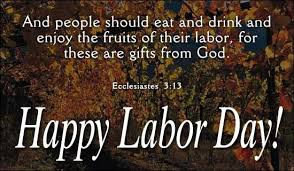
Labor Day

August 26, 2019 by Holy Name Monastery Leave a Comment

Next weekend our nation will be celebrating Labor Day.  Strangely we honor it by the opposite of its name.  In many respects it is a Workers Holiday.  Labor Day was created by the labor movement in the late 19th century and became a federal holiday in 1894.  Since then each year on the first Monday in September we pay tribute to the contributions and achievements of American workers.  You may also know about the celebrations to honor employees on May 1st, the feast of St. Joseph the Worker.  Here in our monastery we host our employees at a special THANK YOU luncheon in gratitude for the services and presence of our employees.  The day is topped off with early release time.  They disappear after lunch – it’s a paid half-day.  That includes the cook for the evening meal.  (Oh, dear!)  Thankfully we have a long-time association with some loyal volunteers who take over the kitchen to provide a home-prepared FISH FRY with our favorite Southern trimmings: grits with butter or cheese, hush puppies, coleslaw and ice cream novelty bars for dessert; beer or soft drinks.  God bless them EveryONE!

So in honor of all workers, even the tiniest among us, let’s talk a bit about workers and work styles.  We often hear the expression “a little child shall lead.”  With the opening of a new school year and Labor Day weekend fast upon us, it seems to me fitting that we let little children lead us to a rightful understanding of “work.”

For many years I enjoyed ministry as a Montessori directress in programs for children ages 6-months to 6-years.  One of the observable differences between children and adults is the contrast between their attitudes toward work.

Have you ever watched a toddler painstakingly build a tower of blocks and then gleefully knock it down, over and over?  That’s “work.”  Or have you been victim to the infant self-feeder who looks at her spoon held over space beyond the highchair tray, then flexes her little fingers so the spoon disappears as she peeks over the arm of the chair to gaze at the spoon on the floor.  The adult carefully picks up the spoon – or if it is the third or fourth time snatches it up – wipes it off (or grabs a clean one from the drying rack) and places it within the child’s grasp.  Now watch out of the corner of your eye while the child waits until you make eye contact, an impish grin appears as the spoon drops, once again, into outer space.  Now, that’s “work.”

The child’s desire to work represents a profound instinct.  A child’s objective is the work itself and they eagerly repeat a task over and over.  Mastery is what matters to them; they are their own taskmasters.

Unlike many adults, children do not follow the law of minimum effort.  Their work consumes their every energy and at the same time it energizes them.  Nor do children look for assistance but defend themselves from interference with great determination.  Watch the two-year-old after mom buttons him up.  He’ll undo every button and with full concentration re-button the shirt – it may hang lopsided but “I did it myself!”

Children, unlike most adults, are in no hurry to complete a task – they are not clock watchers.  They seem to instinctively know that practice makes perfect and growth cannot be hurried.  The ultimate end for which children are working is not consciously known to them but the happiness they radiate gives evidence of an inner contentment.

May each of you know the inner contentment you first experienced in early childhood.  That deep sense of peace when you can say: “Ah, This is where I belong.  I am doing what God created me to do at this time in my life.”

~Reflection by Sister Roberta Bailey, OSB, Prioress
Continue Reading

Filed Under: Blog, Front Page, Homily Tagged With: celebration, children, God, Labor Day, toddler, work

Two Roads Diverged in a Yellow Wood

August 20, 2019 by Holy Name Monastery 1 Comment

From this Gospel we sense that Jesus understands how difficult it is to wait.  You can feel Him “chomping at the bit” as he says to this disciple: I have come to set the earth on fire, and how I wish it were already blazing!”  If Jesus felt that way over 2000 years ago, how would He feel with the world situation today???

The Gospels and the Acts of the Apostles remind us over and over to have patience in waiting: wait for the Spirit, wait for the one who will baptize, wait for the fire of the Spirit.  From the beginning of Jesus’ coming on earth He taught lessons in waiting.  Mary and Elizabeth waited nine long months for the birth of their babes.  The Holy Family waited three years in Egypt until it was safe to return to Nazareth.  Remember Simeon’s prayer of gratitude (that we recite at Compline) upon seeing Jesus with Mary and Joseph in the temple.  “Now, Lord – at last – I can die in peace for with my own eyes I have seen Your salvation.”  Jesus waited 30 years to begin his public ministry, his baptism by his cousin John.  He waited three days to respond to Lazarus’ sisters’ news that his friend had died.  He waited 3 years for His Father to declare it was the right time: time for His last supper with friends, time for betrayal and crucifixion, time to rest in a borrowed tomb until he would be raised from the dead.  He waited for the right time to reveal himself to Mary Magdalene in the garden and later to appear to the disciples and his mother Mary closeted in the upper room.  He waited 40 days for the time to ascend and take his place at the right hand of his father.

And, what do we do?  We tap our foot and mutter when we have to wait a few minutes in the grocery line, or for a red light to turn green, or for an elderly person to negotiate a curb or unfamiliar hallway; or move ahead in the food line at meal time; or hit “print” repeatedly on the computer thinking we can hurry it up.  With a minor adaptation of words in the St. Louis Jesuit’s hymn TRUST IN THE LORD, we should be singing: “Wait for the Lord, you shall not tire; wait for the Lord, you shall not weaken.  For the Lord’s own strength will uphold you, you shall renew your life and live.”

This Gospel is where Jesus reminds us that choosing to do good, to be good, requires on-going decision-making.  To do the right thing, the good thing, won’t always be easy.  Life isn’t conflict-free no matter how holy, easy-going or patient a person may be… living in a monastery can’t protect you.  We’re all still human, with human limitations.  But, we are followers of Jesus who said, “What makes you think I have come to establish peace?  I tell you I have come to sow division.”  He is alerting us to be prepared for difficult decisions; conflicts in life.

It’s good to get this reminder so when conflicts arise we don’t fret: “What did I do wrong?  Why doesn’t God fix this situation?”  Jesus is letting us know beforehand that He is right in the middle of the fray.”  Remember He said: “I have come to set the earth afire.”  He’s is telling us that when we make the decision to follow him, we may face opposition from some quarters, perhaps even from our peers, our family or friends.  He probably cheers us on when conflicts arise and He can foresee the peace of reconciliation coming down the pike.  Figuratively, if we engage the faucet, turn the nozzle, we have the hose that can put out the fire between us.  The ashes will remain.  Ah, but, out of the ashes will come new life: green plants, colorful flowers, and, yes – peace.  Our choices to act or bite our tongue, cool our jets and exercise patience do shape our future.  [If you are interested: this month’s Reader’s Digest has several stories illustrating how insightful, caring mentors change children’s lives.]

At the University’s Opening Mass on Monday, President Senese preempted one of my choices for this reflection when he quoted Robert Frost’s poem: “The Road Not Taken.”  You can probably recite some lines from your 8th grade memory: (edited here for my purpose)

Two roads diverged in a yellow wood,
And, sorry I could not travel both and be one traveler,
Long I stood and looked down one as far as I could
Then took the other, as having perhaps the better claim…

Oh, I kept the first for another day!
Yet knowing how way leads on to way,
I doubted if I should ever come back.

I shall be telling this with a sigh
Somewhere ages and ages hence: Two roads diverged in a wood, and I —
I took the one less traveled by,
And that has made all the difference.

~Reflection by Sister Roberta Bailey, OSB, Prioress
Continue Reading

Filed Under: Blog, Front Page, Homily Tagged With: blazing, earth on fire, Gospel, Jesus, Last Supper, less traveled, trust in the Lord, two roads diverged, Waiting, yellow woods

Letter to President Trump

August 15, 2019 by Holy Name Monastery Leave a Comment

More Than 660 LCWR Members Call on President Trump to Stop All Divisive and Polarizing Rhetoric

August 14, 2019

The following is a letter sent by the Leadership Conference of Women Religious (LCWR) during its annual 2019 conference to President Trump on August 14. 

Mr. President,

We live in a world increasingly marked by hatred, brutality, and violent conflict. We see our own country threatened by increasing disparities in economic, political, and social power. We are caught in a political culture paralyzed by ideological extremism and hyper-partisanship. These are times that require exceptional insight and courageous leadership.

In the face of these unprecedented challenges, we are outraged and heart-broken when our political leaders appeal to our basest instincts and stoke the fires of fear that threaten to tear the fabric of our nation apart. We cannot, we will not, let the voices of hatred and fear carry the day.

Mr. President, we beseech you to end all divisive and polarizing rhetoric. We implore you to never use language that disrespects, dehumanizes, or demonizes others. We expect our president, and all who serve this nation as leaders, to be always mindful of the common good and the dignity of each and every person. You hold a position that has the potential to inspire the best of every one of us and we ask you to use this unique status to bring about healing and never seek to create division.

The people of this pluralistic nation form a diverse polity characterized by a wide variety of beliefs, experiences, and interests. Disagreements and differences have the potential to challenge all of us to abandon easy certainty and seek a fuller truth. The problem is not our many differences or passionate disagreements. Those differences are our greatest strength; those disagreements are opportunities for growth. It is how we handle those inevitable conflicts that spells the difference between building the common good and destroying the bonds that bind this nation.

In his address to the US Congress in 2015, Pope Francis invited our political leaders to promote respect for the dignity of every human person and to renew their commitment to a spirit of cooperation.  He also addressed each of us and all who seek to lead this nation when he said, “Each son or daughter of a given country has a mission, a personal and social responsibility . . . You are called to defend and preserve the dignity of your fellow citizens in the tireless and demanding pursuit of the common good, for this is the chief aim of all politics. A political society endures when it seeks, as a vocation, to satisfy common needs by stimulating the growth of all its members, especially those in situations of greater vulnerability or risk . . . Building a future of freedom requires love of the common good and cooperation in a spirit of subsidiarity and solidarity.”

As Catholic sisters, our ministries frequently require us to be in the heart of situations of discord and division, and thus we understand the great complexities and challenges that are inherent in the work of reconciliation. We too have to reach deep within ourselves to bring forth the grace and strength that are needed to not give in to the temptation of labeling or judging those who are different from us. We share with you, Mr. President, that maintaining this fundamental stance in life requires discipline and fortitude and a constant examination of our daily thoughts and deeds in light of our beliefs. We sometimes come up short, but pledge to do better each day because we are aware of the moral authority we, as sisters, bear. We ask you, Mr. President, if you would consider a similar examination of the practice of your own moral authority.

We send this letter to you as 663 Catholic sister leaders gathered in assembly in Arizona. We and approximately 700 other Catholic sisters are members of the Leadership Conference of Women Religious and represent approximately 35,000 sisters who minister throughout this nation. We promise to never cease raising our voices on behalf of the common good and praying for the healing of this country.

Sincerely,

The Members of the Leadership Conference of Women Religious

Continue Reading

Filed Under: Blog, Front Page, Homily Tagged With: collective voice, discipline, disrespect, end the rhetoric, LCWR, letter, President Trump, respect, social media

Reflection of Vigil Service of Sister Mildred Gelis, O.S.B.

August 14, 2019 by Holy Name Monastery 1 Comment

Reflection of Vigil Service of Sister Mildred Gelis, O.S.B.

June 23, 1925 – July 26, 2019


The opening lines of the Gospel reading we just heard could be Sister Mildred speaking.  I can hear her saying: “Don’t be worried or upset, I’m just going ahead to prepare a place for you.  See you there.”

[Up front I have to tell you, in preparing this reflection I was fortunate to have at hand reflections offered by former prioresses on Sister Mildred’s Golden and Diamond jubilees.] Sister’s nephew and niece (Michael and Cynthia) – here with us tonight – can attest to Sister’s simplicity and quiet sense of humor – I believe she would have smiled lovingly and OK’d my borrowing from the tributes of 1994 and 2004.

Sister Mildred had her first contact with the Benedictine Sisters in grade school in Slidell, LA.  As a youngster she sat in on her older sister’s piano lessons with Sister Helen.  She sat quietly in the room engrossed in a favorite activity:  reading, usually the Reader’s Digest.  Reading remained a favorite past-time until dementia made it a trial to follow the story line.

Sister first visited the community here in FL in 1941.  On that trip she was accompanied by her mother with S. Helen as their driver.  S. Helen recalled that Yvonne was fascinated at the sight of the waters of the Gulf of Mexico. (Remember in 1941 there was no I-10 so they traveled the shore road along the Florida panhandle to Hwy 19.)  Many of you know how much Sister enjoyed that 10 or 12-hour drive to Slidell to visit with relatives.

Only a “call of nature” (that’s Benedict’s expression for a pit stop) would cause Sister to make stop.  In preparation (predating built-in cup holders) she’d position her bottle of Mountain Dew, some fresh apple slices and an easy-to-open container of Whoopers candies.  You do know that Sister Mildred enjoyed her sweets … 2 heaping teaspoons of sugar into her breakfast orange juice, sugar atop cottage cheese or tomatoes. And my goodness, she could own stock in Dollar Tree with her candy purchases!

Many of you knew Sister Mildred as teacher, and later principal at St. Joseph Elementary School – baseball coach and umpire, music and art teacher.  For 31 years she quietly and persistently persuaded the Pasco Schools authority to keep that school open for “her children.”  It grew from a two-room schoolhouse to a full single-grade kindergarten – 8th grade program.  The population grew, so did the plant – now there were indoor bathrooms!  In 1981, with the opening of San Antonio Elementary School, Sister “retired” – that’s a joke – and began working at Saint Leo (then) College in the copy center.  She learned the workings of every machine and became the proficient at making minor repairs.  Sister was a precise set up and copy artist.  (Hope she would approve these service booklets?)  She would work evenings and weekends to make certain we had materials before any deadlines.  In 1990, Sister requested, and was granted, permission to visit with a close friend who was teaching in Germany.   That year she traveled in Germany, France and Japan.  A year before the trip Sister spent many hours boning up on French so that when she visited her father’s homeland and relatives she could converse in the native language.  Her letters home that year bubbled with her excitement and humor.

In one letter she wrote: “I went to the doctor with a sinus infection last fall.  I had numbness in my left arm for over a week, so I went to the doctor again.   He suggested shock treatment which I took in his office every morning for a week.  There was not much improvement so he put it in a cast which I wore for a couple of weeks.  Then feeling came back.  Months later that same numbness started to return.  I checked my watch band and saw that it was too tight.  After loosening it, my arm felt normal again….  So I figured that I had worn my watch band too tight for about a week causing my circulation in that arm to stop.  This caused the numbness.  I have not had the occasion to return to the doctor to let him know what caused this condition.  Now I am always careful to have my band extra loose each time I put it on.  I really thought it was something serious.  It was a great relief to learn the cause of this condition.”   An aside note: With the birth of digital watches Sister became a genius at what each little knob controlled.

Here’s another glimpse into Sister’s quiet ability to laugh at herself.  “One day I was changing my clothes during the day.  I took off my glasses and lay them on the bed.  After the change was made, I sat on the bed to put on my shoes.  Immediately I knew that I had damaged my glasses by sitting on them.  I am always so careful with my glasses for I cannot read without them anymore.  I went to town that day and had them straightened.  I was not charged for this service for which I was thankful.”

Sister’s loving attention to detail and patience with all – including machinery – her  loyalty and spirit of self-giving stood her in good stead in her various ministries which included: teacher, principal, Community Subprioress for many years, Scholastic mistress (director of the young sisters); she served on the community Council and as a St. Leo Town commissioner; was community driver and driver-teacher … (bet she’d have some hairy tales to tell about those sessions!)

Sister took pleasure in carefully crafting newsy letters to friends and Sisters who were studying away from home …  but she worked so painstakingly over the compositions she sometimes decided they were old news and not worth sending.  That did not apply to THANK YOU notes – she wrote those the same day the gift was received.   Some of us have among our souvenirs the Christmas thank you notes carefully penned Christmas afternoon on note pads Sister made with scrap ends she saved at the copy center.  And we looked forward each Christmas to receiving the journal books (50 or so blank pages) with a decorative cover that she compiled for each one of us.

Sister enjoyed making music … over time, with knowledge of the keyboard on piano and organ, she taught herself to play the ukulele and harpsichord, and a variety of flute-like instruments from various countries.  Our opening hymn (Amazing Grace) was one of her favorite harmonica tunes which she played til not long ago for Saint Leo University social work students and other visitors at Heritage Park.

Sister also observed carefully in her father’s barber shop – and later her brother Paul’s shop – where she learned hair clipping skills.  Until a few years ago she kept many of us in “good shape” – often reminding us “looks like you could use a good trim.”  She visited my mother at the nursing home in Lakeland to give snip her braids and give her, as my mother said, “an old lady’s chic cut.”   When we wore the habit it was a custom on the night we received the veil (became a novice) for the superior to give the new Sisters a short haircut.  Shortly before that day for me, Sister Mildred had given Sister Mary Grace a gift from her father: a pair of electric clippers.  I suspect she stood cringing as she watch Sister’s first venture with her new gift.  (I never knew how much I looked like my brother!  Thank God, for my new veil to cover my buzz cut. )

Prior to being at St. Joseph School, Sister Mildred taught elementary grades in Jacksonville Beach, Sarasota and Ocala.  And, as was quite normal in those days, Sisters went to night school and took weekend classes.  Sister did precise work but with her teaching duties, taking her turns cooking and performing other household duties, as well as teaching weekend catechism classes, she was a bit of a procrastinator getting her college assignments done.  Picture Sister Mildred – this is true – riding to her college class, wedged in the back seat of the car with a manual typewriter on her lap furiously typing the paper due in a few minutes.    .

When Sister was assigned to St. Joseph School, she lived at monastery – which was across the highway on the location that is now Benedictine Hall.  In addition, to her duties at St. Joe and ones I’ve already mentioned, Sister served in community as Scholastic Mistress (director of newer members in community), subbed occasionally as organist, helped in the citrus packing house, was community driver and driver instructor and taught weekend CCD classes.  I recall many Sundays that Sister and I went to Floral City, enroute to dropping off two Sisters in Brooksville to conduct catechism and sacramental preparation classes.  As a bonus, Sister Mildred challenged me (and herself) to memorize a psalm every week between Sundays.  Since she was driving, I had the advantage because I could consult the mini black psalm book we used when she was stumped and asked me for a prompt.

In the Rule read earlier in this service, St. Benedict describes the good zeal which monastics ought to have.  The kind of zeal manifested in the love and respect shown to one another in day to day living.  He advices us to anticipate another’s need and to put aside our individual preferences for the sake of what is best for the community.  It was evident to all who knew Sister Mildred that she took these words to heart and lived by them. She was known to be the first to volunteer when we needed extra dishwashers, or to drive someone to the doctor, to a store or to visit a friend.

(About this time Sister Mildred is probably trying to whisper to me: “Thank you, Sister – that’s quite enough now.”)  What was great about Sister Mildred was not what she did but how she did it …  giving of herself with cheerfulness and quiet joy.  While residing at Heritage Park, asked if she needed anything, she’d often answer: “No, I am content.”  I quote her here from her interview when she retired from Saint Leo University: I’ve enjoyed the time I’ve had at Saint Leo …  I would like everyone to remember me as a helpful person who tried to meet your needs in a timely basis.  I also want to be known as a religious person who was a friend to every person I met.”

That you did, Mildred, in splendid fashion!  Now, like ET you can take off on your Honda 150 or your little red scooter to soar to the heights of heaven.  Like ET said: “HOME!”

 ~ Reflection by Sister Roberta Bailey, O.S.B.
Continue Reading

Filed Under: Blog, Homily

  • « Go to Previous Page
  • Page 1
  • Interim pages omitted …
  • Page 66
  • Page 67
  • Page 68
  • Page 69
  • Page 70
  • Interim pages omitted …
  • Page 92
  • Go to Next Page »

Footer

Prayer / Newsletter / Info

 Contact Info

Benedictine Sisters of Florida

PO Box 2450
12138 Wichers Road
St. Leo, FL 33574-2450
(352) 588-8320
(352) 588-8443

 Mass Schedule

Related Links

Copyright © 2026 · Benedictine Sisters of FL · Touching Lives Through Prayer and Service

Copyright © 2026 · Bendedictine Theme on Genesis Framework · WordPress · Log in