• Skip to primary navigation
  • Skip to main content
  • Skip to footer
Benedictine Sisters of FL

Holy Name Monastery
Founded 1889

Donate Now
  • Home
  • About Us
    • History
    • Being Benedictine
    • Benedictine Monasticism
    • Meet Our Community
    • Holy Name Academy-Alumnae
  • What We Do
    • Mission, Vision and Our Partners
    • Invitation to Retreat
    • Accommodations
    • Volunteer Programs
    • Oblate Program
    • Spiritual Direction
    • Aqua/Hydroponics
    • More of Our Ministries
  • What’s Happening
    • Articles of Interest
    • Events
    • Newsletters
    • Brochures
    • Links
  • Support Us
    • Gifts of Support
    • Wish List
  • Stories Shared
  • Galleries
    • Photos
    • Videos
      • Benedictine Sisters of FL Videos
      • Other Videos
  • Contact Us

Articles of Interest

What Nets Entangle Us?

January 22, 2018 by Holy Name Monastery 2 Comments

Day after day it was the same thing; the same sea, the same nets, the same boat, the same back-breaking chores with the same guys.  Day after day it was wind, water, fish, sore muscles, tired bodies.  They’d grown up watching their father and their grandfather, maybe their great-grandfather and uncles do the same thing every day – .watching their future playing out before them.

Cast the net, pull it in.  Cast the net, pull it in.  If you were not casting the net, then you were sitting in the boat mending the nets or on the dock preparing the bait.  Maybe that’s where we get the expression: either fish or cut bait – but don’t just sit there and do nothing.

We may not fish for a living but we do know about preparing bait, mending and casting nets.  Some days it seems like nothing changes.  We get tempted not to expect anything to change.  This is the reality; it’s is just the way it is and the way it’s going to be.

But then we hear Jesus’ invitation: “Follow me!”  It’s an invitation to a new life.  It’s a knock a side of the head – an eye-opener.  When Jesus said, “I will make you fish for people,” he was describing the transformation of our own lives, not simply a promise of new vocations.

Jesus doesn’t work for AAA – he doesn’t offer us a map, an itinerary, or a destination, only an invitation.  Remember what I said last week: Always, Jesus offers an invitation AND a promise.

This invitation is to an inner journey, a journey into the deepest part of our being.  It’s not about planning and organizing, making lists, or packing camping gear or backpacks or suitcases.  It’s not a vacation invitation.  It’s not about gathering stuff, it’s about leaving things behind.  The Scripture says:  “Immediately upon hearing Jesus’ invitation they left their nets behind and followed him.”  Imagine the look of puzzlement on Zebedee’s face at finding himself alone in the boat.  They didn’t simply leave what they were doing; they left their father and the tools of their livelihood: their boat and their nets.

That’s the hard part for most of us.  We’re pretty good at accumulating things and clinging to relationships but maybe not so good at letting go.  More often than not our spiritual growth involves some kind of letting go.  We never get anywhere new as long as we’re unwilling to leave where we are.  We accept Jesus’ invitation to follow, not by packing up, but by letting go.

So, what are the nets that entangle us?  What are the little boats that contain our life?  What do we need to let go of and leave behind so that we might follow Jesus?

People who enjoy fishing are patient people.  They cast their line into the water then wait and wait for a fish to swim by and take the bait.  A plain hook alone does not interest most fish.  And, some fish are picky about what will tempt them.  There must be something on the hook that attracts the fish’s attention and whet’s their taste.

If you ask a person who likes to fish what is the best bait to use, they’re usually eager to tell you what works best to attract the attention of a fish.  What they use for bait often depends upon what type of fish they are trying to catch.  Sometimes it is the color of the lure on the line that attracts a fish.  Sometimes is it actual bait.  Sometimes it’s not food at all.  It can be a “fly,” a lure fashioned out of thread and small feathers to look like a real fly or another type of insect.

Jesus told his disciples that he would teach them how to “fish for people.”  He showed all of us that the way to do that is to have God’s love in our own lives, evident between us and to share it with others.

A variety of motives influence people to exchange their old lives for new ones.  What commitments convince Vocation Seekers that it’s worth leaving behind life as they know it?  Most of us know from our own and each other’s vocation stories, it’s the relationships we witness and experience within a community much more so than ministries that prompt new-comers to “test the waters.”

We, our community, can put all full energy into the production all kinds of “lures” and “bait” …retreats and workshops, attractive vocation materials, holy cards, videos, websites and other social media … but that’s only part of what Jesus meant when he promised to teach us how to fish for people.  And, remember if we’re fishing from our boat each one has to do her assigned task of mending the nets, casting the line or preparing bait … no slackers allowed.  And, all of us have to row in sync lest we tangle oars or go in perpetual circles.  Look to Jesus – how did He fish?  He taught, He gave witness, He invited, He did not disappoint, He was (and is) faithful to His word.

Knowing all that, what witness do we need to be constantly giving?  What do we need to leave behind (individually and communally) to convince an observer that our community is worth a further look?  What is the bait, the lure that will prompt more questions, extended visits, developing relationships and finally prompt the Seeker to have the daring to say “This is where I feel God is calling me; I’m willing to leave all behind for the sake of Jesus’ call, with these Sisters (whom I now call my own) here at Holy Name.”

~Reflection by Sister Roberta Bailey, OSB, Prioress


First Reading  Jonah 3:1-5,10   Second Reading  1 Corinthians 7:29-31
Gospel Mark 1:14-20
Continue Reading

Filed Under: Blog, Front Page, Homily Tagged With: Calling, Fisher of Men, Follow Me, Invitation, Jesus, Leave behind, vocation

What do you want?

January 17, 2018 by Holy Name Monastery Leave a Comment

For a moment, imagine, if you will, that you are an aspiring athlete, artist, musician, writer, chef or whatever…    By a stroke of good fortune, you manage to secure as your mentor the person you consider to be tops in the field.  At once you begin to study under that person and hone your skills, soaking up everything you can learn from your champion.

One day after your lesson your mentor introduces you to a person she considers THE expert in the field.  In fact, she suggests that if you really want to perfect your skills this is the person under whom you should study; leave your classes with her and follow that other person lead.

In a sense, this is what is happening here in this Gospel text.  John the Baptist is a great prophet.  Jesus himself once called him the greatest prophet who ever lived.  Naturally, John has picked up a few disciples, people who are devoted to him as their spiritual leader.  But now John has recognized that somebody else has come along who is far greater then he will ever be.  In fact, when Jesus shows up, John realizes that he is now in the presence of One whose sandals he is not even worthy to untie.  He may be a prophet, but this man is the Lamb of God, the Son of the Most High, the very Savior of the world.

This is astonishing, really, for what preacher would point his disciple to another’s preacher’s ministry?  Here we see that John recognizes his calling and that he is fully in agreement with his purpose, which is not self-promotion. Instead, as John explains in the early part of his gospel: “He must increase, I must decrease.”  His following must grow; my purpose is to point you to His way.  He is the chosen one of GOD, I am not worthy to even unloosen his shoes.

If you’ve ever thought about it, (or think about it now) you may realize that one of life’s more challenging roles is to take the second place when once you’ve held first place.   School principals who step back into the classroom; heads of departments who now work the floor; a committee or commission chair who now is worker-bee; parents who cut the apron strings so their child can soar or, in a case close to home, a superior who rotates out of leadership.  S. Lynn Marie McKenzie writes about this dynamic in her article on “Servant Leadership” in the Fall Issue of BENEDICTINES.  (And it fits right in this week with the reading from the Rule, chapter 2, on the Qualities of the Prioress.)  Sister Lynn reminds the reader that “one does not begin monastic life as a prioress but begins as a member of the community, and one usually does not end monastic life as a prioress but as a member of the community.

When in community we prepare for election of prioress, we often speak of the “grace of office”.  A smooth transition into, out of various roles is reliant on the grace John the Baptist showed in commending his disciples to focus on Jesus and His way.  He prepared his friends, his disciples to move on from his teaching and instead to devote themselves to Jesus.  This is so typical of John.  It was the whole purpose of his life.  Even before he was born, God had determined that John’s life would be spent pointing people towards Jesus.  An angel told his dad before he was born: This child will be a joy and delight to you, and many will rejoice because of his birth, for he will be great in the sight of the Lord. He will bring back many of the people of Israel to the Lord their God.  And he will go before the Lord, in spirit and power to make ready a people prepared for the Lord.”

So look at John!  In your mind’s eye, follow his finger to whom is pointing!  Hear what he’s saying!  In the story he’s standing with two of his friends when Jesus walks by.  He seizes the opportune moment.  He says to his friends, “Look, there goes the Lamb of God.  Here’s your chance.  What are you waiting for?  Go! Follow him!  He’s the one you’ve really been looking for.

All they know is what John has told them about Jesus – they don’t really yet know Jesus.  They don’t know where he is going or if he wants them to follow.  But follow they do – at a distance.  That’s what’s so noteworthy about what happens that day.  As these two men follow him at a distance, Jesus turns around.  He initiates the exchange.  He confronts them.  “What are you looking for?  What are you after?  I see you following me, what are you hoping to find?  What do you think I can do for you?”

So what if, right now, Jesus stopped in his tracks, faced you, and asked point blank, “What are you looking for?  I see you’ve been following me.  I know you’ve been checking me out.  Well, what do you want?  What do you think I can do for you?  What do you want me to give you?  Where do you think I am leading you?  Do you think I have all the answers?  Can I fix your life?  Or are you just curious?

Will your answer be the same as John’s followers: “Teacher, where are you staying?”  You know what Jesus answers, “Come and see.”  This is so typical Jesus – always an invitation is extended, a gracious and wide open invitation.  And, what’s more, the invitation always comes with a promise.  Seek and you will find.  Knock and the door will be opened.  Ask and you will receive.  Come to me if you are weary and heavy burdened and I will give you rest.  You who are thirsty come to me and drink.  Come to the feast for I have prepared a place for you at the table.  Always Jesus invites us: come and see!

~Reflection by Sister Roberta Bailey, OSB, Prioress


First Reading  1 Samuel 3:3b–10,19     Second Reading  1 Corinthians 6:13c–15a,17–20
Gospel   John 1:35–42
Continue Reading

Filed Under: Blog, Front Page, Homily Tagged With: Come and See, disciples, God, Jesus, John the Baptist, Prayer

Holy Family

January 3, 2018 by Holy Name Monastery Leave a Comment

This weekend the Church celebrates the Feast of the Holy Family and, on Sunday evening, the Vigil of Feast of the Mother of God.  So, what does that mean for us as monastics?  We came from a family, we still have families and together we live in an intentional family.  Our life together as family is guided by the simple, yet profound, guidelines designed by St. Benedict.  He was a man of great wisdom, compassion and common sense.  We know that after some time of living in various settings with his original Rule, he added advice based on his observation of the interactions between those who chose monastic life.  Imagine having to warn his men not to sleep with knives, to wear clean underwear on a trip, for the learned to help those who could not read.  His prudence shines through when, in so many words, he says: this is what works for us now – if the schedule of psalmody, the horarium and other daily living details don’t fit your need, change it.

It is the spirit of the Rule that has survived because Benedict, even in his youth, had a deep understanding of human psychology.  A study of his early life lets us know he spent much time with his grandparents who lived a few miles from his home.  Walking along the ridge to their summer home he passed the huts and caves of hermits.  Before he was sent to Rome to pursue academics, he spent hours conversing with these solitary men … maybe women, too.  He absorbed the wisdom and practical advice from the older generations.  This is evident in the Rule –  he tempered discipline with compassion and he saw the spiritual quest as a joyful pursuit of God within the structures of ordinary life.  It is this joyous delight in everyday spirituality that kept his Rule for Monastics alive for over 1500 years.  His simple principles of living together under God’s love have been applied beyond monasteries to family life and especially Benedictine Oblates.

If we know only the first word of the Rule “LISTEN” what an impact it could make on our own happiness and create peace between peoples.  It’s interesting that Benedict uses the word LISTEN and not hear.  I don’t know about you, but it is only when I hear a noise in the night that I strain to listen for the next sound.  To truly listen to another requires perception, knowledge of human nature, biting the tongue before speaking and an open-hands approach in conversation.  To listen requires an attentive spirit … not a scramble to respond with advice, a witty or chiding remark or a one-upmanship story.  When we truly listen to another we can identify their feelings, let it resonant within and know that very often all the person wants is a listening heart that signals authentic caring.

Benedict’s Rule offers us a high ideal and when we breach the ideal we need to be humble enough to ask forgiveness both from God and from each other.  His down-to-earth advice survives because of its inner dynamic.  He wasn’t writing for honors students but for, as one author calls us “a motley crew”.  Benedict expected his followers to work hard, study hard and pray hard as they travel along a life-long path of falling down and getting up in a community where each member is valued and loved unconditionally.

From that first word in his Rule – “LISTEN” … to his advice to begin every good work with prayer … to keeping a lamp burning at night … to don’t loiter outside chapel if you are late … it is evident that Benedict saw God at work within the ordinary events of communal living – in the joys and sorrows of our everyday lives.

Tomorrow will be the eve of one year, and the dawning of a new one.  We recall with fond memory those who were with us last year and this year celebrated Christmas in the intimacy of heaven – we pray for those who in the coming year will, as the saying goes, enter into glory.

At the close of 2017, I invite you to take count of all the ways you have seen God’s glory –  when did THE WORD appear in your life, pierce your heart?  As the days go by, keep LISTENING to God speaking to your own heart, and to your comrades’ hungers and longings.  It may sound trite to say this, but we do have two ears and one tongue …  Maybe God intended us to listen twice as often as we use our words.  If we do this we are less likely toot our own horns or miss the other’s silent cue for a little attention.  When we cultivate silence and sincere listening we won’t step on others feelings, speak harshly or stir the pot by murmuring or spreading slander or spewing unpleasantness into the air we breathe.  Our current world is filled to overflowing with sound, with words, factual and fake. In many instances we do well to ask ourselves if a word is really called for or might silence serve the better part?    Remember the instruction you learned at your mother’s knee: “If you can’t say something nice, don’t say anything at all.”    In the end, our discernment is “what will most likely spread peace?”

As we step out into 2018, a whole new universe of grace lies open before us.  May the gift of faith enable us to see the invisible, believe the incredible and graciously receive the impossible … for with God, all things are possible.

~Reflection by Sister Roberta Bailey, OSB, Prioress
First Reading  Genesis 15:1-6; 21:1-3       Second Reading  Colossians 3:12-21)
Gospel  Luke 2:22-40


Continue Reading

Filed Under: Blog, Front Page, Homily Tagged With: Benedict, Feast of the Holy Family, God, Jesus, listen, Rule, Vigil of the Feast

Annual Icon Writing Workshop

December 20, 2017 by benedict Leave a Comment

Continue Reading

Filed Under: Prayer

Four Weeks Suspended in Kairos

December 11, 2017 by Holy Name Monastery Leave a Comment

In her book, THE LITURGICAL YEAR, Joan Chittister makes the comment: “Advent, more than any other season of the church year, calls us to live simultaneously in the past, the present, and the future.  She elaborates: “We learn in Advent to stay in the present, knowing that only the present well-lived can possibly lead us to the fullness of life.  It takes an overview of the three-year cycle of Advent readings to make clear the multiple meanings of Advent.  Many of our Advent hymns keep this idea before us when we sing “Mara – natha – two words – The Lord has come … God of, and in, our) past, present and future are all lived together … soul.” (Chittister)

We eagerly await the coming of Christ as a baby in Bethlehem (the past), we are invited to welcome him into our hearts now (the present), and we look forward to his future coming as king of glory.  For four weeks of Advent we are suspended in kairos — God’s time — when expectations and reality are held in tension with each other.  We must hold on to a vision of what challenges the church (that’s all of us) should be dealing with today.  Dwelling in the past or wishing for a perfect future can keep us from hearing the will of God in our today.  Many recognize in Pope Francis a voice that is, like John the Baptist, crying in the wilderness … urging us forward in the present to mend the past as we confront the ills of today.

This Gospel introduces us to the man: John.  The opening lines in Mark’s gospel are “the beginning of the Gospel of Jesus Christ” but the first character he introducers is not Jesus, but John the Baptist, the fiery preacher who came out of the desert where he lived on honey and locusts.  And, he is no fashion plate, with his camel’s hair clothes, leather sandals, and leather girdle around his waist — very much like Elijah.  His diet was very simple: locusts (grasshoppers) and wild honey.  This is important, or it would not be here.  It is symbolic. But what does it symbolize?  Well, you cannot wear anything more fundamental in the way of clothing, or eat a more basic diet, than John did.  In other words, it is representative of his ministry — one of simple beginnings.  It is not the end; it is the beginning.  The beginning of the gospel of Jesus Christ, the Son of God is all about repentance.  This is the place to begin.  Even John’s clothing and his diet helped convey that message.

His diet, by the way, was balanced.  Food fanatics will quickly recognize that grasshoppers are protein, and honey is carb.  John’s diet was in perfect balance, so that he was a healthy man.  It was a simple sort of diet, just as his ministry was – nothing elaborate.  Furthermore, he’s very honest.  He says, “Don’t look to me for answers beyond what I have already told you.  Anything beyond that must come from Another, who is coming right after me.  He is so much greater than I that I am not even worthy to untie his shoes.  Remember, this was his cousin he was talking about!  John could bring people to God, but he could not take them beyond that.  John began his ministry in the wilderness, the worst possible place. But it worked!

The people of Jerusalem and Judea left their cities, their recreations and pleasures, and trekked through a howling wilderness to listen to a man preach.  They probably had to walk twenty or thirty miles to hear John, but did so willingly and in such increasing numbers that Mark records, in only slight exaggeration, that “all the country of Judea, and all the people of Jerusalem” came out to hear him.  Something drew these people into the desert to listen to this strange and rugged young preacher proclaim good news.  That is all he did!  He never told how it worked, or why; he just announced it.

How fitting it is that we have this message of forgiveness and repentance as a prologue to our Penance Service on Tuesday evening.  Then, as now, people need to know they can begin again.  God offers us, once again, an opportunity to truly repent.  We can change our attitude and stop defending ourselves and trying to blame everything on others.  There’s a saying: the whole world’s a critic.  Tuesday’s reconciliation service gives us a chance to be our own critic and say, “You know what, God?  I’ve finally realized it’s not those others, it is just me.  This is just the way I am — and I need help.”  In the quiet of your own heart, where God alone hears, you can say, “I repent, send me your Spirit.”

But keep in mind what the prophet Isaiah said about John’s message – this business of reconciliation will resemble a great bulldozer, building a highway in the desert.  John was God’s bulldozer to build that highway.  You know how roads are built – we see the process almost any direction we go on the highway.  Isaiah says: “Every mountain shall be brought low, and every valley shall be lifted up; the crooked places shall be made straight and the rough places plain.”  And, that is what repentance does.  It bulldozes down all the high peaks of pride that we stand on and refuse to admit we’re wrong.  It takes the depressed areas of our life, where we beat and torture and punish ourselves, and lifts them up.  It takes the crooked places, where we have lied and deceived, and straightens them out.  And it makes the rough places plain.  Then, there is God!  God comes to us so that we can come to God.

Our hope is in the promise of God, and God of the Promise… a promise that was fulfilled in Jesus Christ.  It is a hope that will not be disappointed because God may delay, He may tarry but He will not forget His promise.  He will not let us down.  Praise be God!

~Reflection by Sister Roberta Bailey, OSB, Prioress


Readings:      Isaiah 40: 1-5, 9-11               2 Peter 3:8-14              Mark 1:1-8
Intention:       Peoples of Central America
Continue Reading

Filed Under: Blog, Homily Tagged With: Advent, God's time, Gospel, Jesus, John, Kairos, Lord, Promise

Until you know what hurts me…

December 4, 2017 by Holy Name Monastery 1 Comment

Scholars believe that Mark’s Gospel was written 30-40 years after Jesus’ death. His audience would have been Christians who were living in a difficult social and political time, a time of conflict.  They were likely to be facing persecution because they were followers of Jesus.  These early Christians took courage in Jesus’ warning to remain alert and watchful.  It strengthened them to persevere through the sufferings they encountered.

By the 6th century, Advent was tied to the coming of Christ.  But the “coming” they had in mind was not Christ’s first coming in the manger in Bethlehem, but his second coming in the clouds as the judge of the world.  It was not until the Middle Ages that the Advent season was explicitly linked to Christ’s first coming at Christmas.  In our contemporary church year Advent begins at the Vigil of the Sunday nearest the Feast of St. Andrew – sometime between November 27 and December 3rd.  We stretched it to the max this year.

Like the disciples and the faithful in Mark’s community, we must also stay alert and watchful.  Our faithfulness to God, and our experience of God’s faithful to us, through the good times as well as the difficult times, keeps us in a state of readiness for the coming of God in our daily lives and for Christ’s second coming.  It is special time when we strive to counterbalance the challenges in our environment: noise, speed and busyness.  Advent is a sacramental moment – an extended moment spanning 4 weeks.  It is a time for increased prayer, observances of the beauty and the needs in our everyday environment, and a honing of the discipline to respond to what God places in our paths.  It’s not a time to curl into ourselves, look at the pretty Christmas lights and dream of a “white Christmas with every Christmas card we write.”

Advent is certainly a time of waiting and of celebration and anticipation of Christ’s birth.  And it’s more than that.  It is only in the shadow of Advent that the miracle of Christmas can be fully understood and appreciated.  It is only in the light of Christmas that the Christian life makes any sense.  It is the between-time that Karl Barth speaks of when he writes: “Unfulfilled and fulfilled promises are related to each other, as are dawn and sunrise.  Both are promise and in fact the same promise.  If anywhere at all, then it is precisely in the light of the coming of Christ that faith has become Advent faith, the expectation of future revelation.  But faith knows for whom and for what it is waiting.  It is fulfilled faith because it lays hold on the fulfilled promise.  This,” says Barth, “is the essence of Advent.”

The Christmas story reminds us that it was in the midst of the busy stop-over city of Bethlehem that God slipped visibly into our world: a squalling infant to a humble, unpretentious couple.  In those days, Bethlehem was a place where business was conducted quickly, camels were exchanged, horses were watered, travelers would stop to have a meal and maybe spend a night.  Sheep grazed on the hillsides, shepherds kept watch for hungry wolves and marauders on the take.  Bethlehem’s fame was based on a has-been history … it was King David’s hometown.

It was here that the Christmas miracle happened … a God-moment that proves for those who have eyes to see and ears to hear that even a smelly cave can be heaven on earth – a sacred place – God’s house.

We have all had experiences of waiting … that’s part of all our lives.  This season of Advent reminds us that waiting is often the cost of love: in waiting for someone, our own everyday business becomes almost meaningless as we anticipate, worry, and prepare for our loved one’s return.  In waiting, we realize our own powerlessness; we realize our deepest hopes and needs; we realize the gift of the person we are awaiting is to us.

While it is difficult to keep the spirit of Advent in mind in the midst of holiday celebrations, shopping, lights and decorations, and joyful carols, Advent is intended to be a season of fasting, but not the penitential fasting we associate with Lent.  You’ll notice the liturgical color is lavender, not the deep purple of Lent.  Advent is anticipatory fasting of waiting, waiting for the glorious miracle of Christmas.  This is fasting when you’re too excited to do anything else, except sit-on-the-the-edge of the your seat, listen for the sound of approaching footsteps, stare at the door knob so you’ll be the first to see it turn and you keep asking: “Is it time yet?  Is He here?”

May our waiting for the coming of the Holy One this Christmas help us understand and carry on the mystery of compassionate and generous waiting.  Don’t expect a dramatic vision but do try to become more conscious of the Christ coming through our doors, in the ones who enter our community room, our retreat space and share a meal with us.  In our corporate commitment we pledge to be the embodiment of the compassion of Christ.  And it is obvious from our visitors’ comments that this is one of our signature ministries.  Our guests, and we who live here, know that our companions care for us …  the question may be do we care about each other.  One litmus test: until you know what hurts me, you cannot truly love me.“

We pray: fill our hearts with Advent hope so that we may learn to cope with the delays and disappointments we encounter with patience and wisdom.   May a spirit of gratitude and humility guide us on our journey to your dwelling place, enabling us to endure, with joy, the costs of waiting for love, reconciliation, and peace.

What has been your most difficult experience of waiting?  In the end how was your long vigil rewarded?

~Reflection by Sister Roberta Bailey, OSB, Prioress
 

First Reading  Isaiah 63:16b-17,  19b;64:2-7               Second Reading 1 Corinthians 1:3-9
Gospel Mark 13:33-37
Continue Reading

Filed Under: Blog, Homily Tagged With: Advent, Bethlehem, Christ's birth, coming of Christ, God, Holy One, Jesus, Mark

  • « Go to Previous Page
  • Page 1
  • Interim pages omitted …
  • Page 113
  • Page 114
  • Page 115
  • Page 116
  • Page 117
  • Interim pages omitted …
  • Page 132
  • Go to Next Page »

Footer

Prayer / Newsletter / Info

 Contact Info

Benedictine Sisters of Florida

PO Box 2450
12138 Wichers Road
St. Leo, FL 33574-2450
(352) 588-8320
(352) 588-8443

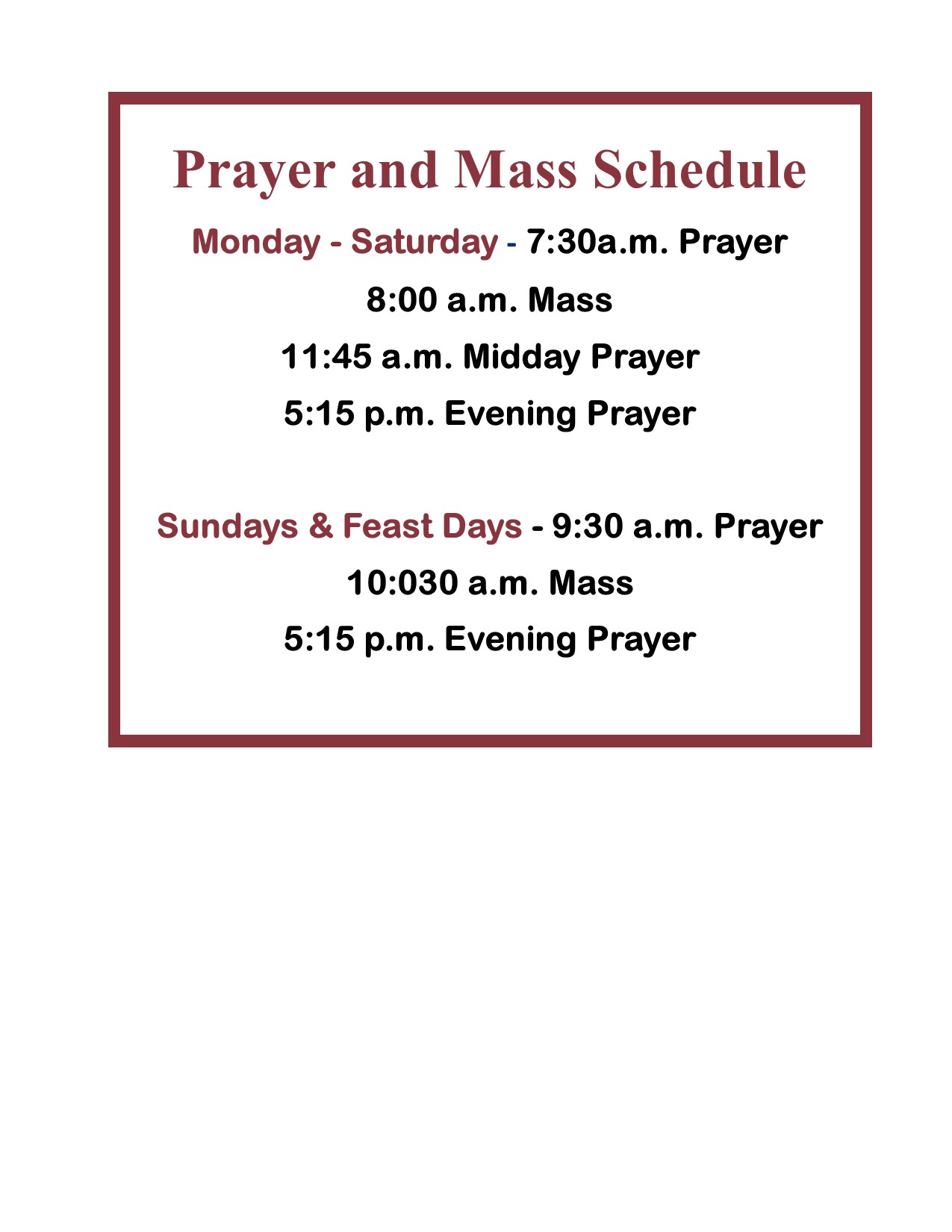
 Mass Schedule

Related Links

Copyright © 2026 · Benedictine Sisters of FL · Touching Lives Through Prayer and Service

Copyright © 2026 · Bendedictine Theme on Genesis Framework · WordPress · Log in