Due to the Coronavirus (COVID-19) we are cancelling the March 15th concert at Holy Name Monastery. We hold everyone’s health as our top priority.
The Benedictine Sisters look forward to re-scheduling at a future time.
Continue Reading

Holy Name Monastery
Founded 1889
Due to the Coronavirus (COVID-19) we are cancelling the March 15th concert at Holy Name Monastery. We hold everyone’s health as our top priority.
The Benedictine Sisters look forward to re-scheduling at a future time.
Continue Reading
At the beginning of the first century, women were considered second-class citizens. Their sworn testimony was inadmissible in court; they were considered the property of their spouses with no legal claim to property of their own. So the only “property” a woman could call her own was her reputation. At a precise moment in history, God entered the life of one member of the chosen people, a woman by the name of Mary, and asked her to sacrifice that one thing – her reputation – and become the mother of Jesus. Surprisingly and at the initial consternation of her fiancé, Mary said yes to God and became the “God bearer,” the first and greatest title she continues to bear as a member of the human race.
God’s voracious enthusiasm and lavish gift-giving erupts in the person of Mary’s son, Jesus. He called it “the kingdom.” … The kingdom was manifest, and, to this very day, we are on the way to experiencing the fulfillment of God’s long-range plan.” By Albert Haase, O.F.M.
If we are alert, we witness or hear most every day stories of the spread of God’s kingdom. It happens at Daystar. It happens when the Dade City police pay off lay-away charges so children get their Christmas gifts. It happens when you discover that your tab in a restaurant has been paid or the person in the checkout lane at a grocery store tells the clerk, “put her items on my ticket.” It happens when you find a ride you were hoping for but reluctant to ask. It happens when the mess you made is cleaned up before you can grab a rag. It happens when your name is erased and someone else’s appears on the dish washing list. It happens when you are able to surprise someone. Like in this story I’ll tell you now … let it touch your heart and inspire you to “pay it forward.”
Paul received an automobile from his brother as a Christmas present. On Christmas Eve when Paul came out of his office, a street urchin was walking around the shiny new car, admiring it. “Is this your car, Mister?” he asked.
Paul nodded. “My brother gave it to me for Christmas.” The boy was astounded. “You mean your brother gave it to you and it didn’t cost you nothing? Boy, I wish…” He hesitated. Of course Paul knew what he was going to wish for. He was going to wish he had a brother like that. But what the lad said jarred Paul all the way down to his heels.
“I wish,” the boy went on, “that I could be a brother like that.” Paul looked at the boy in astonishment, then impulsively he added, “Would you like to take a ride in my automobile?” “Oh yes, I’d love that.”
After a short ride, the boy turned and with his eyes aglow, said, “Mister, would you mind driving in front of my house?” Paul smiled a little. He thought he knew what the lad wanted. He wanted to show his neighbors that he could ride home in a big automobile. But Paul was wrong again.
“Will you stop where those two steps are?” the boy asked. He ran up the steps. Then in a little while Paul heard him coming back, but he was not coming fast. He was carrying his little crippled brother. He sat him down on the bottom step, then sort of squeezed up against him and pointed to the car. “There she is, Buddy, just like I told you upstairs. His brother gave it to him for Christmas and it didn’t cost him a cent. And some day I’m gonna give you one just like it…then you can see for yourself all the pretty things in the Christmas windows that I’ve been trying to tell you about.”
Paul got out and lifted the lad to the front seat of his car.  The shining-eyed older brother climbed in beside him and the three of them began a memorable holiday ride.
Reflection of 4th Sunday of Advent 2019
Sister Roberta Bailey, OSB, Prioress
Benedictine Sisters of Florida
Continue ReadingThis third Sunday of Advent is familiarly known as Gaudete Sunday – a Latin word that means “rejoice” – the first word of the Entrance Antiphon (at Mass): “Rejoice in the Lord always; again I say, rejoice. Indeed, the Lord is  near.” As you know, we mark Gaudete Sunday by lighting a pink candle (in the Advent wreath) and the celebrant at Mass wears rose colored vestments. I wonder why “rose”? Yes, it’s a “happy” color but I wonder if it might be because when you dilute the ‘blue-ness” with the red that makes purple, the red shades are left lightly tinged with blue which creates more of a rose color. The church rejoices because we are halfway to Christmas. The Promised One is nearer at hand. And, we are called to live as people of joy.
But in everyday life I get the impression that “joy” is on the decline. Often what is the response when someone asks: “How was your day?” My sense is that the theme of joy is something of a rare commodity. I hear responses such as “It was OK” or “Could have been better.” Or “I’m just so tired of so and so doing such and such.” Or, “I’m exhausted. Or “Don’t ask.” To have joy or – or as they would say in slang – to do joy – is to have a deep sense of delight. The Greek origins of the word literally means “for the heart, in its deepest place of passion and feelings, to be well.” That’s what it’s like to have joy.
So why is joy so rare? Well, it occurs to me (and not me alone), that for the experience of joy in one’s life, four  qualities must also be found. First, joy takes time. Joy comes of living a “savored” life…of having time and taking time to smell the roses, to observe the pace of a Sandhill Crane as it crosses the street, to glory in a sunset. Joy needs time. There is this old monastic saying about living a joy-filled life. If you are sipping tea or watering a plant, or gazing at an icon, to do just that. We call this “being there” or being “in the moment.” We know – and more than that, we believe, that each moment is pregnant with God’s real presence and promise and providential care. Look for it; wait for it; savor it. Don’t just visit life; life needs time to be lived abundantly.
Secondly, to know joy requires acceptance – a “yes” to life – to the life we’ve been given. We may have discovered at some point that the script we’ve been handed in the play of life is not the part we thought we were trying out for. Joy requires a deep willingness to accept we are God’s creatures and that God is at work according to God’s good pleasure. Joyful persons accept the good gifts of life that actually are there. They do not live in a state of resentment for what might have been or what “used to be.” In God’s plan, there is a reason why today is not tomorrow. We need all of today to prepare us to receive the promise of tomorrow.
So, to be joyful takes time and acceptance. Third, it also requires desire. We have to want joy. Joy is a gift, a gift of the Spirit. If you want the gift of joy, ask God for the gift with your heart open and hands to accept the gift.
And, fourth to be joyful we need stability, patience and endurance. Maybe that’s why Jesus says: “Truly I tell you… you will have sorrow… but your sorrow will turn into joy.
Life for most people is not picture perfect, but there is so much joy to be found If we simply LOOK for JOY. Be on the lookout – SEE and REFLECT on the JOY right before your eyes. The more we dwell on everyday blessings, the more they seem to multiply. And by experiencing more joy in my own life, I have more JOY to give away. JOY is a beautiful gift to embrace, celebrate and give away at Christmastime. And, in doing so, increase our own joy.
 This Gospel introduces us to the man John; John the Baptist, the voice of prophecy in a world where such a voice had been silent for 400 years. Now John is: “The voice (that Isaiah described), the voice crying in the wilderness, ‘Prepare the way for the Lord, make straight His paths’.”
The highlight of John’s ministry was the fantastic success he enjoyed way out in the wilderness. This guy doesn’t care what people think. And, his style worked!
We still hear about it, don’t we? When the people of Jerusalem and Judea left their cities to hear John preach, they probably had to walk twenty or thirty miles. They did so in such increasing numbers that Scripture tells us (with only slight exaggeration) that “all the country of Judea, and all the people of Jerusalem” came out to hear this young preacher proclaim: “The Kingdom of heaven is near! Repent and be baptized.” That is all he did – he announced! He never told them how it worked, or why.
And, he certainly was no fashion plate, with his camel hair clothing, leather sandals and the girdle around his waist. His diet was very simple: locusts (grasshoppers) and wild honey. This note is important, or it wouldn’t be here. It is symbolic. You can’t wear anything more simple in the way of clothing, or eat a more basic diet. In other words, it is representative of his ministry — one of very simple beginnings – the beginning of the gospel of Jesus Christ.
What is all this saying to us? What new road is God building in our lives? When our life’s valley is filled in and the road made straight, will we be ready to “see the Son of Man coming in a cloud.” As we approach the off-ramp of life – will we be so attuned to the divine whisper that we hear clearly the voice of the One crying out – Look! The “salvation of our God” is at hand!
So what kind of forklift will it take to raise our weariness to a conscientious attention to those with whom we live? What kind of backhoe does it take to crack the ridged set in our ways? How many hosing-downs does it take to quiet a hot temper or a sharp tongue? How tall a crane do we need for us to see the bigger picture? What kind of work goggles do we need to protect our eyes from worldliness? What kind of binoculars will it take to pinpoint and zero in on the evils we want to eradicate? Are we keeping the traffic strips on the edges of our souls bright enough to protect us from running off the road to goodness? How tough are the rumble strips that we put down to remind us of “danger ahead”? Is our prayer life regular enough, strong enough and sincere enough to be the barricades we need to protect us from on-coming temptations?
And, then we have the task of repairing old roads. In our lives, no matter how we might like to think that we’ve got it  all together, sooner or later we all need to have a little “heavenly highway repair.” Our God promises to fix what’s broken in our lives. When a hurtful word breaks away a slab of our self-confidence, or when an extended period of neglecting our prayer life creates a pothole of emptiness and isolation, God is there to put out the orange cones. When we are battered by life’s challenges and we feel that our bridge supports are beginning to fail, God promises to strengthen those areas of weakness that plague us so.
We are called to be prophets in today’s world. Each of us has a mission to communicate Christ’s message of hope, love, freedom and peace. We can help people fill in their valleys and make their rough paths smoother.
As we go along, day by day … driving through the work site we call “life,” imagine you see John the Baptist shouting with the powerful words of the prophet Isaiah, almost like a highway foreman, “Prepare the way of the Lord! Make that path straight! Fill in that valley! Get that mountain outta here! Hey, what happened over there? It’s all crooked! Make it straight! Smooth out that rough place! Get busy – do your part. We gotta show everyone the  salvation of God is coming.”
 So, it’s Advent again. Among the general populace, Advent remains an opportunity that is too often little appreciated, little understood and commonly ignored. Advent is about learning to wait. It is about not having to know exactly what is coming tomorrow. Advent teaches us the difference between expectation, anticipation and waiting; suspense, eagerness and “twiddling your thumbs to pass the time.”
Advent is about the power of emptiness and the spiritual meaning of smallness. We strive to live with the basics rather than hoard what, in God’s eyes anyway, after all is not ours. When we have little to begin with, we have even less to lose. When we have fewer possessions, fewer clothes in our closets and fewer books (even the holy ones) and papers that we MIGHT need someday, we spend fewer minutes caring for them. It means that we have less to protect or to fight over and even less to boast about. We can be more open to possibility.
Our conversations can turn to stories and concerns focused outward, on the other rather than the self. There is a rare sprinkling of “I” and “my” and “mine.” Attention is directed away from the self to shine our light on others. We radiate the blessings of life, not the gloom of sadness, sickness, tiredness and woe. We become more fully human, full of compassion and full of consciousness. Our community Advent practices help hone the attitude of prayerfulness, almsgiving and compassion.
Take a stroll down memory lane and feel again the anticipation and impatience you felt for the night Santa Claus would come. That’s the feeling we still need to be filled with as we await the coming of Christmas – the commemoration of the night Jesus opened His eyes and beheld the tender love of his earthly mother and his foster father Joseph; heard the voices of the angels singing praises and felt the warmth of the breath of curious animals.
I invite you to live again, the moment you discovered the reality of the Santa myth. You’d probably had plenty of hints for a long time from older siblings or classmates. In fact you might have known from the beginning that there was no one who was “Santa.” But, you were slow to relinquish the fantasy of the jolly fellow enjoying the cookies you’d left for him and emptying his sack of toys to find the gift with your name on it. Even children who are aware that their families are “dirt poor” cling to the dream of a Santa figure.
As we mature, so do our hopes and dreams. The final line of the selection from Matthew’s Gospel reminds us first: we do not know what day the Lord will appear. Then, “You must be prepared, for at an hour you do not expect, the Son of Man will come.” That does not refer only to the hour of our death. Remember the story of the Abbot who visited his Rabbi friend who shared with him a valuable lesson: “the messiah is among the ranks of your community.” We are challenged to be Messiah to each other. To treat each other, those who walk through the door, with gentleness and courtesy – that one may be the Messiah among us. Now, in place of eager children looking forward to Santa bringing us gifts, we conger ways to be “Santa” to others.
So, we pray: “May the God of Israel increase our longing for Jesus our Savior and give each and all of us the strength to grow in love, that the dawn of Jesus’ coming may find us rejoicing in his presence and welcoming the light of Truth.”
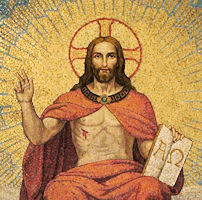 This feast was instituted by Pope Pius XI in 1925, during a time – like today – when respect for Christ and the Church was waning. Originally, the full title of the celebration was “The Solemnity of Christ, the King of the Universe.” In 2015, during the Jubilee year of Mercy, Pope Francis added another part to the title: “…the living face of the Father’s mercy.” Christ is the one who binds up our wounds, heals us, blesses us, and saves us. The combined readings for the solemnity, taken from Samuel, the Letter to the Colossians and the Gospel of Luke – give us a glimpse of how Christ is at the same time both king and the face of the Father’s mercy.
Daily we say these words in Jesus’ prayer: “thy kingdom come.” Thankfully, Jesus has shown us how to bring about that kingdom. We must abandon what the world considers important and be prepared to be ridiculed as Jesus was. It is not easy, nor will it ever be easy, to remain true to values that are at odds with the society we live in. It cost Jesus his life. On that day he made a pledge to all his followers; “Indeed I promise you today, you will be with me in paradise.”
This Gospel pointedly reminds us that Jesus’ kingship is one of love and sacrifice, not power and domination. The traditional way of referring to the day of Jesus’ death is “Good” Friday. The mocking, derisive jabs that Jesus endured ironically proclaimed his true identity: the messiah, the chosen one, the king of the Jews and savior of all people.
When Isaiah crafted his description of the crucifixion, 700 years before it happened, he made Christ’s cross most prominent. He described Jesus’ cross with many verses in careful detail and then simply stated that Jesus would be “numbered with the transgressors.”
Luke’s gospel tells us about one of the “transgressors” commonly referred to as the “good thief.” As the crowd jeers, the thief hanging on the cross to one side of Jesus recognized Jesus as Messiah and King, and that day, that minute finds his salvation.
In tomorrow’s responsorial psalm we will sing: “Jesus is Lord – I will go rejoicing to the house of the Lord!” Elsewhere we’ll say: “The Lord is king, in splendor robed.” We’ll profess in the Creed: “I believe in one Lord Jesus Christ.” The priest-celebrant will greet us: “The Lord be with you.” We sing a blessing on each other: “May the blessing of the Lord be upon you.” In our hymns we sing: “Rejoice the Lord is King; our Lord and King adored.” Is it just from the force of habit we say or sing those titles for Jesus? Or deep down do we believe JESUS IS LORD? And if we do – why do we sometimes scramble to find a substitute to replace the word “Lord”?
As we ponder that question, we might pray the sentiments of the 12th century prayer of St. Bernard of Clairvaux –
“I accept that Jesus is my Lord. I keep myself for him since I acknowledge his rights over me. To me he is God, to me he is the Lord, and I declare: I will have no king but the Lord Jesus! Come then, Lord, … reign in me, for you are my king and my God.”