• Skip to primary navigation
  • Skip to main content
  • Skip to footer
Benedictine Sisters of FL

Holy Name Monastery
Founded 1889

Donate Now
  • Home
  • About Us
    • History
    • Being Benedictine
    • Benedictine Monasticism
    • Meet Our Community
    • Holy Name Academy-Alumnae
  • What We Do
    • Mission, Vision and Our Partners
    • Invitation to Retreat
    • Accommodations
    • Volunteer Programs
    • Oblate Program
    • Spiritual Direction
    • Aqua/Hydroponics
    • More of Our Ministries
  • What’s Happening
    • Articles of Interest
    • Events
    • Newsletters
    • Brochures
    • Links
  • Support Us
    • Gifts of Support
    • Wish List
  • Stories Shared
  • Galleries
    • Photos
    • Videos
      • Benedictine Sisters of FL Videos
      • Other Videos
  • Contact Us

Articles of Interest

PERFECT

February 24, 2020 by holyname Leave a Comment

Lent is coming soon …

That last line is quite a challenge, isn’t it??  “Be perfect.”

In this book: Be A Perfect Person, Stephen Manes writes:
Congratulation! You’re not perfect! It’s ridiculous to want to be perfect anyway. But then, everybody’s ridiculous sometimes, except perfect people. You know what perfect is? Perfect is not eating or drinking or talking or moving a muscle or making even the teensiest mistake. Perfect is never doing anything wrong – which means never doing anything at all. Perfect is boring! So you’re not perfect! Wonderful! Have fun! … You can drink pickle juice and imitate gorillas and do silly dances and sing stupid songs and wear funny hats and be as imperfect as you please and still be a good person. Good people are hard to find nowadays. And they’re a lot more fun than perfect people any day of the week.

So if we believe Manes that we can never be perfect, and perhaps we should not even try to be, what do we do with this difficult word from Jesus?  It’s helpful to learn that the word most often translated “perfect” actually comes from the Greek word telos, which means goal, end, or purpose.   Jesus is not urging us to be what most people think of as “perfect,” but rather to be more like what God intends for us to be.   You are a child of God, made in God’s image. Now live like it.

Now, that may not make things any easier, but it does help put the challenge into a more useful context. The only way we can possibly live as Jesus is asking – repaying evil with good, forgiving and praying for those who harm us, walking the extra mile – is by living into our God-given identity as beloved children.  You know you can’t give what you don’t know.  Only those who have known God’s love can possibly hope to share it with others.  Jesus isn’t asking us, like some demanding parents, to make all “A’s,” get lots of trophies, be named “member of the year.”  Jesus is nudging us to live the God-given identity you received at baptism: You are a child of God.

It is Jesus who gave us the greatest example – He was the perfect model – he talked the talk and walked the walk.   Is it easy to follow His example? Certainly not. We struggle to overcome past disappointments, to overcome old grudges, deep-seated prejudices, smoldering resentments.  It’s our greatest challenge … not to be perfect, but to be mindful of what is getting in our way and preventing us from being the people God wants us to be. So I ask …What is blocking you? What fears or memories or resentments keep you from being the person God wants you to be?

What is it that keeps us from living into our identity as a child of God?  Lent is the time to remove the impediments so that you can truly embrace our God-given identity as citizens of his Heavenly Kingdom. Recall the lines credited to Saint Teresa of Calcutta:

If you are kind, people may accuse you of selfish, ulterior motives.  Be kind anyway.

If you are honest and sincere people may deceive you.  Be honest and sincere anyway.

If you find serenity and happiness, some may be jealous.  Be happy anyway.

The good you do today, will often be forgotten.  Do good anyway.

Give the best you have, and it will never be enough.  Give your best anyway.

In the final analysis it was never between you and them anyway; it is between you and God.

7th Sunday in Ordinary Time

First Reading  Leviticus 19:1-2, 17-18    Second Reading  1 Corinthians 3:16-23

Gospel   Matthew 5:38-48

Reflection by S. Roberta Bailey, OSB

Continue Reading

Filed Under: Blog, Front Page, Homily

“Let your YES mean YES and your NO mean NO.”

February 17, 2020 by Holy Name Monastery 1 Comment

“Let your “yes” mean “yes” and your “no” mean “no.”  Fortunately, generally speaking, we do not have to make sworn oaths – unless we are sworn in as a juror.  So we are meant to heed and obey Jesus, who said: “Just let your Yes mean Yes.”  In other words, be a person of your word.   Jesus is cautioning us against the casual habit, that many people have in their daily conversation, of repeatedly swearing to this or to that, without ever intending to do what they say.  By going “in excess” of a simple Yes or No to state their intentions, are such people revealing that they are really untrustworthy?   How often have you heard someone preface a comment with, “I tell you honestly?”  Or “honest to God” or “I swear to God it’s true.”  Could leave one wondering, “Can I believe anything else you say?”

Jesus always practiced what he preached by letting his Yes mean Yes.  He allowed nothing to sidetrack him from the commission he received from his Father.  The night before He died, He opened his heart to His father praying: “My Father, if it be possible, let this cup pass from me.”  But his “yes” won out.  He continued his conversation with His father: “Nevertheless, not as I will, but as you will.”  Jesus gives us the finest example of one who proved true to what he promised.

In his Rule, in the Tools of Good Works, Saint Benedict reminds us: “Your way of acting should be different from the world’s way; the love of Christ must come before all else …  bind yourself to no oath lest it prove false, but speak the truth with heart and tongue.”  Today he might say – Be a person of integrity – live an undivided life – be predictable, consistent, dependable in honesty, loyalty, discipline, exercise self-control, be accountable and be trust-worthy.

With Ash Wednesday soon upon us and Founders’ Day following fast behind its heels, and then Recollection Sunday, it’s a good time to ponder all that our YES enfolds.

To quote from WISDOM DISTILLED FROM THE DAILY: “St. Benedict invites his disciples to embrace the mystery of community – to live the vision of oneness and equality in Christ.”  By our vows we make, not an oath, but a solemn promise of obedience to listen intently to the voice of God manifested in our peers, our superior and the Spirit deep within.  But, we can’t listen to what we don’t hear.  If we don’t spend time in Lectio and in the company of community members, we only hear part of what we promised to listen to.

And we promise “Fidelity to the monastic way of life” – a life-long commitment to faithful prayer and to seeing Christ in one another and growing in humility ourselves.

We promise Stability – a vow that binds us body and spirit to this community for the rest of our lives.  It’s not an either / or deal.  We promise not to simply rub elbows and sit shoulder to shoulder, but to also feel the pulse of the community and get into that rhythm.

We can find many examples in the lives of the saint-martyrs of persons who gave their lives rather than go back on a promise.  But I offer you a classic example from children’s fable of the maxim: “let your no mean no” (I’m not sure about the yes part).  This character dug in his heels – when he said NO he meant NO.  You’ll recognize it right away – remember the fable of the Three Little Pigs?  What was the answer the little pig gave to the big bad wolf who invited himself into the house – 3 times.  And, when refused entrance, he threatened to blow down the house?  “Little pig, little pig, let me come in.”  “No, no, no by the hair of my chiny-chin-chin!”  And he stuck to his word.  “That’s not going to happen on my watch. Noooo way!”

~Reflection by Sister Roberta Bailey, OSB, Prioress
First Reading  Sirach 15:15-20      Second Reading Corinthians 2:6-10
Gospel  Matthew 5:20-22, 27-28, 33-34a, 37
Continue Reading

Filed Under: Blog, Front Page, Homily

Reflection on Readings for St. Scholastica Day 2020

February 11, 2020 by Holy Name Monastery Leave a Comment

In the first reading today we heard: “Love is strong as death; passion is as strong as death itself.  It bursts into flame and burns like a raging fire.  Water cannot quench it; no flood can drown it.  But if any tried to buy love with their wealth, contempt is all they would get.”  Elsewhere from Paul we hear: “God it is who espouses us in right and truth and justice, in love and mercy and fidelity.”  In our philosophy statement we say: Because we are Christ to one another, we form bonds of mutual love and respect and call forth the best in one another.  So, do we, then, dare do any less for each other than what Paul says in the reading?  What, then, does it mean to be in covenant with each other in truth and right; in love and mercy and fidelity?  To love with a love that is as powerful as death; with a passion as strong as death itself?  What does it mean to love each other with a love so powerful it bursts into flame and burns like a raging fire?  You can’t buy that kind of love.  Once you have it you can’t quench it with water nor drown it with a flood.

In Luke’s Gospel for Scholastica Day, Jesus gives us an example of “unquenchable love” for his friends: Martha, Mary and Lazarus.  He seems to have gone out of His way to visit them in their home.  We each need to know where our “Bethany” is – our home spot where Jesus comes, not only to visit, but to reside.  Our Bethany is the place where we minister to the weary Christ and feed our hungry Guest.  We savor the Word in the light – and that’s contemplation!

Bethany is where we take comfort in being regularly fed in Lectio and times spent at the feet of Jesus.  We don’t have to stop our service ministries.  We seek, rather, to take on a contemplative stance that colors the activities that fill our days.  This contemplative attitude becomes ME.   Remember, the promise in the Song of Songs: “I will lead you into the desert and I will espouse you.”

In the desert, life isn’t lacking but it is different.  In the desert, two very different birds thrive.  The vulture sees nothing but dead and stinking carcasses.  The hummingbird seeks the lovely blossoms of the cactus plant.  The vultures live on the dead past.  The hummingbird lives on the fragrant present.  Each bird finds what it is looking for.  So do we.  It’s a choice we make.  If we do not become more contemplative in attitude and action in this desert where God draws us, we will fry in the noonday heat and suffer hypothermia at midnight.

Contemplation is more than a lotus pose or a prayer stool; more than a beautifully decorated prayer table or a view of the lake.  Contemplation is more than hours in meditation or repeated mantras.  Contemplation is witnessed in a smile or an infectious laugh; a consideration shown to others in our gentle movements, our volume of speech and closing doors, and our anticipation of the other’s need.  Contemplation is beautiful music, a sunset; a baby’s first step; the last breath of a life lived in covenant.

Contemplation is more than centering; contemplation is centeredness.  Contemplation is a way of life, not a way of praying.  Contemplation IS, not DOES.  It is being in touch with Jesus’ as the one thing necessary.  It frees us to boast in the Lord, and causes us to savor the richness and zest of truth and justice, of right and mercy, of love and fidelity.  “I will lead you and speak to your heart; I will espouse you,” says our God.  There we will know the love described in the first reading: a love as powerful as death, bursting into flame and burning like a raging fire.  A love that cannot be bought.  A love that cannot be put out nor drown.  So: here’s the choice: will you be a vulture or a hummingbird?

~Reflection by Sister Roberta Bailey, OSB, Prioress


(Song of Songs 8:6-7, 2 Cor. 10 and Like 10:38-42)
Continue Reading

Filed Under: Blog, Front Page, Homily

Christian Unity

January 22, 2020 by holyname Leave a Comment

The three readings we have this week are, I believe, an example of a woven piece of God’s mysterious message-giving.  It creates a colorful piece with threads that weave the way from Isaiah, through the Letter to the Corinthians, into the Gospel of John, laced with verses from the Responsorial Psalm 40.

From Isaiah we hear: “I will make you a light to the nations, that my salvation may reach the ends of the earth.”  Then Paul tells us who the “you” is: “You who are called to be holy with all who call upon the name of Jesus.”  Now slip in a line from Psalm 40: “Sacrifice or offerings you wish not, but ears open to obedience you gave me.”  This leads us right into the Gospel and a declaration of obedience to listening.  John the Baptist speaks: “I did not know him (that is, when Jesus came to the River Jordan for baptism). I saw the Spirit and the one who sent me to baptize with water told me, ‘On whomever you see the Spirit come down and remain, he is the one’…”  Then slide back to Psalm 40 “To do your will, O my God, (to be obedient) is my delight.”  Obedience is the psalmist’s delight – John’s, Jesus’ and ours.

Today is the opening of the Week of prayer for Christian unity.  The theme is captured by the presence of the two groups at the Jordan, John’s and Jesus’ followers coming together in combination with the presence of our Triune God = the voice of the Father, Jesus in the Jordan, and the hovering Spirit in the form of a dove.

A question: How did John (the evangelist) come to know so many intimate details about John the Baptist’s encounter with Jesus at the Jordan?  It is generally assumed that James and his younger brother John were among the followers of the Baptist.   It is likely this is how they, along with Peter and Andrew, first met Jesus.  John was the only one of Christ’s original disciples who lived into old age and the only one who was not martyred for his faith.  He can tell the story of Jesus from an old man’s perspective laced with the wisdom and vision that is a gift of the elderly…. pondering the essentials, sifting out the riff raft of gossip, suppositions and guess work [or, spicing up the stories with borrowed memories and supposed tidbits].

As we in community (and in our families) know so well, stories are a gift given by older members to newer members – the elders are the torch bearers; the younger the keepers of the torch who coax the sparks to keep the flame burning.  Our future will be enriched by those who keenly listen and preserve the traditional word-of-mouth stories.  This is what enriches our present by helping us better understand the past and the people who gave shape to our present.  Stories of the “good old days” may get “old” but consider what we’d miss if John and the other evangelists had kept secret their experiences with Jesus.

As I said earlier: today we begin the Week of Prayer for Christian Unity with the 2020 theme: “They showed us unusual kindness.” This week has a 100-year history in which Christians around the world pray for the fulfillment of Jesus’ prayer at the Last Supper “that they all may be one.”   It seems appropriate, too, that we have Teams of Our Lady sharing our space today.  Our Lady graciously shared her Son with everyone without distinction.

In today’s world, much like the days of early Christianity, people are facing crises of migration, prejudice, violence and indifference. How can we show “unusual kindness” that is a witness to God’s loving providence for all people? When we invite people to “come and see” they are looking for more than a tour of our parish and monastery buildings and a list of the volunteer ministries. Our spirit of hospitality will have a ripple effect that makes visible Jesus love in today’s world.

Reflection by Sister Roberta Bailey, OSB, Prioress

Isaiah 49: 3, 5-6          1 Corinthians 1: 1-3          John 1:29-34

Continue Reading

Filed Under: Blog, Front Page, Homily

Why Baptism …

January 16, 2020 by holyname Leave a Comment

Traditionally, this feast of the Baptism of Jesus presents us with the 3rd epiphany or manifestation of our Lord: His birth, the adoration by the Magi and now the baptism by John in the River Jordan – (which today is so polluted John would have second thoughts about stepping in). But, next Sunday we will see a 4th manifestation at the Wedding in Cana when water is changed into wine.    In these latter two moments Jesus passed from relative obscurity in the village in Nazareth onto the public stage of his mission of proclaiming the God’s Kingdom.  It was, so to speak, His coming out party – that led eventually to his crucifixion and death.

This is an event that made it into all four Gospels – every author of every gospel found this event so inspiring and important that it was included. It’s an unusual story because there doesn’t seem to be any reason for Jesus to be baptized. For three and a half years, he did His thing and it ended with crucifixion. His baptism was the inauguration of that process.  It was an act of humility to submit to John’s baptism in the presence the people.   It was a commitment to His Father’s plan.  And this event was a baptism of identification: Jesus affirmed his Cousin John’s ministry and identified Himself with the people He’d come to save.

Our baptism is also about humility, commitment, identification and obedience: that’s really what it is all about.   When people witness a baptism their expectation level goes way up.  The same is true when they witness a profession of religious vows or an ordination of a deacon or to the priesthood.  People expect the one making the commitment to walk the talk.  Just like Jesus who was baptized to identify with us, we’re committed to identify with Him.

An understanding of baptism is really important to us as Christians, as Catholic Christians. It is doubly important to us as religious to comprehend the dimensions of this commitment because our pledge in vows is an extension of our baptismal promises – whether spoken by or for us.  The former understanding of the theology of the vows referred to religious profession as a “second baptism” and thus a new name was imposed.  The final vow profession ceremony had the newly professed rising from under the funeral pall symbolically to a new life – the new life originally conferred on us in baptism.  With a clearer understanding of baptism and the theology of the vows all that has changed.

Do you remember what happened when Jesus came out of the water?  “The heavens were opened and He saw the Spirit of God descending like a dove coming down on Him.  And there came a voice from heaven: ‘This is my beloved Son in whom I take great delight’.”   Humble obedience and commitment and identification with God always lead to His affirmation – usually not as dramatically as with Jesus – but it happens, always!

Simply put: Baptism is not just about where you find Jesus.  What is important is what you do once you’ve found Him. It opens up to us the possibility of finding God.  But it does not guarantee it.   It makes it a possibility, not a promise.   At best, (just like our vows) it’s a means, not the end.  It’s not where we find Jesus, it’s what we do after we’ve found Him.

Have you heard the story about the poor wandering soul who stumbled upon a baptismal service one Sunday afternoon.  This was a “down by the river” sort of baptism.  It was down south, back in the day, and this guy walked right down into the water and stood next to the Preacher. The minister finally noticed the older gent and asked, “Are you ready to find Jesus?”  “Yes, Preacher. I sure am.” The minister then dunked the fellow under the water and pulled him right back up.

“Have you found Jesus?” “No, I haven’t!” The preacher then dunked him under for a bit longer, brought him up and said, “Now, brother, have you found Jesus?” “No, I haven’t, Preacher.” The preacher in disgust held the man under for at least 30 seconds this time, brought him out of the water and said in a harsh tone, “Friend, are you sure you haven’t found Jesus yet?” The old man wiped his eyes gasping for breath and said to the preacher, “Naw, preacher, are you sure this is where he fell in?”


Continue Reading

Filed Under: Blog, Front Page, Homily

Need Tax Preparation – Postponed

January 16, 2020 by holyname Leave a Comment

Personal State and Federal Taxes Prepared and Electronically Filed – Postponed

Tax Preparer is IRS Registered AFSP with years and years of experience managing H&R Block and Jackson Hewitt offices.  A member of the National Association of Tax Preparers.

Available Tuesdays from 1:00 pm to 7:00 pm and Saturdays from 10:00 am to 2:00 pm by appointment only.  Call (352) 206-8662 or text: taxdonebyme@aol.com.

 There is no fee for this service, but a donation to the Benedictine Sisters of Florida is appreciated.  This is an opportunity to use my expertise and experience to help you while helping the Sisters – my gift.

Appointments can be scheduled to start on February 4th.

Note:  You will receive an acknowledgement as the taxpayer upon acceptance by the IRS. If not satisfied for any reason, your paperwork will be returned.  Preparer takes full responsibility for any taxes filed based on the information taxpayer has provided.

Continue Reading

Filed Under: Prayer

  • « Go to Previous Page
  • Page 1
  • Interim pages omitted …
  • Page 97
  • Page 98
  • Page 99
  • Page 100
  • Page 101
  • Interim pages omitted …
  • Page 132
  • Go to Next Page »

Footer

Prayer / Newsletter / Info

 Contact Info

Benedictine Sisters of Florida

PO Box 2450
12138 Wichers Road
St. Leo, FL 33574-2450
(352) 588-8320
(352) 588-8443

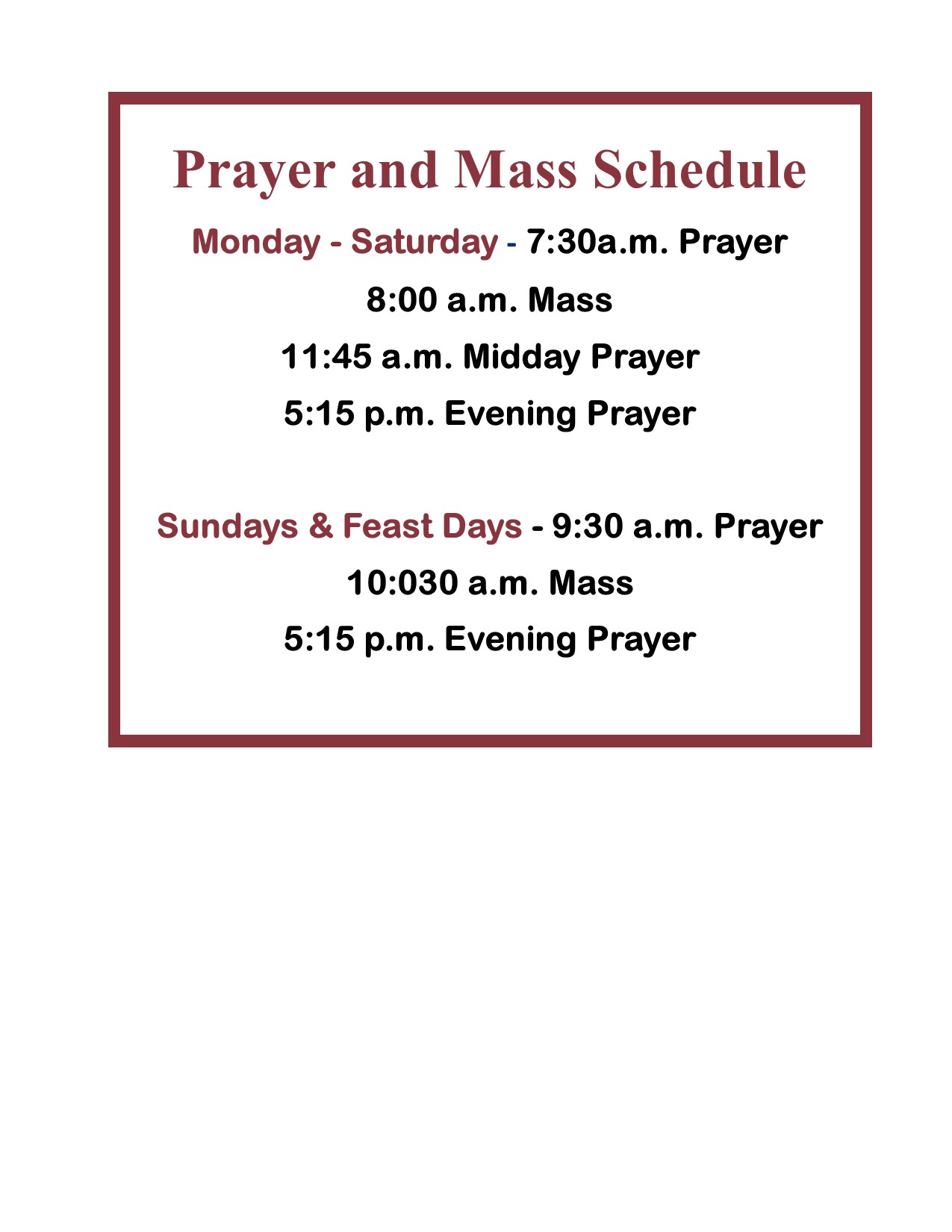
 Mass Schedule

Related Links

Copyright © 2026 · Benedictine Sisters of FL · Touching Lives Through Prayer and Service

Copyright © 2026 · Bendedictine Theme on Genesis Framework · WordPress · Log in