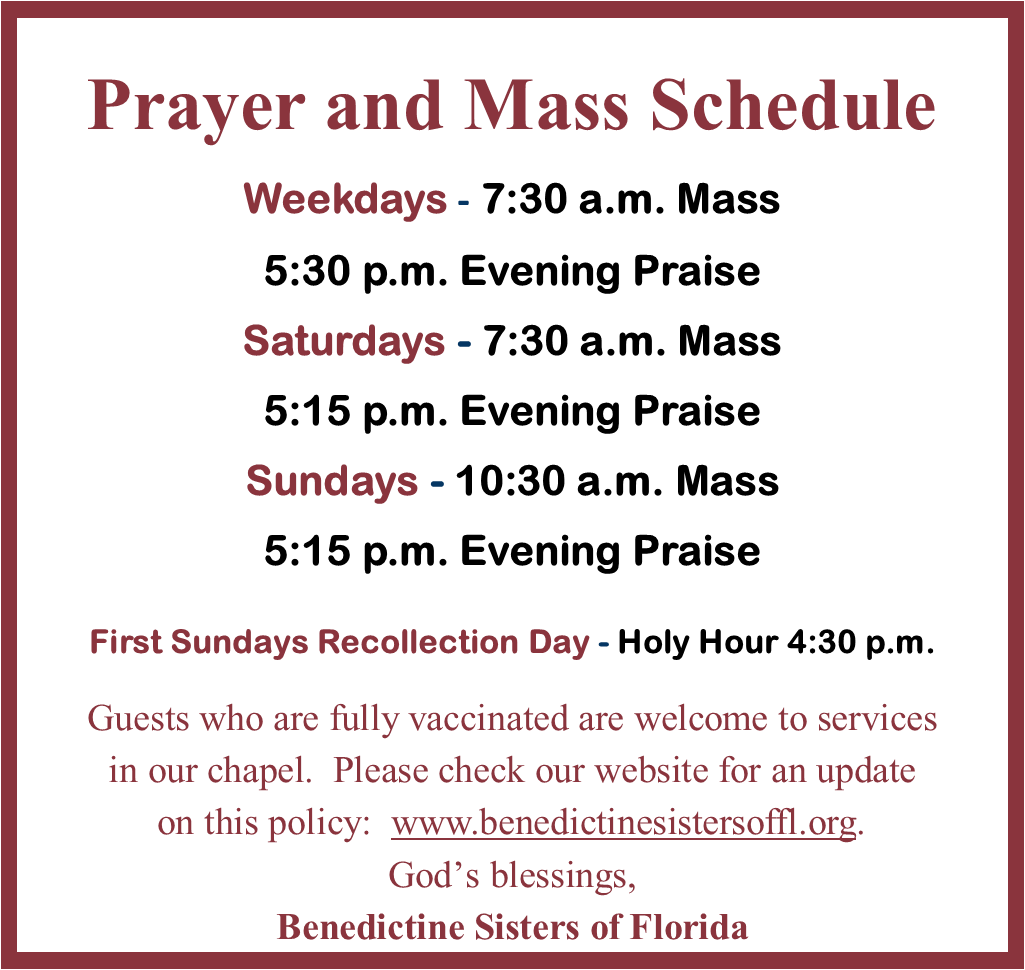
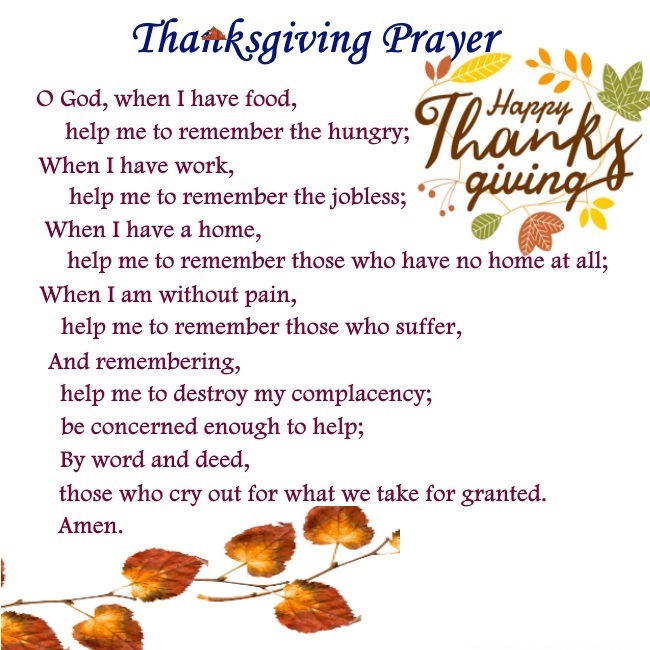
The Benedictine Sisters of Florida
want to wish everyone a
Happy and Safe Thanksgiving.

Holy Name Monastery
Founded 1889
 In the Gospel we have a lesson about perseverance in prayer. The point of the story is not that prayer is nagging God for what we want. Nor is it meant to teach us that God is like the judge in the parable – worn down by requests and coerced to respond.
The key to understanding the meaning is found in the description of the judge as corrupt and unjust. Since God can be neither, we must understand Jesus to be saying that if even an unjust judge responds to the persistence of the widow, how much more will God listen to our prayers. God truly wants to hear our needs and respond generously. Didn’t Jesus say: “Ask and you shall receive?” Jesus is telling us that God wants us to be like the persistent widow, staying in relationship with God, confident that God hears and answers prayers. And He understands how easy it is to lose heart. He asks: “Will such faith, the faith of the widow, be found when the Son of Man returns?”
A beginning of the answer to the question appears to be that the Son of Man will find faith, but it may be in unexpected places, as it has been in the Gospel — not among the religious professionals or the ones certain of their own righteousness, but among the outsiders, the unlovely, the unclean, the ones certain of their sinfulness.
The parable suggests that a sign of faith will be a willingness to persist in prayer, as we see in this widow who persists against all odds in her fight for justice against the powerful judge. Another sign may be in what we pray for: daily bread, the Holy Spirit, the coming of the kingdom, justice.
In his gospel, the evangelist Luke portrays widows as vulnerable but at the same time prophetic, active, and faithful. The widow of this parable is forceful enough to get the justice she demands even from an utterly unjust judge.
If we could read the Greek version of this parable, we’d get a glimpse of Jesus sense of humor. Now by “Greek” I don’t mean the language we refer to when we say “It’s all Greek to me.” In the Greek Scriptures the judge gives in to the widow because if he doesn’t, he fears she may give him a black eye. Jesus uses a metaphor from boxing to make his point about the need to continue in prayer. Be as persistent as a boxer in the ring when it comes to prayer. Jesus gives a second teaching in the parable. If an unjust judge answers the pleas of a widow how much more will God answer our prayers. We just don’t know WHEN. Remember the words of the prophet Habakkuk? “The vision still has its time and will not disappoint.” God takes the long view, knows what is best and we may sometimes have to wait until we’re, as they say: “on the other side of the grass,” where we’ll understand that all along God knew best.
Luke seems to be very much aware of the real danger of giving up, of losing heart when we suffer injustice. Luke is saying that if we pray hard enough and if we don’t lose heart, God will give us justice, right? Well, does God? Is there justice in the world? In our country? In our local communities, and (sadly) In our churches? We have only to watch the evening news or read the day’s headlines to learn of multiple cases of brutality and injustice.
Could it be possible that God’s justice looks different than our justice? Good question. Yet, somehow I trust that God gives us a righteous sense of justice–especially if it is a selfless sense of justice–one that is concerned with others. Look at our widow. What does she do to obtain justice? She is persistent. She is stubborn. Perhaps we should call her attitude a kind of “holy stubbornness.” She doesn’t give up – she doesn’t lose heart. She keeps knocking at the judge’s door.
Now, I believe I don’t have to explain “stubbornness.” Some of us had it sprinkled on us in our cradles! We can prettify it, call it by another name, whatever we want: high principles, perseverance, tenacity, determined or just plain pig-headedness. Yes, we seem to be naturally endowed with the “great gift of stubbornness” and the only thing God has to help us with is to learn how to be stubborn for the right causes — God’s justice. In that case we may talk about a “holy stubbornness.” That happens when we start not only to pray our prayers, but when we start to live our prayers. In other words, we put our actions where our words are. Victims of poverty, injustice or violence don’t want to hear about God’s commandments, about moral values, about self-denial, or even about justice.
Luke is right: it is easy to lose heart and go with the flow rather than go against the current. It takes more than a petition at Mass to make our prayers effective. Think of all the corporate commitment action opportunities we are offered. When we support our petitions with a donation to Christmas for the residents at Heritage, attend the Sunrise Prayer Vigil, write letters asking for legislative action on behalf of the poor, make a donation to the Soup Supper or volunteer at Daystar.
You may ask, or be asked: “can prayer move God’s arm?” Jesus turns this question back on us today and concludes his parable with the question: “Will the Son of man find faith when he returns?” In other words, he is asking: “Can prayer move your own arm? Are you willing to put your actions where your words are?” God always has relied on his children–people like you and me–to usher in His Kingdom. God will give us strength, God will empower us, but we still need to stubbornly live out our prayers for justice. The first reading reminds us we don’t have to be alone in our entreaties. One of the beauties of living in community or being part of a faith community is that, like Moses’ (in tomorrow’s first reading) – we have friends who “hold our hands until sunset” – we have the prayer support of many others. Are our prayers effective? The answer lies squarely with us: “it depends on how effective we help make them.”
~Reflection by Sister Roberta Bailey, OSB
 It’s interesting to me that the disciples ask Jesus to teach them to pray “just as John taught his disciples.” They wanted the words, didn’t they, for certainly Jesus had given them an example of prayer. He had modeled time alone, told them to “go to your room and pray”. They’d witnessed Him with raised eyes, hands and voice in intercessory prayer before miraculous healings. But they, like us, want “the words to say.” We forget sometimes that when we descend into our hearts, in silent waiting, it is there we meet the Spirit who is already praying within us.
We look for “words” … in a prayer book, on a holy card, in the life of a saint …. We look for a guide, a director, a mentor. I don’t mean to belittle the worthwhile role these spiritual aids play in our lives. They are often critical to our spiritual growth and our salvation. We just need to keep in mind the tremendous role that Scripture plays in our lives. It is there that we read “the “Spirit of Truth will show you all things.” St. Paul reminds us: “If you do these things, you can be saved. Be joyful at all times, pray without ceasing and give thanks for all things.”
In the shortened version of what we call the “Lord’s Prayer” we pray “give us each day”. We do not ask for a train load of blessings to last us all year – just today’s help, Lord, that’s all I am asking… not even tomorrow’s help … just get me through today – I trust you will be there tomorrow – even when I feel like Mother Teresa once prayed: “I KNOW GOD WON’T GIVE ME ANYTHING I CAN’T HANDLE … I JUST WISH HE DIDN’T TRUST ME SO MUCH.”
In the Gospel, did you notice the difference in the phrase regarding forgiveness in the Our Father? We pray” forgive us our sins for we ourselves forgive everyone in debt to us.” That statement is strong, firm, and expresses willingness to forgive everyone. In the traditional version we pray “forgive us our debts, (or trespasses) as we forgive our debtors.” It sounds as if God’s forgiveness to me is measured by my willingness to forgive others. I like the second version even while I feel it is a greater challenge. I commit, I promise: I will forgive EVERYONE who is in debt to me. No willy nilly “this one but not that one, at least not today.” I forgive EVERYONE. Think of that in a few minutes when we pray the Our Father… and at Mass tomorrow… you are agreeing to forgive EVERYONE… a huge and freeing commitment.
And we do that day after day after day. Repetition isn’t just for those things we may have told our mothers were stupid… things like making the bed that we are only going to rumple up in a few hours or doing the dishes after every meal instead of collecting them until the cupboard is bare or cleaning the toilet that someone is going to mess up the minute I leave the bathroom. Repetition perfects skill in music, in handwriting, in the acquisition of good, or bad habits. And, in the repetition of daily chores (even the ones only I see), there is a meaningful expression of hospitality to myself and my companions. In the repetition of the Psalms, of favorite prayers, and liturgical actions there is a meaningful acknowledgment of our creaturely participation in God’s creative act, day after day after day.
In today’s Gospel the church offers us three examples of prayer: first the GREAT prayer, then the “ask-seek-knock” words that have inspired hymns, and finally the story of the persistent neighbor which teaches us that knocking at the door gets God’s attention and rewards our persistence. So, we pray, day after day for peace, for relief from suffering and war and for a forgiving heart.
Through our communal and personal prayer, we feed not only our own spirits, but we are, so to speak, attached by a spiritual cord to everyone with whom we have ever come into contact. That is literally, collectively the cord that nourishes thousands of people. We feed ourselves spiritually, and we also nourish all those contacts through our prayers. Our prayer is universal. We forgive everyone who is in debt to us. Luke’s recollection of Jesus’ words in his Gospel is not everyone to whom we owe a debt … rather those who are in debt to us. Who would that be? And why would someone be in debt to me?
I’ll close with a story – a simplistic reminder that sometimes we just have to be in the right DIS-position to pray:
A priest, a minister and a guru were discussing the best positions for prayer. Unbeknownst to them a TECO linesman was listening in as he worked with wires on the nearby pole. The priest was saying: “Kneeling is definitely the best way to pray.” “No,” the minister said, “I get the best results standing with my hands outstretched to Heaven.” “You’re both wrong,” the guru said. “The most effective prayer position is lying down on the floor.” The repairman could contain himself no longer. “Hey, fellas,” he interrupted, “The best praying I ever did was when I was hanging upside down from a power pole.”
~Reflection by Sister Roberta Bailey, OSB

How many books written in the sixth century are still in print today? How many of those are in active, everyday use by tens of thousands around the world today — not only monks and nuns, but oblates and other lay people? The answer is one: The Rule of St. Benedict — what the author, whose feast day we celebrate this Thursday, called “this little rule that we have written for beginners.”
At the heart of his Rule lie the four guiding principles which are the foundation of daily life for the Benedictine Sisters of Florida. These four — community, prayer, service, and hospitality — can light the way to a deeper daily spirituality for anyone.
Community
Benedict understood that community, like family and friends, can be messy. Rooted in scripture, the Rule offers a cure: “No one is to pursue what is judged better for self, but instead what is judged better for someone else. To their companions, they show the true love of sisters or brothers…” How would your own world be transformed if this became the way of life for you and those around you?
Prayer
Benedict’s guidance for prayer might surprise you. “God regards our purity of heart and tears…not our many words. Prayer therefore should be short and pure…” Prayer, Sister Joan Chittister writes, “is meant to call us back to a consciousness of God here and now.” How would your day be transformed if it were laced throughout with short, simple prayer that opened your eyes to the Divine in your daily life?
Service
We often view work, especially work that benefits someone else, as a burden, something we have to do but would rather avoid. Instead, Benedict reminds us that work is a privilege and serving others is an honor — something that has been true since the day Jesus picked up carpenter’s tools, then laid them down to heal, to feed, and to save the lost. “…live by the labor of your hands, as our ancestors and the apostles did…” says Benedict. How would your workdays be transformed if you saw each as a gift from God and an opportunity to serve others in Jesus’ name?
Hospitality
Possibly the most challenging 11 words in the Rule are these: “All guests who present themselves are to be welcomed as Christ.” How would you welcome Christ if He came to your door today? How would our neighborhoods and towns, states and nations be transformed if each of us welcomed everyone everywhere as Christ?
As you can see, St. Benedict wrote something that is as practical today as ever. Our prayer for you, today and always, is that you find yourself in a loving community, that you infuse your days with prayer, that you cultivate a heart for happy service, and that you welcome even the most unlikely person as Christ. When you do, you will find more contentment than you can imagine.
Continue Reading
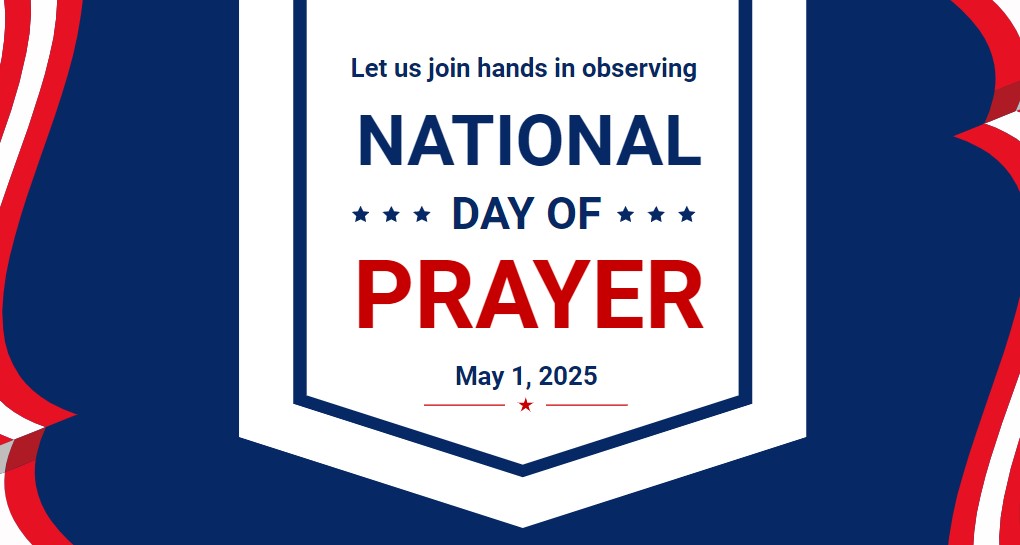
Today is National Day of Prayer. It is so easy to forget to pray. Jesus knows about being human, a soul housed in a human body, a body which needs air, needs water, needs food. But He admonishes us that we must also nourish our spiritual self not only through the sacraments, but also through private prayer.
Today we have the opportunity to join with all people of faith in prayer for ourselves, our communities, and our world. We can go into our personal desert to pray alone as Jesus did while on earth. But prayer is an anywhere, anytime, activity. We can pray in the car, in the shower, while we walk, during the commercial breaks while watching television (the mute button is useful here). Jesus is always ready to hear us.
Today, let us join all who pray. Let us raise our souls to God, if only for moment, if only to say “Here I am. Thank you for life. Thank you for now”.
~by Sister Eileen Dunbar
Continue Reading